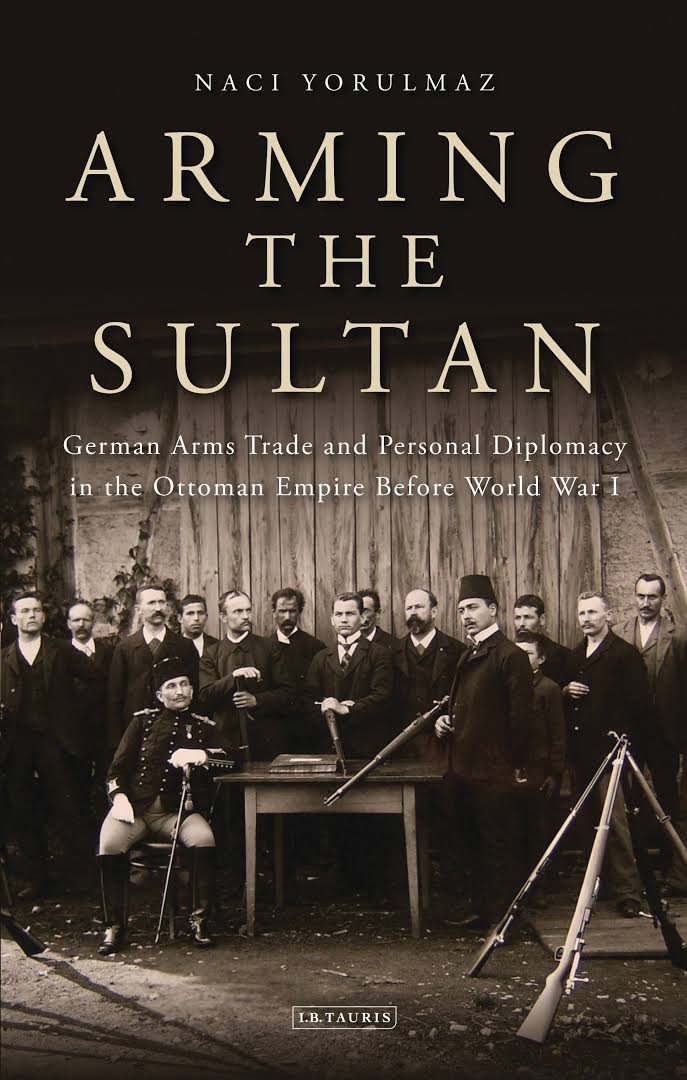
Arming the Sultan: German Arms Trade and Personal Diplomacy in the Ottoman Empire before World War I is the published outcome of Naci Yorulmaz’s doctoral dissertation completed at Birmingham University. The book argues that arms trade agreements in the last century of the Ottoman Empire were products of a complex network of influential figures, including Ottoman pashas, German military advisors, and even the Kaiser, who actively lobbied to shape the outcomes of these negotiations. Unlike other foreign powers, the German government actively intervened to promote its armament companies. Ultimately, these efforts achieved their objectives and a monopoly position for German armament corporations in the Ottoman market. Based on extensive multinational archival research from Ottoman archives in İstanbul, documents and letters from the Stadt-und Zeitungsarchiv Oberndorf/Neckar (where the Mauser rifle factory was located), and documents from the PA.AA in Berlin, the National Archives in London, and the National Archives in Washington, D.C., Yorulmaz attempts to explore the direct or indirect contribution of the following non-commercial influences on the “German style of war business” in the Ottoman market: Chancellor Bismarck, Kaiser Wilhelm II, the German military advisors employed in the Ottoman Army, especially Goltz Pasha, and Ottoman bureaucrats (p. 3).
The book consists of six chapters, along with an introduction and conclusion. Chapter 1 outlines Bismarck’s Ottoman policy from 1880 to 1898. Bismarck’s priority was to find a market for the growing German production industry. He preferred “peaceful penetration” rather than overt colonization (p. 7). This strategy was strengthened and broadened by Kaiser Wilhelm II. The motivation behind this policy was to increase German companies’ capacity. German companies were producing, and German bureaucrats abroad were lobbying to penetrate the government’s decision-making processes. Kaiser Wilhelm II’s two famous visits to the Ottoman Empire, Orientreise (The Orient Journey), had clear economic and diplomatic objectives. After the first visit, Germany’s share in the Ottoman market increased from 6 percent to 21 percent. Between the years 1885 and 1898, German armament firms established a monopoly position in the military orders and a dominant position in naval orders in the Ottoman market.
Chapter 2 conceptualizes German military advisers invited to İstanbul (Dersaadet) by Sultan Abdulhamid II to modernize the Ottoman army as “businessmen in uniform” (p. 7). They acted as reliable informants for the German government and lobbyists for the German armament firms. Through their positions, they accessed the sultan’s inner circle and confidential information, prompting armaments companies in some cases to revise their marketing strategies. Among the officers sent to İstanbul was Colmar Freiherr von der Goltz (Goltz Pasha). From the start of his service in 1883, he established strong ties with Abdulhamid II’s close circle and built an information network. These military advisors gathered detailed information about the marketing strategies and products supplied to the government of competing countries, any modernization or rearming decisions by the Ottoman government, and ministerial discussions regarding possible new war materials. Furthermore, they influenced the Ottoman recruitment policies, which led to an increase in demand for war materials.
Chapter 3 focuses on the situation of the Ottoman military industry and explains the reasons behind such extensive arms purchases. Between 1881 and 1894, Tophane-made military materials gradually disappeared. Yorulmaz argues that there is a significant relationship between the increase in German supply for the army and the decrease in domestic military production. For example, according to British naval attaché Captain Domville’s reports, in 1888 Martini-Henry rifles were being made there at the rate of a hundred a week, whereas in 1890 only ten Martini-Henry rifles a week were being made. The war of 1877-1878 resulted in the destruction of a large portion of the Ottoman artillery. Even so, the investigations and reports conducted by Ottoman commissions indicate that large-scale armament procurement was not an immediate priority. Moreover, the financial state of the empire was not appropriate for such expenditures. Nevertheless, the arrival of the German advisors and the increasing perception of a Bulgarian and Russian threat paved the way for a shift in priorities.
Through his network, Goltz Pasha could pressure the Ottoman government. He and the other advisors put forward arguments about a probable Russian attack, and they claim that the only precaution would be fortification of the straits with guns provided by Krupp, a German armament firm. The next opportunity given to German armament firms was to provide guns for the new recruits of the army. Another German armament company, Mauser, got into the Ottoman market in this way. “The Mauser rifle may not have been the best rifle, but it was certainly the best-marketed rifle” (p. 115). On February 15, 1887, Paul Mauser departed from İstanbul with a contract valued at nearly 37 million marks.
Chapter 4 examines Kaiser Wilhelm’s second and more influential Orientreise (The Orient Journey) in 1898 and its effects on the economic and diplomatic relations with the Ottoman Empire. Abdulhamid II welcomed this visit because he believed he had won the allegiance of Germany in preventing other European countries’ intervention in the Armenian issue. For the Germans, this visit represented a new form of peaceful penetration. During the Orientreise, German cable companies showed their interest in investing in the Ottoman market to the Kaiser. With his intervention, these companies became the main suppliers of Ottoman telegraph requirements. German traders were working with Austrian banks previously, but German Banks spread all around the empire; therefore, they started to work with them. This chapter outlines the German-style war business: via personal contacts, under the generous patronage of the Kaiser, peaceful but aggressive penetration.
Chapter 5 focuses on the Ottoman side. Yorulmaz begins by describing Abdulhamid II’s military-based foreign policy: seeking outside assistance to modernize the army, importing war materials, sending officers to Europe for training, reforming military schools, and constructing railways for military purposes. The threat of occupation by different countries defined the foreign policy priorities. Abdulhamid II’s first move was to invite military advisers from abroad to modernize the army. The reputation Germans gained during the Franco-Prussian War in 1870-1871 and the lack of German colonial interest over Ottoman territories were the main reasons for the Ottoman inclination toward German advisers. Abdulhamid II first tried to centralize state authority to modernize the army. He was involved in every process for purchasing war materials.
Yorulmaz draws attention to the personal ties between Ottoman bureaucrats, German military advisers, and representatives of armament companies. The official reports by the Ottoman commissions on topics such as German-made armaments and new military techniques were influenced by the civil or military bureaucrats’ personal opinions, which could be easily manipulated by baksheesh (gift-giving) or bribery. A warm and friendly reception and generous hospitality during a visit can create considerable influence. Therefore, the arms makers showed hospitality during the visits of Ottoman military purchasing commissions to their factories and their visits, especially in Oberndorf/Neckar and in Essen. In March 1887, the Mauser company built a special residence and headquarters for the Ottoman officers, called the Türkenbau, which was located near the factory site. It enabled the Mauser company to strengthen its customers’ loyalty.
Chapter 6 discusses the change of political power in the empire and the German military officers’ adaptation. This power shift did not bring the German influence to an end. They had invested wisely to cultivate the Ottoman market. Germans assumed that the power that controlled the army, ruled Türkiye. During this period, the Young Turks aimed to reinforce the Ottoman naval force. Although Germany had never gained a monopoly in the Ottoman naval market, Germany still had several influential friends within the Ottoman decision-making circle.
Arming the Sultan shows that the arms exports had a decisive impact on stimulating and strengthening Germany’s political, financial, and military influence. The German state not only facilitated but actively supported the arms industry through both political endorsement and financial means. Yorulmaz successfully knitted a clear and coherent narrative on this complex issue by using a huge compilation of evidence. Despite the extensive use of archival material, the text is concise and understandable by both the general reader and academic historians. This book will appeal particularly to readers interested in diplomatic history, military modernization, and the influence of personal networks in imperial policy. However, one notable limitation is the relative lack of attention to Ottoman domestic responses or dissenting voices regarding German military penetration, leaving the internal complexities of the Ottoman side somewhat underexplored.