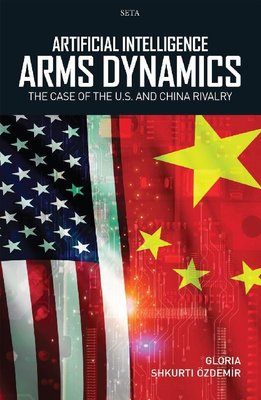
Gloria Shkurti Özdemir’s Artificial Intelligence “Arms Dynamics”: The Case of the U.S. and China Rivalry is a groundbreaking contribution that builds upon her doctoral dissertation and reflects her expertise in international security, emerging technologies, and strategic studies. The book argues that artificial intelligence (AI) is not only redefining the balance of power in the international system but also reshaping the very dynamics of global rivalry. Özdemir asserts that hegemonic competition will no longer be limited to political or economic spheres but will extend deeply into the technological realm, with AI at its core. The evolving rivalry between China and the U.S. is portrayed as a chess game transformed by the logic of AI technologies.
The book consists of five chapters along with an introduction and conclusion. Each chapter contributes to an evolving narrative from historical origins and theoretical insights to case-specific comparisons and final evaluations. The book opens with a historical overview of AI development, starting from its philosophical and mythological roots. The concept of creating intelligent machines, long embedded in human imagination, such as Talos, the bronze automaton of ancient Greek mythology, finds modern expression in technologies like the Enigma machine, which contributed to the Allied victory in World War II. The first chapter also explores AI’s application across civilian domains like education and health. However, the author emphasizes AI’s greater strategic significance in the military field, where it now plays a key role in shaping national defense doctrines and great power rivalries.
Chapter 2 presents the theoretical framework, drawing on three models developed by Barry Buzan to explain Cold War arms dynamics between the U.S. and the Soviet Union. These models, the Action-Reaction Model, the Domestic Structure Model, and the Technological Imperative Model, are employed to assess whether the U.S.-China technological confrontation qualifies as an arms race. Before applying these models, Özdemir differentiates among terms such as arms race, arms competition, maintenance of the military status quo, and the overarching concept of arms dynamics. She notes that while an arms race implies an imminent and abnormal confrontation, arms competition stems from the necessity to advance militarily under systemic pressures. Arms dynamics encompass all these variations and serve as the book’s conceptual foundation.
The subsequent chapters examine the respective AI strategies and military doctrines of the U.S. and China. Özdemir evaluates their national plans, investment structures, and defense-related AI applications. The author compares AI ecosystems in both countries in terms of data accumulation, computing power, human capital, and public-private coordination. This section of the book not only outlines the strategic transformation of each state but also offers rich comparative insights.
In the final chapter, the author reviews the critical moments in U.S.-China relations, beginning with U.S. President Richard Nixon’s visit to China in 1972. This historical perspective sets the stage for her concluding analysis, which integrates the three theoretical models to determine whether the competition is truly a race or something else.
Ultimately, Özdemir concludes that the current state of affairs is better understood as an “arms competition” rather than a full-fledged arms race. While the Action-Reaction and Domestic Structure models illuminate certain aspects, the Technological Imperative Model is given primacy, suggesting that both states are driven less by confrontation and more by the fear of technological lag.
One of the book’s major strengths is Özdemir’s effort to revise and update Buzan’s Cold War models by incorporating the roles of private sector actors, non-state entities, and dual-use technologies elements absent from the original framework. In doing so, she makes a compelling case for rethinking strategic models in an age of rapid innovation and blurred civil-military boundaries.
Accessible and insightful, this book is valuable for both emerging scholars and seasoned academics in the fields of international relations, security studies, and technology policy. Its analytical rigor, clarity, and originality make it a noteworthy contribution to our understanding of 21st century strategic rivalry.
U.S.-China relations date back to 1972, when Nixon visited China and met with Mao Zedong, marking the starting point of diplomatic ties. Since then, the interactions, collaborations, and evolving dynamics between the two nations have transformed into a cold war between two formidable giants. Later, “the book delves into the comparison between the U.S. and China in terms of AI development, including elements such as data, computational power, talents, and innovation ecosystems” (p. 341).
After offering a comprehensive analysis of AI development and its military applications in both states, Özdemir transitions to applying Buzan’s models to evaluate whether the U.S. and China are truly engaged in an arms race. At this stage, the author incorporates various components of the Action-Reaction Model and the Domestic Structure Model, while having the Technological Imperative Model as the main framework for the application of the previous ones.
The methodology employed in this book is primarily qualitative and theoretical, based on model-based comparative analysis. Özdemir applies Barry Buzan’s conceptual models, originally developed to interpret Cold War nuclear dynamics, to the case of AI-powered rivalry between the U.S. and China. Through detailed examination of national security strategies, official policy documents, and publicly available AI development data, the author constructs a structured analytical framework to evaluate state behavior in the emerging techno-strategic domain. The approach is both deductive and interpretative, focusing on systemic-level patterns rather than single-event causality.
Ultimately, Özdemir concludes that the U.S.-China dynamic is better characterized as an arms competition rather than an arms race. She argues that this distinction stems from the technological imperative compelling both states to advance their military capabilities to avoid falling behind, rather than engaging in a zero-sum contest. Through meticulous analysis and an innovative perspective, Özdemir effectively reframes this rivalry as a continuous, mutual drive for technological progress rather than an inevitable path toward direct confrontation.
A key strength of the book is the author’s integration of new elements into Buzan’s theories. When originally written, Buzan’s framework did not include private sector and non-state actors as players in the equation. However, Özdemir revises and updates these models to align with the realities of the new century, addressing gaps and introducing a fresh perspective. Gloria Shkurti Özdemir’s book, written with profound analytical insight, eloquently examines the military and technological rivalry between the U.S. and China in the context of artificial intelligence. By introducing a novel concept and providing a fresh perspective on the dynamics between the two nations, the book makes a significant contribution to the fields of international relations, security studies, and academic discourse in general.
Despite these contributions, the book could have benefited from a more critical engagement with the limits of applying Cold War-era frameworks to 21st century technological rivalries. While Buzan’s models offer a valuable baseline, the complexity and multidimensional nature of AI, especially its integration into civilian infrastructure, data markets, and dual-use technologies, require adaptive frameworks that go beyond traditional state-centric logics. Additionally, the author might have further engaged with ethical, legal, and governance-related implications of military AI, such as accountability, transparency, and compliance with international humanitarian law.
Accessible to a wide audience from newcomers seeking foundational knowledge to academics actively engaged in the field, Artificial Intelligence “Arms Dynamics”: The Case of the U.S. and China Rivalry is an invaluable work that objectively and scientifically addresses the developments between the two countries, presenting its findings with clarity, depth, and elegance.