

Introduction
The Kingdom of Bahrain is an archipelago consisting of Bahrain Island along with nearly 30 smaller islands. Its name means two seas in Arabic which symbolically refers to the island’s location as one of the heartlands in the Gulf waters. It has a population of less than 1.5 million and territorial size of 786 km2, yet its geopolitical position provides the Kingdom long-standing military alliances with the U.S. and the United Kingdom.1
Turkish-Bahraini bilateral ties provide a fertile ground for a comprehensive set of discussions on the regional affairs, yet it is an understudied topic with few works produced on these bilateral ties.2 This research aims to fulfill a valid gap in the Gulf studies literature by describing the Bahraini foreign policy dynamics in its relations with Türkiye. In this respect, the joint history of these two states and their regional power projections are central instruments to delve into a conceptualization of the relations. Primarily, two points are critical to understand the nature and potential of the bilateral ties between Manama and Ankara: the general trends in Bahraini foreign policymaking and in the patterns of the Turkish external affairs towards Manama. In this respect, the purpose of this research is to answer two questions: What are the major national role types that Bahrain accommodates in the contemporary Middle East system in conducting foreign policymaking towards Türkiye? How does Bahrain’s role conceptions towards Türkiye work under a sub-regional Saudi hegemony?
It is critically important to analyze the role conceptions of Bahrain in its relations with Türkiye for several reasons. Firstly, it is an emerging scholarly interpretation within Gulf studies to combine role theory and the Gulf Cooperation Council (GCC) states.3 Even without including the role theory approach, the Gulf states’ policymaking towards Türkiye is understudied and more scholarly and theoretically oriented research is required to extend methodological discussion on these regional relations.
Throughout the 19th century, the Ottomans were settled in cooperation with the local community in several parts of the Gulf including but not limited to Baghdad, Basra, Bahrain, Nejd, al-Ahsa, Qatar, Makkah, and Madinah
Secondly, role theory provides grounds to cooperate on with the other theoretical interpretations to comprehensively analyze the Bahraini external affairs. This research does not argue that Bahraini foreign policymaking opens a new role or identity in their relations with Türkiye. Rather, it is an articulation of a safe alliance to the conventional role conceptions of the Bahraini state. This is called role adaptation for the purpose of pragmatic alliances without threatening its relations with the sub-regional hegemony.4 In the words of Harnisch, “…role adaptation refers to changes of strategies and instruments in performing a role. The purpose of that underlying role remains fixed adaptation processes are often used as causal mechanisms in rationalistic role approaches where roles primarily regulate behavior but are not interpreted as having constitutive effects for an actor or social order.”5 As David Campbell aptly explains, the states and their role perceptions are unfinished entities.6
There is a critically important element of the Saudi hegemony in the Bahraini politics. Furthermore, the interpretation of hegemony in the GCC has changed since the Arab revolts. This research combines post-structural discourse theory’s hegemony with the role theory to reach a well-established foreign policy analysis considering the role of hegemony articulated to it. Yet, not only unfixed definitions of hegemony and roles, but also the impact of sub-regional role contestations require a comprehensive interpretation of hegemonic struggles in the GCC context. This article questions the Bahraini foreign policymaking towards Türkiye amid sub-regional role conception as a faithful ally of Saudi Arabia and strategic role adaptation –which is a unique term proposed in this paper- including the determinant role of the Saudi hegemony.
Therefore, bringing together Ernasto Laclau and Chantal Mouffe’s post-structural discourse theory (PDT) together with role theory, this paper argues that the Bahraini foreign affairs towards Ankara is the articulation of a fixed discourse to their conventional narrative without threatening the primary sedimented discourse in the sub-region.7 Any consolidation in these bilateral ties will not create a myth or a new narrative for their sub-regional (Gulf-wide) or regional (Middle East-wide) roles. Rather, when the regional politics is convenient for the cooperation, an articulated role will be adapted to the sedimented imaginary under the sub-regional hegemony of Riyadh.
Thirdly, role theory provides a fertile ground to combine material and ideational instruments in depicting role conceptions and enactments and this is a critically important aspect of research into the Gulf monarchies, as the concept of power is not purely tangible in a broader understanding of the GCC politics.8 The combination of these two theoretical baselines helps to interpret the intra-Gulf relations according to the Gulf states’ political nature with accommodating the concept of power in its broader definition. Considering the fact that these two bilateral ties are still emerging, with their limited share in political alliances, economic cooperation, and military trade, the diplomatic capital embedded in these relations needs a comprehensive analysis.
Fourthly, as a small state in the Global South, Bahraini foreign policymaking requires an approach bringing horizontal and vertical power rivalries inside the sub-region, region, and state. The difference from research on a middle or great power, is that role theory and PDT opens more scholarly spaces for the small states.9 Bahrain and Türkiye relations have an embedded historical angle, and the following section starts with providing a brief background for the pre-nation state era.
Historical Legitimacy in the Bilateral Ties
In 1559, the Ottoman governor in al-Ahsa, Mustafa Pasha, attempted to conquer Bahrain to provide a safe corridor from the lower Gulf waters to Basra independently, that is without ratifying his actions with İstanbul.10 This was the initial step where the two countries faced each other in a political or military spectrum. However, the Portuguese Empire was better qualified for defending their presence in the Bahraini waters and the Ottoman forces were repulsed. After establishing the Ottoman power in Qatif, extending it to the Island of Bahrain was not only with the purpose of broadening Turkish influence in the Gulf. It was rather to break the Portuguese hegemony in the coastal regions of the Gulf.11 Mustafa Pasha, whose actions led to extreme suffering of the Ottoman forces fighting with the Portuguese, was dismissed by Suleiman the Magnificent.12 This move of the Ottoman Sultan was also relevant considering the fact that the Bahraini ruler was in agreement with İstanbul by 1554, since Baghdad was conquered by the Ottoman forces.13 This was a win-win situation because political support from the Ottomans increased the immunity of the Bahraini leader, Murad Shah, against the Safavids and Portuguese.14 However, paying allegiance to the Ottomans did not save Bahrain from further occupation by the Portuguese, and they used the island as a naval base.
Another reason for the Ottomans to ensure that Qatif and Bahrain were free from the Portuguese occupation was to keep their navy away from the inner Anatolian waters, mainly the Tigris and Euphrates.15 Although this was not realistically an expected move from the Portuguese navy, since the two powers were in an extreme rivalry, the Ottomans were quite careful in their strategies in the areas of potential clashes. This third dimension, which embedded the Ottoman policies towards the Island of Bahrain during the time of Suleiman the Magnificent, was to keep the Safavids at bay, so limiting their influence on the Shia communities in the Gulf hinterland. Fourth, and the summation of the Ottoman perspective at that time in Bahrain, was that for İstanbul the primary purpose was not to conquer Bahrain or gain a total control of Bahraini society. Rather, the Ottoman perspective was to assure that there were no other powers dominating the Gulf hinterland, neither Persians nor Europeans; and to secure the area from inter-Sheikhdom attacks. If the local rulers accepted a form of Ottoman dominance, they were then free in their local dimensions and governance.
The last era of the Ottomans in the Gulf was not one of aggressive political or military action towards Bahrain. This is a critical element in today’s political ties because the Ottomans or later Türkiye, does not have an ‘enemy’ image or a colonial heritage in the Bahraini history
Up until the mid-19th century, the Ottoman power or dominance in Bahrain, thus, was limited to reading the Jumah khutbah in the name of the Ottoman Sultan, that is to say the Caliph.16 However, the Wahhabi power during the 18th century affected the Ottoman alliances and control in the entire Gulf, including Bahrain.17
Throughout the 19th century, the Ottomans were settled in cooperation with the local community in several parts of the Gulf including but not limited to Baghdad, Basra, Bahrain, Nejd, al-Ahsa, Qatar, Makkah, and Madinah. Interestingly, on one occasion the British agent responsible for Bahrain shared some concerns over a potential occupation of the island by other Arab sheiks and asked for help from the Ottoman governor of Basra. The Ottoman forces spread the word about their support of the leader in Bahrain to the Arabian Peninsula underlining the importance of the Bahraini independence on their perspective and so prevented an occupation.18 This move between two leading powers of the time in the Gulf indicates that while Bahrain was politically under the scope of Britain, the Ottomans were a major part of the power struggle between the sheikhs and imperial powers. Accordingly, the archives indicate that during the 19th century, the Bahraini rulers were paying taxes to the Ottoman Sultan through mayors in Najd or Baghdad.19 In addition to this, according to the Ottoman bureaucrat Mithat Pasha’s writings to İstanbul, the Turkish political and military forces in the Gulf were closely following the Bahraini politics. Mithat Pasha underlined in his correspondence to İstanbul that there was a strong and growing British influence in Bahrain, which supported Isa bin Khalifa against other members of the royal family.20
Even for the small details that might trigger the tension between Qatar and Bahrain, the Ottoman forces were focusing on the continuity of the stability, rather than encouraging aggression between the Arab sheiks, to dominate the war conditions. For instance, when two leading figures from the al-Khalifa family, Hamad bin Mohammed al-Khalifa and Ali bin Ahmad, sought asylum in Qatar, management of their properties in Bahrain was handled by the Ottomans without including the Qatari Sheikh Jassim to this crisis.21 In a similar vein, when the Bahraini and Qatari forces came into opposition in the 1895 Zubarah crisis, the Ottomans worked to de-escalate the strain, using their own sources in cooperation with the British.22 Even earlier when Nasser al-Mubarak sought asylum in Qatar due to his political aggression towards the al-Khalifa regime, the Ottoman agents on the ground began paying him monthly allowances and relocated him in Nejd to prevent any Bahraini attack to Qatar that might start a war among the sheikhs.23
Towards the 20th century, and notably by the end of Ottoman Empire’s era, the strain in the Gulf moved from the Portuguese threats to the British expansion and the spread of Wahhabi influence. The British agents working in the Gulf were in an effort to spread their dominance over the sheikhs whose ties with the Ottomans were reliable. There was tension between the Ottomans and the British to decide over an agreement to eliminate İstanbul’s authority on the sheikhdoms in the Gulf including today’s Kuwait, Qatar, and Bahrain. The Ottomans were powerful in their relationship with the Qatari sheikhs compared to their limited influence in Bahrain, which had no chance to rival with the British forces.24 The priority of the Ottoman forces, as the official documents show, was to prevent any intra-Gulf occupation from Bahrain to Qatar or from Nejd to Qatar; and leaving the Gulf without any political gain against the imperial power by 1910s. Therefore, the last era of the Ottomans in the Gulf was not one of aggressive political or military action towards Bahrain. This is a critical element in today’s political ties because the Ottomans or later Türkiye, does not have an ‘enemy’ image or a colonial heritage in the Bahraini history. Rather, the Turkish intervention in the Bahraini history from 1550s to 1910s is commonly targeted at securing stability in the Basra waters, in the inner Arabian Peninsula, eliminating the other powers’ domination, and paying taxes in the name of the Ottoman Caliph. Therefore, today’s Turkish-Bahraini bilateral ties did not inherit a historical legitimacy problem. There is a pattern in Ankara’s policies towards the GCC in the use of historical legitimacy, if there is any evidence of an Ottoman past, as an indication of a positive interpretation on the joint history. Notably for Bahrain, Kuwait, Qatar, and limitedly with Saudi Arabia, this is the case in the narrative of the political elites. The Turkish presidents, prime ministers, and foreign ministers underlined ‘joint and friendly past’ in their narrative and declared it as a base for future cooperation. In a similar vein, King Hamad of Bahrain mentioned the common history of two nations in the time of Ottomans that might be a base to consolidate the cooperation in his very first visit to Türkiye in 2008.25 This is the very first argument of this paper with respect to analyzing Manama’s contemporary strategic calculations towards Ankara.
Contemporary Era of Diplomatic Relations
In the first aspect of analyzing the contemporary bilateral ties, the primary inquiry is how to depict the overall policies of the Bahraini political elites in conducting their external affairs. To start with the basic definitions, Bahrain is an independent small state due to its economic, military, political, and demographic capital. It is in the Middle East regional system notably being part of Arab Gulf monarchies sub-regional and sub-systemic foreign policy dimensions. Throughout this article, the concept of sub-region is used because in terms of the Gulf politics, as a sub-region of the Middle East, this sub-systemic approach is required. The Gulf politics deserves a categorically separate scholarly interest including its sub-regional dynamics, political culture, and rivalries.
The intense era in the bilateral ties started with the AK Party’s comprehensive Middle East policy, which aimed for the consolidation of economic, political, social, and military relations with the regional countries
To continue with Manama’s diplomatic milestones, in 1861, Bahrain officially became a British protectorate and by 1913, the Anglo-Ottoman convention was signed recognizing the independent status of Bahrain along with other Gulf emirates. Bahrain was an independent state with an additional British support under this treaty until 1971, when the protectorate was ended.26 There have been Iranian claims over the island to annex it. After repeatedly declaring these claims, the Bahraini people voted for a survey on independence in 1970 and “the overwhelming majority of the people of Bahrain wish to gain recognition of their identity in a fully independent and sovereign State free to decide for itself its relations with other states.”27
The beginning of the diplomatic history for the contemporary Turkish-Bahraini bilateral ties is the current stage in Manama’s politics. The overall foreign policymaking of the Kingdom is based on protecting its territorial and social integrity against external and domestic attacks; contamination of Iran; projecting itself as a geopolitically critical ally in the Gulf waters; conducting coherent alliances for economic and military security; operating a status quo based regional politics, primarily bandwagoning to the sub-regional hegemon, Saudi Arabia. Depicting the Bahraini policymaking in its nation-state history since the 1970s, displays the Kingdom’s milestones in its’ foreign policymaking. The first one, obviously, is the independence survey. Later, during the Iran-Iraq war, in the establishment of the GCC, Iraqi occupation of Kuwait, Iraq war, the Arab Uprisings, and the 2017 Gulf crisis are the regional cases where the Bahraini role conception and enactment were based on being a faithful ally.
Another layer in the contemporary era of diplomatic relations is high-level visits and diplomatic moves between the parties. The first Turkish ambassador to Bahrain was assigned in 1990 and the Kingdom’s first diplomatic mission in Ankara was established in 2008, despite the century-old correspondence between the two nations.28 Over the centuries, Bahrain has been a focus for power struggles due to its critically important location for the trade routes. In its contemporary history, trade is still an underlying element shaping its alliances, however, its geopolitics has been upgraded with energy routes in the Gulf.29 Ankara established a diplomatic capital in Bahrain in the 1980s. Turgut Özal, Türkiye’s then-President, visited the Kingdom for the first time in 1986 starting a dialogue on economic and political issues.30 In 1999, a presidential level visit to Bahrain was paid by Süleyman Demirel as he was planning to cooperate with the Gulf monarchies.31
The intense era in the bilateral ties started with the AK Party’s comprehensive Middle East policy, which aimed for the consolidation of economic, political, social, and military relations with the regional countries. In 2005, when Recep Tayyip Erdoğan visited Bahrain as the Prime Minister of Türkiye, he was welcomed by a military parade and official ceremony with King Hamad bin Khalifa, a first during the period of bilateral ties.32 This investment in the diplomatic capital from Ankara was responded to positively in 2008 when King Hamad came to Ankara for the first time as the King of Bahrain. The narrative of the political elites from each side was quite hopeful for the future of cooperation and the Bahraini King mentioned the common history of the two nations in the time of the Ottoman Empire that might be a base to consolidate the current cooperation.33 In 2009, Abdullah Gül was in Bahrain as the President of Türkiye and the parties signed cooperation deals on agriculture and tourism.34 He was the first foreign president to address the Bahraini National Council.35 In the 2010s, the high-level visits continued among the parties and King Hamad bin Isa al-Khalida paid another visit to Türkiye as the first Arab leader to visit Erdoğan following the failed coup in July 2016. President Erdoğan was once more in Bahrain in February 2017 expressing his gratitude to Bahrain for “supporting us during our toughest times, you have earned a special place in our hearts.”36
In the post-2017 Gulf crisis era, the parties have been exploring the potential for a new chapter in the relations.37 Notably, considering the fact that Türkiye was a supporter of Qatar during the siege and Bahrain is the last quarter country that normalized relations with Qatar, Manama-Ankara diplomacy has been in a recovery period.38 The two parties actually exchanged phone calls during the 2017 Gulf crisis and the high-level visits were still ongoing, despite the regional tension towards Qatar.
There are social aspects in the emerging ties as Bahrain is one of only two GCC countries, the other being Qatar, that hosts the Yunus Emre Institute and Bahraini aid organizations as well as the state sent rescue teams to Türkiye following the devastating earthquakes in 2023
In March 2022, Türkiye’s then Minister of Finance and Treasury, Nurettin Nebati, was in Bahrain for a meeting of the Bahraini-Turkish Joint Committee. A memorandum of understanding (MoU) to foster business cooperation was signed in which Türkiye is named as one of the authorized partners benefiting from an International Center for Sea and Air Freight Services.39 There are social aspects in the emerging ties as Bahrain is one of only two GCC countries, the other being Qatar, that hosts the Yunus Emre Institute and Bahraini aid organizations as well as the state sent rescue teams to Türkiye following the devastating earthquakes in 2023.40 In summary, there has been continuous, solid, yet limited diplomatic communication between Bahrain and Türkiye.
How to Address the Bahraini Foreign Policy under the Saudi Hegemony?
In analyzing these bilateral ties, there are two sides to the coin: Bahraini and Turkish dynamics. This paper notably addresses the Bahraini foreign policymaking towards Türkiye considering the Saudi hegemony on the island’s foreign affairs. Both tangible and non-material power instruments are central, as the Middle East politics require a broader definition of power to be able to include its unique political elements like religion, non-state actors, leadership roles, sectarianism, transnational tribal connections and inherited historical ties. In particular, any analysis of the Gulf sub-region requires a comprehensive understanding of power to go beyond the discussions on the military dependency or oil. This research accommodates two theoretical interpretations to benefit from their broader definition of power, use of discourse as a data to analyze foreign policymaking: post-structural discourse theory and role theory. Put differently, the concepts of hegemony, crisis and power are used in this paper from a post-structural discourse theory approach combining them with the role theory’s role conceptions-oriented analysis.41
Bringing Together Hegemony, Crisis, Power, and Role
In the last decade, there has been a renewed interest in role theory that includes more studies on cases from the Global South.42 Since these countries are not among the global hegemons, discussing their foreign policymaking purely on tangible materials like economic power, their military capabilities or diplomatic role do not require broader definition of power. The role theory brings multidisciplinary power instruments to the foreign policymaking (such as material, ideational); horizontal and vertical power rivalries, role contestations, allowing the researchers to move beyond a U.S.-centric or Global North-centric field to become more broadly comparative. This interpretation of power offers “a vehicle that not only permits scholars to differentiate the ideational and the material, but also allows them to theorize about the interaction between the two.”43 Notably, for the states like Bahrain, where the foreign policymaking is under the authority of a small group of people, the perceptions of political elites on their state’s role in the international politics make sense for structuring the foreign policy decisions.44
The reading of power as a broader and a relative dynamic is the common point of role theory according to Laclau and Mouffe. The hegemony in the post-structuralist interpretation includes material capabilities that build up the power of a state, a political institution or a network of alliances; ‘however, they do not predetermine the path towards leadership’ of a given region, sub-region or a country.45 This is critical because post-structuralism does not ignore material aspects of power, rather it includes material elements to define power, but does not limit power to solely tangible assets.46 Thus, post-structural power comprises both material and non-material commodities like alliances, power of institutions, and norms and values dominating the given political structure as the role theory proposes material assets and ideational factors in their power definition. There are two reasons for why this research combines these theories. The first one depicted above is their definition of power. The second one is the post-structural discussion on the concept of hegemony. The Bahraini foreign policymaking requires a well-established analysis of sub-regional hegemony including a discussion on its role in the region, thus, a hybrid approach is appropriate.
The strategic role adaptation specifically acknowledges Bahrain’s unique relations with Saudi Arabia also crediting its independent options in external affairs
In the post-structural discourse theory, the concept of hegemony is not “the predominance of one nation over another.”47 Rather, it refers to a comprehensive set of relations under a leadership with a combination of coercion and persuasion through material and non-material means.48 Hegemony in this understanding, via the definition of Gramsci, is delineated as “a class and its representatives exercise power over subordinate classes by means of a combination of coercion and persuasion.”49 Gramsci and international relations scholars following his structure over discussing political dominance, render the concept of hegemony as “a relation, not of domination by means of force, but of consent by means of political and ideological leadership. It is the organization of consent.”50 Laclau adds a discursive approach to the Gramscian definition deconstructing the hegemony and argues that the hegemonic power decides the narrative, the sedimented discourse. And all the meanings in these political contexts under his hegemony are defined according to the hegemonic power’s narrative so the hegemony is the power of discourse.51
This research, thus, scrutinizes the Bahraini policymaking towards Türkiye considering Saudi Arabia’s hegemonic power in the Gulf sub-region. This is a post-structural reading of the Gulf politics, notably focusing on the three angles in a given political context. The first one is the struggle of Saudi hegemony to sustain its power by fixing narrative and roles in the sub-region. Second, however, in the time of crisis, like the Arab Uprisings, the other states who are part of this political complex could be eager to articulate new narratives to the sedimented discourse. This might bring a complete de-construction of the sub-regional imaginary of hegemony. Or the hegemonic power could re-fix the meaning with accepting some role changes as well as transformation of meanings and so the actions. In Gulf politics, this continuous struggle among the sub-regional states to go beyond the fixed narrative was obvious after the Arab revolts that brought the Gulf crises of 2013, 2014, and 2017. As Laclau aptly posits, after the crisis a counter-hegemonic power could institutionalize a new imaginary.52 In the case of the GCC, not only is this re-cycle of dynamic hegemony required due to the smaller Gulf states’ efforts to build up their own hegemonic myth in the areas they focus on. Yet also, as mentioned above, a broader reading of power including material and ideational instruments is primary. Thus, Gulf politics is examined in this paper with centralizing hegemony, crisis, and power in the articulation of new roles of the GCC monarchies to them. This is how the post-structural theory and role theory come together for a better understanding of sub-regional hegemony and intra-Gulf rivalry.
Role Adaptation, Learning, and Transformation
When it comes to understanding the primary concepts of the role theory, according to Breuning, “a role is defined in terms of the state’s actions in the international environment and its interactions with other states.”53 The role, thus, is a social position which is “constituted by ego and alter expectations regarding the purpose of an actor in an organized group.”54 Any form of a role conception, display of a role, presumes states potentially, if not actively, having multiple roles at any one time. Holsti recognized this, theorizing that the “policymakers of most states conceive of their state in terms of multiple sets of relationships and multiple roles and/or functions.”55 These multiple roles, combining it with Laclau, multiple narrative against the sedimented discourse, could create conflict within a role (intra-role conflicts, state and its assumed expectations) and between roles (inter-role conflicts, states’ multiple roles).
The role conflict might bring changes in roles or the performance of the role in two ways: adaptation and learning. To quote Harnisch, “Role adaptation refers to changes of strategies and instruments in performing a role.”56 In the role adaptation, the underlying foreign policy goals remain, yet a constructive adjustment is the case for the agent’s pragmatic motivations without going beyond the systemic regulations. In the role adaptation, a state can carry it a step further and learn a new role with changing of foreign policy goals. In the third stage, a state can completely change its identity and interests transforming its role.57
In March 2024, the GCC and Türkiye upgraded the level of shared economic interests, one of the world’s largest free trade agreements signed between Türkiye and the members of the GCC worth a total value of $2.4 trillion
The central concept among these three forms of change is the role adaptation for this research as it is the primary concept defining the Bahraini policy towards Ankara. In this cluster, a state adapts its role either due to a change in its own role with respect to its principles, norms, and values. Or a state can adapt a new role out of a role conflict between “non-compatible, competing, or clashing role expectations about self and others between states and non-state actors.”58 Role conflict is so that the adaptation of a role does not have to be destructive, as Harnisch, et al. states, “On the contrary, role conflict management can even be productive in the sense of enhancing the welfare of all parties involved. Role conflict management and its consequences are quintessentially political in nature, and thus depend crucially on political actors and decisionmakers.”59 Nabers combines the literature on the role change with Laclau’s writings and argues that an account of roles relying on fixed expectations is not correct as the narrative, roles, and hegemony are in a continuous cycle. As he underlines, “Instead, it is interesting to see how roles change in times of crises. As discourse plays a significant part in the transformation of meanings, discourse analysis is seen as a suitable tool with which to gain attraction on roles in international politics.”60 In this understanding, how to define the Bahraini role conceptions in the Gulf sub-region or in the international politics will be covered in the following section.
Conceptualizing Manama-Ankara Diplomacy
With the seminal work on the role theory, Holsti guides the literature in depicting the role of Bahrain. Firstly, this paper argues that Bahrain displays a role of being a faithful ally of Saudi Arabia in the sub-regional, regional, and international politics. A faithful ally, in the role theory, means that a state commits for mutual assistance and other types of treaties, making a long-term and specific commitment to support the policies of another government.61 This is the central instrument and strategy of Bahraini foreign policymaking as primary goal and orientation in the sub-regional, regional and global role conceptions. Yet, the ally and the hegemony of the sub-region provides a maneuvering space for Manama to adopt new roles either in the times of political stability or crisis, as long as this new role is not a counter-hegemony move to the sedimented regional narrative. Bahrain’s intensive and long-term military relations to the UK and the U.S. are central examples of this role adaptation. Apart from strengthening the country’s security profile and geopolitical importance, Bahrain hosts two critical naval bases. The first one is the U.S. naval headquarters for the Gulf, which has been located on the island for over 70 years and provides facilities for MIDEASTFOR (U.S. Middle East Force), NAVCENT (naval component of U.S. Central Command), Fifth Fleet, and about 5,000 U.S. personnel in addition to some temporary personnel for the U.S. army in Iraq and Afghanistan.62
Beyond the naval force and facility, the U.S. and Bahrain has a defense pact since 1991, like the other members of the GCC. The U.S. also designated Bahrain as a major non-NATO ally, which entitles the Kingdom to buy sophisticated U.S. military equipment. The other is the UK naval support facility which has been in Bahrain since the 1930s, and in 2018 the parties signed a deal for construction of a permanent British military base.63 Bahrain also has economic and military agreements with the several European countries64; therefore, it is valid to define its foreign policy behavior as role conception and enactment as a faithful ally of Saudi Arabia and eager to adopt other alliances under the scope of this hegemonic frame.
The second primary argument, thus, is Bahrain’s strategical articulation of economic, political or military alliances to the central instruments and strategies of the state without declaring a counter-hegemonic move to the “faithful ally to the hegemonic” narrative. The strategic role adaptation specifically acknowledges Bahrain’s unique relations with Saudi Arabia also crediting its independent options in external affairs. The sources for these role adaptations “may be internal, external, or both; they may occur bottom-up/ inside-out within states and societies, as well as top-down/ outside-in through interaction of states and societies with others.”65 In the case of Bahrain, since it is a monarchy and a faithful ally of Saudi Arabia, the role adaptation comes in a balance of domestic and regional calculations (Table 1). The mechanisms of role change are also critical to understand the agency’s conception and role conflict. Harnisch, et al. lists six mechanisms, (namely the democratization of foreign policy; persuasion; socialization; conception-performance gap; self-assertive behavior; and crisis situation) as instruments of a role change. In the case of Bahrain, its foreign policy towards Türkiye as strategic role adaptation that combines post-structural hegemony, power, and crisis with the role conceptions occurs through two mechanisms.
The first one is socialization. As Harnisch, et al. define, it refers to newly-established safe interactions in a new equilibrium of role relationships encompassing fragile, eroding and reified role relationships.66 These are two-way interactions so Türkiye also displays its initiatives to cooperate with Bahrain and socialization might be also supported by international institutions.67 In this case, it is the GCC encouraging consolidation of economic, military, and political cooperation with Türkiye since the signatory of the 2008 strategic partnership agreement.
Table 1: Strategic Role Adaptation
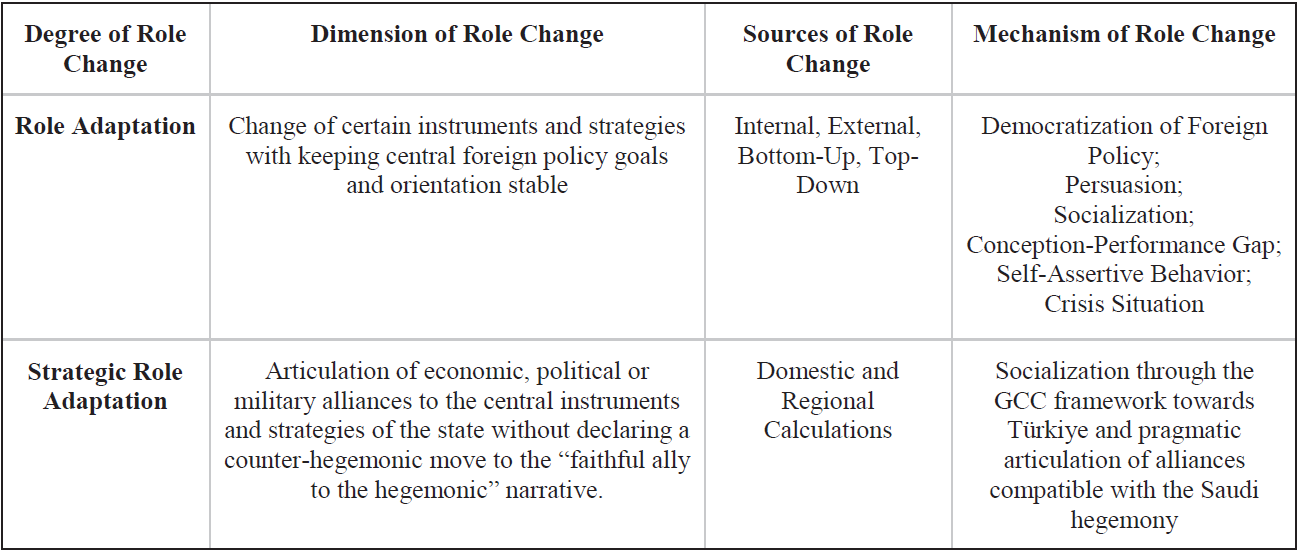
Source: Designed by the Author Combining Harnisch, et al. and Laclau and Mouffe68
The second mechanism of the role adaptation is the pragmatic articulation of alliances compatible with the Saudi hegemony. This is in the same vein with Bahrain’s military relations with the U.S. and the UK. Since the adaptation of roles –and so the alliances– are required to be compatible with the Saudi hegemony addressing the Bahraini political complex as a faithful ally, what makes Türkiye convenient for it? There are several reasons why Türkiye is defined as a compatible ally in the Bahraini role conception considering the Saudi hegemony in Bahrain impacting its strategic role adaptation.
Strategic Role Adaptation of a Faithful Ally
There are two initial material motivations behind defining Türkiye’s eligibility for Bahrain’s strategic role adaption articulating Ankara as an ally: economic and military capital. The GCC capitals and Türkiye have aimed to strengthen economic cooperation since 2008, after the signing of a strategic partnership agreement giving this status for the first time to a non-Gulf country. In March 2024, the GCC and Türkiye upgraded the level of shared economic interests, one of the world’s largest free trade agreements signed between Türkiye and the members of the GCC worth a total value of $2.4 trillion.69 In the words of Ömer Bolat, Turkish Minister for Trade, “this new commercial partnership projection is of great importance in terms of reaching a larger share in the global economy with the GCC countries with the win-win principle.”70 After signing this treaty, the secretary general of the GCC, Jasem Albudaiwi, relates the economic capital embedded in the GCC-Türkiye relations to the GCC’s process of diversifying of its sources and cooperation; and he averred that this cooperation emphasizes its globally important commercial position.71 Not only under the umbrella of the GCC but also bilaterally Türkiye and Bahrain are in an effort to cooperate institutionally including state actors at the ministerial level and private actors like trade chambers, business unions such as the Joint Economic Commission, Turkish Exporters Assembly, and the Turkish-Bahraini Business Council.
Graph 1: Export Rates (Million Dollars)
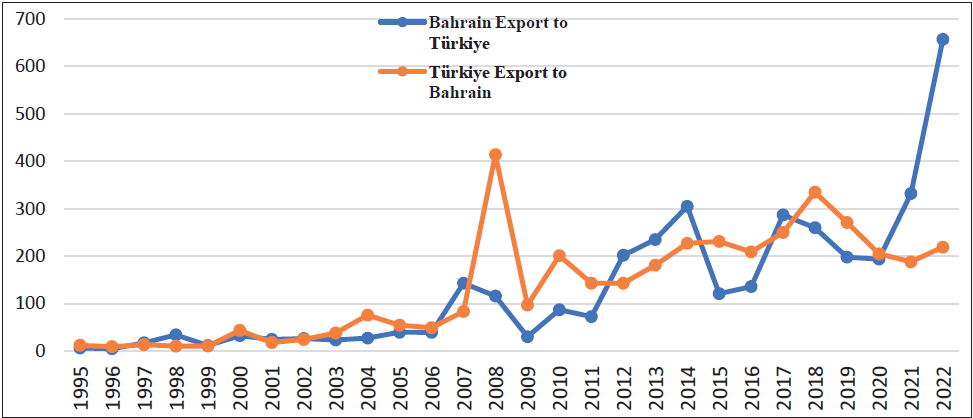
Source: The Observatory of Economic Complexity72
Graph 1, summarizes the total exports from Bahrain to Türkiye and vice versa from 1995 to 2022. It is clear through the data, there is a fluctuation in the trade volumes and values between Manama and Ankara. The products exported vary from food, textile, tobacco, construction material, electrics, raw aluminum, refined petroleum and jewelry.73 As commercial counselor in the Turkish Embassy, Güzin Bayar stated in 2019, the trade among the two countries is under its potential.74 For the economic peak in 2008, the strategic partnership agreement could be the reason but also the trade volume could be representing the outcomes of Erdoğan’s visit to Manama in 2005. Moreover, the Bahraini King al-Khalifa’s visit to Ankara in 2008, may explain that peak in the commercial data representing several overlapping diplomatic achievements. The data indicates that the rapid rise in Bahrain’s export to Türkiye in 2020 is due to export of raw aluminum,75 which was $90 million in 2017 and reached $412 million by 2022. In October 2023, Turkish Ambassador to Bahrain, Çakıl, brought together several companies from Türkiye with their counterparts in Bahrain. Çakıl stated that:
Although there has been growth in trade volume over the last three years, it is still much under its potential, and we seek initiatives like trade delegation and one-to-one meeting opportunities to elevate the long-standing relations to a higher level…The potential is immense, with the help of increasing business-to-business contacts, we aim to improve our economic ties and cooperation in fields of trade and investment.76
Military trade is another critical material element in the bilateral ties and a trend in Türkiye-Gulf relations. Bahrain’s import from Türkiye as a share of total import from 2004-2022 is displayed in Graph 2. In 2004, Bahrain’s total military import was worth $1.8 million with Türkiye having a share of only 1.85 percent ($33.4 thousand).77 According to World Bank data, Bahrain’s military expenditure as a share of its GDP is less than 5 percent since 1990. There is a slight increase between 2013 and 2015, yet it has been in decline since then.78 However, in the share of global arms imports, as Table 2 indicates, Bahrain moved from 0.1 in 2013-2017 to 0.5 in 2018-2022 and 0.7 in 2019-2023. This indicates that there is an increasing opportunity in the Bahraini arms import market.
Table 2: Share of Bahrain’s Global Arms Import
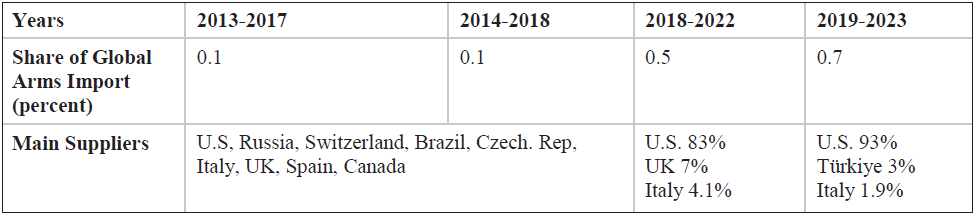
Source: The Observatory of Economic Complexity; Stockholm International Peace Research Institute79
Despite the limited share of Türkiye in Manama’s military spending, for the years of 2019-2023, Ankara is listed among the top three arms exporters to Bahrain with 3 percent (Table 2). According to the data by the Observatory of Economic Complexity (OEC), previously in 2011, Türkiye had the second share in Bahrain’s military import with 13.3 percent. As Graph 2 indicates, there are a couple of peaks, in 2011 and 2014, when Türkiye’s share in Bahraini military trade increased, but it was not a sustained commerce. Thus, there is a problem of continuity both in economic and military trade.
Graph 2: Share of Weapons in Bahrain’s Total Import from Türkiye (2004-2022)
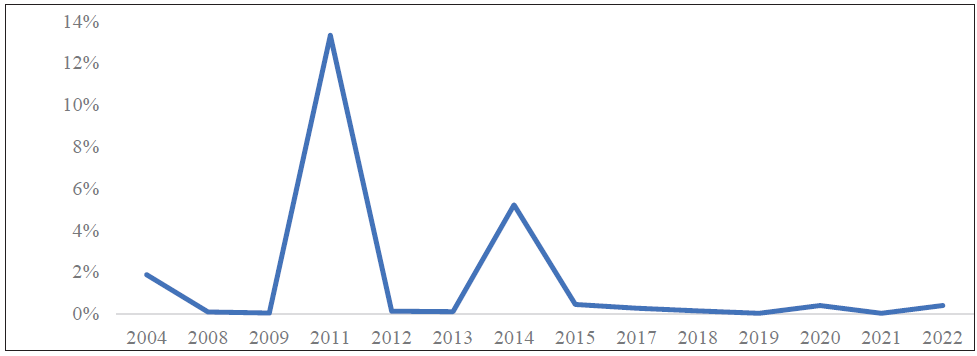
Source: The Observatory of Economic Complexity80
The last angle in the Bahraini-Turkish strategic alliances as an articulated role to Manama’s foreign affairs is the de-escalated political tension and a softened diplomatic narrative. Türkiye had the same potential to cooperate with Bahrain since 2008, yet in the times of crisis between Ankara and Riyadh, Bahrain does not adopt a role to socialize with Türkiye. Rather, it joins the Saudi policy as a faithful ally as in the time of political tensions between Riyad and Ankara after the Gulf crisis in 2017. The strain between Saudi Arabia along with the UAE and Türkiye was conjectural on the basis of their contradictory regional policies in the post-Arab Spring. These contradictory policies included a supportive diplomacy mechanism of Ankara and Doha towards the Muslim Brotherhood movement, which was declared a terrorist organization in the Saudi and Emirates. A critical note to add here is that Bahrain did not depict the “Ikhwan” as a terrorist organization in their local politics to set a standard in its own domestic calculations towards the Shia political groups. In this regard, the Turkish moderate interventions towards the Muslim Brotherhood, in terms of allying with it in certain regional affairs, is not completely unlikely for Bahrain. In the political reading of Bahrain, they differentiate local Bahraini Ikhwan from the regional policies on the movement, thus, this is in the same vein with the UAE and Saudi Arabia. However, the Bahraini political elites have not used the harsh narrative on the movement as opposed to the other two Gulf states. For instance, in 2018, The Bahrain Mirror shared a news item announcing that the Islamic Tribune Society of Bahrain, which is the Muslim Brotherhood affiliate al-Minbar, amended its statute to emphasize that it is not associated with non-Bahraini entities. Quoting from The Bahrain Mirror:
The amended Statute stipulates that the Society shall abide by the provisions of the National Action Charter and Constitution of Bahrain as well as respect the rule of law, as the Society shall not be affiliated neither organizationally nor financially with any non-Bahraini entity, or direct the activities of the Society on the orders or directives of any foreign country or party.81
Even earlier in 2014 Bahrain’s then-Foreign Affairs Minister, Sheikh Khalid bin Ahmed bin Mohammed al-Khalifa, stressed that they support the decision of Saudi Arabia and the Emirates in confronting the Ikhwan. Yet he also underlined Bahrain does not label the political arm of local Ikhwan operating in his country. As Hatlani aptly posted, “he stated that the group has respected the rule of law and has not acted against the security of the country” (referring to Bahrain). The foreign minister explained that “we do not see it as a global movement.”82 Also in March 2014, the Interior Ministry of Bahrain sent a warning to its citizens fighting in conflicts abroad, especially in Syria, along with the Brotherhood affiliates to display its cooperation with the Saudi policies. To differentiate between the ‘good’ and ‘bad’ Ikhwan, or the local Ikhwan affiliated who supported the status quo and the so-called global Brotherhood who called for reform and intervened in Saudi and Emirati internal affairs. The then-Foreign Affairs Minister, Sheikh Khalid tweeted “The Muslim Brotherhood movement is a global movement with a single approach and is spread throughout the world, and will be dealt with according to the law of each country and the covenants to which it is party.”83 Therefore, the elusive balance towards domestic and sub-regional policies was a critical issue for the Bahraini political elites.
Türkiye has been supporting the Bahraini territorial and political unity for not allying with Iran in its regional policies and regime import efforts to Bahrain
As of now, the Turkish-Gulf relations since the de-escalation with Saudi Arabia and the UAE by 2022 also displays clearly that Ankara cooperates with the status quo forces in the Middle East to ease its regional economic policies and to re-raise its strategic power that declined in the post-Arab Spring era. Therefore, in the current form of its policies towards Manama and other GCC states, the regional policy contradiction is not on the surface. The policies over the role and position of the Ikhwan is not at the center, yet not completely solved. However, Türkiye has been supporting the Bahraini territorial and political unity for not allying with Iran in its regional policies and regime import efforts to Bahrain. For Ankara, as is mentioned above, even in the peak time of Arab revolts, the Bahraini state was the ally not the rebellions against it. In this respect, Turkish-Bahrain relations have a political cooperation angle accommodating Türkiye’s role in the regional affairs counterbalancing Iran’s assertive policies raised dramatically following Saddam’s fall from power. This political capital based on shared interests but also not having a history of direct diplomatic clashes, provides room to consolidate the bilateral ties. In 2022, the former Foreign Minister of Türkiye, Mevlüt Çavuşoğlu, visited Bahrain upon the invitation of his counterpart, Abdullatif bin Rashid al-Zayani. His narrative is significant to see the political capital in the ties that eases Bahrain’s strategic role adaptation towards Türkiye. Çavuşoğlu emphasized that “the new dialogue and cooperation period in our region opens a window for permanent peace, stability and prosperity. Türkiye is ready to do its part for regional cooperation on the basis of mutual respect and a common vision; and appreciates the successful efforts of Bahrain.”84 Furthermore, Bahrain’s Deputy Prime Minister Sheikh Khalid bin Abdullah al-Khalifa attended the inauguration ceremony of President Erdoğan in 2023 and proclaimed that “The Kingdom of Bahrain highly values its relations with Türkiye and we continue to welcome Türkiye’s role and positive participations at the regional and international levels, becoming a role model in development.”85 His emphasis was on Bahraini interests to foster relations based on the values of mutual respect and understanding.86 Consequently, there is capital in Bahraini-Turkish bilateral relations to establish on as Ankara politically, economically, and militarily corresponds to the Bahraini central instruments and strategies as a faithful ally of Saudi Arabia.
Conclusion
There are two typologies of national roles in the Bahraini foreign policymaking towards Türkiye: a faithful ally of Saudi Arabia and strategic role adaptation. These two roles either played simultaneously as is the case in the peak years of cooperation with Türkiye or being a faithful ally of Saudi Arabia dominates Bahrain’s strategic role adaptations, notably, in the times of crisis. It is important to underline that these multiple roles are not in conflict with each other. Bahrain only adapts a new role, or cooperation, when it does not clash with the sub-regional hegemony of Saudi Arabia. Put differently, the role of Bahrain as a small state seeking a security and economic cooperation with Türkiye is not the opposite of Bahrain as a bandwagoning state to Saudi Arabia. Rather, these are parallel roles played simultaneously, according to the Bahraini domestic and regional political atmospheres.
To upgrade the bilateral ties to the role learning process is not only a decision of the Bahraini elites, but also the Turkish elites and regional politics need to furnish material and ideational opportunities to flourish the relations
The role adaptation might bring policy learning for both sides as Türkiye is in an effort to institutionalize its relations to the GCC and as Bahrain is opening new spaces for its safe or pragmatic independence. Bahrain has a self-centric role in the international and regional relations, yet this includes a reality of Saudi hegemony. Therefore, to upgrade the bilateral ties to the role learning process is not only a decision of the Bahraini elites, but also the Turkish elites and regional politics need to furnish material and ideational opportunities to flourish the relations.
In conclusion, this post-structuralist approach articulated to the role theory to analyze Bahrain’s affairs with Türkiye bridges the universal-international relations and particularistic-Gulf studies sub-area and contributes to the foreign policy analysis in the field.
Endnotes
1. “UK Opens Permanent Military Base in Bahrain,” Reuters, (April 5, 2018), retrieved May 4, 2024, from https://www.reuters.com/article/idUSKCN1HC2NQ/; “Population and Demographics,” Ministry of Information, retrieved May 5, 2024, from https://www.mia.gov.bh/kingdom-of-bahrain/population-and-demographics/?lang=en.
2. Nawal Aljasim, “Bahreyn–Türkiye İlişkileri: Gelişim, Günün Koşulları ve Gelecekteki Beklentiler,” Master’s thesis, Gazi University, 2019; Aydın Erdoğan and Ali Serman Merdan “Türkiye’nin Körfez Açılımında Bahreyn,” Çankırı Karatekin Üniversitesi İktisadi ve İdari Bilimler Fakültesi Dergisi, Vol. 11, No. 1 (2021), pp. 441-465.
3. Nesibe Hicret Battaloğlu “Ideational Factors in Turkey’s Alignment with Qatar and Their Impact on Regional Security,” The International Spectator, Vol. 56, No. 4 (2021), pp.101-118; Sean Yom, “Roles, Identity, and Security: Foreign Policy Contestation in Monarchical Kuwait,” European Journal of International Relations, Vol. 26, No. 2 (2020), pp. 569-593; Fatima al-Karbi, “The United Arab Emirates Foreign Policy Change in the Post 2011 Middle East: A Role Theory Approach,” Doctoral Dissertation, Durham University, 2022.
4. Sebastian Harnisch, “Role Theory: Operationalization of Key Concepts,” in Sebastian Harnisch, Cornelia Frank, and Hanns W. Maull (eds.), Role Theory in International Relations, (Oxon: Routledge, 2011), pp. 7-15.
5. Harnisch, “Role Theory: Operationalization of Key Concepts,” p. 10.
6. Quoted in Dirk Nabers “Identity and Role Change in International Politics,” in Sebastian Harnisch, Cornelia Frank, and Hanns W. Maull (eds.), Role Theory in International Relations, (Oxon: Routledge, 2011), p. 82.
7. Ernesto Laclau, “Deconstruction, Pragmatism, Hegemony,” in Chantal Mouffe, Simon Critchley, Jacques Derrida, Ernesto Laclau, and Richard Rorty (eds.), Deconstruction and Pragmatism, (Routledge, 1996), pp. 49-70; Ernesto Laclau and Chantal Mouffe, Hegemony and Socialist Strategy: Towards a Radical Democratic Politics, Vol. 8, (Verso, 2014); Dirk Nabers, A Poststructuralist Discourse Theory of Global Politics, (Springer, 2015); Dirk Nabers, “Power, Leadership, and Hegemony in International Politics: The Case of East Asia,” Review of International Studies, 36, No. 4 (2010), pp. 931-949; David Howarth, Aletta J. Norval, Aletta Norval, and Yannis Stavrakakis (eds.), Discourse Theory and Political Analysis: Identities, Hegemonies and Social Change, (Manchester University Press, 2000).
8. Betül Doğan-Akkaş, “Hegemonic Practices in the GCC Political Complex (GPC): Evolvement of Counter-
Hegemonic Formations,” Unpublished Doctoral Dissertation, Durham University, 2023.
9. Nabers, “Power, Leadership, and Hegemony in International Politics,” p. 934; Marijke Breuning, “Role Theory,” in Patrick A. Mello and Falk Ostermann (eds.), Routledge Handbook of Foreign Policy Analysis Methods, (Routledge, 2022), p. 194.
10. Zekeriya Kurşun, “Osmanlı Devleti’nin Basra Körfezi Siyaseti: Bağdat, Basra ve Lahsa Beylerbeylikleri (1534-1672),” FSM İlmi Araştırmalar İnsan ve Toplum Bilimleri Dergisi, Vol. 12, (2018), p. 20.
11. Salih Özbaran, “Bahrain in 1559: A Narrative of Turco-Portuguese Conflict in the Gulf,” Osmanlı Araştırmaları, Vol. 3, No. 3 (1982), pp. 90-104.
12. Salih Özbaran, “16. Yüzyılda Basra Körfezi Sahillerinde Osmanlılar: Basra Beylerbeyliğinin Kuruluşu,” Tarih Dergisi, Vol. 25, (2011), pp. 51-72.
13. Kursun, “Osmanlı Devleti’nin Basra Körfezi Siyaseti,” p. 13.
14. Kurşun, “Osmanlı Devleti’nin Basra Körfezi Siyaseti,” p. 20.
15. Kurşun, “Osmanlı Devleti’nin Basra Körfezi Siyaseti,” p. 11.
16. Zekeriya Kurşun, Katar’da Osmanlılar 1871-1916: Basra Körferzi’nde Osmanlı-İngiliz Çekişmesi, (Türk Tarih Kurumu Basımevi, 2004), p. 25.
17. Kurşun, Katar’da Osmanlılar 1871-1916, p. 28
18. Oktay Kızılkaya, “XIX. Yüzyılın Sonu XX. Yüzyılın Başlarında Basra Körfezinde Uluslararası Hakimiyet Mücadelesi,” Electronic Turkish Studies, Vol. 8, 7 (2013), p. 297.
19. Kurşun, Katar’da Osmanlılar 1871-1916, p. 37.
20. Zekeriya Kurşun, “Basra Körfezi’nde Bir Arap Aşireti: Acman Urbanı (1820-1913),” Belleten, Vol. 63, No. 236 (1999) p. 131.
21. Kurşun, Katar’da Osmanlılar 1871-1916, 180.
22. Kurşun, Katar’da Osmanlılar 1871-1916, 179.
23. Kurşun, Katar’da Osmanlılar 1871-1916, 179.
24. Kurşun, Katar’da Osmanlılar 1871-1916: Basra Körferzi’nde Osmanlı-İngiliz Çekişmesi, 146.
25. Aljasim, “Bahreyn-Türkiye İlişkileri,” p. 44.
26. Sam Pope Brewer, “U.N. Told Bahrain Seeks to Be Free,” The New York Times, (May 3, 1970), retrieved May 5, 2024, from https://www.nytimes.com/1970/05/03/archives/un-told-bahrain-seeks-to-be-free-council-to-consider-report-on.html.
27. “Question of Bahrain Initial Proceedings,” UN, (January 1970), retrieved from https://www.un.org/securitycouncil/sites/www.un.org.securitycouncil/files/en/sc/repertoire/69-71/Chapter%208/69-
71_08-10-Question%20of%20Bahrain.pdf; Edward Gordon, “Resolution of the Bahrain Dispute,”American Journal of International Law, 65, No. 3 (1971), pp. 560-568.
28. “Bilateral Political Relations between Türkiye and Bahrain,” MFA, retrieved May 4, 2024, from https://www.mfa.gov.tr/relations-between-turkiye-and-bahrain.en.mfa.
29. Aljasim, “Bahreyn-Türkiye İlişkileri,” p. 75.
30. “TBMM Tutanak Dergisi 65 inci Birleşim 15.5.1984 Salı,” TBMM Arşivi, retrieved May 5, 2024, from https://www5.tbmm.gov.tr/tutanaklar/TUTANAK/TBMM/d17/c003/tbmm17003065.pdf.
31. “TBMM Tutanak Dergisi 55 inci Birleşim 16.3.1999 Salı,” TBMM Arşivi, retrieved May 5, 2024, from https://www5.tbmm.gov.tr/tutanak/donem20/yil4/bas/b055m.htm.
32. “Erdogan Bahreyn’e Hareket Etti,” Haber 7, (November 13, 2005), retrieved May 6, 2024, from, https://www.haber7.com/dunya/haber/121342-erdogan-bahreyne-hareket-etti.
33. Aljasim, “Bahreyn-Türkiye İlişkileri,” p. 44.
34. “President Gül Due to Bahrain,” Hürriyet, retrieved May 3, 2024, from https://www.hurriyet.com.tr/gundem/president-gul-due-to-bahrain-11424643.
35. Aljasim, “Bahreyn-Türkiye İlişkileri,” p. 48.
36. “Bilateral Political Relations between Türkiye and Bahrain,” MFA, retrieved May 4, 2024, from https://www.mfa.gov.tr/relations-between-turkiye-and-bahrain.en.mfa.
37. Sinem Cengiz, “Are Türkiye-Bahrain Relations Poised for a New Chapter?” Arab News, (February 2, 2024), retrieved May 6, 2024, from https://www.arabnews.com/node/2452861.
38. Cengiz, “Are Türkiye-Bahrain Relations Poised for a New Chapter?”
39. “Bahraini-Turkish Cooperation Discussed,” Bahrain News Agency, (March 31, 2022), retrieved May 6, 2024, from https://www.bna.bh/en/BahrainiTurkishcooperationdiscussed.aspx?cms=q8FmFJgiscL2fwIzON1%2BDqjZbq%2BASlMHPxI%2FWywIQeQ%3D.
40. “Cooperation Protocol between Yunus Emre Institute and University of Bahrain,” Yunus Emre Institiute, (August 26, 2016), retrieved May 6, 2023, from https://www.yee.org.tr/en/news/cooperation-protocol-between-yunus-emre-institute-and-university-bahrain; Betül Doğan Akkaş, “GCC States Support for Türkiye Reflects a Burgeoning Partnership,” Gulf International Forum, (February 28, 2023), retrieved May 6, 2024, from https://gulfif.org/gcc-states-support-for-turkiye-reflects-a-burgeoning-partnership/.
41. Dirk Nabers used these two theories together in his analysis of identity and role theory, see: Nabers “Identity and Role Change in International Politics,” p. 82.
42. Yasemin Akbaba, Özgür Özdamar, and Patrick James, Role Theory in the Middle East and North Africa Politics, Economics and Identity, (Routledge, 2019); Özgür Özdamar and Sercan Canbolat, Leaders in the Middle East and North Africa: How Ideology Shapes Foreign Policy, (Cambridge University Press, 2023).
43. Marijke Breuning, “Role Theory in Foreign Policy,” Oxford Research Encyclopedias, (May 24, 2017), retrieved May 6, 2024, from https://oxfordre.com/politics/politics/view/10.1093/acrefore/9780190228
001.0001/acrefore-9780190228637-e-334?p=emailACFsgIjpFv5/Q&d=/10.1093/acrefore/97801
90228637.001.0001/acrefore-9780190228637-e-334.
44. Steven Wright, “Foreign Policy in the GCC States,” in Mehran Kamrawa (ed.), International Politics of the Persian Gulf, (Syracuse University Press, 2011), pp. 72-93.
45. Nabers, “Power, Leadership, and Hegemony in International Politics,” p. 939.
46. Nabers, “Power, Leadership, and Hegemony in International Politics.”
47. Roger Simon, Gramsci’s Political Thought: An Introduction, (London: Lawrence and Wishart, 1988), p. 24.
48. Simon, Gramsci’s Political Thought.
49. Simon, Gramsci’s Political Thought.
50. Simon, Gramsci’s Political Thought.
51. Laclau and Mouffe, Hegemony and Socialist Strategy.
52. Ernesto Laclau, “Beyond Emancipation,” Development and Change, Vol. 23, No. 3 (1992), pp. 121-137; Laclau and Mouffe, Hegemony and Socialist Strategy.
53. Harnisch, “Role Theory,” p. 5.
54. Harnisch, “Role Theory,” p. 8.
55. Kalevi J. Holsti, “National Role Conceptions in the Study of Foreign Policy,” International Studies Quarterly, 14, No. 3, (1970), p. 277.
56. Harnisch, “Role Theory,” p. 10.
57. Harnisch, et al., “Conclusion: Role Theory, Role Change, and the International Social Order,” in Sebastian Harnisch, Cornelia Frank, and Hanns W. Maull (eds.), Role Theory in International Relations, (Oxon: Routledge, 2011), p. 253.
58. Harnisch, et al., “Conclusion,” p. 256.
59. Harnisch, et al., “Conclusion,” p. 258.
60. Nabers “Identity and Role Change in International Politics,” p. 74.
61. Holsti, “National Role Conceptions in the Study of Foreign Policy,” p. 267.
62. Kenneth Katzman, “Bahrain: Reform, Security, and US Policy,” Congressional Research Service, (2013).
63. “Operation Kipion,” Royal Navy, retrieved May 6, 2024, from https://www.royalnavy.mod.uk/news-and-latest-activity/operations/red-sea-and-gulf/operation-kipion.
64. “Operation Kipion,” Royal Navy.
65. Harnisch, et al., “Conclusion,” p. 253.
66. Harnisch, et al., “Conclusion,” p. 253.
67. Sheldon Stryker, “Traditional Symbolic Interactionism, Role Theory, and Structural Symbolic Interactionism: The Road to Identity Theory,” in Jonathan Turner (ed.), Handbook of Sociological Theory, (New York: Springer, 2006), p. 228.
68. Harnisch, “Role Theory”; Laclau and Mouffe, Hegemony and Socialist Strategy.
69. “Turkey and Gulf States to Launch Talks for Free Trade Pact,” Reuters, (May 21, 2014), retrieved May 6, 2024, from https://www.reuters.com/world/middle-east/turkey-gulf-states-launch-talks-free-trade-pact-2024-03-21/.
70. Ömer Bolat, X, 12:47 PM (March 21, 2024), retrieved from https://twitter.com/omerbolatTR/status/
71. Jasem Al Budaiwi, X, 3:17 PM (March 21, 2024), retrieved from https://twitter.com/jasemalbudaiwi/status/1770786731425484955.
72. “What Does Turkey Import from Bahrain?” The Observatory of Economic Complexity, retrieved from https://oec.world/en/visualize/tree_map/hs92/import/tur/bhr/show/199.
73. “Bahrain’s Import from Türkiye; Türkiye’s Import from Bahrain,” The Observatory of Economic Complexity (OEC), retrieved May 6, 2024, from https://oec.world/en/visualize/tree_map/hs92/import/bhr/tur/show/2018.2019.2020.2021.2022.
74. “Bahrain-Turkey Trade Set to Grow,” EDB Bahrain, (November 4, 2019), retrieved May 5, 2024, from https://www.bahrainedb.com/latest-news/bahrain-turkey-trade-set-to-grow.
75. “Bahrain’s Import from Türkiye; Türkiye’s Import from Bahrain),” The Observatory of Economic Complexity.
76. “Türkiye’s Untapped Potential in Bilateral Trade Highlighted: Bahrain,” Zawya, (October 12, 2023), retrieved May 6, 20204, from https://www.zawya.com/en/world/middle-east/turkiyes-untapped-potential-in-bilateral-trade-highlighted-bahrain-p40ittyz.
77. “Bahrain’s Import from Türkiye; Türkiye’s Import from Bahrain,” The Observatory of Economic Complexity.
78. “Bahrain,” World Bank Data, retrieved May 6, 2024, from https://data.worldbank.org/country/bahrain.
79. “Where Does Bahrain Import Weapons from? (2013),” The Observatory of Economic Complexity, retrieved from https://oec.world/en/visualize/tree_map/hs92/import/bhr/all/19/2013; Stockholm International Peace Research Institute (SIPRI), retrieved from https://www.sipri.org/.
80. “Where Does Bahrain Import Weapons from? (2013),” The Observatory of Economic Complexity.
81. “Muslim Brotherhood in Bahrain Change Their Statute to Confirm They Are Not Affiliated with International Organisation,” The Bahrain Mirror, (March 14, 2018), retrieved May 6, 2024, from http://bahrainmirror.com/en/news/45382.html.
82. Ibrahim Hatlani, “Bahrain between Its Backers and the Brotherhood,” Carnegie Endowment, (May 20, 2014), retrieved May 6, 2024, from https://carnegieendowment.org/sada/?fa=55653.
83. Hatlani, “Bahrain between Its Backers and the Brotherhood.”
84. “Turkey, Bahrain Share United, Stable Gulf Region Vision: FM Çavuşoğlu,” Daily Sabah, (January 30, 2022), retrieved May 6, 2024, from https://www.dailysabah.com/politics/diplomacy/turkey-bahrain-share-united-stable-gulf-region-vision-fm-cavusoglu.
85. “Bahrain ‘Highly Values’ Its Relations with Türkiye, Says Deputy Prime Minister,” Anadolu Agency, (June 6, 2923), retrieved May 6, 2024, from https://www.aa.com.tr/en/middle-east/bahrain-highly-values-its-relations-with-turkiye-says-deputy-prime-minister/2915775#.
86. “Bahrain ‘Highly Values’ Its Relations with Türkiye, Says Deputy Prime Minister,” Anadolu Agency.