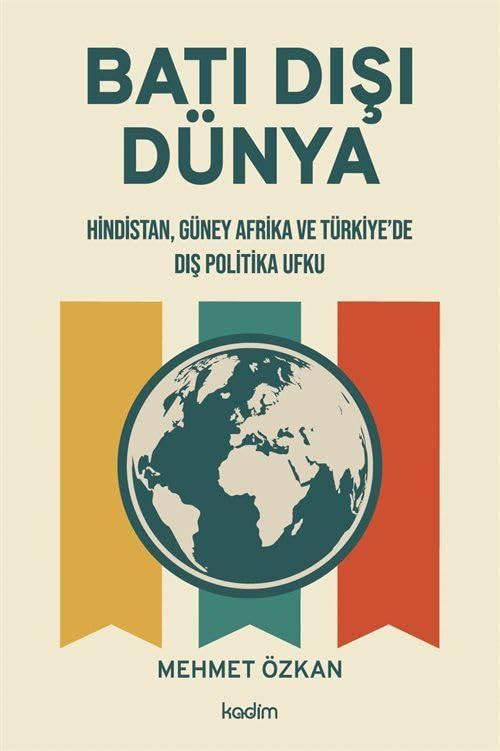
Many states seek to play roles that exceed their material capabilities. Therefore, comprehending the complexities of foreign policymaking necessitates an examination that transcends mere economic and military powers, encompassing culture, religion, historical legacy, and self-consciousness as influential factors. In his book Batı Dışı Dünya: Hindistan, Güney Afrika ve Türkiye’de Dış Politika Ufku (The Non-Western World: Foreign Policy Horizons in India, South Africa, and Türkiye), Mehmet Özkan emphasizes foreign policy perspectives of the three non-Western developing states. He also examines the impact of religion in international relations. In this regard, Özkan contends that religion should not be viewed merely as a belief system but as a strategic factor shaping state behavior. In advancing this argument, Özkan refutes dominant secular political theories that dismiss religion as irrelevant to understanding the conduct of states and societies.
The book is composed of seven chapters, along with an introduction and a conclusion. The first chapter constitutes the theoretical backbone of the study and introduces the concept of strategic thinking in state behavior. Accordingly, non-Western states such as South Africa, India, and Türkiye typically exhibit distinctive patterns of behavior, which are largely shaped by enduring historical, religious, and cultural elements that give rise to a specific strategic thinking. Religion and culture act as foundational forces that shape the boundaries of thought and action; it is therefore inconceivable that a state’s foreign policy perspective would remain immune to this influence. The main aim of the book is to highlight that long-standing historical legacy and heritage, in combination with religious and cultural identity, fundamentally influence how societies and states perceive and engage with the world.
In the following chapters, Özkan leverages illustrative case studies from India, South Africa, and Türkiye, countries from three continents with distinct religious and colonial/non-colonial histories, to offer readers a comprehensive theoretical model explaining how developing states form their foreign policy orientations. As the main argument of this work, there are three types of strategic mentality: regional, continental, and global, represented by India, South Africa, and Türkiye, respectively. Each case study is examined in two chapters: historical background and the corresponding strategic thinking.
This framework treats Islam and Christianity as inherently global religions. By affirming the universality of faith, these belief systems have historically engaged in missionary and proselytizing activities, reflecting expansionist impulses rooted in religious doctrine. Consequently, countries shaped by such traditions tend to develop a strategic mentality that leads them to pursue globally sensitive and proactive foreign policies. On the other hand, Hinduism and Buddhism, which maintain a stronger regional presence, primarily centered around the Indian subcontinent, are categorized as regional belief systems. The third category is Afro-Christianity, which is far more complex than mere regional traditions, yet neither qualifies as truly a global religion. In this study, Afro‑Christianity is classified as a continental thinking providing a cultural experience that both generates and grounds it. This mindset manifests in South Africa’s international policy through responsible yet ultimately constrained behavior.
A clear historical background and theoretical framework preceded each case study, giving readers the context and analytical tools necessary to revisit and deepen their understanding of the book’s arguments. As emphasized in these introductory sections, the strategic mentality of states is historically constructed, evolving over time through critical junctures. Several actions and events such as regional policies pursued during Ghandi’s tenure as prime minister in India, the end of the apartheid era in South Africa and the Gulf War along with shifting domestic dynamics in Türkiye functioned as turning points, illuminating how strategic mentality emerges from a complex interplay of historical forces and cultural values.
In the case of India, the colonial legacy, followed by the partition of Pakistan and Bangladesh and the 1962 defeat against China, inflicted deep psychological trauma, while the adoption of non-alignment during the Cold War further prompted a more inward-oriented foreign policy. Therefore, despite India’s growing economy, its substantial diaspora, and the organic global reach of Bollywood and other cultural exports, we observe a notable reluctance to strategically leverage its soft power assets. Özkan defines this behavior as a form of cautious prudence and also underlines that Asia lacks a robust readiness to assume global actor roles.
The proposition that “South Africa’s destiny is inseparable from the future of Africa” (p. 105) is prominently articulated through its foreign policy. Since 1994, South Africa has emerged as a regional actor, engaging deeply in conflict resolution, peacebuilding, and institutional development throughout Africa, shedding its former isolationist stance from the apartheid years. Consequently, during the 2000s, South Africa increasingly prioritized the principle of African solutions to African problems, foregrounding a continental approach to conflict resolution and stability over external interventions. On the one hand, this explains South Africa’s activism and leadership within the continent. However, on the other hand, Özkan asserts that a sense of victimhood and desire for recognition dominate South Africa’s strategic mentality, an orientation that partly explains why the country’s otherwise conscientious and proactive foreign policy remains constrained.
Meanwhile, Turkish foreign policy during the Republican era underwent multiple phases: particularly during the Cold War, Türkiye adopted a pro-Western stance in response to the Soviet threat, while cultivating only limited relations with countries with which it had historical and geographical ties. On the other hand, to understand Türkiye’s growing activism since the 1990s, it is essential to grasp the role that Islam plays within Turkish social and cultural life. Özkan constructs his argument around three key propositions: Despite internal societal diversity, dominant strategic mentalities consolidate around shared elements associated with Islam; a renewed belief emerged that Türkiye could reclaim its status as a global actor, and Turkish society began to perceive itself not as a victim but as a responsible agent. Özkan situates this process within Türkiye’s discourse of Islamic identity, institutional engagement, and the broader political turn embodied in Justice and Development Party-era state narratives. These factors catalyzed a shift toward a strategic mentality cultivated in cultural and religious legitimacy rather than secularist ideology.
Özkan presents a contextually rich model grounded in history, culture, and religion and makes a significant contribution to the literature on the development of non-Western international relations theory. Although the book leaves us without an answer regarding the applicability of this theory to Western or underdeveloped states, it occupies a noteworthy place in the literature due to its broad historical and conceptual scope. Moreover, it should be acknowledged that the theory falls short of explaining certain unique foreign policy actions. For example, South Africa’s decision to file a case against Israel over the atrocities in Gaza illustrates a globally oriented strategic mentality that transcends the regional boundaries emphasized in the model.