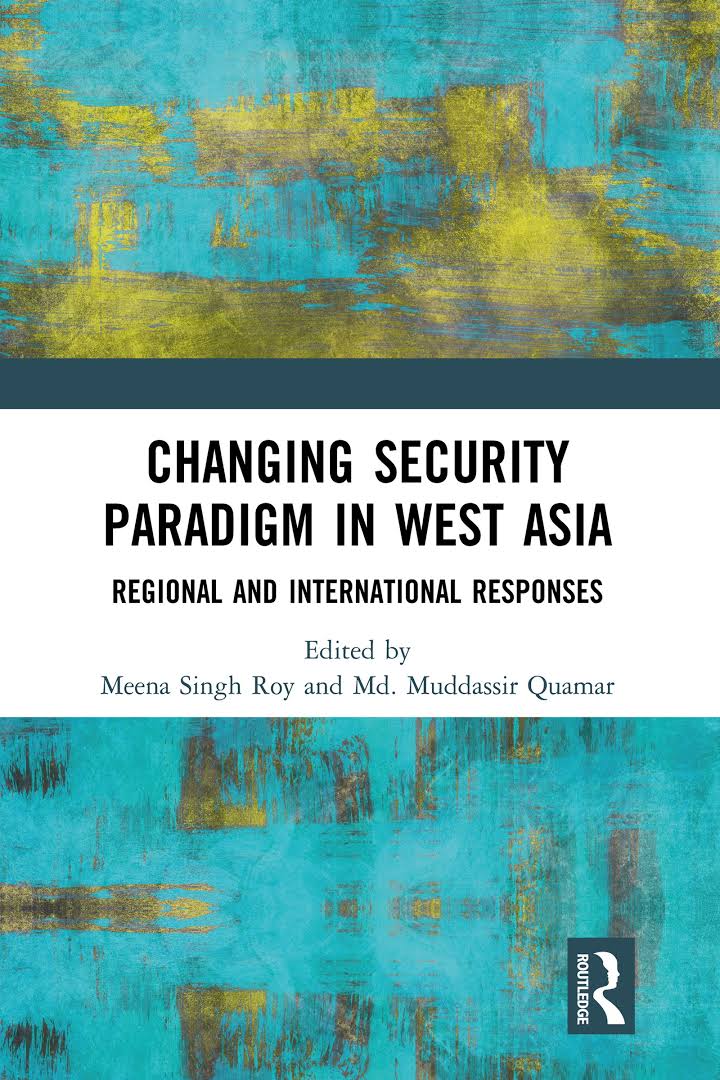
Changing Security Paradigm in West Asia: Regional and International Responses, edited by Meena Singh Roy and Md. Muddassir Quamar, is a 13-chapter volume that explores the security dynamics in West Asia, a region whose borders were arbitrarily drawn by foreign actors unaware of the societal structure of the Middle East. Based on the proceedings of the 2018 West Asia Conference, the book covers the shifts in regional security architectures and their implications both regionally and internationally. It addresses critical issues like energy policies, counterterrorism efforts, sectarian conflicts, and geopolitical rivalries. The book analyzes the security perceptions, policy priorities, and alliance preferences of regional actors, offering both theoretical frameworks and concrete examples for understanding these shifts.
The first chapter emphasizes that regional issues must be seen through multiple perspectives, from states, sectarian groups, international powers, and civil society organizations. These varied viewpoints often lead to conflicting priorities and policy approaches, which in turn slow down or block diplomatic initiatives, peace processes, and institution-building efforts. Key drivers of instability identified include the control of energy resources, ideological divisions, ethnic and sectarian conflicts, and competition between regional and global major powers. The chapter establishes a framework for analyzing these challenges multidimensionally.
Chapter two examines the rivalry between the Shia bloc, led by Iran, and the Sunni bloc, led by Saudi Arabia. The chapter highlights the sectarian nature of this conflict, intertwined with geopolitical power struggles. Iran and Saudi Arabia leverage their energy resources in this competition, impacting regional stability. The author challenges the notion that Iran is the primary destabilizing force, citing its non-involvement in conflicts like Kuwait’s invasion and the Gulf Cooperation Council’s intervention in Libya. The chapter concludes by outlining the strategies of both countries, offering insights and recommendations for future strategies.
Chapter three examines the Arab Spring, or “Arab Renaissance,” in the context of increasing social despair and instability (p. 32). The Arab Spring, which initially raised hopes for stability, ultimately exacerbated security challenges. The absence of strong central governments enabled the growth of terrorist organizations like ISIS, which exploited regional chaos to further its agenda. This chapter argues that the despair following the Arab Spring could have lasting effects on both regional and global security.
Chapter four examines Türkiye’s evolving role in the Middle East. Historically distancing itself from Middle Eastern politics, Türkiye’s engagement deepened after the Cold War, particularly following the rise of the Justice and Development Party (AK Party) in 2002. Türkiye strengthened its ties with Arab countries, and its potential as an energy supplier to Europe was enhanced by the discovery of resources in the Eastern Mediterranean. The chapter discusses the impact of the Arab Spring, with Türkiye being promoted as a role model for Arab nations. However, the internal turmoil in Syria and the establishment of terrorist networks on its borders negatively affected Türkiye’s relations with the United States and led to the arrival of 3.5 million refugees.
The next chapter, focusing on the UN and the Palestine question, discusses the UN’s role in the Palestinian issue and its failures. Despite UN attempts to defend some Palestinian rights, progress was hindered by Israeli interventionism and the interests of regional powers. The chapter explores the migration crisis resulting from the Palestinian conflict and its impact on neighboring countries like Jordan and Lebanon. After the 1973 war, the Palestinian issue gained a global dimension, particularly with the emergence of the Pan-Arab movement. The author analyzes the period in three phases, concluding that, after the UN’s failed initiatives, Palestine became the “world’s largest open-air prison” (p. 69).
In the chapter six, the book explores Egypt’s role in the region, and the security threats it faces. The chapter discusses Egypt’s efforts in counterterrorism, regional alliances, and internal political challenges, such as economic issues and human rights criticisms. These factors affect Egypt’s domestic stability and influence its regional role and security policies. The chapter highlights how Egypt’s foreign policy is centered on revitalizing the Nasser era through domestic and border policy improvements.
Chapters seven and eight focus on India’s increasing relations with Middle Eastern countries. India’s evolving relations with Israel, characterized by military, economic, and diplomatic cooperation, shape security dynamics in the region. Primarily, the book explores the growing synergy between the two countries in areas such as defense, water, agriculture, and the film industry. Additionally, it discusses India’s relationship with the Gulf countries, driven by energy access and the significant Indian migrant population in the region. India’s regional policy dilemmas include balancing its strategic partnership with the United States while maintaining and expanding ties with Iran.
Chapter nine explores the U.S. maritime strategy in the Western Indian Ocean, emphasizing protection of energy resources, secure trade routes, and anti-piracy efforts. The U.S. reinforces its presence through naval bases and regional partnerships, navigating competition via gray zone tactics. Looking ahead, the chapter suggests the U.S. should use its naval power as a tool of diplomacy, broaden cooperation beyond the Gulf and Red Sea to include Indian Ocean coastal states, and approach maritime security as a whole-of-government effort.
In Chapter ten, China’s growing influence in the Middle East is explored. The chapter examines China’s strategic priorities, focusing on energy security, economic cooperation, and a neutral stance on sectarian conflicts. China’s approach contrasts with that of other global powers, as it avoids taking sides in religious and ethnic conflicts while pursuing balanced policies. The chapter highlights China’s investments in infrastructure and economic projects through the Belt and Road Initiative, suggesting that China seeks to create space for itself through economic cooperation rather than challenging the U.S. dominance in the region. It concludes that China’s energy-focused and neutral foreign policy strategy has been effective in protecting its interests and fostering long-term cooperation.
Chapter eleven discusses the EU’s challenges, including the Greek debt crisis, the Syrian refugee crisis, and internal divisions over immigration and governance. These issues have fueled the rise of anti-Muslim sentiment and right-wing movements. The EU has struggled to reconcile its democratic values with pragmatic economic and security interests, especially in the MENA region. Its fragmented decision-making is evident in its responses to Syria, Egypt, and Türkiye. The chapter argues that Europe’s future influence in the region will depend on its relations with Russia, Iran, and Türkiye, while focusing on stabilizing Syria and resolving the refugee crisis.
Chapter twelve examines how the regime changes in West Asia, such as Tunisia, Libya, and Egypt, did not bring peace and stability rather made resulted with the rise of militias and terrorist groups. Moreover, these regime changes eventually have the potential to bring the old authoritarian system if not managed carefully. The last chapter, written by one of the editors, evaluates the book and provides an overview.
The Changing Security Paradigm in West Asia is a valuable resource for those studying regional and international security dynamics. The book examines the changes in the regional security architecture from a multidimensional perspective, offering theoretical frameworks and concrete examples. While conducting in-depth analyses on the security perceptions, policy priorities, and alliance preferences of regional actors, it also provides an in-depth analysis of India’s policies in the region, unlike books written on the region, in addition to global powers such as the U.S., China, and Russia. It also examines security dynamics in a broader context by addressing the role and challenges faced by actors such as Türkiye and the European Union in the Middle East. This volume offers a comprehensive perspective on regional security challenges and offers a multidimensional analysis of geopolitical changes in West Asia, making it an invaluable resource for students and scholars in the field.
However, there are some shortcomings in the book. While addressing Iran’s regional influence, its role in some conflicts is not sufficiently addressed, creating a lack of balanced analysis. Russia’s influence in the region after the Arab Spring and its long-term strategy could have been examined in more depth. Although discussions on the regional policies of the European Union are addressed in the context of internal dynamics, more concrete policy suggestions could have been presented. In addition, the connections between some chapters could have been established more strongly, thus providing a better overall integrity for the book.