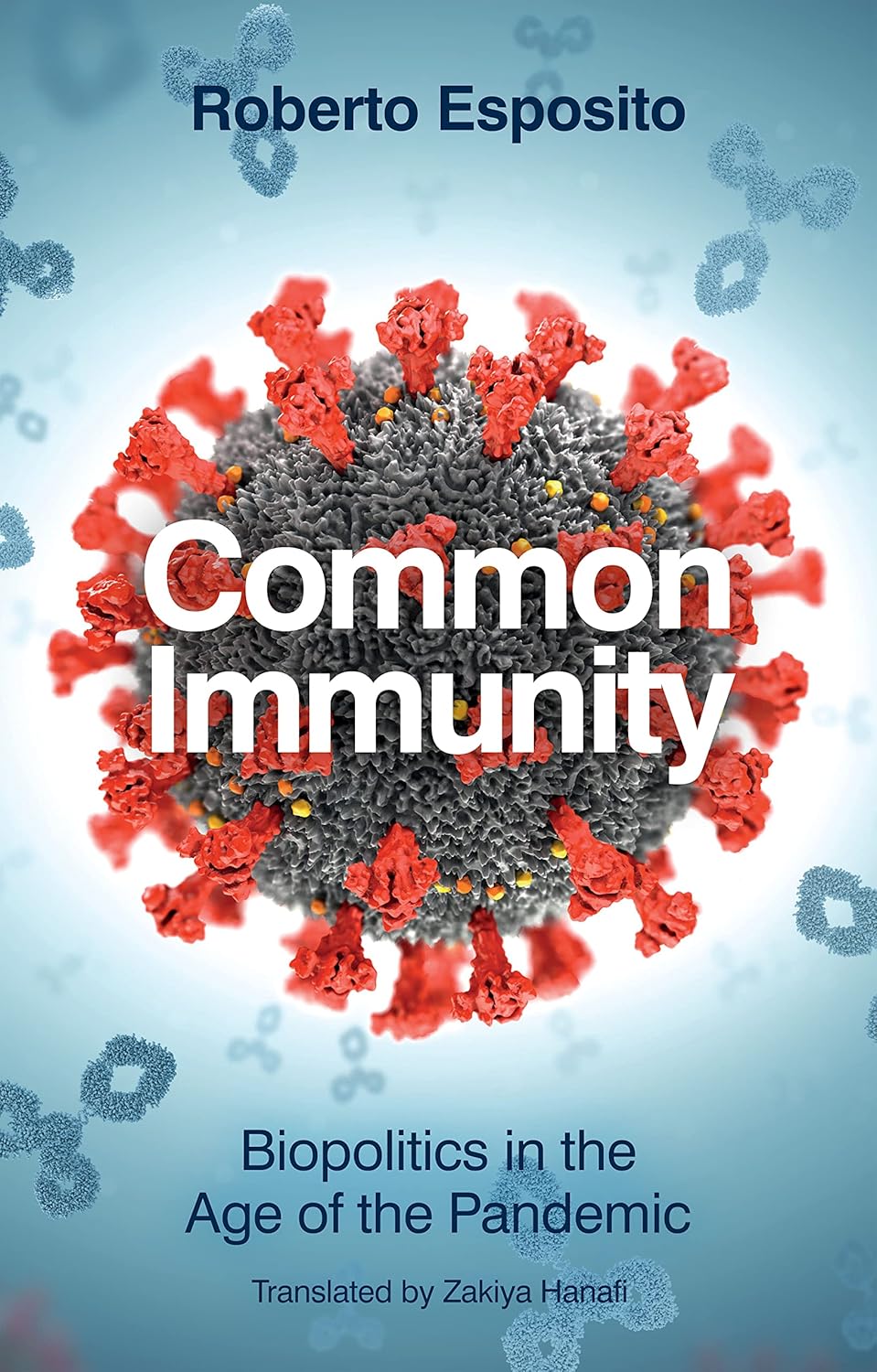
Common Immunity: Biopolitics in the Age of the Pandemic, written by the Italian political philosopher Roberto Esposito, presents an insightful and methodological analysis of biopolitical theory. The book highlights the intricate relationship between public health, political regimes, and law. Over the course of five chapters, Esposito establishes a clear correlation between social acceptability and external events such as COVID-19. The latter, notably, has normalized isolation —an act that effectively restricts citizens’ freedom of choice and movement. Examining the debates that emerge both locally and internationally, he concludes that, beyond its explicit function, healthcare plays a strategic role in reshaping the global geopolitical balance of power.
Contrary to some expectations, the book does not investigate the states’ underlying interests during the COVID-19 pandemic, nor does it address conspiracy theories surrounding the outbreak. Instead, the author draws on the history of medicine and science and fundamental principles of philosophy to critically reflect on the emergence of biopolitics as a concept. He takes a retrospective approach to examining its previous definitions and their implications for contemporary policy frameworks.
In Chapter 1, Contaminations, the author explores the significance of herd (or common) immunity in greater detail, tracing its role in human migration, conquest, and warfare. Esposito underscores how immunity —or its absence— has often functioned as an invisible determinant of national success or failure. In particular, he draws attention to the dramatic impact of disease in the European conquest of America and the defeat of Napoleon’s troops in Russia. Esposito then considers health through a sociological lens, arguing that the fight against disease has historically been intertwined with struggles against social privilege. He observes that, in past centuries, the nobility benefited from what could be described as private healthcare, whereas publicly available, free, or low-cost medical treatment emerged from strategic rather than purely humanitarian concerns. Towards the end of the chapter, Esposito examines the history of medical research and compellingly illustrates how international relations can shape the scientific landscape. The Franco-German rivalry in immunology remains central to his study.
Chapter 2, Autoimmunitarian Democracy, investigates the paradoxical interplay between immunity and democracy, highlighting how inclusionary and exclusionary dynamics manifest within medical and political contexts. Engaging with the philosophical perspectives of Kant, Rousseau, Tocqueville, Derrida, and Schmitt, alongside historical examples from ancient Greece and colonial Algeria, he argues that democracy is characterized by an irresolvable tension between its core values —freedom and equality. This tension, he suggests, acts as a destabilizing force within democratic structures. Building on Antonio Gramsci’s critique, Esposito posits that the rhetoric of equal opportunity and democratic self-representation often conceals the concentration of power among dominant groups, ultimately dictating the trajectory of public opinion. Consequently, democracy risks transforming into a tyranny of the minority rather than an instrument of majority rule. Drawing further on Luciano Canfora’s work, he concludes that democracy possesses an inherently self-destructive tendency, akin to an autoimmune disorder, in which the very safeguards designed to preserve the system ultimately contribute to its collapse.
In Chapter 3, In the Time of Biopolitics, Esposito provides a broad analysis of biopolitics, tracing its evolution and contemporary significance, particularly in the context of the COVID-19 pandemic. Central to his discussion is the work of Michel Foucault, whose theories on discipline, population governance, pastoral power, and the medicalization of politics —Esposito argues— have not only been validated but, in many respects, exceeded by present-day realities. The author contends that public health, understood as biological management, was prioritized over individual freedoms, leading to local and global societal transformations. In doing so, the pandemic reduced the broader existential dimensions of human life to a mere question of survival. Recognizing the limitations of such an approach, Esposito advocates for moving beyond Foucault’s analytical framework to develop what he terms an affirmative biopolitics —a model that seeks to integrate life and politics more holistically and constructively.
In Chapter 4, Philosophies of Immunity, Esposito explores how the concepts of identity, otherness, preservation, and evolution underpin biological processes and political systems. He asserts that modernity can be understood as an era of immunization, where immunity transcends its medical function to become a structuring principle of social organization. Acknowledging the contributions of Nietzsche and Derrida, Esposito proposes that a system does not immunize itself by rejecting or avoiding negative forces or changes but rather relies on them to redefine and strengthen itself. This assertion carries significant implications for his subsequent reflections on democracy and contemporary political transformations.
Chapter 5, Pandemic Policies, summarizes the book’s central arguments, addressing the political, ethical, and biopolitical dilemmas that emerged during the COVID-19 pandemic. Esposito examines how fear —intensified by media and political rhetoric— shaped public responses, frequently legitimizing emergency governance that risked evolving into authoritarianism. In his analysis, he again introduces the concept of immune excess. This phenomenon, he warns, does not arise from an inability to perceive danger but from a disproportionate awareness of threats. In an increasingly interconnected world, such excessive responses risk exacerbating vulnerabilities rather than mitigating them. Esposito extends this perspective to the COVID-19 vaccine distribution. While affluent nations stockpiled vaccines, lower-income regions struggled to obtain even the most essential supplies, particularly in Africa. He concludes that what was initially framed as a vehicle for global solidarity instead served to reinforce the structural disparities that define the global order. Ultimately, the author contends that the pandemic was not just an economic or technological crisis but inherently a political one. In light of this, he asserts that ensuring the survival of populations requires prioritizing political commitment over market-driven imperatives, advocating for a shift in governance that defines politics not merely as a tool of national security but as an instrument of global public health and collective responsibility.
Overall, the book is highly recommended for those seeking a broad, conceptual understanding of the intersection between philosophy, political theory, history, and biopolitics. Policymakers, scholars, legal and human rights advocates, and the general public can certainly benefit from its insights. Esposito’s discussion of the COVID-19 pandemic is particularly significant, as it vividly illustrates how the crisis intensified existing global inequalities. His examination of the relationship between autoimmunity and democracy challenges conventional perspectives on governance, offering a critical evaluation of modern political structures and their paradoxes. In this regard, his warnings about the normalization of emergency states align with contemporary debates on state surveillance, authoritarianism, and the erosion of civil liberties.
However, Esposito’s analysis remains largely theoretical, relying predominantly on philosophical discourse rather than empirical research. The book lacks detailed case studies or statistical analyses that could substantiate his claims. While he critiques vaccine inequality, he does not fully explore potential solutions, such as the role of the World Health Organization, the COVAX initiative, or international collaborations in addressing these disparities. A further limitation is its Eurocentric focus, as Esposito primarily examines Western political thought and governance, leaving non-Western responses to the pandemic largely unaddressed.
To enhance the book’s impact, a comparative analysis of pandemic governance across different political systems and countries, supported by data, would be beneficial. Additionally, while Esposito’s use of immunity as a political metaphor is thought-provoking, readers should be cautious of its potential oversimplifications.