

Introduction
The growth of Islamic thought in Indonesia has experienced very significant development since the 1990s. During this decade, many Muslim scholars like Martin van Bruinessen and Mark Woodward, from abroad, including Europe, the U.S., and the Middle East, and within the country, completed studies fields of Islamic study. The State Islamic Institute (now transformed into the State Islamic University), a university under the auspices of the Ministry of Religious Affairs of the Republic of Indonesia, became one of the driving forces for the arrival of Islamic intellectuals who were influential in the Islamic debate in the archipelago.1 The academics contributed alongside other scholars (scientists) in non-religious universities, under the Ministry of Education, such as the Bandung Institute of Technology, the University of Indonesia, Bogor Agricultural University, Gadjah Mada University, and Airlangga University. All these aspects have contributed to the development of Islamic thought in Indonesia.2
The growth of Islamic thought is increasingly visible in Indonesia and is even considered to have influenced Indonesian political change, with the birth of the Indonesian Association of Muslim Intellectuals (ICMI) on December 7, 1990. The ICMI was established at Brawijaya University in Malang, with the full support of the Suharto-era government to Muslim Intellectuals. President Suharto served on its main advisory board. B.J. Habibie, as the first chairman of the ICMI, was the Minister of Research and Technology, one of President Suharto’s most beloved ministers. Wardiman Djojonegoro was then appointed as general secretary while serving as Suharto’s Minister of Education, and a confidant of Habibie.3 The ICMI was initially perceived as a think tank that would become a political vehicle for Muslim activists in the Suharto government, but this was not the case. The ICMI can be considered one of the drivers of Muslim activists and intellectuals who influenced the development of Indonesian Islamic thought, including scholars like Nurcholish Madjid, M. Dawam Rahardjo, Masdar F. Masudi, Amien Rais, Syafii Maarif, Imaduddin Abdurrahim, Jalaluddin Rakhmat, and A.M. Syaefuddin, was a very influential Muslim scholar in the 1990s.4
After the ICMI was established, it continued to develop up until the 1997 general election. In 1998, President Suharto lost due to the wave of reformation, and the ICMI experienced a decline in its influence on the Indonesian government. However, the development of Islamic thought in Indonesia continued despite the ICMI’s decline and became even more visible. This can be seen from the growth of the Liberal Islamic Network or Jaringan Islam Liberal (JIL), in 2002, with the driving force of Ulil Abshar Abdalla, Lutfi Asyaukani, Budi Munawar Rachman, Zuhairi Misrawi, Rizal Panggabean, Hamid Basyaib, Taufik Adnan Amal, and many more.5 The JIL has a very close relationship with Muslim scholar M. Dawam Rahardjo, former chairman of the ICMI’s board of experts, who did not become a politician along with Nurcholish Madjid and M. Syafii Anwar. After the birth of ICMI, the presence of JIL became one of the pillars of the presence of progressive Islamic thought in Indonesia, even though it often received unpleasant accusations, because it was considered controversial.6
After the birth of ICMI, the presence of JIL became one of the pillars of the presence of progressive Islamic thought in Indonesia, even though it often received unpleasant accusations, because it was considered controversial
As a continuation of the development of progressive Islamic thought in Indonesia, after JIL was founded, the Muhammadiyah Young Intellectual Network (JIMM) was born at the Muhammadiyah University of Malang (UMM). East Java, with the driving force being the young generation of Muhammadiyah, they are within the Muhammadiyah organizational structure, but have an emotional bond with Muhammadiyah. The JIMM received support from the chairman of the Central Leadership of Muhammadiyah (an Islamic organization founded on November 18, 1912, in Yogyakarta) Ahmad Syafii Maarif, Abdul Munir Mulkhan, Haedar Nashir, M. Amin Abdullah, Moeslim Abdurrahman and Muhajir Effendy. JIMM, which was declared by Muhammadiyah youth as Collegial Leadership, includes: Zuly Qodir, Zakiyuddin Baedhawy, Pradana Boy, Ahmad Fuad Fanany, AI Fatimah, and Piet Hizbolah Haeder.7
After the two networks of young intellectuals were established and influenced the debate on Islamic thought in Indonesia, it did not stop there. After 2002, more and more Muslim intellectuals like Ulil Abshar Abdalla, Musdah Mulia, Zuhairi Misrawi and Rizal Panggabean moved to advance the development of Islamic thought in various forms. Conducting thematic discussions in various forums, these intellectuals also published various articles in magazines, newspapers, academic scientific journals, and books that could be read by many parties. The various publications had a very wide impact in Indonesia and were welcomed by students in non-religious and religious state campuses.8 This marked the revival of Islamic thought in Indonesia. It can also be said to mark the uproar of Islam in Indonesia’s democratic space. Democracy is no longer seen as a threat to Muslims but as an opportunity for change. Many young Muslim activists responded positively to the changes in Indonesian politics after the 1998 reform.9
Minority groups that are most often targeted by conservative groups; specifically, Ahmadiyya, Shia, and Christians who establish places of worship (churches), face violence and even the destruction of their places of worship
Educated young people not involved in the Liberal Islamic Network or the Muhammadiyah Young Intellectual Network joined various alliances or cadre organizations close to the Justice Party, now the Prosperous Justice Party (PKS). These included the Indonesian Muslim Student Action Unit (KAMMI), which is a small part of PKS cadres as a tarbiyah group (PKS cadres in non-religious universities such as the University of Indonesia, Gadjah Mada University, Diponegoro University, and religious universities) such as the Jakarta State Islamic University and Yogyakarta State Islamic University. PKS cadres in KAMMI later partly became PKS party activists, such as Fachri Hamzah and Rama Pratama from the University of Indonesia.10 KAMMI, which is a student organization with an educational mission for PKS regeneration, has received a very wide response among Indonesian Muslim students throughout Indonesia, and the PKS has become a party that has continued to gather votes in every Indonesian election from 1999 to the present. The average PKS vote count is 6.7-7.8 percent of the total ballots in Indonesia, making it a successful cadre party.11 The party can thus be considered a survivor despite the onslaught of non-Islamic parties such as the PDIP, the Democrat Party, the Golkar Party, Gerindra Party, Nasdem Party, and Perindo Party.
Despite the growth and development Indonesian Islamic thought saw in 2002-2004, since 2004 the development of Islamic thought has been frozen. It can even be said to have experienced a “decay of thought” amid the rise of conservatism in Indonesian politics.12 In the 2004 and 2009 elections, Susilo Bambang Yudhoyono successfully secured the presidency for two consecutive terms. In Yudhoyono’s era, it is strongly suspected that the growth and development of conservatism found tremendous momentum. The Islamic Defenders Front (FPI), Majelis Mujahidin Indonesia (MMI), Forum Komunikasi Ahlus Sunnah Wal-Jamaah (FKAW), Majlis Tafsir Al-Quran (MTA), and Hizbut Tahrir Indonesia gained a strong space for expression, holding large meetings at Gelora Bung Karno Stadium.13 Yudhoyono is associated with providing protection to conservative groups in Indonesia, allowing them the freedom to carry out activities or extreme violence against different groups, including religious minorities.14
Minority groups that are most often targeted by conservative groups; specifically, Ahmadiyya, Shia, and Christians who establish places of worship (churches), face violence and even the destruction of their places of worship. The conservatives in question maintain a stance that is less able to accept the existence of groups that differ in thought, attitude, and religious practice.15 For conservatives, religion must be one view, one attitude, and cannot be different. Therefore, anything that deviates is considered “heretical” and contrary to the beliefs adopted by Muslims. The FPI, the MMI, and some similar religious groups always place a negative stigma on Ahmadiyya, Shia, and Christians who want to build churches near Muslims. Several incidents of violence befell Christians, the Ahmadiyah Congregation and Shiites such as in Aceh, Mataram, Parung, Mataram and Yogyakarta. Several events that occurred were carried out by conservative groups who used violence after the 1998 Indonesian political reform occurred. The group, as Martin van Bruninessen said, existed during the Suharto era, but was still “underground.”16 Similarly, Leonardo C. Bastian refers to it as the wave of conservatism.17
Muslims do not need to avoid changes in society that apply modern political systems and can run elections to determine the change of president or head of state
In addition to the conservative group that has influenced the growth of Indonesian Islamic thought and attitudes and even Indonesian political behavior during 2010-2023, there has also been a group that can be called the progressive group that fights for substantial matters in Islam such as the rights of minorities, the participation of women in politics, the enforcement of human rights, anti-violence, and the defense of social justice.18 The progressive group thinks about Islam in the context of progress and not only based on the text (norms) contained in the holy book or hadith. They require scientific tools that allow the reinterpretation of norms that have surfaced since the prophetic era of Muhammad.19 The progressive group attempts to influence the development of Indonesian Islamic thought. The progressive group is usually identical to the moderate group, which is fighting for wasathiyah Islam.20 They are two Islamic forces that compete for the Indonesian Islamic public space.
This article aims to analyze the struggle for Indonesia’s Islamic public space between 2010-2023 with its various dynamics, the various themes that were developed and debated, and the influences that occurred in the dynamics of Indonesian Islam. This article uses a political sociology approach for a cursory investigation into the political dimension of Muslims. The data for this article was obtained by reviewing articles that are in accordance with the text that the author presents so that it becomes the basis for analysis. With data analysis, the article explores the development of Indonesian Islamic thought from 2010 to 2023 and the impact of the 2024 Indonesian elections.
Contested Public Sphere
Fighting over the public space of Indonesian Islam is an unavoidable reality for the various groups that emerged after the 2009 elections. The conservative group faced off against the progressive group to influence the Indonesian Islamic public. The strength between the two groups seems to have been tested by various consecutive events in Indonesia. Indonesia is home to a large Muslim population, reaching 88.7 percent of the total population, and in 2020, it was estimated at 274 million people.21 The large population attracts those who want to campaign their ideas in the Indonesian Islamic public space. Moreover, it is known that the Indonesian Islamic tradition is an open Islamic tradition, not closed to new ideas, and is easily digested by the public.
Public space can be understood as a space open to various dynamics of thought and action from the community. Anyone can compete for space to offer ideas and perspectives to the public. Public space is a kind of “big market” of information that can be delivered to all parties. Whether the public will accept or reject does not lie in the ideas presented, but closer to whether the ideas are packaged according to the public’s needs.22 The substance of information thus does not become the main measure in the contestation of public space. One main influencing element is the “media” or “vehicle” and “packaging” of information conveyed to the public. Contestation of the public sphere will thus become a “new social reality” in Islamic discourse in the current era.23
The current era, introduced as the era of information disruption, is a big gamble between conservative groups and progressive groups in campaigning for ideas for the Indonesian Islamic public. There is abundant information available to the public, though it often lacks depth and discursive dialogue. The public can easily access information but it is often “information waste” and false, yet it still garners widespread attention.24 This, of course, can have an impact on the superficiality of Islam absorbed by the Islamic community itself if critical reasoning is lacking. The era of disruption is an era with many societal problems afflicting the world’s population such as the explosion of labor as the birth rate increases.25
The information disseminated on a massive scale, continuously to the public, becomes a “new truth” even though it overturns the truth that has long been held. This is what some experts also call the “post-truth” era, where the truth is found because of the frequent indoctrination of information about something, not because of the objectivity put forward.26 The next impact is what we know as “the death of expertise.”27 The death of expertise occurs because of the flood of information that is disseminated to the Islamic public, posing a serious challenge to present authentic Islamic studies. In Indonesia, expertise is at stake because of the presence of a new world, named social media.
Islamic populism, which has been popular since the Arab Spring in 2011 and continued to occur until 2016 in several Muslim countries, gives the impression that the movement is unable to provide a more peaceful political platform
An expert in jurisprudence, for example, could be eclipsed by those who do not have a clear scientific pedigree, but because they often appear in the public sphere and convey something “new” to the public, in the end, an expert in jurisprudence is defeated by those with more exposure.28 This has also led to the phenomenon of the “loss of authority” of Islam, classically by what we call the era of information factories, such as social media platforms like Instagram, X, Facebook, and TikTok. The internet has “new prophets” of public information sources. As a result of the loss of Islamic authority, nowadays learning Islam is no longer considered interesting using the classical method, namely learning from an Islamic scholar/expert and reading Islamic books, because everything can be enjoyed by using tools (machines) that are more sophisticated than ordinary humans. The world of artificial intelligence is new in the study and development of Islamic thought because Indonesian citizens utilize a lot of artificial intelligence and social media.29
Islam become very much linked to the calculation of profit and loss and how much one will get if one does a good deed or the price for the evil done.30 For example, to counter the sin, if someone commits a crime, like stealing money, then they may try to compensate for the offense with a greater amount of alms or the equivalent of the money. Islam is calculative in its practice, whether it is harmful or beneficial. This kind of Islamic practice is not only related to matters of worship and muamalah but has an impact on political and jihadist Islam.31
Events like this can be said to be a form of Islamic contestation in society with various attributes and actions carried out by those who want to present an Islamic image to the public. Buddhists are competing to build pagodas and temples for Hindus in Bali.32 The wearing of a hijab with new models, Umrah trips at high costs, luxury Hajj, and recitation of actors-actresses with popular ustadz, can be referred to as recitation and celebrity ustadz, as a phenomenon of middle-class Islam.33 This is a phenomenon of contestation of piety that has been rife since 2010. It is likely to become more prevalent because many models of Islam are more artificial than substantial, lacking depth or the Islam of Sufism. This version of Islam is closer to celebrity Islam, which is the “performance of Islam” in the Islamic public itself.34
“Post-Islamism Turn”
Post-Islamism was a term coined by Asef Bayat when describing “the completion of Islamism.” The sociopolitical condition of Islamism, which is considered unsuccessful in contributing to Muslim politics in countries with large Muslim populations, has caused Muslims to change their political course.35 For Asef Bayat, the thesis developed by Islamists, namely making Sharia the main foundation of the state, has been unable to find effective political footing. Sharia has not only been translated as a set of texts that keep Muslims shackled. The conditions of Islamic society will not change by simply attaching artificial normative foundations to manage social and political relations.36 Bayat confidently states that there are conditions that are the background why Islamic society in modern development has shifted from the idea of formalizing Islamic Sharia to the substantialization of Islam, namely an idea that prioritizes Islamic values that are more humanistic towards fellow human beings. According to Bayat, this is a strong reason that Islam is a humanitarian religion that is more humane to humanity than the formalization of Sharia which prioritizes symbols in religion.37
The political direction that is considered more dignified and boosts the community to the level of developed and civilized countries is a community that can make Islam the spirit of the nation and state, bringing prosperity and justice. Islam does not confront political reality. Political reality is a reality that guides the ummah to translate the authentic values of Islam itself. Thus, Muslims do not need to avoid changes in society that apply modern political systems and can run elections to determine the change of president or head of state.38 This is because, in the scriptural texts, it is never explicitly explained that a head of state, president, sultan, or caliph must be simply appointed by hereditary, let alone with ethnic and tribal specificities. Therefore, the change of head of state or president can be a system full of dynamics and creativity, including in countries with a majority Muslim population.39
A “secular” political system in a Muslim-majority country does not necessarily require voters to be secular. “Secular” practices in determining the choice of the state’s form, without abandoning the principles of justice, welfare, and security, and placing women and men equally do not make a state contrary to authentic Islam. In fact, authentic Islamic teachings have made all human beings equal before Allah. There is no second-class human being before Allah.40 Thus, both men and women can participate in society to create social justice for all citizens. Women are also not precluded from becoming the leader of the country, as there is no real hindrance or prohibition in the scriptures for a woman to become the head of a country. These are authentic Islamic teachings for all citizens. The principle of justice for all citizens is a “secular” principle that does not contradict Islam in a state.41
The principle of a “secular state” does not mean a secular practice in the pejorative sense of abandoning or even “hating Islam.” The principle of a secular state is a state practice that places sociopolitical matters not on religious (Islamic) grounds but on the principle of the interests of the ummah. It is not discriminatory and does not use coercion over those in the minority.42 The principle of a secular state, if it can be said to be the principle of a modern state, separates sociopolitical affairs from religious affairs. Matters of a sociopolitical nature are taken care of by the state or government, while religious affairs are left to everyone per the beliefs and religion of each citizen. The state only provides a legal footing so that citizens do not insult each other, denounce each other, or incite violence.43 Thus, the practice of populism that tends to be negative, namely making citizens a means of mass mobilization, does not need to be done.
Islamic populism, which has been popular since the Arab Spring in 2011 and continued to occur until 2016 in several Muslim countries, gives the impression that the movement is unable to provide a more peaceful political platform. Islamic populism in the Middle East and several African countries has made Muslims appear to oppose each other with other religious communities and even fellow Muslims who have different political views and attitudes. Hadiz clearly analyses the Islamic populism in the Middle East and its spread to Indonesia, the country with the largest Muslim population in the world. Hadiz is optimistic about the political development of Muslim-majority countries without making Islam the basis of the state.44 However, Muslim-majority countries have a serious obstacle, namely the existence of groups that sometimes push the state to impose a religious constitution in its political practice. This is what often arises from conservatism.45
Populism itself is a political movement that seeks to offer better conditions than previous conditions full of injustice and authoritarianism. Populism moves to demand changes in the sociopolitical conditions of a country so that citizens become substantial “equal” citizens, not just citizens who suffer, sometimes even under the threat of violence from the state and its apparatus.46 Populism not only occurs in Islamic societies but in all societies that demand justice. However, populism eventually moves toward a more negative direction, namely into politics that makes citizens a means of political mobilization with the political interests of certain groups, in the name of certain religions and even certain ethnicities. Populism is ultimately only a “political vehicle” for the elite to achieve their political goals, even though it makes the political tradition fulfill the standards of a civilized democracy.47
Civilized democracy is a democratic principle that uses civil society as part of a non-discriminatory political process. Democracy is not only a periodic procedural change of power but provides a deep meaning so civil society can play an active role in the political process so the nation can increasingly improve its quality of life.48 Indonesian civil society, which is affiliated with religious organizations such as Muhammadiyah and the NU, can ultimately become one of the pillars of strength, as civil Islam, which synergizes with the state to advance society through the various activities it carries out.49 Civilized democracy could be a prototype of a more substantive democracy, rather than just a more procedural political process. This is because civilized democracy is characterized by equality, justice, non-violence, and respect for human rights. For Hefner, it seems that civil Islam, represented by Muhammadiyah and the NU, is expected to be a significant differentiator in the development of Indonesian Islamic thought after the 1998 reformation, especially after 20 years of reformation as an authentic civil society force.50
With the development of authentic civil Islam, because it is truly born from a society of citizens who are not threatened, free to participate in politics, and free to adhere to beliefs and religion, then society can support citizens whose religion is not just a mere formality, but more substantial. People are religious but don’t necessarily see “Sharia” as a sign that people are religious. In my opinion, the country’s society is not at all secular in a negative sense but has become a religious society, which means it is a post-secular society.51 People are pious in their religion but are not enthusiastic about the formalization of Sharia, which often makes citizens afraid and anxious because of various regulations made by socio-religious organizations and political organizations to get mere “political support” from citizens. The civil Islam that we want is a society that respects each other and places fellow citizens in an equal position. Civil Islam is expected from Muhammadiyah and the NU is a civil society movement based on “piety and social faith” for the transformation of society.52
Post-Secular Society
A post-secular society is not a society that has behavior that is anti-activities of a practical political nature, for example political activities in parties. A post-secular society is more devout in its religious beliefs but does not use religion as the basis of the state. Religious values are the inspiration for state management and public policy making. Therefore, a post-secular society has principles of social and political life in accordance with religious values but does not make religion the basis of its state. It could be said that a post-secular society is a phenomenon freed from the bonds of modernity and machine mechanization that occurred in the industrial era.53 Turner very sharply outlined the characteristics of a post-secular society as a society that moves from a less human civilization to a humane civilization, thereby creating a more equal citizenship in plurality. The state is also present as a manager of diversity and differences in society.54
Religious thought that develops in the post-secular era will support trends more in line with sociopolitical conditions that continue to change rapidly, as is happening in the current information industry era. Rapid social changes due to the influence of information technology often make people trust technology more, thus making people more materialistic, all measuring one’s success from material possessions rather than those with a spiritualistic dimension.55 However, post-secular society will tend to choose things that are rational, informative, and inductive rather than deductive, because post-secular society has the characteristics of being critical, open, and accepting of new views coming from various parts of the world. A post-secular society would thus be compatible with thoughts that do not discriminate and frighten fellow citizens. They think and act independently toward change and fellow religious believers, whatever their religion, beliefs, and convictions.56 Post-secular thought can thus be said to be Islamic thought expected to develop in Indonesia after the political reform that has taken place for more than 20 years.
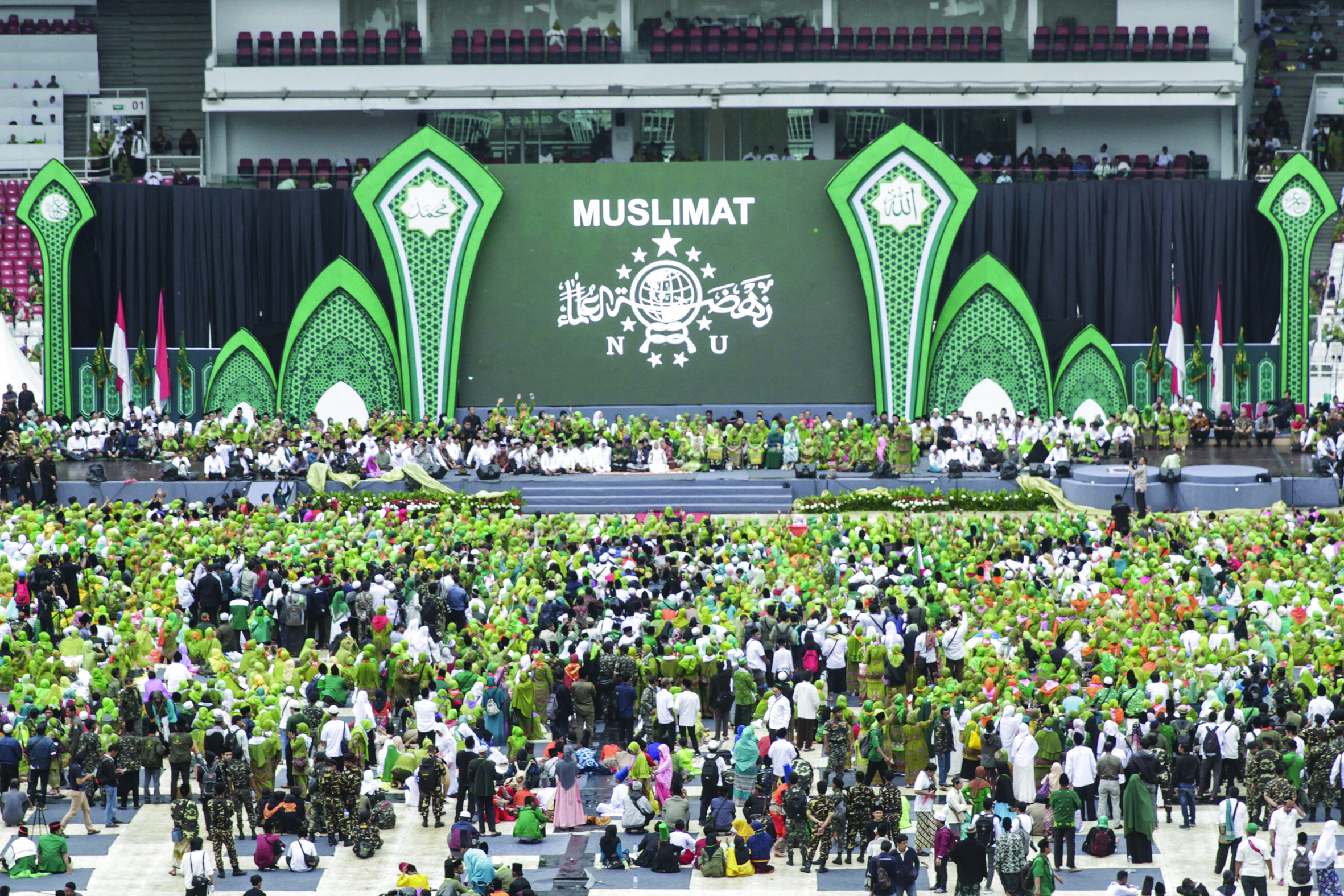
Participants gathered at Bung Karno Stadium in Jakarta, Indonesia for a joint prayer to mark the 73rd anniversary of the Nahdlatul Ulama, on January 27, 2019. EKO SISWONO TOYUDHO / AA
In the construction of a post-secular society, freedom of religion and belief will be one of the main keys to whether society has moved away from formalistic religious thinking as well as if a person or group will be seen as pious or not when they adopt religious norms, especially in politics and social life.57 Political life that has gone beyond a post-secular society is a society that no longer serves as religious symbols in practical politics, such as regional head elections, legislative member elections, and presidential and vice-presidential elections. If society still brings religious and ethnic sentiments into the political arena with religious symbols then substantially that society is still within a sectarian framework, which is formalistic in nature, not the post-secular society we dream of.58 This kind of society is said by Jeremy Menchik to be a democratic society but there is still no substantial freedom for all citizens.59
Post-secular society, according to Bryan Turner, is a continuation of industrial society with religion-like mechanics. Therefore, it is not uncommon for religious societies to make religion a bane for humanity, so some then propose the need to live without religion as it fails to provide peace and fails to respond to problems like injustice, war, and discrimination.60 This trend certainly worries us as religious people who still live amid various religions, ethnicities, and social classes. Therefore, religion in a post-secular society will be able to reflect the real lives of religious adherents, whatever their religion and beliefs. Citizens’ right to freedom of religion really has the highest place above other social rights.
In building a post-secular society, the state acts as a manager of the diversity of its citizens so that citizens truly exist peacefully, respect each other, and place positive law as the basis of the state. Multi-cultural and pluralistic citizenship is one of the main foundations when a post-secular society becomes the goal of a country. The state becomes the manager of sociopolitical conditions fairly, responsibly, and transparently and approaches liberal standards in a positive sense, not liberal in the sense of hyper-individualism and selfishness among citizens.61 Post-secular society, thus, can be said to be a social structure that leads to what we know as a religious civil society that is socially, culturally, politically, and socially dignified. This is also what makes possible the presence of global religious piety, piety that does not care about religious background, ethnicity, tribe, or social class.62
If in Indonesia, substantially, faith in God is slowly able to create a societal structure that has universal piety, then the future of Islamic thought will likely increasingly find its form. Moreover, in the future, Muhammadiyah and the NU as socio-religious organizations have a very large number of followers, estimated at 85 million people from the total number of Indonesian Muslims, which reaches 200 million with various Islamic groups.63 If Muhammadiyah and the NU can work together to create an Indonesia that is truly tolerant, inclusive, and peaceful so that its citizens are calm and achieve prosperity in their lives by prioritizing public good or public virtue, Indonesia will become a country that much more peaceful, calm and toward it main communities.64 A fair country is where people have no fear regarding participating in politics and higher education. Muhammadiyah and the NU are one of the driving forces for the growth of public virtue.
Indonesian civil society, which is affiliated with religious organizations such as Muhammadiyah and the NU, can ultimately become one of the pillars of strength, as civil Islam, which synergizes with the state to advance society through the various activities it carries out
Muhammadiyah and the NU have the same vision of building an inclusive Indonesia by carrying the banner of wasatiyah Islam to all citizens and all Muslim countries, a very visionary idea. This is because, we know that Indonesia, as a country with various religions, ethnicities, and tribes, is a country resulting from a joint agreement between the founding fathers of the nation when formulating the basis of the state. Pancasila is the most concrete form of the Islamic community’s wasatiyah for the great ideals of the nation that was newly declared an independent nation. Pancasila is the glue that binds all nations from various tribes, ethnicities, and social classes. Pancasila is the kalimatun sawa for religious communities in Indonesia.65
Post-Political Sectarian
One of the contemporary Muslim thinkers who firmly introduced the need for Muslims to move away from ideological politics is Khalid Mahmoud. In Khalid Mahmoud’s view, Islamic politics has become so substantial that Islam can be a blessing for all mankind, which is very important in the context of contemporary Indonesia.66 Moreover, we know that in Indonesia the struggle for Islam through politics and opposition against the state has failed, so the path of compromise and negotiation is the most realistic alternative to the struggle for the ideals of Muslims. We have paid close attention to the fate of Islamic parties in the 2024 general election, which just took place, though they did not get sufficient votes with such a large Muslim population. Islamic parties receive less widespread support when compared to parties that are not described as Islamic parties. The Islamic party I am referring to is one that firmly states Islamic principles, not Pancasila.67
Islamic conservatism, which often brings the political power of religious parties, will be one of the obstacles to the transformation of Indonesian Islam, which is more in line with conditions of global change
Politics that does not use religious ideology as a symbol to gain vote support can be said to be an inclusive form of politics. If politics is still sectarian, then citizens with different views, thoughts, and ideological choices will retreat, and will even be considered “political opponents” because of their different ideologies.68 In the future, parties like this will increasingly lose their prestige and followers because society will prefer open parties that fight for the rights of their constituents, rather than secretly relying on the support of religious groups that can be said to be exclusive. We can even say that exclusive groups are “barriers” to the social integration of diversity and difference.69 This is also what will be the challenge for Muhammadiyah and the NU in fighting for wasatiyah Islam and inclusive Islam in Indonesia.
Such exclusive conditions have been proven to create social conflict in society, which tends to lead to extreme violence. Cases of violence against Ahmadiyah, Shia, and local religious groups are one of the most obvious forms of sectarianism that is still developing in Indonesia.70 Indonesia, as a country that adheres to democracy and modern politics, still faces serious challenges from the presence of exclusive religious groups who believe that those with different religious views and beliefs need to have their beliefs straightened out so that they do not deviate from Islam.71 Muhammadiyah and the NU thus face serious challenges when campaigning for the need for wasatiyah Islam (moderate Islam) in a pluralistic country, because in Indonesian Islam, Islamic groups still question the term wasatiyah Islam.72 In this way, it can be said that inclusive and progressive Islam as a characteristic of Indonesian Islam is still dealing with exclusive Islamic groups that tend to be represented by conservative Islamic groups.73
Ideological battles regarding the parties participating in elections occurred in Indonesia from 1995 to 2014. In the 1995 elections, it was clear that political parties were very ideological. Likewise, in the 2009, 2014, and 2019 elections, it was clear that the parties were divided along sectarian ideological lines.74 The 2024 election has created conditions that are different from Indonesian politics in 2004 and 2009 when Susilo Bambang Yudhoyono became president. As has been stated, Yudhoyono was the Indonesian president who “gave free space” to the birth of conservative groups and even became the closest friend to those who were categorized as conservative Muslims.75
The 2024 elections have significantly changed the competition and the sociopolitical map of Indonesia. It is quite difficult to say that the pairs supported by each political party represent the conservative group or the group that used to be in the 1980s and 1990s, as the abangan76 group, (abangan trichotomy). Abangan is a group from the communities Muslim but not rigit with syariat or Islamic Law, but accommodation with tradition and in culture. The conservatives, who were previously identified with the Prosperous Justice Party, nominated Anies Baswedan, who has an Arab background close to Muhammadiyah, and Muhaimin Iskandar who has an NU background. Meanwhile, Prabowo-Gibran is not identified as a representative of the Indonesian Islamic group, even though he is supported by the National Mandate Party, a party that was previously close to Muhammadiyah along with the Golkar party, the Democratic Party, and others. Meanwhile, the Ganjar-Mahfud pair can no longer be considered a representation of the abangan, as Clifford Geertz once categorized them. This is because Ganjar is even supported by the PDIP, as well as the United Development Party (PPP) and the Hanura Party. There is also the figure of Mahfud MD who has a NU background, is close to the modernist organization Muhammadiyah and the Islamic Student Association (HMI), which is often affiliated with the Golkar Party and Muhammadiyah. Javanese Islam is one of the actual conditions in Indonesia which also influences Indonesian politics.77
Public Islam now uses parties not as a basis of belief, but as a means of changing the social conditions of society, so that they are more open
Therefore, the 2024 election can be labeled a modern post-sectarianism or even a “post-ideology” Indonesian election. The 2024 election was ultimately won by the Prabowo-Gibran pair. The duo was supported by a large coalition of political parties, such as the Golkar Party, Democratic Party, National Mandate Party, and the Indonesian Solidarity Party (PSI), which is a non-religious party.78 In such a context, we can hope that Indonesia’s political thinking in the future will truly be a politics that is no longer sectarian and goes beyond religious-based ideology toward a modern pluralistic society and modern parties that fight for the substance of democracy.79 Public Islam now uses parties not as a basis of belief, but as a means of changing the social conditions of society, so that they are more open. Muslim citizenship and the thoughts of Muslims as a majority are increasingly open to the social changes that befall society.80
With open Islamic thinking, the future of Islamic thinking will increasingly find its stance because Indonesia’s political climate is increasingly open. Likewise, Indonesian politics is no longer dominated by ideas that use religion as the basis for arguments to win battles. The future of Islamic thought, which is open to political change and changes in the real conditions of society, will become a new hope for Indonesian Islam as an Islam of wasatiyah for the creation of social justice for all citizens, without exception.81 Without a change in view toward a more substantial democracy and the political process as the best way to create conditions for a prosperous and equal nation for all, it will be difficult to find an inclusive political and religious culture. Inclusivism must be supported by the experience of a pluralistic society that is increasingly mature in religion and politics.82
Conclusion
The future of the dynamics that occur in Indonesian Islamic thought, between conservative groups and progressive groups, lies in the growth of progressive groups, those who prioritize Islamic messages substantially for the public interest. The progressive group will likely win the battle over the conservative group if the largest Islamic organizations in Indonesia, Muhammadiyah and the NU accommodate the substantial growth of thought. However, if Muhammadiyah and the NU are carried away by the conservative groups, which tend to be artificial and are accepted by the Islamic public due to their symbolism, then the development of Indonesian Islamic thought will again move toward conservatism. Islamic conservatism, which often brings the political power of religious parties, will be one of the obstacles to the transformation of Indonesian Islam, which is more in line with conditions of global change.
The future of Indonesian Islamic thought can be said to lie in the strength of Muhammadiyah and the NU, as Islam, which has consistently fought for wasatiyah Islam, hopes to propel Indonesia toward a more democratic future
Conservatism, which does not hesitate to carry out political activities and supports political groups that mirror itself, finds space in the Islamic public if progressive groups are unable to “control the virtual public space,” which has recently become a space for the battle of thoughts and the spread of ideas. Thus, 2024 can now be said to be an era to compete for Indonesian Islamic public space. The agenda for the future is an agenda for Islamic thought and politics that is more open and substantial so that the future of Muslims will increasingly find a more democratic face. The future of Indonesian Islamic thought can be said to lie in the strength of Muhammadiyah and the NU, as Islam, which has consistently fought for wasatiyah Islam, hopes to propel Indonesia toward a more democratic future.
Endnotes
1. Fuad Jabali and Jamhari, The Modernization of Islam in Indonesia, (Indonesia: Logos, 2003).
2. Carool Kersten, Islam In Indonesia: The Contest for Society, Ideas and Values, (Cambridge, Massachusetts, and London, England: Oxford University Press, 2015), pp. 1-14; Zuly Qodir, Citizenship, Conservatism and Post Islamism: Political Contestation in Indonesia Post New Order, (Yogyakarta: UMY Press, 2024), pp. 18-65.
3. Bahtiar Effendy, Islam dan Negara, (Jakarta: Project Democracy, 2011), p. 254.
4. Zuly Qodir, Hasse Jubba, Mega Hidayati, Irwan Abdullah, and Ahmad Sunawari Long, “A Progressive Islamic Movement and Its Response to the Issues of the Ummah,” Indonesian Journal of Islam and Muslim Societies, Vol. 10, No. 2 (2020), pp. 1-30.
5. Carool Kersten, “Islamic Post-Traditionalism: Postcolonial and Postmodern Religious Discourse in Indonesia,” Sophia, Vol. 54, No. 4 (2015), pp. 473-89.
6. Yon Machmudi, “The Emergence of New Santri in Indonesia,” Journal of Indonesian Islam, Vol. 2, No. 1 (2008), pp. 69-102.
7. Martin Van Bruinessen, “Overview of Muslim Organizations, Associations and Movements in Indonesia,” in Martin van Bruinessen (ed.), Contemporary Developments in Indonesian Islam: Explaining the Conservative Turn, (Singapore: Institute of Southeast Asian Studies, 2013).
8. Carool Kersten, “Al-Jabri in Indonesia: The Critique of Arab Reason Travels to the Lands Below the Winds,” Middle East Today, Vol. 1, No. 8 (2018), pp. 149-167.
9. Edward Aspinall, “Democratization and Ethnic Politics in Indonesia: Nine Theses,” Journal of East Asian Studies, Vol. 11, No. 2 (2011), pp. 289-319.
10. Ahmad-Norma Permata and Najib Kailani, Islam and the 2009 Indonesian Elections, Political and Cultural Issues: The Case of The Prosperous Justice Party (PKS), (Bangkok: IRASEC, 2010).
11. Marcus Mietzner and Burhanuddin Muhtadi, “Explaining the 2016 Islamist Mobilisation in Indonesia: Religious Intolerance, Militant Groups and the Politics of Accommodation,” Asian Studies Review, Vol. 42, No. 3 (2018), pp. 479-497.
12. Edward Aspinall and Marcus Mietzner, “Southeast Asia’s Troubling Elections: Nondemocratic Pluralism in Indonesia,” Journal of Democracy, Vol. 30, No. 4 (2019), pp. 104-118.
13. Alexander R. Arifianto, “Rising Islamism and the Struggle for Islamic Authority in Post-Reformasi Indonesia,” TRaNS: Trans-Regional and National Studies of Southeast Asia, Vol. 8, No. 1 (2020), pp. 37-50.
14. Sri Yunanto and Angel Damayanti, “The Root Causes and Nexus of Militant Islamic Movements in Indonesia: Case Studies of Darul Islam and Jemaah Islamiyah,” Jurnal Asia Pacific Studies, Vol. 1, No. 1 (2017), p. 28.
15. Al Makin, “Homogenizing Indonesian Islam: Persecution of the Shia Group in Yogyakarta,” Studia Islamika, Vol. 24, No. 1 (2017), pp. 1-32.
16. Bruinessen, “Overview of Muslim Organizations, Associations and Movements in Indonesia.”
17. Leonard C Sebastian and Andar Nubowo, “The ‘Conservative Turn’ in Indonesian Islam: Implications for the 2019 Presidential Elections,” The Institut Français des Relations Internationales, No. 106 (March 2019).
18. Haedar Nashir, Zuly Qodir, Achmad Nurmandi, Hasse Jubba, and Mega Hidayati, “Muhammadiyah’s Moderation Stance in the 2019 General Election,” Journal of Islamic Studies, Vol. 57, No. 1 (2019), pp. 1-24.
19. Norshahril Saat and Ahmad Najib Burhani (eds.), The New Santri, (Singapore: ISEAS Publishing Institute of Southeast Asian Studies, 2020).
20. Ahmad Najib Burhani, “Liberal and Conservative Discourses in the Muhammadiyah: The Struggle for the Face of Reformist Islam in Indonesia,” in Martin van Bruinessen (ed), Contemporary Developments in Indonesian Islam and the “Conservative Turn,” (Singapore: ISEAS–Yusof Ishak Institute, 2013), pp. 105-144.
21. Robert W. Hefner, Islam and Citizenship in Indonesia: Democracy and the Quest for an Inclusive Public Ethics, (London/New York: Routledge, 2023).
22. Talal Asad, “Free Speech, Blasphemy and Secular Criticism,” in Talal Asad, Wendy Brown, Judith Butler, and Saba Mahmood (eds.), Is Critique Secular? Blasphemy, Injury and Free Speech, (Berkely: Los Angeles, London: University of California Press, 2009), pp. 20-63
23. Noorhaidi Hasan, “The Making of Public Islam: Piety, Agency, and Commodification on the Landscape of the Indonesian Public Sphere,” Contemporary Islam, Vol. 3, No. 3 (2009), pp. 229-250.
24. Philip Schlesinger, “After the Post-Public Sphere,” Media, Culture and Society 42, No. 7-8 (2020), pp. 1545-1563.
25. Francis Fukuyama, The Great Disruption, (United States: Profile Books Ltd, 1999).
26. Norman Vasu, Benjamin Ang, Terri-Anne-Teo, Shashi Jayakumar, Muhammad Faizal, and Juhi Ahuja, “Fake News: National Security in the Post-Truth Era,” Rajaratnam School of International Studies, (January 2018), retrieved from https://www.rsis.edu.sg/wp-content/uploads/2018/01/PR180313_Fake-News_WEB.pdf.
27. Vasu, Ang, Teo, Jayakumar, Faizal, and Ahuja, “Fake News: National Security in the Post-Truth Era.”
28. Tuukka Ylä-Anttila, “Populist Knowledge: ‘Post-Truth’ Repertoires of Contesting Epistemic Authorities,” European Journal of Cultural and Political Sociology, Vol. 5, No. 4 (2018), pp. 356-388.
29. Paul Nemitz, “Constitutional Democracy and Technology in the Age of Artificial Intelligence,” Philosophical Transactions of the Royal Society A: Mathematical, Physical and Engineering Sciences, Vol. 376, No. 2133 (2018).
30. Johan Meuleman, “Dakwah, Competition for Authority, and Development,” Bijdragen Tot de Taal-, Land- En Volkenkunde, Vol. 167, No. 2-3 (2011), pp. 236-269.
31. Vedi R. Hadiz, Islamic Populism in Indonesia and the Middle East, (Cambrigde University Press, 2016).
32. Pattana Kitiarsa, Religious Commodifications in Asia: Marketing Gods, Religious Commodifications in Asia: Marketing Gods, (London: Routledge, 2007).
33. Hasan, “The Making of Public Islam: Piety, Agency, and Commodification on the Landscape of the Indonesian Public Sphere.”
34. Thomas B. Pepinsky, R. William Liddle, and Saiful Mujani, Piety and Public Opinion: Understanding Indonesian Islam, Piety and Public Opinion: Understanding Indonesian Islam, (Oxford: Oxford University Press, 2018).
35. Asef Bayat, “The Coming of a Post-Islamist Society,” Critique, Vol. 5, (1996), pp. 45-53.
36. Asef Bayat, “Islamism and Social Movement Theory,” Third World Quarterly, Vol. 26, No. 6 (2005), pp. 891-908.
37. Asef Bayat, Islam and Democracy: What Is the Real Question?, (Leiden: Amsterdam University Press, 2007).
38. Asef Bayat, Life as Politics, (California: Stanford University Press, 2013).
39. Bayat, “Islamism and Social Movement Theory.”
40. Muhammad Ansor, “Post-Islamism and the Remaking of Islamic Public Sphere in Post-Reform Indonesia,” Studia Islamika, Vol. 23, No. 3 (2016).
41. Saba Mahmood, Politics of Piety: The Islamic Revival and the Feminist Subject, (Princeton: Princenton University Press, 2005).
42. Muchamad Ali Safa’at, “Indonesian Secularities: On the Influence of the State-Islam Relationship on Legal and Political Developments,” Multiple Secularities - Beyond the West, Beyond Modernities, (2019).
43. Michael Buehler, “Subnational Islamization through Secular Parties: Comparing Shari’a Politics in Two Indonesian Provinces,” Comparative Politics, Vol. 46, No. 1 (October 2013), pp. 63-82.
44. Hadiz, Islamic Populism in Indonesia and the Middle East.
45. Edward Aspinall, “Oligarchic Populism: Prabowo Subianto’s Challenge to Indonesian Democracy,” Indonesia, No. 99 (April 2015), pp. 1-28.
46. Marcus Mietzner, “Fighting Illiberalism with Illiberalism: Islamist Populism and Democratic Deconsolidation in Indonesia,” Pacific Affairs, Vol. 91, No. 2 (June 2018), pp. 261-282.
47. Robert W. Hefner, “Islam and Institutional Religious Freedom in Indonesia,” Religions, Vol. 12, No. 6 (2021).
48. Robert W. Hefner, “Whatever Happened to Civil Islam? Islam and Democratisation in Indonesia, 20 Years on,” Asian Studies Review, Vol. 43, No. 3 (2019), pp. 375-396.
49. Hefner, “Whatever Happened to Civil Islam? Islam and Democratisation in Indonesia, 20 Years on.”
50. Robert W. Hefner, Civil Islam: Muslims and Democratization in Indonesia, (Princeton University Press, 2011).
51. Robert W. Hefner, “Which Islam? Whose Shariah? Islamisation and Citizen Recognition in Contemporary Indonesia,” Journal of Religious and Political Practice, Vol. 4, No. 3 (2018), pp. 278-296.
52. Hefner, “Whatever Happened to Civil Islam? Islam and Democratisation in Indonesia, 20 Years on.”
53. Bryan S. Turner, Religion and Modern Society, (Cambridge: Cambridge Press University, 2011).
54. Bryan S. Turner, “Contemporary Citizenship: Four Types,” Journal of Citizenship and Globalisation Studies, 1, No. 2 (2017), pp. 10-23.
55. Martin Slama, “A Subtle Economy of Time: Social Media and the Transformation of Indonesia’s Islamic Preacher Economy,” Economic Anthropology, 4, No. 1 (2017), pp. 94-106.
56. Peter Berger, “Post-Secular Sociology,” Approaching Religion, 3, No. 1 (2013), pp. 4-15.
57. Saba Mahmood, “Religious Reason and Secular Affect: An Incommensurable Divide?” Is Critique Secular?: Blasphemy, Injury, and Free Speech, 35, (2013), pp. 58-94.
58. Pepinsky, William Liddle, and Mujani, Piety and Public Opinion: Understanding Indonesian Islam.
59. Jeremy Menchik, Islam and Democracy in Indonesia: Tolerance without Liberalism, (Cambridge: Cambridge University Press, 2016).
60. Kent R. Kerley, Current Studies in the Sociology of Religion, (Basel: MDPI, 2018).
61. Peter L. Berger and Robert W. Hefner, “Spiritual Capital in Comparative Perspective,” Spiritual Capital Planning, 1, No. 3 (2003), pp. 1-6.
62. Bryan S. Turner, “Islam, Gender, and Democracy in Comparative Perspective,” Journal of Religious and Political Practice, Vol. 4, (2018), pp. 195-201.
63. Hefner, “Whatever Happened to Civil Islam? Islam and Democratisation in Indonesia, 20 Years on.”
64. Zuly Qodir, Hasse Jubba, Dyah Mutiarin, and Mega Hidayati, “Muhammadiyah Identity and Muslim Public Good: Muslim Practices in Java,” International Journal of Islamic Thought, Vol. 19, (June 2021), pp. 133-146.
65. Moch Nur Ichwan, The Making of a Pancasila State: Political Debates on Secularism, Islam and the State in Indonesia,(Tokyo: Institute of Asian Cultures Sophia University, 2012).
66. Muhammad Khalid Masud, “Religion and State Are Twin Brothers: Classical Muslim Political Theory,” Islam and Civilisational Renewal, 9, No. 1 (2018), pp. 9-26.
67. Luthfi Assyaukanie, “Religion as a Political Tool Secular and Islamist Roles in Indonesian Elections,” Journal of Indonesian Islam, 13, No. 2 (2019), pp. 454-479.
68. Thomas B. Pepinsky, R. William Liddle, and Saiful Mujani, “Indonesian Democracy and the Transformation of Political Islam Thomas,” Cornell University, (2010), p. 25.
69. Edward Aspinall and Marcus Mietzner, “Indonesia’s Democratic Paradox: Competitive Elections amidst Rising Illiberalism,” Bulletin of Indonesian Economic Studies, 55, No. 3 (2019), pp. 295-317.
70. Ahmad Najib Burhani, “Torn between Muhammadiyah and Ahmadiyah in Indonesia,” Indonesia and the Malay World, Vol. 28, No. 140 (2020), pp. 60-77.
71. Ahmad Najib Burhani, “Geertz’s Trichotomy of Abangan, Santri, and Priyayi: Controversy and Continuity,” Journal of Indonesian Islam, 11, No. 2 (2017), pp. 329-349.
72. Masdar Hilmy, “Whither Indonesia’s Islamic Moderatism?: A Reexamination on the Moderate Vision of Muhammadiyah and NU,” Journal of Indonesian Islam, 7, No. 1 (2013), pp. 24-48.
73. Suaidi Asyari, “Real Threat from within: Muhammadiyah’s Identity Metamorphosis and the Dilemma of Democracy,” Journal of Indonesian Islam, 1, No. 1 (2007), pp. 18-41.
74. Saiful Mujani, “Religion and Voting Behavior: Evidence from the 2017 Jakarta Gubernatorial Election,” Aljamiah Journal of Islamic Studies, 58, No. 2 (2020), pp. 419-450.
75. Arifianto, “Rising Islamism and the Struggle for Islamic Authority in Post-Reformasi Indonesia.”
76. Burhani, “Geertz’s Trichotomy of Abangan, Santri, and Priyayi: Controversy and Continuity.”
77. Mark Woodward, Java, Indonesia and Islam, (London/New York: Springer New York, 2011).
78. Hefner, Islam and Citizenship in Indonesia.
79. Pepinsky, William Liddle, and Mujani, Piety and Public Opinion: Understanding Indonesian Islam.
80. Saiful Mujani and R. William Liddle, “Personalities, Parties, and Voters,” Journal of Democracy, 21, No. 2 (2010), pp. 15.
81. Nashir et al., “Muhammadiyah’s Moderation Stance in The 2019 General Election.”
82. Nashir Haedar and Mutohharun Jinan, “Re-Islamisation: The Conversion of Subculture from Abangan into Santri in Surakarta,” Indonesian Journal of Islam and Muslim Societies, Vol. 8, No.1 (2018), pp. 1-28.