
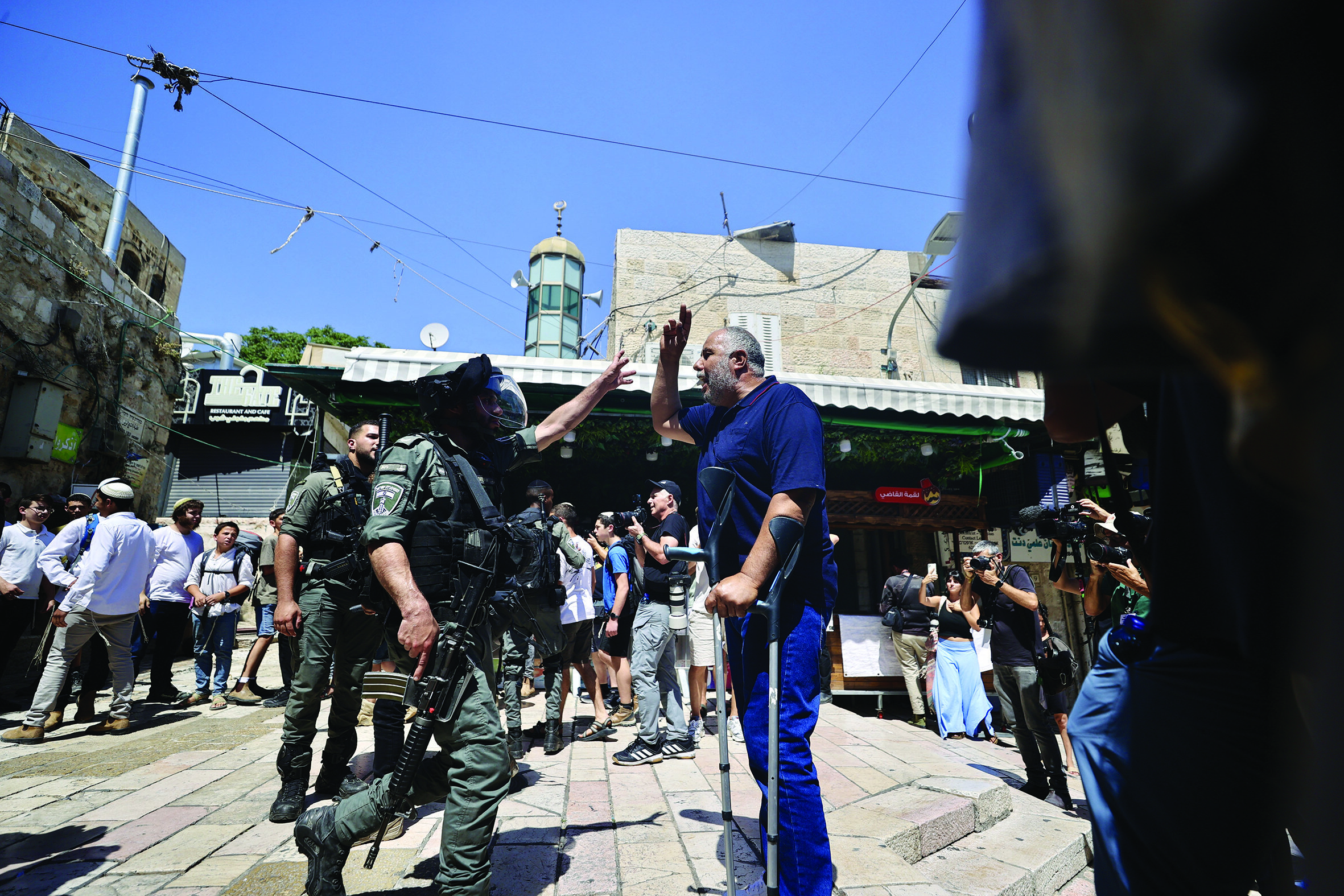
Introduction
Jerusalem stands as a city emblematic of profound historical, religious, and cultural significance, yet it is also a locus of intense geopolitical contestation. This unique city not only captures the essence of multi-religious reverence but also mirrors the complex interplay of heritage, identity, and politics. Situated at the heart of the Middle East, Jerusalem’s architectural and demographic dynamics offer a unique lens through which to examine the intersection of ancient legacies with the pressures of modern urban governance and geopolitical strife. The city’s status as a focal point in global diplomacy further amplifies the need for a comprehensive understanding of its socio-spatial dynamics.
Despite the critical role of Jerusalem in international affairs and its symbolic significance in global culture, academic literature has often overlooked the importance of conserving its diverse cultural heritage amidst ongoing conflict. This oversight not only diminishes the understanding of the city’s complex identity but also overlooks the potential of heritage conservation as a tool for peace-building and reconciliation. This paper seeks to address this gap by providing an in-depth analysis of the challenges and opportunities in preserving Jerusalem’s cultural treasures, against the backdrop of its contested geopolitical landscape.
The study is methodically divided into four main sections to systematically explore the intertwined issues of politics, identity, and heritage preservation. The first section sheds light on the array of international and national efforts aimed at managing and conserving Jerusalem’s contested spaces, highlighting the roles and initiatives of global and regional organizations. The second section introduces the theoretical framework of ‘colonial ethnocracies,’ elaborating on how this concept applies to the urban and architectural evolution of Jerusalem. This is followed by an analysis in the third section, which critically examines the processes and impacts of colonization that have shaped the city’s present-day architectural and demographic configurations.
The concluding section synthesizes the insights gathered from the analysis, proposing a set of solutions that aim to transcend the current state of conflict by fostering a framework for coexistence and mutual recognition of heritage rights. The paper advocates for a transition from conflict to a shared acknowledgment of Jerusalem’s multicultural heritage as a foundation for peace.
Through a meticulous examination of both the preservation of cultural treasures and the broader sociopolitical challenges, this paper aims to contribute to a more nuanced discourse on Jerusalem. It endeavors to highlight how the preservation of tangible and intangible heritage can serve as a pivotal element in resolving the city’s enduring conflicts by fostering a shared sense of identity and history among its diverse inhabitants.
Preservation and Conflict: The Multifaceted Role of UNESCO, TİKA, and Architectural Transformations in Jerusalem
TİKA (Turkish Cooperation and Coordination Agency) has established a commendable position in protecting Jerusalem’s heritage through restoration and conservation projects, aligning with the OECS (Organization of Eastern Caribbean States) criteria. Notable projects include the refurbishment of the crescent atop the Dome of the Rock within the al-Aqsa Mosque, renovation of the Chain Dome’s tiles, and the restoration of historic houses, a clock tower, a fountain, and madrasas.1 Additionally, TİKA has significantly extended its presence in Palestine by opening a program coordinator office in Ramallah in 2005, managed by Bülent Korkmaz, who oversees these initiatives with his team.2
Situated at the heart of the Middle East, Jerusalem’s architectural and demographic dynamics offer a unique lens through which to examine the intersection of ancient legacies with the pressures of modern urban governance and geopolitical strife.
TİKA’s contributions in Palestine also encompass a variety of other projects. These include the Gaza-Turk Friendship Hospital, the Tubas Turk Hospital, the containment wall restoration at Jerusalem’s Yusufiye Cemetery, and several educational projects such as the construction of the al-Halil (Hebron) School, and the Nuri Pakdil Women’s School. Restoration efforts extend to Nablus’s Reşadiye School and the establishment of an Olive Oil Production Facility in Gaza’s Abasan Municipality. Overall, TİKA has invested approximately $40 million in these projects, including a $1 million emergency humanitarian aid package during Ramadan 2018 specifically for Gaza.3
UNESCO has played a pivotal role in promoting the conservation and preservation of cultural heritage globally. However, the Israeli-Palestinian conflict has often impeded the organization’s positive interventions. The Old City of Jerusalem and its walls, heralded as a “masterpiece of human creative genius,” were inscribed on the UNESCO World Heritage Sites list in 1982, after Jordan successfully advocated for their inclusion in 1981. This recognition highlighted the area’s significance as a site of worship for three major monotheistic religions.4
The Old City of Jerusalem and its walls possess unique characteristics of outstanding universal value, a status that UNESCO affirmed over 40 years ago
Despite efforts to place the Old City under the protection of UNESCO, Israel declined to comply with the directives from the World Heritage Centre, thereby weakening UNESCO’s capacity to safeguard the heritage rights of the site. A notable incident occurred during the fifteenth session of the UNESCO General Conference in 1968, which strongly condemned Israeli archaeological excavations that altered the cultural character of key Christian and Islamic religious sites.5 This condemnation extended to other illegal archaeological activities. In response to ongoing non-compliance and overt disregard by Israel, UNESCO issued a controversial reprimand in 1974 and suspended its assistance. This measure, however, elicited strong backlash from Western countries, which in turn increased the application of The Hague Convention in international law, effectively reducing UNESCO’s leverage over Israel’s heritage policies. These events underscored perceived legal weaknesses within UNESCO’s framework.6 Nonetheless, in a significant development, Israel ratified the World Heritage Convention in 1999, marking a complex chapter in its engagement with UNESCO.
In October 2011, “The State of Palestine” was recognized as a UNESCO member. On November 29, 2012, its status was upgraded from ‘non-member observer entity’ to ‘non-member observer state.’7 This recognition marked the Palestinian Authority’s first significant victory in UNESCO, distinct from its engagements at the United Nations (UN). On October 31, 2011, UNESCO granted full member state status to Palestine. Following this status recognition, Israel and the U.S. expressed strong opposition at the UNESCO General Conference. In retaliation, both countries cut funding to UNESCO, despite the U.S. contributing 22 percent of the organization’s entire budget. Moreover, in 2012, the Palestinian Authority nominated Bethlehem’s “Birthplace of Jesus: Church of the Nativity and the Pilgrimage Route, Bethlehem” as an “emergency nomination.” This legacy of conservation meant that, by 2012, Bethlehem was no longer under Israeli rule.
To summarize, there have been four phases of UNESCO’s involvement in the Holy Land. The first phase, from 1967 to 1971, was marked by Israel’s refusal to cooperate with UNESCO on heritage management. The second phase, from 1971 to 1990, saw Professor Raymond Lemaire making efforts to rebuild relations with the Israeli government. The third phase, from 1990 to 1999, focused on cultural heritage protection, actively pursued while avoiding political tensions. Following the onset of the Second Intifada, the fourth phase of UNESCO’s involvement began. During this period, UNESCO attempted to unite all parties for dispute resolution.8
UNESCO’s diplomatic role in Palestine is crucial.9 Additionally, ICOMOS, the International Centre for the Study of the Preservation and Restoration of Cultural Property, alongside the International Union for Conservation of Nature, has also played a significant role. It has evaluated the Holy Land as representing “the history of the three great monotheistic religions,” the architectural significance of monuments such as the Church of the Holy Sepulchre and al-Haram al-Sharif (The Noble Sanctuary), and has noted Jerusalem’s “exceptional testimonies to its vanished civilizations.”10
The Old City of Jerusalem and its walls possess unique characteristics of outstanding universal value, a status that UNESCO affirmed over 40 years ago. Engaging with this heritage is fraught with risks due to ethical considerations. Despite these concerns, Jerusalem’s turbulent history throughout the 20th century, marked by British, Jordanian, and Israeli occupations, has led to significant deterioration of its cultural heritage and architectural integrity.11 In 1917, the British army occupied Palestine following the decision of the League of Nations at the San Remo Conference to implement the Balfour Declaration. This period saw rapid urban development characterized by new, large housing settlements and other constructions, funded heavily by the British to serve their cultural heritage-altering agenda.12 After the UN decided to partition Palestine between the Arabs and the Jews, Jordanian and Egyptian control persisted from 1948 to 1967.
Prior to the spring of 1948, there was a significant Arab majority in the city.13 Post-1947, following the UN Partition Plan, Israel gained control over 77 percent of Palestinian land, effectively forcing approximately 900,000 Palestinians into exile.14 The 1967 Six-Day War led Israel to implement urban modernization and Judaization plans for Jerusalem. That same year, Israel’s occupation of the West Bank and the Gaza Strip created intense demographic pressures due to reduced living areas and inadequate infrastructure, leading to urban chaos in Palestinian architecture.15 Following the war, Jerusalem was primarily segregated along ethnic lines.16 The Israeli government also unilaterally annexed East Jerusalem and expanded the city’s municipal boundaries.17 Consequently, essential services remain inadequate and disproportionately favor Jewish residents over Palestinian citizens.18
Until the Second World War, the architecture of Jerusalem was predominantly designed by foreign architects. From then until the 1970s, the first generation of post-war local architects began to disregard traditional architectural styles, transitioning the architectural language of Jerusalem from traditional to contemporary.19 This shift contributed to an urban chaos that transformed the traditional identity of the city into a modern, contemporary architectural identity.
In the 1980s, Jordan sought to establish a new UNESCO platform over East Jerusalem in opposition to Israel.20 From the early 2000s, escalating violence and tension between Israel and the Palestinians, including bombings and other attacks, caused significant damage to the frontier hill and other architectural heritage.21 The Oslo Agreement in 1994 led to the construction of Israeli settlements and bypass roads following the withdrawal of Israeli authority from the Occupied Palestinian Territories (OPT).22 Subsequently, the second uprising (al-Aqsa Intifada) in 2000, characterized by the destruction of houses and infrastructure along with the erection of Separation Walls in the West Bank, presented numerous conflicts and challenges. Currently, the population ratio in Jerusalem is one-third Muslim, two-thirds Jewish, and two percent Christian.23
Urban Dynamics and Geopolitical Transformations in Jerusalem
According to Haim Yacobi, if a city exhibits urban ethnocracy, it becomes an ‘ethnocracity.’ Urban ethnocracy arises when a hegemonic group within the city’s apparatus creates a contested space and social instability.24 The ethnocratic regime enforces the hegemonic control of an “ethno-nation” over multi-ethnic territories,25 segregating racial and ethnic minorities, which leads to structural instability.26 This ethnocratic approach has crafted a colonial prism in Jerusalem. It is asserted in our forthcoming article that these demographic controls are evolving into urban ethnocracy, which in turn is transitioning into urban apartheid in Jerusalem.
The discussion in this paper will delineate how argued assertions differ from proven declarations in Jerusalem, highlighting both in detail. Initially, when literature on the “Israeli conflict” emerged, Jerusalem was described as a ‘divided’ city. However, Prof. Dr. Haim Yacobi was the pioneer in advocating for the ‘contested city’ concept for Jerusalem (al-Quds). This article supports the initiated ‘contested city’ literature with both tangible and intangible declarations. As the discourse in Jerusalem literature shifted from ‘divided’ to ‘contested,’ our aim is to propose solutions to transform the current state of apartheidization and urban ethnocracy into a eemocracy, establishing a bi-national and multicultural entity for Jerusalem (al-Quds).
This paper elaborates on the reasons and mechanisms of how geopolitical balance in terms of demographic control transformed the urban dynamics and geopolitics of Jerusalem (al-Quds) from ethnocracy to urban apartheid up until two decades ago. Ethnic exclusion, racial capitalism, and discrimination might ultimately lead to ‘urban apartheid’ in Jerusalem, as Israeli national aspirations intensify the ‘Jerusalem conflict’ in contested Jerusalem (al-Quds). The events of 1967 illustrate the consequences of a regime as a Jewish ethnocracy; its aim is to ethnically characterize a contested territory.27 Judaization represents the colonial expansion of political, territorial, demographic, and economic control. Israel has leveraged military might and economic power to alter the borders and boundaries, reshaping the city’s geography to enhance Jewish dominance, executing an ethno-national contestation and extensive colonization.28 For Braier and Yacobi, planning Jerusalem is inherently a colonial project. Similarly, Marxist theory focuses on how modernization, industrialization, and class classifications are significant factors affecting urban dynamics and the urbanization process, reproducing social stratification and wealth.29 Thus, the impacts of modernization, industrialization, and class classifications are also evident in the Jerusalem context.
Israel has leveraged military might and economic power to alter the borders and boundaries, reshaping the city’s geography to enhance Jewish dominance, executing an ethno-national contestation and extensive colonization.
The city’s morphology has been transformed by a long period of mandate and colonial occupation.30 Furthermore, Nitzan-Shiftan31 argued that even though the spirit of the city was encapsulated in its stone architecture and historical facades, the Zionist projects in Jerusalem obliterated the authenticity of the historic city due to inconsistent building heights altering the town’s silhouette.32 Michel Foucault emphasized the strong relationship between power mechanisms and architecture, affecting the role of architecture in territorial control.33 Postcolonial literature similarly examines the social structures of spaces, as seen in the Jerusalem case. Massive destruction and the elimination of the Palestinian landscape were executed by the Israeli army, significantly altering urban morphology and form.34
For Zygmunt Bauman, cities are sociopolitical arenas where different ethnic groups, migrants, strangers, and classes interact.35 Acts of acceptance, violence, and protests manifest through these interactions, which are embedded in urban life, leading strangers to eventually become neighbors.36 These collisions occur not only due to macro-political categories but also due to social sub-categories, such as Jerusalem Palestinians, Israeli Palestinians, secular Jews, and Haredi Jews. Although secular Jews, Haredi Jews, and Israeli Palestinians are all Israeli citizens and accustomed to Israeli social spaces, ethno-national conflicts have formed new coalitions and territorial positioning in spatial contestation, leading to demographic transformations.37 Veteran Palestinian residents have emigrated from their neighborhoods. These ethnic segregations will be further explained; they include ethno-national (Jews/Arabs), Jewish ethnic origin (European/Arabic/Russian/Ethiopian), Jewish religious-cultural identity (secular/modern-Orthodox/ultra-Orthodox), ideological (Kibbutz vs. Moshav), and socio-economic (social housing/private compounds) differences.38 In Jerusalem, groups such as secular Jews, Haredi Jews, Israeli Palestinians, and Jerusalem Palestinians are evident. Additionally, Ultra-Orthodox Jews in Israel, referred to as Haredim (plural) and Haredi (singular), are characterized by their strict religious behavior and rejection of secular culture.39
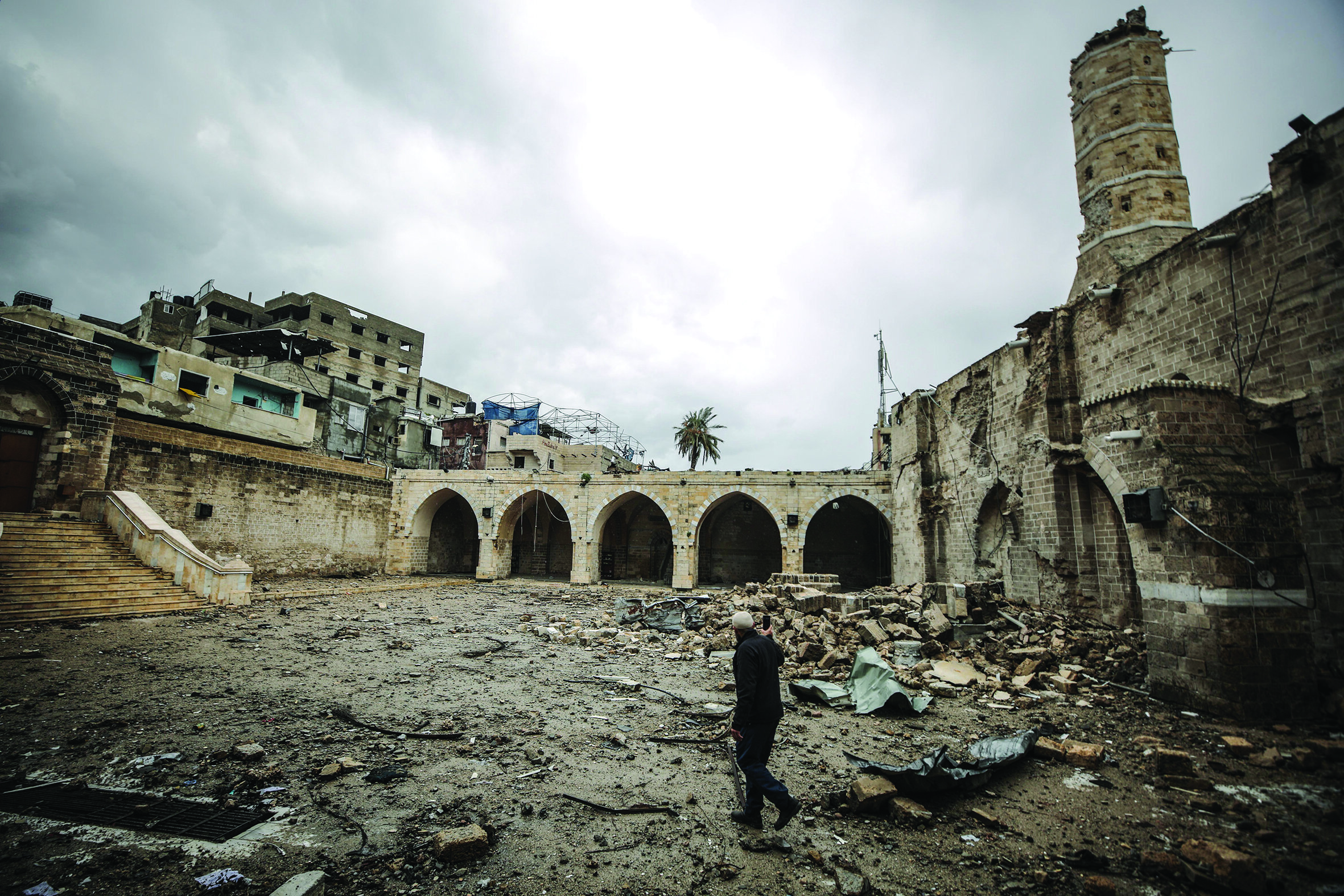
The Gaza Grand Mosque in Gaza City was destroyed along with its minaret during the Israeli army’s bombardment of the Gaza Strip, on January 31, 2024. ALİ JADALLAH / AA
The Geopolitical and Cultural Dynamics of Jerusalem
The geographical situation of Palestine is described as both “a curse and a blessing.”40 Jerusalem, a city of significant religious, cultural, and historical sensitivity, also serves as a modern, unified bridge between the West and East.41 Its intersection of diverse religions and cultures positions Jerusalem as a key example for this paper, illustrating the spatial-political dynamics that form a base for further radicalization.42 Jerusalem exemplifies how colonial power and governance dynamics impact urban contexts.43 The city’s apartheidization has led to residents’ rights and opportunities being defined by their ethnicity and race. Yiftachel and Yacobi highlighted Jerusalem (al-Quds) as a definitive case of urban ethnocracy,44 now also a clear example of urban space degradation and intense political conflict.45 In fact, the city’s geo-cultural features have a multiplier effect on its geopolitical importance. The city’s identity and culture also determine its geo-cultural character.46
Jerusalem, a city of significant religious, cultural, and historical sensitivity, also serves as a modern, unified bridge between the West and East
Looking at the current situation, since October 7, Israel has executed a large-scale, devastating military action in the Gaza Strip. According to a report by Anadolu Agency dated December 24, 2023, 78 days after the start, this operation resulted in the complete destruction of 55,000 homes, 115 mosques, and 92 educational institutions; additionally, 258,000 homes, 200 mosques, 285 educational institutions, and 126 governmental agencies suffered damage. Furthermore, 23 hospitals and 53 health centers were put out of service.47 This situation was horrifying, prompting the Jerusalem Greek Patriarchate to condemn the massacre at places of worship in Gaza and to make an international call for the protection of civilians.48 Moreover, an Israeli attack on December 21, 2023, destroyed a media office building in Gaza City, and since the start of the attacks, 97 Palestinian journalists have been killed.49 The conflict has resulted in approximately 20,000 Palestinian casualties (mostly women and children), with 52,586 injured, compared to 1,200 Israeli fatalities.
Anadolu Agency also reported that more than 200 cultural heritage sites were destroyed, affecting a total of 325 historical buildings in Gaza. These include significant sites such as the Ez-Zafr Demri Mosque in the Shujaiye District, El-Hidir Maqam in Deyr el-Balah city, Halil er-Rahman Mosque in Han Yunus, and the Manuscripts Center. Furthermore, landmarks such as the Byzantium Church, Greek Orthodox Church of Saint Porphyrius, Great Omer Mosque, Monastery of Saint Hilarius, Zafer ed-Demri Mosque, and Prosperity Church were also targeted.50
Urban Racism and Apartheid in Jerusalem
In Jerusalem, it has become apparent that Jewish enmity has evolved into urban racism. This form of urban apartheid manifests through planning, policy, and architectural development policies,51 which will be further explored in the remainder of this article. To maintain Jewish control, Israel has utilized its military might and economic power to redefine boundaries, selectively grant or deny rights and resources, and reshape territories.52 The mechanisms of ethnocratic control include “forceful land seizures, formal legislation, an exclusivist public discourse, and subtle means of control.”53 In essence, the main ethnonational strategies involve “Judaization, segregation, and division.”54 The subsequent sections of our article will discuss diplomatic efforts aimed at managing ethnicities, underscoring the objectives of Jewish nationalism.55
According to Mazza, urban planning serves as an “instrument for governance,” facilitating “inclusion and exclusion.”56 Spatial practices influence power relations.57 The Jerusalem Municipality, based in West Jerusalem, actively pursues the Judaization of the city, promoting Jewish urban and demographic expansion into the Eastern sectors.58 This involves efforts to contain Arab expansion in Jerusalem through strategic urban planning.59 Such plans have led to architectural violations in the Old City and its environs, deviating from long-established conservation and planning rules. The proposed plans aim to significantly alter the environment of the Old City, contradicting decades of conservation principles.60 Additionally, Palestinian areas are strategically selected on maps as part of this nationalistic agenda, further evidencing the mission of Jewish nationalism.61 Observations of the urban plan in East Jerusalem reveal a high degree of informality, evident in vacancy rates.62 Therefore, in Jerusalem, the prevailing planning ideologies and urban geopolitics reflect a form of cultural imperialism.63
Legislation and Urban Planning in Jerusalem: Impacts and Controversies
In 1965, the Planning and Construction Law was enacted, and the Land Ordinance followed in 1968.64 The Israeli government implemented the Municipalities Ordinance (Amendment No. 6) Law, 5727–1967, in East Jerusalem.65 Additionally, the Absentee Property Law 14 enabled the Jerusalem Municipality to demolish Palestinian houses and hinder new constructions. In December 1969, the Rogers’ Plan was introduced, proposing a shared administration involving the three major religious communities.66 This plan, named after U.S. Secretary of State William Rogers, sought to establish shared religious initiatives in December 1969.67 However, Israeli authorities rejected Rogers’ plan, insisting on a predominantly Jewish presence in the city rather than allowing a representation of other nationalities, a policy referred to as “de-Palestinization.”68 Chiodelli describes this as “de-Arabization.”69
To intensify the Jewish presence in East Jerusalem, low-rise housing was replaced with constructions that added three or four additional floors, as seen in the French Hill project, aiming to fortify the process of Judaization
To intensify the Jewish presence in East Jerusalem, low-rise housing was replaced with constructions that added three or four additional floors, as seen in the French Hill project, aiming to fortify the process of Judaization –a topic that will be further elaborated in subsequent sections.70 This paper argues that buildings can reflect the state’s political power.71 This conflict is evident in the architectural landscape, where starkly modern buildings incorporate Middle Eastern stylistic elements such as arched windows, rusticated stone, and stepped houses.72 An orientalist interpretation is apparent in the architectural style, language, and forms, particularly noticeable in areas like French Hill and Tzameret Habira, which will be discussed in detail later.
According to Chiodelli, urban planning is a critical instrument in what he describes as a “low-intensity war.”73 This form of conflict melds dramatic events –such as bombings, killings, and the use of bulldozers– with more gradual interventions like the construction of buildings and the implementation of planning policies. Thus, it can be viewed as “a war of cement and stone.”74 The practice and experience of urban planning, which has significantly shaped the city’s characteristics, policies, and principles, dates back to the mid-19th century.75
First Colony Project: Tzameret Habira (French Hill)
French Hill is a neighborhood that exemplifies the intersection of neo-liberalism, colonialism, and ethno-nationalism in Jerusalem.76 Prior to 1948, Jewish ownership accounted for 30 percent of the property in Jerusalem; today, Jews own more than 90 percent.77 Following the occupation of East Jerusalem by Israel in June 1967, a new phase of spatial transformation began, marking a significant turning point in colonial strategies. Israel implemented two complementary strategies: intensive planning and construction of high-rise, gated Jewish neighborhoods and communities, including French Hill,78 and the suppression of Palestinian development through housing demolitions, restricted housing permits, and immigration controls.79
The Separation Wall, initially constructed in 2002, serves as a physical barrier, reinforcing Israel’s political boundaries and further dividing the city into isolated hinterlands
Constructed in 1971, French Hill was the first settlement established under Israeli territorialization post-1967, strategically located to connect West Jerusalem with the Hebrew University Campus. It represents a de facto annexation of the settlements within the municipal boundaries,80 exemplifying the Israeli control over Palestine.81 Described as a “modern, westernized neighborhood” amidst the older urban traditions of Middle Eastern cities,82 French Hill is home to an upper-middle-class secular Jewish population, including Ultra-Orthodox Jews and Palestinians. This demographic mix results in “intense inter-ethnic and intra-ethnic collisions.”83 The ongoing ethnocratic regime and Israeli colonial control underscore the top-down geopolitical dynamics at play.
Furthermore, the separation line in Jerusalem arises not only from ethno-national identities but also from “socio-economic cleavage and contradicting cultural affiliations.”84 It is noteworthy that secular Jews represent the largest demographic group in French Hill. Many Israeli-Palestinians have chosen to reside in French Hill due to the relatively higher standards and enhanced quality of life it offers, in addition to its proximity to key institutions like the Hebrew University and Hadassah Hospital.85
Master Plan-Jerusalem 2000
In 2004, Israeli authorities launched the Jerusalem 2000 Master Plan, aiming to maintain a demographic balance of 40 percent Palestinian to 60 percent Jewish population.86 Many authors have highlighted the “political and ethno-national bias underlying the objectives of the Jerusalem Master Plan, in which the Jewish population is favored over the Arab-Palestinian population in Jerusalem.”87 The plan is critiqued for facilitating colonial demographic and geographic control88 and perpetuating unequal distribution of resources to Palestinian residents.89
The Jerusalem Master Plan is the first comprehensive citywide plan, encompassing both the Western and Eastern parts of Jerusalem.90 From the mid-1990s to the 2010s, the Jerusalem Planning and Building District Committee developed a significant number of independent plans for East Jerusalem.91 Each year, a few dozen plans were authorized and validated.92 However, these large-scale plans resulted in a ‘de facto inability’ for Palestinian East Jerusalem to see on-the-ground improvements, instead restricting progress.93
The 2000 Master Plan was introduced to keep the demographic balance of 40 percent Palestinian to 60 percent Jewish.94 It is a document with intertwined political and technical goals. Chiodelli argues that the purpose of the master plan is to balance Jews and Arabs without segregation or discrimination, while aiming to create the first “unified Jerusalem” comprehensive plan linking the Eastern and Western parts of the city.95 Despite its intentions, the plan has been criticized for expanding Jewish presence and dominance throughout the city and hindering Palestinian growth in Jerusalem.96
The Jerusalem 2000 Plan was never ratified and remains a guiding document, criticized for granting excessive rights to Palestinians.97 It reflects the Jewish authorities’ intentions to increase Jewish presence in the city.
Light Rail and Urban Segregation in Jerusalem
Transportation connecting various neighborhoods in Jerusalem is not sufficiently inclusive of Palestinian settlements.98 The Light Rail project specifically connects select areas while segregating the city, transforming it into a “conflict infrastructure.”99 This hegemonic interpretation is also evident in cultural events like the Jerusalem Marathon, held in February 2013. During the marathon, the narrative focused exclusively on 3000 years of Jewish history and Israeli national ownership, conspicuously omitting any mention of Palestinian sovereignty. This omission underscored the portrayal of Jerusalem as a modern, European Jewish metropolis rather than a traditional, Middle Eastern Palestinian city.
The Separation Wall, initially constructed in 2002, serves as a physical barrier, reinforcing Israel’s political boundaries and further dividing the city into isolated hinterlands.100 Since the 1967 Colonial Regime, the Separation Wall has been recognized as a ‘hard border,’ contrasting with the ‘softer’ approaches such as urban and housing plans that subtly enforce segregation.101
UNESCO’s Action Plan for Jerusalem and the Mughrabi Gate Ascent Controversy
UNESCO has initiated two practical efforts in Jerusalem: the ‘Action Plan’ and the creation of mediation and consensus over the restoration of the Mughrabi Gate Ascent.102 The Action Plan was launched in January 2005 by UNESCO and encompasses nineteen conservation projects, rehabilitation manuals, local crafts training, and cultural activities. While this action plan is considered both breathtaking and rewarding, it has been placed in abeyance due to political conditions, including inadequate financial support from the Israeli municipal authorities and the Waqf Administrations.103 The Action Plan proposes pragmatic approaches to contested topics; however, it has offered only limited solutions to the problems.
UNESCO Director General Koichiro Matsuura has stated that UNESCO “doesn’t want to deal with political issues –we are duty-bound to preserve the authenticity of Jerusalem.”104 Additionally, it is too early to fully assess the Action Plan’s effectiveness. It is noteworthy that despite significant opposition from Israel, UNESCO and the World Heritage Site (WHS) have taken more proactive measures as inspired by the Action Plan.
Israel conducted detailed archaeological excavations at Haram al-Sharif, sparking significant global controversy. In February 2007, UNESCO called on Israel to halt these excavations to facilitate the restoration of the building. In response, UNESCO developed a two-track approach to manage this dispute. The first approach was the initiation of a ‘Reinforced Monitoring Mechanism,’ and the second was to encourage ‘Professional Encounters’ among Israeli, Jordanian, and Waqf experts.105 On February 13 and 24, 2008, two such encounters took place; however, the plan was approved despite 14 public objections. This situation highlights UNESCO’s challenges in the Old City, underscoring its limitations as an international overseer and guardian of cultural heritage. It illustrates that World Heritage sites are subject to the influence of state power and the dynamics of political struggles.106
Orientalism and Its Implications on Jerusalem’s Cultural Identity
It is crucial to reference Edward Said when discussing orientalist thoughts in this article, as his ideas underscore the sociological impacts in non-European settings, focusing on complex identity formations and cultural degenerations due to cosmopolitan and neo-colonial influences.107 According to Yacobi,108 the conflict over geography is more moral than rational. Furthermore, he suggests that moral geography is inherently linked with the discipline of Orientalism, which typifies the Western perspective towards the Orient with exotification and geopolitical perceptions, often discriminating through a binary lens.109 Thus, the moral rule is intertwined with Orientalism, possessing an imperial superiority complex. The actions of Israel in Jerusalem have been described as manifestations of “the Imperial superiority complex” with a mission to culturally dominate.110 These moral rules are grounded in colonial perceptions and racial categorization.111
Drawing from Edward Said’s perspectives, the struggle with geography implies a sense of belonging that residents feel towards their territory, history, and heritage. The perception of ownership over their geography manifests in ideas, forms, images, and imaginings. If these images and imaginings are negative, a geographical struggle can arise, leading society to drift from their essence, losing interest in searching for their identity. This phenomenon is observable in Jerusalem, where there is a noticeable disconnect with traditional architecture among the new generation. Students are influenced by foreign literature and tend to undervalue the traditional Palestinian cultural heritage.112
Heritage, history, and tradition are fundamental in reshaping society’s identity. To combat the orientalist interpretations within the city, it is essential to firmly adhere to these values to foster a robust identity while avoiding an inferiority complex
To clarify the concept of the orientalist gaze: Europeans have historically considered themselves as representatives of humanity.113 Influenced by orientalist literature, Karl Marx famously stated in his book The Eighteenth Brumaire of Louis Bonaparte, “They cannot represent themselves; they must be represented.”114 Generally, universal values have been Eurocentric,115 which Edward Said termed “the apogee of Orientalist confidence.”116 According to Benjamin, there is an urgent need to revisit and redefine these Eurocentric definitions to align with our values,117 to achieve the convergence of East and West as proposed by Said.
As people experience melancholy over their lost heritage, they often unconsciously adopt society’s capitalist orientation, distancing themselves from knowledge, wisdom, or books, which is characteristic of the orientalist gaze.118 Although the academic discourse suggested that the impact of orientalism had waned by the 1980s, this article illustrates how orientalist ideas are still deeply ingrained in society and continue to influence governmental policies and the collective consciousness. These entrenched views also shape humanity’s wisdom, thereby limiting the authenticity of communities, or as Walter Benjamin would say, diminishing their ‘aura.’ If society’s ‘aura’ diminishes, so does the ‘cult of beauty.’ However, Darvill emphasized that history and heritage are crucial in forging a sense of belonging and rediscovering authentic values.119 Derrida referred to ‘heritage as healing’ and ‘culture as cure.’120 In this light, the concept of ‘taking on tradition’ can be revitalized through heritage and history, as Derrida claimed. Therefore, it is imperative to critically reevaluate and redefine Eurocentric views to reinvigorate our sense of identity and aura. Heritage, history, and tradition are fundamental in reshaping society’s identity. To combat the orientalist interpretations within the city, it is essential to firmly adhere to these values to foster a robust identity while avoiding an inferiority complex. The subsequent sections will discuss colonial approaches and projects as evidence of this orientalist interpretation.
Benjamin Netanyahu expressed that ‘unified Jerusalem’ is subject to Israeli sovereignty and ethno-national aspirations.121 This paradigm of ethnocracy supports the “Judaization of Jerusalem,” extending control over political, territorial, demographic, and economic domains. This ethnocracy stems from “not merely military occupation but also colonial planning and demographic engineering.”122 As Netanyahu alluded in May 2009, citing the Torah, the ‘promised lands’ stretch “from the Wadi of Egypt to the great river, the Euphrates,”123 legitimizing these actions.
This ethnic discrimination, rooted in Torah and orientalist perspectives, has provoked tensions between Palestinians and Haredi Jews, exacerbated by reactions from the secular Jewish majority.124 There is notable economic, social, and cultural divergence between these groups.125 Concerns about losing dominance and declining housing prices arise with the increasing presence of Palestinians in traditionally Jewish areas. Palestinians holding blue Jerusalem residency ID cards risk losing their Jerusalemite status if they live outside Jerusalem, unlike Israeli Jerusalemites who have full citizenship.126
Elie Rosenfeld, chair of the neighborhood council, critically analyzes the budget allocated for Haredi cultural events in Ramat Eshkol, noting that these events occur in French Hill but not in Palestinian areas, marking a clear division between the neighborhoods.127 Migration is another tool for Judaization, with disparities in infrastructure and basic services pushing Palestinians across borders.128
In the 1980s and 1990s, properties in Silwan were declared ‘absentee properties’ under the 1950 Absentee Property Law, allowing them to be sold to the Israeli Development Authority. The Jewish National Fund (JNF) and its organ Himnuta, established in 1938, facilitated the transfer of properties exclusively to Jews, leading to legal proceedings to evict Palestinian tenants. Social inequalities are also evident in street names commemorating Jewish military events, such as Mavo Hamaavak (Struggle Alley), Partizan Alley, Mavo Hahitnadvut, and HaEtzel and HaLehi Streets.129
According to interviews mentioned in Yacobi and Pullan’s study, underlying social discrimination is revealed; Ariella, an Israeli resident, describes rising Palestinian houses as illegal and expresses discomfort with their presence.130 Bracha feels uneasy seeing Arabs in a local café, perceiving them as a threat. Ariella fears that the presence of middle-class Arabs in French Hill could lead to more Arabs moving there, potentially isolating them in an unfriendly environment.131 Conversely, Antuan, a Palestinian resident, asserts that Arabs in French Hill are breaking stereotypes and views their socio-economic success as symbolic decolonization.132 However, this positive viewpoint contrasts starkly with the pervasive dissatisfaction and fears among some Jewish residents, underpinning the urban apartheid evident in Jerusalem.
Conclusion
In Jerusalem, a city marked by conflict, heritage has unfortunately become a weapon and battleground, affecting the initiatives of UNESCO, ICOMOS, and TİKA, which serve as global guardians of cultural heritage. UNESCO’s efforts, including the Action Plan and the Mugrabi Gate Ascent, aimed to strategize with Israel but ultimately led to controversy. Reflecting on the concept of ‘World Heritage,’ David Lowenthal asserted that national patrimony is distinct from ethnic legacies or global heritage, a distinction that is clearly evident in the Jerusalem case.133 Additionally, the tensions of nationalism, colonialism, and neo-liberalism form the underlying power structure.134 It is evident from the Jerusalem experience that Jewish enmity has transformed into urban racism. The above discussions have made it clear that territory, sovereignty, and citizenship, though often considered separate, are in fact inseparable. When sovereignty and citizenship are in conflict, it results in the ‘contested city’ scenario, as seen in Jerusalem. Consequently, the city has become an ‘archipelago of semi-autonomous enclaves’ due to ‘scattered borders.’135
When sovereignty and citizenship are in conflict, it results in the ‘contested city’ scenario, as seen in Jerusalem. Consequently, the city has become an ‘archipelago of semi-autonomous enclaves’ due to ‘scattered borders
Moreover, cities like Belfast, Montreal, Sarajevo, and Kuala Lumpur exemplify ethnocratic regimes but are neither divided nor contested cities. They are managed through multi-ethnic or bi-national capital solutions. For instance, Belgium functions as a unitary state with a bi-ethnic federation, accommodating Dutch-speaking Flemish and French-speaking Walloons in their respective regions.136 Similarly, Chandigarh hosts multiethnic residents and serves as a capital city shared by two states, navigating ethnic tensions and past separatism while preventing unilateral confiscation and expropriation.
At the 2023 Doha Forum in Qatar, Jerusalem was a primary topic of discussion. Themes such as the anti-apartheid movement, hostage exchange, the state of Palestine, rights of non-Jewish minorities, anti-Semitism, Islamophobia, and bi-national consensus were highlighted on December 10th and 11th. According to Khaled Elgindy and Salman Shaikh, the status of Jerusalem and its Holy Sites needs to be resolved by meeting the necessities of both sides through a two-state solution.137 Elgindy and Byman also suggest that the Palestinian refugee issue could be equitably resolved within an independent state, with Jerusalem as its capital within Israeli occupation.138 However, given the historical context of Jerusalem, where there was a substantial Arab majority before the 1950s as noted by Edward Said, it is contested that rebuilding the city under Israeli occupation would be fair. Therefore, ensuring that Palestinians and Jews are equal in Jerusalem and providing harmonious coexistence in a bi-national capital appears more just.
According to Klein, it is feasible to create an open and unified city where Jews, Muslims, and Christians could coexist peacefully.139 Nolte and Yacobi posit that Jerusalem has the potential to become a cosmopolitan metropolis.140 Although Israeli authorities view Jerusalem as their national capital and dismiss any contrary claims,141 the concept of a bi-national capital involves equal sovereignty for all. Mayor Nir Barkat expressed that there is room for everyone in Jerusalem, including Arabs, Jews, ultra-Orthodox, and secular individuals, and these diverse populations can significantly contribute to the city’s dynamism.142 Yiftachel and Yacobi believe that equal representation of Christian, Muslim, and Jewish communities in Jerusalem is achievable, and that equal spatial, economic, environmental, and political management could alleviate the ethnic urban tensions in the city, allowing everyone to work, reside, and relax peacefully.143 In conclusion, considering the recent catastrophic events in Gaza that have drawn global attention and led to worldwide protests calling for peace and a ceasefire, this article aims to spotlight the ongoing discrimination in Jerusalem. It is an attempt to raise our voice through academic literature in support of international peace.
Endnotes
1. Kürşad Mahmat, “10 Yılın Hasılası: Filistin’de TİKA Proje ve Faaliyetleri (2005-2015),” Türkiye Lisansüstü Çalışmalar Kongresi, (2016).
2. Helin Sarı Ertem “Filistin’in Sosyo-Ekonomik Sıkıntılarının Giderilmesinde Türkiye’nin İmkan ve Sınırları,” Türkiye Ortadoğu Çalışmaları Dergisi, Vol. 6, No. 1 (June 2019), pp. 133-168.
3. Mustafa Deveci and Turgut Alp Boyraz, “TİKA’dan Gazze’ye 1 Milyon Dolarlık Acil Yardım,” Anadolu Ajansı, (May 18, 2018), retrieved from https://www.aa.com.tr/tr/dunya/tikadan-gazzeye-1-milyon-dolarlik-acil-yardim-/1149903#.
4. Aurélie Élisa Gfeller, “Culture at the Crossroad of International Politics: UNESCO, World Heritage and the Holy Land,” Foundation Pierre du Bois, No. 3 (April 2013), retrieved from https://www.fondation-pierredubois.ch/wp-content/uploads/2009/05/no3_2013_jerusalem-2.pdf; Craig Larkin and Michael Dumper, “UNESCO and Jerusalem: Constraints, Challenges and Opportunities,” Jerusalem Quarterly, No. 39 (2009), pp. 16-28; Benedetta Serapioni, “Reflecting on Diplomacy of Culture: UNESCO’s First Mission to the Holy Land, 1957-1960,” Jerusalem Quarterly, No. 71 (2017), pp. 132-142.
5. Larkin and Dumper, “UNESCO and Jerusalem.”
6. Larkin and Dumper, “UNESCO and Jerusalem.”
7. Gfeller, “Culture at the Crossroad of International Politics: UNESCO, World Heritage and the Holy Land”; “General Assembly Votes Overwhelmingly to Accord Palestine “Non-Member Observer State” Status in United Nations,” United Nations, (November 29, 2012), retrieved from http://www.un.org/News/Press/docs/2012/ga11317.doc.htm.
8. Larkin and Dumper, “UNESCO and Jerusalem.”
9. Serapioni, “Reflecting on Diplomacy of Culture: UNESCO’s First Mission to the Holy Land, 1957-1960.”
10. Gfeller, “Culture at the Crossroad of International Politics: UNESCO, World Heritage and the Holy Land”; “[Evaluation], World Heritage List No. 148 (Rev.),” ICOMOS, (April 1981), retrieved from https://whc.unesco.org/en/list/148/documents/%23Abevaluation.
11. Mumen Abuarkub and Faiq M. S. Al-Zwainy, “Architectural and Historical Development in Palestine,” International Journal of Civil Engineering and Technology, Vol. 9, No. 9 (September 2018), pp. 1217-1233.
12. Abuarkub and Al-Zwainy, “Architectural and Historical Development in Palestine.”
13. Edward W. Said, The Question of Palestine, (New York: Vintage, 1992).
14. Abuarkub and Al-Zwainy, “Architectural and Historical Development in Palestine.”
15. Abuarkub and Al-Zwainy, “Architectural and Historical Development in Palestine.”
16. Yosef Jabareen, “The Politics of State Planning in Achieving Geopolitical Ends: The Case of the Recent Master Plan for Jerusalem,” International Development Planning Review, Vol. 32, No. 1 (January 2010), pp. 27-43.
17. Marik Shtern and Haim Yacobi, “The Urban Geopolitics of Neighboring: Conflict, Encounter and Class in Jerusalem’s Settlement/Neighborhood,” Urban Geography, Vol. 20, No. 4 (2019), pp. 467-487.
18. Amina Nolte and Haim Yacobi, “Politics, Infrastructure and Representation: The Case of Jerusalem’s Light Rail,” Cities, Vol. 43, (2015), p. 28-36.
19. Abuarkub and Al-Zwainy, “Architectural and Historical Development in Palestine.”
20. Gfeller, “Culture at the Crossroad of International Politics: UNESCO, World Heritage and the Holy Land.”
21. Haim Yacobi and Wendy Pullan, “The Geopolitics of Neighbourhood: Jerusalem’s Colonial Space Revisited,” Geopolitics, Vol. 19, No. 3 (May 2014), pp. 514-539.
22. Ali Abdelhamid, “Urban Development and Planning in the Occupied Palestinian Territories: Impacts on Urban Form,” The Conference on Nordic and International Urban Morphology: Distinctive and Common Themes, Stockholm, Sweden, (September 3-5, 2006).
23. Michal Braier and Haim Yacobi, “The Planned, the Unplanned and the Hyper-Planned: Dwelling in Contemporary Jerusalem,” Planning Theory and Practice, Vol. 18, No. 1 (2017), pp. 1-16.
24. Haim Yacobi, “Architecture, Orientalism, and Identity: The Politics of the Israeli-Built Environment,” Israel Studies, Vol. 13, No. 1 (2008), pp. 94-118.
25. Oren Yiftachel, Ethnocracy: Land and Identity Politics in Israel/Palestine, (Philadelphia: University of Pennsylvania Press, 2006).
26. Douglas S. Massey and Nancy A. Denton, American Apartheid: Segregation and the Making of the Underclass, (Cambridge: Harvard University Press, 1993); Janet Abu-Lughod, Rabat: Urban Apartheid in Morocco, (New Jersey: Princeton University Press, 1981).
27. Oren Yiftachel and Haim Yacobi, “Planning a Bi-National Capital: Should Jerusalem Remain United?” Geoforum, Vol. 33, No. 1 (February 2002), pp. 137-144.
28. Michal Braier and Haim Yacobi, “The Planned, the Unplanned and the Hyper-Planned: Dwelling in Contemporary Jerusalem,” Planning Theory & Practice, Vol. 18, No. 1 (2017), pp. 109-124.
29. Shtern and Yacobi, “The Urban Geopolitics of Neighboring: Conflict, Encounter and Class in Jerusalem’s Settlement/Neighborhood.”
30. Abdelhamid, “Urban Development and Planning in the Occupied Palestinian Territories: Impacts on Urban Form.”
31. Alona Nitzan-Shiftan, “Seizing Locality in Jerusalem,” in N. Alsayyad (ed.), The End of Tradition? (London: Routledge, 2004), pp. 231-255.
32. Braier and Yacobi, “The Planned, the Unplanned and the Hyper-Planned: Dwelling in Contemporary Jerusalem.”
33. Yacobi, “Architecture, Orientalism, and Identity.”
34. Abdelhamid, “Urban Development and Planning in the Occupied Palestinian Territories.”
35. Zygmunt Bauman, Liquid Fear, (Cambridge: Polity Press, 2006).
36. Leonie Sandercock, “When Strangers Become Neighbors: Managing Cities of Difference,” Planning Theory and Practice, Vol. 1, No. 1 (2000), pp. 13-30.
37. Shtern and Yacobi, “The Urban Geopolitics of Neighboring.”
38. Erez Tzfadia and Haim Yacobi, Rethinking Israeli Space: Periphery and Identity, (New York: Routledge, 2011).
39. Shtern and Yacobi, “The Urban Geopolitics of Neighboring.”
40. Abuarkub and Al-Zwainy, “Architectural and Historical Development in Palestine,” p. 1218.
41. Nolte and Yacobi, “Politics, Infrastructure and Representation.”
42. Haim Yacobi, “From Ethnocracy to Urban Apartheid: The Changing Urban Geopolitics of Jerusalem/al-Quds,” Cosmopolitan Civil Societies Journal, Vol. 8, No. 3 (2016), p. 100-114.
43. Haim Yacobi, “Jerusalem: From a ‘Divided’ to a ‘Contested’ City—and Next to a Neo-Apartheid City?” City, Vol. 19, No. 4 (2015), pp. 579-584.
44. Yiftachel and Yacobi, “Planning a Bi-National Capital.”
45. Abuarkub and Al-Zwainy, “Architectural and Historical Development in Palestine.”
46. Osman Horata, “Türk Dünyası’nın Kültürel Ufukları: Tarihsel Bağlam İçinde Genel Bir Değerlendirme,” Bilig, No. 82 (August 2017), pp. 117-131.
47. Gülşen Topçu, “İsrail 78 Günde Gazze Şeridi’nde 55 Bin Konutu Tamamen Yıktı,” Anadolu Ajansı, (December 24, 2023), retrieved from https://www.aa.com.tr/tr/dunya/israil-78-gunde-gazze-seridinde-55-bin-konutu-tamamen-yikti/3090973.
48. Mahmut Geldi, “Kudüs Rum Ortodoks Patrikhanesi, İsrail’in Gazze’deki İbadethanelere Saldırılarını Kınadı,” Anadolu Ajansı, (December 17, 2023), retrieved from https://www.aa.com.tr/tr/dunya/kudus-rum-ortodoks-patrikhanesi-israilin-gazzedeki-ibadethanelere-saldirilarini-kinadi/3085235.
49. Mustafa Haboush, “Israeli Army Destroys Media Office Building in Gaza City,” Anadolu Agency, (December 21, 2023), retrieved from https://www.aa.com.tr/en/middle-east/israeli-army-destroys-media-
office-building-in-gaza-city/3089153.
50. “İsrail, Gazze’de Tarihi Cami, Kilis ve Müzeleri Hedef Alarak Kültürel Mirası da Yok Ediyor,” Anadolu Ajansı, (December 7, 2023), retrieved from https://www.aa.com.tr/tr/dunya/israil-gazzede-tarihi-cami-kilise-ve-muzeleri-hedef-alarak-kulturel-mirasi-da-yok-ediyor/3076138#:~:text=%C4%B0srail%20ordusu%2C%207%20Ekim’den,yap%C4%B1y%C4%B1%20k%C4%B1smen%20veya%20tamamen%20y%C4%B1kt%C4%B1.
51. Yacobi, “Jerusalem: From a ‘Divided’ to a ‘Contested’ City—and Next to a Neo-Apartheid City?”
52. Michael Dumper, The Politics of Jerusalem Since 1967, (New York: University of Columbia Press, 1996).
53. Yacobi, “From Ethnocracy to Urban Apartheid.”
54. Yacobi, “From Ethnocracy to Urban Apartheid.”
55. Nolte and Yacobi, “Politics, Infrastructure and Representation.”
56. Luigi Mazza, “Centenary Paper: Plan and Constitution – Aristotle’s Hippodamus: Towards an ‘Ostensive’ Definition of Spatial Planning,” Town Planning Review, Vol. 80, No. 2 (2009), pp. 114, 131.
57. Nolte and Yacobi, “Politics, Infrastructure and Representation.”
58. Francesco Chiodelli, “Planning Illegality: The Roots of Unauthorised Housing in Arab East Jerusalem,” Cities, Vol. 29, No. 2 (2012), pp. 99-106; Francesco Chiodelli, “The Jerusalem Master Plan: Planning into Conflict,” Jerusalem Quarterly, No. 51 (2012), p. 7; Francesco Chiodelli, “Re-shaping Jerusalem: The Transformation of Jerusalem’s Metropolitan Area by the Israeli Barrier,” Cities, Vol. 31, (2013), p. 417; Michael Safier, “The Struggle for Jerusalem: Arena of Nationalist Conflict or Crucible of Cosmopolitan Co-existence?” City, Vol. 5, No. 2 (2001), p. 141.
59. Nolte and Yacobi, “Politics, Infrastructure and Representation.”
60. Yiftachel and Yacobi, “Planning a Bi-National Capital.”
61. Yacobi and Pullan, “The Geopolitics of Neighbourhood.”
62. Shtern and Yacobi, “The Urban Geopolitics of Neighboring.”
63. Yacobi and Pullan, “The Geopolitics of Neighbourhood.”
64. Yacobi and Pullan, “The Geopolitics of Neighbourhood.”
65. Yacobi, “Jerusalem: From a ‘Divided’ to a ‘Contested’ City—and Next to a Neo-Apartheid City?”
66. Yacobi, “Jerusalem: From a ‘Divided’ to a ‘Contested’ City—and Next to a Neo-Apartheid City?”
67. Shtern and Yacobi, “The Urban Geopolitics of Neighboring: Conflict, Encounter and Class in Jerusalem’s Settlement/Neighborhood.”
68. Nolte and Yacobi, “Politics, Infrastructure and Representation.”
69. Chiodelli, “The Jerusalem Master Plan: Planning into Conflict.”
70. Chiodelli, “The Jerusalem Master Plan: Planning into Conflict.”
71. Chiodelli, “The Jerusalem Master Plan: Planning into Conflict.”
78. Nolte and Yacobi, “Politics, Infrastructure and Representation,” p. 8.
73. Chiodelli, “The Jerusalem Master Plan: Planning into Conflict.”
74. Chiodelli, “The Jerusalem Master Plan: Planning into Conflict,” p. 6.
75. Abdelhamid, “Urban Development and Planning in the Occupied Palestinian Territories.”
76. Shtern and Yacobi, “The Urban Geopolitics of Neighboring.”
77. Yacobi and Pullan, “The Geopolitics of Neighbourhood.”
78. Braier and Yacobi, “The Planned, the Unplanned and the Hyper-Planned.”
79. Yacobi and Pullan, “The Geopolitics of Neighbourhood.”
80. Yacobi and Pullan, “The Geopolitics of Neighbourhood,” p. 523.
81. İbrahim Karataş, “Jewish Settlements in Palestine: An Analysis of Some Ottoman Documents,” Journal of International Relations and Politics, Vol. 4, No. 1 (2024).
82. Yacobi and Pullan, “The Geopolitics of Neighbourhood,” p. 524.
83. Shtern and Yacobi, “The Urban Geopolitics of Neighboring,” p. 1.
84. Shtern and Yacobi, “The Urban Geopolitics of Neighboring,” p. 13.
85. Shtern and Yacobi, “The Urban Geopolitics of Neighboring.”
86. Chiodelli, “Planning Illegality”; Jabareen, “The Politics of State Planning in Achieving Political Ends”; Jonatham Rokem, “Politics and Conflict in a Contested City: Urban Planning in Jerusalem under Israeli Rule,” Bulletin du Centre de Recherche à Jerusalem, No. 23 (2012), pp. 1-12.
87. Chiodelli, “Re-shaping Jerusalem,” p. 54; Chiodelli, “Planning Illegality”; Chiodelli, “The Jerusalem Master Plan: Planning into Conflict,” p. 8; Rokem, “Politics and Conflict in a Contested City,” p. 6.
88. “Planning in Jerusalem: The Implication of the New Outline Plan of Jerusalem for Palestinian Neighborhoods,” Bimkom, (Jerusalem, 2009); Chiodelli, “The Jerusalem Master Plan: Planning into Conflict”; Yosef Rafeq Jabareen, “The Politics of State Planning in Achieving Political Ends: The Case of the Recent Master Plan for Jerusalem,” International Development Planning Review, Vol. 32, No. 1 (January 2010).
89. Chiodelli, “The Jerusalem Master Plan: Planning into Conflict”; Braier and Yacobi, “The Planned, the Unplanned and the Hyper-Planned.”
90. Chiodelli, “The Jerusalem Master Plan: Planning into Conflict.”
91. Braier and Yacobi, “The Planned, the Unplanned and the Hyper-Planned.”
92. Michal Braier, “Zones of Transformation? Informal Construction and Independent Zoning Plans in East Jerusalem,” Environment and Planning, Vol. 45, No. 11 (2013).
93. Braier and Yacobi, “The Planned, the Unplanned and the Hyper-Planned.”
94. Chiodelli, “Planning Illegality”; Chiodelli, “The Jerusalem Master Plan: Planning into Conflict”; Jabareen, “The Politics of State Planning in Achieving Political Ends”; Rokem, “Politics and Conflict in a Contested City.”
95. Chiodelli, “The Jerusalem Master Plan: Planning into Conflict.”
96. Nolte and Yacobi, “Politics, Infrastructure and Representation.”
97. Shtern and Yacobi, “The Urban Geopolitics of Neighboring.”
98. Nolte and Yacobi, “Politics, Infrastructure and Representation.”
99. Nolte and Yacobi, “Politics, Infrastructure and Representation.”
100. Haim Yacobi, Israel and Africa: A Genealogy of Moral Geography, (London and New York: Routledge, Taylor and Francis Group, 2016).
101. Yacobi “Jerusalem: From a Divided to a ‘Contested’ City-and Next to a Neo-Apartheid City.”
102. Larkin and Dumper, “UNESCO and Jerusalem.”
103. Larkin and Dumper, “UNESCO and Jerusalem.”
104. Larkin and Dumper, “UNESCO and Jerusalem,” p. 19.
105. Larkin and Dumper, “UNESCO and Jerusalem.”
106. Larkin and Dumper, “UNESCO and Jerusalem.”
107. Merve Alkan, “Critical Explorations of Cultural Heritage Values and the Relationship to Contemporary Conservation Management in Cairo,” University College London, Dissertation, (London, 2021).
108. Yacobi, Israel and Africa.
109. Yacobi, Israel and Africa.
110. Etienne Balibar, Race, Nation, Class, Ambiguous Identities, (London: Verso, 1991).
111. Yacobi, Israel and Africa.
112. Abuarkub and Al-Zwainy, “Architectural and Historical Development in Palestine.”
113. David Lowenthal, The Past Is a Foreign Country, (Cambridge: Cambridge University Press, 1985).
114. Edwars Said, Orientalism, (New York: Vintage, 1979), p. 21.
115. Denis Byrne, “Western Hegemony in Archaeological Heritage Management,” History and Anthropology, No. 5 (1991); Ken Taylor, “Cultural Heritage Management: A Possible Role for Charters and Principles in Asia,” International Journal of Heritage Studies, Vol. 10, No. 5 (2004), p. 417-433; David C. Harvey, “Heritage Pasts and Heritage Presents: Temporality, Meaning and the Scope of Heritage Studies,” International Journal of Heritage Studies, Vol. 7, No. 4 (2001); Laurajane Smith, Uses of Heritage, (New York: Routledge, 2006); John Urry, “How Societies Remember the Past,” in Sharon Macdonald and Gordon Fyfe (eds.), Theorising Museums, (Oxford: Blackwell, 1996).
116. Said, Orientalism, p. 49.
117. Alkan, “Critical Explorations of Cultural Heritage Values and the Relationship to Contemporary Conservation Management in Cairo.”
118. Alkan, “Critical Explorations of Cultural Heritage Values and the Relationship to Contemporary Conservation Management in Cairo.”
119. Timothy Darvill, “Value Systems in Archaeology, in Managing Archaeology,” in John Carman, Malcolm Cooper, Anthony Firth, and David Wheatley, Managing Archeology, (London: Routledge, 1995) pp. 40-50.
120. Simon Glendinning, “Derrida and Europe beyond Eurocentrism and Anti-Eurocentrism,” The Forum for Philosophy, (November 2, 2015), retrieved from https://blogs.lse.ac.uk/theforum/derridaandeurope/.
121. Yacobi, Israel and Africa.
122. Yacobi, Israel and Africa.
123. Karataş, “Jewish Settlements in Palestine.”
124. Shtern and Yacobi, “The Urban Geopolitics of Neighboring.”
125. Braier and Yacobi, “The Planned, the Unplanned and the Hyper-Planned.”
126. Yacobi and Pullan, “The Geopolitics of Neighbourhood.”
127. Shtern and Yacobi, “The Urban Geopolitics of Neighboring”; “Protocols of the French Hill Neighborhood Council Board,” French Hill Neighborhood Council, (March 3, 2014), retrieved from http://www.eshkolbagiva.org.il/community-center/Board.
128. Yacobi and Pullan, “The Geopolitics of Neighbourhood.”
129. Yacobi and Pullan, “The Geopolitics of Neighbourhood.”
130. Yacobi and Pullan, “The Geopolitics of Neighbourhood.”
131. Yacobi and Pullan, “The Geopolitics of Neighbourhood.”
132. Yacobi and Pullan, “The Geopolitics of Neighbourhood.”
133. David Lowenthal, The Heritage Crusade and the Spoils of History, (New York: Viking, 1997).
134. Braier and Yacobi, “The Planned, the Unplanned and the Hyper-Planned.”
135. Yacobi, “Jerusalem: From a Divided to a ‘Contested’ City-and Next to a Neo-Apartheid City.”
136. Yiftachel and Yacobi, “Planning a Bi-national Capital.”
137. Khaled Elgindy and Salman Shaikh, The Arab Awakening: America and the Transformation of the Middle East, (Washington: The Brooking Institution, 2011).
138. Khaled Elgindy and Daniel Byman, “The Deepening Chaos in Sinai,” The National Interest, (2013).
139. Menachem Klein, “Old and New Walls in Jerusalem,” Political Geography, Vol. 24, No. 1 (2005), pp. 53–76.
140. Nolte and Yacobi, “Politics, Infrastructure and Representation.”
141. Klein, “Old and New Walls in Jerusalem.”
142. Nir Barkat, “The Mayor’s Vision for Jerusalem,” Center for Public Affairs, Vol. 10, No. 5 (August 1, 2010).
143. Yiftachel and Yacobi, “Planning a Bi-national Capital.”