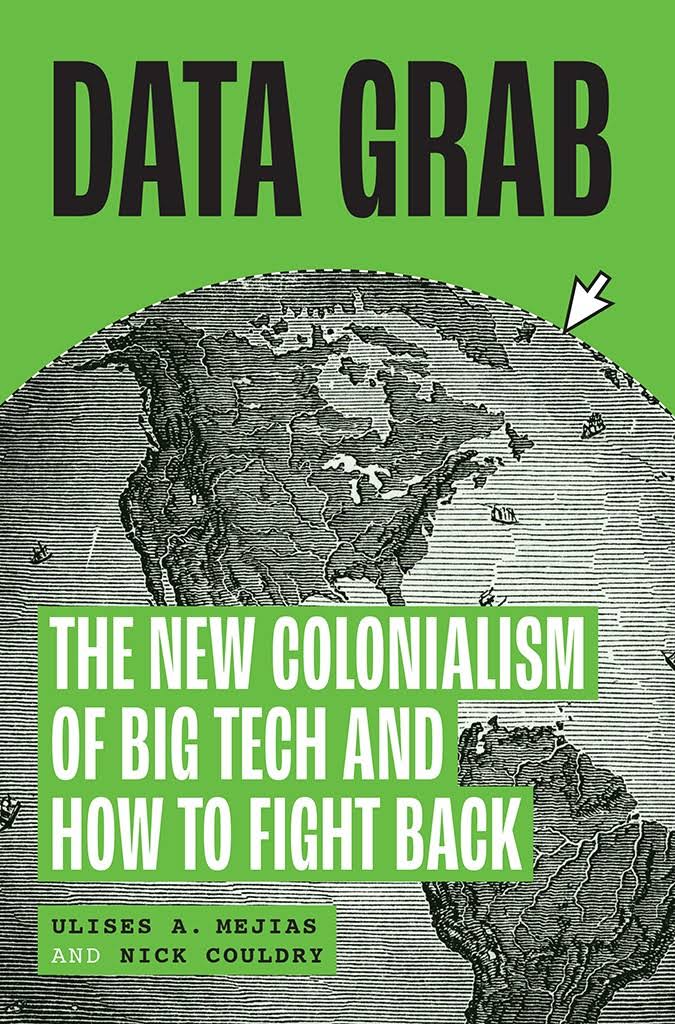
In their book Data Grab: The New Colonialism of Big Tech and How to Fight Back, Ulises A. Mejias and Nick Couldry present a compelling argument that historical colonialism, characterized by land grabs, exploitation, and violence, lives on in a new form: data colonialism. The book opens with an introduction that provides a brief historical overview of the land grab (and the uprisings, suppressions, and wars that accompanied it) in what would become Southern Rhodesia (now Zimbabwe) in the late 19th century. It outlines two distinct characteristics of colonialism: first, its global scale; and second, its long-lasting impact despite having brought dispossession and injustice. The book challenges the dominant mindset that historical colonialism is long gone, instead asserting that today’s data grab is a continuation of the colonial land grab that reorganized the world’s resources centuries ago, exploiting the masses and placing opportunities in the hands of the few. Historical colonialism and data colonialism are two parallel and deeply interconnected phenomena.
The book, after the introduction, entails six chapters and a conclusion. The first chapter aims to solidify the relationship between colonialism and capitalism, arguing that contemporary digital practices can be understood through the lens of colonialism. To portray this, they attempt to track how colonialism and colonialist activities helped facilitate capitalism, stating, “Capitalism has always had a colonial gene within it” (p. 32). The authors also take into account how colonialism and capitalism have transformed and evolved: from land grab to data grab, direct violence (physical, cultural, or economic) to symbolic violence (e.g. algorithmic discrimination or undermining alternative forms of living), but also argue that the core act or function of colonialism (historical or data) is identical: to establish a social order that firmly benefits only the colonizers. With this in mind, the goal is to spark a new understanding that, “Yes, there is a new colony, a new zone of extraction. Data colonialism exploits it. What it exploits is our lives as human beings. Wherever we are” (p. 33).
Interestingly, the authors begin every chapter with a story, whether fictional or real, that effectively illustrates the perspective they are conveying. In Chapter 2, the authors begin with the story of a worker who, after being given a fitness tracker by his boss, noticed that his health data was used, for example, to show him targeted ads, and he was at risk of all his health-related data being shared. They expand on this illustration by arguing that society has become a data territory (invisible zones where companies capture and process data in ways that restructure how we live), as software is embedded in the devices we use and the platforms we visit through the use of a Four-X model: Explore, Expand, Exploit, Exterminate. The range of computers was expanded through the emergence of more convenient and smaller computers for every single person to have, the multiplication of the platforms from which data can be extracted, and finally, the conversion of our everyday lives and places into a terrain for data collection and exploitation. This then leads to an asymmetrical, controlling, and limitless data relationship with people on one side (the losing side) and governments or corporations whose goal is to maximize data extraction on the other. Rich nations and powerful corporations monopolize data and AI infrastructure, while the Global South is reduced to a data-producing periphery. The authors suggest that this asymmetry replicates colonial hierarchies, reinforcing dependency and underdevelopment.
In Chapter 3, Mejias and Couldry unmask the narratives being used to justify and normalize data extraction, convenience, connection, and the idea that AI is smarter than humans. These civilizing narratives, they argue, mirror those used in colonial history, which justified exploitation through discourses of Europe’s supposed superior knowledge, enlightenment, and a change to civilization. What, however, are the costs attached to this? While connectivity and convenience are good and useful benefits, the authors ask: “Is that really a good bargain at the societal level?” (p. 88). Connection, convenience, and an easier life are all good, but not if it means more data extracted from us for profit, constant surveillance, societal inequalities, extreme radicalization, and discrimination.
Before moving on to resistance mechanisms, the authors, in the fourth chapter, draw attention to the “colonial class:” networks of companies involved in and supporting the extraction of data value from every sector of the economy, working often in close collaboration with governments. They explore big corporations: GAFAM (Google, Amazon, Facebook, Apple, Microsoft) in the U.S. and China’s BATX (Baidu, Alibaba, Tencent, and Xiaomi), and the role each company plays, with multiple examples of the involvement of these companies. The fusion of corporate and state interests, what they call the algorithmic state, is explored using the example of Palantir. The authors warn against the concentration of decision-making power in unelected entities because a concerning question comes to mind: With all of the powerful AI agents and technological systems, “who has control over such power, and to what ends?” (p. 136). They also critically examine how users help sustain their regimes of data extraction through click-to-agree mechanisms, persuasive design, and dependency on digital convenience.
The final two chapters shift the book’s tone toward defying the status quo. Mejias and Couldry highlight resistance movements ranging from indigenous data sovereignty efforts to digital rights activism. Drawing on thinkers such as Achille Mbembe and Bartolomé de Las Casas, they frame resistance as both historical and contemporary, collective and individual. As the authors frequently remind us throughout the book, all these are possible when we equip ourselves with different ideas, which include rethinking our understanding of what counts as knowledge and rational behavior, and seeing colonial extractivism for what it is: a grab for power.
The “Playbook for Resistance” outlines three strategic paths: working within the system (through regulation and ethical design), against the system (via boycotts and protests), and beyond the system (through alternative technologies and frameworks of digital justice). Interestingly, they highlight numerous groups, workers, citizens, activists, and even indigenous communities, standing at the forefront of the resistance. While the authors are cautious not to promise quick solutions, they remain adamant that resistance is both possible and already underway.
In today’s world, where technology is rapidly advancing, it is crucial to understand what is really happening and to fully grasp the concept of artificial intelligence. The book appeals to those looking for a different perspective on the data revolution and wanting to understand the underlying processes in our seemingly harmless daily lives. The comparison of data colonialism with historical colonialism makes a significant contribution to critical data studies. By presenting data extraction as a political and colonial act, the authors challenge us to consider the ethical and structural consequences of our digital existence.
The book not only offers a different viewpoint and a platform for understanding and challenging the power structures of the digital age; it also discusses the impact that data and data centers have on the environment, and even discusses the transformation of the classroom, the health sector, the workplace, gig platforms, and even the agricultural sector into data territories, and the adverse effects on these spheres of life, all while offering very detailed case studies and real-life inspirations.
Yet, the book is not without its limitations. While the historical comparisons are well-researched and compelling, some readers may find the analogy between traditional colonialism and data practices stretched at times. For example, while dispossession is a useful analytical lens, the lack of direct violence in data colonialism raises questions about the extent of the comparison. The authors anticipate this critique and address it by emphasizing that violence today takes more symbolic and economic forms; however, this nuance might not satisfy all readers. Moreover, despite having detailed case studies on other aspects, there is little discussion, for instance, of how international bodies like the UN, the World Bank, or the World Trade Organization might factor into resisting or regulating data colonialism.
The book is a valuable resource for policymakers, human rights advocates, and especially everyday citizens, providing insight into how the ongoing data revolution is deeply intertwined with our society.