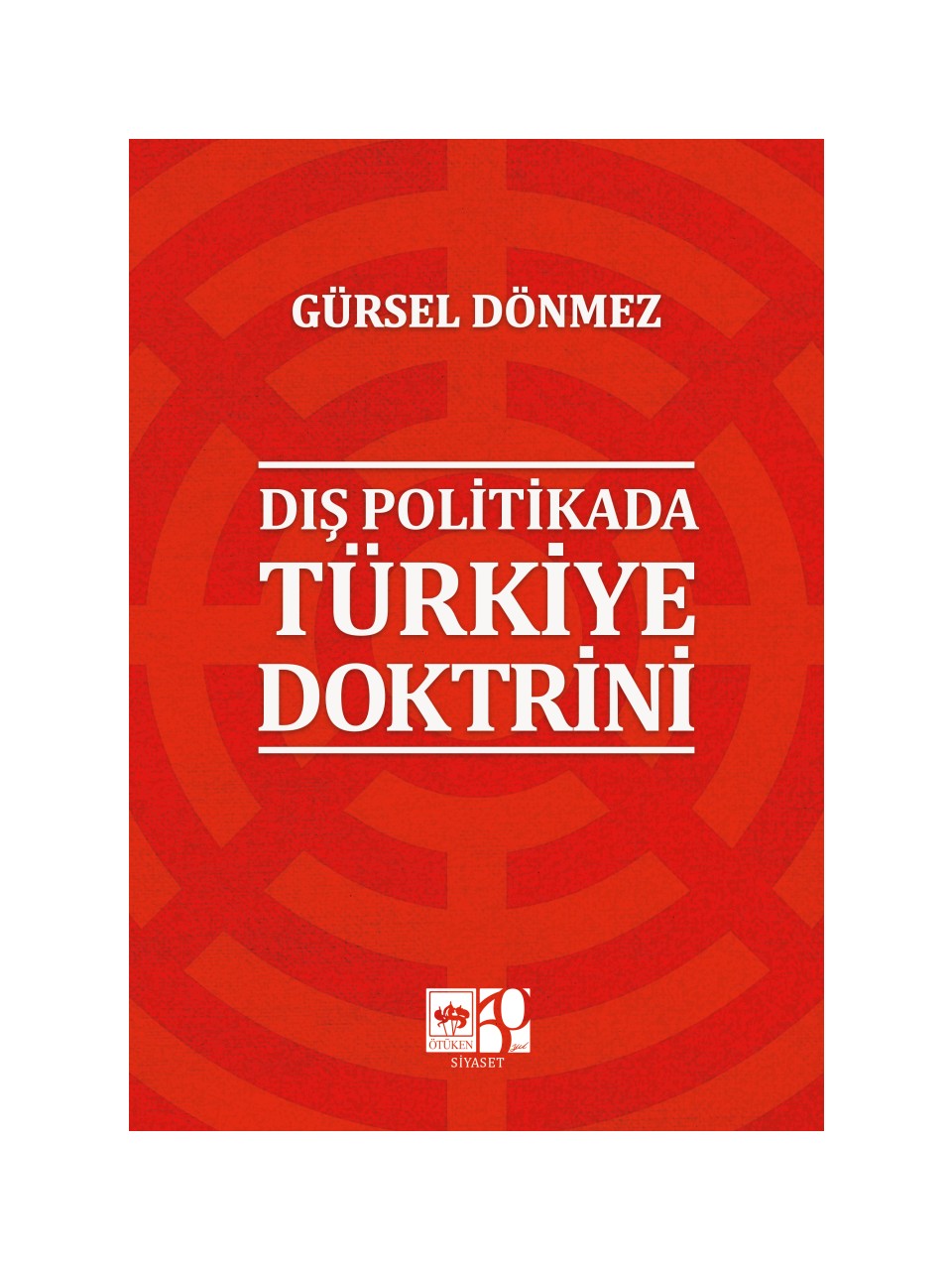
Debates surrounding the orientation of Turkish foreign policy, particularly discussions on its strategic anchor and claims of an axis shift, remain relevant to both academic and policy circles. Amid such debates, the writings, memoirs, and reflections of former policymakers and bureaucrats gain particular importance. It is in this context that Dış Politikada Türkiye Doktorini (Türkiye Doctrine in Foreign Policy) by Gürsel Dönmez emerges as a timely and significant contribution. The book is noteworthy not only for its insights into the evolving trajectory of Turkish foreign policy but also because of its author’s close relationship with Hakan Fidan, the current Minister of Foreign Affairs. At the time of publication, the author served as Deputy Minister of Foreign Affairs and currently holds the post of Turkish Ambassador to Vienna.
The book is divided into seven main chapters, supplemented by three brief introductory chapters, a conclusion, and two appendices. It opens with an introduction in which the author deliberately frames the concept of a “doctrine” as central to the work, arguing that Türkiye, now over a century old and standing at a historical crossroads, embodies more than a nation-state, positioning this new period as the “Century of Türkiye.”
In the first chapter, the author outlines the fundamentals of Turkish foreign policy. He argues that Türkiye, with its deep-rooted historical past and as a country surrounded by conflicts, will always face challenges due to geopolitical events. He goes on to explain Türkiye’s foreign policy roadmap after Fidan took office via five points: vision (Türkiye as a system-building actor), mission (to uphold human values and global peace), understanding (national-traditionalist), method (since foreign policy is conducted not only by the ministry but also by other institutions such as non-governmental organizations, it is necessary to maintain a systematic and strategic inventory of all state and non-state actors by developing a roadmap for potential alternative scenarios and generate positions accordingly, basically create positions and ensure coordination), and strategic goals (institutionalizing foreign relations, promoting regional peace and security, advancing national prosperity and economic strength, and enhancing global influence). It is also stated that with the fractum fundamentum, the global establishment has been damaged to its core and that this rupture will evolve into a new order.
The second chapter, named “Conceptual Roots,” addresses the issue within the context of Türkiye and doctrine, taking into account the systemic rupture or stagnation mentioned in the previous section. Doctrine is defined as the foundational principles and attitudes guiding a state’s stance, reflecting a clear and purposeful approach to achieving its goals. The author argues that Türkiye is now on the verge of taking full control of its own path by 2024.
The third chapter examines Türkiye’s position and challenges within the context of global power dynamics and explains the actors and factors in the power struggle in the global system. The author notes that critical sectors such as energy, defense, food, technology, finance, and infrastructure are identified as focal points of global power struggles. The “oligarchic” and “elitocratic” structures within such sectors are emphasized as exerting a growing influence on the world order and constraining the power of nation-states. He argues that Türkiye must leverage strong diplomacy, strategic partnerships, and economic strength to succeed. The chapter also includes advice on topics that diplomats need to know, such as international organizations, capital flow, funds, and sectors like energy, defense, agriculture, etc. The chapter concludes by asserting that Türkiye can restore its power by drawing on its historical legacy and addressing economic shortcomings.
The fourth chapter provides an overview of the historical roots of Turkish foreign policy and its current priorities. The author argues that Türkiye’s diplomatic tradition, which emerged from a 2,500-year-old tradition, has evolved significantly with the establishment of the republic following the War of Independence, and explores how Türkiye’s future will be shaped by reclaiming its historical awareness.
The fifth chapter outlines a framework for Turkish foreign policy, focusing on its core concepts, strategic objectives, and implementation areas. The author highlights that global uncertainty and change present both opportunities and challenges for Türkiye. He analyzes the strategies used by powerful states to achieve their goals of peace, trust, and stability. He details the tools and policies needed for Türkiye to reach its foreign policy goals. He emphasizes that a state’s identity stems from its vision and mission, while its character is shaped by the doctrine guiding its actions.
The sixth chapter introduces the Türkiye Doctrine, which reflects Türkiye’s unique attitude, behavior, and style, rooted in a constitutional basis and practical application. The Türkiye Doctrine is summarized through five key principles: national vision, humanitarian mission, holistic method, realistic attitude, and courageous action. Nationality is defined not only by Turkish origin but by prioritizing local elements. The doctrine highlights the country’s expanding global role and the goals of the “Century of Türkiye,” aligning with its geopolitical realities and historical heritage. Advocating for national unity, human values, realism, and courageous foreign policy, the chapter also provides recommendations for Türkiye to enhance its effectiveness as a system-building country.
The seventh chapter examines the concept of politikum, which addresses foreign policy to achieve the Türkiye century goal. Politikum encompasses strategic, diplomatic, economic, and geopolitical relations, presented as an essential tool for strengthening Türkiye’s position in the global order. The chapter envisions a Pax Turcia (Türkiye century) and emphasizes the importance of political stability, a robust economy, effective diplomacy, and a strong defense system to achieve this goal. The author argues that Türkiye should establish a characteristic epistemology and conduct its foreign policy with a multidimensional understanding and invites readers to contribute to this process.
The conclusion emphasizes the anticipation of a significant global transformation in this century and highlights the necessity for Türkiye to adopt a unique and independent perspective to achieve the “Century of Türkiye” vision amid these changes. The first appendix discusses Fidan’s peace efforts in his first 11 months in the Ministry of Foreign Affairs on the Russia-Ukraine War and the Israel-Palestine conflict and emphasizes the principle of peace in the world. The second examines the historical and religious roots of Israel’s policy towards Palestine and argues that Israel is guilty of democide.
The framework expressed in the Türkiye Doctrine in this book is similar to the goals of the “Century of Türkiye.” The context here is consistent with Fidan’s (2023) article titled “Turkish Foreign Policy at the Turn of the ‘Century of Turkey’: Challenges, Vision, Objectives, and Transformation.” It is clearly stated that it does not claim to be an academic book. Therefore, the book has a different narrative style from the common academic methods in international relations. Likewise, since it does not pursue an academic approach, its structure is inconsistent in terms of levels of analysis. Additionally, there is no clear theoretical perspective in international relations literature. All in all, the book aims to provide a general framework, and that is what it does. The author could have been more direct in his arguments. Still, it is remarkable work in terms of explaining Türkiye’s goals for the new century and inviting readers to contribute to them.
The book primarily targets those interested in Turkish foreign policy, particularly youth who want to join the Ministry of Foreign Affairs of the Republic of Türkiye. In this regard, the author’s current position added significance, offering prospective diplomats an extended reflection that resembles a rare, in-depth conversation or internal seminar, one they might not otherwise have access to. Likewise, it is also directed at researchers and academics, inviting them to engage with, critique, or build upon the concept of the Türkiye Doctrine as articulated by the author. The intended audience includes not only ministry officials and members of the security bureaucracy but also academics, students, and general readers with an interest in foreign policy and diplomacy.