
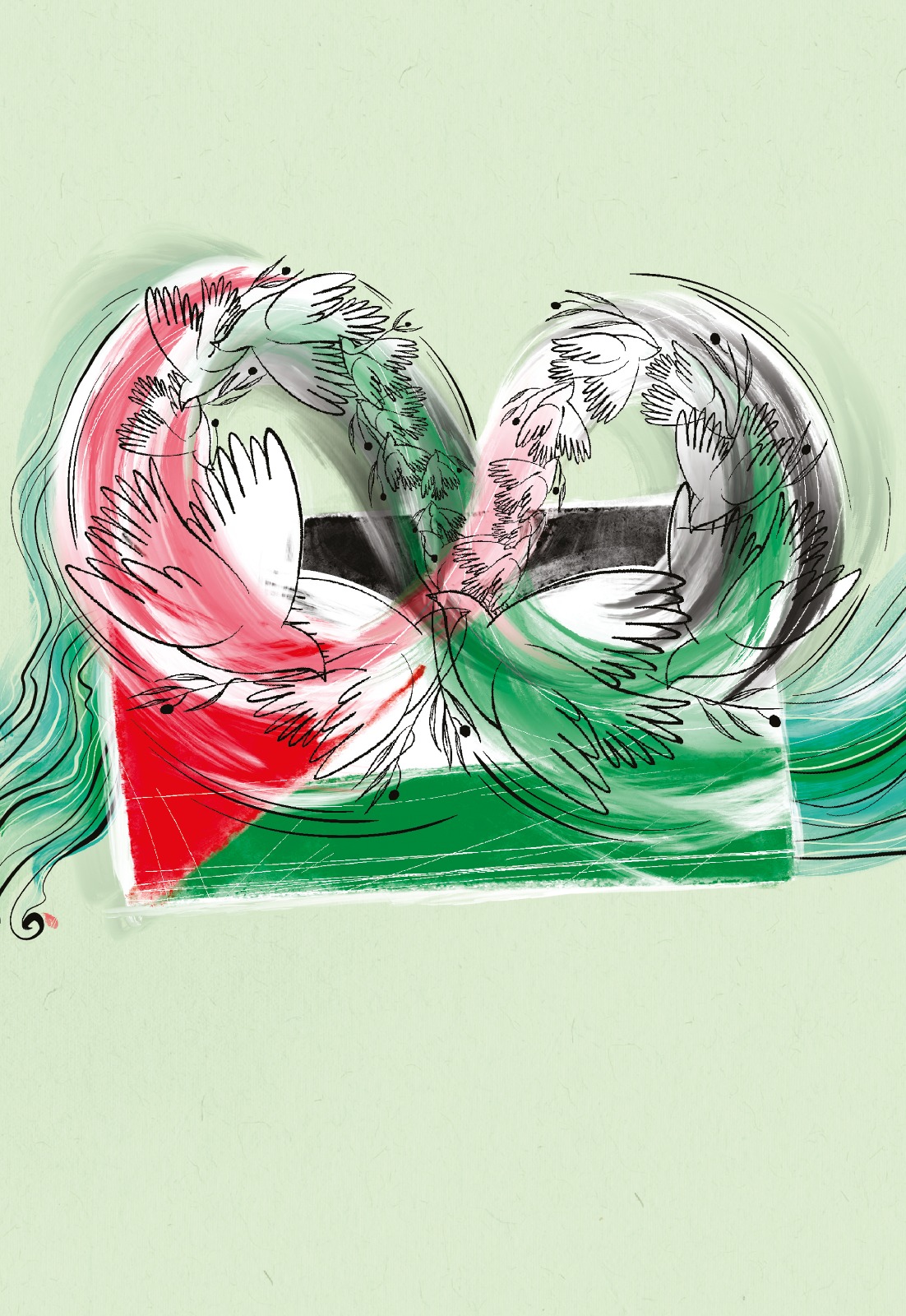
The Palestinian-Israeli issue is one of the most enduring and complex problems in modern history. Since the beginning of the 20th century, the Palestinian territories have been one of the most fundamental issues in international politics, representing the struggle between Western hegemony and anti-imperialism. Western imperialism has since established the state of Israel, which has led to numerous regional wars and countless crises, at the expense of the Palestinian people.
Israel has been the instigator of numerous regional wars, including four Arab-Israeli wars. It has been occupying the Palestinian lands since its establishment. At least, according to the United Nations (UN) resolutions and the main principles of international law, three pieces of the Palestinian territory, namely East Jerusalem, the West Bank, and the Gaza Strip, have been defined as the “occupied Palestinian territories.” As a result, considering that Israel has been following an aggressive and expansionist agenda towards the regional states, it can be argued that Israel is not only a state that has been occupying the Palestinian territories, but also violating national sovereignty of regional states.
Within this context, it has been consistently violating the basic principles of international law, the fundamental norms of human rights, and many UN resolutions. Israel has forced millions of Palestinians to flee their homes since 1948. Unfortunately, the Palestinians who choose to remain on their land have been deprived of all their fundamental human rights. Since then, Israel has been following discriminatory policies and implementing a strict apartheid regime against the Palestinian people.
After the Arab insurgencies and revolutions in 2011, there was a buildup of energy in the Palestinian territories, poised to explode any day. Recently, with the change of the political tide in the Arab world, the Palestinians were abandoned and isolated, consequently Israel increased the level of oppression against the Palestinian people. Many Arab regimes went even further and declared Hamas, the most effective and influential resistance movement representing the Palestinians, as a terrorist organization. Thus, they provided the atmosphere for Israel to eradicate all chances for the establishment of a Palestinian state. Palestinians were subjected to all manner of crimes by Israeli forces on a daily basis. Israel was expanding its territory by inviting the Jewish people living in other countries to come to Palestine in order to occupy the remaining land that is internationally recognized as belonging to the Palestinians.
As all these were taking place, Palestinians were completely ignored by both regional and global powers, as they were trying to appease the occupier and oppressor (Israel), not the occupied and oppressed (Palestine). The world’s solution to provide a better life for the occupied Palestinians, was to create an ‘open air prison’. The U.S. government, in particular, took two unilaterally damaging steps recently: moving its embassy from Tel Aviv to Jerusalem and recognizing the annexation of the Golan Heights, which historically and legally belongs to Syria. This and similar steps further encouraged Israel to continue its aggressive and expansionist policies.
The al-Aqsa Flood Operation, which started on October 7 2023, represents a turning point in the history of the conflict in Palestine. However, it is not a complete paradigm shift, but an intensification of processes on the ground, demonstrating that there are no radical differences between the previous context and the current context and situation. However, the impact of al-Aqsa Flood on the regional balances has been influential. Israel initiated a genocidal military campaign against the innocent Palestinian people living in Gaza. The Israeli war machine supported by the Western global powers has destroyed almost the whole of the Gaza Strip. It has targeted not only civilian infrastructure, but also hospitals, schools, mosques, and churches. It has relentlessly killed innocent civilians including children, women, journalists, aid workers, and international workers. It committed genocide not only by killing a large portion of the population of Gaza, but is also forcing them to die of starvation. So far, about 70,000 Palestinians have been killed by Israel, the majority of which are children and women. Unfortunately, the whole world has been silently watching this ongoing genocide.
Unfortunately, there is currently no state coming to the aide of the Palestinians while they are living under these inhumane conditions. Arab regimes largely remain indifferent to the genocide. Some Muslim countries have been diplomatically and politically criticizing the perpetrator of this genocide Israel, but they are taking no obvious action to change the conditions on the ground. In spite of the many reports prepared by the UN officials and institutions, by well-known international NGOs such as Amnesty International, and decisions made by the International Court of Justice and the International Criminal Court, many states continue to provide unconditional support to Israel to continue its genocide against the Palestinians in Gaza.
When we look over the last two years, we can easily see that there are three categories of states, in terms of their response to the Israeli genocide. The first group, consisting mostly of major Western powers led by the United States, the United Kingdom, Germany and some non-Western countries allied with Israel such as India, provide Israel with unconditional political, economic, and military support. This group of states are all complicit in the Gaza genocide.
The second group of states stands with the just cause of the victimized Palestinian people. Many countries in a geography stretching from the Middle East to Latin America, from East Asia to Africa, fall into this group. Among the most prominent examples are South Africa and Türkiye. South Africa has taken a historic and principled stance by bringing Israel before the International Court of Justice on charges of genocide, thereby transforming moral condemnation into concrete legal action. Türkiye, on the other hand, has been one of the loudest and most persistent voices against the atrocities in Gaza. President Erdoğan, in particular, has repeatedly denounced Israel’s actions as genocide on international platforms, including the United Nations, and has called upon other states to take a stronger and more unified stance against these crimes. Furthermore, some European states such as Ireland, Spain, Norway, and Slovenia have also openly opposed Israel’s genocide in Gaza.
The third group of states appears to remain indifferent to Israel’s unacceptable massacre of innocent people. Due to the global political and financial dominance of the transnational zionist network, many states choose to remain silent about Israel’s brutality in Gaza, possibly out of fear of repercussions. A large number of Arab states, which are largely dependent for their existence on the support of Western global powers, can be cited as members of this group.
Each group evaluates recent developments from its own perspective. The first group of states calls for the elimination of Hamas and its supporters regardless of how this will affect the Palestinian people. The second group is working for an immediate humanitarian ceasefire and calling on Israel to end its atrocities and the mass killings in Gaza. The third group is pursuing a “wait-and-see policy,” choosing not to react until they see the consequences of these developments.
However, the international community has begun to increase its opposition against Israel’s genocide. People around the world have begun to call on their respective governments and politicians to react to the genocide. An effective global coalition and a global network of human rights organizations have initiated a global conscience movement which is strongly condemning Israel’s aggression and expansionism. Most notably, the rise of the Western peoples is quite critical, since their governments are the main supporters and therefore complicit in the genocide. The Sumud Flotilla, 47 ships carrying 497 activists from 46 different countries in an attempt to break through the illegitimate and inhumane Israeli blockade against Gaza, is the most recent indication of this emerging global coalition.
Amid these developments, in this special issue, we aimed to provide a rigorous and multidimensional exploration of pressing political, humanitarian, and legal issues in Palestine. Specifically, in light of the ongoing humanitarian crisis and genocide in Gaza, this issue brings together analyses that span international law, diplomacy, media studies, conflict resolution, and political theory, offering both empirical insights and conceptual reflections. The contributions examine not only state and non-state actors’ strategies but also the perceptions and experiences of affected populations, providing a holistic view of regional dynamics and their global implications.
Emile Badarin’s commentary critiques the recent recognition of a Palestinian state, highlighting that it remains largely symbolic and fails to ensure the protection of the Palestinian people and their territory, two essential pillars of genuine statehood. Against a backdrop of ongoing Zionist settler-colonial practices, including ethnic cleansing, urbicide, territorial appropriation, and genocide, such recognition does not advance Palestinian freedom, self-determination, or sovereignty. Instead, it rewards Israel through regional normalization while undermining Palestinians’ moral and legal right to resist, functioning primarily as a diplomatic gesture that diverts attention from urgent efforts to halt ongoing crimes against humanity and war crimes.
A very important study is that of Zeynep Burcu Uğur, Ola Alkhuffash, and Islam Shahwan which presents survey data from 1,188 Gazans following the October 7 attacks, revealing that 58 percent blame Israel for the conflict, while 64 percent still view Hamas as essential for Palestine’s future despite criticisms. Respondents express support for both military and diplomatic solutions and view regional actors such as Egypt, Jordan, the UN, and Türkiye as key influencers, whereas Israel, the EU, and the U.S. face strong opposition. The findings of this article reveal the complexity of Gazan perspectives, challenging assumptions of uniform support for Hamas and highlighting the group’s resilience under intense pressure.
Furthermore, Abdulgani Bozkurt and Muharrem Doğan analyze Israel’s policies in Gaza through a framework of othering, destruction, and purification. They argue that conventional international relations concepts like conflict or war are insufficient to explain Israeli policies. The study examines how Jewish religious doctrines, “chosenness” and the Promised Land, are mobilized in political discourse to legitimize exclusion and frame Palestinians as the “other.” Through process analysis over 22 months, the article shows how political and religious elites employ theological references to portray the conflict as both a political struggle and a theologically grounded project of purification.
The genocide taking place in Gaza right now has highlighted many problems worldwide, including in the elite educational systems. In this regard, Ebubekir Ceylan critiques the suppressive response of British academia to the Gaza genocide, examining how geopolitical alliances, neoliberal institutional logic, and the weaponization of anti-Semitism have constrained academic freedom. Case studies illustrate how accusations of anti-Semitism have been used to silence pro-Palestinian critique, while acts of resistance, including protests, legal victories, and divestment campaigns, persist. The article concludes that the Gaza crisis exposes profound ethical failures in British academia, underscoring the need for a structural reimagining of academic responsibility, free speech, and global solidarity.
Similar problems have also been dominating the media. Mehmet Özdemir evaluates Thomson Reuters’ coverage of the Palestinian-Israeli conflict from October 7, 2023, to January 7, 2024, analyzing language, themes, visuals, tone, and emphasis. His findings show that Western media, often claiming neutrality, in fact tends to present Israel-centric narratives, emphasizing Israeli security while downplaying Palestinian suffering. The study highlights how media ownership and editorial control shape global perceptions and contribute to broader discussions on war journalism and media studies.
Besides news, the cinema sector has also been part of the Israeli façade. This can be understood better from the article of Muhammed Hüseyin Mercan and Yusuf Ziya Gökçek where they analyze the TV series Fauda, exploring how its narrative strategies legitimize Israel’s security-oriented claims and frame Palestinians as passive or trouble-making actors. The study demonstrates how media can reproduce social struggles and sovereignty discourses, transforming humanist themes into narratives that justify controlled or “secured” violence.
When we talk about genocide, international humanitarian law becomes an indispensable part of discussions. In this context, Yakup Yıldırım examines allegations of genocide against Israel following its attacks on Gaza after the al-Aqsa Flood Operation. Reports by UN independent experts indicate strong evidence of genocidal intent, while South Africa’s case at the International Court of Justice (ICJ) seeks to enforce the Genocide Convention and secure humanitarian protection. Israel’s noncompliance with ICJ measures and ongoing hostilities underscore challenges in enforcing international human rights obligations, but the case represents a critical opportunity to prevent grave crimes and reaffirm the supremacy of international law. Furthermore, Burak Güneş investigates interim injunctions issued by the ICJ in the South Africa-Israel genocide case, questioning the notion that international law serves only the powerful and exploring avenues to advance legal protections for Gaza based on the concept of “common interest.”
To understand better the roots of the problems we are facing today it is always necessary we go back to the historical background. With this purpose, Erhan Bektaş, in his article, examines the Sursuk family’s role in facilitating Jewish migration to Palestine during the late Ottoman period (1890-1920). Using archival documents, the study details land transactions arranged by the Sursuks, highlighting the multidimensional regional and international networks that enabled permanent Jewish settlement in Palestine, therefore leading to the current war in Palestine.
Hezbollah has been another actor in the Israel-Gaza war, and therefore it is important that its strategy is analyzed. In this context, Talha İsmail Duman investigates Hezbollah’s evolving war strategy after the October 7, 2023, al-Aqsa Flood Operation, focusing on its shift to high-intensity engagement with Israel. Applying Ontological Security Theory, the study explores Hezbollah’s dual role as a Lebanese political actor and resistance movement, highlighting the interplay between immediate security concerns, regional dynamics, and ideological identity in shaping strategic decisions.
In another article, Gökhan Çınkara focuses specifically on the relation between Türkiye and Israel, therefore helping to understand better Türkiye’s stance towards the Gaza genocide. His article traces Türkiye-Israel relations from 1949 to the present, highlighting key developments including the Abraham Accords, Türkiye’s post-Arab Spring foreign policy recalibration, and domestic social reactions to Israel’s actions in Gaza. The study demonstrates how structural, geopolitical, and societal factors interact, showing that public opinion increasingly shapes bilateral policy and signaling a potential recalibration of Türkiye’s approach to Israel.
Besides these pieces, this special issue includes several off-topic analyses that touch upon Turkish foreign policy and other developments taking place regionally. Firstly, Orkhan Valiyev analyzes Türkiye’s ‘New Türkiye’ strategy, arguing that the country is being reconfigured as a regional economic and political center rather than returning to early republican ideals. The study examines the restructuring of nationalism and state power in the post-Kemalist context, emphasizing a pragmatic, multipolar model of statehood that balances tradition with global repositioning amid global economic and social challenges.
In another article, Ahmet Faruk Levent and Hatice Gül study the abolition of the Turkish Language and Culture course in French middle schools. Using qualitative interviews with parents and teachers, the research finds that the course is viewed as essential for students’ language development and cultural connection to Türkiye, and that its removal reflects France’s assimilation policy, which risks weakening ties between Turkish children in France and their homeland.
The Armenia-Azerbaijan conflict has been one of the major regional issues lately. Despite the fact that the war ended, negotiations between the two parties still need to take place. Farhad Huseynov examines the application of the ‘principled negotiation’ method in the Armenia-Azerbaijan peace talks. Developed by the Harvard Negotiation Project in the early 1980s, this method emphasizes cooperation, mutual understanding, and consideration of each party’s interests to achieve solutions beneficial to all. The article argues that the adoption of principled negotiation could significantly enhance security and foster lasting peace in the South Caucasus, offering a model for conflict resolution grounded in collaboration rather than confrontation.
In the last years, UAE is emerging as a very important actor in the Middle East. Mukerrem Miftah analyzes the UAE’s post-2010 expansion in Africa, detailing economic and geopolitical investments exceeding $60 billion, including the construction of ports, military outposts, and engagement in security cooperation. The article suggests that the UAE’s stated objectives, emerging as a major power, countering security threats like the Muslim Brotherhood, al-Shabaab, and the Houthis, and protecting economic and strategic interests, mask more aggressive ambitions. Behind this expansion, the monarchy is accused of undermining African states’ sovereignty, perpetuating human rights abuses, fostering corruption, and exploiting resources across the continent.
Lastly, in his commentary Abdennour Toumi discusses Algeria’s foreign policy recalibration following the collapse of Bouteflika’s system in 2019. Facing regional instability and geopolitical rivalry with Morocco, Algeria has adopted an active and preemptive diplomatic posture focused on Tunisia, Libya, Morocco, the Sahel, and more recently, Sudan. Global challenges such as the COVID-19 pandemic and the Russia-Ukraine War position Algeria as a potential mediator, leveraging relationships with Moscow, Kiev, Beijing, and Washington. Its accession to the ASEAN Treaty of Amity and Cooperation in July 2025 underscores a commitment to multilateral diplomacy, while domestic reforms under President Tebboune enhance the credibility of Algeria’s evolving foreign policy.
This special issue offers a comprehensive and multidisciplinary examination of ongoing conflicts, state policies, media narratives, and societal responses, shedding light on the political, legal, and humanitarian challenges at the heart of the Israel-Palestine war and its global reverberations. Together, the contributions call for deeper analytical nuance, ethical awareness, and proactive engagement with the complex dynamics shaping the region today. We hope this issue will serve as a meaningful contribution to the growing body of analysis on the Gaza war and its broader implications.