
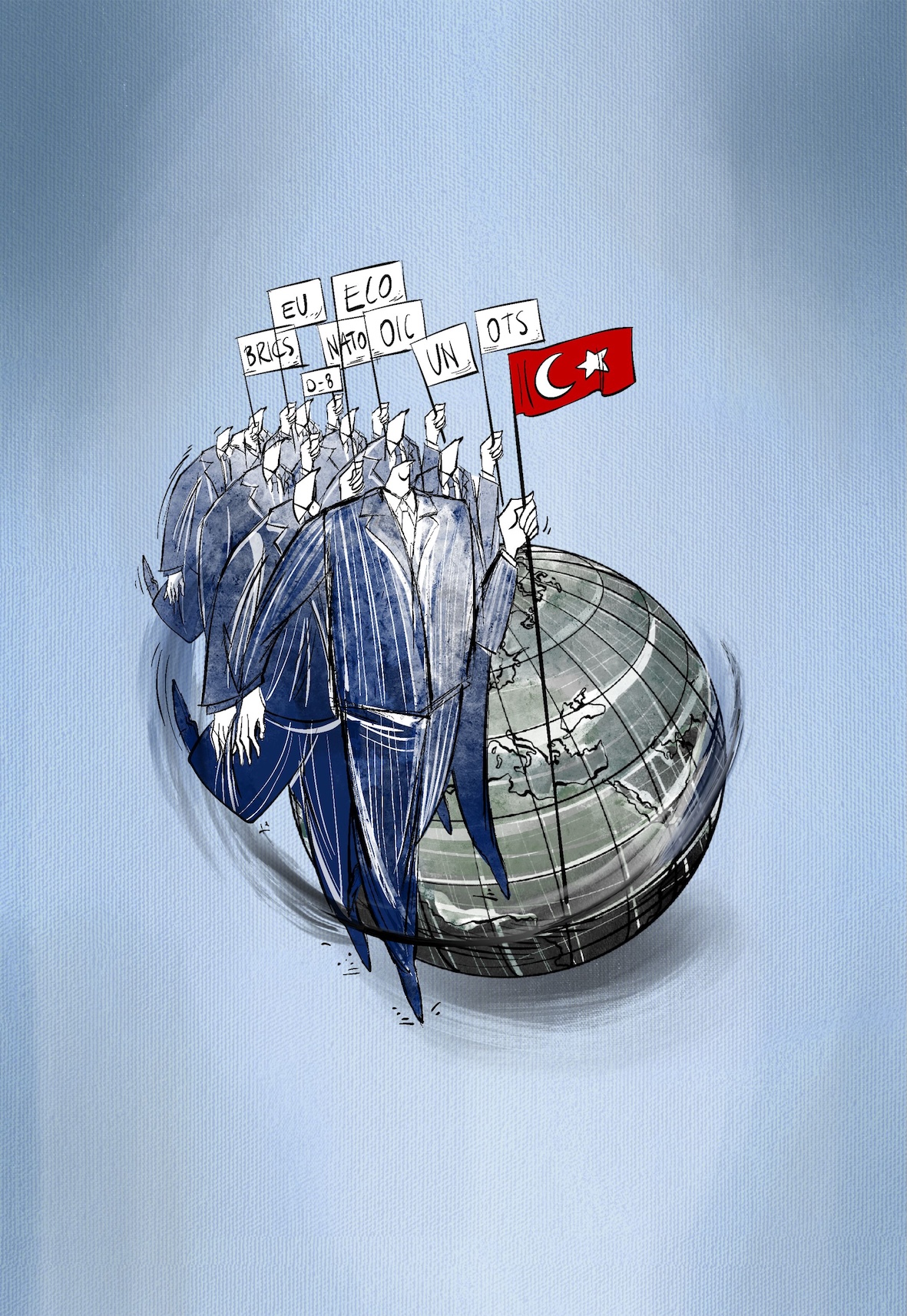
The changing dynamics in international politics and ongoing crises in different regions have largely brought the end of the global order. With the intensification of the global rivalry and the return of power-politics, the influence of international organizations (IOs) has also decreased. The war crimes, crimes against humanity, and genocide committed by Israel with the support of Western states have become the final nail in the coffin of the international order. In addition, Trump’s antagonistic statements against the territorial integrity of his Western allies, brushing aside the basic principles of international law and the fundamental norms of the current international system, are also an indication of the collapse of the global system.
All these developments have revealed the dysfunction and ineffectiveness of international organizations, which are designed as the main actors that ensure the order of the international system. Recently, not only revisionist countries, mainly non-Western countries who are excluded from the international system, but also Western countries, who established the current international order after the Second World War, oppose the IOs.
The United States (U.S.), who initiated the process for the establishment of the United Nations system after the Second World War in order to consolidate its global hegemony, has begun to undermine the role of global international organizations. For instance, the recent U.S. governments have been insistently ignoring the decisions made by the UN organs and affiliated IOs. Not only does the U.S. remain indifferent to the IOs decisions against itself, but also opposes the implementation of decisions made regarding a number of other countries.
In spite of all these detrimental developments that contribute to the ineffectiveness of global IOs, nation-states continue to come together and establish regional international organizations. Notably, small states and middle powers choose different strategies such as regionalism and minilateralism in order to maximize their national interests and to increase their deterrence in international politics. While, on one hand, small states and middle powers develop their relations with some countries on the principle of regionalism, which facilitates a collective identity and cooperation grounded in shared cultural, ideological and geographical ties. On the other hand, they develop their relations with other countries on the principle of minilateralism, which emphasizes pragmatic collaborations built on mutual national interests. Thus, they try to fortify their influence in international politics and reduce their dependence on global powers.
Türkiye places great emphasis on multilateral diplomatic activity. It is committed to the principles of the United Nations Charter and other norms of international law, including the territorial integrity and sovereign equality of states, maintenance of international peace and protection of international security. Türkiye, who aims to make contributions to the international system, has recently increased its presence in international institutions. Accordingly, it has initiated many openings to different regions and continents of the world in order to increase its global status.
Türkiye, who has been increasingly playing an initiator role in IOs, has recently emerged as a global actor that makes great contributions to the functioning of international organizations. On the one hand, Türkiye has been calling other states to reform the UN system. Within this context, Turkish President Recep Tayyip Erdoğan uses two complementary discourses, “The World Is Bigger than Five” and “A Fairer World Is Possible,” which both appeal for the restoration of the global system.
On the other hand, Türkiye, who is already a member of dozens of global and regional IOs, has been recently playing an initiator role in the establishment or the revision of some IOs. For the last three decades, Türkiye led the establishment of several important regional IOs. During the Özel period, Türkiye initiated the process for the establishment of the Economic Cooperation Organization (ECO) and the Organization for the Black Sea Economic Cooperation (BSEC). Then Turkish Prime Minister Necmettin Erbakan was the mastermind of the D-8, the headquarters of which is in İstanbul.
During the Erdoğan era, Türkiye has dramatically increased its relations with and influence in IOs. Türkiye has been trying to increase its role and effectiveness in global international institutions such as the UN and its affiliated organizations. Türkiye and President Recep Tayyip Erdoğan, who has been attending the UN General Assembly annual meetings for the last several years, attach great importance to the gatherings.
Türkiye expects the UN to take action on specific global and regional issues such as the COVID-19 pandemic, the Syrian crisis, and the Libyan issue. Türkiye calls on the UN to adopt a more active and effective position in the Israeli-Palestinian issue and the Syrian crisis. Ankara also insistently calls on the global powers to abide by the UN resolutions and the basic principles of international law such as the prohibition of the annexation of any territory by force from any country, whether it is Russia that annexes the Crimean Peninsula or Israel that annexes the Golan Heights. In addition, it calls on the global powers to not take unilateral action against other states, all of which undermine the very existence of the current international order.
Furthermore, Türkiye has been contributing to the UN position on certain regional issues. For instance, Türkiye hosted, facilitated and mediated the grain agreement under the auspices of the UN. Thus, by allowing, facilitating and organizing the passage of millions of tons of grain through the Turkish Straits, it has made a great contribution to the resolution of the global food crisis. Similarly, it is one of the few countries that supports the UN-recognized government in Libya. While most global and regional countries such as the U.S., France, and Russia have been supporting putschist Gen. Khalifa Haftar, Ankara has been supporting the UN-recognized Government of National Accord.
Türkiye has been trying to maintain its close collaboration with Western multilateral institutions such as NATO, the Organization for Economic Co-operation and Development (OECD), the Organization for Security and Co-operation in Europe (OSCE) and the Council of Europe. Ankara has upheld its responsibilities under these platforms and has never attempted to break off its relations with Western countries. On the contrary, it insistently accentuates its relations with the Western world. Unlike many European countries, including those that have declared the brain death of NATO, Ankara still values its NATO membership. Türkiye still tries to improve its political, military and economic relations with the West on the basis of equal partnership.
As an indication of its diversified foreign policy orientation, Türkiye has been trying to improve its relations with non-Western international organizations, such as the Shanghai Cooperation Organization (SCO), and to initiate regional integration processes with different categories of countries, such as the Turkic states. Türkiye has turned to other multilateral platforms mainly due to the deterioration of trust with Western allies; therefore, blaming Türkiye for improving its relations with the non-Western multilateral platforms is misleading. Another reason for Türkiye’s shift to regional platforms is the rising impact of regionalization on the global agenda. Not only Türkiye but also most states in the world try to initiate regional initiatives at different levels. Since a state cannot solve most of the problems that it faces alone, it has to cooperate with others to overcome the challenges. One of the processes that Türkiye prioritizes is improving cooperation among the Turkic states through the Organization of Turkic States (OTS). All in all, Türkiye has been trying to diversify its foreign relations. It is necessary to consider this diversification as a reaction to the policies of other states and an answer to the current necessities that have arisen in the international system.
In this special issue of Insight Turkey, we will focus on Türkiye’s increased activism in international organizations. Through comprehensive examinations, the articles in this issue shed light on Türkiye’s evolving strategies in navigating complex geopolitical landscapes, from its leadership in shaping the governance structures of international institutions to its mediation in conflicts and its active participation in addressing pressing international issues. This collection of works provides a rich perspective on Türkiye’s growing influence as an initiator state, highlighting its capacity to shape and redefine international norms and practices in the pursuit of a more equitable and multilateral global order.
In the evolving landscape of global diplomacy, Türkiye has long been committed to multilateralism, with its engagement to the UN serving as a cornerstone of this foreign policy approach. Gonca Oğuz Gök explores this enduring commitment, particularly highlighting Türkiye’s advocacy for reforming the UN Security Council through its “The World Is Bigger than Five” discourse and its broader efforts to promote a more equitable system of global governance. Gök examines how Türkiye has strategically positioned itself as a key actor in peacebuilding and conflict resolution, reflecting its overarching vision for a fairer and more just global order.
Mustafa Kibaroğlu, in his commentary, explores the evolving dynamics of transatlantic relations, focusing particularly on the changing approach of the U.S. under President Trump’s second administration. Kibaroğlu examines the broader implications for NATO’s future, its involvement in the war in Ukraine, and the prospects for the Alliance’s eastward expansion. Kibaroğlu highlights how these developments may influence the trajectory of Türkiye-NATO relations.
Musa Kulaklıkaya explores Türkiye’s leadership within the Organization of Islamic Cooperation (OIC), focusing on how the country has spearheaded reforms aimed at addressing socio-economic disparities, enhancing humanitarian responses, and promoting solidarity among member states. His analysis delves into Türkiye’s strategic use of the OIC as a platform to amplify the voices of the Islamic world on key global challenges, ranging from economic development to responding to humanitarian crises.
In his examination of Türkiye’s contributions to the Organization for Economic Co-operation and Development (OECD), Kerem Alkin offers a profound analysis of Türkiye’s role as a founding member. He traces Türkiye’s efforts to bridge the global North-South divide, advocating for sustainable and inclusive economic policies. Alkin further focuses on Türkiye’s evolving economic strategies, shedding light on how the nation navigates the complex terrain of balancing traditional alliances with the emergence of new global partnerships.
In another commentary, Sergey Ryabkov examines the evolving international system, marked by shifting economic power and geopolitical realignments, which have prompted the rise of BRICS as a strategic partnership. Advocating for a multipolar world order, BRICS seeks to represent the interests of the global South and East. Ryabkov explores the bloc’s expansion and its initiatives in trade, finance, technology, and climate action.
In their insightful analysis on Türkiye’s growing role in IOs, Muhittin Ataman, Metin Yücekaya, and Ömer Naim Küçük challenge the conventional notion that mere membership in global institutions signifies a state’s foreign policy activism. They introduce the thought-provoking concept of the “initiator state,” which highlights Türkiye’s increasingly proactive stance in shaping the establishment and governance of international bodies. This exploration focuses on Türkiye›s historical trajectory, tracing transformative periods under the visionary leadership of Atatürk, Özal, and Erdoğan, each of whom steered the nation towards assuming a pivotal and dynamic leadership role within global organizations.
As mentioned above, OTS is a very important organization in terms of Türkiye’s foreign policy that is why it deserves special attention. Fırat Purtaş, in his comprehensive analysis, explores Türkiye’s pivotal role in fostering deeper integration among Turkic states, emphasizing its strategic position as a regional connector. Through the cultivation of cultural ties and the execution of key infrastructure projects, such as TANAP and the BTK railway, Türkiye has effectively bridged geographical and political divides. The paper intricately examines Türkiye’s evolving diplomacy, particularly its adaptive responses to the Russia-Ukraine war, while showcasing how Türkiye has skillfully transformed cultural cooperation into a more formalized, political integration within the OTS.
In a compelling examination of Türkiye’s relationship with the European Union, Aylin Ünver Noi revisits the EU’s distinctive status as a sui generis international organization and offers a nuanced evaluation of Türkiye’s ongoing EU membership process. Her analysis explores Türkiye’s alignment with the EU’s Common Foreign and Security Policy (CFSP) from 1999 onward, focusing on the intricate effects of Europeanization, de-Europeanization, and renationalization on Turkish foreign policy. Through this, Ünver Noi provides a deep reflection on the evolving complexities and challenges in EU-Türkiye relations, highlighting the dynamic shifts in their diplomatic trajectory.
Despite the Western organizations, non-Western ones have gained a lot of importance in the last decade. Within this context, Ferhat Durmaz offers a comprehensive analysis of Türkiye’s expanding ties with key Asian institutions, including the SCO, the Asian Infrastructure Investment Bank (AIIB), and the Association of Southeast Asian Nations (ASEAN). In his research article, Durmaz analyzes the political, economic, and security dimensions of Türkiye’s engagement with these organizations, shedding light on the strategic balancing act Türkiye faces as it navigates its commitments to NATO while simultaneously cultivating a growing influence in Asia.
This issue of Insight Turkey includes also 5 off-topics research articles that touch upon very important issues. One of these issues is related to the Israeli-Palestinian conflict. Specifically, Zelal Başak Yariş and Necmettin Acar analyze the evolving policies of the European Union towards the Israeli-Palestinian conflict in their article, shedding light on the shifting dynamics that have influenced EU strategies. Their work traces the EU’s transition from a more balanced approach to one increasingly focused on security concerns. By examining the changing identities of pivotal political actors, such as the Palestine Liberation Organization and Hamas, the article highlights how these transformations have played a significant role in shaping EU policy decisions.
Moreover, focusing especially on the Islamophobic ideologies by taking the into consideration the Zionist and Hindutva movements in the films Exodus (1960) and Bharat Ek Khoj (1988), Rabia Aamir, offers a critical examination of how these cinematic works contribute to the construction of “implonialism” —a fusion of colonialism, imperialism, and fascism— through their reinforcement of Islamophobic ideologies. Aamir’s study not only challenges the historical narratives presented in these films but also uncovers the subtle yet powerful role of popular culture in perpetuating harmful prejudices against marginalized communities.
In another off-topic research article, Hamza Preljević explores the numerous challenges confronting Bosnia and Herzegovina on its arduous path to EU membership. Identifying pivotal obstacles —including the political system, societal divisions, and the intricate status of the Muslim population— Preljević highlights the factors that have impeded Bosnia’s progress. This study sheds light on the multifaceted barriers that continue to obstruct the country’s integration process and the broader implications of its struggles for EU accession.
Furthermore, in their detailed examination, Fadi Zatari and Ahmad Mawlana explore the crucial role of the Central Security Forces (CSF) in upholding authoritarian regimes in Egypt, tracing their origins from the establishment by Gamal Abdel Nasser through to their development under Sadat and Mubarak. The article analyzes the increasing significance of the CSF in safeguarding the regime against both internal and external threats. However, it also sheds light on their failure to suppress the 2011 protests, a critical moment that resulted in Mubarak’s resignation and the eventual downfall of the authoritarian regime.
Finally, in a compelling exploration, Muhammet Koçak and Ufuk Can Keküllüoğlu unravel the profound transformation in the diplomatic relationships between Türkiye and Central Asian nations, particularly Kazakhstan and Uzbekistan, in the wake of the Second Karabakh War. Through the lens of Critical Discourse Analysis, the authors artfully trace the evolution of the political narratives in both countries, shedding light on how Türkiye’s stature as a pivotal strategic ally in regional geopolitics and its growing role in fostering cultural ties have reshaped the contours of its diplomatic interactions.
Together, these topics illustrate Türkiye’s dynamic and evolving foreign policy, its growing regional and global influence, and its active role in shaping international organizations and geopolitical dynamics. This special issue provides crucial insights into the strategies and challenges Türkiye faces in a rapidly changing global landscape, positioning itself as a key player in both regional and international affairs.
By presenting a diverse range of perspectives, this special issue offers an in-depth understanding of Türkiye’s foreign policy trajectory. The analyses not only illuminate Türkiye’s strategic priorities but also underscore its capacity to navigate global challenges with resilience and adaptability. This collection of articles and commentaries serves as a valuable resource for scholars, policymakers, and practitioners interested in Türkiye’s growing role in international relations.