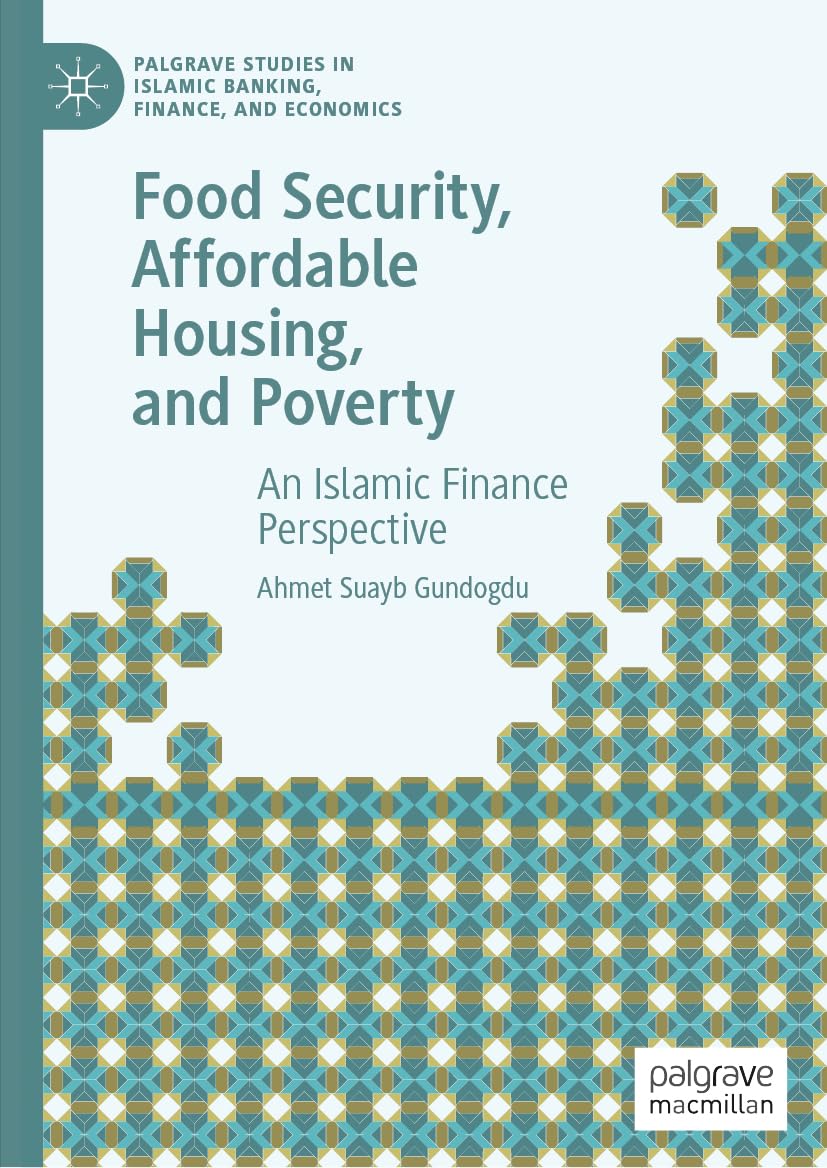
The book, Food Security, Affordable Housing, and Poverty: An Islamic Finance Perspective, is part of a series that aims to contribute to developments in the Islamic finance industry, moral economics, regulatory and supervisory issues, and risk and asset management. This series focuses on key developments in the Islamic finance sector, as well as related contributions to moral economics, innovations in financial instruments, regulatory and supervisory issues, risk management, insurance, and asset management. The book explores the issue of poverty, intricately intertwined with food security and affordable housing. The book argues that financial institutions’ lending practices and collateralization issues are driving up prices in the housing and food sectors. This book consists of seven chapters. It addresses the issues of food security, affordable housing, and poverty from the perspective of Islamic finance. It is also based on the premise that the financial sector can only promote economic progress if it directs capital to its most productive uses, while avoiding moral hazard and adverse selection. Islamic banks became necessary as the complexity and product diversity of conventional finance began to increase. However, difficulties in managing liquidity for treasury functions led some scholars to criticize Islamic banks. In response, Shariah-compliant alternatives were developed. Despite the criticisms, typical Islamic finance contracts such as Istisna, Ijara, Mudaraba, and Murabaha were found to be Shariah-compliant in the lending process. On the other hand, Islamic finance products that were not Shariah-compliant included Bai Al-Inah, Islamic Discounting/Factoring (Bai Al-Dayn), and Commodity Murabaha based on Organized Tawarruq.
In the first chapter, the book addresses the issues of house prices and poverty. The author argues that the behavior of financial institutions encourages real estate hoarding, which hinders the provision of affordable housing for the younger generation. In agriculture, these institutions favor lending to large agricultural producers while neglecting small-scale farmers. The adverse selection stemming from these practices is said to contribute to food security and affordable housing challenges. The book contends that financial liberalization alone is insufficient to tackle poverty and inequality. Instead, it advocates for strong policy measures and financial regulations to channel capital toward ensuring long-term sustainability. By examining food security and housing issues from the perspective of Islamic finance, the book makes significant contributions to the literature. Its primary aim is to uncover the poverty and inequality caused by financial policies and to propose solutions rooted in Islamic finance principles. In this respect, it serves as a valuable resource for researchers and policymakers seeking to develop Islamic finance-based solutions. Moreover, the book’s recommendations for ensuring fair price formation in financial and economic systems offer a unique perspective on sustainable development and poverty alleviation.
In the second chapter, the book examines Islamic mortgages and securitization. It highlights that financing facilitated by both conventional and Islamic banks contributes to rising prices. The more funds are utilized and the lower the interest/profit share, the higher the demand for housing, which leads to escalating prices and an affordability crisis. This reflects the design and outcomes of the current financial and economic system. It assumes that affordable housing can be achieved through increased housing production and mortgages, supported by the trickle-down effect. However, directing funds to housing production and sales leads to inflated land prices. More funding further drives up land and housing costs, weakening purchasing power. The book argues that land-use policies should discourage land hoarding and corruption. It suggests that Islamic economics, with its principles of limited ownership and the application of zakat on hoarded properties, could reduce the motivation for hoarding and corruption in the real estate sector.
Chapters 3 and 4 focus on food security, poverty, and financing agricultural commodity trade. The author critiques financial institutions for favoring large-scale agricultural producers while neglecting small farmers, exacerbating issues of food security and affordable housing. To combat land rent-seeking, the book proposes Islamic land-use policies such as zakat and ownership limitations. This approach is expected to enhance social welfare and economic justice. The author also emphasizes the need for zakat on unused agricultural land based on market value to promote sustainable production. The book advocates for time limits on land ownership to prevent hoarding by a minority with excessive control over pricing. Rather than imposing rent caps, it proposes limiting land ownership. It also calls for reforms in financing practices that drive up housing prices, suggesting stricter credit conditions and policies to reduce land and housing costs. The author argues that shorter financing terms and reduced securitization risks could mobilize resources more efficiently, benefiting society overall despite potentially harming land hoarders and profit driven banks. In agriculture, the book stresses the importance of supporting small farmers while preventing monopolistic practices by large producers. This approach is expected to foster rural development, ensure food security, and reduce land hoarding and corruption.
In chapter 5, the book explores the role of cooperatives in enhancing food security. Cooperatives with sound governance practices can play a vital role by providing lower-cost financing, discounted input supplies, crop processing and storage, and higher profit margins for sold crops. Typically established by members who come together when market conditions fail to provide affordable and acceptable-quality goods or services, cooperatives aim to enhance economic opportunities. They achieve this by increasing bargaining power in input supply and output sales and ensuring access to necessary services and products, including financing. Operating on a competitive basis, cooperatives aim to reduce costs, manage risks, and improve income opportunities.
In chapter 7, the book discusses the role of the state from an Islamic perspective. It argues that the state’s role should be limited to regulation, supervision, and law enforcement rather than directly providing credit, housing, infrastructure, or agricultural production. The state should create an enabling environment for society to overcome its challenges. Instead of directly assisting the poor from the public budget, the state should develop and manage a safety net system based on zakat, ensuring wealth transfer from the rich to the poor. The Islamic perspective defines the state’s role within the framework of hisbah (accountability), which involves enforcing laws, regulating markets, and supervising compliance. The state’s role should be clearly defined within the context of providing infrastructure services. Islamic wisdom suggests that private provision is suitable for economic infrastructure, while the waqf model is recommended for social infrastructure. The government’s role, grounded in hisbah, is to ensure accountability. Historically, state failures often stemmed from a lack of accountability and inadequate involvement in economic and social infrastructure.
The book deeply explores how Islamic finance principles can promote social justice and economic stability. However, its impact could be enhanced with more concrete case studies and empirical data to support the proposed policies. While offering significant theoretical and conceptual discussions, the book could have benefited from more detailed analysis of how financial policies influence social cohesion and contribute to overall societal welfare. This book is a valuable resource for undergraduate and graduate students, as well as policymakers, offering insights into the intersection of Islamic finance and socioeconomic challenges.