
Introduction
Throughout its historical evolution, “Malaysia” has been identified by a plethora of names, encompassing the Malay Peninsula, Malaya, and Melaka. In the era of colonial dominion, it was denominated as “British Malaya” or the “Straits Settlements.” Analogously, Türkiye has been designated by a multitude of appellations across the annals of history, including Anatolia, Byzantium, and the Ottoman Empire. Beyond these generic nomenclatures, historical documents attributable to both cultures have employed more nuanced terms to refer to each other. Esteemed works of classical Turkish literature, such as the Kitab-ı Bahriye and the Cihannûma, reference the Malay Peninsula utilizing a variety of expressions, including “Ceziretü’l-Hindiyye” and “Malakka.” Furthermore, traditional Malay texts spanning from the 15th to 17th centuries frequently employ terms such as “Turk,” “İstanbul,” and “Rum,” with references to their sovereigns as “Raja Rum.”1 Thus, the lexicon employed in the historical narratives of both Malaysia and Türkiye reflects the rich tapestry of cultural interchange and underscores the deep-rooted connections and mutual recognition that have evolved over centuries.
The term “Indo-Malay world,” which today draws attention with its Muslim population nearing 350 million, describes the Muslim geography in Southeast Asia. Commensurate with the prevailing flow of people and trade, new ideas, cultures, and religions from the lands to the West have significantly influenced the entirety of the Indo-Malay world.2 Hence, the Western part of the Indo-Malay world, which today includes the Malay Peninsula and Indonesia’s Sumatra Island, were the geographical regions that first encountered these innovations. In the Malay Peninsula, the oldest evidence related to the presence of Islam is an inscription found within the boundaries of the Malaysian state of Terengganu. Syed Naquib Alatas claimed this inscription, which provides information on the principles of Islamic law; dates back to 1303,3 although some recent studies have shown that the inscription dates to 1308.4
The lexicon employed in the historical narratives of both Malaysia and Türkiye reflects the rich tapestry of cultural interchange and underscores the deep-rooted connections and mutual recognition that have evolved over centuries
Just 200 years after these initial findings regarding the Islamization of the Malay Peninsula, the occupation of Malacca by the Portuguese in 1511 would influence the region’s fate up to the present day. The onset of this colonization in the region also led to the involvement of the Ottoman Empire and the commencement of initial relations. Following this brief introduction, this paper examines the relations between Malaysia, which the Turks would regard as a hub in their interactions with Southeast Asia, and Türkiye, from a historical perspective. In conclusion, this study also addresses the current and potential relations between these two distant states within the Islamic world in the context of contemporary relations.
The uniqueness of this study lies in its comprehensive exploration of the historical ties between the Turks and Malays, spanning not only the modern era but also delving into ancient relations between the two societies. This approach provides a holistic framework, tracing the evolution of these relations from antiquity to the present day. The study draws upon a rich array of primary sources, including archival documents and official correspondence, meticulously sourced from repositories such as the Ottoman Archives, the Archives of the Republic of Türkiye, and the Malaysian Archives. The primary data extracted from BOA: Directorate of the State Archives of Türkiye (Cumhurbaşkanlığı Devlet Arşivleri Başkanlığı Osmanlı Arşivi), BCA: Presidency of the Republic of Türkiye Directorate of State Archives Republican Archives (Türkiye Cumhuriyeti Cumhurbaşkanlığı Devlet Arşivleri Başkanlığı Cumhuriyet Arşivi) and National Archives of Malaysia (Arkib Negara Malaysia). The primary sources used in this study for a comprehensive overview of relations between Malaysian and Turkish peoples in cementing global Islamic bonds between nations. Additionally, extensive efforts were made to incorporate newspaper and secondary sources in Turkish, English, and Bahasa Melayu, further enriching the analysis. Furthermore, current trade and tourism data between the two nations were sourced from the official websites of their respective diplomatic missions, ensuring accuracy and reliability.
Ottoman Caliphate and the Malay Sultanates
In addition to the eponymous Malay Peninsula, Malay people inhabit regions such as Sumatra, South Thailand, and Borneo, reflecting their widespread distribution. This expansive geographical presence is crucial when examining Malay-Turkish relations; thus, areas beyond the Malay Peninsula, like Riau, Jambi, and Pattani, are integral to this analysis. Additionally, Malay Sultanates such as Johor, Kedah, Perak, and Malacca form the core of this study. The Ottoman Sultans, bearing the title of Caliph and seen as protectors of the Muslim community (ummah), played a pivotal role in global Islamic identity, and the particular interest of local sultanates in the Ottoman Caliphate was further galvanized by the onset of colonial encroachments in the region, highlighting the geopolitical significance of these interactions.
Historically, the Ottoman Sultans were revered in Malay societies as eminent rulers and were considered the nominal leaders and guardians of all Muslims since the 16th century
In 1511, the Portuguese occupation of Malacca −a strategic port city located on the southern tip of the Malay Peninsula, overlooking the Strait of Malacca− inspired the beginning of diplomatic engagements between the Ottoman Empire and the Muslim societies of the Indo-Malay world. Concerned by the Portuguese expansion and the potential threat to their trade routes, the Sultanate of Aceh −one of the most formidable powers in the Indo-Malay world during the early modern period− sent his letter to the Ottoman Sultan, Süleyman the First (1520-1566). Sultan Alaeddin Riayat Shah of Aceh (1537-1571) dispatched a letter to İstanbul, seeking an alliance against the Portuguese incursion.5 In response, the Ottoman Empire sent military support to the Muslims in the Indo-Malay region to help them reclaim Malacca.6 However, this intense period of cooperation between the Ottomans and the Indo-Malay Muslims was short-lived, drawing to a close in the 1570s. It was not until the mid-19th century that relations between the Malays and Turks were rekindled on a new basis, expanding to encompass a broader array of engagements with numerous Malay sultanates.
From the 16th to early 20th centuries, the Malays held the Ottoman Empire and its leaders in high regard, perceiving them as spiritually influential, despite their geographical distance. Although formal ties had been ruptured for some time, the 19th century saw a revival of diplomatic interactions between the Turks and Malays. The reconnection began when the Kedah Sultanate, located in the northwest of the Malay Peninsula, reached out to the Ottoman Empire in 1824, coinciding with the year of the Anglo-Dutch Treaty. Sultan Ahmad Tajuddin Halim Shah of Kedah (1803-1821 and 1842-1845) penned a letter to the Ottoman Sultan in İstanbul, seeking assistance against Siamese aggression.7 In his correspondence, he described himself as “the sultan of one of the lands of the Javanese, which is beneath the equator, called Kedah, which has belonged to us since ancient times.”8 Unfortunately, the letter’s arrival in İstanbul coincided with the outbreak of the Greek uprising, rendering the Ottomans unable to respond to the Sultan’s request.9 It was not until nearly 25 years later that more substantial interactions between the two regions began to develop.
Following the withdrawal of the Portuguese, the Dutch and the British began to assert their presence in the region, dividing the territories of present-day Indonesia and Malaysia among themselves as a result of the Anglo-Dutch Treaty of 1824. As a consequence of this arrangement with the British, the Dutch embarked on a policy of invasion and expansion in the Archipelago (the British largely confined their activities to the Straits Settlements at this juncture, having limited engagement with the Malay sultanates). However, this policy alarmed the sultanates in the region, turning their attention once again towards İstanbul, i.e., the Caliphate. While no diplomatic relations had been observed between the Ottoman Empire and the Sultanate of Aceh since the breakdown of their relationship in 1571, Sultan Ibrahim Mansur Shah of Aceh (1838-1870) successfully established new diplomatic ties with his contemporary, the Ottoman Sultan Abdulmejid (1839-1861), through a delegation he sent in 1849.10
In the petition presented by the Acehnese envoy el-Hac Muhammad Gus, it was stated that “they considered themselves as subjects of the Ottoman Empire both in the past and the future, consistently offered prayers and supplications for the Sultan during the five daily prayers and Friday sermons, and would not accept any state other than the Ottomans.” This request was conveyed both verbally and in writing to the Ottoman Sultan.11 The Acehnese Sultan’s desire to affiliate with the Ottoman Empire was met with great satisfaction by the Ottoman Sultan. However, it was communicated to the Acehnese Sultan that the final response to this request would be determined after observations and analyses by a special envoy to be sent by the Ottoman Governor of Yemen.12 Nevertheless, the Ottoman Empire could not replicate the same level of engagement in 1850 as it had in the 16th century.
The Acehnese resistance inspired neighboring states such as Riau and Jambi, which are predominantly inhabited by Malays. While the diplomatic relations with the Sultanate of Aceh were ongoing, other Malay sultanates on the island of Sumatra, just across the Malay Peninsula, conveyed their desires to become vassal states under the Ottoman Empire to İstanbul. In their letters to the Ottoman Sultan Abdulmejid, similar requests to those of the Acehnese sultan were expressed by Riau Sultan Amir, Ali ibn Ja’afar in 1857,13 and Jambi Sultan Taha Safuiddin in 1858.14 However, it is understood from archival records that the Ottomans, being unfamiliar with the region, were unsure of how to respond to these requests. These requests for allegiance, seen as a way to escape colonial invasions, somewhat complicated the situation for the Ottoman Empire, which was primarily pursuing a policy of balance and damage limitation, fearing that establishing relations with the regional sultanates could harm their relations with the British.
During the reign of Sultan Abdulhamid the Second (1876-1909), the last significant Ottoman Sultan (who wielded effective political power), there was a significant shift in the Sultanate’s role as a mediator between the subjugated Muslim populations and global powers. This period marked the emergence of a new policy commonly referred to as the pan-Islamism movement, which first resonated with Muslims in India, particularly with figures like Shibli Nu’mani (1857-1914), who actively raised funds to support the Ottoman cause in the Balkans.15 This influence rapidly evolved into a powerful intellectual movement, galvanizing Muslims in colonial territories across the globe. Historically, the Ottoman Sultans were revered in Malay societies as eminent rulers and were considered the nominal leaders and guardians of all Muslims since the 16th century. However, from the 1880s onwards, the notion of the “Caliph” gained unprecedented importance. According to Ali Hasjm, the Sultanate of Aceh recognized the Ottoman Sultans as Caliphs not only during the late 19th century but also from the early 16th century, underscoring a long-standing reverence that predated Abdulhamid the Second’s era.16
Within this context, the Ottoman Empire appointed consuls to strategic locations in Southeast Asia, such as Singapore and Batavia (present-day Jakarta). This move was complemented by grassroots activism, including the efforts of pilgrims and students from Java, as well as the local press, which played a crucial role in introducing and spreading new ideas, including those related to Ottoman soft-power initiatives, throughout the region. The Arab Hadrami community, which had settled in the region for centuries, was particularly instrumental in embracing and propagating these ideas across the archipelago.17
Following the appointment of Ottoman consuls to Singapore, the regional hub of trade and shipping, the relationship between the Ottoman Empire and the Sultanate of Johor reached its zenith. This official engagement began during the reign of Sultan Abu Bakar (1833-95) of Johor, who made a notable visit to the Ottoman capital in 1893.18 On June 14, 1894, Sultan Abu Bakar dispatched an envoy to İstanbul to express his regards, marking a significant step in fostering mutual understanding and cooperation between the two civilizations.19 Sultan Abu Bakar of Johor’s visit to İstanbul was pivotal in bridging cultural and legal exchanges between the two regions. One notable influence of the Ottoman Empire on Johor was in the realm of Islamic law. The Mecelle-i Ahkam Adliyye, a legal code compiled during the late Ottoman period by Ahmad Cevdet Pasha and widely recognized across the Islamic world, was translated into Bahasa Melayu in 1913 under the title Majallah al-Ahkam al-Adliyyah Turki Uthmaniyah, further illustrating the deep-rooted connections and exchanges between the Ottoman Empire and the Malay world.20
During the early 20th century, as the Ottoman Empire was embroiled in numerous conflicts and the Malay community expressed a desire to support the Turks in their struggles against Western powers
During Sultan Abdulhamid the Second’s tenure, visits to İstanbul by regional monarchs, including sultans and princes, were a notable trend. A prime example of this was the visit of the Prince of Siam (modern-day Thailand) to İstanbul, where he met with Sultan Abdulhamid the Second in 1891. The Thai Royal family’s trips to İstanbul did not end there, with subsequent visits recorded in 1891, 1899, and 1909.21 Sultan Suleiman Sharif Alaeddin (1890-1899) of Pattani, representing the Muslim Malays in what is now Southern Thailand, also harbored intentions to visit İstanbul, further illustrating the deep fascination and respect the Malay community and their leaders had for the Ottoman Empire.22 This interest went beyond mere diplomatic visits; during the early 20th century, as the Ottoman Empire was embroiled in numerous conflicts and the Malay community expressed a desire to support the Turks in their struggles against Western powers.
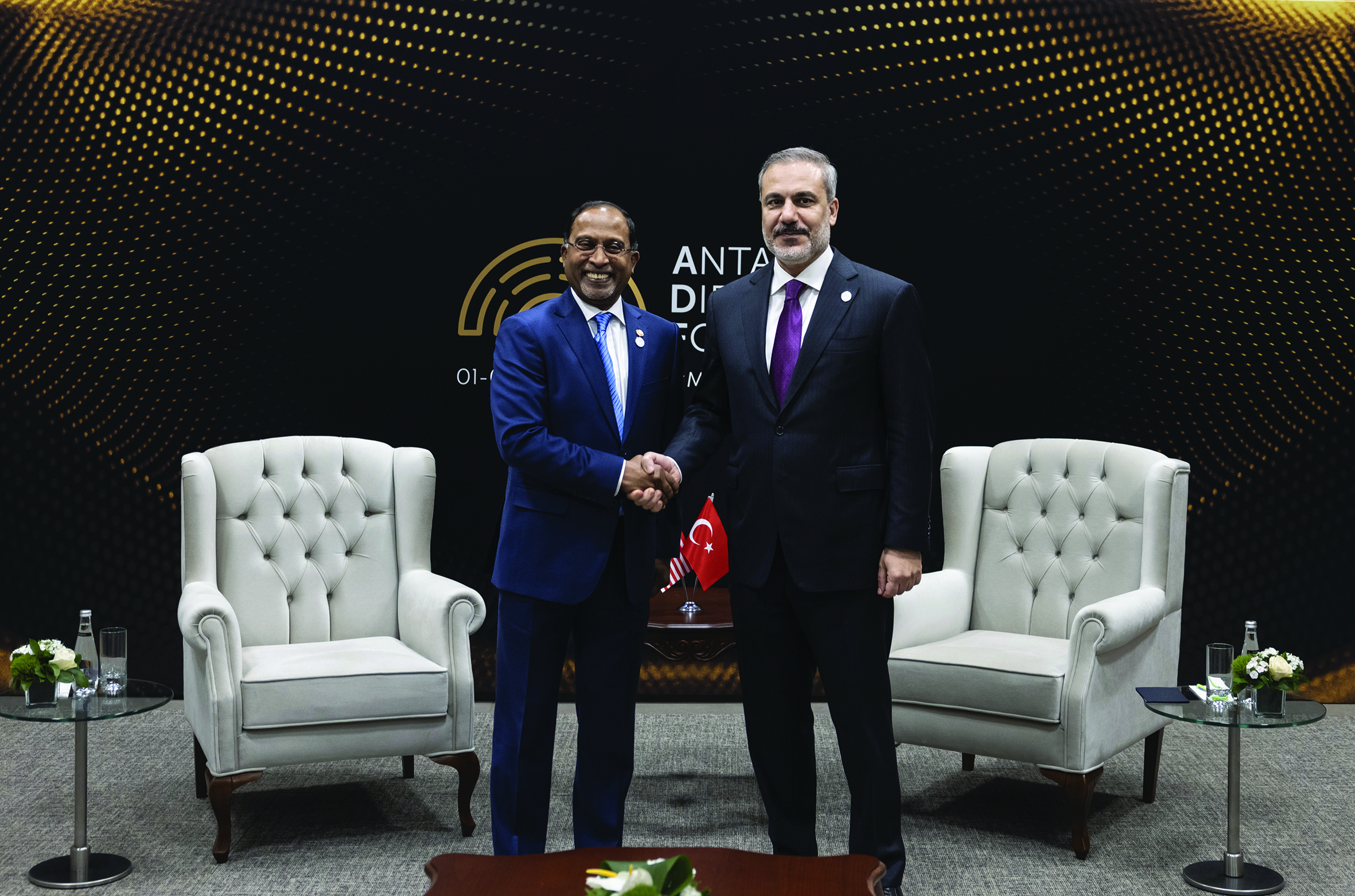 Foreign Minister Hakan Fidan (R) met with Malaysian Foreign Minister Dato’ Seri Zambry Abdul Kadir (L) within the scope of the 3rd Antalya Diplomatic Forum, in March 2024. MURAT GÖK / AA
Documentary evidence reveals tangible instances of this support, such as the Perak Sultanate, located on the West coast of the Malay Peninsula, raising funds for the Turkish Red Crescent (Kızılay) to aid Turkish soldiers wounded in battles against non-Muslim nations.23 Similarly, the residents of Muar located less than 50 km from Malacca, demonstrated their solidarity by sending financial aid to İstanbul on August 20, 1913, to support the Ottoman Empire in its confrontations with Western countries.24 This sense of unity was further manifested in local conflicts, such as the skirmishes in Sungai Ujung, North of Malacca, around the same period. During these encounters with British forces, some local armed groups chose to fly the Ottoman flag, symbolizing their allegiance and shared sentiment with the Ottoman cause.25
The enduring mutual religious and cultural beliefs between the two countries constitute a pivotal base for the enrichment bilateral relations
The fall of the Ottoman Empire and the subsequent formation of the Republic of Türkiye marked a significant shift in Turkish-Malay relations, entering what could be described as a second phase of discord. During the era of Mustafa Kemal Atatürk, Türkiye’s interactions with the Islamic world were notably constrained. The war-ravaged land was dominated by a new secularist Turkish nationalism, firmly focused on imitating European nation-states, whose colonial empires dominated most Muslim lands and people, and the active suppression of the country’s former Islamic identity undermined its historical links with Muslims worldwide. The abolition of the Caliphate just a year after the establishment of the Republic may have also altered the perceptions of Southeast Asian Muslims, known for their loyalty to this institution, towards the new Republic of Türkiye.
This period saw a virtual cessation of ties with regions under foreign dominion, including Malaysia, which was then a British colony. However, the landscape of these relationships transformed with Malaysia’s emancipation from British rule on August 31, 1957, heralding the inception of the Federation of Malaya. This pivotal moment signified the commencement of a new chapter, marking the third phase in the evolving dynamics between Türkiye and Malaysia.
Two New States: Republic of Türkiye and Federation of Malaya
The First World War had a negligible impact on the Malay population, as fighting was centered on the Western and Eastern Fronts in Europe and the Middle East. After Abdulhamid the Second was deposed in 1909, the Ottomans experienced substantial setbacks, with defeats in the Balkan Wars (1912-1913) and post-First World War nationalist struggles (1919-1922). Conversely, the Second World War had a far more profound effect on the Malays, most notably in the Japanese occupation of Malaya (1942-45).26 On a local level, the Japanese occupation had the significant effect of politicizing the Malay population, awakening their potential for post-war religio-nationalist mobilization. For the first time, non-elite Malays gained valuable administrative experience and developed stronger anti-European sentiments.27
The establishment of the United Malays National Organization (UMNO) in 1946 marked a pivotal moment in the history of Malaysia, laying the groundwork for the nation’s path to independence. UMNO emerged as a crucial political entity, significantly contributing to the movement for liberation. Malaysia celebrated its sovereignty from British colonial rule on August 31, 1957. Türkiye was among the first nations to extend its congratulations on this monumental achievement. A document housed in the Archives of the Republic of Türkiye reveals that preparations to celebrate Malaysia’s impending independence were made in advance. Turkish Prime Minister Adnan Menderes (1899-1961) penned a message of felicitation to Malaysian Prime Minister Tunku Abdul Rahman (1903-90), dated August 17, 1957, before the official declaration of independence. The message expressed that “On the happy occasion of the proclamation of the Malayan independence, I take great pleasure in presenting to your Excellency, my warmest congratulations and most sincere wishes for the welfare and prosperity of the Malayan people.”28
Roughly 18 months following the congratulatory gestures for Malaysia’s independence, the Republic of Türkiye took a significant step by deciding to station its inaugural diplomatic envoy in Malaysia. On February 17, 1959, it was resolved that Tevfik Kazım Kemahlı, the ambassador in Jakarta, would concurrently serve as Türkiye’s representative to the Malaysian Government.29 Mirroring Türkiye’s approach, Malaysia opted not to directly assign an ambassador to Ankara. Instead, the first Malaysian Ambassador to Iran, His Excellency Ahmad Zainal Abidin Mohd Yusof, was appointed in 1971, signifying Malaysia’s broader diplomatic strategy.30 The establishment of these foreign representatives laid the groundwork for deepening bilateral relations. Over the subsequent decade, diplomatic ties between Türkiye and Malaysia saw considerable growth, culminating in the latter part of the 20th century with the opening of consulates in each country, symbolizing a new era of intensified cooperation and mutual engagement.
Malaysia-Türkiye Bilateral Relations, 1964-2002
The year 2024 is the 60th centenary of the diplomatic affiliation cemented between Türkiye and Malaysia in 1964. The enduring mutual religious and cultural beliefs between the two countries constitute a pivotal base for the enrichment bilateral relations. Apart from their active embassies in each other’s capital cities, Türkiye and Malaysia have numerous twinned cities, including Johor Bahru and İstanbul.
The initial diplomatic relations between Malaysia and the Republic of Türkiye began with the appointment of a Turkish ambassador in 1964, and Malaysian Prime Minister Hussein’s visit to Türkiye in 1977.31 The main grounds for a mutual bond were laid during the second Tun Hussein’s trip to Türkiye in 1983, on which three accords were agreed, including the founding of the Islamic University of Malaysia; the standard pact on air flight services between Kuala Lumpur and Ankara, and between Johor Bahru and İstanbul; and the impending mutual transfers of academic professionals.32 From 1971 to 1977, Ahmad Zainal Abidin, the former Malaysian Ambassador to Iran, was assigned to Türkiye, and the Malaysian Embassy in Ankara was inaugurated in 1977 at the level of Chargé d’Affaires. The first designated Malaysian ambassador to Türkiye, Mohamed Mustapha bin Datuk Mahmud, presented his credentials in Ankara on June 20, 1978, while Türkiye opened its Embassy in Kuala Lumpur in 1976.33
Turkish Prime Minister Necmettin Erbakan made attempts to change the course of Turkish foreign policy and restore elements of Islamic identity by cooperating with the Muslim countries in matters from economy to defense, and visited Malaysia on August 16, 1996, for economic and political talks. Erbakan was greatly known for his achievement in founding the Group of Developing Eight (D-8), promoting developmental cooperation between its eight Muslim-majority member states, including Malaysia, which was strongly backed by Mahathir Mohamad (commonly referred to in Malaysia and internationally as “Mahathir”).34 Mahathir visited Türkiye in 1983, 1994, and 1997.
During his earlier four-day visit in 1983, Mahathir and Turkish Prime Minister Bülent Ulusu signed two agreements, on-air communications between the two states and collaboration between Ankara’s Middle East Technical University and the University Technology Malaysia, with an exchange of lecturers whereby Türkiye agreed to be one of the founding members of the International Islamic University Malaysia. Both leaders showed their concern about the low level of trade between the two countries.35
During his 1994 visit, Mahathir exchanged views with his Turkish counterpart, Tansu Çiller, who ascribed Malaysia’s remarkable global prominence to his incredible strategies. She articulated that the two countries would obtain measures to expand and broaden their relations in mutual dialogues to increase economic cooperation. She was also optimistic that many Malaysian entrepreneurs would find links with Turkish businesspeople to gauge the opportunities for further collaboration, marking the great economic development of both countries, with prospects to exchange views on regional and international issues.36
With a population of 400 million and a combined GDP of $500 million, AFTA offers a massive trade perspective for Turkish companies; both sides were reassessing and identifying directions to enhance bilateral ties
Mahathir’s 1997 visit was to attend the first D-8 Summit in İstanbul. However, following the coup d’état in Türkiye on February 28, 1997, Erbakan’s government abruptly tilted Turkish foreign policy back toward Western nations, ignoring the manifest global importance of Malaysia and Southeast Asia and the unique opportunities existing relations offered at that juncture.37 Subsequently, when the AK Party rose to power in 2002, bilateral relations were resurrected, with a rapid boost in mutual trade.38
Modern Relations, 2003-2024
Then-Prime Minister of Türkiye, Recep Tayyip Erdoğan came to Malaysia for a three-day state visit on June 13, 2003, along with a 200-member delegation, including three Cabinet ministers and nine members of the Turkish Parliament, seeking the reactivation and revitalization of the Malaysia-Türkiye Business Council and the Economic and Trade Joint Commission. Mahathir encouraged firms from Türkiye to use Malaysia as a regional base to enter the huge Asian market and to tap the opportunities provided by the ASEAN Free Trade Area (AFTA).39 With a population of 400 million and a combined GDP of $500 million, AFTA offers a massive trade perspective for Turkish companies; both sides were reassessing and identifying directions to enhance bilateral ties.40
The era of Prime Minister Abdullah Badawi (2004-2009) initiated the new approach of “Islam Hadhari” (Islamic Civilization), which shaped prospects for Malaysia to resuscitate and widen its relationships with Muslim-majority states, including Türkiye, which was highlighted during a visit by Prime Minister Erdoğan in 2005 during a commiserative tour of countries affected by the 2004 tsunami. However, there was no official visit at the level of heads of state between Türkiye and Malaysia, although Erdoğan and Abdullah Badawi exchanged ideas during UN meetings in 2007.41
Following increased diplomatic exchanges, bilateral relations between Malaysia and Türkiye were always germane to increasing cooperation. Prime Minister Dato’ Sri Mohd Najib Tun Abdul Razak (commonly referred to as “Najib”) promoted the slogan “Wasatiyah” (moderation) and officially visited Türkiye in February 2011. In personal meetings with Erdoğan, the leaders signed a memorandum of understanding between SME Corp. Malaysia (Small and Medium Enterprise Corp. Malaysia) and KOSGEB (Small and Medium Enterprise Development Organization) Türkiye and the agreement between Deftech Defense Technologies Sdn Bhd Malaysia and FNSS Savunma Sistemleri A.Ş., Türkiye. In İstanbul, Najib visited President Abdullah Gül and participated in the Malaysia-Türkiye Business Round Table negotiations between the Malaysian Industrial Development Authority (MIDA) and Universal Movement for Justice, Peace and Dignity jointly organized by the Institute for Strategic and International Studies (ISIS) and International Movement for a Just World.42
On the invitation of Prime Minister Erdoğan, Najib visited Türkiye in 2014 to boost bilateral cooperation and contact in all dimensions. On the 50th anniversary of diplomatic relations, a “Free Trade Agreement and Agreement Concerning Mutual Visa Exemption” was signed, and Erdoğan said, “In our efforts to develop cooperation with the Southeast Asian countries, our relations with our strategic partner Malaysia give us power and confidence.”43
Prime Minister Erdoğan officially visited Malaysia on January 10, 2014, and both Prime Ministers discussed relations and international progress. Erdoğan noted that the “Strategic Cooperation Action Plan” was the basis for increasing collaboration between Türkiye and Malaysia. Erdoğan articulated that “Our views overlap on contribution to regional and global stability. Within this framework, we can take the necessary steps by addressing current developments both at the bilateral level and within the framework of international organizations such as the United Nations, Organization of Islamic Cooperation, and D-8.” The International Islamic University Malaysia granted him an honorary Ph.D. in an elegant ceremony. Prime Minister Erdoğan also addressed the conference “Transforming Eastern Asia - Pacific Region and Türkiye.”44
Prime Minister Najib Tun Razak’s visit to Türkiye for the G20 Summit in November 2015 provided an opportunity for him to engage in discussions with President Erdoğan on bilateral matters concerning both nations. Malaysia’s participation in the Summit, representing ASEAN as its chair, underscored the robust existing ties between Malaysia and Türkiye.45 Additionally, Najib attended the Organization for Islamic Cooperation (OIC) Summits in Türkiye in 2016 and 2017, during which he met the Turkish Minister of Foreign Affairs and other senior government officials.46 The latter was to address the U.S. recognition of illegally occupied Jerusalem as the capital of Israel. Malaysia reasserted its staunch support for the Palestinian people in their quest to achieve their rightful and absolute rights for a sovereign State of Palestine based on pre-1967 borders, with East Jerusalem as its capital.47
In the early 16th century, the Ottomans formally adopted the title of Caliphate and forged ties with the Acehnese of Southeast Asia. This engagement led to the enduring presence of Ottoman and Turkish influence among Southeast Asian Muslims for centuries
Upon his return to office as Prime Minister, Mahathir was officially invited by President Erdoğan to visit Türkiye from July 24-27, 2019. During this visit, discussions centered on bilateral relations, particularly in defense, and explored potential avenues for enhancing cooperation in foreign affairs and business matters between Türkiye and Malaysia.48 Subsequently, defense cooperation emerged as a pivotal dimension in Türkiye-Malaysia relations, exemplified by agreements signed in 2019 between Sapura Secured Technologies and ASELSAN for military communication, and between Havelsan and AMP Corporation for coastal radar surveillance. This ongoing collaboration has positioned Türkiye as one of the largest participating countries at the Defense Services Asia (DSA) and National Security Conference Asia (NATSEC) fairs held in Kuala Lumpur in March 2022, showcasing the strengthening ties between the two nations, particularly in the military sphere.49 Such initiatives and similar activities in defense highlight the deepening relations and growing partnership between Türkiye and Malaysia.
On the invitation of President Recep Tayyip Erdoğan, Prime Minister Ismail Sabari Yaakob arrived in Türkiye on July 5, 2022, with many high-ranking government officials, including the Ministers of Foreign Affairs and Science, Technology and Innovation. During his stay, the premier visited the MKE Corporation and Turkish Aerospace Industries (TAI). Türkiye is the third-largest trade partner for Malaysia in Western Asia (with the largest being Saudi Arabia, followed by the UAE), with a volume of over RM 16.97 billion last year, and projects implemented valued at RM 444.59 million. Last year, Malaysia exported RM 4.68 billion worth of palm oil and related products for the Turkish food, home, and personal care industries.50
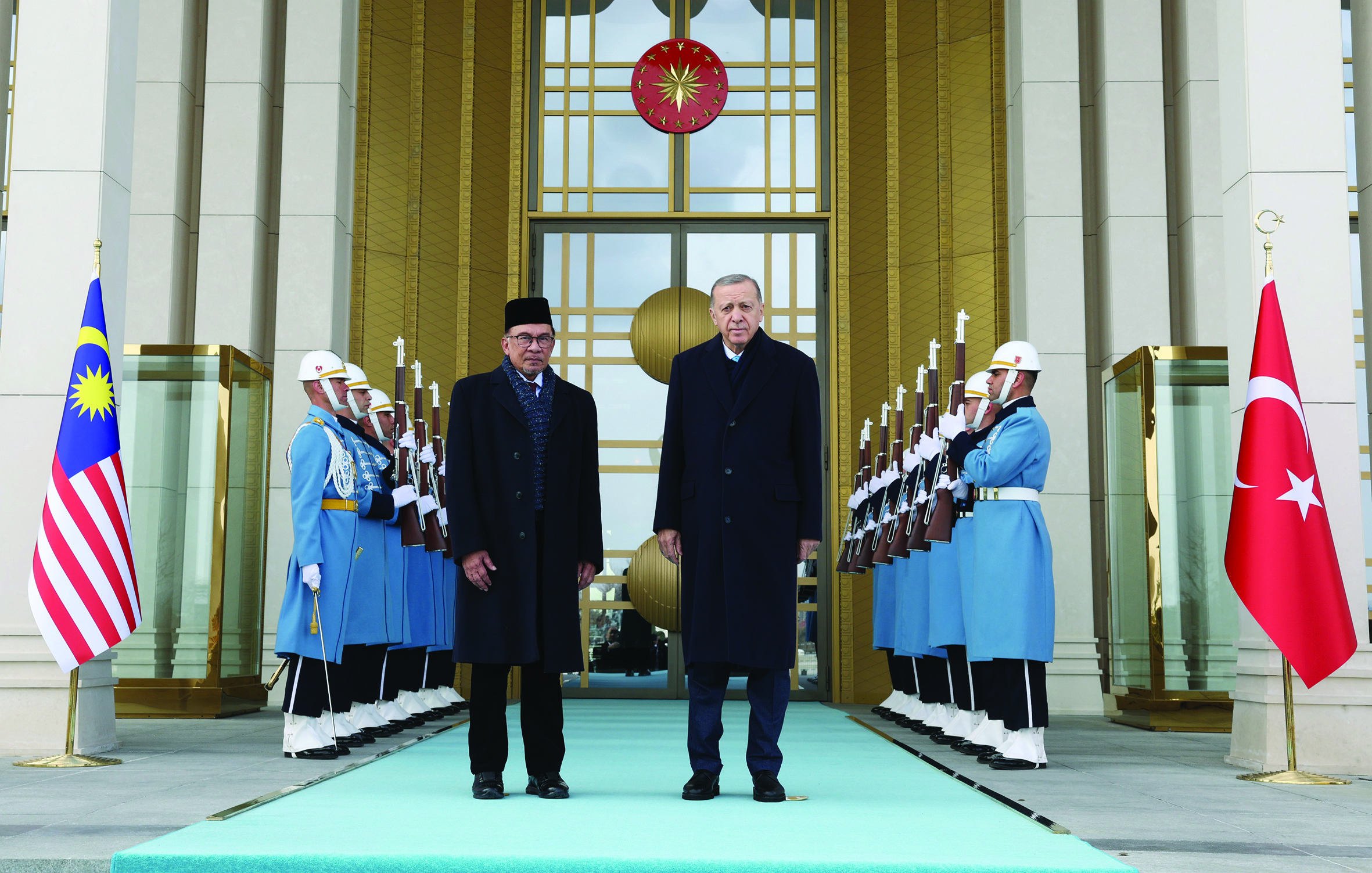
Following the February 2023 earthquakes, Malaysian Prime Minister Anwar Ibrahim met President Erdoğan in Ankara and visited affected areas, while bringing 75 members of the Malaysian Special Search and Rescue Team (SMART) to assist in emergency efforts. He extended condolences to Ankara, saying: “I am deeply saddened by the huge loss of lives, injuries and massive destruction. On behalf of the government and the people of Malaysia, I wish to extend my deepest sympathies and condolences to the victims and families, as well as to all countries affected by the disaster. May Allah the Almighty grant the victims and bereaved quick recovery and solace.”51
In the face of contemporary challenges and opportunities, the Republic of Türkiye and the Federation of Malaya continue to strengthen their partnership, recognizing the importance of collaboration in navigating the complexities of the modern world
Prime Minister Anwar Ibrahim visited again in October of the same year, meeting with Erdoğan and several high civil and defense officials, along with the Malaysian Foreign Minister. The main items discussed during the meeting included increasing perturbation with regard to the Arab-Israeli conflict.52
Conclusion
Malaysia and Türkiye share a rich history of enduring ties marked by mutual respect, affection, and tangible support. Dating back to the spread of Islam in Southeast Asia centuries ago, Malay communities have maintained strong bonds and engaged in diverse cultural and socio-economic exchanges with their counterparts in South and West Asia. This relationship serves as a compelling example of how distant geographical locations can foster deep and multifaceted connections over time. The adoption of Islam by Malays in the 14th century saw the emergence of Turks, referred to as “Rum,” in their traditional epic narratives known as hikayats.
In the early 16th century, the Ottomans formally adopted the title of Caliphate and forged ties with the Acehnese of Southeast Asia. This engagement led to the enduring presence of Ottoman and Turkish influence among Southeast Asian Muslims for centuries. The onset of colonial occupations in the Malay world further solidified connections between the Ottomans and Malays. The presence of colonial powers such as Portugal, Spain, the Netherlands, and Britain in the region played a significant role in shaping relations between the Ottoman Empire and the Malay world. Despite occasional interruptions, relations between these two regions reached their zenith in the last quarter of the 19th century.
The re-established relations between the Republic of Türkiye after the First World War and the Federation of Malaya after the Second World War differed significantly from their previous interactions. Today, the modern relationship between these two nations encompasses a broad spectrum of fields, ranging from the defense and microchip industries to diplomatic collaboration and tourism. The enduring bond between Muslim Malays and Turks is rooted in shared love and affection, characteristic of all members of the Muslim ummah. Their historical solidarity in resisting Western colonialism serves as a testament to this connection. While modern political fluctuations have occasionally disrupted their former relations, recent decades have witnessed a resurgence, with both countries now standing united. They are increasingly engaging in extensive economic cooperation and aligning their defense and foreign policies, positioning themselves to lead the global Muslim community toward a more equitable and universally beneficial future.
In the face of contemporary challenges and opportunities, the Republic of Türkiye and the Federation of Malaya continue to strengthen their partnership, recognizing the importance of collaboration in navigating the complexities of the modern world. As they forge ahead, both nations remain committed to fostering deeper cultural understanding, economic prosperity, and strategic cooperation. Together, they strive to uphold the principles of mutual respect, solidarity, and progress, ensuring that their shared journey leads to a brighter and more prosperous future for their people and the broader Muslim community worldwide.
Endnotes
1. In the Holy Quran, the term ‘Rum’ is used in Arabic to denote the “Romans,” who are recognized in Western history as the Byzantines. This designation was also adopted in Turkish writings to describe the Roman and Christian communities in the Eastern Mediterranean region. In classic Malay texts, the Ottoman Empire was called “Rum,” and its leader was titled as the “Raja Rum” or “Sultan of Rum.” See: Vladimir Braginsky, “Turkic-Turkish Theme in Malay Literature, with Special Reference to the Works of the Fourteenth to Mid-Seventeenth Centuries,” A. C. S. Peacock and Annabel Teh Gallop (eds.), From Anatolia to Aceh - Ottomans, Turks and Southeast Asia, (Leiden: Oxford University Press, 2015), p. 264.
2. Syed Hussein Alatas, “Reconstruction of Malaysian History,” Revve du Sudest Asiatique, No. 3 (1962), pp. 219-245.
3. Syed M. Naquib al-Attas, The Correct Date of the Trengganu Inscription, (Kuala Lumpur: Muzium Negara, 1970), p. 24.
4. Ahmat Adam, The New and Correct Date of the Trengganu Inscription, (Kuala Lumpur: SIRD, 2017), pp. 1-21.
5. “No. E-8009, H. 15/Jumādā al-Ākhirah/973,” Topkapı Palace Museum Archive, (January 7, 1566). See for the full text of the letter for further details: Razaulhak Şah, “Açi Padişahı Sultan Alaeddin’in Kanuni Sultan Süleyman’a Mektubu,” Tarih Araştırmaları Dergisi, Vol. 5, No. 8 (1967), pp. 373-409.
6. “A. {DVNSMHM.d, 7/244,” BOA: Directorate of the State Archives of Türkiye.
7. Alaeddin Tekin, “The Ottomans and the Malay Sultans of the Peninsula,” in Asyraf Isyraqi Bin Jamil and Ömer Altun (eds.), Deepen the Ties: A Multi-Dimensional Perspectives of Malaysia-Türkiye Relations, (Kuala Lumpur: Universiti Malaya Press), pp. 17-32.
8. “HAT, 785/36657,” BOA: Directorate of the State Archives of Türkiye.
9. İsmail Hakkı Kadı and Andrew C. S. Peacock, Ottoman-Southeast Asian Relations (2 Vols.): Sources from the Ottoman Archives, (Brill, 2019), pp. 155-159.
10. “İ. HR, 66/3208,” BOA: Directorate of the State Archives of Türkiye.
11. “İ. HR, 73/3511,” BOA: Directorate of the State Archives of Türkiye.
12. “İ. MVL, 230/7935,” BOA: Directorate of the State Archives of Türkiye.
13. Alaeddin Tekin, “Restoration of Riau Sultanate-Ottoman Relations (1857-1904): Explanatory Factors,” Al-Shajarah: Journal of the International Institute of Islamic Thought and Civilization (ISTAC), Vol. 26, No. 2 (2021), pp. 177-196; See: “İ. HR, 368/24377,” BOA: Directorate of the State Archives of Türkiye.
14. “İ. HR, 173/9431,” BOA: Directorate of the State Archives of Türkiye.
15. Arshad Islam, “Indian Muslims’ Support for Ottoman Pan-Islamism: The Case of Shibli Nu’mani,” Intellectual Discourse, Vol. 27, No. 1 (2019), pp. 197-220.
16. Ali Hasjmy, “Banda Aceh Darussalam Pusat Kegiatan Ilmu dan Kebudayaan,” Seminar Sejarah Masuk dan Berkembangya Islam di Aceh dan Nusantara, (Majelis Ulama Propinsi Daerah Istimewa Aceh dan Pemerintah Daerah Tingkat 2, Aceh Timur, 1980), p. 4.
17. See for more information on Hadramis in Malay world; Alwi Alatas and Alaeddin Tekin. “The Indonesian-Hadramis’ Cooperation with the Ottoman and the Sending of Indonesian Students to Istanbul, 1880s-1910s,” Tarih İncelemeleri Dergisi, Vol. 37, No. 1 (2022), pp. 27-52.
18. “HR. TO, 114/76,” BOA: Directorate of the State Archives of Türkiye.
19. “HR. SFR.3, 428/16,” BOA: Directorate of the State Archives of Türkiye.
20. Ermy Azziaty Rozali, “Sayid Muhammad Al-Saoff in Johore-Ottoman Sovereign Relations,” Advances in Natural and Applies Sciences, Vol. 6 (2012), pp. 893-898.
21. İsmail Hakkı Kadı, The Ottoman Empire and the Kingdom of Siam through The Ages, (Bangkok: Institute of Asian Studies, 2017).
22. “Y. A. HUS. 389/5,” BOA: Directorate of the State Archives of Türkiye.
23. “HR. SFR.3, 695/1,” BOA: Directorate of the State Archives of Türkiye.
24. “BEO, 4214/315984,” BOA: Directorate of the State Archives of Türkiye.
25. Barbara Watson Andaya and Leonard Y. Andaya, Sejarah Malaysia, (Kuala Lumpur: Syarikat R&S, 1983), p. 189.
26. Paul H. Kratoska, The Japanese Occupation of Malaya: A Social and Economic History, (University of Hawaii Press, 1997), pp. 35-36.
27. Ahmad Fauzi Abdul Hamid, “Malay Anti-colonialism in British Malaya: A Re-appraisal of Independence Fighters of Peninsular Malaysia,” Journal of Asian and African Studies, 42, No. 5 (2007), p. 384.
28. “7/36-7/A4,” BCA: Presidency of the Republic of Turkey Directorate of State Archives Republican Archives.
29. “151/75-6/1-86,” BCA: Presidency of the Republic of Turkey Directorate of State Archives Republican Archives.
30. “Brief History,” Ministry of Foreign Affairs, Malaysia, retrieved from https://www.kln.gov.my/web/irn_tehran/history#:~:text=The%20first%20Ambassador%20of%20Malaysia,Ahmad%
20Zainal%20Abidin%20Mohd%20Yusof.
31. Turki Duta Besar Mr. Hasan, Istinyeli Menyampaikan Tauliahnya di Istana Negara, (Kuala Lumpur: National Archive of Malaysia G.3840 2001/0044256, 1964); Lawatan Rasmi ke Turki, Datuk Hussein Onn dan Datin Suhaila Diberi Sambutan Meriah, di Lapangan Terbang Istanbul, (National Archive of Malaysia, G.14789 2001/0044231, 1977); see also: Asmady Idris and Ömer Kurtbağ, “Malaysia-Turkey Relations in History and Today,” Programs, (November 19, 2013), retrieved from https://www.researchgate.net/publication/305735378_Malaysia-Turkey_Relations_in_History_and_Today. Middle East Institute.
32. Asmady Idris and Ömer Kurtbağ, “Lawatan ke Turki, Perdana Menteri, Dato Seri Dr Mahathir Mohamad di Upacara Menandatangani Tiga Perjanjian,” Angkara, (National Archive of Malaysia, G.18443 2001/0048310, 1983); Asmady Idris and Ömer Kurtbağ, “Malaysia-Turkey Relations in History and Today,” Middle East Institute, (November 19, 2013), retrieved from https://www.researchgate.net/publication/305735378_Malaysia-Turkey_Relations_in_History_and_Today.
33. “History,” Ministry of Foreign Affairs, Malaysia, retrieved from https://www.kln.gov.my/web/tur_ankara/history?.
34. “Lawatan Rasmi TYT Prof. Dr. Necmettin Erbakan, Perdana Menteri Republik Turki ke Malaysia - 16.8.1996-18.8.1996,” National Archive of Malaysia, 356 1999/0025650; Yücel Bozdağlıoğlu, Turkish Foreign Policy and Turkish Identity: A Constructivist Approach, (New York: Routledge, 2003), pp. 55-126; see: Hasan Kösebalaban, Turkish Foreign Policy: Islam, Nationalism, and Globalization, (New York: Palgrave Macmillan, 2011), p. 136; William Hale, Turkish Foreign Policy since 1774, (New York: Routledge, 2013), p. 228; Jan Stark, “Malaysia-Pakistan Linkages: Searching for New Diversified Regional Contacts,” The Round Table: The Commonwealth Journal of International Affairs, Vol. 98, No. 401 (2009); The other members are Bangladesh, Egypt, Indonesia, Iran, Nigeria, Pakistan, and Türkiye. The current population of the eight countries is about 1.2 billion or 60 percent of all Muslims, or close to 13 percent of the world’s population and occupying an area of 7.6 million square kilometres, 5 percent of world land area. The İstanbul Declaration of Summit of Heads of State/Government officially established the group on June 15, 1997; Dipo Alam, “A Glimpse at D-8 Achievements,” Republic of Türkiye Ministry of Foreign Affairs, retrieved from https://www.mfa.gov.tr/data/Kutuphane/yayinlar/EkonomikSorunlarDergisi/sayi32/dipoalam.pdf.
35. “Dr. Mahathir’s Four-Day Visit to Turkey,” The Star, (May 17, 1983).
36. “Malaysia and Turkey Have Agreed to Have Regular High-Level Contacts to Exploit Fully the Trade and Investment Potential between the Two Countries. The Agreement Was Reached in Talks between Prime Minister Datuk Seri Dr Mahathir Mohamad and Turkish Prime Minister Tansu Ciller in Ankara on Tuesday,” New Straits Times, (October 25, 1994); Koleksi Arkib Ucapan Ketua Eksekutif, (October 27, 1994).
37. Sabri Orman, “Malaysia and Turkey: Comparative Experiences and Bilateral Relations,” in Abdul Razak Baginda (ed.), Malaysia and the Islamic World, (London: ASEAN Academic Press, 2004), pp. 119-156.
38. “The Official Dinner in Honour of H. E. Recep Tayyip Erdogan Prime Minister of the Republic of Turkey,” Koleksi Arkib Ucapan Ketua Eksekutif, retrieved from https://www.pmo.gov.my/ucapan/?m=p&p=mahathir&id=1374.
39. “The Official Dinner in Honour of H.E. Recep Tayyip Erdogan Prime Minister of the Republic of Turkey,” Koleksi Arkib Ucapan Ketua Eksekutif; “Erdogan: My Visit to Malaysia Very Fruitful,” The Star, (June 16, 2003), retrieved from https://www.thestar.com.my/news/nation/2003/06/16/erdogan-my-visit-to-malaysia-very-fruitful.
40. “Erdogan Arrives for Talks,” Bernama, (June 13, 2003); see also: “Turkish Premier Arrives for Talks,” The Strait Times, (June 14, 2003).
41. Ferhat Durmaz and Syaza Shukri, “Turkey-Malaysia Relations in the 21st Century,” Bölgesel Araştırmalar Dergisi, Vol. 3, No. 1 (2019), pp. 115-148.
42. “Najib, Rosmah ke Turki Untuk Lawatan Rasmi,” Malaysiakini, (February 21, 2011), retrieved from https://www.malaysiakini.com/news/156569.
43. “Prime Minister of Malaysia, Najib bin Tun Abdul Razak Paid a Visit to Turkey,” Republic of Türkiye Ministry of Foreign Affairs, retrieved from https://www.mfa.gov.tr/prime-minister-of-malaysia_-najib-bin-tun-abdul-razak-paid-a-visit-to-turkey.en.mfa.
44. “Prime Minister Erdoğan in Malaysia,” Republic of Türkiye Ministry of Foreign Affairs, retrieved from https://www.mfa.gov.tr/prime-minister-erdogan-in-malaysia.en.mfa.
45. “PM Najib to Visit Turkey in Conjunction with G20 Summit,” Bernama, (November 14, 2015), retrieved from http://www.bernama.com/bernama/v8/newsindex.php?id=1189390.
46. Ministry of Foreign Affairs, Malaysia, retrieved from https://www.kln.gov.my/web/guest/home?ppauth=JpFUn9zq&ppid=49&pplifecycle=1&ppstate=normal&ppmode=view&49strutsaction=%2Fmysites%2Fvie
w&49groupId=8390448&49privateLayout=false.
47. “Working Visit of the Prime Minister of Malaysia to Istanbul,” Ministry of Foreign Affairs, Malaysia, retrieved from https://www.kln.gov.my/web/are_abu-dhabi/news-from-mission/-/blogs/working-visit-of-the-prime-minister-of-malaysia-to-istanbul.
48. “Prime Minister Tun Dr Mahathir Mohamad Met with Turkish President, Recep Tayyip Erdogan,” D-8 Organization for Economic Cooperation, retrieved from https://developing8.org/news/prime-minister-tun-dr-mahathir-mohamad-met-with-turkish-president-recep-tayyip-erdogan/.
49. Ferhat Durmaz, “Türkiye’s Asia Anew Initiative and Relations with Regional Powers: The Case of Malaysia,” in Asyraf Isyraqi Bin Jamil and Ömer Altun (eds.), Deepen the Ties: A Multi-Dimensional Perspectives of Malaysia-Türkiye Relations, (Kuala Lumpur, Universiti Malaya Press, 2023), pp. 217-218.
50. “PM to Visit Turkey, Strengthen Bilateral Ties,” The Star, retrieved from https://www.thestar.com.my/; “PM Ismail Sabri Visits Major Turkish Defence Aerospace Companies in Ankara,” Bernama, (June 7, 2022), retrieved from https://www.bernama.com/en/news.php?id=2098068.
51. “Malaysian PM Meets Erdoğan in Post-quake Solidarity Visit to Türkiye,” Daily Sabah, (February 15, 2023) retrieved from https://www.dailysabah.com/politics/malaysian-pm-meets-erdogan-in-post-quake-solidarity-visit-to-turkiye/news.
52. “PM Anwar Arrives in Istanbul to Meet President Erdogan,” Prime Minister’s Office of Malaysia, (October 23, 2023), retrieved from https://www.pmo.gov.my/2023/10/pm-anwar-arrives-in-istanbul-to-meet-president-erdogan/.