
Introduction
While writing my article for the Autumn 2024 issue of Insight Turkey, which delineated the evolution and vulnerabilities of Iranian intelligence,1 it was impossible for me to foresee that this country would, within months, become the subject of one of the largest intelligence operations of the modern era. Nevertheless, a similarly effective operation against Hezbollah in September 2024, albeit on a smaller scale, demonstrated unequivocally the superiority of the CIA-backed Mossad over its sworn adversaries on the frontlines, achieved through the integration of modern technology with deep infiltration capabilities. Indeed, it became starkly evident how technological advancements, particularly in communications and drone technologies, which extraordinarily facilitate civilian life and create daily dependencies, could alter intelligence and security balances that had persisted for nearly half a century.
The animosity between Israel and Iran can be traced back to the earliest days of Iran’s 1979 Revolution. Over the ensuing four decades, the parties have repeatedly targeted each other, overtly or covertly. While Israel typically executed its attacks against Iran through covert operations, sabotage, and assassinations, Iran sought to target Israel via its proxy forces. However, Hamas’ October 7 attacks constituted a watershed moment for Israel, making it abundantly clear that Israel’s strategic patience regarding Iran had expired following those events. The Netanyahu government, while perpetrating genocidal-level violence in Gaza, simultaneously incapacitated Hezbollah, designated as the region’s most powerful non-state actor, through swift and effective strikes. It also abandoned the reservations it had maintained since the Revolution’s inception concerning the overthrow of Syria’s Baathist regime, one of Iran’s most crucial regional allies.
Subsequent statements by Trump, such as “we control the airspace” and “unconditional surrender,” further confirm the centrality of the U.S. administration’s role
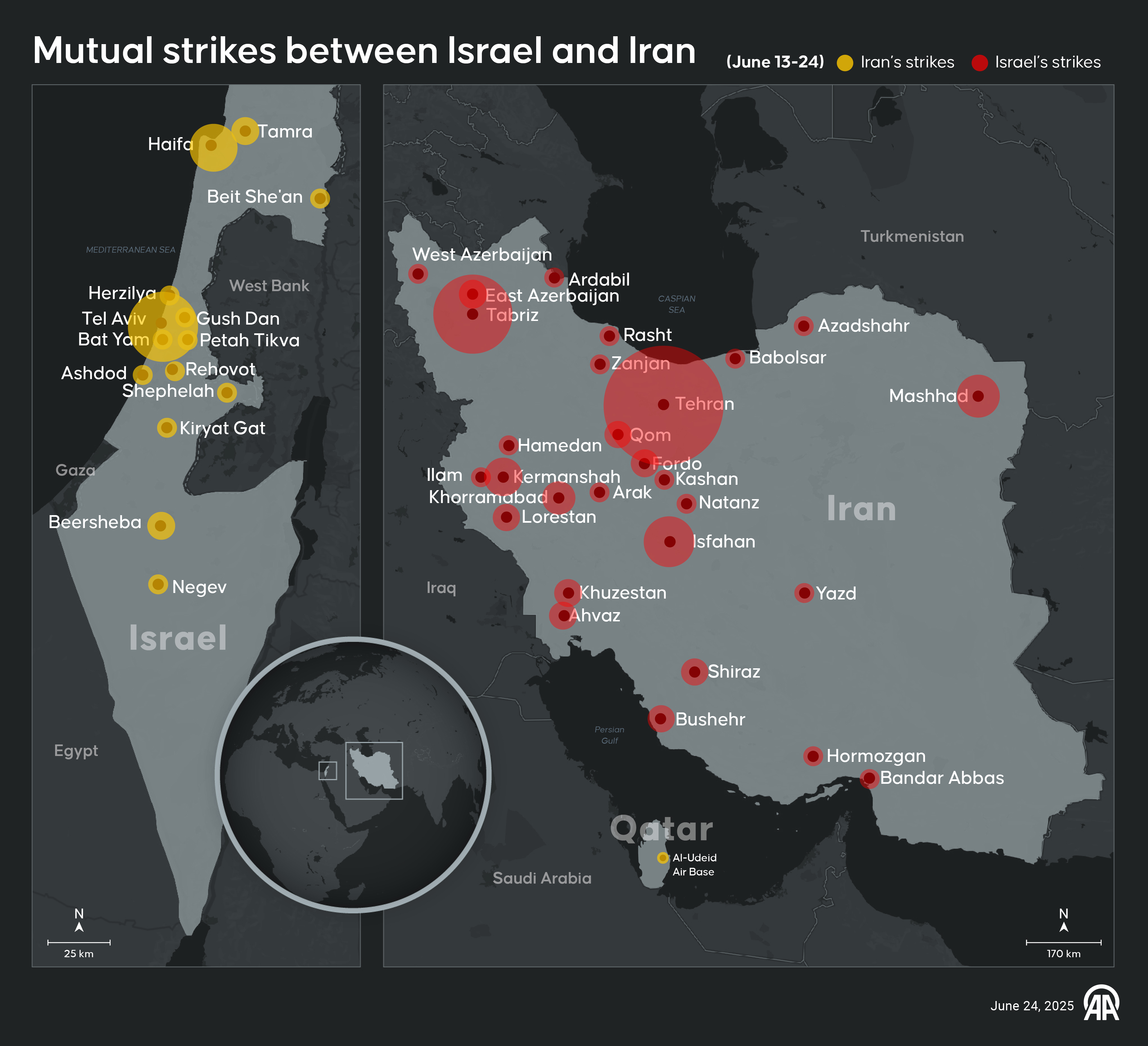
The multidimensional Israeli attacks on Iran on the morning of June 13, comprising hundreds of aircraft, thousands of munitions, cyber operations, and infiltrated elements, represent a potential turning point in Israeli-Iranian relations and indeed for the entire region’s future. The attacks resulted in the deaths of dozens of high-ranking Iranian military bureaucrats, the killing of more than ten nuclear scientists, and severe damage to nuclear facilities such as Natanz and Fordo, as well as numerous air defense bases in the country’s western flank, including Kermanshah and Tabriz.2 These strikes constitute the most severe blow Iran has suffered in a single attack, including during the eight-year Iraq War. The shock induced by the event temporarily paralyzed Iran; Tehran required many hours to regroup and mount a retaliatory strike. Israel’s attacks continued unabated in subsequent days; at the time of writing, Israel conducts airstrikes against various Iranian military and civilian targets, primarily Tehran, during daylight hours, while Iran prefers nocturnal attacks targeting Israel’s strategic regions, chiefly Tel Aviv and Haifa. Furthermore, the implication by U.S. President Trump that his country might enter the war and his personal threat against Iranian leader Khamenei underscore the gravity and complexity of the situation.
Two principal dynamics appear to underpin this potentially pivotal conflict. The first was the impasse in U.S.-Iran nuclear negotiations, particularly concerning uranium enrichment capacity. Indeed, Trump’s proprietary statements following the attacks revealed this reality. Asserting he had given the Iranians a chance during negotiations and that certain hardliners had opposed this, Trump implied that “since those figures are now neutralized, Iran might still have an opportunity.” Subsequent statements by Trump, such as “we control the airspace” and “unconditional surrender,” further confirm the centrality of the U.S. administration’s role.3 Consequently, it is plausible to argue that the Trump Administration, seeking to extract concessions at the diplomatic table, leveraged the latest International Atomic Energy Agency (IAEA) report on Iran while simultaneously positioning Israel as the ‘bad cop.’ Statements emerging from Iran also emphasize the U.S.’ active responsibility in the attack. This dynamic offers insight into how the conflict might conclude. It is precisely for this reason that mediating actors like Türkiye, concerned about the conflict’s prolongation and escalation, accelerated contacts with the U.S.; President Erdoğan spoke to Donald Trump on the phone three times within three days, demanding Israel halt its attacks and return to the negotiation table.
The second dynamic undoubtedly originates from Israel. The Netanyahu Administration, having defined Iran as a threat for many years and elevated this to paranoia levels after the October 7 attacks, argued that ‘not only the tentacles but also the head of the octopus’ must be targeted.4 The prioritization of diplomatic channels by both the Biden Administration and the Trump Administration during five rounds of negotiations prevented structurally dependent Israel from receiving the desired green light from the U.S. When the possibility of unilateral Israeli action emerged, details of Israel’s operational plans were even published in the Western press. As emphasized repeatedly during the crisis, a strategic decision against Iran cannot be taken unilaterally by Israel; only a U.S.-Israeli consensus could enable such a comprehensive war decision. Trump’s description of the operation as “excellent,” noting it “happened with U.S. weapons and more is coming,” confirms this. Therefore, Tehran’s failure to take Trump’s two-month ultimatum seriously proved exceedingly costly. Trump had previously issued a similar personal threat against Qasem Soleimani and followed through. Consequently, a significant Iranian error appears to have been steps that closed the policy gap between the U.S. and Israel.
Iran will not abandon its goal of becoming a threshold nuclear weapons state; indeed, pro-nuclear weapon voices within the country will likely grow louder
Following the initial attack, we witnessed the customary questioning of Iran’s military capabilities. Despite the severe and evident consequences of Israel’s strikes, it is impossible to destroy the entire or even the majority of the military capacity of a power like Iran within days; moreover, as explained above, this was not the Trump Administration’s primary objective. Iran subsequently demonstrated its residual capabilities by launching over a hundred missiles at Israel, some of which penetrated U.S.-Israeli joint air defense layers and reached their targets. It remains entirely possible that Iran could sustain such attacks for some time and adapt to the new reality to deliver more effective responses. Regarding a prolonged conflict, Iran possesses a relative advantage: its economy has endured low expectations for years, and it is less susceptible than Israel to democratic public opinion pressure despite technological disadvantages. Furthermore, vivid memories of the eight-year Iraq War could facilitate rapid internalization of the conflict.
A less-discussed dimension is the effective utilization of Israel-linked infiltration networks within Iran. Iran has previously claimed arrests of CIA/Mossad-linked individuals, executing some after broadcasting confessions.5 This recent episode revealed the extent and professionalism of these networks, often labeled ‘political activists’ by opposition circles and Western sources. Likely operating independently, some groups advanced to establishing mini-drone factories domestically, while launch ramps mounted on ordinary pickup trucks played a major role in initially disabling Iranian air defenses, akin to Ukrainian strikes against strategic Russian bombers deep inside Russia. Consequently, such surprise raid tactics against air defenses and even heavy strategic assets, as seen in Russia, may well be replicated in future conflicts elsewhere.
Quo Vadis the Middle East?
The future trajectory is of paramount importance. In my assessment, despite the profound psychological, military, and scientific impacts of these attacks, they will not alter the strategic resolve of the Khamenei leadership. More explicitly, Iran will not abandon its goal of becoming a threshold nuclear weapons state; indeed, pro-nuclear weapon voices within the country will likely grow louder. Considering the regime’s three-decade effort to build societal legitimacy through national security and nuclear technology narratives, paying heavy prices, especially in sanctions, it becomes understandable why this issue is viewed as existential by the ruling elite. Nevertheless, this does not imply Iran will completely close the door to compromise. Especially if, as Trump implied, the Khamenei factor is removed, compromise becomes more plausible. Iran has historically demonstrated skill in crafting interim diplomatic formulas during nuclear negotiations. Declaring a ‘voluntary’ renunciation of certain critical nuclear technologies, including uranium enrichment, could constitute such a compromise. Iranian officials will strive to prevent their country from becoming a completely failed state, as witnessed elsewhere in the region.
Reading between the lines of statements by both President Erdoğan and Devlet Bahçeli reveals that Türkiye’s state authorities grasp the issue’s seriousness and potential negative repercussions
However, choosing political compromise by offering significant concessions carries heavy costs for Iran, as does pursuing an uncompromising path by driving nuclear activities underground. Primarily, should the Trump factor, central to our analysis, conclude that Iran is pursuing nuclear weapons by any means, the nature of Israeli attacks could escalate, potentially involving direct U.S. military intervention. Indeed, days after the attack, U.S. aircraft carriers and aircraft, particularly aerial refueling tankers, were observed moving to the region. While it is true Trump likely wishes to avoid a major war, rapidly advancing war technologies, as evidenced in some Ukraine operations and by June 13, demonstrate the U.S.’ capacity to deliver devastating blows at minimal conventional cost. Should Iran escalate, its vital infrastructure, especially energy, could be targeted, potentially hindering basic human needs as seen in Iraq and Syria and significantly increasing public dissatisfaction with the regime. While initial Israeli operations appeared consciously designed to minimize impact on Iranian civilians watching via TV/internet, subsequent strikes targeted civilian objectives like the Radio-TV and Foreign Ministry buildings, likely reflecting frustration over incomplete target attainment. Calls by Israeli officials like Netanyahu for the evacuation of Tehran (population exceeding 10 million) should be interpreted as psychological warfare.
These attacks will likely prove decisive for Iran’s domestic politics. Unlike the eight-year war with Iraq, this conflict is not confined to border fronts; moreover, Israeli officials openly endorse regime change. While Israel has long advocated this policy, the Iranian state’s domestic control has prevented socio-political discontent from coalescing into sustained mass movements. The Mahsa Amini protests, sparked by mandatory hijab enforcement, caused temporary demonstrations but eventually subsided. However, the perceived vulnerability displayed by the regime could now embolden opposition movements. Targeting strategically unimportant but symbolic sites or figures, state broadcasters, police headquarters, or fuel depots to paralyze daily life, could serve this Israeli objective. The efficacy of this policy, however, remains uncertain. Achieving regime change solely via airstrikes in a country like Iran is evidently difficult, regardless of intensity, though this possibility could strengthen if the war deepens and more Iranian political leaders are targeted.
Regional Implications of the Israel-Iran War
The regional complications are highly significant and, as evidenced by the emergency trilateral coordination meeting convened at the Foreign Ministry on the attack’s first day, are being closely monitored by Ankara. Türkiye, like other regional states, fundamentally opposes Iran acquiring nuclear weapons; moreover, Ankara and Tehran have previously clashed over Syria and Iraq. However, Türkiye views the unilateral military attack against Iran, whose activities are under IAEA supervision, as unacceptable. Beyond principle, practical reasons underpin Ankara’s stance. Having paid heavy material and intangible costs over the past 25 years due to crises originating first in Iraq and then Syria, and facing significant threats to its national security, Türkiye stands among the countries that would pay the highest price should the conflict spiral out of control, chaos engulf Iran, or the central state collapse. Despite all disputes, the two countries maintain large-scale cooperation in energy, economy, and transportation; disruption would confront Ankara with new, greater challenges.
The U.S.-Israel duo wants to achieve a sort of “persuasion through showing death” including the option of regime change, by forcing Khamenei to choose between being Gorbachev or Saddam/Qaddafi
Reading between the lines of statements by both President Erdoğan and Devlet Bahçeli reveals that Türkiye’s state authorities grasp the issue’s seriousness and potential negative repercussions. Consequently, while developing broad diplomatic initiatives involving primarily the U.S, Iran, and Russia, Türkiye simultaneously emphasizes the necessity for increased investment in its defense industry, announcing new decisions in this regard. Indeed, the genocide in Gaza, Russia’s invasion of Ukraine, and Israel’s indiscriminate attacks on Iranian civilian and military targets signal a new era where established legal norms have lost meaning. As Erdoğan stated on June 16, we are in a period where countries feeling stronger or confident in their backing perceive any aggression as permissible.6
Whether the Israel-Iran war concludes swiftly or persists, Iran’s regional standing will be seriously affected. Iran’s regional influence, already declining since Qasem Soleimani’s killing in early 2020, became significantly more fragile following losses in Lebanon and Syria over the past year. Indeed, one motivation for Israel’s attack was the diminished threat capability of Iran’s regional allies towards Tel Aviv. Post-attack, political realignments can be anticipated even in Iraq, where Iranian influence remains relatively potent. Although steps have recently been taken to limit Iran-backed militias, groups linked to Iran retain decisive influence in both political and military spheres. The Sudani government’s chances of persuading these groups via diplomatic channels have likely increased. The significant weakening of Iran, especially the Revolutionary Guards, could encourage Iraqi groups to decouple their fate from Tehran. Otherwise, targeting certain high-profile symbolic figures would not be surprising.
Should Israeli attacks persist or the U.S. intervene directly on Israel’s behalf, Iran could enter an interregnum akin to Iraq’s between the two Gulf Wars (1991-2002). In this scenario, even without regime collapse, Iran could become semi-paralyzed, endure routine Israeli airstrikes, suffer major economic infrastructure collapse, and face severe constraints on foreign relations. Large-scale Iranian emigration would be unsurprising; many, due to historical and cultural ties, might choose Türkiye for temporary or permanent residence, deepening Türkiye’s migration crisis. Energy, trade, and transportation cooperation with Iran would suffer extensively. A weak, semi-collapsed Iran could embolden factions within the PKK, potentially dealing a blow to the “Terror-Free Türkiye” project, similar to how the Syrian crisis disrupted initial resolution efforts. Furthermore, ethnic and sectarian groups, especially Iranian Turks, might adopt different political stances. The possibility of coup attempts in such chaos cannot be entirely discounted. Consequently, Iran could become one of Türkiye’s foremost foreign policy priorities.
Israel, the other belligerent, might also recalibrate its position post-conflict. Escalating Iranian retaliatory strikes and rising economic/political costs could accelerate Netanyahu’s departure. Coupled with a new Gaza ceasefire, this could temporarily subside Israel-centered crises and reduce regional tension. However, a swift and decisive Netanyahu victory could usher in new phases of Israeli aggression. Both Netanyahu’s persona and Israel’s eighty-year history demonstrate the country’s difficulty in establishing normal relations with neighbors. Having fought and neutralized Egypt, Lebanon, Syria, Iraq, and Iran, Israel might persist in provoking the U.S. and harassing regional states.
It is known that recent security and intelligence reports by Western countries, primarily the U.S., consistently designate Iran, alongside China, Russia, and North Korea, as active members of an adversarial axis.7 Iran’s transfer of kamikaze drones to Russia during the Ukraine War was framed within this strategic context. Therefore, the rapid strategic marginalization of Iran, situated in a critical geography, would be unwelcome for this bloc. China is likely monitoring the conflict’s technological dimensions very closely, identifying Iranian vulnerabilities and adversary strengths. Should Iran survive the initial turbulent week, we can anticipate increased covert, likely indirect, Chinese support in intelligence and technology. A tangible manifestation would be more active Iranian air defense engagement and an increased tally of downed enemy aircraft over its territory. The facile marginalization of Iran, a major regional power, would significantly impact global power balances. As noted in previous analyses, while Tehran pursues strategies aligned with national interests, this does not negate its role as an indirect proxy force within the grander strategic designs of a major global power. The 25-year China-Iran Strategic Agreement signed in recent years is instructive when viewed from this perspective.
Finally, the ceasefire declared after the U.S. heavy bombers attacked Iran’s nuclear facilities, primarily in Fordo on June 22, and then Iran’s missile attack on U.S. bases in Qatar, albeit symbolically, seems to have stopped the clashes for now. The following can be said about the current outlook after the ceasefire that the parties have complied with in the past few days: first of all, it has become clear again that the main determining force in the conflict is the U.S. The intensification of Israeli attacks, especially on the capital Tehran, a few days before the ceasefire shows that there is also coordination between Israel and the U.S. in terms of timing. It is possible to say that the effective missile attack that Iran launched on Birussebi (Beersheba) just before the ceasefire, which caused casualties, was aimed at the message of ‘we are not destroyed, we are standing.’ However, it can be stated that Iran’s military capacity has been destroyed by 30-40 percent in general, and that this rate is much higher in critical areas such as air defense. This also leaves Iran open to various air attacks and sabotage in the coming period, although not as in the last example. It would not be surprising if Israel were to apply this method, which it has previously used particularly in Syria, to Iran. On the other hand, although it is not possible to confirm Trump’s statements regarding the damage to Iran’s nuclear facilities, it is clear that the country’s nuclear program has been set back by months or even years. Finally, it seems that the elites who have been governing Iran for nearly half a century are at a turning point in domestic politics. The U.S.-Israel duo wants to achieve a sort of “persuasion through showing death” including the option of regime change, by forcing Khamenei to choose between being Gorbachev or Saddam/Qaddafi. It will soon be clear how Iranian leaders will respond to this move.
Endnotes
1. Hakkı Uygur, “Iran’s Intelligence Apparatus from Past to Present: Institutional Process and Political Handicaps,” Insight Turkey, Vol. 20, No. 4 (2024), pp. 203-227.
2. “Iran’s Top Military Commanders, 6 Nuclear Scientists among 78 Killed in Israeli Strikes,” Arab News, (June 14, 2025), retrieved June 20, 2025, from https://www.arabnews.com/node/2604346/middle-east; David Gritten, “Centrifuges at Iran’s Natanz Site Likely Destroyed, Nuclear Watchdog Says,” BBC, (June 26, 2025), retrieved June 26, 2025, from https://www.bbc.com/news/articles/cn9yll5yjx5o.
3. Donald Trump, X, 07:47 AM, (June 17, 2025), retrieved from https://x.com/realDonaldTrump/status/1935016454644023767; Donald Trump, X, 07:48 AM, (June 17, 2025), retrieved from https://x.com/realDonaldTrump/status/1935016621569179804.
4. Sébastian Seibt, “What Does Israel Really Want in Iran?” France 24, (June 17, 2025), retrieved June 26, 2025, from https://www.france24.com/en/middle-east/20250617-what-israel-really-wants-in-iran.
5. Syed Zafar Mehdi, “Iran Says 3 Mossad Agents Arrested for Transferring ‘Classified Info,’” Anadolu Agency, (April 21, 2022), retrieved June 23, 2025, from https://www.aa.com.tr/en/middle-east/iran-says-3-mossad-agents-arrested-for-transferring-classified-info/2568938.
6. “Cumhurbaşkanı Erdoğan, Kabine Toplantısının Ardından Millete Seslendi,” C. İletişim Başkanlığı, (June 16, 2025), retrieved from https://www.iletisim.gov.tr/turkce/haberler/detay/cumhurbaskanligi-kabinesi-cumhurbaskani-erdogan-baskanliginda-toplandi-16-06-25.
7. Christopher S. Chivvis and Jack Keating, “Cooperation between China, Iran, North Korea, and Russia: Current and Potential Future Threats to America,” Carnegie Endowment for International Peace, (October 8, 2024), retrieved from https://carnegieendowment.org/research/2024/10/cooperation-between-china-iran-north-korea-and-russia-current-and-potential-future-threats-to-america?lang=en.