
Hamas’ decision to launch Operation al-Aqsa Flood on Israel last October took Hezbollah by surprise since all indicators at the time suggested that Hamas ought pacification with Israel and focused, instead, on managing Gaza and consolidating its rule over the besieged sector, the world’s most congested territory. Hezbollah was in no way interested in fighting Israel, despite its pompous claims to the contrary. Hezbollah’s anti-Israel role ended in 2000 when it pulled out unilaterally from Southern Lebanon without even reaching an agreement with Lebanon. Since then, the occasional minor attacks it launched on Northern Israel aimed at swapping Lebanese prisoners with Israelis to justify the usefulness of its military wing for Lebanese factions that resented its failure to disarm like all other local militias. While Hezbollah continued to express its ultimate objective of driving Israel from still-occupied Lebanese territory in the South, it practically served as Iran’s leading regional proxy in serving the interests of the Islamic Republic, mainly in Syria and Iraq.1
This commentary argues that Hezbollah’s involvement in the fighting seemed perfunctory since fighting Israel was not a priority and it was entirely preoccupied with domestic and regional issues utterly unrelated to conflict with Israel or liberating Lebanese territory still occupied by it. In his first speech a month after the start of the war in Gaza, Hezbollah Secretary-General Hassan Nasrallah clarified that Hamas’ operation was a 100 percent Palestinian decision and that his party’s measures aimed at lending support to Gaza mainly by forcing one-third of the Israeli military to deploy near the border with Lebanon. He warned that Israel’s war on Gaza would blow up the entire region and that he would not go into details about the battlefield decisions that Hezbollah intended to take, preferring to leave Israel confused.
Hezbollah has been using the claim of resistance to Israeli occupation and its purported claim of achieving a deterrent military capability vis-à-vis the Jewish state to camouflage its status as Iran’s premier regional proxy. Its decision to open a secondary front of solidarity with Hamas turned out to be a miscalculated gambit, and it fell into Israel’s trap. Its ideological affinity with Iran did not shield it against Israeli retaliation, revealing Iran’s military weakness and aversion to military confrontation. Stuck in its conflict with Israel, Hezbollah now faces severe domestic challenges to disarm like all other Lebanese factions that gave up their arms at the end of the civil war in 1989.
Hezbollah as Iran’s Premier Regional Proxy
Hezbollah cannot admit that it is no longer an anti-Israel resistance movement for reasons of popular legitimacy and justification for its survival as a military group. Hezbollah is more than just an ordinary party with an armed component; instead, it is a faction in the Iranian Revolutionary Guard Corps. It is faithful to the directives of Iran’s Supreme Leader, an integral part of his regional project, and a vital component of the Islamic Republic’s strategic depth strategy.2 Nasrallah admits that Hezbollah’s weapons, funding, and food come from Iran and proudly says that he is a soldier in the army of Ayatollah Khamenei.3
Hezbollah has been using the claim of resistance to Israeli occupation and its purported claim of achieving a deterrent military capability vis-à-vis the Jewish state to camouflage its status as Iran’s premier regional proxy
The war in Gaza put Hezbollah in a dangerous dilemma. Its failure to support Hamas by opening the Southern Lebanon front would have led to the elimination of what Iran called the Unity of Fronts, i.e., simultaneously opening the Gaza, Lebanon, Syria, Iraq, and Yemen fronts against Israel. Failure to act would have exposed Iran’s slogans before its popular base in the region. On the other hand, Hezbollah’s joining the war would invite an Israeli response beyond Hezbollah’s ability to withstand, leading to terminating the existing rules of engagement between Israel and Hezbollah. Furthermore, hostilities in the South would reignite the internal debate in Lebanon about the necessity of disarming Hezbollah due to the threat it poses to the country’s security and safety.
Iran views Hezbollah as its most valued strategic regional asset. It reasoned against fully involving it in the war between Hamas and Israel, choosing to “exercise restraint.”4 Instead, it authorized involving it in launching low-intensity attacks on Israeli-occupied Lebanese territory in Shebaa Farms and Kfar Shuba Hills as a gesture of solidarity with Hamas. Neither Iran nor Hezbollah could watch Hamas fight alone against a disproportionately more powerful adversary. Hezbollah linked the cessation of attacks against Israel to ending the fighting in Gaza. It got into trouble because Israel insisted on destroying Hamas and demanding that Hezbollah abandon the border demarcation line. Israel has been escalating its attacks on Hezbollah and has made it clear that it is determined to establish a buffer zone on the Lebanese side of the border.
The Unity of Fronts, which includes the Iranian-led Axis of Resistance, goes back to the Battle of Saif al-Quds, which Hamas launched in May 2021 in response to the Israeli violations of the al-Aqsa Mosque. The Unity of the Fronts has gained momentum since the Hamas attack last October. The concept includes political-military groups whose interests intersect in hostility toward Israel, preventing it from achieving its goals in the Palestinian Territories and elsewhere in the region. These groups, which spread across Gaza, Lebanon, Syria, Yemen, and Iraq, seek to strike Israel militarily and target its interests to weaken it materially and morally. The concept of the Unity of the Fronts also aims to form an acceptable level of deterrence on Israel to prevent it from singling out any of Iran’s regional allies, as well as to put pressure on the U.S., Israel’s main ally, to moderate its regional policies. The alliance, sometimes dubbed the mini-Iranian NATO, avoids escalating military confrontations into a general regional war that favors Israel. Iran’s involvement in the coalition stops at assigning roles to its allies in a way that keeps it away from confrontation with Israel.5
The Hamas’ operation resulted in significant shifts in the balance of the conflict between Hezbollah and Israel, going beyond breaking the rules of engagement that existed since the 2006 war
On the 23rd anniversary of Israel’s withdrawal from Southern Lebanon, which it describes as a war of liberation, Hezbollah conducted a military exercise for 200 elite troops simulating the storming of an Israeli army site under the title “No One Can Defeat You,” in which it displayed its growing military capabilities, threatening Israel with another defeat.6 However, the head of the Israeli army’s intelligence service, Aharon Haliva, who advised Israel’s enemies not to miscalculate, warned that “Nasrallah, 17 years after the sin he committed in 2006, is very close to committing a sin that could lead the region to a major war.”7
Hezbollah’s Miscalculated Gambit
Nasrallah stressed that the attack launched by Hamas on Israel on October 7 was 100 percent Palestinian and that it revealed the weakness and frailty of Israel, describing it as weaker than a spider’s web. He also stressed that Hezbollah’s front against Israel was only one of solidarity with Hamas because the decisive battle with it had not yet come.8 By opening the Southern front, Hezbollah wanted to preoccupy Israel without triggering a comprehensive war and compromising Iran’s regional interests.9 When it opened the Southern front, Hezbollah estimated that Lebanon was not Gaza and that a comprehensive Israeli war on Lebanon would meet much more significant international opposition than its war on Gaza. As a state with institutions and foreign relations, Lebanon is not isolated like Gaza. Some countries will move quickly to save Lebanon and prevent its collapse, such as France, with its distinguished ties with Lebanon, and even the U.S., which has strategic allies such as the Lebanese army. In addition, Israel has never raised the possibility of eliminating Hezbollah, and therefore, Hezbollah will be able to rebuild its forces quickly and with Iranian support. Israel realizes that there is no point in going to a full-scale war against an enemy that you are unable to destroy and force to recognize its existence.10
Hezbollah took Israel’s threats of massive escalation lightly. Right after Hamas’ operation last October, Israeli Prime Minister Benjamin Netanyahu said he would “change the Middle East.”11 His statement implied that the situation on the Northern front would not return to the pre-attack period. Hezbollah did not take Netanyahu’s warning seriously and chose to escalate militarily, although in a carefully calculated manner, to avoid massive Israeli retaliation. Still, Israel deemed Hezbollah’s military restraint irrelevant given the unprecedented shock of Hamas’ attack, which it had completely ruled out as irrational and suicidal.
Iran is doing everything in its power to avoid the expansion of the war in Gaza beyond the involvement of its proxies in Lebanon, Yemen, and Iraq. It is careful to avoid a situation where the U.S. and Israel might target Iranian territory
Even though Hezbollah’s Deputy Chief, Naeem Qassem, made it clear that his party had no interest in triggering an all-out war, he still had doubts about Israel’s intentions. He declared that if the war broke out, it would be because Israel wanted it to happen. He admitted, however, that Hezbollah expected Israel’s war on Gaza to be brief, as in previous encounters over the past 15 years: “We didn’t expect the war would last this long because we didn’t think that Netanyahu was that foolish.”12 Israel insists that Hezbollah’s withdrawal from the border area, i.e., 10 kilometers, means losing 70 percent of its ability to strike Israeli targets and depriving its strikes of their importance. The geographical nature of Lebanon in the border region gives the party’s fighters the advantage of operating in primarily high-forested areas. Topography enables them to use direct and uncurved missiles fired at targets in Israeli settlements located below Lebanese territory, creating a dilemma for Hezbollah. If the party’s fighters evacuate the border area, they will lose the ability to launch guided missiles, forcing them to use ineffective curved and unguided projectiles.13
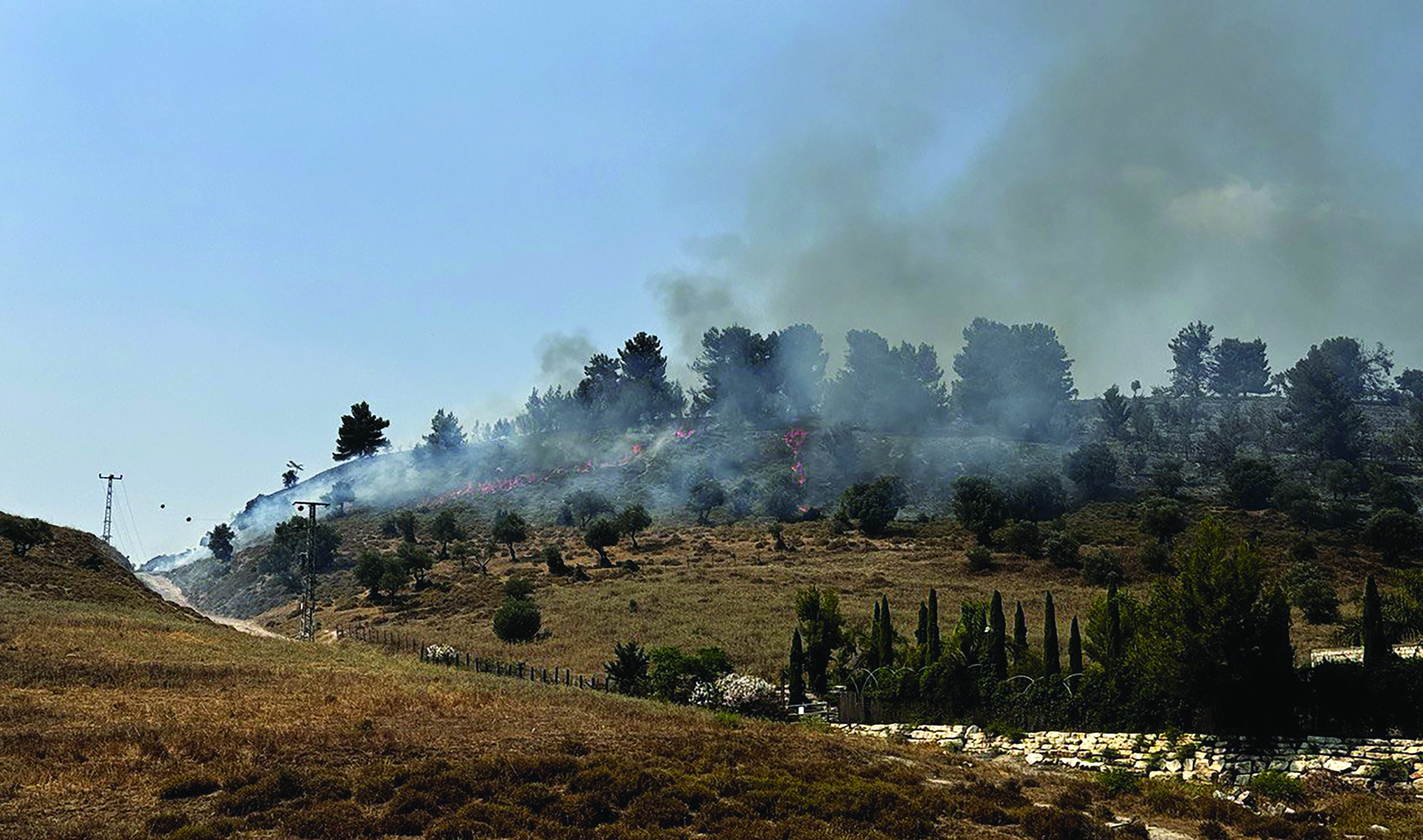
The Hamas’ operation resulted in significant shifts in the balance of the conflict between Hezbollah and Israel, going beyond breaking the rules of engagement that existed since the 2006 war. The attack brought about radical changes in the nature and concept of the war between the two sides, negatively impacting the settlements in Northern Israel and Southern Lebanese villages; it turned into a battlefield that led to the displacement of more than 90 thousand citizens, the destruction of thousands of homes, the burning of agricultural lands, and the death of hundreds of thousands of livestock. Nasrallah did not hide his fear about the chances for the military situation to slide into a full-scale war after he realized that the rules of engagement that existed before October 7 had expired due to Israel’s escalatory strikes. He realized that Israel, which possesses enormous firepower, mandated that Hezbollah introduce new, unconventional weapons to the battlefield to restore a semblance of deterrent capability. Nasrallah acknowledged heavy human and material losses attributable to his forces’ carefully calculated fighting, which refrained from expanding the scope of confrontations. However, Nasrallah stressed that if Israel imposed a war, there would be no controls on Hezbollah’s use of its full firepower.14
After the Israeli army took control of most of Northern Gaza and began dismantling Hamas in the South, it did not face a significant escalation from Hezbollah. Encouraged by Hezbollah’s trepidation, Israel started attacking its forces across Lebanon in December. By December, Hezbollah appeared to be implementing a tactical retreat, as most of its Radwan’s elite forces withdrew to avoid precision raids by Israel. Hezbollah avoided responding forcefully to the Israeli attacks, fearing it could trigger an all-out war, fully aware that it would lose.15 Israeli Defense Minister Yoav Galant said during a visit to the headquarters of the Northern Command that his forces killed about half of Hezbollah’s field commanders in Southern Lebanon and that the coming period will be decisive.16 Usually, killing the enemy’s field commanders suggests the presence of plans to launch a sizeable ground operation.
The chairperson of the Israeli parliament’s Foreign Affairs and Defense Committee reiterated Israel’s determination to end Hezbollah’s presence on the border with Israel, diplomatically or militarily. Western diplomats frequently visit Beirut to sway the Lebanese government to pull out of the border area to avert a significant Israeli military campaign. Hezbollah has adamantly rejected the proposals of evacuating the South or even considering accepting a ceasefire while Israel’s war on Gaza continued. Hezbollah’s Chief, Hasan Nasrallah, said he would not listen to such proposals.17
Hezbollah says it will end its military operations against Israel once a ceasefire takes hold in Gaza. However, the Israelis say it is not up to them to decide when to start or end hostilities, given the growing public pressure in Israel to mount a comprehensive campaign to flush Hezbollah from the border area.18 Some Israelis do not think it is sufficient to push Hezbollah a few kilometers from the border. They insist that the argument of “Hezbollah withdrawing to the Litani River is outdated and naive, offering no long-term solution; Hezbollah would still possess approximately 200,000 missiles and rockets, a fleet of UAVs, and advanced surveillance capabilities.”19
Iran’s Paper Tiger
Iran and Hezbollah are aware of the serious risks that could result from a broader war in Lebanon, including strikes on Iranian nuclear facilities, so Tehran wants to avoid any war between Israel and Hezbollah.20 The Israel-Hamas war has demonstrated Iran’s power deficiency, limited to verbal bellicosity and condemnation of Israel. Its empty rhetoric has exposed it to Shiite allies. Hezbollah’s Lebanese base of Shiite support understands that Iran will not rescue them in the event of war with Israel.21 For more than a decade, the Israeli air force hammered Iranian military sites in Syria, killing scores of Iranian Revolutionary Guard Corps advisors, to which Iran did not answer, stating that it would choose the time and place to settle scores with Israel. When Iran finally decided to retaliate against the destruction of its consulate in Damascus, it launched hundreds of drones and long-range missiles against Israel that inflicted no casualties. Iran keeps rationalizing its avoidance of responding to Israeli lethal attacks on the grounds of its strategic patience.22
No matter how this conflict ends, it would be unlikely to decimate Hezbollah, which has succeeded over the past four decades in becoming a grassroots movement. Nevertheless, presenting itself as a resistance movement and the defender of Lebanon would become a spurious claim since it failed to defend itself against Israel
Revolutionary Guard Commander Ismail Qaani told Hassan Nasrallah when he met with him in Beirut last March that Hezbollah’s response to Israeli strikes should be carefully considered, even if they exceeded the rules of engagement, because Iran had no intention of expanding Gaza’s war and had no interest in confronting the U.S. and Israel because it wanted to protect its regional assets. Qaani addressed Nasrallah, saying that if a war occurred between Israel and Hezbollah, Iran would not join it. When Hezbollah coordination official Wafiq Safa visited the United Arab Emirates shortly after Qaani’s visit, he informed the officials he met there of the party’s readiness to stop fighting on the Southern Lebanon front and declare the border area along the Blue Line a demilitarized zone with a military presence limited to UNIFIL and the Lebanese army. Then, after the ceasefire, an agreement would be reached to demarcate the land borders, as happened with the maritime borders. Israel rejected the proposal, saying that it would not accept any agreement with Hezbollah before it fully surrenders its weapons to the Lebanese army.23
Iran is doing everything in its power to avoid the expansion of the war in Gaza beyond the involvement of its proxies in Lebanon, Yemen, and Iraq. It is careful to avoid a situation where the U.S. and Israel might target Iranian territory.24 The late Iranian Foreign Minister Hossein Amir Abdollahian who recently died in a helicopter crashsent several letters to the U.S. to stress that his country did not seek to expand tensions with Israel. Abdollahian confirmed that the Iranian response to the Israeli attack on its consulate in Damascus had ended the escalation on its part and that the issue was closed.25 The massive Iranian cruise and ballistic missile attack on April 13, codenamed Operation True Promise, inflicted minor damage at an Israeli air base that remained operational, while Israel, backed mainly by the U.S., intercepted and destroyed 99 percent of the missiles before reaching the Israeli airspace. Six days later, the Israeli air force attacked an Iranian air base near Isfahan, inflicting minor damage, clearly in a bid to avoid further escalation with Iran. U.S. diplomacy succeeded in averting a military confrontation between Iran and Israel that neither one of them wanted.
Hezbollah’s Fate
When Hezbollah chose to open a secondary front to ease the military pressure on Gaza, it expected the war to end within weeks, the same way previous wars between Hamas and Israel had ended. However, by June 2024, the war had entered its ninth month with no apparent end. Hezbollah’s involvement in the armed conflict turned into an attrition war, inflicting heavy human losses on Hezbollah, including most of its field commanders, in addition to destroying its infrastructure in Southern Lebanon. The war revealed the vulnerability of Hezbollah and the unbridgeable technological gap with Israel. Israel insists that Hezbollah must withdraw voluntarily from the South Litani area, about 30 kilometers from the border, or face an all-out war. Neither option bodes well for Hezbollah’s future as the dominant actor in Lebanese politics.
The barrier of fear of Hezbollah’s influence over Lebanon is eroding day after day, and instances of restlessness against its policies are increasing even within the Shiite community, especially since the economy collapsed five years ago. The Lebanese public is increasingly realizing that the country has become an arena of regional contestation. The notion of a widespread embrace of Hezbollah has severely waned, even before it opened a front in support of Hamas. Most Lebanese no longer see Hezbollah’s weapons as primarily directed against Israel but rather to serve Iran’s regional interests. In August 2021, residents of a Druze village in the South confiscated a Hezbollah rocket launcher after firing a salvo at Northern Israel, embarrassing the party and forcing it to take responsibility for the incident.26
Hezbollah faces an inhospitable Lebanese environment that rejects its involvement in the armed conflict, which is getting worse due to the difficulty in reaching a ceasefire that Hezbollah wants today and not tomorrow. However, the fighting is likely to continue because Israel has set conditions, such as the party’s withdrawal from the border region. It rejected Hezbollah’s demands to withdraw from occupied Lebanese territories in Shebaa Farms and Kfar Shuba Hills. It is unlikely that when the war ends, it will be according to Hezbollah’s terms. The consequences would be detrimental to Hezbollah’s self-image as a resistance movement, further increasing the pressure on it to disarm. The post-war domestic situation is likely to lead to civil strife in Lebanon, eventually paving the way for the national army with international backing to take steps to bring about law and order in the country. No matter how this conflict ends, it would be unlikely to decimate Hezbollah, which has succeeded over the past four decades in becoming a grassroots movement. Nevertheless, presenting itself as a resistance movement and the defender of Lebanon would become a spurious claim since it failed to defend itself against Israel.
Endnotes
1. For a detailed account of Hezbollah’s policy orientation after 2000, see: Hilal Khashan, Hizbullah: A Mission to Nowhere, (Lanham: Lexington, 2019).
2. Iran has had a tumultuous history for the past two centuries with Russian and British intrusion on its territory. Also, the U.S. manipulated its domestic affairs, notably the 1953 Operation Ajax that overthrew the government of the democratically elected Prime Minister Mohammad Mosaddegh and restored the reign of Mohammad Reza Pahlavi. The 1979 Islamic Revolution introduced the Arab Policy, which sought to spread the revolution into Arab countries to increase Iran’s foreign policy leverage and shield it against Western schemes.
3. Rafiq Khoury, “Dawr Hezbollah al-Iqlimi Yu’atil Dawr Lubnan [Hezbollah’s Regional Role Hinders Lebanon’s Role],” Independent Arabia, (December 24, 2022).
4. Mat Nashed, “Can Lebanon’s Hezbollah Afford to Go to War with Israel?” Al Jazeera, (October 16, 2024), retrieved from https://www.aljazeera.com/news/2023/10/16/can-lebanons-hezbollah-afford-to-go-to-war-with-israel.
5. “Mafhum Wahdat al-Sahaat: Hilf NATO Musaghhar li_Iran wa Jama’atiha [The Concept of Unity of Fronts: A Mini-NATO for Iran and Its Groups],” Radio Sawa, (May 22, 2023).
6. “Nasrallah: Muawarat Hezbollah Ja’at li Tu’akkid ‘ala Jahiziyat al-Muqawama wa Israel Taraja’at ‘an Tahdidatiha [Nasrallah: Hezbollah’s Maneuvers Came to Confirm the Readiness of the Resistance, and Israel Backed Down from Its Threats],” Al Jazeera, (May 25, 2023).
7. “Israel Tuhaddir min Mukhatataat Hezbollah [Israel Warns of Hezbollah’s Plans],” Al Hurra, (May 22, 2023).
8. “Nasrallah: Inkharatna fi al-Harb min al-Bidaya wa Mustamirrun Fiha [Nasrallah: We Were Involved in the War from the Beginning, and We Are Continuing It],” Al Jazeera, (November 3, 2023).
9. Jana Dhaybi, “Ma’alat Nusf ‘Aam min Harb Musagghara bayn Israel wa Hezbollah [The Consequences of Half a Year of a Minin-War between Israel and Hezbollah],” Al Jazeera, (April 4, 2024).
10. Nidal Kanaana, “Al-I’tibaraat al-Isralilia Qabl Fath Harb ‘ala Hezbollah [Israeli Considerations before Opening a War on Hezbollah],” Sky News Arabia, (January 24, 2024).
11. “Netanyahu Says Israel’s Response to Gaza Attack Will Change the Middle East,” Reuters, (October 9, 2023), retrieved from https://www.reuters.com/world/middle-east/netanyahu-says-israels-response-gaza-attack-will-change-middle-east-2023-10-09/.
12. “Qassem Stresses Hezbollah’s Determination to Avoid Full-Scale War,” L’Orient-Le Jour, (April 19, 2024), retrieved from https://today.lorientlejour.com/article/1410972/qassem-stresses-hezbollahs-determination-to-avoid-full-scale-war.html.
13. Nadhir Rida, “Hezbollah Yatamassak bi al-Baqa’ ‘ala Hudud Janub Lubnan Tajannuban li Khisarat al-Ta’thir al-‘Askari [Hezbollah Insists on Remaining on the Borders of Southern Lebanon to Avoid Losing Military Influence],” Aawsat, (January 18, 2024).
14. “Al-Sayyid Nasrallah: Musta’iddun li Harb min Dun Dawabitwa min Dun Saqf [Sayyid Nasrallah: We Are Ready for War without Controls and without Ceilings],” Al-‘Ahd News, (January 4, 2024).
15. Yonah Jeremy Bob, “Why Israel Yet Has to Launch a Full-Blown War on Hezbollah?” Jerusalem Post, (March 13, 2024).
16. “Galant: Nisf Qadat Hezbollah al-Maydaniyin Tamat Tasfiyatuhum wa al-Fatra al-Qadima Hasima [Galant: Half of Hezbollah’s Field Commanders Have Been Eliminated, and the Coming Period Will Be Decisive],” RT Arabic, (April 24, 2024).
17. Dan Williams and Tom Perry, “Israel Wants Hezbollah Away from Border, Lawmaker Says,” Reuters, (December 13, 2023), retrieved from https://www.reuters.com/world/middle-east/israel-
wants-hezbollah-away-border-lawmaker-says-
2023-12-13/.
18. Justin Salhani, “Is Israel Hoping to Escalate Hostilities with Hezbollah in Lebanon?” Al Jazeera, (March 12, 2024), retrieved from https://www.aljazeera.com/news/2024/3/12/is-israel-hoping-to-
escalate-hostilities-with-hezbollah-in-lebanon.
19. Omer Dostri, “To Provide Security for Its Citizens, Israel Must Go to War with Hezbollah,” Yedioth Ahronoth, (February 26, 2024), retrieved from https://www.ynetnews.com/article/r149ynknp.
20. “Hezbollah Tam’ana Iran: lan Najurrakum ila Harb Ghaza wa Sanuqatil Wahdana [Hezbollah Reassured Iran: We Will Not Drag You into the Gaza War, and We Will Fight Alone],” Al-Arabiya, (March 15, 2024).
21. Hilal Khashan, “Hezbollah’s Last Stand,” Geopolitical Futures, (December 13, 2023), retrieved from https://geopoliticalfutures.com/hezbollahs-last-stand/.
22. Hilal Khashan, “Iran’s Strategic Dilemma,” Geopolitical Futures, (April 10, 2024).
23. Huda Husseini, “Sallimu al-Silah Yaslam al-Janub [Hand over the Weapons, the South Will Be Safe],” Ash-Sharq al-Awsat, (March 28, 2024).
24. “Iran la Tuman’ fi Qasqasat Ajnihat Hezbollah li Mana’ Tawassu’ al-Harb [Iran Does Not Mind Clipping Hezbollah’s Wings to Prevent the Expansion of the War],” Al-Arab, (March 16, 2024).
25. “Iran Tu’akkid li Washington Annaha la Turid Tawsi’ al-Tawatturat maa’ Israel [Iran Assures Washington That It Does Not Want to Expand Tensions with Israel],” Ash-Sharq al-Awsat, (April 18, 2024).
26. Jonny Fakhry, “Tamalmul wa Ghadab fi Bi’at Hezbollah [Restlessness and Anger in Hezbollah’s Environment],” Al-Arabiya, (December 1, 2021).