
Introduction
From the beginning of Kazakhstan’s independent path, Turkic states have been one of the strategically essential directions in Kazakhstan’s foreign policy strategy of multi-vector diplomacy. According to the concept of Kazakhstan’s foreign policy for 2020-2030,1 among the “key priorities in the field of regional and multilateral diplomacy,” there is an emphasis on the need to strengthen relations with the countries of the Turkic Council.
Therefore, Kazakhstan’s key priority in cooperation with the Turkic World has been the institutional development of cooperation processes among member states, observer states, and the Organization of Turkic States (OTS) partners that created a solid natural foundation –a joint humanitarian and cultural space.
Since Kazakhstan is going through a significant political and economic transformation stage, cooperation with the Turkic states is gaining increasing importance. As President of Kazakhstan Kassym-Jomart Tokayev stated, “Our goal is to turn the Turkic World into one of the most important economic, cultural, and humanitarian regions of the 21st century.”2
Over the years, Turkic states have come closer not only in matters of cultural and civilizational cooperation but also in a shared understanding of the role and place of the Turkic World on the international stage. It should be noted that this progressive convergence has become possible mainly because Turkic states share similar goals, including ensuring international security and stability, increasing the well-being of their citizens, and harmoniously promoting national and cultural identity.
Even amidst the prevailing geopolitical uncertainties, the positions of Turkic countries remain close, harmonious, and aimed at shaping a stable world order. In these turbulent times, their unity remains a dependable foundation upon which to forge strategic trust-based relationships and navigate the complexities of the international stage.
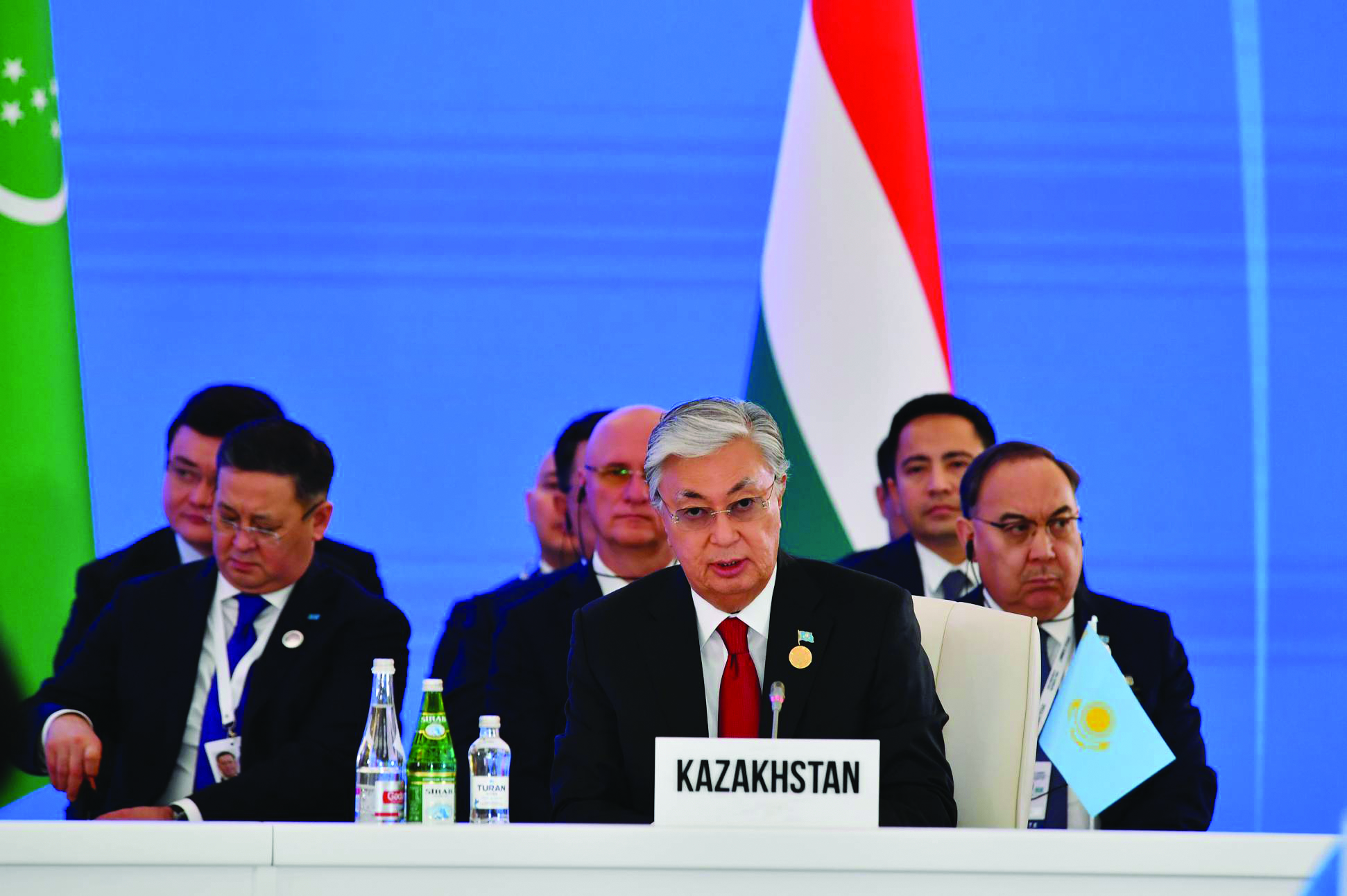
At the 10th Summit of the Organization of Turkic States, President Tokayev introduced Kazakhstan’s vision for its chairmanship during 2023-2024, aptly named “TURKTIME!” This vision outlined eight primary priorities, each contributing to the overarching goal of strengthening Turkish cooperation: traditions, unity, reforms, knowledge, trust, investment, mediation, and energy.
This initiative reflects a comprehensive approach to addressing the shared challenges and opportunities of the Turkic World, encompassing cultural, economic, and diplomatic aspects. Through these priorities, Kazakhstan aims to strengthen Turkic unity and cooperation further, ultimately contributing to the stability and prosperity of the entire region.
Over the years, Turkic states have come closer not only in matters of cultural and civilizational cooperation but also in a shared understanding of the role and place of the Turkic World on the international stage
In this commentary, it is aimed to evaluate trending tracks of cooperation with Turkic states to define Kazakhstan’s strategic priorities in the short and medium term. Specifically, the first four sections address trade, transportation, high-tech ventures, and water resource management, among other topics. The final section outlines the essence of the role of OTS in Kazakhstan’s intricate web of institutional connections.
Trade Partnership
At present, against the backdrop of open confrontation among major powers and unprecedented geopolitical challenges, cooperation within the framework of the OTS has noticeably intensified. This can be seen in economic indicators as well. From 2010 to 2022, Kazakhstan’s trade turnover with Turkic states nearly tripled, increasing from $4.5 billion to $12.9 billion. It is realistic to expect mutual trade turnover to increase to $23 billion within a few years.3
Furthermore, 74 percent of the total trade turnover, which amounts to $9.6 billion, constitutes Kazakhstan’s exports to the Turkic states. Türkiye is the largest partner, contributing 50 percent ($4.8 billion) to the trade turnover, followed by Uzbekistan at 39 percent ($3.7 billion), Kyrgyzstan at 8 percent ($745.3 million), and Azerbaijan at 4 percent ($375.3 million).4
The majority of Kazakhstan’s exports consist of raw materials and commodities such as oil, coal, gas, copper, zinc, aluminum, lead, and more. Considering plans to develop the manufacturing industry and transition to a more complex, non-resource-based economic model, Kazakhstan’s strategic priority is the development of cooperation with Turkic states, particularly Türkiye, with its advanced industry.
In this context, it is worth mentioning that cooperation with Türkiye remains one of the strategically essential directions in Kazakhstan’s foreign policy. Türkiye, following its foreign policy vision, the ‘Century of Türkiye,’ is confidently acting as a regional leader and global influential player,5 possessing significant mediation experience in resolving regional conflicts and geopolitical capabilities to strengthen Kazakhstan’s position in Central Asia and its relationships with major powers like Russia, China, and the West.
Kazakhstan’s foreign policy toward Türkiye encompasses a wide range of tasks, from political and economic areas to humanitarian and cultural aspects, military-political and defense cooperation, regional stability, and security
Kazakhstan and Türkiye actively support each other on the international stage. In this regard, Türkiye serves as an alternative channel for Kazakhstan to implement its multi-vector policy, providing Kazakhstan with a platform for discussing regional and global security issues. For example, in 2010, Türkiye chaired the Conference on Interaction and Confidence Building Measures in Asia (CICA),6 initiating the process of rotating chairmanships, which Kazakhstan initially proposed. In 2017-2018, Türkiye supported Kazakhstan’s non-permanent membership in the United Nations Security Council.7
Kazakhstan’s foreign policy toward Türkiye encompasses a wide range of tasks, from political and economic areas to humanitarian and cultural aspects, military-political and defense cooperation, regional stability, and security.
The economic structure between Kazakhstan and Türkiye demonstrates trade complementarity, where the two countries complement each other rather than compete.8 Türkiye is among the top five economic partners and the top ten largest investors in Kazakhstan,9 with joint projects valued at $5.5 billion.10
It should be emphasized that, in the near future, the opening of the special economic zone “TuranSEZ” is expected. It was established in the city of Turkistan at the initiative of the presidents of Kazakhstan and Türkiye. This will be one of the most important steps toward the development of industrial zones, contributing to increased trade in goods and services and mutual investments between member and observer countries of the OTS.
An important aspect of the Turkish vector in Kazakhstan’s foreign policy is the development of transit potential through strengthening transport and logistics connections with Türkiye. This aligns with the objectives of Turkish foreign policy, including its “energy terminal and corridor” concept for transporting global energy resources from Eurasia to Türkiye and EU countries.11 Given its geographical location, Türkiye serves as a hub for diversifying energy resource supplies to recipient countries, exemplified by projects such as the Baku-Tbilisi-Ceyhan and Baku-Tbilisi-Erzurum pipelines, as well as other projects related to the Ceyhan energy terminal in Türkiye.12
Transport Connectivity
In recent years, the space of OTS has undergone a significant transformation, becoming a zone of progressive economic and transport connectivity. In this vein, Kazakhstan’s primary focus is the development of the Trans-Caspian International Transport Route, which is an essential infrastructure project with great potential to enhance the transport and logistics capacity of OTS member states.
The volume of cargo transportation along the “Middle Corridor” reached 1.5 million tons in 2022, nearly three times the 2021 figure.13 In March 2022, Kazakhstan, Azerbaijan, Türkiye, and Georgia signed a declaration on the East-West Trans-Caspian Corridor, which enhanced the importance of this corridor and outlined steps to strengthen the transit potential of the signatory states. This document aims to integrate the Trans-Caspian East-West Corridor into the international transport system, and the countries involved have established a joint venture to implement these plans.
It is worth noting that the transit period from China to Europe has been significantly reduced, at least threefold, from 53 days to 19-23 days. Transit through Kazakhstan’s territory has also halved, from 12 days to 6 days, with plans to reduce it to 5 days by the end of 2023.14 In quantitative terms, cargo transportation through the Middle Corridor during the first half of this year amounted to 1.3 million tons, almost double the figure for the same period last year. It is expected that, from a medium-term perspective, cargo transportation via the Trans-Caspian route will increase to 10 million tons per year.15
However, it is also important to point out the necessity of addressing the issue of the Caspian Sea’s shallow waters. Kazakhstan’s ports, Aktau and Kuryk, face certain restrictions due to the need for dredging works to ensure navigational safety and the capacity of existing infrastructure. According to preliminary estimates by Kazakhstan, around 40 billion Tenge is needed to address the problem of shallowing in the port waters of Aktau and Kuryk.16 Therefore, one of the priority goals of Kazakhstan’s chairmanship in the OTS is cooperation in the logistics and transport sectors.
Moreover, the level of internal economic connectivity within the OTS countries remains insufficient to describe them as a fully formed economic zone. For example, the total volume of external trade for OTS in 2022 reached $1.2 trillion,17 while trade turnover between members of the Organization was just around $22 billion.18 The rest of the trade is conducted with third countries.
Consequently, there is still significant work ahead to transform the OTS space into a genuinely unified region, and the political will of the participating states will play a crucial role in achieving this. In this regard, President of Kazakhstan, Tokayev, proposed to accept the unified standards and terminology of OTS countries. In his view, this initiative paves the way for the free export of goods to the common market and will allow for an increase in trade by 1.5 times.19
Scientific and Technological Interaction
The COVID-19 pandemic has demonstrated the significance of science and new technologies. Therefore, Kazakhstan is deeply interested in the development of joint projects in the scientific field, artificial intelligence, and big data analysis within the framework of the OTS. Kazakhstan has already taken significant strides in the development of such technologies, including the implementation of e-government and the adoption of advanced technologies and digital solutions in the banking and financial sectors (FinTech).
The development of digital and financial technologies in the OTS countries can enhance their competitiveness and support the economic transformation of the region
Kazakhstan launched e-government services as early as 2008. Currently, this system provides over 83 percent of government services. Thanks to this, Kazakhstan ranks among the countries with a very high level of e-participation and an open government index, holding the 28th place out of 193 countries worldwide.20 This is the highest ranking among the Commonwealth of Independent States (CIS) and Central Asian countries.
The financial technology market in Kazakhstan is one of the fastest-growing in the country and the largest in Central Asia. One of the major trends in the FinTech market in Kazakhstan is the growth of digital payments and e-commerce. The vast majority of the population (78 percent) makes digital payments.21
Kazakhstan has also made significant progress in the field of e-commerce, both in terms of simplifying and digitizing all customs and customer payments, as well as in the area of international trade transactions. The total e-commerce market amounted to 2.6 billion dollars in 2021.22
The development of digital and financial technologies in the OTS countries can enhance their competitiveness and support the economic transformation of the region. From offering simpler and more accessible ways to manage financial transactions to the latest technologies and innovations, FinTech can and should become an integral part of the economic development of Turkic states.
In this context, another priority is cybersecurity. According to various expert assessments, the losses from cybercrimes in 2022 are estimated at 8 trillion dollars, and they are projected to reach 10.5 trillion dollars by 2025.23 Furthermore, according to leading global agencies, the global cybersecurity market will grow to 172.32 billion dollars in 2023 and is expected to reach 424.97 billion dollars by 2030.24
Considering this, it seems reasonable to expand technology transfers among OTS countries and, ultimately, create their own digital technology market. The Turkic World boasts several key advantages, including macroeconomic stability, substantial natural resource reserves, a large domestic market, low labor costs, and significant digital development potential.
Water Resource Management
One of the vital areas for cooperation of Turkic states and predominantly Central Asian countries is taking coordinated actions to address water-related challenges. Forecasts indicate that in the next decade, significant reductions in water flow in Central Asia could jeopardize socioeconomic development plans in the region. The negative ecological consequences of climate change, predicted initially for 2050, are already unfolding, with accelerated glacier melting, diminished river flow in vital waterways such as the Syr Darya, Amu Darya, Ural, Irtysh, Ili, Chu, and Talas rivers, as well as increased instances of droughts and floods.
To address this challenging situation, immediate and coordinated reforms in the water resource management sector are imperative for Central Asian countries. Kazakhstan, in particular, has taken a proactive step by establishing a dedicated Ministry of Water Resources and Irrigation to oversee the reinstatement of the National Hydrogeological Service. Solving these water resource issues is a collective and strategically vital endeavor for Central Asian countries and the wider Turkic World.
Afghanistan’s legal and economic instability further exacerbates the region’s water resources problem. The Taliban government has initiated the construction of the Qosh Tepa irrigation canal on the border with Tajikistan, which is 285 km long, 100 m wide, and nearly 8.5 m deep.25 This project poses a significant threat to further drying up the Amu Darya River, consequently affecting the Aral Sea and reducing agricultural lands in Central Asian countries.26
The critical situation in Afghanistan, marked by a severe food shortage and the threat of hunger, especially among children, is a cause for concern. This situation could potentially trigger a migration crisis, with millions of Afghans forced to flee neighboring countries, including those in Central Asia.
In general, the situation in Afghanistan, especially after the Taliban’s rise to power, is one of the critical areas of joint work for the OTS countries and Central Asian nations in particular. For instance, President Kassym-Jomart Tokayev of Kazakhstan, in his address to the 78th session of the United Nations General Assembly, proposed the establishment of a UN Regional Center for Central Asia and Afghanistan in Almaty.
One of the current tasks for the OTS countries is to formulate a unified policy on Afghanistan, considering not only the challenges but also cooperation with the Taliban government to develop transit and transport corridors through Afghanistan to South Asia.
In terms of addressing Afghanistan’s issues and advancing cooperation in Central Asia, Tajikistan holds a significant position. However, from an ethnic and linguistic perspective, Tajikistan is somewhat removed from various integration projects among Turkic countries, remaining on the periphery of the Turkic World. Nonetheless, Kazakhstan recognizes the importance of nurturing relations between OTS and Tajikistan, given the high degree of mutual trust and alignment on various regional cooperation matters. This demonstrates the region’s commitment to addressing complex challenges collaboratively for the betterment of all involved.
Geopolitical Balance
From Kazakhstan’s perspective, cooperation within the OTS goes beyond specific areas of cooperation. It holds long-term strategic significance in building the architecture of the “Eurasian Heartland,” considering the developments of the current geopolitical situation. The long-term security of Kazakhstan, situated in the center of the continent, can be reliably ensured through a network of interconnections and interdependencies among the significant continental powers, with stability preservation serving as a fundamental priority for all.
As known, Kazakhstan’s “Eurasian Heartland” doctrine originally envisioned the integration of the EU, the Eurasian Economic Union (EAEU), and the Belt and Road Initiative, with the Trans-Caspian Transport Corridor being an integral part of it. Currently, Kazakhstan and several Turkic states participate in various capacities in such international structures as the Shanghai Cooperation Organization (SCO), the CICA, the EAEU, and the Central Asian Cooperation. In Kazakhstan’s view, this overlapping system of institutional connectivity creates a pan-Asian geopolitical balance.
Cooperation within the SCO framework is of particular importance as it plays a crucial role in addressing regional security challenges as well as providing a platform for economic cooperation and trade facilitation. Kazakhstan leverages its position to foster dialogue, trade, and cultural exchange between Turkic nations and the wider Asian community.
Besides the SCO, the CICA also holds significant strategic importance for Kazakhstan. It currently does not have a critically significant impact, but it brings together all OTS and SCO member states. In this regard, CICA should be maximally utilized for the joint and coordinated promotion of Turkic countries’ initiatives and interests, both as a high-level international platform and as a structure contributing to the formation of efficient transit transport corridors.
OTS and the EAEU also have an ‘intersecting’ composition: among OTS member states, Kazakhstan and Kyrgyzstan are EAEU members, while Uzbekistan has observer status. Russia, the largest state within the EAEU, maintains a close format of comprehensive cooperation with Türkiye, which has only strengthened amid the current global crisis. As for Azerbaijan, despite its non-formal status within the EAEU, its economic ties with EAEU member states are extremely close. Furthermore, the recent Fifth Summit of Central Asian Leaders held in Dushanbe on September 14-15, 2023, marked the convergence of two integration processes –Central Asian and Turkic– and for the first time, it took place in a ‘Central Asia + Azerbaijan’ format.
Regional cooperation dynamics significantly elevate Central Asia’s geostrategic importance and draw the interest of leading nations in bolstering their partnerships with the countries in the region
Regional cooperation dynamics significantly elevate Central Asia’s geostrategic importance and draw the interest of leading nations in bolstering their partnerships with the countries in the region. The establishment of eleven ‘CA+’ formats vividly demonstrates that external players perceive the region as a substantial and potentially interconnected market with significant prospects.
Thus, Turkic states’ current cooperation and convergence organically blend several continental-scale integration processes. In other words, at this moment, the Turkic World is not only striving for unity but, simultaneously, similar to the days of the Great Silk Road, becoming once again a “meeting point” in the architecture of the “Eurasian Heartland” on a new turn of the historical spiral.
As highlighted in the concept of Kazakhstan’s foreign policy, the importance of nurturing relationships with OTS member states has remained a central focus, driven by a shared vision of creating a joint humanitarian and cultural space
In the face of an unprecedented crisis in the entire international legal system and the growing divide of obligations between Russia and the West, the changing balance among continental superpowers presents new challenges and opportunities for Kazakhstan and other OTS countries. It is essential to recognize that every challenge also carries new opportunities.
Due to objective historical circumstances, the Turkic World is geographically adjacent to regions with persistent tensions requiring a collective response. Although cooperation on security issues among Turkic countries has been reflected in the “Turkic World Vision - 2040” strategy, OTS has yet to institutionalize this direction sufficiently.
In this regard, it is appropriate to mention President Tokayev’s call for strengthening Turkic solidarity: “The world continues to face an unstable situation. The international situation remains precarious. In these troubled times, it is essential to strengthen the unity of Turkic peoples, which will serve as a reliable guarantee of our collective security.”
It should be noted that Kazakhstan’s key strategic priority in international security will remain to maintain the territorial integrity of all states and non-interference in their internal affairs. Therefore, Astana will continue to stress the importance of adhering to international law and the resolution of any conflicts solely through peaceful negotiations and diplomatic dialogue.
To unite efforts, the need to enhance interaction between OTS countries’ academic and expert communities is evident. It’s necessary to reach a common understanding of existing problems and develop the most effective approaches to solving them at the expert level.
Conclusion
Today, member states of the OTS are situated within a common geopolitical, economic, and civilizational space, and the Organization itself has become one of the significant actors in regional and international politics. Kazakhstan has consistently advocated for strengthening integration processes among Turkic states, involving the Turkic public in the idea of belonging to a unified Turkic World, and actively participating in establishing various OTS institutions.
Kazakhstan’s unwavering dedication to strengthening cooperation within the Turkic World stands as a cornerstone of its foreign policy strategy. As highlighted in the concept of Kazakhstan’s foreign policy, the importance of nurturing relationships with OTS member states has remained a central focus, driven by a shared vision of creating a joint humanitarian and cultural space.
The economic ties between Kazakhstan and its Turkic partners have demonstrated remarkable growth, with trade turnover nearly tripling over the past decade. The potential for even more significant economic cooperation within the Turkic World is evident, especially in diversifying Kazakhstan’s economy and industrial development.
Kazakhstan’s robust relationship with Türkiye is a testament to the strategic importance of the Turkish vector. This partnership extends across political, economic, and cultural spheres, contributing to regional stability and international influence.
The development of transport routes, such as the Trans-Caspian International Transport Route, has greatly enhanced the connectivity of the Turkic World. These projects contribute to economic growth by cutting transit times and are poised to facilitate further expansion in the near future.
Kazakhstan’s emphasis on scientific and technological collaboration highlights innovation’s essential role in shaping the Turkic states’ future. The shared pursuit of advancements in artificial intelligence, big data, and cybersecurity underscores the collective drive toward progress and prosperity.
Coordinated action in managing water resources represents a pressing challenge that unites the Turkic states, particularly in the face of ecological threats. Kazakhstan’s leadership in addressing this issue is a testament to the region’s commitment to collective well-being.
Looking forward, the geopolitics of the Turkic World remain central to Kazakhstan’s interests. The establishment of a pan-Asian geopolitical balance and the overlapping institutional connectivity within Central Asia provide a platform for addressing security challenges and fostering economic cooperation.
In a time of geopolitical shifts and uncertainties, Kazakhstan and the OTS countries must seize the opportunities that lie within the challenges. The Turkic World’s geographic proximity to regions with persistent tensions necessitates collective responses, further underscoring the importance of regional cooperation.
Endnotes
1. “About the Foreign Policy Concept of the Republic of Kazakhstan for 2020-2030,” President of the Republic of Kazakhstan, (March 9, 2020), retrieved September 12, 2023, from https://www.akorda.kz/ru/legal_acts/decrees/o-koncepcii-vneshnei-politiki-respubliki-kazahstan-na-2020-2030-gody.
2. Amina Smakova, “Tokayev: Our Goal Is to Turn the Turkic World into One of the Economically Developed, Cultural Regions of the 21st Century,” Inform Buro, (March 31, 2021), retrieved November 3, 2023, from https://informburo.kz/novosti/tokaev-nasha-cel-prevratit-tyurkskij-mir-
v-odin-iz-vazhnejshih-ekonomicheskih-kulturnyh-regionov-xxi-veka.
3. “Trade with the Countries of the Turkic States Has Tripled,” Ministry of National Economy of the Republic of Kazakhstan, (March 16, 2023), retrieved October 20, 2023, from https://www.gov.kz/memleket/entities/economy/press/news/details/522944?lang=ru.
4. “Trade with the Countries of the Turkic States Has Tripled,” Ministry of National Economy of the Republic of Kazakhstan.
5. Muhittin Ataman, “The Century of Türkiye: A New Foreign Policy Vision for Building the Türkiye Axis,” Insight Turkey, Vol. 25, No. 3 (2023), retrieved November 4, 2023, from https://www.insightturkey.com/article/the-century-of-turkiye-a-new-foreign-policy-vision-for-building-the-turkiye-axis, pp. 73-96.
6. Nikolay Kuzmin, “Why Will Contacts between Kazakhstan and Turkey Become Even Closer?” Kursiv, (June 8, 2023), retrieved September 4, 2023, from https://kz.kursiv.media/2023-06-08/pochemu-kontakty-kazahstana-i-turczii-stanut-eshhe-tesnee/.
7. Aliya Raimbekova and Askar Asgarlı, “Kazakistan’ın BMGK Üyeliği Sona Erdi,” Anadolu Ajansı, (January 1, 2019), retrieved September 13, 2023, from https://www.aa.com.tr/tr/dunya/kazakistanin-bmgk-uyeligi-sona-erdi-/1353461.
8. Nevzat Şimşek, Hayal Ayça Şimşek, and Cengizhan Zhanaltay, “Trade Relations between Turkey and Kazakhstan on the 25th Anniversary of Kazakhstan’s Independence,” Perceptions, Vol. 22, No. 1 (Spring 2017), pp. 7-28.
9. Sergey Markasyan, “Trade Turnover between Kazakhstan and Turkey in 2010-2021,” Kazdata Insider, (April 5, 2022).
10. Muhammet Tarhan, “Kazakistan Cumhurbaşkanı Tokayev: Türkiye, Kazakistan için çok Önemli bir Stratejik Ortak,” Anadolu Ajansı, (May 11, 2022), retrieved from https://www.aa.com.tr/tr/dunya/kazakistan-cumhurbaskani-tokayev-turkiye-kazakistan-icin-cok-onemli-bir-stratejik-ortak/2584121.
11. Akçay Nurettin and Guo Changgang, “Türkiye’s Middle Corridor and China’s BRI: Identification and Assessment,” Insight Turkey, Vol. 25, No. 1 (2023), retrieved November 4, 2023, from https://www.insightturkey.com/commentaries/turkiyes-middle-corridor-and-chinas-bri-identification-and-assessment, pp. 63-74.
12. “Turkic Cooperation and Turkish Foreign Policy in Central Asia: Interview with E. Usubaliev,” Central Asian Analytical Network, (December 15, 2020), retrieved September 4, 2023, from https://www.caa-network.org/archives/21201.
13. Irakli Danelia, “Route to Kazakhstan: Connecting Central Asia and Europe through the Middle Corridor,” Maersk, (September 13, 2023), retrieved October 30, 2023, from https://www.maersk.com/news/articles/2023/09/13/unlocking-the-middle-corridor-a-new-route-for-central-asia-to-europe-logistics#:~:text=In%202022%2C%20the%20route%20saw,and%20showcasing%20its%20growth%20opportunity.
14. Meray Ozat and Haley Nelson, “The Middle Corridor: The Beginning of the End for Russia’s Northern Corridor?” Caspian Policy Center, (June 30, 2023), retrieved October 30, 2023, from https://www.caspianpolicy.org/research/energy-and-economy-program-eep/the-middle-corridor-the-beginning-of-the-end-for-russias-northern-corridor.
15. Ozat and Nelson, “The Middle Corridor: The Beginning of the End for Russia’s Northern Corridor?”
16. “The Ports of Aktau and Kuryk Have Been Restricted in the Caspian Sea,” Tengrinews, (September 8, 2023), retrieved October 30, 2023, from https://tengrinews.kz/kazakhstan_news/nujno-40-milliardov-portyi-aktau-kuryik-ogranichili-kaspii-509851/.
17. Total volume includes Kazakhstan ($134, 4 billion), Azerbaijan ($52,686 billion), Türkiye ($617,909 billion), Uzbekistan ($50 billion), Hungary ($307,994 billion), Turkmenistan ($20 billion). For more, see: “Kazakhstan’s Foreign Trade Turnover Reached Record Levels in 2022,” Forbes, (February 16, 2023), retrieved October 30, 2023, from https://forbes.kz/actual/stats/vneshnetorgovyiy_oborot_kazahstana_v_2022_godu_dos
tig_rekordnyih_pokazateley/; “Azerbaijan’s Foreign Trade Surplus Increased 2.2 Times in 2022,” Finmarket, (January 25, 2023), retrieved October 30, 2023, from http://www.finmarket.ru/news/5884366; “Annual Statistics on International Merchandise Trade,” Trend Economy, retrieved October 30, 2023, from https://trendeconomy.ru/data/h2/Turkey/TOTAL; “Uzbekistan’s Foreign Trade Turnover Reached $50 Billion in 2022,” Forbes, (February 8, 2023), retrieved October 30, 2023, from https://forbes.kz/news/2023/02/08/newsid_294681; “Annual Statistics on International Merchandise Trade,” Trend Economy, retrieved October 30, 2023, from https://trendeconomy.ru/data/h2/Hungary?time_period=2022,2021,2020,2019,2018,2017,2016,2015,
2014,2013,2012,2011; “2022: Foreign Trade Turnover of Turkmenistan Amounted to $20 Billion,” Business Turkmenistan, (April 11, 2023), retrieved October 30, 2023, from https://business.com.tm/ru/post/10088/2022-vneshnetorgovyi-oborot-turkmenistana-sostavil-20-mlrd.
18. “The X Summit of the Organization of Turkic States Took Place,” President of the Republic of Kazakhstan, (November 3, 2023), retrieved November 4, 2023, from https://www.akorda.kz/ru/sostoyalsya-x-sammit-organizacii-tyurkskih-gosudarstv-3105444.
19. “The X Summit of the Organization of Turkic States Took Place,” President of the Republic of Kazakhstan.
20. “Kazakhstanis Received 2.4 Million Government Services in Electronic Format in the First Quarter of This Year,” Prime Minister of the Republic of Kazakhstan, (April 12, 2023), retrieved November 3, 2023, from https://primeminister.kz/ru/news/reviews/24-mln-gosudarstvennykh-uslug-v-elektronnom-formate-poluchili-kazakhstantsy-v-pervom-kvartale-tg-23879#:~:text=Так%2C%20согласно%20рейтингу%20ООН%20Казахстан,страна%20заняла%208%2Dе%20место.
21. “International Experts Assessed the Fintech Industry of Kazakhstan,” Kapital, (April 13, 2023), retrieved October 30, 2023, from https://kapital.kz/finance/114724/mezhdunarodnyye-eksperty-otsenili-fintekh-industriyu-kazakhstana.html.
22. “International Experts Assessed the Fintech Industry of Kazakhstan,” Kapital.
23. Steve Morgan, “Cybercrime to Cost the World 8 Trillion Annually in 2023,” Cybercrime Magazine, (October 17, 2022), retrieved October 30, 2023, from https://cybersecurityventures.com/cybercrime-to-cost-the-world-8-trillion-annually-in-2023/.
24. “The Global Cyber Security Market Size Is Projected to Grow From $172.32 Billion in 2023 to $424.97 Billion in 2030,” Fortune Business Insights, retrieved October 30, 2023, from https://www.fortunebusinessinsights.com/industry-reports/cyber-security-market-101165.
25. “Qosh Tepa Canal Being Built by the Taliban May Worsen Already Poor Water Management in Central Asia,” Asia Plus, (July 26, 2023), retrieved October 20, 2023, form https://asiaplustj.info/en/news/tajikistan/economic/20230726/qosh-tepa-canal-being-built-by-the-taliban-may-worsen-already-poor-water-management-in-central-asia.
26. Dmitry Nikitin, “The Taliban Opened the First Section of the Qosh Tepa Canal: Is There a Threat to Kazakhstan?” Ulys Media, (October 12, 2023), retrieved October 20, 2023, form https://ulysmedia.kz/news/21766-taliby-otkryli-pervyi-uchastok-kanala-kosh-tepa-est-li-ugroza-dlia-kazakhstana/.