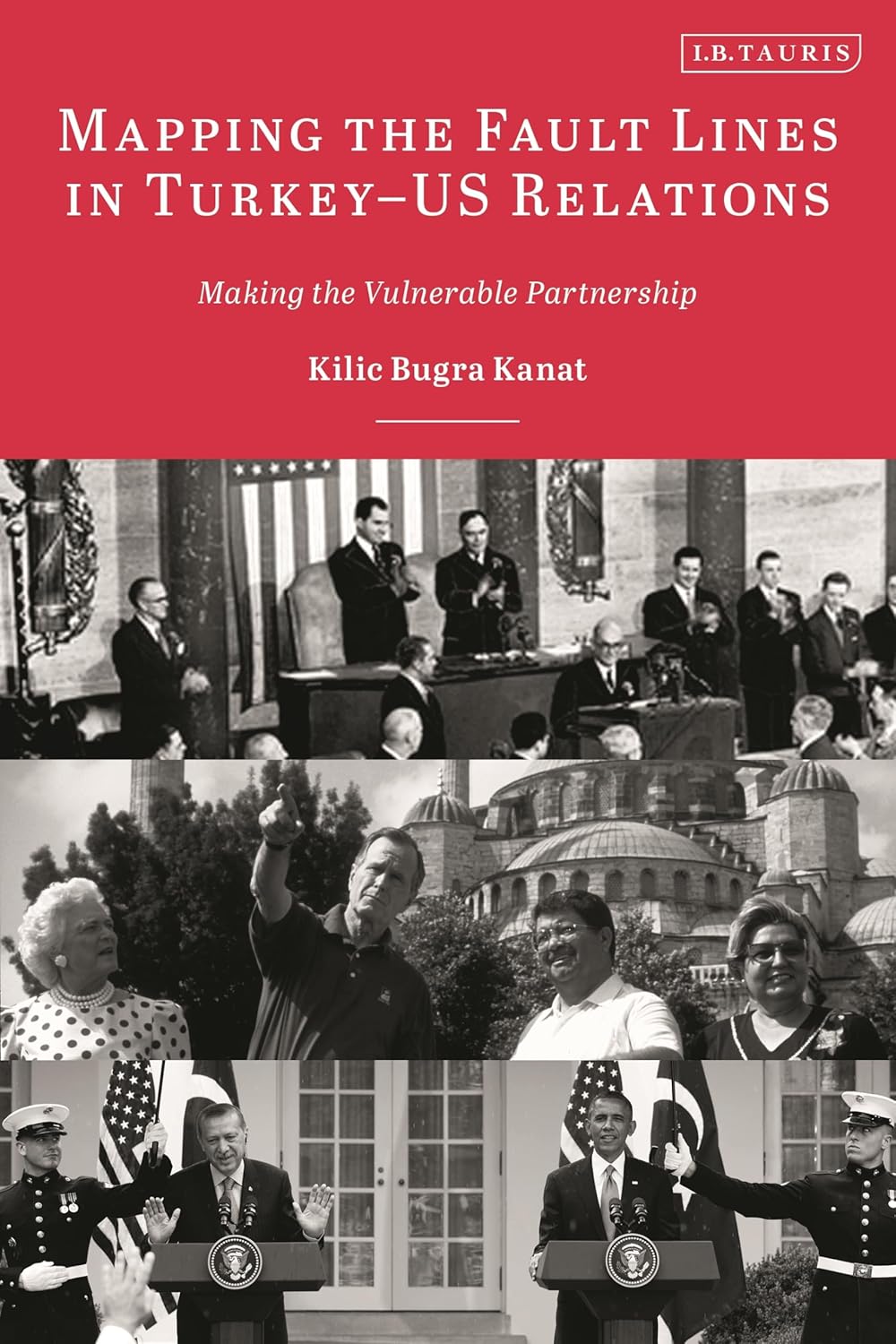
Kılıç Buğra Kanat’s Mapping the Fault Lines in Turkey-U.S. Relations: Making the Vulnerable Partnership is thoughtfully organized into five chapters, each systematically addressing key facets of the complex bilateral relationship. Chapter 1, “The Role of Public Opinion,” is structured to analyze how domestic societal attitudes and media narratives influence government policy, drawing on public surveys, opinion polls, and media analysis to demonstrate the impact of public sentiment on diplomatic decisions. Chapter 2, “U.S. Congressional Attitudes: A Long Running Challenge for Türkiye,” is designed to explore legislative dynamics by examining congressional debates, resolutions, hearings, and political discourse that reveal persistent challenges and shifts in U.S. policymaking towards Türkiye. This chapter contextualizes how congressional attitudes have historically shaped or constrained diplomatic options. Chapter 3, “Türkiye-U.S.-Russia Triangle: Common Enemy, Realignments, Unipolarity,” is organized to dissect the geopolitical triangle, focusing on how shared concerns over security threats, particularly from Russia, have led to tactical realignments, yet also expose underlying strategic tensions, with discussions on military cooperation, alliances, and diplomatic negotiations. Chapter 4, “ Syria as a Faultline in Turkish-American Relations,” is structured to examine the Syrian conflict’s role in straining bilateral ties, emphasizing military interventions, refugee issues, and diplomatic disagreements, illustrating how regional crises serve as flashpoints. Finally, Chapter 5, “Fault Lines in the Middle East: Iraq, Iran, and Israel,” broadens the analysis to regional conflicts that influence U.S.-Türkiye relations, highlighting how external regional dynamics such as Iran’s regional role, Israel-Türkiye relations, and Iraq’s stability act as persistent sources of divergence or cooperation.
This research is made up of some eye-catching strengths. One of the most significant strengths of Kanat’s work is careful research and a clear approach to the theme. Each chapter embarks on critical factors that affect bilateral relations, providing readers with more than mere summaries, but goes as far as to analyze a framework for understanding these complexities. For instance, he examines the U.S. congressional attitudes, which offer a historical backdrop serving as a complement to queries in contemporary diplomacy. In Chapter 2, he details Türkiye’s struggle to sustain a good image in Washington, even though the current prejudices from U.S. legislators are very much noteworthy. Here, Kanat progresses by connecting realities today with historical developments, thus providing significant grounds for his assertions.
In Chapter 3, which examines the Türkiye-U.S.-Russia triangle, Kanat provides a comprehensive analysis of how regional realignments and shared security concerns, particularly regarding Russia, influence the broader geopolitical landscape. He details how the U.S. has strategically supported groups such as the People’s Protection Units (YPG) and the Democratic Union Party (PYD), which are considered terrorist organizations by Türkiye due to their ties to the Kurdistan Workers’ Party (PKK). This support, primarily aimed at countering ISIS and containing Russian influence, has inadvertently empowered these groups, leading to significant tensions with Türkiye, which perceives such backing as a direct threat to its sovereignty and regional stability. The U.S. military presence in Syrian YPG-controlled territories, often justified as part of the fight against terrorism, has deepened mistrust, especially since Ankara views these groups as extensions of the PKK and, thus, terrorist proxies. The complex balancing act involves the U.S. navigating its strategic interests in containing Russia and Iran while managing its alliances with Kurdish militias that Türkiye regards as terrorists. This support underscores the realpolitik-driven nature of American foreign policy, where alliances are often transactional and fraught with contradictions, ultimately complicating regional security and undermining Türkiye-U.S. relations.
Moving to Chapter 5, the book expands this analysis to regional conflicts involving Iraq, Iran, and Israel, highlighting how the U.S.’ support for groups in Iraq, such as the Peshmerga and the YPG, mirrors its approach in Syria, further alienating Türkiye. Washington’s backing of these factions in Iraq, often in coordination with Kurdish authorities, is perceived by Ankara as a continuation of its strategy to empower terrorist-affiliated groups, which threatenTürkiye’s national security. Furthermore, the U.S. approach toward Iran through sanctions, nuclear negotiations, and regional containment clashes with Türkiye’s interests in maintaining good relations with Tehran, despite the U.S. pressure. Similarly, support for Israel’s military security and diplomatic alliances often puts the U.S. at odds with Türkiye’s regional ambitions. These external support policies, often justified as counterterrorism efforts, have inadvertently entrenched the very divisions that Kanat highlights as fault lines, especially the support for Kurdish groups like the PYD/YPG, deepening mistrust and complicating diplomatic negotiations. His analysis underscores how these intertwined support strategies, driven by broader geopolitical objectives, exacerbate regional instability and challenge the prospects for a stable Türkiye-U.S. relationship.
Even though there are some noteworthy strengths in this publication, nevertheless, the book does have weaknesses that deserve critical examination. One significant limit is the absence of a diverse range of views, especially those drawing from Turkish civil society. By integrating voices that match public sentiment in Türkiye more widely, Kanat’s analysis could be improved on how foreign policy is influenced by public opinion. There is a restriction in the depth of his narration on grassroots barriers and the support that Turkish leaders face when framing their diplomatic strategies, simply because of this omission. For example, in Chapter 1, the showing of the impact generated by the Turkish media on public sentiment provides a temporary view that could benefit from deeper navigation of civil society frameworks that usually highlight or counter governmental narratives.
Again, while the research carefully discusses congressional attitudes by the U.S., it somewhat underplays the dominance of players emerging at global levels, including China and the European Union, on U.S.-Türkiye relations. Still in Chapter 2, the change in the global balance of power and the dynamics of alliances paint an urgent need for a more comprehensive examination of how historical allegiances and foreign policy decisions are altered by these new actors. By including such discussions, Kanat could provoke wealthy scholarly debates on the evolving nature of diplomatic ties within the context of a multipolar world.
Concerning the portions that need to be improved, a more engaging narrative style could uplift access to the material, especially for less versed readers in international relations. The author’s scholarly tone, even though authoritative, may alienate readers with a general interest who might benefit from a more conversational approach. Added to the above, extending on future research orientations could offer a roadmap for scholars targeting the subject matter. Discussions concerning public diplomacy effectiveness, particularly in responding to misconceptions within public views, would serve as an essential area for future exploration and also connect the discourse to wider themes of global diplomacy.
Interestingly, Mapping the Fault Lines in Turkey-U.S. Relations goes beyond its direct focus and resonates with international relations themes at a broader level, particularly within the African context. The emphasis on the power dynamics in the text, characterized by the tensions between foreign actors and regional players, mirrors obstacles encountered by African states navigating post-colonial legacies and contemporary international partnerships. Both African scholars and policymakers would benefit from reflecting on the analysis provided by Kanat, deriving parallels to the complicated diplomatic dance witnessed in their nations.
To conclude, Mapping the Fault Lines in Turkey-U.S. Relations: Making the Vulnerable Partnership sets out as a rich contribution to the present body of knowledge on international relations, especially concerning Türkiye and the U.S. Kanat’s careful research underscores the importance of historical context in understanding interactions in modern diplomacy. Despite its shortcomings in broadening views and engaging a broader audience, the book stimulates conversations in a critical manner and informative discourse on international relations in a fast-changing world. As affiliations continue to evolve globally, especially against the backdrop of geopolitical power shifts, Kanat’s insights remain timely and essential for understanding the intricate layers of diplomacy today.