

Introduction
Throughout the 2010s, Türkiye tried to rejuvenate its ties to the Asia-Pacific countries. In this context, since 2010, Türkiye has established strategic partnerships1 with six nations in the Asia-Pacific region: China, Japan, Indonesia, Korea, Malaysia, and Singapore. The deepening relations with Asia should be seen as a reflection of Turkish identity as an inseparable part of Asia. Türkiye has historical, cultural, linguistic, and religious links with many nations that have helped Türkiye become a nation that bridges differences and various interests. In keeping with Türkiye’s innovative and human-oriented foreign policy and considering the Asia-Pacific’s growing economic and political importance, the country has implemented measures to open up to the region, which has grown significantly in recent years. Turkish bilateral approaches with countries in the Asia-Pacific have resulted in a growing number of Turkish strategic partnerships and thus increased trade and socio-cultural exchanges. This is seen as necessary for rising middle powers such as Türkiye to convert their traditional, lateral relations from one-way to multilayered.2 This is also an opportunity for middle-sized powers to diversify their asymmetrical relationship with great powers by searching for new trade partners. In this context, for Turkish foreign policymakers, this paved the way for such opportunities to be explored in the Asia-Pacific region.
After an extended period of disengagement, Turkish foreign policymakers put forth a new approach, known as Yeniden Asya (Asian Anew),3 to further comprehend and connect with the Asia-Pacific region. This new initiative led Türkiye to rediscover Asia and take significant steps toward establishing strategic partnerships with the countries in the region. Turkish-Indonesian relations were no exception and have also significantly furthered in recent years. Both countries cooperate closely in several international organizations and multilateral forums, such as the UN, the OIC, the G20, the D-8, and MIKTA. Many bilateral relations are thus expected to gain better momentum within the Asian Anew approach. One of the most awaited is the bilateral relationship between Indonesia and Türkiye. As such, Ankara and Jakarta are forging ways to further their bilateral relationship through a strategic partnership.
In keeping with Türkiye’s innovative and human-oriented foreign policy and considering the Asia-Pacific’s growing economic and political importance, the country has implemented measures to open up to the region, which has grown significantly in recent years
Türkiye-Indonesia relations entered a new stage when “The Joint Declaration of Indonesia-Türkiye: Towards an Enhanced Partnership in a New World Setting” was signed on April 5, 2011, in Jakarta. Following this declaration, the Consulate General of Indonesia opened in İstanbul in 2012. In 2017, President Joko Widodo, often known as Jokowi, committed to furthering bilateral relations through strengthening strategic sectors, including but not limited to industries such as political, security, economic, cultural, education, science, and technology collaboration. In this meeting, both countries set a target of $10 billion in trade volume by 2023. For instance, the Indonesia-Türkiye Comprehensive Economic Partnership Agreement, commonly abbreviated as IT-CEPA, was signed in 2017 and is expected to strengthen economic ties between Indonesia and Türkiye. As a result of such developments, some literature has considered that relations between Jakarta and Ankara are a form of strategic partnership.4 Here, one can easily say that bilateral relations are mostly based on material factors such as trade. However, considering what constitutes a strategic partnership in international relations, this article will inquire whether the bilateral relations of Indonesia and Türkiye suit this concept, which requires re-examination. This question constitutes the analyzed problem of this study.
To move the relations to the level of strategic partnership, the compatibility of mutual expectations between the opposing states is important. Even if the word “partnership” solely implies “becoming a partner,” in the context of studies on international relations, it can be suggested that the parties share expenses and risks in addition to working toward specific goals and objectives.5 Here, factors such as leaders’ foreign policy orientation and the domestic politics of a country help to construct both common goals and aims.
This analysis, therefore, will explore the two countries’ ties by implying Nadkarni’s theory to comprehend the underlying factors of the strategic partnership between Türkiye and Indonesia. Nadkarni’s theory is relevant since it explains strategic partnership from both material and nonmaterial views. In this context, this paper will examine the Türkiye-Indonesia relations not only regarding economic and military relations but also through cultural differences and domestic politics. This will help to analyze both countries’ relations not only at the bureaucratic level but also deeper. This analysis argues that, as the process of recognizing the identity differences between the two countries increases, the possibility of defining it as a strategic partnership also increases. The discussion finds that although cooperation between Türkiye and Indonesia is rising in economic and military terms, there is still a lack of understanding regarding norms, values, and culture. This uncertainty may present differences or obstacles regarding the two countries supporting each other in both bilateral and multilateral forums and reaching the committed goals.
After an extended period of disengagement, Turkish foreign policymakers put forth a new approach, known as Yeniden Asya (Asian Anew), to further comprehend and connect with the Asia-Pacific region
This study consists of three main sections. Firstly, the writers will provide a general definition of strategic partnership as a theoretical framework. Then, the study will explain why Nadkarni’s theory is relevant to the discussion. The second section delves into an analysis of Indonesian foreign policy and then will apply Nadkarni’s theory to see which elements have an enormous impact on the construction of partnerships. Finally, the discussion will analyze the challenges and opportunities of the two nations’ strategic partnership potential.
Literature Review
Türkiye-Indonesia relations have followed an improving trend since President Jokowi Period. Therefore, the number of studies on Türkiye-Indonesia bilateral relations in the literature has been increasing. One of the most notable works frequently cited on this topic is a book by Çolakoğlu and Güler on the historical journey and current achievements of Indonesian-Turkish relations.6 While this work could be considered the earliest that explained the nature of Indonesian-Turkish relations in detail, it lacks details about the main actors involved in the advancement of Indonesian-Turkish relations. Most of the issues discussed by Çolakoğlu and Güler only covered general outlines of Indonesian-Turkish ties, such as economic and political cooperation. During the early 2010s, other research that needs to be highlighted is Altı’s comparative study on the existence of the military in the social sphere in Indonesia and Türkiye.7 Altı’s study does not focus on analyzing the trends in bilateral relations but specifies the discussion about societal perception toward a military role in both countries. Several kinds of research were also dedicated to studying the comparative aspects of the politics in Indonesia and Türkiye, such as the contesting values of Islamism and secularism by van Bruinessen and the interethnic violence cases in the Aceh and Kurdish regions by Qurtuby, as well as the construction of identity in the post-secular context in Indonesia and Türkiye by Mushoffa and the comparative analysis of Indonesian and Turkish foreign policies on the issues of Palestine by Pramuji.8
As the relationship between the two countries advances, research focusing on the nature of the bilateral relationship between Indonesia and Türkiye is growing. One article by Bishku attempts to alleviate the existing gaps among many researchers concerning the development of Indonesian-Turkish relations, both in historical and contemporary contexts.9 More research that deserves mentioning due to its specified topics is on potential agricultural cooperation between Indonesia and Tûrkiye, which was conducted by Sumiahadi, Direk, and Acar.10 A more recent example of trying to comprehend the relationship between Indonesia and Türkiye is a recently published thesis by Fadillah in 2022.11 However, this research does not extensively cover the issue of Indonesian-Turkish contemporary bilateral ties but instead focuses on the historical developments of Indonesian-Turkish relations.
Türkiye-Indonesia relations entered a new stage when “The Joint Declaration of Indonesia-Türkiye: Towards an Enhanced Partnership in a New World Setting” was signed on April 5, 2011
This research seeks to delve deeper into the dynamics of the bilateral relations, especially during the presidencies of Joko Widodo and Recep Tayyip Erdoğan, which seemingly could be indicated as one of the golden periods of the bilateral relationship aside from Yudhoyono’s presidency from 2004-2014. By engaging with the theoretical framework of strategic partnership, this research expects to display the current status of bilateral relationships in a different perspective and a more comprehensive nature compared to the previous research mentioned above.
Strategic Partnership Concept
Although discussions on strategic partnerships initially emerged in organizational (business and management) studies, the topic began to be included in the study of international relations and political science in the mid-1990s.12 Most authors who investigated the origins of this phenomenon contended that the agreement between U.S. President Bill Clinton and Russian President Boris Yeltsin in 1994 set forth a new stage for a mature strategic partnership based on equality, mutual advantages, and recognition of each other’s national interests. However, strategic partnerships are versatile and adaptable foreign policy tools of dominant, emerging/middle, and minor countries, particularly in the post-Cold War world, which was marked by a more interdependent and complex international system. The U.S. and the People’s Republic of China have established over 130 such relationships, thus making them the two most active nations in creating strategic partnerships.13 Others are significantly less ambitious, signifying continuous bilateral diplomatic conversations that lack a shared objective or goal. Thus, the nature of strategic partnerships varies greatly, ranging from a broad scope, structure, and intensity of contact to having essentially no stable structure, covering just a few areas of collaboration, and including minimal regular activity.14 This situation generally creates the perception that when a major power joins another major or middle/emerging power, it establishes a strategic partnership.
It can be seen in both presidents’ terms that Indonesia has built its strategic partnerships with major powers on issues prioritized by its presidents. The most important reason for this is the perception of the security threat posed by major powers such as China
Strategic partnerships are a growing and elusive phenomenon, and the scholarly community has yet to develop an adequate, let alone unanimous, description. Neither in 2003, when strategic partnerships entered the European Union vocabulary, nor in 2010, when it became one of the union’s foreign policy priorities, was the notion specified: “Strategic partnerships are a political term that no EU statute or declaration fully defines.”15 For Maihold, “partnership” is a cultural ideal in the collaborative form of cooperation. The term implies that it assumes equal rights and duties, as well as the potential of constructively addressing the mutual growth of the partnership. With this collaboration, mutual exclusivity is expected.16
In terms of definition, “strategic” alludes to its political significance and master plan support without restricting the parties’ relations to only military means. Since the primary purpose of strategic partnership is the cooperation of actors who share the same goals, states often perceive cooperation as the best way to achieve their goals.17 Strategic partnerships are bilateral relations that promise long-term collaboration between actors, institutional flexibility , and protect the legal sovereignty of the actors. Similar to Czechowska, for Bendiek and Kramer, the ‘strategy’ concept can only be possible with the well-planned pursuit of a long-term, well-defined goal or the planned fulfillment of a long-term goal.18 For Michalski and Pan, a strategic partnership is a particular type of bilateral interaction between two players in the international system to establish privileged bilateral connections.19 Lessa described strategic partnerships as “priority political and economic contacts, mutually compensating, built based on an accumulation of bilateral relations of a universal type.”20 Emerson et al.’s agential perspective on the concept defines ‘strategic partnership’ as a special relationship that “involves two powerful actors capable of taking strategic action jointly.”21
In this context, the definitions of strategic partnerships and the context of strategic partnerships used in the literature vary greatly. Therefore, the next section will explain Nadkarni’s theoretical framework for strategic partnership between Türkiye and Indonesia since it is relevant in helping to elaborate Indonesia-Türkiye relations, both in its material and non-material aspects.
Vidya Nadkarni’s Strategic Partnership as a Theoretical Framework
This study borrows Vidya Nadkarni’s theoretical framework to explain empirical findings of the bilateral relations between Türkiye and Indonesia. By using Nadkarni’s theory, the relations between the two countries will not only be evaluated in terms of economic and military cooperation but also the normative elements that position the two countries in terms of culture and education will be discussed. In this context, Nadkarni’s theory is relevant since both Indonesia and Türkiye apply Nadkarni’s six pillars of strategic partnership conditions with their strategic partners such as the U.S., China, or ASEAN. According to Nadkarni, the inventory of six strategic partnership constitutive traits is one of the most cited conceptualizations of the notion. Strategic partnerships often include numerous common aspects that unite nations that are neither allies nor rivals but have a variety of both similar and contrasting interests: (i) formalized in multiple written declarations, statements, agreements, and memoranda of understandings that outline clear policy objectives and attempt to build upon and deepen multifaceted ties; (ii) establishments of formal institutional links at various governmental and non-governmental levels, generating multiple interactive channels at the levels of Track I (official) and Track II (people-to-people) diplomacy; (iii) establishment of mechanism for summit meetings between top leaders that are held alternately in the capital cities of the two countries, with more frequent meetings at the sub-ministerial and bureaucratic levels where officials explore common interests or concerns, often in joint task forces established to address specific issues; (iv) commitment for a common vision to strengthen connections between respective military establishments through joint military exercises, and working on confidence-building measures; (v) commitment to strengthen economic ties; and (vi) interest in raising common knowledge of each other’s cultures through youth exchanges and cultural festivals.
Since the two countries are democratic and Muslim in their sociopolitical characteristics, the two countries would want to play significant roles in ensuring that democratization, development, and stability could go hand-in-hand in the region
Nadkarni continued her argument by emphasizing that although the partnership seems comprehensive, this cannot be considered an alliance.22 Rather, the formation of strategic partnerships like this would help countries in Asia to form a more flexible arrangement in the course of the development of their relations, such as in the form of regional security architecture. In this matter, Nadkarni captured the complexity of forming relationships and alliances in Asia, where enmity and amity could change dynamically according to regional and global political balances. Through this concept, Nadkarni tries to rationalize this complexity by capturing the arguments from realism, liberalism, and constructivism through the theoretical lens of strategic partnership theory.
Engaging with Nadkarni’s theory, this study will use six pillars of strategic partnership by looking at six initiatives between Indonesia and Türkiye. The first pillar will focus on the two countries’ declarations, statements, and agreements. Second, from a formalist perspective, the study will explain MIKTA and G20 as inter-governmental cooperation initiatives that enable Turkish-Indonesian relations to be developed positively. Third, this study will look into the establishment of the Joint Working Group of the Indonesian and Turkish Police Departments as a joint task force. Fourth, it will focus on military agreements to increase military capacity and collaborate on the production of military hardware, specifically on the production of a main battle tank, submarine, and other important spare parts of military hardware. Fifth, it will concentrate on economic and commercial ties, particularly on the issue of the IT-CEPA negotiation.
This discussion will end on the issue of civil society initiatives and socio-cultural exchanges in the bilateral relationship of Indonesia and Türkiye. Civil society initiatives in some parts are initiated and coordinated by Islamic organizations interested in fostering the connection between religious institutions in both countries. All these positive developments are not without their challenges. Some challenges exist in ensuring the continuation of the strategic partnership between Indonesia and Türkiye, such as the problem of the mutual naming of streets in Jakarta and Ankara. This will also be elaborated further by thoroughly unfolding the influence of Indonesia’s civil society organizations and political parties on Indonesian foreign policy. The next chapter will explain the recent priorities of Indonesian foreign policy by explaining Indonesia’s understanding of the issue. It is important for these two countries to understand their foreign policy prioritization and the foreign policy orientations and goals of their leaders before establishing a strategic partnership to build the partnership on healthier foundations.
Understanding Indonesian Foreign Policy Priorities and Expectations
This section will reveal Indonesia’s foreign policy understanding during the presidencies of Susilo Bambang Yudhoyono (SBY) and Jokowi to comprehend Türkiye’s expectations of Indonesian foreign policy. Turkish authorities need a strong and in-depth understanding of Indonesian foreign policy if Türkiye wants to have solid bilateral ties with Indonesia. First of all, Indonesia stands for the principle of non-alignment as a political and moral compass that would guide Indonesia’s choice of partners in regional and global politics. During the end of the Cold War, Indonesia didn’t neglect its non-alignment principle as a basis for choosing partners and friends in Indonesia’s diplomacy. This could be seen in the case of Yudhyono’s presidency, who tried to reinterpret Indonesia’s non-alignment commitment into the motto of “Million Friends, Zero Enemy.” While this motto of Yudhoyono’s presidency looks pragmatic in many senses, it is actually a ‘naive’ embodiment of the spirit of non-alignment in democratic Indonesia.23 Thus, during the era of Yudhoyono, Indonesia witnessed an increase in stronger bilateral engagements and the establishment of new strategic partnerships due to the motto of Yudhoyono’s foreign policy. The president was carefully navigating possible risks in the Asia-Pacific by maintaining active communication with different states and actors, both in bilateral and multilateral forums. Yudhoyono’s delicate way of balancing expectations from different parties made Indonesia relatively able to play a leadership role in ASEAN and mediate conflicts at the regional level while keeping priorities for national interests.
It seems that a similar vision is now continued by Joko Widodo, who considers Indonesian economic advancement to escape the middle-income trap as the most important achievement of his administration. Widodo sees that all foreign policy agendas should be directed to make sure that Indonesia is able to make the most gains in trade cooperation. Thus, making new friends in different corners of the world would be a priority for his presidency, even with non-traditional allies and unconventional countries like Israel.24 But unlike Yudhoyono, Indonesia under Widodo was not willing to be considered a proactive player in regional and global politics. This could be seen in how Widodo is not making ASEAN a cornerstone in Indonesian foreign policy by not promoting new initiatives in the bloc. Widodo’s continuing absence from the annual United Nations General Assembly sessions is also a sign of Indonesia’s avoidance of becoming more engaged in the global agenda. Thus, Widodo’s presidency has been marked by its strong tendency toward bilateralism and cautious multilateralism.25 Widodo is only interested in forging partnerships with countries or regions he deems to significantly benefit Indonesian political and economic interests and also leverages Indonesia’s status as one of Asia’s growing economic powers. This tendency is the reason why Widodo’s presidency is willing to engage more with Africa and do more projects with Indonesia’s existing strategic partners, particularly China, Australia, and Japan.26 Indonesia’s opening to countries in the Pacific region in recent years is also part of Widodo’s calculated move. While this move is economically costing Indonesia, the Pacific opening signifies Widodo’s Administration’s willingness to anticipate increasing support from Pacific and Melanesian countries toward the Papuan independence struggle in Indonesia, which would risk Indonesia’s sovereignty.27
In the case of cooperation between the defense ministers of both Indonesia and Türkiye, it could be seen that both ministers are willing to do significant exchanges and conduct multiple joint projects to strengthen the bilateral defense cooperation and to explore more avenues of cooperation between the two countries
Due to the strong emphasis on economic advancement, it could be seen that Widodo’s diplomatic engagement and choices for strategic partnership would not only be decided by the Ministry of Foreign Affairs but also by the Coordinating Ministry for Maritime and Investment Affairs.28 While this could make decisions made by the Indonesian government much more comprehensive, there is some concern about whether Indonesia’s foreign policy would no longer be strongly anchored to its primary ideals but rather adjust the interests of its strategic partners. One of the examples that showcases this behavior is Indonesia’s close partnership with the People’s Republic of China. While this partnership has brought a significant amount of Chinese investment to Indonesia, it would be risky and precarious to the Indonesian leadership in ASEAN, as Indonesia won’t be confident enough to exert new initiatives in the case of the South China Sea dispute.
However, it can be seen in both presidents’ terms that Indonesia has built its strategic partnerships with major powers on issues prioritized by its presidents. The most important reason for this is the perception of the security threat posed by major powers such as China to Indonesia’s economic trade. This shows that while middle powers construct strategic ties with other middle powers, it has to be noted that countries’ regional ties and expectations with great powers are significant determinants. In this case, it is seen that Indonesia and Türkiye, a rising middle power, often define their strategic partnership through their relations with great powers such as the U.S., Russia, and China in terms of economic and security norms. In this context, Türkiye-Indonesia relations have to be examined from a different perspective, which includes not only material notions but nonmaterial as well. Therefore, in the next chapter, we will apply Nadkarni’s theory to explore whether Türkiye and Indonesia can actually be defined as strategic partners.
Building Strategic Partnership between Middle Powers: Six Pillars of Indonesia-Türkiye Relations
Formal Agreement to Reach Clear Policy Objectives
The starting point for any strategic partnership is usually a declaration, agreement or any kind of formal document that signifies the advancement of the existing bilateral relationship. In the case of Indonesia and Türkiye, this document was the “Joint Declaration of Türkiye and Indonesia: Towards an Enhanced Partnership in a New World Setting.”29 During one of his speeches made in Jakarta, President Abdullah Gül commented that the signing of the joint declaration would mean that a new era for the Indonesian-Turkish bilateral relationship was coming.30 This document was signed on April 5, 2011, during the eve of the Arab Spring. It can be argued that Indonesia was looking forward to collaborating with Türkiye to welcome the momentous occasion of democratization in the Middle East. Since the two countries are democratic and Muslim in their sociopolitical characteristics, the two countries would want to play significant roles in ensuring that democratization, development, and stability could go hand-in-hand in the region. As both countries also share similar aspirations as a middle power in global politics, Indonesia and Türkiye also wanted the nature of their bilateral relations to be upgraded in all aspects to allow for the betterment of their role in their respective regions and the world at large. In the joint declaration, it is stated that both Indonesia and Türkiye envision a bilateral strategic partnership that would increase exchanges and cooperation between the two countries in the political, security, economic, science, cultural, and educational sectors. Besides the joint declaration, both parties have already agreed to foster economic cooperation between the two countries by starting negotiations on the Indonesia-Türkiye Comprehensive Economic Partnership Agreement in 2017.31
On the collaboration in commercial sectors, Indonesia and Türkiye have also agreed to increase the trade between in diverse sectors, ranging from goods such as agricultural and fisheries products to manufactured goods
It is expected that once the joint declaration is signed by both parties, Indonesia and Türkiye will soon initiate the establishment of formal links that are institutionalized and available at various levels to allow interactions between state and non-state actors coming from different countries. Interestingly enough, this is not the case for the strategic partnership between Indonesia and Türkiye. Since the agreement commenced way back in 2011, talks surrounding the establishment of any high-level committee or bilateral commission have been subject to further discussions between Indonesia and Türkiye. No exact reason is known why the delay could be happening, but the change of government in Indonesia from Yudhoyono to Widodo might be one of the reasons why the delay is happening in terms of leaders’ policy orientation toward foreign policy priorities. Also, Turkish preoccupation with the troubling questions of Syria and conflicts with PKK threat at the Turkish border added to the turmoil and political instability arising from the July 15 coup attempt in 2016, complicating a lot of things for Turkish policymakers. Thus, it could be noted that the sociopolitical circumstances surrounding the Indonesian and Turkish foreign policymakers could be the reasons behind the delay. Eventually, after eight years of waiting, both Indonesia and Türkiye decided to establish a High-Level Strategic Council that will include the heads of state from both countries, ministers, and related officials to enable intensive talks and discussions on ways to further existing strategic partnerships.32 The fruition of the Indonesian-Turkish High-Level Strategic Council was finally achieved during Widodo’s visit to Türkiye in 2022, but the formal setting and technical arrangement of this council is still subject to further negotiations.33 In the last visit conducted by Indonesian Foreign Minister Retno Marsudi to Türkiye in 2024, both governments signed an agreement to start the High-Level Strategic Council by this year. This agreement also covers the expedited implementation of the IT-CEPA.34
Establishments of Formal Institutional Links
Official engagements between Indonesia and Türkiye have also frequently happened in multilateral forums, such as the G20 and MIKTA. Sideline bilateral meetings could serve as a moment where both leaders could initiate negotiations and reach agreements on how to advance the strategic partnership. The existence of the G20 and MIKTA allowed interactions between officials, but only within the topics that had been agreed in the scope of the G20. Since most of the MIKTA meetings are also taking place during the G20, it seems unsurprising that meetings conducted by Indonesia and Türkiye are not significantly improving bilateral relations. One of the significant reasons is that MIKTA is still defined under the title of “lack of subject specificity.”35 This is the missing part of building strategic partnerships via the multilateral forums if there is no specific goal or subject to accomplish.
Recently, civil society institutions from Indonesia and Türkiye have started grassroots efforts to prompt further engagements in socio-cultural sectors
On the other hand, it should be noted, though, that some G20 engagement forums allow for meetings and engagements between government officials and non-state actors such as businessmen and academics. Then again, without any clear formal institutionalized forum between Indonesia and Türkiye, spaces to engage and explore ideas for the betterment of Indonesia-Türkiye ties are confined to technical talks. Regarding the summit, outside of the mentioned Indonesian-Turkish High-Level Strategic Council, there are no more arrangements that could qualify as equal or larger than the agreed mechanism. So far, Indonesia and Türkiye have not made any other commitment to hold frequent summits between the heads of state of both countries, at least in annual or biannual settings. Rather, ministers should take more initiative to conduct inter-ministerial meetings and sign inter-ministerial agreements that would allow cooperation to happen on much more specific and technical issues. One of the main reasons behind the lack of talks is Indonesia’s tendency toward economic diplomacy which paved the way to seek both traditional and non-traditional markets in the period of President Jokowi (2014-2024) and delayed Türkiye-Indonesia relations in terms of strategic ties.
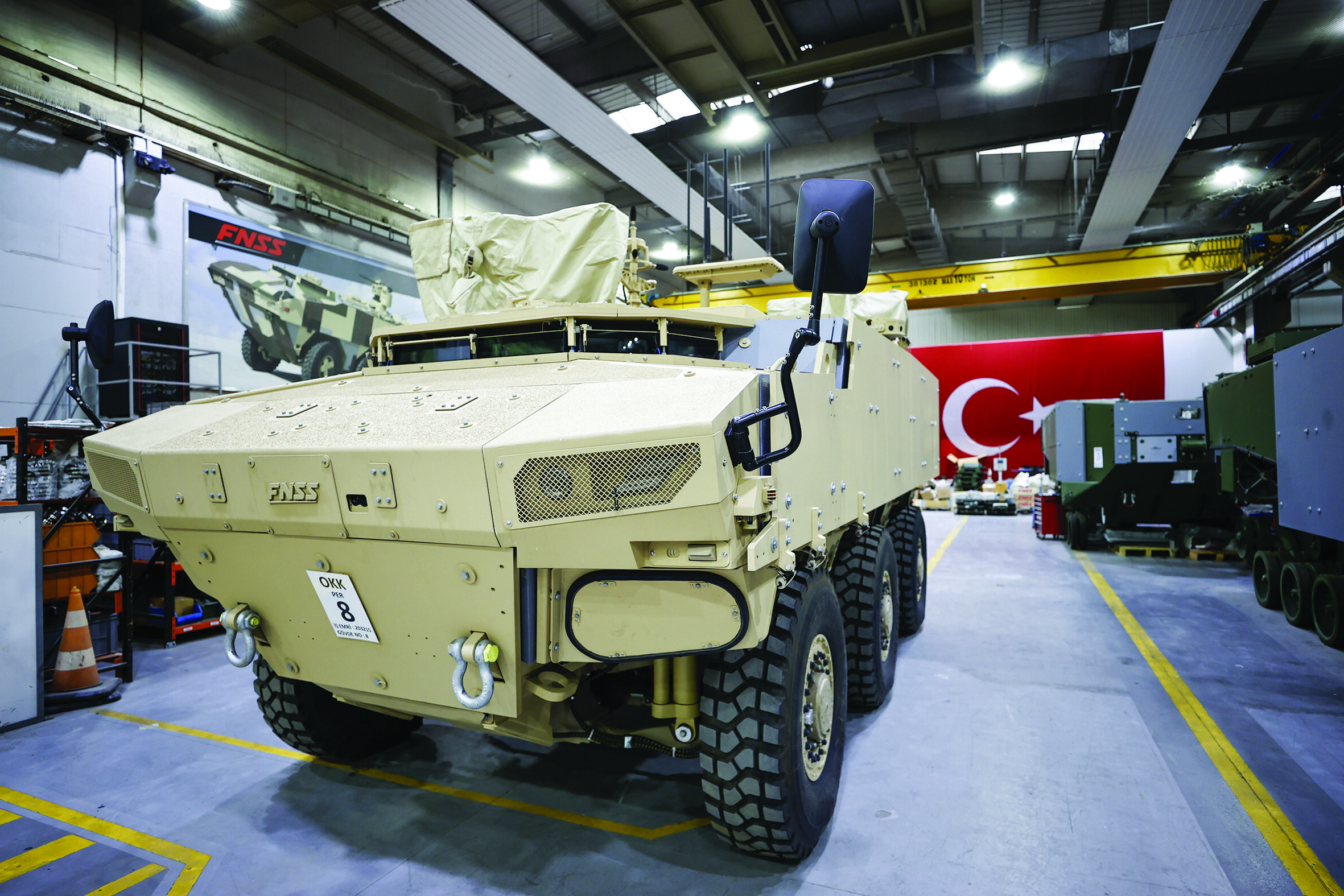
A Kaplan MT tank, 18 of which have been delivered by Türkiye to Indonesia, following a defence agreement between both states. DOĞUKAN KESKİNKILIÇ / AA
Initiatives are taking place more at the ministerial level because the issues negotiated are technical in nature, thus allowing for negotiations to happen in more streamlined and effective ways. Due to the large scale of the events and the time-consuming nature of summit preparations, it could be understood that Indonesia and Türkiye still do not have bilateral summits as a way to improve bilateral relations. Both governments seem to have more expectations for dialogue and discussions to happen between ministers and related officials of important governmental bodies. Some of the discussions occurred between the Ministry of Defense, the Ministry of Social Affairs, the Ministry of Trade, and also between the Ministry of Justice of the Republic of Türkiye and the Coordinating Ministry for Political, Security and Law Affairs of the Republic of Indonesia during the G20 sessions in Bali in the year 2022.
Respective Military Establishments
In the case of cooperation between the defense ministers of both Indonesia and Türkiye, it could be seen that both ministers are willing to do significant exchanges and conduct multiple joint projects to strengthen the bilateral defense cooperation and to explore more avenues of cooperation between the two countries. During the era of Minister Prabowo Subianto of Indonesia and Minister Hulusi Akar of Türkiye, new agreements on joint projects to develop tanks, weapons, missiles, drones, and submarines were reached.36 Both countries industry shares similar visions on the importance of building a strong national defense industry, which will be the backbone for an agile national defense system.37 On this issue, Minister Subianto declared that his ministry would be dedicated to promoting the defense diplomacy agenda. This agenda will allow for an upgrade and increase in Indonesia’s defense and military capability through joint collaboration, especially through joint projects and technical collaborations. The leadership initiative would also allow for further cooperation to happen at the sub-ministerial levels and national defense companies. The achievements of Indonesian-Turkish defense cooperation resulted in the production of the jointly designed Kaplan Tank (Tank Harimau), which has been shipped to Indonesia.38 On the other side, Minister Subianto also managed to negotiate agreements with the Ministry of Agriculture of the Republic of Türkiye to secure investments and knowledge sharing on food estate construction in Indonesia.39 It is seen that relations in terms of the defense sector are relatively higher than others. One of the significant reasons behind this tendency is Türkiye’s achievements in defense technology in recent years. This choice was made by Indonesia due to the Turkish status as one of NATO’s member states that is not only capable of making technologically advanced weapons but also sharing its technological know-how with its counterparts in non-NATO member states.
If the two countries decide to forge better relations on the right notions and norms, it will directly affect public opinion and facilitate the government’s steps toward establishing a multidirectional strategic partnership
As strategic partners, both Indonesia and Türkiye are committed to more cooperation between military establishments. Such cooperation between the military establishments is made possible either through the Ministry of Defense or through the Indonesian Armed Forces and its respective Army, Navy, and Air Force branches. Nonetheless, since the signing of the Indonesia-Türkiye Strategic Partnership in 2011, there has only been one significant military exercise conducted by the Indonesian Navy and the Turkish Navy in the Mediterranean Sea.40 Together with TCG Yıldırım, the Indonesian warship KRI Sultan Hasanuddin conducted military exercises together to share know-how on the issue of maritime security. Both warships also did active work to ensure the UNIFIL mission in Lebanon went smoothly. Other than that, as mentioned above, Indonesia and Türkiye have also conducted projects in defense industries. New agreements on military research and weaponry development have been agreed upon by both the National Defense University of Indonesia and the National Defense University of Türkiye.41 Another important achievement that needs to be mentioned is the visit conducted by the Indonesian warship KRI Frans Kaisiepo to the earthquake-stricken area in Mersin. While doing the humanitarian operation, the KRI Frans Kaisiepo was also conducting a joint naval exercise with the UNIFIL Maritime Task Force, which consisted of naval warships from Lebanon, Bangladesh, Greece, and Türkiye.42
Other ministries have also launched several different initiatives in various sectors. Since 2019, intensive discussions have been held between both Indonesia and Türkiye to ensure that the incremental negotiations on the trade of goods are continuing on the expected target. Different ministries, such as the Ministry of Social Affairs, the Ministry of Forestry and Environmental Issues, and the Coordinating Ministry for Political, Legal, and Security Affairs, have signed multiple bilateral ministerial agreements to strengthen bilateral collaboration on various issues, ranging from joint workshops to consolidation of both countries’ efforts to block the financial transaction flows to terrorists and foreign militants under the FATF (Financial Action Task Force) mechanism. Several breakthrough initiatives were also made by both Indonesia and Türkiye during the G20 Summit in Indonesia.43 Most are ministerial agreements, not included within the larger scope of the memorandum of understanding, which will be able to be applied as a wide-ranging mechanism. For example, in the case of security cooperation, Indonesia and Türkiye have agreed and signed the Security Cooperation Agreement, which will allow both parties to talk about security cooperation on various issues during the Security Dialogue Meeting. Under this agreement, many other related institutions have established better collaboration in the form of joint working groups, such as the 1st Joint Working Group between the Indonesian National Police and the National Police of Türkiye.44 However, to allow more work to happen, both parties still need to sign the memorandum of understanding.
Strengthen Economic Ties
On the collaboration in commercial sectors, Indonesia and Türkiye have also agreed to increase the trade between in diverse sectors, ranging from goods such as agricultural and fisheries products to manufactured goods. According to the data provided by UN Comtrade, Indonesia’s trade values have increased significantly, particularly in 2013, where the recorded data shows a remarkable achievement of trade between the two countries amounting to $2.85 billion (Graph 1). In 2021, according to the UN COMTRADE, Indonesia successfully reached a significant trade surplus from Türkiye in 2021 of $1.2 billion, which is considered the highest trade surplus achieved since 1989.45 Currently, the IT-CEPA is still in its third round of negotiations, which was conducted in January 2019. The third round of negotiations focuses on eliminating trade barriers and finishing terms of reference as a basis for conducting negotiations in the future. Due to the amount of bilateral economic partnership agreements that Indonesia is currently negotiating, such as the additional protocols for the IJEPA, negotiations on the I-UAE EPA, and the RCEP, it seems that negotiations on the IT-CEPA are still waiting to enter the next stage.46 Indonesia’s ambition to further resource-based industrialization should be considered by Turkish policymakers and stakeholders in this sector as one of the avenues to possibly accelerate the IT-CEPA negotiation processes.47 Several Turkish companies are focusing on resourced-based industrialization, such as BOTAŞ. Recently, an agreement was signed with PT Perusahaan Gas Negara to explore potential collaboration in gas exploration.48
Graph 1: Trade Goods between Indonesia and Türkiye (1989-2021)
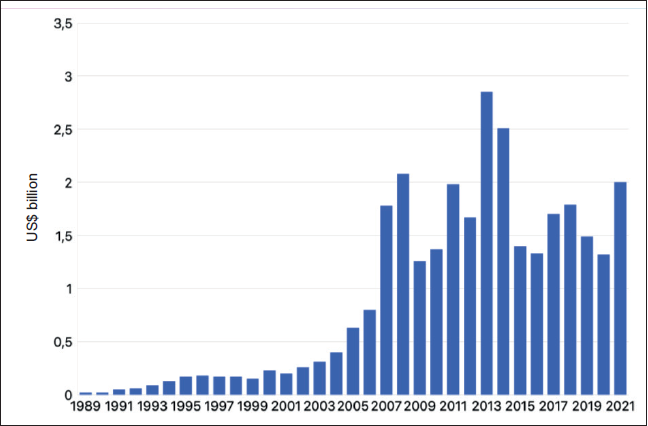
Source: Databoks49
Increasing Common Knowledge of Cultures
Lastly, regarding socio-cultural exchanges and cultural festivals, Indonesia and Türkiye lack official arrangements, formal agreements, and institutions that could solidify any formal activities in these sectors. But recently, civil society institutions from Indonesia and Türkiye have started grassroots efforts to prompt further engagements in socio-cultural sectors. One of the most significant achievements in this regard is the establishment of Yunus Emre Kültür Merkezi (Yunus Emre Cultural Center) and Pusat Budaya dan Bahasa Indonesia KJRI İstanbul (Indonesian Cultural Center at the Indonesian Consulate in İstanbul). The establishment of two institutions by governmental institutions aims to bridge cultural differences between the two nations and spread awareness about the two cultures. In this aspect, the Yunus Emre Cultural Center is engaging with Indonesian counterparts by teaching Turkish to the wider public and specified authorities, such as Indonesian military personnel.50 Another aspect of cultural engagements that should be noted is the meeting between the Nahdlatul Ulama Central Board and Türkiye Maarif Vakfı (Turkish Maarif Foundation).
Nahdlatul Ulama’s educational wing, Maarif Educational Institutions, seeks to emulate the Turkish educational model that can face the challenges of the current economic system. Nahdlatul Ulama is especially interested in learning from the Turkish government and the Turkish Maarif Foundation in implementing the Turkish vocational model in its existing educational system.51 In a rather different context, the roles of Turkish alumni of Indonesia and Indonesian students in Türkiye are more crucial. An example of this is Indonesian students who have become instrumental in conducting cultural fairs in several universities in Türkiye. Turkish alumni from Indonesia have also initiated several platforms that allow the exchange between Indonesian and Turkish students to happen, as in the case of the annual İstanbul Youth Summit.52 Student exchange programs between higher educational institutions in Indonesia and Türkiye were also conducted under the Mevlana or Erasmus+ programs. What is still lacking is the inbound movement of Turkish students to Indonesia, and this has to be encouraged through scholarships from the Indonesian government or exchange programs targeting Turkish students interested in the Indonesian language and culture.
Where are thousands of students from Indonesia coming to Türkiye and completing their undergraduate and graduate education through different scholarships and mechanism, Türkiye only has several students who had graduated from Indonesian educational institutions. In a sense, this creates an asymmetrical result in the academic development of Türkiye’s cultural ties with Indonesia. Consequentially, having an equal academic exchange to establish more comprehensive cooperation plays an important role in recognizing cultural differences that will hopefully eliminate this asymmetric relationship. Therefore, it is seen that having a better understanding of a country could lead the way to deeper engagement to improve strategic partnerships.
Challenges for Indonesian-Turkish Strategic Partnership
At least two major challenges influenced the advancement of strategic partnerships between Indonesia and Türkiye. One of the major challenges is domestic constraints from both the Indonesian and Turkish sides. Particularly on the Indonesian side, some Indonesian politicians are still skeptical about the Turkish state being secular. In this respect, the contemporary debate about the mutual naming of streets in Jakarta and Ankara has reflected the dilemma and skepticism from Indonesian politicians and some figures in Indonesian civil societies. This is reflected in one of the in-depth articles written in Cumhuriyet newspaper that captures the debate surrounding the naming of the Atatürk street in Jakarta.53 While the Turkish government and Ankara municipal government readily accepted the plan to change the name of the street currently hosting the Indonesian Embassy in Ankara from Hollanda Street to Ahmet Sukarno Street, the expected response was not seen from the Indonesian government or Jakarta’s municipal government.
When Türkiye proposed the street’s name as Mustafa Kemal Atatürk, it immediately attracted responses from Indonesian politicians and several Muslim leaders. According to them, Atatürk would never be accepted as the name of a street in Jakarta, as it would tarnish the image of Indonesia as a Muslim nation. Some important Muslim figures in Indonesia still considered Atatürk as a person who was fully responsible for the fall of the caliphate. At the same time, the facts surrounding this case differ.54 Some figures, such as Deputy Head of Indonesian Parliament Hidayat Nur Wahid, argued that the name Atatürk could be replaced by other honorary figures from the Ottoman era, such as Fatih Sultan Mehmet or Kanuni Sultan Süleyman.55 However, the mutual naming should be based on common ground by using a figure on a similar level and from the same historical context. Unfortunately, there has still been no effort to rename the street “Mustafa Kemal Atatürk Street” in Jakarta.
Governmental and non-governmental organizational cooperation helped establish a common framework and assist policymakers in making policies specific to the needs of the stakeholders in Indonesia and Türkiye
This debate shows that domestic constraints based on political sentiments could be one of the primary inhibitors in advancing the nature of strategic partnerships between the two countries. From the Indonesian side, a lack of proper knowledge about Türkiye might be one of the reasons for the domestic constraints. As a solution, academic exchanges would encourage mutual understanding of both countries’ norms. Turkish alumni in Indonesia and alumni of Turkish origin would also become potential bridges between Indonesia and Türkiye, especially those alumni working in crucial sectors such as policymaking and bureaucracy. Recently, the establishment of the Maarif Center for Turkish Studies at Universitas Indonesia and the academic visits between universities in both countries have been important steps in comprehending the domestic norms and values of both countries.56
Another issue concerns the political will exerted by key political actors from both countries. It seems that the lack of personal engagement and networking between Indonesia and Türkiye could also be factors that slow the advancement of strategic partnerships. However, during the presidency of Widodo, the government has tried to build a cordial relationship with Erdoğan to encourage mutual trust and a sense of cooperation between both parties. Within Widodo’s Cabinet, Prabowo Subianto, one of the actors playing a key role in furthering strategic partnerships, has already won the 2024 presidential election. His victory might send a good signal to Turkish policymakers, especially those who are working in the security and defense sectors. As Subianto had already forged a good friendship with Hulusi Akar, a member of Parliament and former Turkish defense minister, it will hopefully be easier for both sides to initiate comprehensive talks in the future. In the process of foreign policymaking in Indonesia, Indonesian foreign policy is highly influenced by the decisions and the wisdom of its president and its leadership circle. Through Subianto’s worldview, which is heavily anchored in strategic and militaristic visions, Türkiye-Indonesia relations have great potential to be built through the purchase and sale of military equipment or technological transfer.
Conclusion
Within the scope of the theoretical framework, this study shows that although the two countries have defined themselves as strategic partners since 2011, their relations other than in the military and economic dimensions have not reached the level of a strategic partnership. This situation puts the relations between the countries in a significantly “neo-realist” context, which somehow inhibits them from reaching the “strategic partnership” level. The most important reason for this is that bilateral relations are only progressing in the elite circle. The domestic and foreign policy modeling of both leaders is unable to fully create the perception of the “strategic concept” of the two countries. While the military and economic needs between the two countries serve the idea of “strategic partnership,” it is understood that the socio-cultural obstacles encountered in the transition from the leadership level to the state level will prevent the relations from moving to the next stage. There are still many cultural differences that need to be bridged between the two societies in state-level relations. Therefore, if the two countries decide to forge better relations on the right notions and norms, it will directly affect public opinion and facilitate the government’s steps toward establishing a multidirectional strategic partnership. Otherwise, the strategic partnership will heavily depend on the country’s advancement exclusively on material issues, such as military or economic cooperation.
In this context, this paper finds that the future trajectory of Indonesian-Türkiye strategic partnerships depends on several factors. First, the availability of formal documents and the willingness to implement those documents into workable institutional arrangements that suit the needs of both Indonesia and Türkiye. The availability of documents is not the only sign that shows a working relationship; there is more work to be done to make the points agreed upon into operative policy in real-world settings. The availability of formal documents should also be followed by the commitment to ensure the continuation of a recently established high-level summit mechanism between the leaders of Indonesia and Türkiye. Second, the initiatives are made by leaders from Indonesia and Türkiye, who have cordial relations. This cordial friendship, built on a personal level, helps both leaders nurture trust as the relations between the two countries grow. Third, collaboration between governmental and non-state actors should be one of the main focuses that would drive the future trends of the Indonesian-Turkish strategic partnership. As explained in previous sections, governmental and non-governmental organizational cooperation helped establish a common framework and assist policymakers in making policies specific to the needs of the stakeholders in Indonesia and Türkiye. Fourth, the policymakers of Indonesia and Türkiye should not overlook domestic politics while trying to advance the bilateral strategic partnership. Domestic politics could be influenced by various factors, and it is advisable for policymakers to carefully consider and be aware of internal political dynamics that are developing in Indonesia and Türkiye.
Endnotes
1. A strategic partnership constitutes a formal relationship between states, aimed at achieving mutual benefits through collaboration across a spectrum of issues, including security, economic development, and political cooperation. For a deeper understanding of this concept, please refer to the following key texts and further readings: O. N. Methrota, “Indo-Russian Strategic Partnership in the Current World Order,” in Shams Ud Bin (ed.), India and Russia: Towards a Strategic Partnership, (New Delhi: Lancer Books, 2001); Sean Kay, “What Is a Strategic Partnership?” Problems of Post-Communism, Vol. 47, No. 3 (2000), pp. 15-24; Avery Goldstein, “An Emerging China’s Emerging Grand Strategy,” in G. John Ikenberry and Michael Mastanduno (eds.), International Relations Theory and the Asia-Pacific, (New York: Columbia University Press, 2003).
2. Gürol Baba, “Türkiye’s “-lateralisms” in Asia: A Multi-Vectorial Analysis,” Insight Turkey, Vol. 26, No. 1 (2024), pp. 65-89.
3. Ali Merthan Dündar and Mehmet Özay, Asya-Pasifik Çalıştayı: Yeniden Asya Açılımı Çerçevesinde Fırsatlar ve Zorluklar Bildiriler Kitabı, (İstanbul: Fatih Sultan Mehmet Vakıf Üniversitesi Yayınları, 2022).
4. Selçuk Çolakoğlu and Arzu Güler, Turkey and Indonesia from Friendship to Partnership, (Ankara: Uluslararası Stratejik Araştırmalar Kurumu, 2011); Emel Parlar Dal and Ali Murat Kurşun, “Assessing Turkey’s Middle Power Foreign Policy in MIKTA: Goals, Means, and Impact,” International Journal, Vol. 71, No. 4 (2016), pp. 608-629; Kamer Kasim, “Türkiye-Indonesia Relations in the Framework of Türkiye’s Southeast Asia Policy,” Yönetim Bilimleri Dergisi, Vol. 21, No. 49 (2023), pp. 608-626.
5. Andriy Tyushka and Lucyna Czechowska, “Strategic Partnerships in Twenty-Second Century Global Politics: From Weathering Storms to the Politics of Anticipation,” in Lauran Horn, Ayşem Mert, and Franziska Müller (eds.), The Palgrave Handbook of Global Politics in the 22nd Century, (London: Springer International Publishing, 2023), pp. 83-106.
6. Çolakoğlu and Güler, Turkey and Indonesia from Friendship to Partnership.
7. Altay Atlı, “Societal Legitimacy of the Military: Turkey and Indonesia in Comparative Perspective,” Turkish Journal of Politics, Vol. 1, No. 2 (2010).
8. Martin van Bruinessen, “Secularism, Islamism and Muslim Intellectualism in Turkey and Indonesia: Some Comparative Observations,” in Mirza Tirta Kusuma (ed.), Ketika Makkah Menjadi Seperti Las Vegas: Agama, Politik dan Ideologi, (Jakarta: PT Gramedia Pustaka Utama, 2014); Sumanto Al Qurtuby, “Interethnic Violence, Separatism and Political Reconciliation in Turkey and Indonesia,” India Quarterly, 71, No. 2 (2015), pp. 126-145; Eva Mushoffa, “The Construction of Identity in the Post-Secular States: The Case of Turkey and Indonesia,” Advances in Social Science, Education and Humanities Research, Vol. 129, (November 2017), pp. 243-246; Noor Fahmi Pramuji, “A Comparative Analysis of Indonesia and Turkey’s Foreign Policy toward the Middle East: A Case of Palestine Issue,” Journal of International and Local Studies, Vol. 4, No. 1 (2020).
9. Michael B. Bishku, “Turkey and Indonesia: A Relationship of Muslim-Majority Middle Powers,” Sociology of Islam, Vol. 9, No. 2 (2021), pp. 95-117.
10. Ade Sumiahadi, Mithat Direk, and Ramazan Acar, “Potential Agro-Industrial Commodities for the Development of Indonesia-Turkey Economic Partnership,” IOP Conference Series: Earth and Environmental Science, 637, No. 1 (2021).
11. Nur Fadillah, “Analysis of Indonesian-Turkish Relations (Political, Diplomatic, and Economics since 2002) [Endonezya-Türkiye İlişkilerinin Analizi (2002’den Beri Siyasi, Diplomatik ve Ekonomi)],” Master’s Thesis, Sakarya University, 2022.
12. Anna Michalski, “Diplomacy in a Changing World Order: The Role of Strategic Partnerships,” The Swedish Institute of International Affairs, No. 10 (2019), retrieved from https://www.ui.se/globalassets/ui.se-eng/publications/ui-publications/2019/ui-paper-no.-10-2019.pdf.
13. Anna Michalski, “Diplomacy in a Changing World Order: The Role of Strategic Partnerships,” The Swedish Institute of International Affairs, No. 10 (2019), retrieved from https://www.ui.se/globalassets/ui.se-eng/publications/ui-publications/2019/ui-paper-no.-10-2019.pdf.
14. Michalski, “Diplomacy in a Changing World Order.”
15. Anne Schmidt, “Strategic Partnerships– A Contested Policy Concept,”German Institute for International and Security Affairs, (December 7, 2010)
16. Günther Maihold, “Conclusion: Leadership Coalitions as a New Element for the EU’s External Action,” in Jörg Husar, Günther Maihold, and Stefan Mair (eds.), Europe and New Leading Powers, (Baden-Baden: Nomos, 2010), pp. 147-156.
17. Lucyna Czechowska, “The Concept of Strategic Partnership as an Input in the Modern Alliance Theory,” The Copernicus Journal of Political Studies, Vol. 2, No. 4 (2013).
18. Annegret Bendiek and Heinz Kramer, “The EU as a ‘Strategic’ International Actor: Substantial and Analytical Ambiguities,” European Foreign Affairs Review, Vol. 15, No. 4 (2010).
19. Anna Michalski and Zhongqi Pan, Unlikely Partners? China the European Union, and the Forging of a Strategic Partnership, (Singapore: Palgrave MacMillan, 2017).
20. Antônio Carlos Lessa, “Brazil’s Strategic Partnerships: An Assessment of the Lula Era (2003-2010),” Revista Brasileira de Política Internacional, 53 (2010), pp. 115-131.
21. Michael Emerson, The Elephant and the Bear: The European Union, Russia and their Near Abroads, (Brussels: CEPS, 2011).
22. Vidya Nadkarni, Strategic Partnerships in Asia: Balancing without Alliances, (London and New York: Routledge, 2010).
23. Evi Fitriani, “Yudhoyono’s Foreign Policy: Is Indonesia a Rising Power?” in Edward Aspinall, Marcus Mietzner, and Dirk Tomsa (eds.), The Yudhoyono Presidency: Indonesia’s Decade of Stability and Stagnation, (Singapore: ISEAS–Yusof Ishak Institute, 2017), p. 77.
24. “Indonesia-Israel Back-and-Forth Efforts to Establish Diplomatic Ties,” Dinsight, (March 4, 2024), retrieved March 4, 2024, from https://dinsights.katadata.co.id/read/2024/03/04/indonesia-israel-back-
and-forth-efforts-to-establish-diplomatic-ties.
25. Mohamad Rosyidin, “Foreign Policy in Changing Global Politics: Indonesia’s Foreign Policy and the Quest for Major Power Status in the Asian Century,” South East Asia Research, Vol. 25, No. 2 (2017), pp. 175-191.
26. Christophe Dorigné-Thomson, “Indonesia’s African Foreign Policy Shift under President Jokowi,” Journal of Social and Political Sciences, Vol. 4, No. 3 (2021).
27. Floranesia Lantang, and Edwin Tambunan, “The Internationalization of “West Papua” Issue and Its Impact on Indonesia’s Policy to the South Pacific Region,” Journal of ASEAN Studies, Vol. 8, No. 1 (2020), pp. 41-59.
28. Muhammad Zulfikar Rakhmat, “Luhut Binsar Pandjaitan: The Prominent Enabler behind China-Indonesia Relations,” Global Policy, (July 24, 2020), retrieved March 26, 2024, from https://www.globalpolicyjournal.com/blog/24/07/2020/luhut-binsar-pandjaitan-prominent-enabler-behind-china-indonesia-relations.
29. “Joint Declaration - Indonesia and Turkey: Towards an Enhanced Partnership in a New World Setting,” Ministry of Foreign Affairs of the Republic of Indonesia, (April 5, 2011), retrieved March 4, 2024, from https://kemlu.go.id/download/L1NpdGVBc3NldHMvTGlzdHMvRXRjJTIwTWVudS9EaXNwRm9ybS9Kb2ludCUyMERlY2xhcmF0aW9uJTIwUkklMjBUdXJraSUyMDIwMTEucGRm.
30. Selçuk Esenbel, “Turkey and Indonesia: Historical Roots, Contemporary Business Links,” Middle East Institute, (November 4, 2013), retrieved March 4, 2024, from https://www.mei.edu/publications/turkey-and-indonesia-historical-roots-contemporary-business-links.
31. “Indonesia-Turkey Comprehensive Economic Partnership Agreement (It-Cepa) Trade in Goods Negotiation,” Ministry of Trade of the Republic of Indonesia, (July 6, 2017), retrieved March 4, 2024, from https://ditjenppi.kemendag.go.id/index.php/bilateral/eropa/turki.
32. “Indonesia, and Türkiye Agree to Set Up a High-Level Strategic Council,” Antara News, (October 22, 2017), retrieved March 4, 2024, from https://en.antaranews.com/news/113161/indonesia-turkey-agree-to-set-up-high-level-strategic-council?utm_source=antaranews&utm_medium=related&utm_campaign=related_news.
33. “Indonesia, Turkey Discuss Enhancement of Bilateral Cooperation,” Antara News, (July 15, 2023), retrieved March 4, 2023, from https://en.antaranews.com/news/288426/indonesia-turkey-discuss-enhancement-of-bilateral-cooperation.
34. “Indonesia Committed to Intensifying Cooperation with Turkey,” Antara News, (May 2, 2024), retrieved May 8, 2024, from https://en.antaranews.com/news/312330/indonesia-committed-to-intensifying-cooperation-with-turkey.
35. Baba, “Türkiye’s “-lateralisms” in Asia.”
36. “Prabowo ke Turki, Ternyata RI Borong Anti-Torpedo Kapal Selam,” CNBC Indonesia, (October 24, 2020), retrieved July 2, 2024, from https://www.cnbcindonesia.com/news/20201024162116-4-196844/prabowo-ke-turki-ternyata-ri-borong-anti-terpedo-kapal-selam.
37. “Prabowo’s Defence Diplomacy,” The Jakarta Post, (July 6, 2021), retrieved March 4, 2024, from
https://www.thejakartapost.com/academia/2021/07/05/prabowos-defense-diplomacy.html; Sarp Özer, “Turkish Defence Chief’s Intense Diplomacy in 2022,” Anadolu Agency, (January 8, 2023), retrieved March 4, 2024, from https://www.aa.com.tr/en/politics/turkish-defence-chiefs-intense-diplomacy-in-2022/2782397.
38. Göksel Yıldırım, “Kaplan Tankı Endonezya’da Vitrine Çıktı,” Anadolu Ajansı, (November 4, 2022), retrieved March 4, 2024, from https://www.aa.com.tr/tr/savunma-sanayisi/kaplan-tanki-endonezyada-vitrine-cikti/2729529.
39. “Prabowo Sepakati Perdagangan Pertanian Rp 146 T dengan Turki,” Republika, (July 25, 2020), retrieved March 4, 2024, from https://ekonomi.republika.co.id/berita/qdzg7i366/prabowo-sepakati-perdagangan-pertanian-rp-146-t-dengan-turki.
40. “KRI Sultan Hasanuddin-366 Latihan Bersama Mailbag Transfer Dengan Kapal Perang Turki TCG Heybeliada di Laut Mediterania,” The Indonesian National Armed Forces, (March 29, 2021), retrieved March 4, 2024, from https://tni.mil.id/view-195686-kri-sultan-hasanuddin-366-latihan-bersama-mailbag-transfer-dengan-kapal-perang-turki-tcg-heybeliada-di-laut-mediterania.html.
41. “Rektor Unhan RI Menerima Kunjungan Delegasi National Defence University of the Republic of Türkiye,” Indonesia Defence University, (November 15, 2023), retrieved March 4, 2024, from https://www.idu.ac.id/berita/rektor-unhan-ri-menerima-kunjungan-delegasi-national-defense-university-of-the-republic-of-turkiye.html.
42. “KRI Frans Kaisiepo-368 Hadir di Turki, Kirim Bantuan Kemanusiaan Dalam Rangka Confidence Building Measure,” The Indonesian National Armed Forces, (March 17, 2023), retrieved March 4, 2024, from https://ppid.tni.mil.id/view/32436353/kri-frans-kaisiepo-368-hadir-di-turki-kirim-bantuan-kemanusiaan-dalam-rangka-confidence-building-measure.html.
43. “G20 Hasilkan Kerjasama Bilateral Indonesia-Turki,” G20 Indonesia 2022, (November 12, 2022), retrieved March 4, 2024, from https://indonesia.go.id/g20/kategori/siaran-pers-g20/6586/siaran-pers-
g20-hasilkan-kerjasama-bilateral-indonesia-turki?lang=1.
44. “Menko Polhukam dan Mendagri Turki Teken Perjanjian Payung Kerjasama Keamanan,” Ministry of Political, Legal and Security Affairs of the Republic of Indonesia, (August 23, 2023), retrieved March 4, 2024, from https://polkam.go.id/mahfud-md-dan-mendagri-turki-teken-perjanjian-payung-kerjasama-keamanan/.
45. Dzulfiqar Fathur Rahman, “Perdagangan Indonesia-Turki Tembus US$2 Miliar pada 2021,” Databoks, (August 17, 2022), retrieved March 4, 2024, from https://databoks.katadata.co.id/datapublish/2022/08/17/perdagangan-indonesia-turki-tembus-us2-miliar-pada-2021#.
46. “Sekilas FTA,” The Directorate General of Customs and Excise, (2023), retrieved March 4, 2024, from https://fta.beacukai.go.id/sekilas-fta/.
47. “Explainer: Indonesia’s Return to Industrialization,” Stratsea, (January 10, 2024), retrieved March 4, 2024, from https://stratsea.com/explainer-indonesias-return-to-industrialization/.
48. “PGN dan BOTAS Kerja Sama Gas Bumi di Turki,” Antara Kepri, (November 13, 2022), retrieved March 26, 2024, from https://kepri.antaranews.com/berita/139077/pgn-dan-botas-kerja-sama-gas-bumi-di-turki.
49. “Perdagangan Indonesia-Turki Tembus US$2 Miliar pada 2021,” Databoks.
50. Mustafa Deveci and Muhammad Abdullah Azzam “Lembaga Türkiye Buka Cabang di Jakarta untuk Promosikan Budaya dan Bahasa,” Anadolu Agency Indonesia, (December 14, 2022), retrieved March 4, 2024, from https://www.aa.com.tr/id/budaya/lembaga-promosi-budaya-dan-bahasa-turkiye-buka-
cabang-di-jakarta-/2763468.
51. “NU Sepakati Kerja Sama Pendidikan Dengan Yayasan Maarif, Turki,” Antara News, (July 25, 2019), retrieved March 4, 2023, from https://www.antaranews.com/berita/976200/nu-sepakati-kerja-sama-pendidikan-dengan-yayasan-maarif-turki.
52. “About,” Istanbul Youth Summit, retrieved March 4, 2024, from https://istanbulyouthsummit.com/about.
53. “‘Jalan Atatürk’ Cakarta’yı Salladı,” Cumhuriyet, (October 31, 2021), retrieved March 4, 2024, from https://www.cumhuriyet.com.tr/pazar-yazilari/jalan-ataturk-cakartayi-salladi-1880843.
54. “‘Jalan Atatürk’ Cakarta’yı Salladı,” Cumhuriyet.
55. “HNW Tolak Penggunaan Kemal Pasya Ataturk Sebagai Nama Jalan Di Jakarta,” The People’s Consultative Assembly of the Republic of Indonesia, (October 19, 2021), retrieved March 4, 2023, from https://www.mpr.go.id/berita/HNW-Tolak-Penggunaan-Kemal-Pasya-Ataturk-Sebagai-Nama-Jalan-Di-Jakarta.
56. “UI dan Ankara University Bakal Jalin Kolaborasi Bidang Kesehatan,” Antaranews, (June 14, 2023), retrieved July 2, 2024, from https://www.antaranews.com/berita/3587157/ui-dan-ankara-university-bakal-jalin-kolaborasi-bidang-kesehatan.