
Introduction
The geopolitical landscape of Central Asia and the Caucasus, characterized by intricate interactions between states, international organizations, and regional dynamics, has witnessed the emergence of the Organization of Turkic States (OTS). This research examines the multifaceted role of the OTS within the international and regional systems. Acknowledging the limitations of singular theoretical lenses in studying international relations, this research embraces an eclectic theoretical framework, aligning with the principles of analytic eclecticism. By doing so, this research positions OTS as an entity composed of multiple states within the complex landscapes of Central Asia and the Caucasus. This approach recognizes that the OTS’ role in the international system is shaped by a multitude of factors, including structural changes, leadership dynamics, domestic decision-making processes, and significant international events. I argue that the as a newly established entity, OTS holds significant potential to exert considerable strategic, economic, and cultural influence over the Central Asia and Caucasus regions in the medium-to-long term. However, this potential hinges upon several critical factors, including the sustained unity within the OTS, the advancement of bilateral relationships among its member states, and the OTS’ ability to effectively compete with rival regional frameworks for prominence.
Therefore, this research utilizes an eclectic framework and organizes the international and regional systems into three interconnected structures: the strategic, economic, and social structures. Each structure presents a unique lens through which the OTS’ activities and potential can be evaluated. The strategic structure entails defense alliances, military collaboration, and security arrangements, aligning with principles of structural realism. In this dimension, the OTS states form alliances strategically, considering the impact of the anarchic system on shaping their interactions. The economic structure centers on economic cooperation, trade agreements, and developmental endeavors, drawing from realist and liberal perspectives. It emphasizes the OTS’ efforts to foster economic integration among Turkic states, reflecting the potential for economic cooperation to enhance prosperity and regional stability. The social structure encompasses the systems’ cultural, social, and normative aspects, recognizing the composite nature of states influenced by sociocultural and economic groupings. In this dimension, the OTS leverages shared cultural and historical affinities among its member states to cultivate its image and promote its interests on a global stage.
The subsequent sections will introduce the theoretical framework used in this research and provide a brief overview of the OTS’ evolution, its growth, challenges, and pivotal moments, culminating in its transformation into the OTS in 2021. Finally, this research will explore the current activities of the OTS within the international and regional systems, considering its potential within economic, strategic, and social dimensions.
Theoretical Framework
The constraints of relying on a single theoretical lens when studying international relations and organizations like the OTS have been recognized by prominent scholars within the International Relations literature. Kenneth Waltz, in Men, State, and War, underscores the limitation of singular theoretical perspectives, highlighting how they lead to incomplete analyses, hindering our ability to comprehend the intricate dynamics at play.1 Similarly, Robert Gilpin’s International Political Economy advocates for eclecticism, arguing that a synthesis of Marxism, Liberalism, and Realism can enhance theoretical precision.2 In a later edition of his work, Gilpin stresses the importance of considering both material and ideal forces for a comprehensive understanding of the political world.3 In a similar vein, Robert Keohane integrates elements of neo-realism and Gramscian Marxism in his hegemonic stability theory.4 Therefore, this article makes use of an eclectic theoretical framework aligned with the principles of analytic eclecticism championed by Sil and Katzenstein. In their 2010 book, they advocate for a flexible perspective on causality, emphasizing the need to break free from the constraints of single paradigms when analyzing intricate and diverse interactions.5 To this end, we are able to position the OTS as a composite entity within the complex landscapes of Central Asia and the Caucasus. This approach recognizes that the OTS’ role in the international system is shaped by structural changes, leadership dynamics, domestic decision-making processes, and significant international events.
The OTS leverages shared cultural and historical affinities among its member states to cultivate its image and promote its interests on a global stage
Relying upon analytic eclecticism, this article assumes a tripartite system for international and regional systems in three distinct yet interrelated structures: strategic, social, and economic. Judgment for OTS’ potential in Central Asia and South Caucasus should take into consideration the OTS’ activities in these dimensions and the challenges it is facing. This framework helps evaluate the interactions between the member states and the OTS’ relations with other states and international organizations by taking the multidimensional and multilevel nature of the global political system. Within the theoretical strategic structure, we find the conceptual possibility of defense alliances, military collaboration, and security arrangements among Turkic states and other regional and global actors.
Borrowing insights from structural realism, this domain predominantly deals with states in their unitary form and considers changes at the domestic level as only changes within the system. It focuses on how the anarchic system shapes and shoves the interactions among different units.6 It is within this sphere that the OTS states potentially align strategically with each other in order to form an alliance within the strategic realm. Second, the economic structure is centered around economic cooperation, trade agreements, and developmental endeavors. In our case, it involves fostering economic integration among Turkic states. Here, states are acknowledged as composite entities, showcasing their economic and developmental attributes. Aside from states, business entities and companies also have agency in this realm. Within the Classical Realist perspective, Hans Morgenthau highlights how states pursue economic cooperation to strengthen their positions in the global hierarchy.7 Accordingly, the OTS’ efforts in fostering economic integration among Turkic states can be viewed as a means to enhance their collective influence amid global power struggles. The idea that economic interdependence fosters peace and stability is also put forward by widely acclaimed scholars in the IR literature, including Joseph Nye.8 In the case of the OTS, the emphasis on trade agreements and economic partnerships reflects the liberal perspective, emphasizing the potential for economic cooperation to not only enhance prosperity but also contribute to regional stability. Third, the social structure encompasses the systems’ cultural, social, and normative aspects. It is a realm of diplomatic ties, cultural exchanges, and normative convergences among Turkic states. Inspired by constructivist frameworks, this sphere recognizes the composite nature of states, acknowledging the sociocultural and economic groupings and associations within Turkic states that influence interactions.9 The OTS leverages shared cultural and historical affinities among its member states to cultivate its image and promote its interests on a global stage.
The victory in the Second Karabakh War paved the way for the transformation of the Turkic Council into the Organization of Turkic States
In summary, the OTS is designed to serve as a unifying force, empowering Turkic states to collectively navigate the complex security environment in Central Asia, the Caucasus, and beyond. The theoretical framework used in this work recognizes the OTS as such an actor in this arena, where the collective strength and influence of the Organization play a role in shaping regional dynamics in multiple structures. Thus, the theoretical framework deployed in the analysis of the OTS within the international context spotlights the intricate interplay between economic, strategic, and soft power activities, all of which constitute essential facets of the OTS’ engagement with the international and regional systems. A comprehensive understanding of these dynamics is paramount to appreciate the Organization’s position and impact in the intricate geopolitical landscape of Central Asia and the Caucasus.
Brief Overview of the Evolution of OTS
The dissolution of the Soviet Union in 1991 created a seismic shift in Eurasia, leading to the emergence of independent Turkic states seeking to define their destinies. In response to this transformation, the Turkic Council was established in 1992, originally known as the Summit of Turkish-Speaking Countries’ Heads of State. This regional organization aimed to foster collaboration among nations sharing cultural, linguistic, and historical ties, including Azerbaijan, Kazakhstan, Turkmenistan, Uzbekistan, Kyrgyzstan, and Türkiye. The inaugural Turkic Council Summit occurred on October 30-31, 1992, in Ankara, Türkiye. The Ankara Declaration signed during this summit emphasized the importance of shared language, history, and culture among Turkic peoples, promoting brotherhood, solidarity, and cooperation. It underscored principles such as independence, sovereignty, territorial integrity, non-interference in internal affairs, and equality in relations.10 However, in the subsequent years, the initial enthusiasm toward the Organization waned due to the disagreements among Turkic states driven by different foreign policy orientations and Russia’s restoration of influence in Central Asia through the Commonwealth of Independent States. As a result of this, during the 1990s and 2000s, summits were held infrequently and did not yield significant breakthroughs.
In 2009, the institutionalization of cooperation among Turkic states took a crucial turn with the signing of the Nakhchivan Agreement. This landmark accord led to the formation of the Turkic Council, which provided a formal institutional framework for their collaboration. The agreement’s core aims encompassed enhancing mutual trust, preserving regional and global peace, adopting unified stances in foreign affairs, coordinating efforts against international terrorism, fostering robust regional and bilateral cooperation, creating favorable conditions for trade and investment, and pursuing comprehensive economic, social, and cultural development.11 The agreement aimed to strengthen cooperation among member states and bolster the Council’s regional influence. Subsequent summits focused on distinct themes in various member countries, yielding advancements in economics, culture, transportation, tourism, media, youth, and sports. Institutions like the Turkish Academy and the International Turkic Culture and Heritage Foundation were established to facilitate scientific collaboration and cultural preservation.
TİKA emerged as a vital instrument for executing projects in newly independent Turkic nations in Central Asia and the Caucasus post-Soviet Union dissolution
The significance and functionality of the Turkic Council increased markedly after the Second Karabakh War in 2020. During the conflict, the Council provided unequivocal support to Azerbaijan. In a statement issued on September 28, 2020, the Council emphasized the urgent need to resolve the issue, highlighting Azerbaijan’s sovereignty and territorial integrity. The support of member states, particularly Türkiye, played a pivotal role not only in helping Azerbaijan achieve victory but also in maintaining the balance of power in the region and fostering unity among Turkic nations.12 The victory in the Second Karabakh War paved the way for the transformation of the Turkic Council into the Organization of Turkic States. The formation of OTS in 2021 marked a turning point, enabling enhanced cooperation between member states. Uzbekistan’s joining the Organization in 2019 and Turkmenistan’s inclusion as an observer member in 2021 contributed to the strength of the Organization in this period. During the 9th Summit of the OTS in Uzbekistan in 2022, members endorsed the “Organization of Turkic States Strategy for 2022-2026” to implement the “Turkic World Vision – 2040,” a strategic vision for promoting international peace, security, and prosperity.13 The document emphasized the importance of effective global governance, joint action against global challenges, and adherence to the UN Sustainable Development Goals, signaling a commitment to deeper institutionalization and integration.14
Economic Structure
Economic cooperation is one of the main motivations for collective action among the member states of the OTS. The Organization boasts a collective population of about 155 million, comprising approximately 17 percent of Europe and Central Asia’s total populace and 2 percent of the world’s overall inhabitants.15 OTS member states have a combined Gross Domestic Product (GDP) of nearly two trillion dollars. Moreover, they hold a 2 percent share of the global GDP.16 Economic cooperation within the Turkic World has gained momentum, especially since the late 2010s, as Turkic states focus on strengthening trade, investments, and joint ventures across various sectors despite the fact that the economic influence of China and Russia in the region remains. The region’s rich natural resources and a desire to leverage each other’s strengths are driving efforts to enhance economic integration and collaboration.17 Moreover, the evolving transportation routes in Central Asia and the South Caucasus are poised to reshape trade and economic development in the region, offering newfound opportunities for connectivity and prosperity. In this dynamic landscape, OTS potentially emerges as a key player, and its role is deeply intertwined with the economic interests of great powers such as the U.S., the European Union (EU), Russia, and China.
The geographic location of the OTS member states, and geoeconomic developments contributed to OTS’ economic potential growth. The Second Karabakh War led to the potential opening of the Zengezur corridor, connecting Nakhchivan and Azerbaijan. This corridor offers a more efficient route for trade, linking Türkiye with the Turkic World, bypassing Georgia and Iran. Leaders of Turkic Council member states have highlighted its role in revitalizing the Great Silk Road and strengthening Europe-Asia trade connections.18 Uzbekistan is also positioning itself as a regional transportation hub, with projects like the Turkmenbashi-Navoi railway line and plans for a North-South railway through Afghanistan to Pakistan’s Karachi port.19 In the context of energy, the European need for alternatives to Russia for hydrocarbon transfers from Central Asia and the Caucasus to Europe elevated the significance of the Trans-Caspian Gas Pipeline, connecting Turkmenistan and Azerbaijan to the Trans-Anatolian Natural Gas Pipeline. The partial resolution of Caspian Sea legal status disputes in 2018 had already set the ground for these projects.20 The developments also paved the way for the project of the Caspian Transit Middle Corridor, connecting Anatolia to Chinese territories via the Caspian Sea, which offers substantial economic advantages compared to alternative routes.21
The Turkic Council has played a pivotal role in catalyzing economic cooperation among its member states, evidenced by concrete decisions and initiatives discussed at its summits. As early as 1992, Türkiye’s President Turgut Özal proposed various initiatives during the first summit, including harmonizing customs legislation, establishing a free trade regime allowing the free movement of people, goods, and services, creating a joint investment and development bank, enhancing telecommunications, and facilitating the transportation of natural resources from Turkic-speaking countries through Türkiye to Europe.22
Founded in 1992, the Turkish Cooperation and Coordination Agency (TİKA) emerged as a vital instrument for executing projects in newly independent Turkic nations in Central Asia and the Caucasus post-Soviet Union dissolution. TİKA’s mandate encompassed advancing social structures, cultivating identities, and enhancing technical infrastructures. It also contributed to the cultivation of amicable and cooperative relationships within the region.23 Moreover, two prominent Turkic Council summits were held on issues related to the economy. The Gebele Summit in 2013 underscored the critical role of transportation networks, recognizing them as indispensable instruments for enabling economic and cultural integration across Turkic nations.24 The Bodrum Summit in 2014 placed a significant emphasis on boosting the tourism sector, aiming to facilitate tourism exchanges and revenue generation among Turkic nations.25 In 2019, the Union of Turkic Chamber of Commerce and Industry (TCCI) was founded in İstanbul with a permanent Secretariat. The primary goal was to encourage collaboration among business communities in the Turkic states, ultimately aiming to enhance economic integration and stimulate economic and social progress in the region.26 The “Turkic World Vision – 2040” also calls for elevating political, economic, and social standards by enhancing governance and promoting economic cooperation. Priorities include fostering a robust regional economic entity, diversifying economic activities with a focus on digital technologies, supporting a knowledge-based economy, exchanging best practices, and mobilizing international resources for sustainable and inclusive growth.27 The Turkic Council’s strategic focus on these critical areas reflects a shared commitment to economic collaboration and progress within the Turkic World.
China’s economic influence in Central Asia is marked by an asymmetrical trade relationship where Central Asian states are significant import partners for China. At the same time, China is the dominant import partner for them
Central Asia and the Caucasus has become a focal point for major global actors, each driven by distinct strategic interests. For the U.S., Central Asia and the Caucasus remains an important region because of its continued commitment to actively engage to contain China on a global scale and counter Russian aggression following the invasion of Ukraine. Thus, even after its withdrawal from Afghanistan, the U.S. remained committed to preserving its interests in the region. Over three decades, following the independence of the five Central Asian states, the U.S. has provided over $9 billion in direct assistance to support peace, security, democratic reform, and economic growth. It has led prominent international financial institutions in extending over $50 billion in credit, loans, and technical assistance. Private sector investments have exceeded $31 billion, creating local jobs and enhancing human capacity.28 For the EU, the region holds strategic value in diversifying energy sources and routes, reducing dependency on Russia. The transfer of hydrocarbon resources through Central Asia and the Caucasus via routes facilitated by the Turkic states, including Azerbaijan and Turkmenistan, enhances energy security for European nations. Following the start of sanctions on Russia, the resources of the Caspian Sea gained further importance for the EU. In 2022, this cooperation brought a Memorandum of Understanding concerning a strategic partnership in the energy sector with a pledge to double the Southern gas corridor’s capacity, aiming to deliver 20 billion cubic meters to the EU annually by 2027.29 This supports the EU’s diversification goals in the REPowerEU Plan and reduces European dependence on Russian gas. Azerbaijan is already boosting gas exports to the EU, expected to rise from 8.1 bcm in 2021 to around 12 bcm in 2022.30 Here, it is also important to remember that the EU remains Türkiye’s largest trade partner by far due to its membership in the Customs Union.31 That, along with Türkiye’s desire to continue its engagement with the EU, despite its slim chances for full membership in the foreseeable future, precludes its further economic cooperation with the OTS member states in Central Asia and the Caucasus.
Russia exerts significant economic and trade influence in Central Asia and the South Caucasus, capitalizing on historical legacies as former Soviet states as well as established economic connections between Russia and the rest of the former Soviet countries. The Eurasian Economic Union (EAEU) is an ambitious economic integration project in the former Soviet region, aiming to establish a common market similar to the EU. In the EAEU, Russia holds over 85 percent share of the combined EAEU GDP and the trade model is structured as a ‘hub and spoke’ system, with most trade occurring between Russia and the four other member states rather than trade happening in-between other members. Such a dominant position allows Russia to act unilaterally within the union, impacting the EAEU’s ability to fully realize its economic integration goals and shared decision-making among member states.32 Additionally, Russia’s control of pipelines and investments in regional energy infrastructure consolidates its sway in the energy sector, further underlining its economic dominance. Following the outbreak of the Russia-Ukraine war in 2022, however, Russia’s economic influence started to erode. Central Asian nations have not supported Russia’s invasion of Ukraine, and they adhere to Western sanctions. Russia’s trade volume with most members of the OTS did increase in this period. However, this increase did not occur as a result of the strengthening of trade ties with Russia. Instead, the exodus of Russian draftees and the circumvention of sanctions on Russia through third countries have contributed to this trend.33 For Türkiye, Russia is the top source of import due to its share of Türkiye’s import of natural gas. Therefore, while the Turkic countries are diversifying their economic engagements, trade with Russia continues to be important.
China’s economic influence in Central Asia is marked by an asymmetrical trade relationship where Central Asian states are significant import partners for China. At the same time, China is the dominant import partner for them. China’s role in foreign direct investment (FDI) is prominent, particularly in less diversified Central Asian economies. In the years between 1991 and 2016, China’s trade turnover with Central Asia had increased 60-fold.34 The economic engagement includes intergovernmental dealings and, at times, raises questions about transparency and ethical considerations as well.35 With the help of the Belt and Road Initiative (BRI), which is a comprehensive infrastructure and economic development project, China continues to extend its reach to the Central Asia and Caucasus regions, which hold significant importance within the BRI framework. Through the BRI, China has invested in various projects, including transport corridors, energy pipelines, and trade agreements, aimed at enhancing connectivity, trade, and economic cooperation across Central Asia and the Caucasus.36 While China’s economic influence is apparent, its direct political sway in Central Asia remains a topic of debate, as governments of the region tend to avoid taking positions contrary to China’s interests or commenting on sensitive issues to maintain good relations.
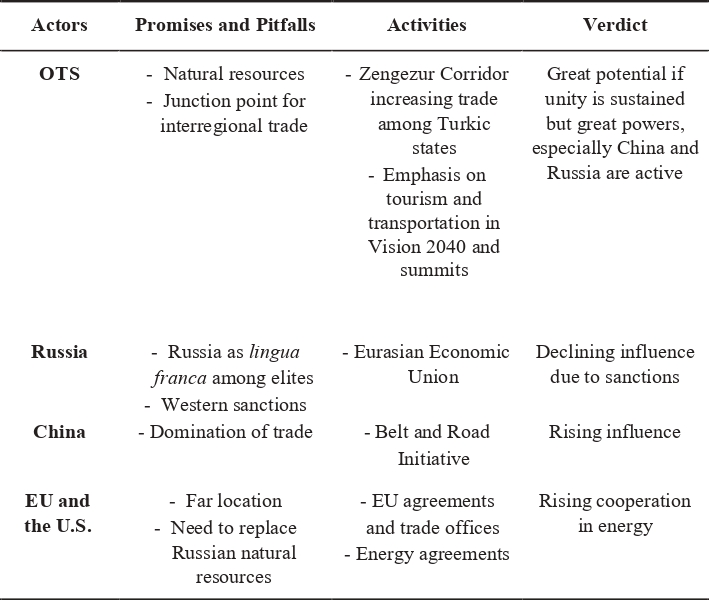
Table 1: OTS’s Regional Economic Influence in Comparison with Great
As an organization, based on an idea of developing ties between Turkic nations, common culture and identity is a significant component of the OTS
As summarized in Table 1, the Turkic states are driven by a significant economic incentive to foster collective action. Their combined economic strength, which accounts for 2 percent of global GDP, and their strategic geographical location at the crossroads of evolving transportation routes in Central Asia and the South Caucasus offer promising prospects for increased trade and connectivity. Major global powers such as the U.S., the EU, Russia, and China are keenly aware of the geoeconomic potential of this region and are actively engaging. While there are concerted efforts to boost economic ties within the OTS and between member states through bilateral mechanisms, the member states continue to engage in trade with third parties, demonstrating their multifaceted approach to economic cooperation.
Cultural Structure
As an organization, based on an idea of developing ties between Turkic nations, common culture and identity is a significant component of the OTS. United by a congruent linguistic and religious heritage, the member states, which are former members of the Soviet Union, hold the promise of bridging historical schisms borne from the Soviet era. The commonality of the Turkic language and the adherence to the Islamic faith serve as formidable unifying forces, helping the facilitation of cultural exchanges and collaborations. With concerted endeavors, the OTS is well positioned to serve as the linchpin for fostering a profound cultural synergy among these nations.
Having been under the helm of the Soviet Union, the newly independent nations in Central Asia and the Caucasus have taken enthusiastic steps towards rediscovering their identity since the early 1990s. The OTS, and its predecessor organizations, have provided platforms to these efforts. The inaugural Turkic Speaking Countries Summit, held in Ankara in 1992, set the stage for deeper cultural collaboration among Turkic-speaking nations. The Ankara Declaration highlighted the common cultural, historical, and linguistic threads that unite these countries, acting as a catalyst for enhanced cultural endeavors. A significant milestone in cultivating a shared culture among OTS member states was the establishment of TÜRKSOY (International Organization of Turkic Culture) in 1993. TÜRKSOY’s primary mission is to preserve, study, and promote the culture and heritage of Turkic-speaking peoples. Through cultural events, exhibitions, and educational programs, TÜRKSOY plays a pivotal role in showcasing the richness of Turkic cultures.37 Furthermore, the inception of the Turkic Academy in 2012 marked another crucial step in nurturing a common cultural identity. Initiated by Azerbaijan, Kazakhstan, Kyrgyzstan, and Türkiye, this academy serves as a hub for joint scientific activities in language, literature, culture, and history. It facilitates research and scholarly exchanges that deepen understanding shared cultural heritage.38 The Turkic Culture and Heritage Foundation, founded in 2012 with the support of several member states, plays a pivotal role in promoting cultural collaboration. By endorsing activities related to culture, education, science, human rights, tourism, and more, this foundation bolsters cultural bonds among Turkic-speaking nations.39 OTS places significant importance on nurturing a shared cultural identity among its member states. Initiatives such as the TÜRKSOY, the Turkic Academy, and the Turkic Culture and Heritage Foundation have played a crucial role in fostering cultural collaboration, preserving heritage, and promoting a common cultural identity among Turkic-speaking nations, strengthening their bonds and solidarity. The effort to adopt common Latin alphabet by the Turkic states has been an important step towards realizing cultural unity within the Turkic World as well.40 Lastly, The “Turkic World Vision – 2040,” ratified at the 8th Summit of OTS encourages the discovery of shared cultural ties and repatriation of cultural heritage. The document also underscores coordination for UNESCO nominations, celebrating Turkic customs, nurturing traditions, and fostering dialogue. Annual cultural events are proposed to strengthen communal bonds. Additionally, the vision calls for diaspora engagement and civil society participation to reinforce shared values and enhance regional connections.41
Initiatives such as the TÜRKSOY, the Turkic Academy, and the Turkic Culture and Heritage Foundation have played a crucial role in fostering cultural collaboration, preserving heritage, and promoting a common cultural identity among Turkic-speaking nations, strengthening their bonds and solidarity
Amid these cultural endeavors, the region is also a stage for great power rivalry. Russia, for instance, retains a vested interest in maintaining influence, stemming from the common use of the Russian language, shared Soviet heritage, and the presence of Russian communities in these countries. Russia competes with the endeavor to establish cultural ties among Turkic states through the proactive support of soft power institutions. The Russkiy Mir Foundation, promotes Russian culture, language, and values abroad, often targeting countries with historical and linguistic connections to Russia, including Turkic states in the Caucasus and Central Asia. This soft power approach fosters closer cultural and educational ties, and, in some cases, engenders affinity toward Russian language and culture.42 The Gorchakov Foundation, on the other hand, facilitates academic and cultural exchanges, thereby strengthening Russia’s diplomatic and cultural presence in these regions.43 By promoting the Russian language and cultural values, these institutions aim to establish a cultural bridge that connects these regions to Russia, potentially challenging the formation of a unified Turkic cultural front. In essence, Russia leverages its historical and linguistic influence, and such influence almost overwhelms the efforts of Turkic states to forge their own cultural unity. However, Russian soft power in Central Asia is declining as a majority of Central Asians, including 70 percent in Kyrgyzstan, 55 percent in Kazakhstan, and 30 percent in Uzbekistan, link their economic woes to Russia’s Ukraine invasion. Anti-war protests in Bishkek and Almaty, refusal to host Russian entertainers, and a decreasing interest in the Russian language are indicative of this shift.44
China, on the other hand, views the evolving cultural landscape in the region through the lens of the Uighur issue, raising concerns about cultural and religious influences that might spill over into its territory. Beijing is wary of any developments that could exacerbate the Uighur issue, making it vigilant about activities within the Turkic-speaking nations.45 Due to China’s economic influence, most members of the OTS, especially the Central Asian states, do not openly challenge China on the Uyghur issue. Central Asia exhibits a contrasting stance toward China, with elites favoring China and the general public harboring skepticism stemming from historical tensions, limited knowledge of China’s activities, concerns over Chinese immigration, and Xinjiang policies. This divergence presents a challenge to the BRI and the development of China-Central Asia relations.46 Central Asian nations also host dozens of Confucius Institutes, which promotes Chinese culture and language.47
The West, geographically distant from Central Asia also exhibit limited engagement due to differing priorities. The U.S., historically security-focused with Afghanistan as a focal point, has reevaluated its approach following the withdrawal of troops in 2021. Within the framework of the 5+1 platform, the foreign ministers of the U.S. and five Central Asian countries meet and search for ways to improve relations between the U.S. and Central Asian nations. In 2022, a Secretariat for the platform was established as an indication of continuing U.S. commitment following the withdrawal of troops from Afghanistan.48 As part of U.S. effort to enrich cultural and academic links with the region, Fulbright is active in all OTS member states.
The EU pursues soft security and perceives Central Asia as an extension of its broader neighborhood, emphasizing long-term, comprehensive interests through projects such as Erasmus+ similar to Fulbright. More recently, the European Union Council adopted its updated EU Strategy on Central Asia on June 17, 2019. It made progress in establishing regional dialogues, EU delegations in Central Asian countries, and human rights dialogues. The new strategy emphasizes partnership for resilience, prosperity, and collaboration with Central Asian countries in promoting democracy, human rights, economic growth, and political dialogue.49 Although the region’s geographic distance, and heavy influence of other players prevent the EU from realizing its written strategy, the soft power potential of the West is only growing with English-language becoming more popular with Russia’s decreasing influence.
The support and positions of the member states of the Council, especially Türkiye, played a pivotal role in maintaining the balance of power in the region and fostering unity within OTS that would later emerge
Table 2: OTS’ Regional Cultural Influence in Comparison with Great Powers
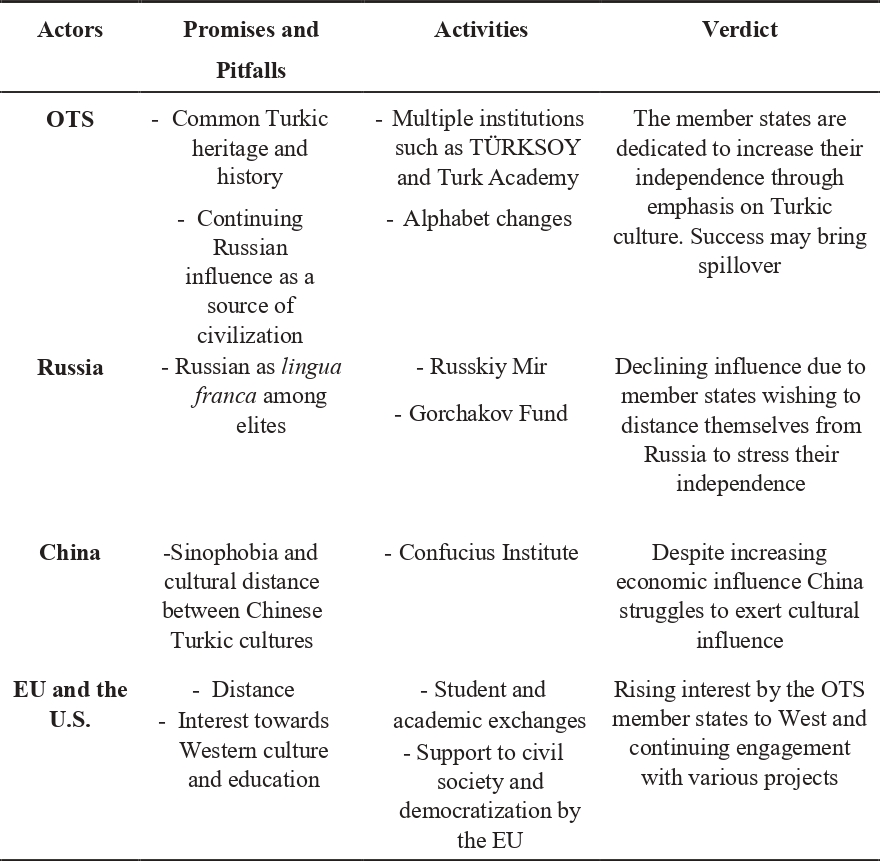
As summarized in Table 2, OTS serves as a crucial platform for fostering cultural ties among its member states, united by common heritage and language. Initiatives like the Turkic Council, TÜRKSOY, the Turkic Academy, and the International Turkic Culture and Heritage Foundation have played a key role in nurturing a shared cultural identity. Despite challenges from global powers like Russia and China, as well as evolving strategies from the U.S. and the EU in Central Asia, the cultural endeavors within the OTS strengthen the bonds between member states and contribute to the vibrancy of Turkic culture in a region marked by intersecting geopolitical interests. The shared heritage of these nations remains a powerful force for unity in a dynamic geopolitical landscape.
Strategic Structure
Security realm is one of the main dimensions in which cooperation between member states is to be developed. Especially after the Karabakh war in 2020, the importance of this realm has visibly increased. The “Turkic World Vision – 2040” also places significant emphasis on security imperatives. The document advocates for synchronized initiatives to combat transnational organized crime, encompassing illicit drug trade, human trafficking, cybercrime, and related issues. The Vision also champions the establishment of multilateral channels, which serve as a strategic framework for addressing migration-related concerns with a comprehensive approach, including provisions for humanitarian aid, educational initiatives, and healthcare services.50 Yet, despite positive signals, increasing cooperation in defense industry and the positive atmosphere created by the Karabakh war, the member states seem to be not ready to show considerable commitment in this realm. The fact that the issue areas focused on the vision do not extend to military cooperation is indicative of such hesitance.
Turkic Council’s importance and functionality rapidly and unprecedentedly increased following the Second Karabakh War in 2020. Still bearing the title of the Turkic Council, the council provided unequivocal support to Azerbaijan during the conflict. In a statement issued on September 28, 2020, immediately after Armenia breached the ceasefire and attacked Azerbaijani positions, the Council emphasized the urgent need to resolve the issue, highlighting Azerbaijan’s sovereignty and territorial integrity. The statement also referenced the UN Security Council resolutions from 1993, which called for the immediate, unconditional withdrawal of Armenian armed forces from all territories they had occupied within the Republic of Azerbaijan.51 Azerbaijan’s acquisition of advanced military hardware, such as the Bayraktar TB2 unmanned aerial vehicle and Turkish TRG-300 rockets from Türkiye, had a significant impact on the character of the war. These weapon systems provided the Azerbaijani military with a distinct advantage over the Armenian forces on the battlefield contributing to the swift resolution of the conflict in Azerbaijan’s favor within 44 days.52 Such support took place within the framework of the “Strategic Partnership and Mutual Assistance Agreement” signed between Türkiye and Azerbaijan in 2010, in which both countries committed to aiding each other in case of an attack.53 The victory that stemmed from the solidarity of two Turkic states facilitated the solidarity of Turkic states, culminating in the formation of OTS, which replaced the Turkic Council. The support and positions of the member states of the Council, especially Türkiye, played a pivotal role in maintaining the balance of power in the region and fostering unity within OTS that would later emerge. Türkiye’s support to Azerbaijan from the outset of the conflict with providing substantial military assistance significantly contributed to the solidarity among Turkic nations in the region. Azerbaijan’s victory increased Turkey’s influence in Central Asia and Caucasus with substantial concrete developments in energy and defense sectors.54
Seeking to maintain its cultural and political ties to safeguard its regional influence, Russia is wary of the OTS potentially challenging its dominant position within the Collective Security Treaty Organization and the region as a whole
Despite these developments, OTS still grapples with a palpable deficit in military and security cooperation among its member states. The member states remain ensnared in the complexities of great power competition and their affiliations with the Collective Security Treaty Organization (CSTO). The recent application by Kazakh leader Tokayev to the CSTO for military assistance to quell the domestic unrest exemplifies this challenge. The victory in Karabakh war, while being a momentous achievement for the region, has not succeeded in establishing comprehensive and unified security measures across member states. Regarding this, Türkiye’s President Erdoğan noted in the Samarkand Summit in 2022 that effective solutions to regions pressing security problems necessitate more robust collaboration and coordination, especially in the realm of security, to address these multifaceted and urgent concerns.55 In the backdrop of Russia’s invasion of Ukraine, coupled with Western sanctions targeting Russian energy resources, the demand for alternative energy supply routes has grown, rendering a fertile ground for advancing military cooperation among OTS member states.
Russia has historically considered Central Asia and the Caucasus as within its sphere of influence due to common language and Soviet heritage as well as ethnic Russians in the former Soviet republics. Seeking to maintain its cultural and political ties to safeguard its regional influence, Russia is wary of the OTS potentially challenging its dominant position within the Collective Security Treaty Organization and the region as a whole. The Collective Security Treaty Organization plays a crucial role in Russia’s strategy to maintain influence in Central Asia. Founded in 1992 on the principle of “collective security,” the CSTO commits member states to provide comprehensive support in the face of military aggression, offering military assistance and even invoking the UN Charter’s Article 51 for collective defense.56 The CSTO divides its mission into three groups: regional forces to deter external aggression, collective forces for peacekeeping, and the “Collective Rapid Reaction Forces” to combat terrorism and non-state actors. As for its objectives, the Organization focuses on maintaining peace, safeguarding sovereignty and territorial integrity, and resolving international issues without violence. Yet, the CSTO showcases a power imbalance within the Organization, and Russia’s dominant role leads to selective activations. Member states are expected to align with Moscow in case of conflicts directly opposing Russia’s interests, making the CSTO a means for Russia to secure its regional policies and influence. The Organization often reflects Russia’s interests, as seen in its passive response to internal crises like the ethnic clashes in Kyrgyzstan. In such cases, the CSTO tends to categorize these events as internal affairs.57 CSTO did intervene into Kazakhstan upon the unrest that occurred there in 2022, but such intervention was found to be symbolic and not consequential. In other words, CSTO’s military intervention did not make any substantial change to the balance of power in the region.58 More recently, the CSTO played a significant role in quelling the unrest in Kazakhstan upon the invitation of President Tokayev. The absence of mechanisms within the OTS comparable to those of the CSTO highlights the need for further development in this particular area for the OTS.
China views the OTS with concerns regarding its potential to promote pan-Turkism and pan-Islamism, potentially leading to security challenges to Chinese authority in Xinjiang. Xinjiang has experienced ethnic tensions and separatist threats, and the OTS’ cultural and linguistic affinity to Xinjiang’s Uighurs raises alarm in Beijing.59 Additionally, China worries about the OTS influencing regional dynamics within the Shanghai Cooperation Organization (SCO). The SCO has unequivocally become a pivotal conduit for Chinese hegemonic influence in Central Asia, imbued with multifaceted dimensions. Instituted in 2001, the SCO’s initial mandate, primarily focused on regional security, has since seamlessly expanded to encompass a broader spectrum of economic, political, and cultural collaboration among its member states. Within this strategic framework, China, a linchpin member, has harnessed the SCO to serve as a formidable instrument for projecting its power and advancing its vested interests in the Central Asian sphere. While ameliorating shared security apprehensions, most notably concerning terrorism, separatism, and extremism, with direct pertinence to its restive Xinjiang region, China has not only bolstered its domestic security but has strategically positioned itself as the regional steward for addressing these common threats. In parallel, China’s far-reaching BRI has harmonized with the SCO’s broader agenda, fostering infrastructure development and spurring economic synergies throughout the region. Thus, through judicious investments in regional connectivity and trade facilitation, China has deftly strengthened its economic ties and has concurrently elevated its geopolitical prominence within the SCO framework, emblematic of its grand strategy to consolidate its ascendancy and prominence within the dynamic geopolitical landscape of Central Asia.
The U.S. and the EU, while not as deeply entrenched in the region as Russia and China, have increasingly shown interest in Central Asia and the Caucasus. Furthermore, following the withdrawal from Afghanistan, the U.S. is determined to compete with China economically in Asia, advocating for alternative infrastructure to challenge China’s Belt and Road Initiative such as the IMEC (India-Middle East Corridor).60 The EU, through diplomatic platforms and investment projects, aims to become a key political and economic player in Central Asia. The EU has signed Partnership and Cooperation Agreements (PCAs) with Azerbaijan, Kazakhstan, Kyrgyzstan Uzbekistan and Turkmenistan, underscoring its commitment to fostering political and economic ties.61 Both the U.S. and the EU may view organizations like the OTS as entities that could potentially align with their interests and counterbalance Russia and China.
As the great powers vie for influence in Central Asia, the OTS possesses the potential to enhance regional security, consolidate its role, and counterbalance the dominant influences of Russia and China
Table 3: OTS’ Regional Strategic Influe nce in Comparison with Great Powers
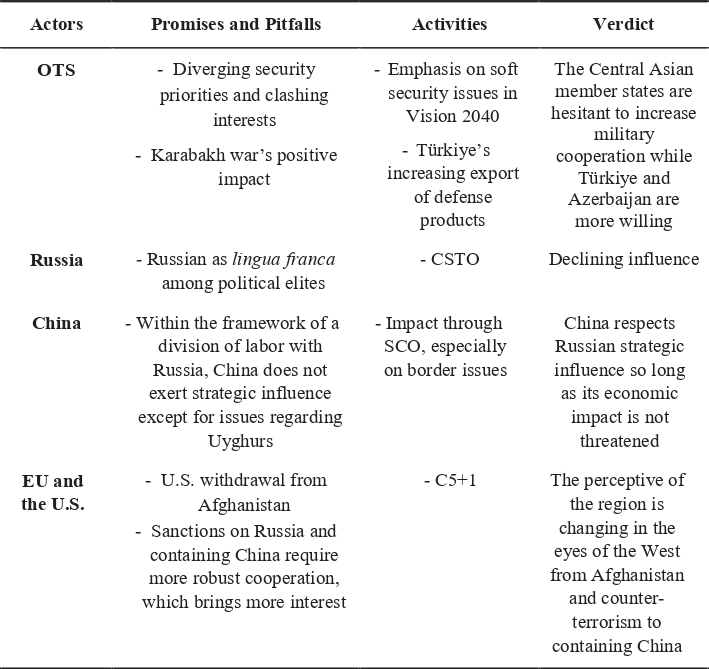
As summarized in Table 3 above, in the backdrop of Russia’s invasion of Ukraine and the resultant Western sanctions targeting Russian energy resources, the demand for alternative energy supply routes has intensified. This scenario offers a fertile ground for advancing military cooperation among member states of the OTS. While the Organization grapples with a persistent deficit in military and security collaboration, the victories achieved during the Karabakh war demonstrate the potential for such cooperation, particularly through substantial military aid and advanced weaponry transfers. As the great powers vie for influence in Central Asia, the OTS possesses the potential to enhance regional security, consolidate its role, and counterbalance the dominant influences of Russia and China.
In Lieu of Conclusion
This research explored the multifaceted role of the OTS in the complex geopolitical landscape of Central Asia and Caucasus. It employs an eclectic theoretical framework, recognizing the limitations of singular perspectives and emphasizing the composite nature of the OTS. The study categorizes the international and regional systems into three interconnected structures: strategic, economic, and social. Having examined the historical evolution of the OTS and its transformation into the OTS in 2021, the article highlighted the Organization’s potential in economic, strategic, and social dimensions and its role as a unifying force in Central Asia and the Caucasus, shaped by structural changes, leadership dynamics, and international events. The research underscores the importance of understanding the OTS’ engagement with international and regional systems, considering economic, strategic, and soft power activities.
OTS serves as a vital platform for fostering economic, cultural, and security cooperation among its member states. The economic realm highlights the significant potential for increased trade, connectivity, and prosperity within the region, especially with the evolving transportation routes in Central Asia and the South Caucasus. Great powers, including the U.S., the EU, Russia, and China, recognize the region’s geoeconomic importance and actively engage to advance their respective interests. In the cultural and social realm, the OTS plays a pivotal role in nurturing cultural bonds among member states, united by common heritage, language, and historical ties. Initiatives like the Turkic Council, TÜRKSOY, and the Turkic Academy have been instrumental in promoting shared cultural identity and heritage. While great powers like Russia and China also seek to exert their cultural influence, the commitment to a shared Turkic identity remains a powerful force for unity in the face of external influences. The strategic realm underscores the paramount importance of security cooperation within the OTS. The “Turkic World Vision – 2040” emphasizes the need to address challenges such as radicalization, terrorism, and transnational organized crime. While some member states have demonstrated the potential for military collaboration, complexities arising from great power competition and affiliations with organizations like the CSTO persist. However, the OTS holds the potential to shape the geopolitical landscape in Central Asia and the Caucasus, as great powers like the U.S. and the EU may seek partnership to counterbalance the influence of Russia and China. In the evolving dynamics of the OTS, member states must continue to navigate the complexities of cooperation in these three realms while managing their interactions with great powers. By leveraging their shared heritage, language, and geographical location, the OTS member states can foster greater economic integration, cultural unity, and enhanced security to realize the shared vision of a prosperous and united Turkic World.
By leveraging their shared heritage, language, and geographical location, the OTS member states can foster greater economic integration, cultural unity, and enhanced security to realize the shared vision of a prosperous and united Turkic World
This research showcases the need for eclectic approaches when studying international organizations like the OTS. It also contributes to the geopolitics discourse in Central Asia and the Caucasus, shedding light on the OTS’ impact within the strategic, economic, and social domains. For policymakers, it emphasizes the OTS’ importance in fostering cooperation among member states, whether economically, culturally, or in security matters.
Future research could more deeply examine the changing economic dynamics within member states, cultural initiatives and their impact, and evolving security landscapes. These areas present opportunities to enhance our understanding of the OTS’ role and its implications for academic scholarship and policymaking in Central Asia and the Caucasus.
Endnotes
1. Kenneth Waltz, Man, the State, and War, (New York: Columbia University Press, 2001), p. 230.
2. Robert Gilpin, International Political Economy, (Princeton: Princeton University Press, 1987), p. 25.
3. Robert Gilpin, Global Political Economy, (Princeton: Princeton University Press, 2001), p. 20.
4. Robert Keohane, After Hegemony, (Princeton: Princeton University Press, 1984), pp. 43-45.
5. Rudra Sil and Peter J. Katzenstein, Beyond Paradigms Analytic Eclecticism in the Study of World Politics (New York: Palgrave Macmillan, 2010), pp. 9-10.
6. Kenneth Waltz, Theory of International Politics, (New York: Addison-Wesley Publishing Company, 1979), pp. 62-67.
7. Hans Morgenthau, Politics among Nations: The Struggle for Power and Peace, (New York: Knopf, 1991), pp. 130-139.
8. David C. Copeland, “Economic Interdependence and War: A Theory of Trade Expectations,” International Security, Vol. 20, No. 4 (1996), pp. 5-41.
9. Alexander Wendt, Social Theory of International Politics, (Cambridge: Cambridge University Press, 1999).
10. Dışişleri Bakanlığı 1992 Tarihçesi, (Ankara: Dışişleri Bakanlığı, 1994), pp. 467-469.
11. “Nakhchivan Agreement,” Organization of Turkic States, (October 10, 2009), retrieved October 10, 2023, from https://www.turkicstates.org/assets/pdf/temel_belgeler/nakhchivan-agreement-on-theestablishment-of-the-copperation-council-of-turkic-speaking-states-1-en.pdf.
12. “Statement of the Secretary General of the Turkic Council,” Organization of Turkic States, (September 28, 2020), retrieved October 18, 2023, from https://turkicstates.org/en/haberler/statement-of-the-secretary-general-of-the-turkic-council_2261.
13. “Samarkand Declaration of the Ninth Summit of the Organization of Turkic States,” Organization of Turkic States, (November 11, 2022), retrieved October 14, 2023, from https://turkicstates.org/ninth-summit-declarataion-16-en.pdf.
14. “Turkic World Vision - 2040,” Organization of Turkic States, (November 13, 2021), retrieved October 14, 2023, from https://turkicstates.org/en/haberler/turkic-world-vision-2040_2396.
15. İbrahim Gökburun, “Küresel ve Bölgesel Güçler Çağında Türk Dünyası Nüfusu,” Journal of Turkish World Studies, Vol. 21, No. 1 (June 2021), p. 16.
16. “GDP (current US$) Indicator,” Worldbank, retrieved October 10, 2023 from https://data.worldbank.org/indicator/NY.GDP.MKTP.CD.
17. Deniz İstikbal, “Türk Dünyasında Ekonomik İş Birliği,” Kriter, Vol. 6, No. 62 (November 2021), retrieved October 15, 2023, from https://kriterdergi.com/dosya-turk-dunyasi/turk-dunyasinda-ekonomik-is-birligi.
18. Gismat Gozalov, “Yeni Nahçıvan Koridoru ve Bölgesel İşbirliğine Katkıları,” Anadolu Ajansı, (May 27, 2021), retrieved October 13, 2023, from https://www.aa.com.tr/tr/analiz/gorus-yeni-nahcivan-koridoru-ve-bolgeselisbirligine-katkilari/2256165.
19. Fırat Purtaş, “Yeni Özbekistan ve Türk Dünyası,” Kriter, Vol. 6, No. 62 (November 2021), retrieved October 15, 2023, from https://kriterdergi.com/dosya-turk-dunyasi/yeni-ozbekistan-ve-turk-dunyasi.
20. Bruce Pannier, “Russia Says Caspian Legal Status Resolved, Agreement Ready for Signing,” Radio Free Europe, (December 7, 2017), retrieved October 13, 2023, from https://www.rferl.org/a/qishloq-ovozi-caspianstatus-resolved-russia-says/28903729.html.
21. Burak Çalışkan, “Hazar Denizinde Yeni Statü ve Beklentiler,” İNSAMER, (July 8, 2020), retrieved October 13, 2023, from https://insamer.com/tr/hazar-denizinde-yeni-statu-ve-beklentiler_3066.html.
22. Bahar Özsoy, “The Role and Importance of the Organization of Turkic States in the Discourse of the ‘Turkic World,’” Anasay, 7, No. 25 (2023), pp. 48-49.
23. “Hakkımızda,” TİKA, retrieved October 15, 2023, from https://www.tika.gov.tr/tr/sayfa/hakkimizda-14649.
24. “Declaration of the Third Summit of the Cooperation Council of Turkic Speaking States,” Organization of Turkic States, (August 16, 2013), retrieved October 14, 2023, from https://www.turkicstates.org/assets/pdf/temel_belgeler/third-summit-declaration-10-en.pdf.
25. “Declaration of the Fourth Summit of the Cooperation Council of Turkic Speaking States,” Organization of Turkic States, (June 5, 2014), retrieved October 14, 2023, from https://www.turkicstates.org/assets/pdf/temel_belgeler/fourth-summit-declaration-11-en.pdf.
26. “The Union of Turkic Chamber of Commerce and Industry,” Organization of Turkic States, retrieved October 14, 2023, from https://www.turkicstates.org/en/iliskili-kurumlar/tcci_6.
27. “Turkic World Vision - 2040,” Organization of Turkic States.
28. “United States Strategy for Central Asia 2019-2025: Advancing Sovereignty and Economic Prosperity,” US Embassy in Tajikistan, (February 5, 2020), retrieved October 14, 2023, from https://tj.usembassy.gov/united-states-strategy-for-central-asia-2019-2025-advancing-sovereignty-and-economic-prosperity/#:~:text=The%20percent20United%20percent20States%20percent27%20percent20primary%20percent20strategic,international%20percent20investment%20percent3B%20percent20and%20percent20has%20percent20strong%20percent2C.
29. “EU, Azerbaijan Sign Deal to Double Gas Imports,” AA Energy, (July 19, 2022) retrieved October 14, 2023, from https://www.aa.com.tr/en/energy/international-relations/eu-azerbaijan-sign-deal-to-double-gas-imports/35848.
30. “EU and Azerbaijan Enhance Bilateral Relations, Including Energy Cooperation,” EU Commission, (July 18, 2022) retrieved October 14, 2023, from, https://ec.europa.eu/commission/presscorner/detail/en/ip_22_4550.
31. Zeynep Dierks, “Share of Exports from Türkiye to the European Union (EU-27) as a Proportion of Total Exports from 2013 to 2022,” Statista, (August 23, 2023) retrieved October 15, 2023, from https://www.statista.com/statistics/1045891/share-of-exports-to-the-eu-in-total-export-trade-of-turkey/.
32. “What Is the Eurasian Economic Union?” Chatham House, (July 15, 2022), retrieved October 16, 2023 from https://www.chathamhouse.org/2022/07/what-eurasian-economic-union.
33. Temur Umarov, “Russia and Central Asia: Never Closer, or Drifting Apart?” Carnegie Endowment, (December 23, 2022), retrieved October 14, 2023, from https://carnegieendowment.org/politika/88698.
34. “Over 25 Years, China’s Trade Turnover with Central Asian Countries Has Increased 60 Times,” Forbes, (January 11, 2017), retrieved October 17, 2023, from https://forbes.kz/news/2017/01/11/newsid_132050.
35. Pál Dunay, “China’s Influence in Central Asia: Implications for the Euro-Atlantic World,” (October 2020), retrieved October 14, 2023, from https://www.marshallcenter.org/sites/default/files/files/2020-10/pC_V10N3_en-6_Dunay.pdf.
36. Roza Nurgozhayeva, “How Is China’s Belt and Road Changing Central Asia?” The Diplomat, (July 9, 2020), retrieved October 16, 2023, from https://thediplomat.com/2020/07/how-is-chinas-belt-and-road-changing-central-asia/.
37. “Türksoy Hakkında,” TÜRKSOY, retrieved October 14, 2023, from https://www.turksoy.org/turksoy-hakkinda.
38. “Turkic Academy,” Organization of Turkic States, retrieved October 14, 2023, from https://turkicstates.org/en/iliskili-kurumlar/turkic-academy_1.
39. “Turkic Culture and Heritage Foundation,” Organization of Turkic States, retrieved October 14, 2023, from https://turkicstates.org/en/iliskili-kurumlar/turkic-culture-and-heritage-foundation_5.
40. Ömer Faruk Karaman, “Ortak Kültür ve Değerler Bağlamında Türk Dünyası Entegrasyonu,” Kriter, Vol. 6, No. 62 (November 2021), retrieved October 15, 2023, from https://kriterdergi.com/dosya-turk-dunyasi/ortak-kultur-ve-degerler-baglaminda-turkdunyasi-entegrasyonu.
41. “Turkic World Vision - 2040,” Organization of Turkic States.
42. “About Russkiy Mir Foundation,” Russkiy Mir, retrieved October 14, 2023, from https://russkiymir.ru/en/fund/index.php.
43. “Mission and Goals,” The Gorchakov Fund, retrieved October 14, 2023, from https://en.gorchakovfund.ru/portal/page/2902cca9-09f4-4a53-b9ed-868b5977a57b.
44. Umarov, “Russia and Central Asia: Never Closer, or Drifting Apart?”
45. Bruce Pannier, “Why Are Central Asian Countries Silent about China’s Uyghurs?” Radio Free Europe, (September 22, 2020), retrieved October 14, 2023, from https://www.rferl.org/a/why-are-central-asian-countriessilent-about-china-s-uyghurs-/30852452.html.
46. Roman Vakulchuk and Indra Overland, “China’s Belt and Road Initiative through the Lens of Central Asia,” in Fanny M. Cheung and Ying-yi Hong (eds.), Regional Connection under the Belt and Road Initiative, (Routledge, 2018), pp. 117-118.
47. Vakulchuk and Overland, “China’s Belt and Road Initiative through the Lens of Central Asia,” p. 118.
48. “Joint Statement on the C5+1 Meeting during UNGA 77,” S. Department of State, (September 28, 2022), retrieved October 14, 2023, from https://www.state.gov/joint-statement-on-the-c51-meeting-during-unga-77/.
49. Alica Kizeková, “The European Union in Central Asia: Balancing Competing Actors and Opportunities for the V4 Countries,” Ústav Mezinárodních Vztahů, (November 12, 2019), retrieved October 17, 2023, from https://www.iir.cz/the-european-union-in-central-asia-balancing-competing-actors-and-opportunities-for-the-v4countries.
50. “Turkic World Vision - 2040,” Organization of Turkic States.
51. “Türk Devletleri Teşkilatı,” Organization of Turkic States, retrieved October 2, 2023 from https://turkicstates.org/tr/turk-konseyi-hakkinda.
52. “Statement of Secretary General of the Turkic Council on Nagorno-Karabakh settlement,” Organization of Turkic States, (November 10, 2020), retrieved October 13, 2023, from https://turkicstates.org/en/haberler/statement-of-secretary-general-of-the-turkic-council-on-nagorno-karabakh-settlement_2107.
53. “On the Approval of the Agreement “On Strategic Partnership and Mutual Assistance between the Republic of Azerbaijan and the Republic of Turkey,”” Azərbaycan Respublikasının Milli Məclisi, (December 21, 2010), retrieved October 14, 2023 from https://meclis.gov.az/news-qanun.php?id=1309&lang=az.
54. “Turkey, Nagorno-Karabakh, and the Central Asian Nexus,” New Lines Institute, (March 19, 2021), retrieved October 14, 2023, from https://newlinesinstitute.org/geo-economics/energy/turkey-nagorno-karabakh-and-the-central-asian-nexus/.
55. “Turkic States Should Develop Common Security Concept, Erdoğan Says,” Daily Sabah, (November 11, 2022), retrieved October 14, 2023, from https://www.dailysabah.com/politics/diplomacy/turkic-states-should-develop-common-security-concept-erdogan-says.
56. “Collective Security Treaty Dated May 15, 1992,” Organization of the Collective Security Treaty, (April 26, 2012), retrieved October 19, 2023, from https://odkb-csto.org/documents/documents/dogovor_o_kollektivnoy_bezopasnosti/#loaded.
57. Ömer Faruk Kocatepe, “Türk Cumhuriyetleri’nin Bölgesel Güvenlik Kaygıları Bağlamında Uluslararası Örgütlerle İş Birliği,” Türk Dünyası Araştırmaları, 130, No. 257 (April 2022), p. 415.
58. Alexander Libman and Igor Davidzon, “Military Intervention as a Spectacle? Authoritarian Regionalism and Protests in Kazakhstan,” International Affairs, Vol. 99, No. 3 (May 2023), pp. 1293-1312.
59. Nurettin Akçay, “Does the Organization of Turkic States Worry China and Russia?” The Diplomat, (November 23, 2022), retrieved October 20, 2023, from https://thediplomat.com/2022/11/does-the-organization-of-turkic-states-worry-china-and-russia/.
60. Hüseyin Korkmaz, “Kuşak ve Yol Girişimi’ne Karşı IMEC Projesi,” Anadolu Ajansı, (September 20, 2023), retrieved October 19, 2023, from https://www.aa.com.tr/tr/analiz/gorus-kusak-ve-yol-girisimine-karsi-imec-projesi/2996662.
61. “Partnership and Cooperation Agreements (PCAs): Russia, the Southern Caucasus and Central Asia,” EUR-Lex, retrieved October 14, 2023, from https://eur-lex.europa.eu/EN/legal-content/summary/partnership-and-cooperation-agreements-pcas-russia-the-southern-caucasus-and-central-asia.html.