
Introduction
Africa’s strategic importance in international relations is constantly growing. Notably, the continent’s economic and political potential continues to increase the influence of African countries in global politics. In contrast, many African countries still struggle with various internal challenges and inevitably need the support of external actors to overcome them. This dilemmatic situation, accumulating since the years of decolonization, has paved the way for the emergence of a multilateral international competition regarding Africa. Considering its importance, any actor aiming for noteworthy influence on international politics must also be aware of the significance of the continent. Therefore, actors that intend to improve their relations with African countries and increase their presence on the continent usually adopt a multi-layered foreign policy approach toward African countries.
Although external actors have distinctive approaches to increasing their influence in Africa, the approaches can be generalized into two categories based on similarities. The first is the traditional Western-centered approach shaped by the neo-liberal worldview. The second is alternative approaches arising from the criticism of the subordinate-superior relationship and preconditions inherent in the traditional approach. This classification does not assert that countries adopting the traditional or alternative approach prefer identical behavior toward African countries. On the contrary, traditional or alternative approaches can sometimes be intertwined, and/or countries adopting the same approach may have different preferences on certain issues. Hence, it is essential to focus on similarities rather than differences when considering traditional and alternative approaches.
China and Türkiye are two significant actors that have rapidly expanded their spheres of influence in Africa, particularly in the last quarter century. The most notable resemblance between these countries in their relations with African countries is that they provide an alternative to the Western-centric supremacist approach. China’s and Türkiye’s historical experiences, relations with Western countries, expectations of the international system, and opportunities they offer African countries are the main factors driving their alternative approaches. Accordingly, three interrelated factors influence the choice of China and Türkiye as case studies for this article. The first is the alternative stances of Beijing and Ankara in their relations with African countries and their practical implications. Second is many African leaders’ appreciation of the stances of China and Türkiye. Interrelated to these two factors, the third is the rapid acceleration of Beijing’s and Ankara’s relations with African countries in various fields in the 21st century.
Therefore, this study delves into Beijing’s and Ankara’s similar foreign policy approaches toward African countries. The main argument of the study is that the approaches of the two countries present noteworthy alternative stances in international competition in Africa. In this respect, the article uses the case study method to analyze the approaches of non-Western actors versus the examples of China and Türkiye.
China and Türkiye are two significant actors that have rapidly expanded their spheres of influence in Africa, particularly in the last quarter century
Rising Competition: Traditional and Alternative Approaches
Africa is one of the centers for international competition in the 21st century. Two main factors have played a major role in the emergence of this situation. The first is related to the multifaceted opportunities offered by African countries. Their natural resources, strategic locations, labor and market opportunities, need for further development, voting potential in international forums, and expectations of a more democratic international system make African countries attractive to external actors.1 Secondly, regional and/or global struggles for influence are also inspiring these actors to show more interest in Africa. In other words, traditional and emerging countries perceive their influence in Africa as an important part of their quest for regional and global prestige.2
One of the most prominent, and largely universal, manifestations of external actors’ competition on the continent is the Africa+1 summits organized to deepen their relations with African countries. The summits, whose origins trace back to the Franco-Africa Summit in 1973 and the Tokyo International Conference on African Development (TICAD) in 1993, have progressed toward the spotlight in the 21st century.3 Accordingly, the Forum on China-Africa Cooperation (FOCAC), held triennially since 2000, has given a significant impetus to mutual relations and encouraged many other external actors to organize similar summits or to boost the prestige of their existing gatherings.4 In this respect, France, Japan, China, South Korea, India, Türkiye, the U.S., Russia, Italy, and Saudi Arabia are among the external actors organizing forum summits with African countries.
Aside from forums, the race in competition has seen greatly differing foreign policy models and approaches toward Africa. In the most general terms, the mentioned competition is between the Western-centered approach, which we can refer to as the traditional approach, and the non-Western approach(es), which can be considered as rising alternative(s).5 The economic, political, and moral traces of Western supremacist understanding are immediately apparent in the traditional approach, which stipulates that African countries should benefit from Western experiences and follow its development path. The bitter medicines of the Bretton Woods institutions, namely the World Bank and International Monetary Fund, constitute the traditional approach’s main agenda in the economic field.6 In the political sphere, preconditions such as the promotion of democracy, good governance, and human rights play a dominant role.7 Especially in the 1990s, after the disintegration of the Soviet Union and the triumph of the liberal world, the traditional approach was at the center of external actors’ relations with African countries. However, in the following years, this approach began to be seriously questioned by Africans and other rising actors for three main reasons: (i) inability to solve economic problems, (ii) perception of interference in internal affairs, and (iii) emergence of alternative approach(es).
Particularly since the 21st century, alternative approaches have become popular in external actors’ relations with African countries. However, there is no single alternative that covers all emerging external actors in Africa. Even the term “emerging actors” is controversial due to its ambiguous nature.8 A term referring to the non-Western world,9 these actors are generally Southern Hemisphere countries with rapidly growing economies, dissatisfaction with the current structure of the international system, and growing influence on international affairs. Although there is no single alternative approach in theory, there are common foreign policy strategies of emerging actors at the discourse and practice levels.10
Firstly, alternative approaches to Africa are shaped by an emphasis on shared and non-colonial historical references. The Chinese emphasis on Admiral Zheng He’s voyages,11 the Turks’ reminding of the Ottoman Empire’s peaceful past,12 and the Russians underlining of the Soviet support for the independence movements13 are all products of this understanding. These discourses of alternative actors mainly serve two purposes: (i) to obtain moral superiority over the colonial traces of Western actors and (ii) to eliminate the colonialism concerns of African countries and invalidate the neo-colonialism accusations of traditional actors.14
Secondly, alternative approaches prioritize mutual pragmatic interests and emphasize equal partnership rather than a subordinate-superior relationship.15 In this respect, these approaches usually avoid economic or political preconditions that could be seen as a violation of African countries’ sovereign rights.16 Alternative approaches are often based on the argument that economic relations and political issues should be separate. Accordingly, emerging actors, going to African countries with different economic and political models, have also engaged in investment activities, which Western countries ignored, deemed risky, or offered preconditions, in many areas of the continent. After all, although Western actors have blamed alternative approaches for promoting authoritarianism, bad governance, and corruption, many African leaders have welcomed these approaches as significant foreign policy alternatives.17 Moreover, African countries are important for alternative actors not only because of their economic opportunities but also their unique position in international politics. Indeed, their vote potential in international forums allows the continental countries to shape the course of regional and global affairs.18 In this context, securing African votes in critical votes may sometimes be necessary for the foreign policy interests of emerging actors, who are not satisfied with the current form of the international system or would like to expand their strategic gains. For these actors, increasing their influence in Africa and establishing solid relations with African countries is highly crucial in terms of their prestige in international politics.19 Hence, one of the distinguishing features of alternative approaches is to show an active and accelerating diplomatic will to improve relations with African countries to increase their global influence.
African countries are important for alternative actors not only because of their economic opportunities but also their unique position in international politics
Finally, related to their growing political and economic presence, emerging actors have eventually had to operate as security providers in Africa. This is a natural consequence of their need to protect their influence and interests in the continent. Accordingly, these actors have undertaken various attempts to contribute to African countries’ efforts to ensure their security. The most important one is supporting the peacekeeping operations carried out by the United Nations and the African Union in various means.20 Another one is to share the products and experience of the defense industry with African countries under more favorable conditions.21 Furthermore, as in the case of the United Arab Emirates, India, Israel, Türkiye, Saudi Arabia, Russia, and China, establishing a military base is among the recent security-provident activities of emerging actors in Africa (see Graph 1).22 In this regard, emerging actors are also becoming more prominent in peacebuilding efforts and bringing solidarity and mutual support to the agenda instead of the interventionist political and economic reforms of the traditional understanding.23
Graph 1: The Number of Foreign Military Bases in Africa by 2023
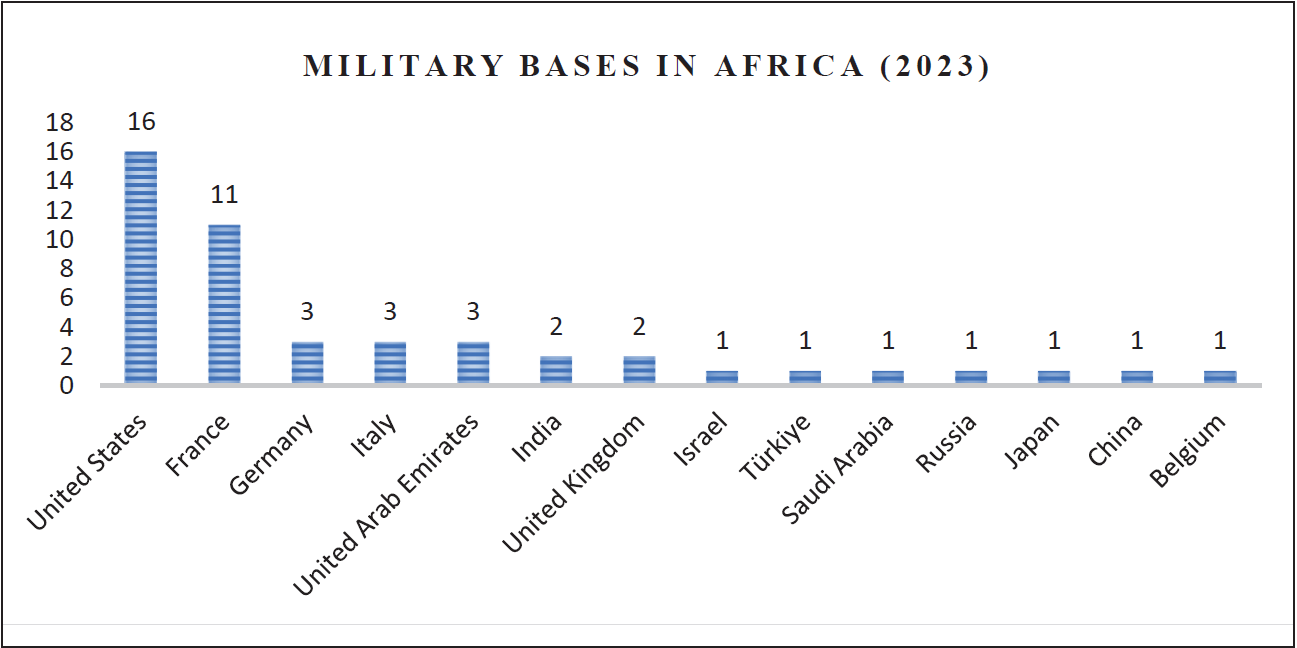
Source: Mo Ibrahim Foundation24
Despite clear differences, the boundary between traditional and alternative approaches in Africa is sometimes vague and transitive. It means, any country associated with one of these approaches may occasionally implement foreign policy practices related to the other. For instance, despite being one of the pioneers of alternative approaches, China advocates trade liberalization, a core tenet of neoliberalism, at every FOCAC forum.25 As another example, Japan, whose foreign policy understanding is identified with the traditional approach, has not put forward preconditions during the TICAD forums and has given more responsibility to African countries instead of a subordinate-superior relationship.26 Likewise, the U.S., one of the pioneers of the traditional approach, has softened its political preconditions toward African countries, especially during the Donald Trump era, in response to alternative approaches’ growing influence.27 Beyond the exceptions, the above-mentioned main characteristics of the traditional and alternative approaches render it possible to categorize how external actors engage with African countries.
China and Türkiye in Africa: Emergence of Alternative Approaches
China and Türkiye have significantly enhanced their influence in Africa and strengthened their relations with African countries, especially in the 21st century. The impacts of this are obvious in several areas, including diplomatic relations, economic activities, security issues, and socio-cultural interactions. Nowadays, many academic studies on international competition in Africa give special attention to these two countries. Although the successful alternative approaches of Ankara and Beijing are not the same, there are remarkable similarities. In this context, this section will reveal how the effects of similar historical experiences and foreign policy expectations have shaped Türkiye’s and China’s alternative approaches and discourses toward African countries.
Theoretically, China’s and Türkiye’s policies toward Africa have traces of social constructivism and realism. Constructivism argues that not only material elements but also intangible factors such as ideologies, norms, perceptions, and identities are influential in interstate relations. In other words, a state’s perception of the other state is shaped by these intangible phenomena, which can profoundly affect relations between parties.28 From this perspective, China, describing itself as a developing state, often pursues South-South cooperation to improve its relations with African countries and emphasizes the common colonial victimization of the past to avoid neo-colonialism accusations.29 Türkiye, standing out with its criticism of the current structure of the international system, draws attention to its strong historical and cultural ties with Africa and seeks to shape the future based on the associated past.30 Here, the most distinctive point is Beijing’s and Ankara’s efforts to cooperate with African countries, with which they share a common or similar ground in the constructivist context, as an economic and political balance against their Western counterparts.
Emerging actors are becoming more prominent in peacebuilding efforts and bringing solidarity and mutual support to the agenda instead of the interventionist political and economic reforms of the traditional understanding
China’s and Türkiye’s focus on their national interests in relations with African countries, especially the desire to increase their power and prestige in the international system, can be associated with realism. However, two basic points should be noted here. Firstly, Beijing’s and Ankara’s African policies are shaped not around the expectation of a selfish national interest but the discourse of mutual benefit.31 China’s and Türkiye’s support for African countries’ development efforts and their emphasis on the need to improve these countries’ positions in the international system are the most obvious examples of this argument. Secondly, contrary to the realist understanding, considering economic factors are low-priority political issues, economic interests are crucial to Beijing’s and Ankara’s relations with Africa.32 In fact, regarding China’s and Türkiye’s national interests in Africa, it would not be wrong to argue that economic issues are more prominent than security concerns.
Despite their intense interactions in the past, unlike Western actors, China and Türkiye do not have a colonial legacy in the continent.33 This provides Beijing and Ankara with an advantage both at the discursive level (a moral superiority) and in practice (the image of a reliable partner) in their relations with African countries. However, like James Bolton or Emmanuel Macron, Western statespeople can sometimes accuse China and Türkiye of neo-colonialism in Africa.34 Generally, these allegations are highly debatable due to the ambiguous nature of the term neo-colonialism and its use in relation to national interest concerns. In parallel to the accusations of Western actors, Chinese and Turkish political elites also use every opportunity to reiterate the negative consequences of Western colonialism.35 Beyond all, their non-colonial histories make it easier for Beijing and Ankara to design multidimensional policies toward Africa and establish more secure relations.
The gradual deterioration of relations with the Western world, especially since the 1990s, has been instrumental in the two countries’ greater orientation toward Africa. In this respect, Türkiye’s and China’s relations with the West in the 1990s were fraught with disappointment. For Ankara, developments such as uncertainty of the end of the Cold War, deadlock in the European Union membership process, and intense disagreements over combating PKK terrorism were influential.36 For Beijing, disappointment can be associated with the harsh reaction of Western countries to China during the Tiananmen Square protests and the sense of insecurity caused by the perception of interference in its internal affairs.37 In response, Chinese and Turkish governments, which sought to vary their foreign policy alternatives and reduce dependence on Western countries, have emphasized policies to improve relations with African countries. The main incentive for Beijing and Ankara in this case has been the above-mentioned comprehensive political and economic potential of the continent.
Chinese and Turkish governments, which sought to vary their foreign policy alternatives and reduce dependence on Western countries, have emphasized policies to improve relations with African countries
Politically, the concern to increase its global prestige and the expectation of a fairer international system have drawn China and Türkiye closer to Africa. The significant representation of African nations in international forums, especially the 54 votes of the continent in the UN, has reinforced this convergence of interests. For instance, in 1971, China garnered support from 26 African nations for its UN membership bid over Taiwan’s, highlighting Africa’s role in pivotal global decisions.38 Presently, China receives substantial backing from African nations to counter Western-led condemnations and sanctions in the UN.39 In return, China often shields African interests by utilizing its veto power in the UN Security Council (UNSC).40 Similarly, during Türkiye’s candidacy for non-permanent UNSC membership (2009-2010), Ankara received important support from 51 of the 53 African countries.41 Recent collaborations between Türkiye and African nations on UN issues, such as voting on the status of Jerusalem, also underscore the significance of Africa’s votes.42 This influence aligns with the aspirations of China and Türkiye for a more democratic global order. Additionally, African countries’ expectations for enhanced international standing resonate with Türkiye’s and China’s broader objectives, fostering a natural basis for cooperation.
Besides political expectations, new and diverse economic opportunities on the continent have also played a noteworthy role in Türkiye’s and China’s accelerating relations with African countries. The rapidly growing trade and investment activities, especially in 20 years, between the parties demonstrate this. For Beijing, Ankara, and African capitals, this economic relationship can mainly be interpreted as a search for external support for domestic development.43 In this respect, the continent’s abundant raw materials and market potential inevitably attract China’s and Türkiye’s interests, as producing countries. Similarly, African countries seek to benefit from the economic capacities and development experience of Ankara and Beijing to achieve their development goals. This situation, characterized as a win-win approach,44 has enabled Chinese and Turkish businesspeople and investors to reach out to various parts of Africa, which traditional actors have mostly ignored. Relatedly, the combination of increasing economic relations and the countries’ geostrategic visions has made it necessary for Beijing and Ankara to play security-providing roles in Africa as ties progressed. As Elling Tjønneland stated, this necessity is underpinned by the security vulnerabilities of African countries and the motives of both sides to protect their interests.45
In addition to trade and investment activities, China and Türkiye aim to contribute to African countries’ development efforts through their increased foreign aid/assistance. While Türkiye focuses mainly on humanitarian aid with state institutions, especially the Turkish Cooperation and Coordination Agency (TİKA) and religion-affiliated non-governmental organizations,46 China prioritizes infrastructure assistance with its financial institutions and companies.47 In this context, Muslim African countries are more prominent in Ankara’s aid/assistance, while Beijing does not have a religion-based preference. Therefore, Türkiye’s religious and humanitarian diplomacy tools in Africa are stronger than China’s.48 Despite differences in practice, Ankara and Beijing also use various soft power instruments in areas such as education, culture, and health to improve African countries’ human capacities. Accordingly, the foreign aid/assistance and related soft power activities of these countries in Africa are not carried out in an atmosphere completely independent from trade and investment relations and are shaped within the framework of development cooperation.
Based on these factors, an inevitable question arises: Are the Chinese and Turkish models complementary or competing? According to one view, Beijing and Ankara’s presence in Africa is the product of alternative approaches that challenge Western-style practices. The approaches, which incorporate the practices of many non-Western actors, include political and economic development models that are different from the traditional understanding.49 In addition, the Turkish model opens a third way in Africa against the liberal Western model and the Chinese-style socialist development model. Federico Donelli, for example, argues that the Turkish model, as a unique and hybrid approach between West and East, distinguishes itself from traditional and emerging alternatives on the continent. Accordingly, its democratic institutions, industrial development experience, EU candidacy, NATO membership, non-colonial history, and Muslim identity are among the unique characteristics that nourish the Turkish model.50 Ultimately, whether competing or complementary, it is evident that the Chinese and Turkish models are emerging as alternatives to the traditional approach in Africa.
China and Türkiye in Africa: Resemblances in Practice
Compared to Western countries, China and Türkiye adopt alternative approaches, which can be called the Beijing Consensus51 and the Ankara Consensus,52 in their foreign policy preferences toward Africa. As analyzed previously, three interrelated factors have shaped the two countries’ alternative approaches. Firstly, their relations with African countries are not burdened by the negative baggage of historical experiences. Secondly, China’s and Türkiye’s deteriorating relations with the West have increasingly placed Africa in the fore. Thirdly, Beijing’s and Ankara’s political and economic expectations have led them to pay more attention to the continent’s countries. In practice, these factors have revealed China’s and Türkiye’s current foreign policy understandings on the continent, which are similar. Therefore, this section will comparatively assess similar practices of the Beijing Consensus and Ankara Consensus toward African countries.
In addition to trade and investment activities, China and Türkiye aim to contribute to African countries’ development efforts through their increased foreign aid/assistance
Beijing and Ankara stress equal partnership rather than a supremacist discourse in relations with African countries. This is evident in China’s and Türkiye’s summits, mutual visits, and official statements. Likewise, the two actors’ avoidance of preconditions demanded by the traditional approach also sets their practice methods apart.53 As stated, adherents of the traditional approach often impose economic or political preconditions when engaging with African countries. China and Türkiye, however, equate these preconditions with interfering in African countries’ internal affairs.54 For this reason, Ankara and Beijing usually tend to avoid preconditions in relations with their African counterparts, with few exceptions like Taiwan and, partly, Fetullah Terror Organization (FETÖ) issues.55 While such a stance is sometimes criticized by Westerners for encouraging authoritarian regimes, bad governance, and corruption, it generally has a positive impact on the reputations of China and Türkiye in Africa.
Relatedly, the similar stances of China and Türkiye are influenced by the motivation to separate political and economic relations. In other words, Beijing and Ankara prioritize commercial relations rather than African countries’ domestic political issues, which is an area of individual sovereignty. The impact of this preference on mutual relations is apparent in China’s and Türkiye’s trade and investment volumes with African countries. For instance, the trade volume between China and Africa increased from $12 billion in 2002 to $250 billion in 2021.56 Similarly, China’s foreign investment in the continent, which was $490 million in 2003, reached $43.5 billion at the end of 2021.57 Although there was a relatively smaller increase compared to China, Türkiye’s trade and investment volumes also gained momentum in this process. For example, the trade volume between Türkiye and African countries, which was $4.3 billion in 2002, increased to $29.4 billion in 2021.58 Likewise, the volume of Türkiye’s foreign investment in the continent, which was around only $100 million in 2003, had exceeded $7 billion by the end of 2020.59 Based on these, it can be argued that China and Türkiye adopted an economy-oriented approach, at least at the beginning, in their relations with African countries. Overall, when it comes to economic issues, China’s and Türkiye’s unconditional approaches become more prominent.
Graph 2: China-Africa Trade Volume (2005-2022, billion $)
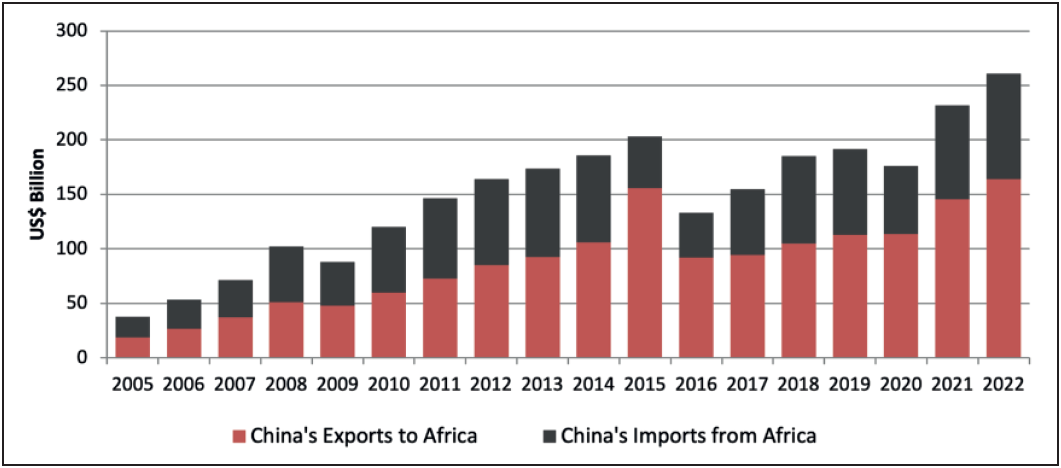
Source: China Africa Research Initiative60
Graph 3: Türkiye-Africa Trade Volume (2000-2022, billion $)
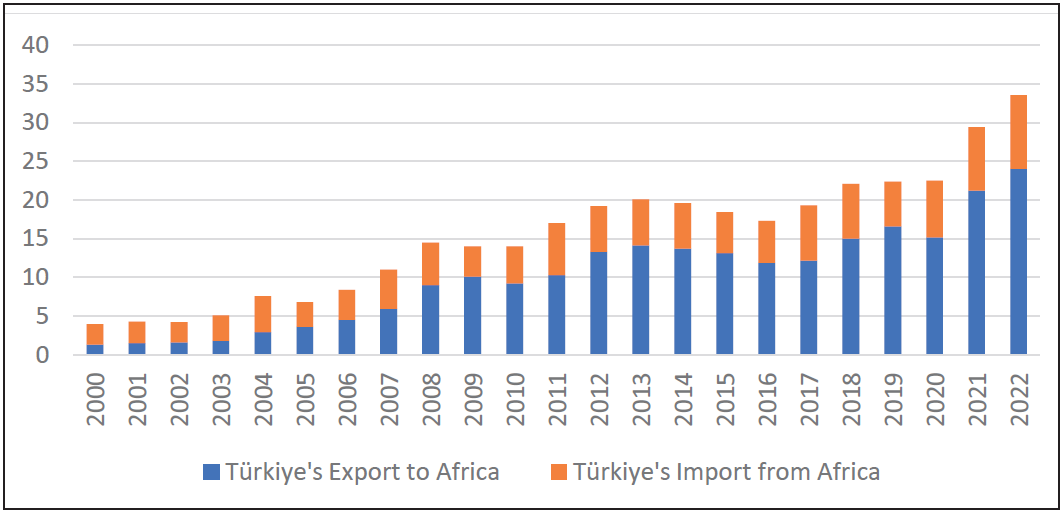
Source: TÜİK61
Besides the economic orientation, China and Türkiye have recently become more involved in the security issues of African countries. In this regard, Beijing and Ankara have contributed to the peacekeeping operations, organized by the UN and the African Union (AU), in some African countries, including Mali, the Democratic Republic of Congo, the Central African Republic, Sudan, and Somalia.62 Moreover, both countries also have a military base/training center in Africa. While Djibouti has been hosting a Chinese military base since July 11, 2017,63 Türkiye has operated a military training center in Somalia since September 30, 2017.64 Especially for Türkiye, the military training center in Somalia signals that this country is evolving from a benign donor to a security provider in Africa.65 More attractively, Türkiye’s and China’s defense industry products, especially unmanned aerial vehicles (drones), have recently been highly sought after by various African countries. This growing interest is driven by Chinese and Turkish companies that offer useful products at a relatively affordable price and that the governments do not impose preconditions during or after sales.66 Through these activities, both countries are protecting their interests in certain regions and contributing to the emergence of an even more stable environment in Africa.
As another similarity, China and Türkiye stand out with their high level of diplomatic representation on the continent. According to the Global Diplomacy Index, the two states are among the countries with the largest number of diplomatic representations in Africa and the world. In this context, China has a total of 173 embassies and 91 consulates worldwide,67 and 53 of the aforementioned embassies are located in Africa. In other words, the Beijing government has an embassy in all African countries except for the Eswatini Kingdom (formerly named Swaziland), which has diplomatic relations with the Taiwan administration.68 On the other hand, Türkiye has 146 embassies and 98 consulates around the world, with 44 embassies in Africa. Considering that Ankara had embassies in only 12 continental countries in 2002, the acceleration in Türkiye-Africa relations in the 21st century is clear evidence of the growing ties.69 In this respect, the increasing diplomatic representations indicate the significance of Africa for both countries and the growing relations.
The rapidly increasing number of official visits contributes to Beijing’s and Ankara’s interactions and multidimensional cooperation with African states
In addition to the high level of diplomatic representation, Chinese and Turkish statespeople are also notable for their diplomatic activism toward African countries. The rapidly increasing number of official visits contributes to Beijing’s and Ankara’s interactions and multidimensional cooperation with African states. For example, Chinese foreign ministers have been visiting African countries during overseas tours annually since 1991.70 Likewise, between 1990 and 2021, a total of 556 official visits were made from Beijing to almost all African countries at the level of heads of state, prime ministers, deputy prime ministers, and ministers.71 On the other hand, there has also been a noticeable increase in Türkiye’s official visits at various levels, especially in the last two decades. As the most specific example, Recep Tayyip Erdoğan, first as prime minister and then as president, has made over 50 official visits to more than 30 African countries and has stood out as the most active non-continental leader since 2003.72
Similarly, Turkish officials and business representatives have continued to visit African countries.73 During the same period, on the other side, there has been a significant increase in official visits from African capitals to Beijing and Ankara in response.74 Accordingly, the most tangible return of China’s and Türkiye’s active diplomacy with African countries is the crucial cooperation agreements signed in different areas such as trade, investments, security, industry, education, culture, etc. At this point, it should be noted that China’s and Türkiye’s visits to African countries have a more proactive and decisive tendency than those of traditional actors. Erdoğan’s visit to Somalia in 2011 is one of the most prominent examples in this regard. This visit in the midst of civil war and a lethal drought, at a time when many Western actors were hesitating, was a significant milestone for Ankara’s relations with Mogadishu and its African policy. Following this visit, Türkiye became Somalia’s security provider in time and gained many African countries’ favor with its decisive stance.75
Another common point of China’s and Türkiye’s approaches is the effective use of summit diplomacy to improve relations with African countries. Accordingly, China has been organizing the FOCAC every three years since 2000.76 On the other hand, Türkiye has held three Türkiye-Africa Partnership Summits since 2008.77 These forums highlight three aspects. Firstly, FOCAC’s success sets a valuable example for Türkiye and other external actors. In this context, this forum is a cornerstone in terms of the summit diplomacy of international actors with African countries.78 Secondly, these forums pave the way for the institutionalization of Beijing’s and Ankara’s relations with continental countries.79 Thirdly, cooperation agreements signed in various fields and development assistance promised to African countries allow the Turkish and Chinese governments to expand their spheres of influence based on equal partnership discourse.80
An analysis of official documents shows that the goals and expectations outlined in China’s and Türkiye’s forums bear some similarities with other traditional and alternative actors’ forums. Some of these include the development of economic and political relations, ensuring peace and security in the continent, enhancing socio-cultural cooperation, and supporting the development efforts of African countries through various means. However, emphases such as avoiding a supremacist discourse while supporting the development efforts, acting together for a more democratic international system, and not politicizing sensitive issues like human rights stand out as the leading differences between the two countries’ forums and those of traditional actors.81 All in all, Beijing’s and Ankara’s increasing presence in Africa since they started to organize the FOCAC and Türkiye-Africa Partnership Summit demonstrates the functional aspect of these gatherings.
Moreover, in recent years, China and Türkiye have used public diplomacy activities more effectively than traditional actors in Africa. The main reasons for this include spreading existing good relations to all segments of African societies, strengthening their positive images in the continent, and contributing to the development of African countries’ human resource capacities. In this context, China and Türkiye utilize soft power instruments such as education, culture, and health in their approaches to African countries. For instance, Confucius Institutes, established to promote Chinese culture to the world, have 61 branches in 48 African countries by 2021 (Figure 1).82 Similarly, one-fifth of the branches of the Yunus Emre Institute, which is a significant cultural instrument for Türkiye’s soft power in 65 countries worldwide, are located in 13 African countries.83 In addition, 25 branches of the Turkish Maarif Foundation, which contribute to the universalization of Turkish-style education in 48 countries around the world, are situated on this continent (Figure 2).84
Figure 1: Confucius Institutes’ Presence around the World in 2021
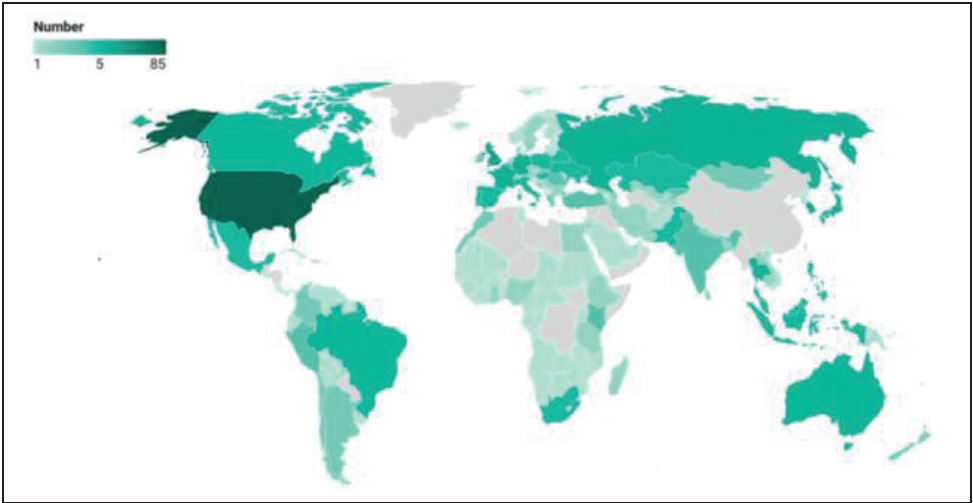
Source: Center for Global Studies85
Figure 2: The Turkish Maarif Foundation’s Presence Worldwide in 2023
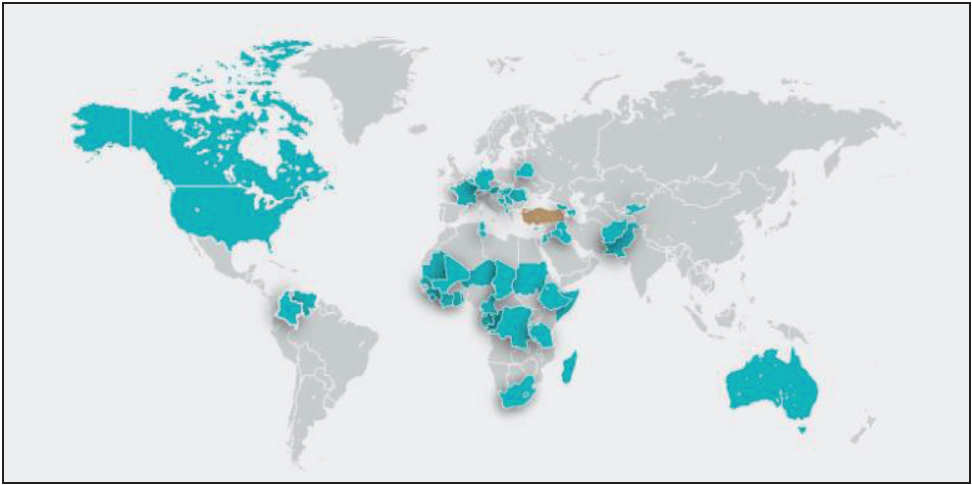
Source: Turkish Maarif Foundation86
Beijing and Ankara are improving their socio-cultural relations with African countries not only through their various activities in the continent but also by making their countries a center of attraction. The most important reflection of this is the existence of a high number of international students in the two countries. Accordingly, the number of African students choosing China or Türkiye for higher education has been steadily increasing. For instance, in 2020, nearly 16.5 percent (approximately 80,000) of the half a million international students in China are citizens of an African country.87 Likewise, in 2023, almost a quarter of the international undergraduate and graduate students in Türkiye, whose total number exceeds 260,000, come from several African countries.88 Studies reveal that factors such as scholarship opportunities, inexpensive and qualified education, development experiences, cultural affinities, growing reputation in the continent, and rising international prestige have been effective in increasing the number of African students in China and Türkiye.89 As Graph 4 and Graph 5 show, China (since the early 2010s) and Türkiye (since the late 2010s) have become competitive with countries like the U.S. and the UK in terms of the number of African students enrolled in higher education institutions.
Graph 4: The Number of African Students Studying in China, the U.S., and the UK (2005-2015)
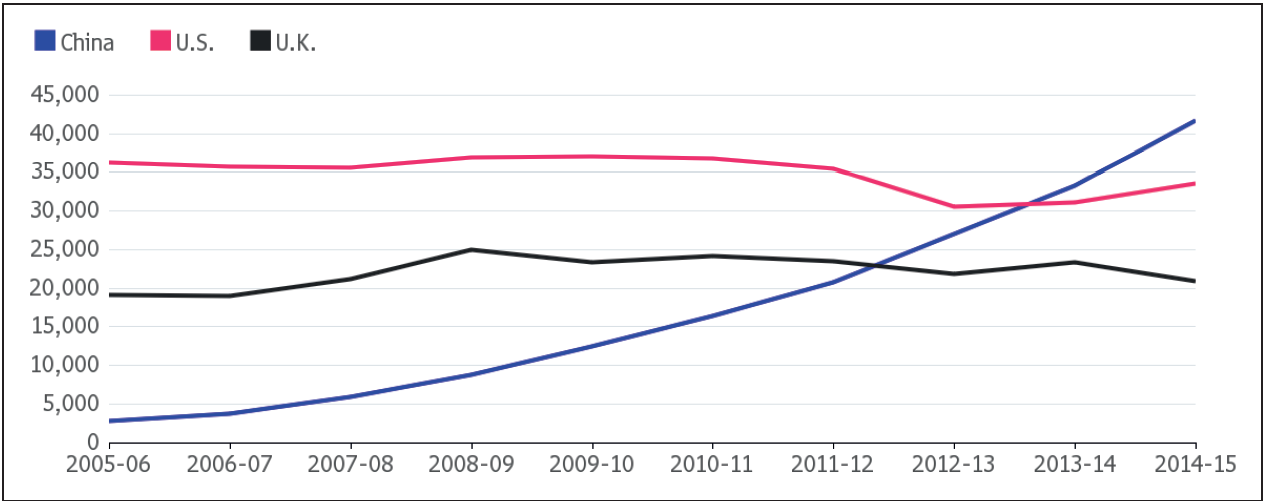
Source: China Africa Research Initiative90
Graph 5: The Number of African Students Studying in Türkiye (2012-2022)
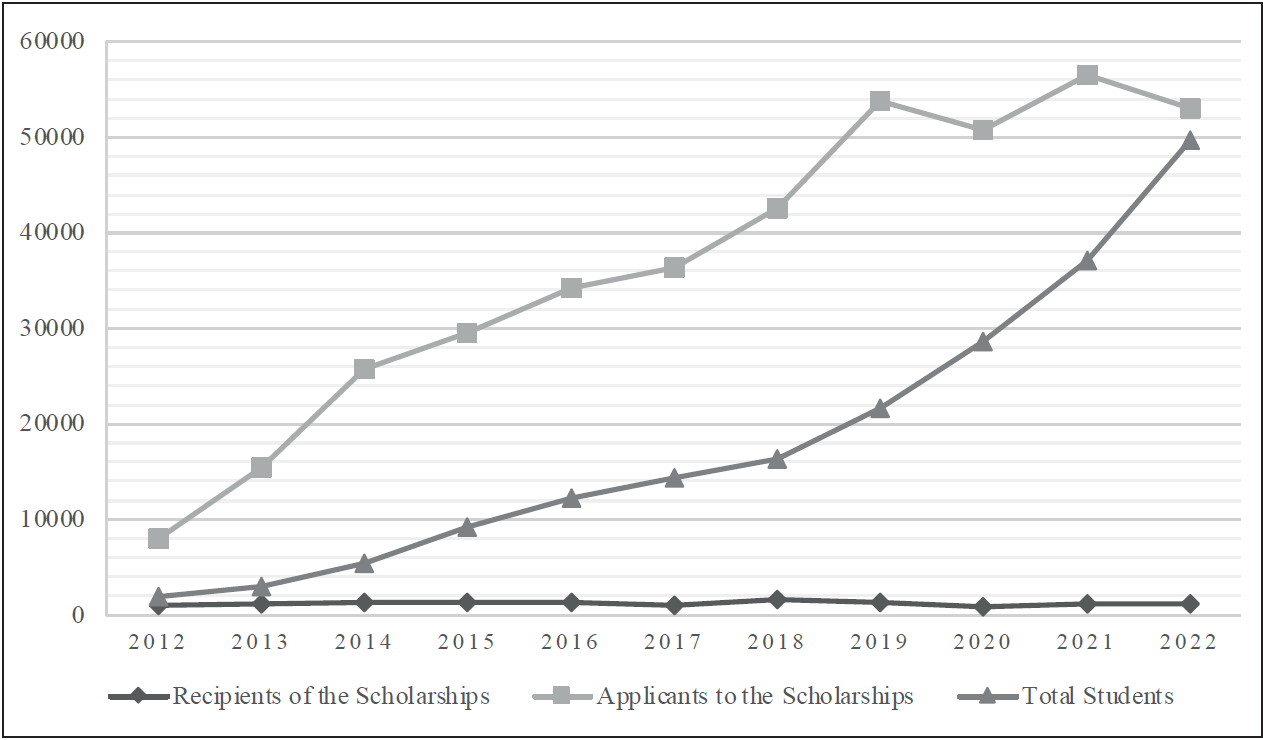
Source: Journal of University Research91
Finally, it can be stated that China and Türkiye can reach out to African countries more quickly, willingly, and comprehensively than traditional actors, especially in times of crisis. This has manifested itself most clearly during the COVID-19 pandemic. During and after the pandemic, many traditional actors, particularly the U.S., were criticized for not providing sufficient and efficient support to African countries.92 In contrast, Beijing and Ankara quickly sent food, respirators, masks, test kits, vaccines, medical personnel, and other health assistance to support continental countries’ fight against COVID-19.93 This assistance, sent in an environment in which they were also struggling with the negative effects of the pandemic, inevitably had a positive impact on their relations with African countries and their image among the citizens of these countries. In other words, Beijing’s and Ankara’s pandemic assistance to African countries stood out as successful soft power instruments in their relations with the continent.94
In recent years, China and Türkiye have used public diplomacy activities more effectively than traditional actors in Africa
Conclusion
This article sought answers to three interrelated questions about the competition of international actors in Africa: (i) What are the differences between traditional and alternative approaches? (ii) What are the main factors shaping China’s and Türkiye’s alternative approaches? (iii) What are the similarities between Beijing’s and Ankara’s approaches in practice?
Firstly, the traditional approach is rooted in Western supremacism and presents Western practices as a development model for African countries. This approach, severely criticized by African countries and other external actors, includes an implicit hierarchical understanding. As neo-liberal policies were insufficient to solve Africa’s main problems and concerns of African countries about their national sovereignties increased, alternative approaches to the traditional one have come to the fore. Even if each state has different understandings and policies in practice, some common features can be found in alternative approaches. Some include emphasizing common historical and cultural references, focusing on pragmatic interests, highlighting the principles of equality and non-interference in internal affairs, and benefiting the economic and political potential of African countries. Unlike the traditional approach, avoidance of economic and political preconditions toward African countries has increased the popularity of alternative approaches on the continent.
As Ankara’s and Beijing’s relations with African countries increase and their spheres of influence in this continent expand, new areas of conflict may likely emerge and the phenomenon of competition may interfere with the similarities
Secondly, China and Türkiye adopt alternative approaches to the Western-centered paradigm in their relations with African countries. Similar historical backgrounds and foreign policy expectations are among the main factors shaping the alternative approaches of these two countries. The lack of colonialist baggage and deteriorating relations with the Western countries are similar historical conditions that have nourished China’s and Türkiye’s stance toward Africa.
As similar foreign policy expectations shape the two countries’ approaches, some political, economic, security, and socio-cultural objectives can be discussed. Some of these objectives include the development of trade and investment relations, the desire to increase their international prestige, revising the current structure of the international system more democratically, supporting the development efforts of African countries, and assisting these countries in their efforts to ensure security.
The lack of colonialist baggage and deteriorating relations with the Western countries are similar historical conditions that have nourished China’s and Türkiye’s stance toward Africa
Thirdly, there are many similarities between China’s and Türkiye’s presence in Africa. Most importantly, Beijing and Ankara, which frequently emphasize the principle of equal partnership and usually refrain from imposing economic and political preconditions, have widely developed their relations with African countries in many areas. The rapid increase in trade and investment relations, operating as security providers to protect their interests and to meet the security needs of African countries, high level of diplomatic representations, effective use of official visits and summit diplomacy, and benefiting from various soft power instruments are some of the leading similarities between China’s and Türkiye’s Africa policies. Here, although they use similar traditional foreign policy instruments such as diplomacy, security, and economy, Beijing and Ankara differ from Western actors in that they have resorted to a new and different way of establishing relations with African countries.
Although beyond the scope of this study, there are also notable differences in China’s and Türkiye’s policies toward African countries. These differences are largely based on factors such as the two states’ capacities, systems, ideologies, investment focuses, and assistance and cooperation styles. Under the current circumstances, however, the similarities in China’s and Türkiye’s approaches to the continental countries outweigh the differences. The main reasons for this are that Beijing and Ankara have adopted alternative approaches toward African countries, they are not engaging in destructive competition on the continent, and their spheres of interest are mostly not confrontational for now. Nevertheless, as Ankara’s and Beijing’s relations with African countries increase and their spheres of influence in this continent expand, new areas of conflict may likely emerge and the phenomenon of competition may interfere with the similarities.
Endnotes
1. Serhat Orakçı, “Afrika Kıtası’nda Küresel Rekabet,” İNSAMER, (March 23, 2020), retrieved January 15, 2024, from https://www.insamer.com/tr/uploads/pdf/rapor-afrika-kitasi-nda-kuresel-rekabet.pdf, pp. 2-6.
2. Hasan Aydın, “Uluslararası Aktörlerin Afrika Zirveleri Nasıl Okunmalı?” AFAM, (November 21, 2019), retrieved January 15, 2024, from https://org.tr/uluslararasi-aktorlerin-afrika-zirveleri-nasil-okunmali/.
3. Emeka Nwokedi, “Franco-African Summits: A New Instrument for France’s African Strategy?” The World Today, Vol. 38, No. 12 (December 1982), pp. 478-482; Bert Edström, “Japan and the TICAD Process,” Institute for Security and Development Policy, (December 1, 2010), retrieved January 15, 2024, from https://eu/content/uploads/publications/2010_edstrom_japan-and-the-ticad.pdf, p. 13.
4. Zeng Aiping and Shu Zhan, “Origin, Achievements, and Prospects of the Forum on China-Africa Cooperation,” China International Studies, Vol. 72, No. 88 (September/October 2018), pp. 99-100.
5. Yun Sun, “Unpacking the Engagement of Nontraditional Actors in Africa: China and Other Emerging Players,” Brookings Institution, (January 14, 2020), retrieved January 15, 2024, from https://www.brookings.edu/articles/unpacking-the-engagement-of-nontraditional-actors-in-africa-china-and-other-emerging-players/.
6. Zekeri Momoh, “The Bretton Woods Institutions and the Quest for Development in Africa,” Otoritas: Jurnal Ilmu Pemerintahan, Vol. 13, No. 2 (2023), pp. 352-361.
7. John-Jean B. Barya, “The New Political Conditionalities of Aid: An Independent View from Africa,” IDS Bulletin, Vol. 24, No. 1 (1993), pp. 16-17.
8. Khalid Chegraoui, Rida Lyammouri, and Maha Skah, “Emerging Powers in Africa: Key Drivers, Differing Interests, and Future Perspectives,” PCNS, (November 10, 2020), p. 5.
9. Beth Elise Whitaker and John F. Clark, Africa’s International Relations: Balancing Domestic and Global Interests, (London: Lynne Rienner Publishers, 2018), pp. 321-323.
10. Chegraoui, Lyammouri, and Skah, “Emerging Powers in Africa: Key Drivers, Differing Interests, and Future Perspectives”; Chris Alden, “Introduction,” in Nicholas Kitchen (ed.), Emerging Powers in Africa, (London: LSE, June 2013), pp. 7-9.
11. Li Xinfeng, China in Africa: In Zheng He’s Footsteps, (Pretoria: HSRC Press, 2018).
12. Ahmet Kavas, “Osmanlı-Afrika İlişkileri,” TASAM, (April 17, 2006), retrieved May 11, 2024, from https://tasam.org/tr-TR/Icerik/383/osmanli-_afrika_iliskileri.
13. Jade McGlynn, “Why Russia Markets Itself as an Anti-Colonial Power to Africans,” Foreign Policy, (February 8, 2023), retrieved May 11, 2024, from https://foreignpolicy.com/2023/02/08/russia-ukraine-colonialism-diplomacy-africa/.
14. Alden, “Introduction,” p. 9.
15. Chris Alden, “New Actors, New Models, New Outcomes?” Oxfam International, (July 27, 2017), retrieved January 15, 2024, from https://policy-practice.oxfam.org/resources/new-actors-new-models-new-outcomes-african-countries-engagement-with-china-and-620319/, p. 9, pp. 18-19.
16. Mürsel Bayram and Hüseyin Emiroğlu, “Afrika’da Artan Çin Nüfuzunun Çok Yönlü Sonuçları,” Akademik Sosyal Araştırmalar Dergisi, Vol. 4, No. 28 (July 2016), p. 506; Osman Kağan Yücel and Hasan Aydın, “Afrika ile Neden İlgilenmeli?” Fikir Turu, (June 22, 2023), retrieved January 15, 2024, from https://fikirturu.com/jeo-strateji/afrika-ile-neden-ilgilenmeli/.
17. Chien-Kai Chen, “China in Africa: A Threat to African Countries?” Strategic Review of Southern Africa, Vol. 38, No. 2 (November 2016), p. 107.
18. Muhammed Ali Sekkaf, “Afrika’nın Uluslararası Platformlardaki Oy Bloğunun Boyutları,” Independent Türkçe, (August 4, 2021), retrieved November 11, 2024, from https://www.indyturk.com/node/395016/dünyadan-sesler/afrikanın-uluslararası-platformlardaki-oy-bloğunun-boyutları.
19. Chris Alden, “Emerging Powers and Africa: From Development to Geopolitics,” Istituto Affari Internazionali, (November 2019), p. 5.
20. Elling Tjønneland, “Rising Powers in Africa: What Does this Mean for the African Peace and Security Agenda?” NOREF, (March 2014), pp. 1-2.
21. Andrew Hull and David Markov, “Chinese Arms Sales to Africa,” Institute for Defense Analyses, (2012), pp. 25-31; Federico Donelli, “UAVs and Beyond: Security and Defence Sector at the Core of Turkey’s Strategy in Africa,” Mega Trends Africa, (March 2, 2022), pp. 1-8.
22. “Global Africa: Africa in the World and the World in Africa,” Mo İbrahim Foundation, (2023), p. 88.
23. Agnieszka Paczynsk, “New State Actors and Conflict-Affected States: Confronting Violence, Shifting Ambitions, and Adjusting Principles,” Frontiers in Political Science, Vol. 3, (2021), pp. 1-13.
24. “Global Africa,” Mo Ibrahim Foundation, p. 88.
25. Li Anshan, Liu Haifang, and Pan Huaqiong, FOCAC Twelve Years Later: Achievements, Challenges and the Way Forward, 1st ed., (Uppsala: Nordiska Afrika Institutet, 2012), pp. 17-19.
26. “TICAD Tenth Anniversary Declaration,” Ministry of Foreign Affairs of Japan, (October 1, 2003), retrieved from https://www.mofa.go.jp/region/africa/ticad3/declaration.html.
27. Hasan Aydın, “Donald Trump Döneminde ABD’nin Afrika Politikası: Farklar, Beklentiler ve Gerçekler,” Cappadocia Journal of Area Studies (CJAS), Vol. 3, No. 2 (December 2021), p. 178.
28. Sarina Theys, “Introducing Constructivism in International Relations Theory,” E-International Relations, (February 23, 2018), retrieved May 19, 2024, from https://www.e-ir.info/2018/02/23/introducing-constructivism-in-international-relations-theory/.
29. Yih-Jye Hwang and Lindsay Black “Victimized State and Visionary Leader? Questioning China’s Approach to Human Security in Africa,” East Asia, Vol. 32, No. 1 (2020), pp. 1-19.
30. Andrew Lebovich and Nienke van Heukelingen, “Unravelling Turkish Involvement in the Sahel: Geopolitics and Local Impact,” Clingendael, (July 2023), retrieved November 11, 2024, from https://www.clingendael.org/sites/default/files/202307/Policy_brief_Unravelling_Turkish_involvement_in_the_Sahel.pdf, pp. 1-12.
31. Ferit Belder and Samiratou Dipama, “A Comparative Analysis of China and Turkey’s Development Aid Activities in Sub-Saharan Africa,” in Emel Parlar Dal (ed.), Middle Powers in Global Governance: The Rise of Turkey, (London: Palgrave Macmillan, 2018), pp. 235-237.
32. Deniz İstikbal, Afrika’da İşbirliği ve Rekabet: Türkiye ve Çin, (İstanbul: SETA Yayınları, 2020), pp. 17-34.
33. Li Anshan, China and Africa in Global Context: Encounters, Policy, Cooperation and Migration, 1st ed., (London and New York: Routledge, 2022), pp. 3-21.; Ahmet Kavas, Osmanlı-Afrika İlişkileri, (İstanbul: Kitabevi, 2011), pp. 111-126.
34. John Bolton, “A New Africa Strategy: Expanding Economic and Security Ties on the Basis of Mutual Respect,” Heritage Foundation, (February 20, 2019), retrieved January 16, 2024, from https://www.heritage.org/global-politics/report/new-africa-strategy-expanding-economic-and-security-ties-the-basis-mutual; Burhanettin Duran, “Combative and Brazen: State of France’s Macron,” SETA, (November 9, 2022), retrieved January 16, 2004, from https://www.setav.org/en/combative-and-brazen-state-of-frances-macron/.
35. “Erdoğan’dan Sömürge Düzenine Tepki: Korktukça Zulüm Afrika’yı Sarar,” SDE, (October 19, 2021), retrieved January 16, 2024, from https://www.sde.org.tr/afrika/erdogandan-somurge-duzenine-tepki-korktukca-zulum-afrikayi-sarar-haberi-24277; David Smith, “China Denies Building Empire in Africa,” The Guardian, (January 12, 2015), retrieved January 16, 2024, from https://www.theguardian.com/global-development/2015/jan/12/china-denies-building-empire-africa-colonialism.
36. William Hale, Turkish Foreign Policy since 1774, 3rd ed., (New York: Routledge, 2013), pp. 158-194; Elem Eyrice Tepeciklioğlu, “Economic Relations between Turkey and Africa: Challenges and Prospects,” Journal of Sustainable Development Law and Policy, Vol. 8, No. 1 (2017), pp. 4-5.
37. Harry Harding, “The Impact of Tiananmen on China’s Foreign Policy,” The National Bureau of Asian Research Analysis, Vol. 1, No. 3 (December 1, 1990).
38. George T. Yu, “Africa in Chinese Foreign Policy,” Asian Survey, Vol. 28, No. 8 (August 1988), p. 855.
39. Tom Fowdy, “Support for National Security Law for HKSAR Shows Strenght of China-Africa Ties,” China Global Television Network (CGTN), (July 3, 2020), retrieved January 16, 2024, from https://news.cgtn.com/news/2020-07-03/Support-for-national-security-law-shows-strength-of-China-Africa-ties-ROFQRp0OIw/index.html.
40. Seval Çolak, “İçişlerine Karışmama İlkesi Bağlamında Çin’in Afrika’daki Askeri ve Güvenlik Politikaları (1955-2021),” Topkapı Journal of Social Sciences, Vol. 1, No. 1 (2022), pp. 77-78.
41. Hüsamettin İnanç, Aymene Hadji, and Younes Benmansour, “The Prospect for Turkish Foreign Policy in Africa under AK Party Governments,” Afro Eurasian Studies, Vol. 9, No. 3 (April 2022), p. 154.
42. Mürsel Bayram, “Türkiye-Afrika İş Birliği: Üçüncü Bir Yol Mümkün mü?” in Burhanettin Duran, Kemal İnat, and Mustafa Caner (eds.), Türk Dış Politikası Yıllığı 2021, (İstanbul: Seta Yayınları, 2022), p. 181.
43. Zhang Chun, “The Sino-Africa Relationship: Toward a New Strategic Partnership,” in Nicholas Kitchen (ed.), Emergin Powers in Africa, (London: LSE, June 2013), p. 11.
44. “Afrika Kıtasıyla İlişkilerimizi ‘Kazan-Kazan ve Eşit Ortaklık Temelinde’ İlerletmek İstiyoruz,” Presidency of Republic of Türkiye, (October 17, 2021), retrieved May 19, 2024, from https://tccb.gov.tr/haberler/410/130964/-afrika-kitasiyla-iliskilerimizi-kazan-kazan-ve-esit-ortaklik-temelinde-ilerletmek-istiyoruz-; “Xi: China, Africa Embark on Distinctive Path of Win-Win Cooperation,” Ministry of Foreign Affairs of PRC, (September 3, 2018), retrieved May 19, 2024, from_https://www.fmprc.gov.cn/eng/wjb_663304/zzjg_663340/fzs_663828/xwlb_663830/201809/t20180904_541644.html.
45. Tjønneland, “Rising Powers in Africa,” p. 2.
46. Yunus Turhan and Şerif Onur Bahçecik, “The Agecny of Faith-Based NGOs in Turkish Humanitarian Aid Policy and Practice,” Turkish Studies, Vol. 22, No. 1 (2021), pp. 141-159.
47. Hema Narang, “Infrastructure Diplomacy the Key to China’s Influence in Africa,” East Asia Forum, (February 7, 2024), retrieved May 19, 2024, from https://eastasiaforum.org/2024/02/07/infrastructure-diplomacy-the-key-to-chinas-influence-in-africa/.
48. Belder and Dipama, “A Comparative Analysis of China and Turkey’s Development Aid Activities in Sub-Saharan Africa,” pp. 246-249.
49. Justin Van der Merwe, Ian Taylor, and Alexandra Arkhangelskaya (eds.), Emerging Powers in Africa: A New Wave in the Relationship?, (London: Palgrave Macmillan, 2016).
50. Federico Donelli, Turkey in Africa: Turkey’s Strategic Involvement in Sub-Saharan Africa, (London and New York: Bloomsbury Academic, 2021).
51. Jarso Galchu, “The Beijing Consensys versus the Washington Consensus: The Dilemma of Chinese Engagement in Africa,” African Journal of Political Science and International Relations, Vol. 12, No. 1 (January 2018), pp. 1-9.
52. Federico Donelli, “The Ankara Consensus: The Significance of Turkey’s Engagement in Sub-Saharan Africa,” Global Change, Peace & Security, Vol. 30, No. 1 (February 2018), pp. 1-20.
53. Fuat Kabakçı and Muhammet Tarhan, “Dışişleri Bakanı Çavuşoğlu: Türkiye, Afrika’yı Sömürgeci Olarak Değil, Ortak Olarak Gören Bir Ülkedir,” Anadolu Ajansı, (June 22, 2021), retrieved January 16, 2024, from https://www.aa.com.tr/tr/politika/disisleri-bakani-cavusoglu-turkiye-afrikayi-somurgeci-olarak-degil-esit-ortak-olarak-goren-bir-ulkedir/2281772; “Wang Yi: China and Africa Stand Shoulder to Shoulder to Safeguard International Fairness and Justice,” Embassy of PRC in Ethiopia, (August 18, 2022), retrieved January 16, 2024, fromchina-embassy.gov.cn/eng/gnyw/202208/t20220821_10747202.html.
54. Yücel and Aydın, “Afrika ile Neden İlgilenmeli?”
55. Unlike Western actors’ preconditions, those of Beijing and Ankara focus on their national security issues, not the internal affairs of African countries. Even, despite their similar approaches, there is also a notable difference in tone between China’s and Türkiye’s preconditions. While Beijing refuses to establish diplomatic ties with any country that recognizes Taiwan, Ankara’s efforts to constrain FETÖ’s influence on the continent are characterized by a softer attitude. At this point, these two actors’ focus on their national security issues rather than the internal affairs of African countries leads them to have fewer problems with the continent’s leaders. For instance, no African country except the Kingdom of Eswatini recognizes Taiwan nowadays. As another example, many African countries have prevented FETÖ’s activities in their countries. On the other hand, unlike Beijing, Ankara maintains its multidimensional relations even with African countries where FETÖ sympathizers can continue their educational activities and organize in other fields freely.
56. “Data: China-Africa Trade,” China Africa Research Initiative, (April 2023), retrieved January 16, 2024, fromsais-cari.org/data-china-africa-trade.
57. Jason Mitchell, “Africa’s Reliance on China Is Only Likely to Get Worse,” Investment Monitor, (January 26, 2023), retrieved January 16, 2024, from https://www.investmentmonitor.ai/features/africas-reliance-on-china-is-only-likely-to-get-worse/.
58. Deniz Çiçek Palabıyık, “Afrika Açılımı Türkiye’nin Kıtayla Ticaret Hacmini 45 Milyar Dolar Seviyesine Çıkardı,” Anadolu Ajansı, (September 30, 2022), retrieved January 16, 2024, from https://www.aa.com.tr/tr/dunya/afrika-acilimi-turkiyenin-kitayla-ticaret-hacmini-45-milyar-dolar-seviyesine-cikardi/2698819.
59. Deniz İstikbal, “Türkiye’nin Afrika Politikası,” SETA, (February 26, 2022), retrieved January 16, 2024, from https://www.setav.org/turkiyenin-afrika-politikasi/.
60. “Data: China-Africa Trade,” China Africa Research Initiative.
61. “Dış Ticaret İstatistikleri,” TÜİK-Veri Portalı, retrieved September 24, 2024, from https://data.tuik.gov.tr/Kategori/GetKategori?p=Dis-Ticaret-104.
62. “Troop and Police Contributions,” United Nations Peacekeeping, (2023), retrieved January 16, 2024, from https://peacekeeping.un.org/en/troop-and-police-contributors.
63. Charles Davis, “China’s Sustanined Success in Sub-Saharan Africa: Letting China Pick Up the Check,” Military Intellegence, (October-December 2020), p. 62.
64. İbrahim Karataş, “Turkey’s Military Presence in Somalia: Doing What, Why and for Whom?” in Mohamed A. Eno and Abdulkadir Osman (eds.), Theorising Somali Society: Hope, Transformation and Development, (New Delhi: Authors Press, 2022), p. 181.
65. Pınar Akpınar, “From Benign Donor to Self-Assured Security Provider: Turkey’s Policy in Somali,” İstanbul Policy Center, (December 2017), pp. 3-6.
66. Robert Bociaga, “Why Are Chinese Drones the Growing Choice in Africa,” The Africa Report, (April 10, 2023), retrieved January 16, 2024, from https://www.theafricareport.com/296467/why-are-chinese-drones-the-growing-choice-in-africa/; Mürsel Bayram, “Türkiye: Rising Power in Defense of Africa,” Anatolian Agency Analysis, (May 25, 2022), retrieved January 16, 2024, from https://www.aa.com.tr/en/analysis/analysis-turkiye-rising-power-in-defense-of-africa/2596975.
67. “Global Diplomacy Index: 2024 Country Ranking,” Lowy Institute, (2024), retrieved May 8, 2024, from https://globaldiplomacyindex.lowyinstitute.org/.
68. “Chinese Embassies: Africa,” Ministry of Foreign Affairs of PRC, retrieved January 16, 2024, from https://www.fmprc.gov.cn/mfa_eng/wjb_663304/zwjg_665342/2490_665344/2493_665350/.
69. “Türkiye-Africa Relations,” Republic of Türkiye Ministry of Foreign Affairs, retrieved January 16, 2024, from https://www.mfa.gov.tr/turkiye-africa-relations.en.mfa.
70. “Çin Dışişleri Bakanı Wang, Yılın İlk Dış Gezisi için Afrika’ya Gidiyor,” CRI Turkish, (January 4, 2022), retrieved January 16, 2024, from https://cri.cn/20220104/80bb15bf-9639-4d6e-d21c-c0091ea
228c3.html.
71. Faqin Lin, Wenshou Yan, and Xiaosong Wang, “The Impact of Africa-China’s Diplomatic Visits on Bilateral Trade,” Scottish Journal of Political Economy, Vol. 64, No. 3 (July 2017), p. 5.
72. “Afrikalı Gençlerle Söyleşi Programı’nda Yaptıkları Konuşma,” Türkiye Cumhuriyeti Cumhurbaşkanlığı, (December 16, 2021), retrieved January 16, 2024, from https://www.tccb.gov.tr/konusmalar/353/133980/afrikali-genclerle-soylesi-programi-nda-yaptiklari-konusma-.
73. “Türkiye-Afrika İş Konseyleri,” DEİK, retrieved January 16, 2024, from https://www.deik.org.tr/turkiye-afrika-is-konseyleri?pm=&sm=etkinlikler.
74. Tufan Aktaş and Gökhan Kavak, “Afrikalı Liderlerin Yeni Rotası ‘Türkiye,’” Anadolu Ajansı, (October 15, 2021), retrieved January 16, 2024, from https://www.aa.com.tr/tr/dunya/afrikali-liderlerin-yeni-rotasi-turkiye/2392927; Rosie Wigmore, “Power Plays: Why Are more African Leaders Visiting China despite Geopolitics,” The Africa Report, (October 12, 2023), retrieved January 16, 2024, from https://www.theafricareport.com/324794/power-plays-why-are-more-african-leaders-visiting-china-despite-geopolitics/.
75. Abdurrahim Sıradağ, “Turkish-Somali Relations: Changing State Identity and Foreign Policy,” Inquiry: Sarajevo Journal of Social Science, Vol. 2, No. 2 (2016), pp. 92-93; Brendon Cannon, “Deconstructing Turkey’s Efforts in Somalia,” Bildhaan: An International Journal of Somali Studies, Vol. 16, No. 14 (2016), pp. 98-116.
76. “About FOCAC,” FOCAC, (2023), retrieved January 16, 2024, from http://www.focac.org/eng/ltjj_3/ltjz/.
77. “Türkiye and African Union,” Republic of Türkiye Ministry of Foreign Affairs, retrieved January 16, 2024, from https://www.mfa.gov.tr/turkiye-and-the-african-union.en.mfa.
78. Aiping and Zhan, “Origin, Achievements and Prospects of the Forum on China-Africa Cooperation,” p. 100.
79. Garth Shelton, “The FOCAC Process and Sino-African Strategic Partnership,” China Quarterly of International Strategic Studies, Vol. 2, No. 2 (2016), pp. 265-267; Mehmet Özkan, “Turkey Discovers Africa: Implications and Prospects,” SETA Policy Brief, No. 22 (September 2008), p. 7.
80. Francis Kwesi Kyirewiah and Zou Xiaolong, “20 Years of China-Africa Cooperation: Processes, Developments and Achievements,” Journal of African Foreign Affairs (JoAFA), Vol. 9, No. 2 (August 2022), pp. 35-40; Hasan Basri Kurt, “Afrika ile Stratejik Ortaklık Aracı Olarak Zirveler ve Türkiye-Afrika Zirveleri,” Kriter Dergi, Vol. 6, No. 63 (Aralık 2021), retrieved January 16, 2024, from https://kriterdergi.com/dis-politika/afrika-ile-stratejik-ortaklik-araci-olarak-zirveler-ve-turkiye-afrika-zirveleri.
81. “Beijing Declaration of the Forum on China-Africa Cooperation,” FOCAC, (October 12-14, 2000), retrieved May 19, 2024, from http://www.focac.org/eng/zywx_1/zywj/200909/t20090925_8079752.htm; “Third Africa-Türkiye Partnership Summit Declaration,” African Union, (December 16-18, 2021), retrieved May 19, 2024, from https://au.int/sites/default/files/newsevents/reports/41270-rp-E_AfricaTurkiye_Summit_2021_Declaration.pdf.
82. “61 Confucius Institutes, 48 Confucius Classrooms Established in Africa: White Paper,” Xinhua, (November 26, 2021), retrieved January 16, 2024, fromnews.cn/english/2021-11/26/c_1310334064.htm.
83. “Kültür Merkezlerimiz,” Yunus Emre Enstitüsü, retrieved January 16, 2024, from https://www.yee.org.tr/tr/kurumsal/yunus-emre-enstitusu.
84. “Dünyada Maarif,” Türkiye Maarif Vakfı, retrieved January 16, 2024, from https://turkiyemaarif.org/dunyada-maarif.
85. Xuewu Gu, Clara Dinkelbach, Christiane Heidbrink, Ying Huang, Xiaojun Ke, Maximilian Mayer, and Hendrik Ohnesorge, “China’s Engagement in Africa: Activities, Effects and Trends,” Center For Global Studies, (June 2022), p. 38.
86. “Dünyada Maarif,” Türkiye Maarif Vakfı.
87. Wachiro Kigotho, “Educational Superhighway from Africa to China Speeds up Mobility,” University World News–Africa Edition, (November 19, 2020), retrieved January 16, 2024, from https://www.universityworldnews.com/post.php?story=20201118132655210.
88. “Scholarships Attracting African Students to Turkey,” The Pie News, retrieved January 16, 2024, from https://thepienews.com/news/turkey-african-student-numbers-grow/.
89. A. Jiani, “Why and How International Students Choose Mainland China as a Higher Education Study Abroad Destination,” Higher Education, Vol. 74, (October 2016), pp. 563-579; Oya Tamtekin Aydın, “Why Do International Students Choose Turkish Universities and What Are the Challenges They Encounter?” Issues in Educational Research, Vol. 31, No. 1 (2021), pp. 274-290.
90. “Is China Winning the (Hearts and) Minds of African Students?” China Africa Research Initiative, (May 7, 2018), retrieved September 24, 2024, from https://chinaafricarealstory.com/2018/05/is-china-winning-hearts-and-minds-of.html.
91. Hacer Atabaş and Mehmet Köse, “The Role of Foreign Policy in International Student Mobility: The Case of the Turkish ‘Opening to Africa’ Policy,” Journal of University Research, Vol. 6, No. 4 (2023).
92. “Macron Urges US, EU to Rapidly Divert COVID Vaccines to Africa,” Al Jazeera, (February 18, 2021), retrieved May 18, 2024, from https://www.aljazeera.com/news/2021/2/18/macron-urges-us-eu-to-rapidly-divert-covid-vaccines-to-africa.
93. Ulaş Birkan Çakılcı, “China’s Health Diplomacy Activities during the Covid-19 Pandemic,” Politik Ekonomik Kuram, Vol. 7, No. 1 (June 20, 2023), p. 98; Yunus Turhan, “Turkish Humanitarian Assistance during the Covid-19 Pandemic: Focus on Africa,” Journal of Balkan and Near Eastern Studies, Vol. 26, No. 3 (2024), pp. 327-345.
94. Bilal Zubair, Sibra Waseem, and Khushbakht Shahid, “Soft Power and Vaccine Diplomacy: An Analysis of China’s Global Image Enhancement during the COVID-19 Pandemic,” BTTN Journal, Vol. 2, No. 2 (December 2023), pp. 104-129; Narmina Mamishova, “Vaccine Diplomacy as a Form of Soft Power: The Successful Case of Türkiye,” Insight Turkey, Vol. 24, No. 3 (2022), pp. 167-187.