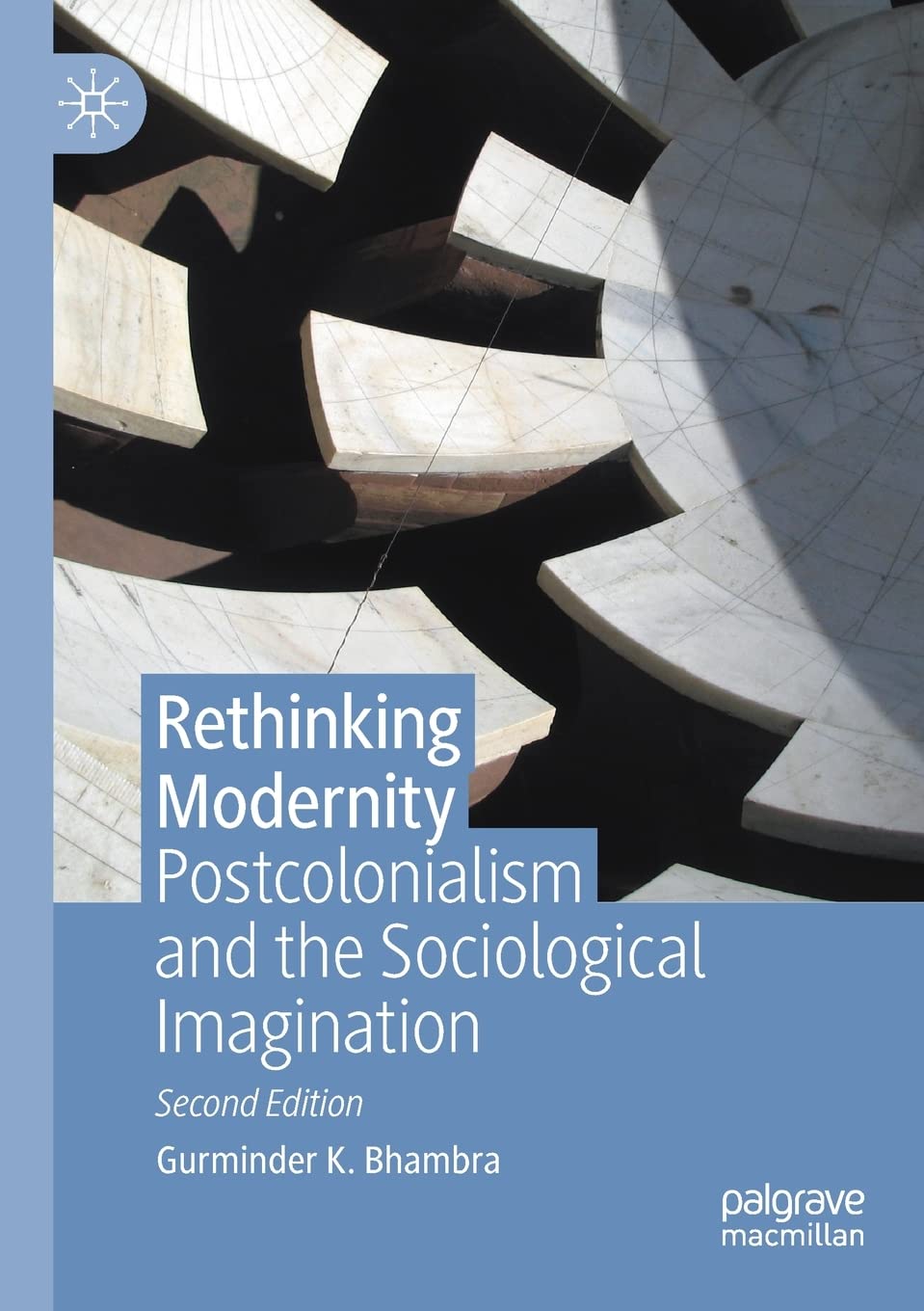
Decolonization involves dismantling European colonial rule and challenging knowledge systems shaped by “colonial modernity” (p. xi). It advocates for rethinking academic disciplines and curricula in light of how colonialism has shaped our world perception. In the revised edition of “Rethinking Modernity: Postcolonialism and the Sociological Imagination,”Gurminder K. Bhambra, the author and Professor of Historical Sociology in the Department of International Relations at the University of Sussex, emphasizes this necessity, advocating for a deeper understanding of how colonialism has shaped sociological concepts. She challenges the prevalent Eurocentric sociological frameworks by probing into the crucial part that colonial histories played in the development of modernity. There needs to be more than just pluralizing voices; we need to fundamentally revalue knowledge structures with diverse perspectives. Through incisive critique, she invites readers to reassess prevailing notions of modernity and to engage with the interconnected histories that shape our understanding of the world. Referring to the theoretical framework of Qadri Ismail, a postcolonial writer, she agreed that it is not to “beseech inclusion in the canon” but to besiege the disciplines themselves. He was compelled to put “history itself to question” as it “unsettles the structure of the modern episteme” (p. xii).
She argues to ‘de-link’ Europe’s dominance in discussions of modernity, emphasizing non-Western contributions. She challenges a linear view of modernization, arguing for a progressive global perspective. By emphasizing Sanjay Subrahmanyam’s theory of “connected histories,” she highlights the interconnectedness of diverse civilizations and the importance of contextualizing historical narratives within broader frameworks of power and inequality (p. 79). Bhambra uses C.W. Mills’ “sociological imagination” to argue for revising socio-historical narratives to better understand social theory in today’s globalized world (p. 29). Bhambra’s conception of modernity as the social, cultural, political, and economic changes that took place in Western Europe from the mid-16th century onwards highlights the geographical and temporal characteristics of conventional understandings of modernity.
Similarly, her definition of Eurocentrism as the belief in the world-historical significance of events believed to have developed endogenously within the cultural-geographical sphere of Europe highlights the implicit biases inherent in Eurocentric narratives. Bhambra’s alternative conception of Eurocentrism challenges the notion that modernity is the sole property of Europe, emphasizing the interconnectedness of global histories as she writes that “newly discovered” histories and voices were not previously lost; instead, they were associated with activities that were not seen as significant within standard accounts but cannot now be recovered as simply additional to them” (p. 23).
Bhambra argues that colonial modernity recognizes the deep connection between colonialism and the development of the modern world. She reveals how mainstream sociological accounts often omit colonial histories by examining pivotal moments like the Renaissance, the Industrial Revolution, and the French Revolution. Recognizing the involvement of marginalized groups (the “other”) in history, theoretical discourse, and political practice can be reconceptualized (p. 191). Particularly divided into two parts, the book discusses multiple aspects of colonialism, modernity, and Eurocentrism. The first part, titled “Sociology and Its Historiography,” uncovers into the absence of the colonial encounter from social sciences and critiques subaltern historiography. She introduced the concept of “connected sociologies” to spotlight the interconnectedness of historical processes and promote a more inclusive and transformative approach to theoretical categories, inspired by historian Sanjay Subrahmanyam’s call for “connected histories”(p. 21).
The opening chapter, “Modernity, Colonialism, and Postcolonial Critique,” introduces the link between modernity and colonialism, shedding light on overlooked colonial aspects in traditional sociological narratives. Following this, “European Modernity and the Sociological Imagination” reaffirming a broader view of modernity that recognizes its global dimensions (p. 36). The section concludes with “From Modernization to Multiple Modernities: Eurocentrism Redux,” acknowledging diverse modern experiences worldwide instead of one.
Part 2, “Deconstructing Eurocentrism: Connected Histories,” deals with chapters that analyze particular Eurocentric narratives surrounding key historical events. Bhambra redefines the Renaissance, stressing its global interconnectedness beyond Europe (p. 84).
Similarly, in “Myths of the Modern Nation-State: The French Revolution,” she deconstructs Eurocentric views of the French Revolution and explores the global dimensions of nation-state formation (p. 121). Finally, in“Myths of Industrial Capitalism: The Industrial Revolution,” Bhambra critiqued Eurocentric narratives regarding industrialization, emphasizing the contributions of non-European societies to the emergence of industrial capitalism (p. 152).
The book concludes with a chapter titled “Sociology and Social Theory after Postcolonialism Towards a Connected Historiography,” where Bhambra synthesizes the key arguments presented throughout the book and proposes a framework for reconceptualizing sociology within a postcolonial paradigm (pp. 182-184).
The second edition maintains core arguments while updating references and insights to reflect evolving discourse on postcolonialism and globalization. Bhambra’s engagement with recent developments ensures the book’s relevance in decolonizing knowledge production within social sciences. This revised version offers refined perspectives with updated scholarship, distinguishing it from the first edition (2007).
Throughout the book, Bhambra employs intext citations to support her arguments and engage with relevant literature. For example, she critiques the notion of a singular trajectory of modernization, citing recent scholarship that emphasizes the diversity of contemporary societies (p. 69). Drawing upon the work of postcolonial theorists, she lays “reparatory sociology” to repair both the social sciences and to address the global inequalities (implicitly), persuading readers to rethink their historical understanding of the past and present (p. viii).
Bhambra’s capacity to integrate and apply complex theoretical ideas to specific historical and sociological contexts is one of its main strengths. For instance, she aptly deconstructs the Eurocentric biases inherent in traditional accounts of modernity, demonstrating how they perpetuate inequalities and injustices (p. 179). By foregrounding the voices of marginalized groups, she encouraged a more inclusive and reflexive approach to knowledge production.
While the book’s deconstructive chapters are compelling and persuasive, Bhambra’s Notion of connected sociologies” may be less convincing to some readers (p. xiv). While she acknowledges the importance of cross-cultural interactions in societies, some may find her advocacy for embracing all perspectives problematic, as it risks relativism and overlooks power imbalances (p. 191). Though Bhambra acknowledges that her goal of decentering Europe’s hegemony in sociology may no longer seem novel in the wake of postcolonial critiques, she contends that her criticisms of postcolonial theorists for perpetuating the binary play between the West and the rest underscore the continued importance of her work for advancing social theory.
Nevertheless, the book offers updated content and an expanded approach, making it essential for scholars, students, and anyone interested in colonialism and the sociological imagination. Bhambra’s integration of postcolonial theory and connected sociologies enhances discussions on decolonization, sparking new avenues for research. It will fascinate those interested in sociology, historiography, postcolonialism, and decolonial theory, providing valuable insights into the relationship between Eurocentrism, colonial legacies, and present global concerns.