
Introduction*
The dissolution of the Soviet Union in 1991 was a watershed moment for the Turkic World as it created a new geopolitical reality, opening up new opportunities for cooperation and collaboration. For centuries, borders, empires, and ideologies had divided Turkic peoples. However, with the collapse of the Soviet Union, these barriers were finally removed, and Turkic people were able to come together and reconnect with their shared history, culture, and language. Moreover, the Turkic states gained their independence in Central Asia and the Caucasus. Thus, Azerbaijan, Kazakhstan, Kyrgyzstan, Turkmenistan, and Uzbekistan were included in the international system, and together with Türkiye, they all created the Turkic World.
The independent Turkic states were eager to cooperate with each other and to promote their shared interests. They first came together through Summits of the Heads of Turkic Speaking States in 1992 and started the integration process in the Turkic World, which in 2009 turned into an international organization known as the Turkic Council and now called the Organization of Turkic States. The 1996 Tashkent Summit is noteworthy in terms of the institutionalization of the Turkic Speaking Countries Summit by establishing the Secretariat of the Summits. The institutionalization took the form of an international organization with the Nakhchivan Agreement in 2009, which established the Cooperation Council of Turkic Speaking States (Turkic Council). İstanbul was chosen for the Council’s headquarters and the Heads of the Turkic states appointed Ambassador Halil Akıncı as the first Secretary General of the Council. The Council was later renamed the Organization of Turkic States (OTS) at the 8th Summit Meeting held in İstanbul in 2021. Azerbaijan, Kazakhstan, Kyrgyzstan, Türkiye, and Uzbekistan are current OTS members, while Hungary, Turkmenistan, and the Turkish Republic of Northern Cyprus are observer members.
Under the umbrella of OTS, Turkic states underline cooperation and solidarity based on shared values and aim to develop a common attitude within the scope of issues affecting the interests of the Turkic World.1 In this respect, the OTS serves as a platform for political, economic, social, and cultural cooperation among Turkic states. Beyond these areas, the Organization also plays a crucial role in enhancing security cooperation. Consequently, OTS members have expressed their will to pursue coordinated policies on security issues of common interest.2 In order to realize their expressed will, the OTS member states decided to hold security consultations and develop a common stance on security issues at the Almaty Summit in 2011.3 Later, they reiterated their decision in every subsequent summit to continue security consultations on a regular basis within the OTS at the level of Ministers of Foreign Affairs. Specifically, the Samarkand Declaration of the 9th Summit of the Organization of Turkic States in 2022 underlined the determination of the OTS member states to continue security consultations to ensure close coordination and cooperation on security issues of common interests. The member states went beyond consultations by adding a new dimension to their security cooperation at the 9th Summit. They called for closer cooperation and military collaboration in the defense industry.4
Under the umbrella of OTS, Turkic states underline cooperation and solidarity based on shared values and aim to develop a common attitude within the scope of issues affecting the interests of the Turkic World
In addition to their commitment to security cooperation in Summit Declarations, Turkic states have also developed a common attitude towards security problems they face in parallel with security consultations and declarations on cooperation within the OTS. For example, the OTS issued a statement during the 44-Day War between Azerbaijan and Armenia in 2020 and demanded the withdrawal of the Armed Forces of Armenia from Azerbaijani territories under occupation.5 Moreover, upon the armed conflict on the Kyrgyz-Tajik border on January 27-28, 2022, the OTS expressed “support to the efforts of the Kyrgyz Republic to find a peaceful solution to the situation.”6
In this respect, although not primarily a security organization or an independent military bloc, the OTS plays a crucial role in deepening and strengthening the security cooperation among Turkic states. This growing integration among Turkic states is expected to have a positive impact on the security of the Turkic World, both at the regional and global levels. In light of this, the present study aims to explore the potential outcomes of security collaboration under the OTS for the Turkic World. The study takes a theoretical approach to assess the effects of OTS on the security of the Turkic World within the anarchic international system and regional system. It also examines the practical implications of this collaboration, particularly concerning key security issues such as counter-terrorism efforts and the military capabilities of Turkic states.
From a geopolitical perspective, the Eurasian region, which encompasses the center of the Turkic World, emerges as one of the world’s major arenas of competition
The initial section of the study employs a neorealist perspective to analyze the competition among superpowers in the Turkic World region. It also examines the systemic security implications of the OTS for the Turkic states in the face of superpower competition. The subsequent section combines neorealist analysis with Wendtian constructivism, incorporating analytical eclecticism.7 This section delves into the transformation of the existing culture of anarchy in the Turkic World region through the implementation of the OTS. Consequently, it explores the potential shift in the regional security climate towards the establishment of a security community. The third section primarily focuses on the empirical outcomes that may arise from security cooperation under the OTS. It specifically addresses issues such as countering terrorism and enhancing military capabilities. Notably, the issue of terrorism, fueled by radical movements exploiting religion, is a significant challenge that the Turkic states are compelled to confront within their region. Furthermore, the development of a robust military capacity, both individually and collectively, is crucial for the Turkic states to effectively address their security needs arising from their geopolitical positions, the presence of failed states like Syria and Afghanistan, and the potential threat of terrorism.
Systemic Security of the Turkic World
The U.S. stands as the sole regional hegemon, exerting its dominance over the Western Hemisphere.8 Hence, the U.S. is often referred to as the global hegemon despite the fact that it may not truly hold this position. Nevertheless, the U.S. actively seeks to establish hegemony in various regions, and if this proves unattainable, it strives to hinder superpowers from achieving regional dominance. Consequently, while superpowers pursue regional hegemony, they also make efforts to impede others from attaining such status. The reason behind this is that other superpowers’ attainment of regional dominance could potentially disrupt the current distribution of power in the international system that favors the existing regional hegemon. This disturbance could result in a decline in the security of the existing regional hegemon and pose a threat to its interests.9 This dynamic results in the manifestation of superpower competition at the regional level and amplifies the significance of regions, which function as sub-systems within the international system.
In this respect, one region that has gained increasing importance, especially in the post-Cold War international structure, is the Turkic World, which includes Central Asia and the Caucasus. During the Cold War, the Soviet Union held a regional hegemonic position in the Turkic World outside of Türkiye, but after the end of the Cold War, there was no longer a regional hegemon dominating the region. As a result, a competition for regional hegemony status among superpowers has emerged, so to speak, in the Turkic World region, where a power vacuum has arisen. This is not surprising, given the rich natural resources, such as oil and natural gas, that the Turkic World states possess and the region’s geopolitical location at the center of Eurasia. Indeed, as of 2020, the total proven oil reserves of Kazakhstan, Azerbaijan, Turkmenistan, and Uzbekistan were approximately 38.2 billion barrels. This level corresponds to approximately 2.2 percent of the total proven oil reserves worldwide. Among these reserves, Kazakhstan’s proven oil reserves, which are at a level of 30 billion barrels, are particularly noteworthy. With this level, Kazakhstan holds approximately 1.7 percent of the total proven oil reserves worldwide. Additionally, in 2021, Kazakhstan, Azerbaijan, Turkmenistan, and Uzbekistan produced approximately 3.4 percent of the world’s total oil production. As of 2020, the total proven natural gas reserves of Kazakhstan, Azerbaijan, Turkmenistan, and Uzbekistan are at approximately 19.2 trillion cubic meters. Accordingly, these four Turkic states hold approximately 10.1 percent of the total proven natural gas reserves worldwide. In the context of natural gas, Turkmenistan stands out with its 13.6 trillion cubic meters of reserves. Turkmenistan holds approximately 7.2 percent of the total proven natural gas reserves worldwide.10
From a geopolitical perspective, the Eurasian region, which encompasses the center of the Turkic World, emerges as one of the world’s major arenas of competition. In fact, the Eurasian region holds a central position in terms of global domination, as emphasized by classic geopolitical theories. In this regard, the pioneer of the Heartland Theory, Mackinder, defined Eurasia as the “Heartland” of the world.11 According to Spykman’s Rimland Theory, which is the opposite of Mackinder’s Heartland Theory, the Eurasian region is also important. Spykman argued that the “Rimland,” the area surrounding the Heartland, is the key to global power. This is because the Rimland is home to many of the world’s major powers and is a crucial point of access to the sea, which is necessary for global trade and military dominance. Therefore, both Mackinder and Spykman emphasize the importance of the Eurasian region in global power politics. The Rimland Theory emphasizes that the Eurasian region is depicted as a center, but the necessity of dominating around this center is emphasized.12 On the other hand, during the Cold War Eurasia, which was under the control of the Soviets, was described by Brzezinski as a kind of “Grand Chessboard” that harbors superpower competition. Accordingly, the Eurasian region has become the most significant geopolitical gift for the U.S. following the collapse of the Soviet Union. Throughout nearly half of the last millennium, the world has witnessed the predominance of Eurasian powers in global politics. With the end of the Cold War, an opportunity arose for a non-Eurasian power to establish dominance in the region. In this regard, according to Brzezinski, the sustainability of the U.S.’ global supremacy directly depends on its dominance in Eurasia and how much impact it can make.13
Drawing on this, the post-Cold War period has seen a systemic outcome of superpower competition over the Eurasian region. When combined with its unique features such as its rich natural resources and strategic location, the vacant regional hegemonic position in the region presents both opportunities and risks for superpowers. The vacant regional hegemonic position in the Eurasian region creates an opportunity for the superpowers in the system to fill this position, which may not always emerge in the course of history. However, the activities of other great powers seeking to take advantage of this opportunity towards regional hegemony in Eurasia will inevitably entail risks and threats. Therefore, the power vacuum in the Turkic World led to a competition between the superpowers of the U.S., Russia, and China in Eurasia in the post-Cold War era. In other words, the unique characteristics of the Turkic World, such as its rich natural resources and geopolitical position, combined with the vacuum of regional hegemonic power, have created both opportunities and risks for superpowers to fill this position.
As a result, the Turkic World region, which includes Central Asia and the Caucasus at the heart of Eurasia, has been forced to confront the international systemic competition that has taken place since the end of the Cold War. This situation inevitably carries significant consequences for the security of the Turkic states that constitute the Turkic World. In the first place, the Turkic states outside of Türkiye (Azerbaijan, Kazakhstan, Kyrgyzstan, Uzbekistan, and Turkmenistan) gained their independence following the collapse of the Soviet Union. Therefore, these states are particularly cautious in preserving their sovereignty and independence that they have recently acquired. The Turkic World, as a regional sub-international system, has transformed from a hierarchical structure where the Soviet Union was the sole dominant power to a multi-polar and anarchic system where the superpowers compete for influence. In this system, the newly independent Turkic states prioritize the preservation of their independence, while the superpowers aim to achieve their own interests.
However, the Turkic states, which have relatively little experience in maintaining their sovereignty on their own, have therefore sought to evaluate opportunities for cooperation with superpowers that have an influence in the region. Since superpowers have conflicting interests in the region, they have seen formations where they are not present or excluded as a threat. Hence, Turkic states, which have little experience in preserving their sovereignty on their own, have faced, and are still facing, the risk of becoming a part of the competition between superpowers as they evaluate opportunities for cooperation in order to preserve their sovereignty. Indeed, it is possible to say that the cooperation mechanisms established with superpowers inevitably reflect the goals and interests of these powers due to the power asymmetry.
For instance, in the former Soviet geography, the Collective Security Treaty Organization (CSTO) was established in 2002 based on the Collective Security Treaty initiated by Russia in 1992. The CSTO offers a security and defense cooperation mechanism primarily for its member states.14 However, it is possible to evaluate the CSTO essentially within the framework of Russia’s security and power search. After the increasing presence of the U.S. and NATO in Central Asia with the Afghanistan intervention, the CSTO intensified and expanded its activities in the region. In parallel with this, there have been growing thoughts that the CSTO is gradually turning into an effective tool in the superpower hegemony competition of its leading donor Russia over the region.15
In a similar vein, the Shanghai Cooperation Organization (SCO), which was founded in 1996 and took on the form of an international organization in 2001, aims to establish and maintain peace, security, and stability in the region, as well as combat transnational crimes such as terrorism, separatism, extremism, and drug trafficking.16 In this sense, the SCO serves as a mechanism for cooperation, among Turkic states in the region, to address common security issues. However, it is also possible to argue that the SCO is one of the instruments of superpower competition in the region. It would not be an incorrect argument to say that the SCO serves the balancing policy of Russia and China against the increasing presence of the U.S. in the region.17 In addition to being instrumental in providing Russia and China with balance against the U.S., there are also studies suggesting that the SCO has an important function for Russia in controlling and balancing the increasing Chinese activity and influence in Central Asia.18
The Turkic World region, which includes Central Asia and the Caucasus at the heart of Eurasia, has been forced to confront the international systemic competition that has taken place since the end of the Cold War
Drawing on examples such as the CSTO and SCO, the cooperation mechanisms dominated by superpowers, while providing some positive outcomes for smaller states in terms of security, ultimately serve the systemic interests of these superpowers as a reflection of power relations. This perspective, based on Mearsheimer, argues that “The most powerful states in the system create and shape institutions so that they can maintain their share of world power, or even increase it. In this view, institutions are essentially arenas for acting out power relationships.”19 Hence, international organizations established and operated under the guidance of superpowers have the potential to put the Turkic states in a passive actor position in the context of international superpower competition. Therefore, for these organizations to address the unique security issues of the Turkic states, which they perceive and share in their own way, it is necessary for these issues to become a priority within the context of superpower competition.
Thus, the organizations under superpower influence remain ineffective in solving the security problems of the Turkic World. One of the most striking examples of this is the conflict between Azerbaijan and Armenia over the occupation of Nagorno-Karabakh, which is an Azerbaijani territory in the South Caucasus. This conflict was not solved for about 30 years, despite the efforts of the Minsk Group, led by the U.S., France, and Russia, within the Organization for Security and Cooperation in Europe (OSCE). Other cooperation mechanisms dominated by superpowers, such as the SCO and CSTO, have not taken steps toward a solution either. The solution to the problem came with the 44-Day War between Azerbaijan and Armenia in 2020. The long-standing contributions of another state of the Turkic World, Türkiye, especially to the Azerbaijani army, played an important role in Azerbaijan’s victory in the war. In this respect, Türkiye plays a significant role in assisting the Turkic states in maintaining their positions amidst the intense rivalry among superpowers in Central Asia. The triumph of Azerbaijan in Karabakh, in particular, underscored Ankara’s capability to foster stability, security, and collaboration within the region.20
At the same time, during the 44-Day War, the then-named Turkic Council provided full support to Azerbaijan. When the ceasefire declared during the war was violated by Armenia, the Council declared on September 28, 2020, referring to Azerbaijan’s sovereignty and territorial integrity that the issue needed to be resolved urgently. The Council called for the “immediate, unconditional and full withdrawal” of the Armed Forces of Armenia from Azerbaijani territories under occupation in terms of the resolution.21
In the end, the OTS and, thus, the Turkic World, whose member states voluntarily and on a common language basis, played an active and effective role in solving the Nagorno-Karabakh issue while international organizations dominated by superpowers had refrained from taking steps for 30 years on this issue due to hegemonic relations and competition. This situation is essential in showing that the priority of cooperation mechanisms established with superpowers is in the interests of superpowers and explains why they have been ineffective in solving the security problems of the Turkic World.
Turkic states can only achieve their common interests by using their capabilities jointly and coordinating and collaborating on security issues, thus pursuing active and independent policies alongside superpowers
Based on this, a regional sub-system where Turkic states define each other as enemies or rivals in a region where superpowers such as the U.S., Russia, and China compete will put the Turkic World in a passive position. In other words, the Turkic World region will be a playing field for superpowers through factions among competing Turkic states. In a game where the founders are superpowers, Turkic states run the risk of becoming tools in the competition between these superpowers. In this regard, Turkic states can only achieve their common interests by using their capabilities jointly and coordinating and collaborating on security issues, thus pursuing active and independent policies alongside superpowers. As Duran asserts, although the competition between superpowers brings about certain risks and uncertainties, the Turkic states have the ability to establish a rational platform that can effectively address internal problems and expedite the process of integration, even in the face of mounting tensions between the West, Russia, and China.22 Indeed, this situation will arise not from a perspective that views superpowers as adversaries but from an understanding that regards them as equal partners.
Regional Security within the Turkic World
In addition to their systemic effects, the efforts of the Turkic states to come together and establish consultation and coordination based on common values such as identity, language, culture, and geography have reduced the effects of anarchic structure within the Turkic World sub-regional system and even transformed its character within the international system. In a typical systemic level anarchic structure, no centralized authority regulates sovereign states’ behavior. This creates an environment where states can potentially harm or even destroy one another without any overarching power to intervene. The presence of such a structure amplifies fear and uncertainty as states which possess offensive capabilities inherently pose potential threats to one another.23
However, there are three types of anarchic cultures among states depending on the nature of their interactions: Hobbesian, Lockean, and Kantian.24 In Hobbesian anarchy, states position themselves as enemy subjects to each other. Therefore, in a Hobbesian culture, states do not recognize the right of others to exist outside of themselves. In such an environment, there are no restrictions to prevent states from using violence in their relationships or prevent them from threatening each other’s survival. Therefore, Hobbesian anarchy is a structure in which uncertainty and fear are at their highest levels in interstate relations.25
In a security community within the Turkic World, Turkic states will not spend their resources on arming themselves or forming factional alliance relations against each other. Instead, they will cooperate in resolving shared problems and develop a common attitude towards regional and international issues that affect their interests
In Lockeian culture, states perceive each other as rivals rather than enemies. Therefore, while there is a possibility of using violence in interstate relations, the likelihood of this happening is relatively low. The use of violence occurs not to threaten the independence of states but rather to revise national borders or to achieve conflicting strategic interests. In Lockeian culture, even though there is no authority above the states, they are bound by certain international laws and regulations in order to protect their sovereignty. Therefore, the survival of states in Lockeian culture is more likely than in Hobbesian culture. Moreover, although there is still an element of uncertainty and fear in the system, the degree of these elements is lower than in Hobbesian culture. Therefore, it is possible to say that the current anarchic international system is closer to Lockeian culture.26
On the other hand, the Kantian culture of anarchy refers to a structure in which states define each other as friendly agents. The position of a friendly agent here carries a normative meaning that is different from the strategic, temporary, and contextual relationship of an alliance. In Kantian culture, since states define each other as friends, they use legitimate ways and means they have previously determined among themselves to achieve their goals and realize their interests instead of resorting to violence.27 Thus, even though there is no hierarchical authority above the states, state behavior is “limited by a non-centralized authority.”28 This situation eliminates the climate of uncertainty and fear arising from the anarchic structure of the international system.
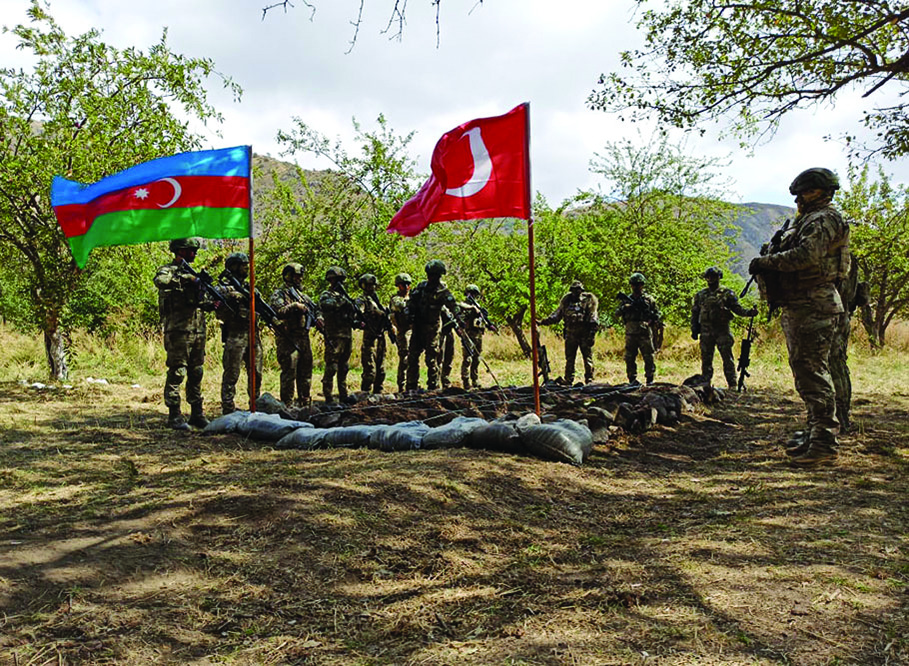
Turkish and Azerbaijani soldiers started joint military exercises in Lachin province, which was recently liberated from Armenian occupation, drawing attention to military cooperation in the Turkic World. THE MINISTRY OF DEFENCE OF THE REPUBLIC OF AZERBAIJAN / AA
The cooperation under the OTS framework towards the integration of Turkic states represents a transition from the Lockeian culture to the Kantian culture within the anarchic structure of the Turkic World sub-regional system. In this situation, it can be inferred that uncertainty and the resulting insecurity are no longer valid in the relationships between Turkic states. This is replaced by the understanding of mutual benefit based on common values to ensure and strengthen security and safety in a shared manner. The statement of Uzbekistan’s President Shavkat Mirziyoyev, “Thanks to the open and constructive policies of the Turkish-speaking states, their political will and regular meetings of heads of state, a mutual atmosphere of trust is being formed and growing in the region,” reveals the security environment provided by OTS among Turkic states in sub-regional systemic terms.29 Similarly, the 6th President of Kyrgyzstan, Sooronbay Jeenbekov, stated that “In a period of long-standing conflicts and sanctions, cooperation in the OTS format can make a significant contribution to strengthening the atmosphere of friendship, trust, and good neighborliness among our countries,” referring to the emerging security community in the Turkic World.30
In practical terms, the OTS adopts two strategies that strengthen the evolving security landscape in the Turkic World. In this regard, the first approach is to release an official declaration on behalf of the Organization or the Secretary-General concerning any circumstance involving member states. This statement would urge the parties involved to seek resolution through mutual agreement, a negotiation process, or other diplomatic methods. The second approach involves convening the Council of Ministers of Foreign Affairs in relevant cases or situations to handle security matters within the organization effectively.31
The security environment between Turkic states through cooperation under the OTS framework may reveal the potential for the emergence of a security community in the Turkic World.32 A security community implies a collective of individuals who believe that societal issues of shared concern can be addressed solely through nonviolent methods without resorting to physical violence.33 This is to say that states within a security community apply peaceful ways of resolving disputes through institutionalized rules and procedures.34 Accordingly, in a security community within the Turkic World, Turkic states will not spend their resources on arming themselves or forming factional alliance relations against each other. Instead, they will cooperate in resolving shared problems and develop a common attitude towards regional and international issues that affect their interests. For example, border disputes, ethnic issues, disagreements over sharing water resources, terrorism, separatism, extremism, and illegal drug trafficking are common security issues shared by the sub-regional system of the Turkic World. Solving these problems in an environment dominated by uncertainty and fear among Turkic states is impossible. On the contrary, in such an environment, these security problems will grow even bigger and may become an intractable problem. Indeed, combating these transnational threats can only be effective in a sincere environment of inter-state cooperation.
Potential Practical Reflections on Thematic Security Issues
The OTS has emerged as a prominent institutional mechanism within the Turkic World, encompassing various domains such as politics, economics, society, and culture. In addition to these areas, Turkic states have progressively enhanced their collaboration and synchronization in the realm of security. Although the primary role of the OTS is not that of a security organization or military bloc, Turkic states have unequivocally expressed their determination to pursue concerted policies concerning security matters of mutual concern. To actualize this stated aspiration, member states of the OTS have resolved to partake in security consultations and develop a unified position on security issues.
In this respect, the OTS summit declarations have consistently highlighted the significance of cooperation and joint efforts in combating terrorism. From the initial declaration to the latest one, there has been a strong emphasis on the need for collaboration. Furthermore, the Turkic states have gone beyond mere consultations and have taken a bold step by introducing a new element into their security cooperation. They have advocated for a more robust collaboration in the defense industry and military domain, which clearly demonstrates their dedication to strengthening their alliance.35 The commitments made by these states in countering terrorism and enhancing military cooperation, within the framework of the OTS, showcase the remarkable potential of the security aspect of integration in the Turkic World.
Terrorism in the Turkic World
The phenomenon of terrorism is one of the fundamental issues that threaten the stability of states and, along with it, international peace and security. In this respect, the Turkic World is not immune to the threats posed by terrorism. On the contrary, Turkic states are forced to confront the issue of international terrorism caused by radical movements that exploit religion. In fact, the Central Asian Turkic states have historical cities like Bukhara, Samarkand, and Tashkent, which are important centers for the Islamic religion. These centers are places where religious harmony prevailed before Soviet rule.36
However, under Soviet rule, policies were pursued to suppress religious beliefs and close religious institutions. In fact, while there were around 25,000-30,000 mosques in the Soviet Union in 1920, this number dropped to around 1,000 by 1941. Only 2,000 of the 47,000 imams survived, and 14,500 religious schools were closed.37 Despite the pressure imposed, the society continued to practice their religious beliefs, albeit in secrecy. After the dissolution of the Soviet Union, the pressure in the religious field decreased, and the society’s inclination towards religious movements increased. As Nursultan Nazarbayev stated, religious beliefs rapidly became politicized in the framework of the ideological vacuum that ensued after the collapse of the Soviet Union.38 In such an environment, divisions rather than unity emerged in the religious belief field, and radical movements that exploited religion for their own benefit took root.39 The exploitation of religion by these movements in the Turkic World has led to a security risk that threatens the stability and security of Turkic states, especially with the presence of safe havens, education, human resources, and logistical support in neighboring Afghanistan. Hizb ut-Tahrir and the Uzbekistan Islamic Movement are prominent terrorist organizations in this regard.
The founding document of OTS, the Nakhchivan Agreement, and the 8th Summit Declaration highlighted the need for consultation and coordination among the Turkic states in the fight against terrorism, extremism, and separatism
Specifically, the OTS has already taken steps regarding developments in Afghanistan. As an example of this, foreign ministers of the OTS member states held an extraordinary meeting on September 27, 2001, in İstanbul to exchange their views on the state of affairs in Afghanistan and the potential consequences it may have on both regional and global levels. The ministers noted their diligent observation of the unfolding events in Afghanistan. In this respect, emphasis was placed on the crucial nature of preventing and combating terrorism in Afghanistan, with the objective of ensuring that no terrorist organization can exploit its territory to endanger or assault any country. The ministers further highlighted the importance of consistently implementing efficient strategies in Afghanistan to counter and suppress terrorist groups like ISIS and al-Qaeda. They stressed the significance of preventing these organizations from spreading their influence to neighboring countries.40
On the other hand, the Fethullah Terrorist Organization (FETÖ), which attempted a bloody coup in Türkiye on July 15, 2016, appears as another religiously exploitative terrorist organization that seeks to infiltrate critical positions and strategic institutions, particularly in Türkiye and other Turkic states, by prioritizing education, business, and media sectors. FETÖ’s most distinctive characteristic is its exploitation of the resources of the countries in which it operates to sustain and expand its organizational activities. FETÖ members usually hide their true identity as members of various ideological groups within society and carry out their activities through secretive schools, associations, foundations, and companies.41
The fight against these terrorist organizations with a transnational character can only be possible through a joint and coordinated effort by the Turkic states. This awareness already exists among the Turkic states. The founding document of OTS, the Nakhchivan Agreement, and the 8th Summit Declaration highlighted the need for consultation and coordination among the Turkic states in the fight against terrorism, extremism, and separatism. As a matter of fact, it is not possible for any country to achieve complete security on its own in the fight against terrorism. An effective counter-terrorism strategy requires timely diplomatic, military, law enforcement, intelligence, and judicial coordination among states. It is essential to constantly operate processes and protocols such as mutual control of shared borders, joint protection of international transportation routes, collection of transnational evidence, extradition of individuals linked to terrorism between states, and fair trials. In addition, efforts to increase the counter-terrorism capacity of some states negatively affected by terrorism, including the provision of military support if necessary, are also on the agenda within international efforts.42
Communication and coordination under the OTS framework against terrorism, will enable Türkiye to share its experience in counter-terrorism with other Turkic states in an institutionalized manner
The OTS, in this regard, has the potential to serve as an important institutional mechanism for ensuring inter-state communication, cooperation, and coordination needed for combating terrorism. In the “Turkic World 2040 – Vision,” the Heads of States within the OTS have decided to instruct their respective state institutions to “Build a network for cooperation and information sharing among the member states to combat the threats of radicalization, violent extremism, … and terrorism.”43 This highlights the importance placed on coordinated efforts to combat terrorism within the OTS framework.
Undoubtedly, the coordination that will be achieved through OTS will yield positive results in the fight against terrorism. In addition, it is possible to say that Türkiye’s experience in combating terrorism will bring significant contributions to other Turkic states. Türkiye has been one of the most effective countries in the world in combating terrorism almost since its establishment. In terms of demonstrating its experience in combating terrorism, Türkiye is currently successfully fighting terrorist organizations with messianic and esoteric elements such as FETÖ, ethnic separatist PKK/PYD, extreme left-leaning DHKP-C and MLKP, and those who exploit religion like ISIS and al-Qaeda. In its fight against terrorism, Türkiye follows a multi-layered and integrated strategy that involves intelligence, law enforcement, military, and social dimensions. Communication and coordination under the OTS framework against terrorism, in this regard, will enable Türkiye to share its experience in counter-terrorism with other Turkic states in an institutionalized manner. Türkiye already conducts training programs and capacity-building activities on counter-terrorism for many countries in the international arena. Therefore, developing a common counter-terrorism strategy with the participation of all Turkic states based on Türkiye’s experience will contribute positively to the security of the Turkic World. Türkiye has already demonstrated its willingness to cooperate against terrorism under the OTS as Turkish President Recep Tayyip Erdoğan called on the OTS member states to act together in tackling terrorism by stating, “We are determined to continue our fight against all forms of terrorism. We must increase our cooperation in this regard.”44
Military Capacity of Turkic States
The collaboration developed under the OTS framework provides another positive security outcome for Turkic states in the military security field. However, it should be noted that OTS is not essentially a military organization. Therefore, it would be incorrect to consider OTS as a military block on its own. The Turkic states that comprise the OTS are already aligned with military organizations with different missions and visions, such as NATO and the CSTO. For example, while Türkiye is a member of NATO, Kazakhstan and Kyrgyzstan are members of the CSTO.
However, due to the geopolitical position of the Turkic World and the presence of failed states such as Syria and Afghanistan on its borders, as well as the potential threat of terrorism, it has become essential for Turkic states to have effective military capabilities both individually and collectively. Indeed, factors such as the size of the armed forces, military technological capabilities, defense budget, and self-sufficiency in the defense industry demonstrate the military capacity of Turkic states. In this context, it is difficult to say that the military capacities of other Turkic states besides Türkiye are sufficient to deter regional and global threats on their own. Türkiye has a significantly larger army size and military expenditure compared to other Turkic states. As of 2021, Türkiye had a total of 890,700 personnel, including 355,200 on active duty, 156,800 gendarmerie, and 378,700 reserves, making it the second-largest army in NATO after the U.S.45 The active, gendarmerie and reserve military personnel of Azerbaijan, Kazakhstan, Kyrgyzstan, Uzbekistan, and Turkmenistan combined is around 597,350.46 Moreover, while Türkiye‘s military spending in 2020 was realized at the level of 17.724 billion dollars, the total military spending of the other five Turkic states in 2020 was 5.647 billion dollars.47
Table 1: Militaries of Turkic World in Numbers
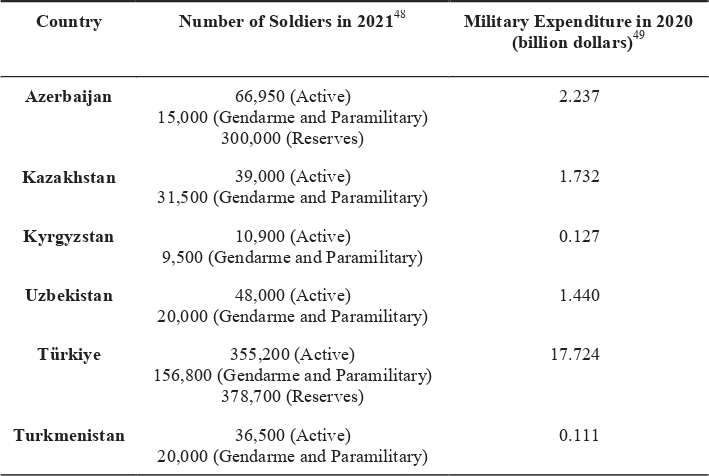
Source: The Military Balance and Military Expenditure
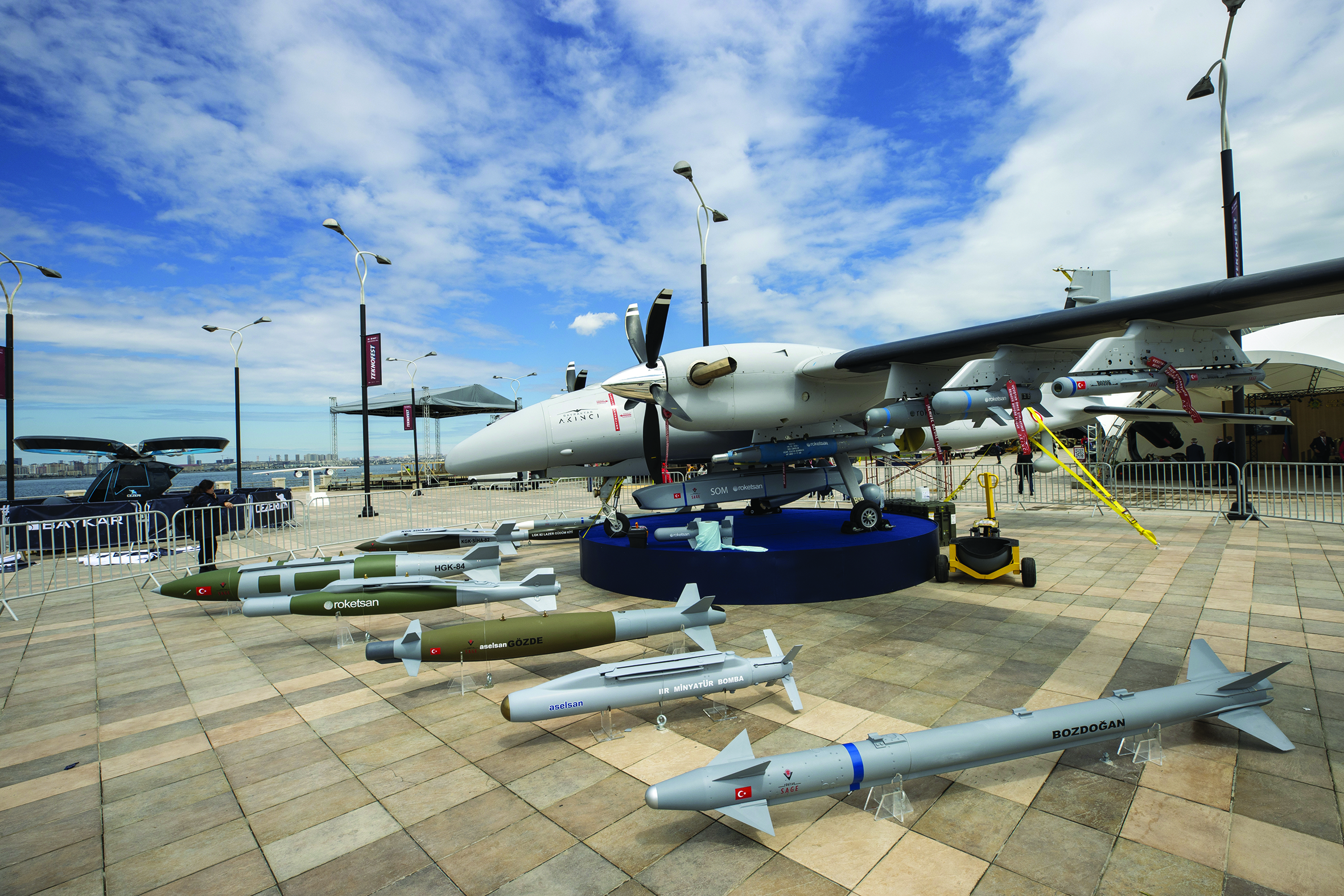
The Turkish Armed Forces is also one of the world’s leading armies in terms of technological capabilities. The level reached by the Turkish defense industry is very influential in this situation. Currently, the Turkish defense industry has reduced the external dependence of the Turkish Armed Forces and has become the source of its striking power. Türkiye is able to produce wheeled and tracked armored and unarmored ground vehicles such as tanks, howitzers, air defense systems, ballistic missiles, other combat vehicles, and personnel carriers, as well as naval platforms, including corvettes, frigates, destroyers, coastal security boats, submarines, and other classes. Türkiye is also capable of producing armed and unarmed unmanned aerial vehicles, helicopters, and training aircraft. In addition, Türkiye is able to meet all types of ammunition it needs domestically, including infantry rifles, anti-tank weapons, electronic warfare, and radar systems. Accordingly, Türkiye’s defense industry sector reached a turnover of $10,159 billion in 2021. $3,224 billion of this amount was generated from exports. As well as the U.S., many countries in Europe, the Middle East, Asia, Africa, and South America, show interest in Türkiye’s defense industry products.50
Under the umbrella of the OTS, Turkic states voluntarily come together based on a shared language and identity, with principles of both sovereign equality and fraternity
Considering Türkiye’s capacity, it is possible to say that it can be an effective actor in building the military competence and capability needed by Turkic states. In this regard, although the OTS is not a military organization, its goal of “strengthening security and stability of the member states in accordance with the generally recognized norms and principles of international law, in particular the respect of and support for the sovereignty, territorial integrity and inviolability of the internationally recognized borders (and) non-interference in internal affairs” will be possible with the strengthening of the military capacities of Turkic states.51 In taking on such a role, Türkiye can help reduce the impact of power asymmetries in military cooperation with superpowers for the Turkic states. In fact, under the umbrella of the OTS, Turkic states voluntarily come together based on a shared language and identity, with principles of both sovereign equality and fraternity. Therefore, their relationship reflects common historical and cultural values rather than a hegemonic character. According to Turkish President Recep Tayyip Erdoğan, “OTS was founded with the political will and determination of its founding members, as a natural result of the historical and cultural fraternity among the Turkic states. The aim of the member states is to contribute to security in Central Asia and the South Caucasus … to preserve our cultural heritage and support the efforts in this regard. OTS takes firm steps from historical fraternity to strategic cooperation and bridges the future with our traditions.”52
The positive outcomes of the longstanding military cooperation based on common language and identity values between Türkiye and Azerbaijan constitute an important example in terms of demonstrating the military potential of the Turkic World integrated under the OTS umbrella. Military cooperation between Türkiye and Azerbaijan, which began in the early 1990s with the slogan “Two States, One Nation,” has expanded, deepened and shown great progress to this day. In this context, after Azerbaijan’s independence, the two countries signed a Military Education Cooperation Agreement on August 11, 1992. As a result, Türkiye started activities such as education, experience sharing, logistics support, and equipment modernization for the capacity development of the Azerbaijani Armed Forces. Military cooperation later reflected in the defense industry as well, and on September 20, 2000, a Defense Industry Cooperation Agreement was signed. With this agreement, a legal framework has been established between Türkiye and Azerbaijan regarding defense industry procurement and sales, as well as joint production. In 2010, the Strategic Partnership and Mutual Assistance Agreement was signed and Türkiye and Azerbaijan agreed to provide mutual assistance to each other in the event of an armed attack or military aggression by a third country or group of countries, using their military capabilities and abilities within the existing opportunities, to take all necessary measures for the implementation of the individual or collective legitimate defense right recognized in Article 51 of the UN Charter. Parallel to the legal framework that has been established in the field of military cooperation, Türkiye and Azerbaijan have organized numerous military exercises to increase their joint operational capabilities. At the same time, the Azerbaijani Armed Forces have started to use Turkish defense industry products intensively and effectively. As a result, military cooperation with Türkiye has significantly strengthened the military capacity, personnel competency, command capability, and equipment quality of the Azerbaijani Armed Forces.
Since the disintegration of the Soviet Union in 1992, the Turkic states have gradually strengthened their collaboration, resulting in the establishment of a comprehensive international organization known as OTS
The most significant outcome of the military cooperation between Türkiye and Azerbaijan has been the success of the Azerbaijani Armed Forces during the 44-Day War between Azerbaijan and Armenia in 2020. During the war, the President of Defense Industries of Türkiye, İsmail Demir, stated Türkiye’s position as “Our defense industry, with all its experience, technology and capabilities, from our armed drones to our ammunition and missiles and our electronic warfare systems, is always at the disposal of Azerbaijan!”53 In the end, Azerbaijan achieved a decisive victory in the 44-Day War that took place in 2020. The main reason for this victory is the determination and resilience of the Azerbaijani people since their independence. Additionally, the capacity development of the Azerbaijani Armed Forces over the years was an important factor. It is worth highlighting Türkiye’s training and material support in this capacity development. Turkish armed and unarmed – unmanned aerial vehicles and long-range rockets were effectively used by the Azerbaijani army, providing them with a clear advantage over the Armenian forces. The Turkish weapons used by Azerbaijan have been frequently mentioned in the international arena.54
The victory of the 44-Day War that resulted from military cooperation between two Turkic states is important for OTS members in terms of demonstrating the possibilities for military cooperation that all Turkic states can achieve by uniting. Azerbaijan’s victory has enabled the opening of the Zangezur Corridor, and the Turkic World has been seamlessly connected to each other geographically. Military cooperation between Turkic states has the potential to further strengthen this connection and make the Turkic World region more secure with equality and unity.
In addition, the Shusha Declaration signed between Türkiye and Azerbaijan on June 15, 2021 constitutes a landmark in the sphere of military collaboration in the Turkic World. With its content, the Declaration not only elevated the relations between the two Turkic states to the level of alliance, but also created a road map for how bilateral relations will progress in the future and a feasible model for the development of cooperation in the Turkic World.55 In this respect, The Shusha Declaration outlines the necessity of prompt and resolute action in the event of a threat or act of aggression against any of the involved parties. Nevertheless, the declaration’s primary focus on collaborative endeavors to safeguard global and regional peace and stability, in alignment with international law and the principles of the United Nations Charter, underscores the defensive and peace-oriented nature of the alliance. Conversely, the regular convening of joint meetings between the Security Councils of both Turkic states on matters pertaining to national security signifies a novel and significant phase in their bilateral relations, even in the absence of an immediate threat.56 If comprehended in this manner, the Shusha Declaration between Türkiye and Azerbaijan has the capacity to act as a collective security blueprint for the entirety of the Turkic World, operating under the auspices of the OTS.
Conclusion
Since the disintegration of the Soviet Union in 1992, the Turkic states have gradually strengthened their collaboration, resulting in the establishment of a comprehensive international organization known as OTS. Under the umbrella of OTS, the cooperation between these states has expanded to encompass political, economic, social, and cultural aspects. Although the primary focus of OTS lies outside the realm of security, recent Summit Declarations have witnessed the integration of security dimensions into the multidimensional cooperation areas. Consequently, there has been noticeable progress in the security-related relations among the Turkic states.
In this respect, the present study examines the security implications of the integration process in the Turkic World, which is being facilitated by the OTS. The study emphasizes the growing security cooperation among the Turkic states and argues that the OTS has the capacity to make significant contributions to the security of these states at both regional and global levels. The study discusses the potential contributions of the OTS in a theoretical framework, focusing on systemic and sub-systemic regional levels. Additionally, the study provides practical insights into the security issues related to countering terrorism and enhancing military capabilities.
Accordingly, the OTS has facilitated increased security cooperation among Turkic states, which has the potential to mitigate the systemic risks faced by the Turkic World. This cooperation will empower Turkic states to act as autonomous and proactive entities against superpowers, rather than being sub-ordinated to their competition. At the regional level, the culture of interstate anarchy will undergo a significant transformation in the Turkic World. This transformation will be driven by the growing security cooperation, which is based on shared identity, language, culture, and geography. Consequently, the factor of uncertainty and the subsequent climate of insecurity will become irrelevant in the interactions among Turkic states. Instead of relying on self-help behavior and the balance of power, the Turkic World will adopt a new approach centered on mutual benefits and common values. The primary objective will be to collectively ensure and strengthen security and safety within the region. With such a view, the security cooperation among Turkic states under the OTS framework has the potential to give rise to a security community in the Turkic World regional system.
The OTS holds immense potential not only in addressing present security challenges but also in cultivating a sense of unity within the Turkic World. This in itself represents a substantial security outcome arising from the ongoing integration among Turkic states under the OTS
Looking at practical outcomes, the communication and coordination to be established between the Turkic states through OTS will have important contributions to the fight against terrorism, especially against ISIS, al-Qaeda, Hizb ut-Tahrir, the Uzbekistan Islamic Movement, FETÖ and other terrorist movements emanating from unstable countries located alongside the Turkic World. In this regard, the OTS would foster the establishment of counter-terrorism training programs, capacity building and common strategy among Turkic states. Finally, despite not being inherently a military entity, Turkic nations have the opportunity to enhance their military prowess through their collaborative efforts in the realm of security. Given the geopolitical positioning of the Turkic World and the presence of unstable nations like Syria and Afghanistan along its borders, coupled with the looming threat of terrorism, it has become imperative for Turkic states to possess effective military capabilities both individually and collectively. The Shusha Declaration between Türkiye and Azerbaijan serves as an exemplary model, outlining a roadmap for the future progression of bilateral relations and presenting a viable framework for fostering military cooperation within the Turkic World under the auspices of the OTS. In this respect, Türkiye’s military and industrial capacity positions it to potentially serve as a catalyst and play a significant role in bolstering the military proficiency and capability needed by Turkic states.
In conclusion, the OTS serves as an international entity that is fundamentally based on the values of a common language, identity, culture, and geography. Consequently, the OTS holds immense potential not only in addressing present security challenges but also in cultivating a sense of unity within the Turkic World. This in itself represents a substantial security outcome arising from the ongoing integration among Turkic states under the OTS.
Endnotes
* This manuscript is derived from the conclusion report, “Turkic World Security Community in the Anarchical International System,” of the project, “Turkic World Vision - 2040,” Integrative Partnership, carried out jointly by the Ahmet Yesevi University and the Council of Elders of the Organization of Turkic States.
1. “İstanbul Declaration of the 8th Summit of the Organization of Turkic States,” Organization of Turkic States, (November 12, 2021), retrieved from https://www.turkicstates.org/assets/pdf/haberler/declaration-of-8th-summit-2395-148.pdf, p. 1.
2. “İstanbul Declaration of the 8th Summit of the Organization of Turkic States,” Organization of Turkic States, p. 3.
3. “Declaration of the First Summit of the Cooperation Council of Turkic Speaking States,” Organization of Turkic States, (October 21, 2011), retrieved from https://turkicstates.org/assets/dokuman/Declaration_ENG.pdf, p. 4.
4. “Samarkand Declaration of the 9th Summit of the Organization of Turkic States,” Organization of Turkic States, (November 11, 2022), retrieved from https://www.turkicstates.org/assets/pdf/haberler/samarkand-declaration-2679-165.pdf, p. 3; “Astana Declaration of the 10th Summit of the Organization of Turkic States,” Organization of Turkic States, (November 3, 2023), retrieved from https://www.turkicstates.org/assets/pdf/haberler/astana-declaration-3113-215.pdf, p. 4.
5. “Statement of the Secretary General of the Turkic Council,” Organization of Turkic States, (September 28, 2020), retrieved from https://turkicstates.org/en/haberler/statement-of-the-secretary-general-of-the-turkic-council_2075?fbclid=IwAR3dBb6RPWxyGKIDTugYl8RbcRhpmpjanumrNx_PQqq39TPkYyx4PgSTjfk.
6. “Statement by the Secretary General of the Organization of Turkic States on the Situation at the Kyrgyz-Tajik State Border,” Organization of Turkic States, (2022), retrieved from https://turkicstates.org/en/haberler/statement-by-the-secretary-general-of-the-organization-of-turkic-states-on-the-situation-at-the-kyrgyz-tajik-state-border_2444.
7. Rudra Sil and Peter J. Katzenstein, “Analytic Eclecticism in the Study of World Politics: Reconfiguring Problems and Mechanisms across Research Traditions,” Perspectives on Politics, Vol. 8, No. 2 (June 2010), pp. 411-431.
8. John J. Mearsheimer, The Tragedy of Great Power Politics, (New York: Norton & Company, 2001), pp. 41, 84, 140-141.
9. Mearsheimer, The Tragedy of Great Power Politics, pp. 41-42, 141.
10. “Statistical Review of World Energy,” British Petroleum, (2021), retrieved from https://www.bp.com/content/dam/bp/business-sites/en/global/corporate/pdfs/energy-economics/statistical-review/bp-stats-review-2021-full-report.pdf; “BP Statistical Review of World Energy,” British Petroleum, (2022), retrieved from https://www.bp.com/content/dam/bp/business-sites/en/global/corporate/pdfs/energy-economics/statistical-review/bp-stats-review-2022-full-report.pdf.
11. Halfold J. Mackinder, Democratic Ideals and Reality: A Study in the Politics of Reconstruction, (New York: Norton & Company, 1919), p. 262.
12. Nicholas J. Spykman, The Geography of the Peace, (New York: Harcourt and Brace, 1942), p. 43.
13. Zbigniew Brzezinski, The Grand Chessboard: American Primacy and Its Geostrategic Imperatives, (New York: Basic Books, 1997), p. 30.
14. “Collective Security Treaty, Article 4,” Collective Security Treaty Organization, (May 15, 1992), retrieved from https://en.odkb-csto.org/documents/documents/dogovor_o_kollektivnoy_bezopasnosti/#loaded.
15. Roy Allison, “Regionalism, Regional Structures and Security Management in Central Asia,” International Affairs, Vol. 80, No. 3 (May 2004), p. 470.
16. “Charter of the Shanghai Cooperation Organization, Article 1,” Shanghai Cooperation Organization, retrieved from https://www.iri.edu.ar/publicaciones_iri/manual/Doc.%20Manual/Listos%20para%20subir/ASIA/SHANGAI-ORG/charter_shanghai_cooperation_organization.pdf.
17. Eda Kuşçu Sönmez, “Çin’in Bölgesel Hegemonya Araçları Olarak Asya Pasifikte Uluslararası Örgütler,” Doğu Asya Araştırmaları Dergisi, Vol. 3, No. 6 (July 2020), pp. 40-41.
18. Andrei Kazantsev, “Russian Policy in Central Asia and the Caspian Sea Region,” Europe-Asia Studies, Vol. 60, No. 6 (2008), p. 1080.
19. John J. Mearsheimer, “The False Promise of International Institutions,” International Security, Vol. 19, No. 3 (1994-1995), p. 13.
20. Burhanettin Duran, “In Astana, a New Step toward Integration,” SETA, (November 2023), retrieved from https://www.setav.org/en/in-astana-a-new-step-toward-integration/.
21. “Statement of the Secretary General of the Turkic Council,” Organization of Turkic States, (September 28, 2020), retrieved from https://turkicstates.org/en/haberler/statement-of-the-secretary-general-of-the-turkic-council_2075.
22. Burhanettin Duran, “New Steps for Integration of Turkic World in Samarkand,” SETA, (November 14, 2022), retrieved from https://www.setav.org/en/new-steps-for-integration-of-turkic-world-in-samarkand/.
23. Kenneth N. Waltz, Theory of International Politics, (MA: Addison-Wesley, 1979), 103-104; Mearsheimer, The Tragedy of Great Power Politics, pp. 30-31.
24. Alexander Wendt, Social Theory of International Politics, (Cambridge: Cambridge University Press, 1999), p. 258.
25. Wendt, Social Theory of International Politics, p. 264.
26. Wendt, Social Theory of International Politics, p. 270.
27. Wendt, Social Theory of International Politics, p. 297.
28. Wendt, Social Theory of International Politics, p. 307.
29. Shavkat Mirziyoyev, “New Opportunities for Integration and Cooperation,” in Ceyhun Şahverdiyev and Cavid Veliyev (eds.), Turkic Council: 10th Anniversary of the Nakchivan Agreement, (Baku: Turkic Council, 2019), pp. 23-24.
30. Sooronbay Jeenbekov, “Deepening Cooperation between Member States of the Cooperation Council of Turkic Speaking Countries,” in Ceyhun Şahverdiyev and Cavid Veliyev (eds.), Turkic Council: 10th Anniversary of the Nakchivan Agreement, (Baku: Turkic Council, 2019), p. 12.
31. Murodjon Mustofaev, “The Organization of Turkic States: A New Approach to Global and Regional Challenges,” Perceptions: Journal of International Affairs, Vol. 27, No. 1 (July 26, 2022), pp. 112-113.
32. For security community potential in Turkic World, see: Erman Akıllı, “Türksoy, Turkic Council and Cultural Diplomacy,” Bilig, No. 91 (October 22, 2019), pp. 16-18.
33. Karl W. Deutsch et al., Political Community and the North Atlantic Area: International Organization in the Light of Historical Experience, (New Jersey: Princeton University Press, 1957), p. 6.
34. Deutsch et al., Political Community and the North Atlantic Area: International Organization in the Light of Historical Experience, p. 5.
35. “Samarkand Declaration of the 9th Summit of the Organization of Turkic States,” Organization of Turkic States, 3; “Astana Declaration of the 10th Summit of the Organization of Turkic States,” Organization of Turkic States, p. 4.
36. Niklas L. P. Swanström, Svante E. Cornell, and Anara Tabyshalieva, “A Strategic Conflict Analysis of Central Asia with a Focus on Kyrgyzstan and Tajikistan,” Central Asia-Caucasus Institute Silk Road Studies Program, (June 2005), p. 11.
37. Arthur Sagadeev, “Rusya ve Büyük Güç İdeolojisi,” Avrasya Dosyası, Vol. 1, No. 1 (1994), p. 30.
38. Nursultan Nazarbayev, Kritik On Yıl, (Ankara: ASAM, 2003), p. 61.
39. Oliver Roy, Yeni Orta Asya ya da Ulusların İmal Edilişi, translated by Mehmet Moralı, (İstanbul: Metis Yayınları, 2000), pp. 216-217.
40. “Statement of the Council of Foreign Ministers of the Cooperation Council of Turkic Speaking States on the Situation in Afghanistan,” Organization of Turkic States, (September 27, 2021), retrieved from https://turkicstates.org/en/haberler/statement-of-the-council-of-foreign-ministers-of-the-coopertion-council-of-turkic-speaking-states-on-the-situation-in-aghanistan_2344.
41. “FETÖ as an International Threat,” Turkish National Police Academy Press, (June 2019), retrieved from https://www.pa.edu.tr/Upload/editor/files/FET%C3%96%20AS%20AN%20INTERNATIONAL%20THREAT.pdf.
42. David Omand, “Countering International Terrorism: The Use of Strategy,” Survival, Vol. 47, No. 4 (2005), p. 110.
43. “Turkic World Vision - 2040,” Organization of Turkic States, (November 12, 2021), retrieved from https://www.turkicstates.org/assets/pdf/haberler/turkic-world-vision-2040-2396-97.pdf, p. 8.
44. “Turkey Urges Turkic Council to Act on Global Issues,” Daily Sabah, (November 12, 2021), retrieved from https://www.dailysabah.com/politics/diplomacy/turkey-urges-turkic-council-to-act-together-on-global-issues.
45. “The Military Balance,” International Institute for Strategic Studies, (2022), p. 155.
46. “The Military Balance,” International Institute for Strategic Studies, 182, 188, 190, 209, 216.
47. “Military Expenditure (current USD),” The World Bank.
48. “The Military Balance.”
49. “Military Expenditure (current USD).”
50. “2021 Performans Raporu,” Savunma ve Havacılık Sanayii İmalatçılar Derneği, (2022), retrieved from https://www.sasad.org.tr/sasad-sektor-performans-raporu-2021.
51. “İstanbul Declaration of the 8th Summit of the Organization of Turkic States,” Organization of Turkic States, p. 1.
52. Recep Tayyip Erdoğan, “Turkic Council: A Future Vision Arising from the Historical Brotherhood,” in Ceyhun Şahverdiyev and Cavid Veliyev (eds.), Turkic Council: 10th Anniversary of the Nakchivan Agreement, (Baku: Turkic Council, 2019), p. 19.
53. “Turkish Defence Industry Says It Can Support Azerbaijan,” Reuters, (July 17, 2020), retrieved from https://www.reuters.com/article/us-azerbaijan-armenia-turkey-defence-idUSKCN24I1JM.
54. “Turkish Arms Sales to Azerbaijan Surged Before Nagorno-Karabakh Fighting,” Reuters, (October 14, 2020), retrieved from https://www.reuters.com/article/us-armenia-azerbaijan-turkey-arms/turkish-arms-sales-to-azerbaijan-surged-before-nagorno-karabakh-fighting-idUSKBN26Z237/?edition-redirect=in.
55. Durdu Mehmet Özdemir ve Gökmen Kantar, “Şuşa Beyannamesi’nin Önemi ve Olası Etkileri,” MANAS Sosyal Araştırmalar Dergisi, Vol. 12, No. 2 (April 2023), pp. 739-740.
56. Ferhat Pirinççi, “Şuşa Beyannamesi’nin Anlamı,” SETA, (June 19, 2021), retrieved from https://www.setav.org/susa-beyannamesinin-anlami/.