
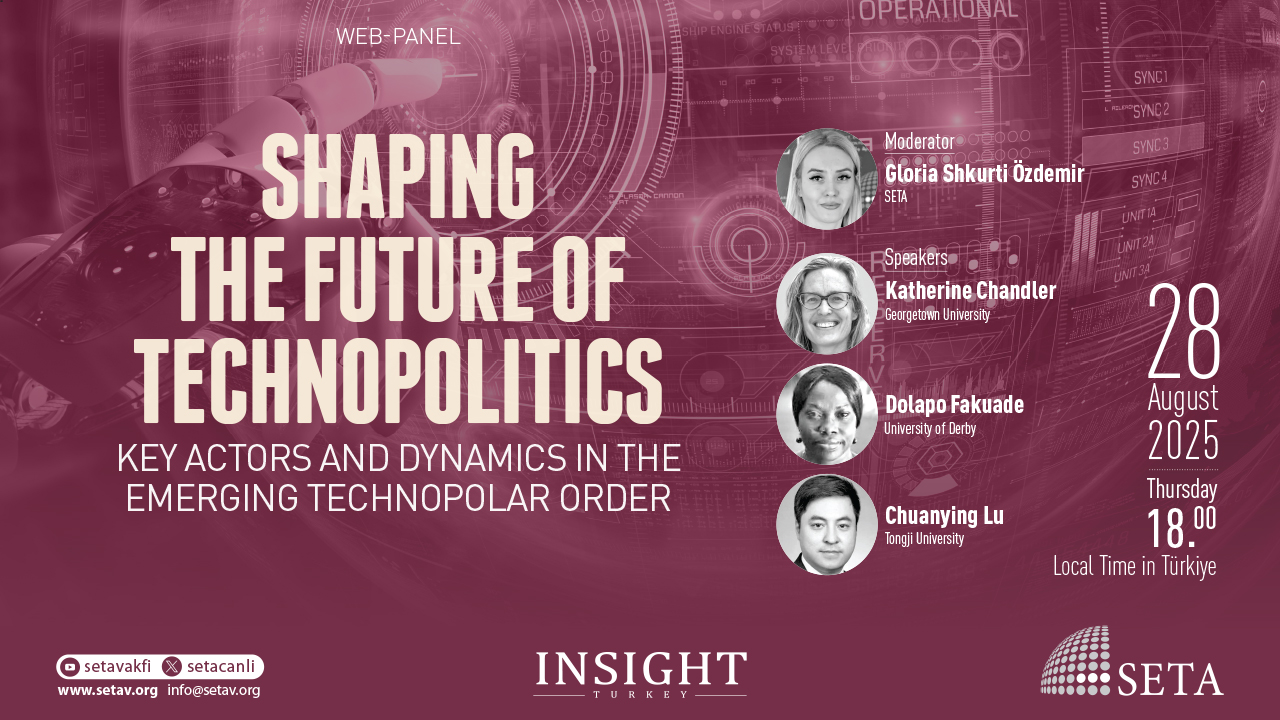
Moderator
Gloria Shkurti Özdemir, SETA
Speakers
Katherine Chandler, Georgetown University
Dolapo Fakuade, University of Derby
Chuanying Lu, Tongji University
Chuanying Lu
Lu started his speech by highlighting the importance of discussing digital geopolitics in the context of China–US competition. Unlike traditional technologies such as nuclear or biochemical weapons, digital technologies like artificial intelligence, algorithms, data, and computing power are virtual, rapidly evolving, and deeply embedded in everyday life. These innovations have created a new digital space where states, companies, and individuals all play a role, generating both opportunities and mistrust. The rivalry between the United States and China is visible in areas such as data security, algorithms exemplified by TikTok, and infrastructure cases like Huawei’s 5G networks. Revelations such as the Snowden disclosures and the Huawei controversy shaped China’s perception of US intentions in cyberspace.
While the US has adopted strategies of containment, sanctions, and export controls, China emphasizes openness and indigenous innovation, though this has been driven largely by necessity. The US continues to prioritize large AI models supported by immense computing power and capital, whereas China develops smaller, open-source models due to chip restrictions and resource constraints. Despite the intensity of the competition, complete decoupling is unrealistic, as governments remain dependent on private companies, global supply chains, open-source communities, and academic exchanges. This interconnectedness ensures that cooperation persists even amid rivalry. Ultimately, digital geopolitics is reshaping the global order, and the challenge for both sides will be finding a balance between competition and collaboration to avoid a new technological cold war.
Kate Chandler
Chandler addresses how AI is made from the data aspects, referring to following questions: What does it mean for a technology to actually be global? What does it mean for AI to actually reproduce intelligence? What kinds of ideas about human and the intelligence are baked into these systems that really ignore lots of other ways of thinking about what intelligence could be and what thinking actually means?
With respect to the data, Chandler views the data as one of the ways that we can see both the tremendous possibilities that are incapsulated by AI but also the ways AI is only one kind of intelligence. At this point, she emphasizes the need for other forms of intelligence. She also sheds light on the continued human aspect of these technologies, as many people are involved in the production of AI across the globe and there have been various interdependent relationships. Furthermore, Chandler underlines how talking about the data is becoming even more complicated. She reveals that the major AI companies in the U.S. are really talking about how they want to control data, how they want to have access to all of the world’s data, how they want to build giant data banks and how control over data is basically controlling the future of AI.
Moreover, she assumes if AI is actually to be intelligent it will require global collaboration and engagement of all kinds of people across the world. She draws attention to the discussion of all of the ways in which there are so many ways the humans are engaging and interacting across the globe that are not captured digitally, online and so obviously can not be captured through AI. Chandler also higlights the importance of thinking about the ways in which the obsession over capturing data and information and trying to control it can ultimately be counterproductive and a failure. Therefore, the knowledge is something that is generated collectively and shared. Indeed, she argues that the idea of universal intelligence can not be controlled by a single nation or group. So, thinking about data in a global context really challenges us to think about the limitations of a kind of technopolar order where we are describing AI.
She moves, then, to the discussion of another aspect of the data which is the question of labor and work. While AI often seems like a magical system that produces outputs based on algorithms, the enormous amount of work that goes into organizing and training data has been ignored by AI. At this point, she states that the data is not just collected and then sent into an algorithm. It has to be prepeared in order for the algorithm to use it and then it has to be tested and evaluated. Eventually, all of that work is currently being done by millions of people. Therefore, we need to more carefully consider all of the ways in which this work and this data is part of how we are developing AI and part of how it is going to play out in a global context and who has a stake in its use and who should be able to talk about how it is used and what kind of limits we should have, what kind of controls we have. Chandler reiterates that these systems are going to be used accross the globe. So, we really need to have a better way of having a global conversation about how we are going to use AI.
By the end of the speech, Chandler reveals her experience with Chat GPT, asking to think about current conflicts in the Western Sahel and where it thought a future attack might occur. Throughout the answers, Chandler discusses that Chat GPT ignored lots of other issues of why these conflicts are happening, including things like climate change, local relationships. Regarding the future attack, she says, it took the Western part of Africa and inserted Cuba onto the map of Africa, relying on the existing data. Stating that it was totally shocking, Chandler argues that it was giving Cold War image. With reference to the data aspect, she reiterated that when you are working from existing data and that is how you are trying to interpret all of the contemporary conflicts, obviously that becomes a lens in which the systems are trying to interpret things.
Dolapo Fakuade
Professor Fakuade discusses the dual impact of AI technologies on intercultural communication. She highlights how AI, including tools like machine learning and translation systems, facilitates communication across cultural barriers, enhancing real-time dialogue, language translation, and cultural preservation. She also acknowledges that AI offers opportunities for inclusivity, with initiatives like UNESCO's funding of digital heritage projects.
However, she warns of the challenges AI presents, including biases in algorithms that can reinforce stereotypes and marginalize non-dominant cultures. AI systems often reflect the values and biases of the cultures that create them, which can lead to unequal representation and the loss of cultural nuance. She also emphasizes the role of technopolitics, where AI development is influenced by global powers, particularly the US and China, which shape AI to prioritize their own values and political norms.
In conclusion, while AI offers opportunities for enhancing intercultural communication, it also raises risks of inequality and cultural exclusion. The challenge is to balance these opportunities with the potential negative consequences of AI.
Insight Turkey hopes that the panel was beneficial and provides a better understanding of this critical issue. You can find the full video of our panel on our YouTube channel: https://www.youtube.com/watch?v=pWD77jnQ5xU.