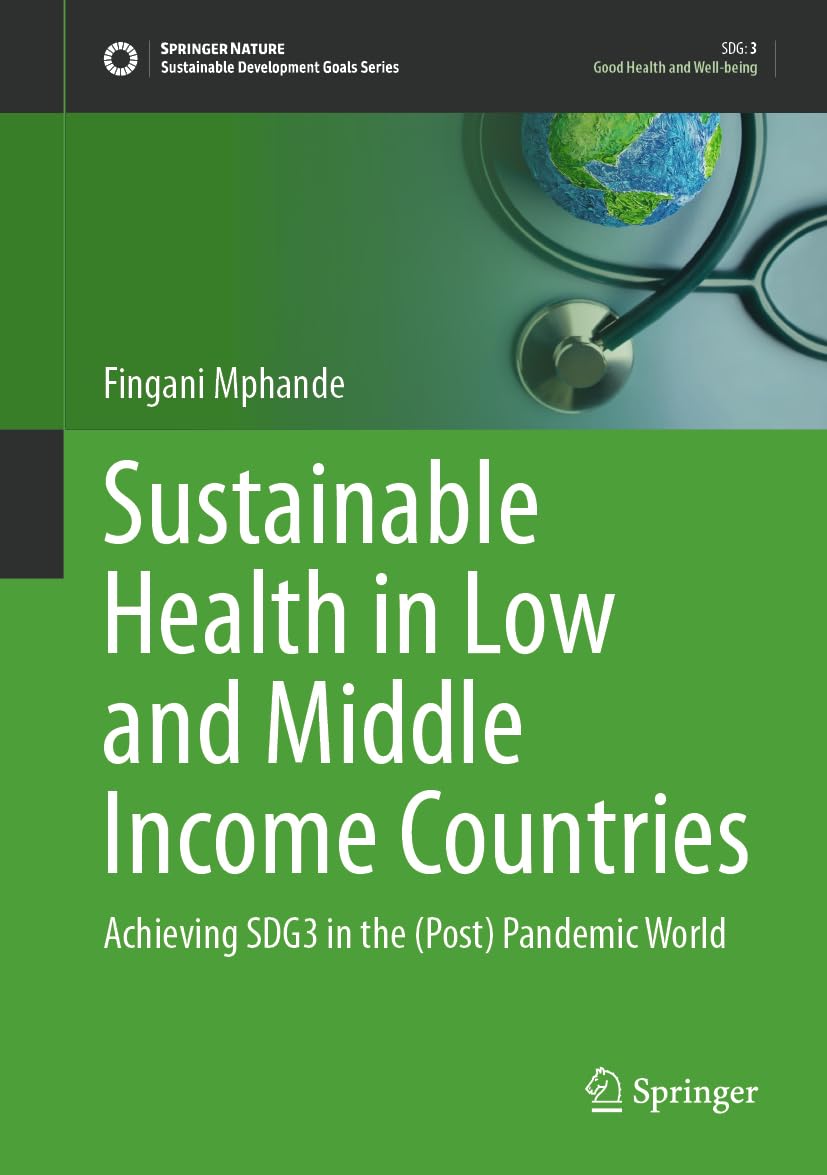
Sustainable Health in Low and Middle Income Countries: Achieving SDG3 in the (Post) Pandemic World by Fingani Annie Mphande was published under the shadow of the COVID-19 pandemic in 2023. The book analyzes low- and middleincome countries (LMICs) with a main focus on Sustainable Development Goals (SDG) 3. The main concerns of the book are how to achieve SDG 3 and what kind of lessons can be drawn from the pandemic. Although the author is a molecular microbiologist the book may be a valuable source for varied professionals from healthcare workers and researchers to policymakers and students. The book consists of 8 chapters. These chapters analyze a great variety of issues such as health literacy (HL) and mental health, all of which are related to different aspects of SDG 3. Despite the variety of issues, all chapters emphasize inequalities between high-income countries (HICs) and LMICs, along with. the emphasis on inequalities within LMICs. However, rather than solely summarizing inequalities, the book goes beyond and draws attention to underlying factors of inequalities in different respects. For instance, by explaining in research and development (R&D), the author analyzes how LMICs are left behind since there is no equitable accesses to innovative health technology, such as tools for vaccine development and/or information. Besides, scholars and researchers from LMICs are often excluded from development opportunities due to the high fees and visa requirements to attend international conferences. Additionally, the book provides valuable case studies, which are a practical means to enrich understanding for the reader.
The first chapter focuses on how to build sustainable health systems (SHS) in LMICs. In this chapter the author investigates how the COVID-19 outbreak affected the SDG goals for fighting against HIV/AIDS, malaria and TB. Chapter 2 investigates ‘No-One Left Behind’ approach which is a holistic approach and critical for sustainable health systems (SHS). This chapter demonstrates political and/or military conflicts, brain drain, knowledge and technology gap as the main underlying challenges to achieve SHS in LMICs. It is argued that sustainable health can be achieved by eliminating: inequalities in healthcare access, neglect of diseases, vaccine inequities, and systematic exclusion of affected and vulnerable from decision-making process.
In chapter 3, the author explains priority diseases and analyzes challenges to the fight against them. Priority diseases are those designated and updated regularly by WHO as having the potential to cause a public health emergency. This chapter demonstrates how controlling priority diseases is key to achieving SDG 3 by 2030. This chapter also underlines that priority diseases are not only health issues, but they have economic and social aspects. Therefore, to deal with these challenges, the author argues that LMICs need programs for their needs, not one-size fits all programs. Chapter 4 evaluates the responses during the Monkeypox and COVID-19 pandemics in the light of SDG 3.3: Fight communicable diseases. By analyzing a variety of examples during the monkeypox outbreak from Nigeria to Latin America, this chapter reinforces the message of the book.
In chapter 5, the author emphasizes a new but vital aspect to achieve SDG 3, limiting the spread of misinformation on social media. Misinformation is divided into two subcategories. On the one hand, there is misinformation which is “false information but not created with intention to cause harm” (p. 81). On the other hand, there is disinformation/malinformation, which means “false information based on reality but created to harm a particular person, social group, institution or country” (p. 82). This chapter evaluates how the spread of misinformation through social media has become a public health issue. The author demonstrates that health literacy (HL) as the key to the fight against health-related misinformation. HL is defined as the ability of people to obtain and interpret health information and apply their knowledge to the information. Chapter 6 “Equitable Health Response:Lessons from COVID-19 and Monkeypox”underscores the fact that emerging and re-emerging diseases increased in the last decade and this burden is mostly carried by LMICs. In this chapter, the author mainly argues that “…the management of a pandemic should be universal and not discriminatory”(p. 98). It is demonstrated how nationalistic and discriminatory policies impeded SDG 3, particularly during the COVID-19 pandemic. Unlike small-pox which was eradicated with joint efforts, during COVID-19, while HICs had access to vaccines and other necessary equipment, LMICs remained behind. Chapter 7 focuses on a different aspect of health. The author analyzes ‘mental health’ and how it is critical to achieve SDG 3. Health is composed of mental, physical, and social aspects. Mental health is mostly neglected; however, it is important particularly for LMICs since the most affected populations by mental health live in LMICs. Despite the long ignorance,“Mental health is among the top 10 leading causes of disease burden worldwide” (p. 110). Therefore, dealing with mental health is another key challenge in achieving SHS and SDG 3. Chapter 8 focuses on the question of ‘What to do for sustainable preparedness and response in LMIC?’. Since it is the final chapter of the book, the author presents some suggestions for future outbreaks in LMICs by drawing lessons from COVID-19 and the monkeypox outbreak. In this chapter, the author underlines the fact that when an outbreak strikes, most LMICs already have various health problems. Because of this, outbreaks, such as COVID-19, usually make the situation worse in most LMICs. Therefore, the author highlights that any plan for preparedness and response must consider the problems already existing within LMICs.
Although the book mainly focuses on SDG 3, it is well captured that public health and sustainable health systems are related to all SDGs. Moreover, the book is seminal since different aspects concerning health, such as health literacy and mental health are included. Besides, the author repeats examples and constantly explains SDGs which helps the readers understanding. The book goes beyond the existing literature on different points. For instance, inequalities between Northern countries and the Global.
South have been studied in-depth with the author giving attention to nuanced difficulties that deepen these inequalities. For instance, the book emphasizes obstacles that researchers from LMICs can and often face, such as visa requirements and application fees. Besides, not only inequalities between HICs and LMICs, but also inequalities within LMICs and the underlying factors of these inequalities have a critical place in the book. The COVID-19 pandemic has accelerated‘health’ studies in social science, thus, more and more researchers from different disciplines have become interested in global health. For those who are already interested in global health, this book may be a valuable source to think through different aspects of global health, such as health literacy. However, the book might seem complicated for beginner-level researchers in global health. In other words, if one has just started to study lobal health and/or pandemics with no background information on how health became ‘global’ may find the book difficult to read. It is taken for granted that the reader is aware of issues such as: how COVID-19 and earlier pandemics/epidemics differentiate, the role of the World Health Organization (WHO) in global health management and how its position has evolved, the TRIPS Agreement (Trade-Related Aspects of Intellectual Property Rights) and Doha Declaration, but most importantly the role of political economy in health issues. To conclude, the book includes a great deal of issues in health to achieve sustainable health systems in LMICs. The author is a scientist with a deep capability to evaluate health issues scientifically, socially, and politically. Thus, the author’s suggestions have great potential for policymakers, health researchers, and civil society workers.