
Introduction
Thirteen years have passed since mass protests broke out against the Syrian regime in March 2011. The regime responded with ferocious violence and plunging the country into an armed conflict it subsequently dragged in multiple foreign powers. Iran intervened in 2012, which gave Israel justification to launch a campaign of air strikes the following year that has continued for more than a decade. Russia entered the conflict in 2015 to prevent the armed opposition from bringing about the collapse of the regime. The persistence of the conflict and the failure to reach a political solution gave rise to several terrorist organizations, most prominently ISIS, which prompted the U.S. to intervene in Syria in 2014, on the grounds of combating terrorism. However, American cooperation with the Syrian branch of the terrorist organization Kurdistan Workers’ Party (PKK) compelled Türkiye to send in forces in 2016 to prevent the emergence of a separatist entity on its Southern border that could threaten its own national security.
International efforts to find a political solution began early on in the war. The Arab League was the first body to attempt to mediate, starting from late 2012, but these efforts faltered due to the refusal of the regime, emboldened by the political support of Russia and China, to make a single concession, despite being on the back foot militarily. New international efforts were launched in 2015 to find a solution to the conflict, as the U.S. and Russia reached agreement over the formulation of United Nations (UN) Security Council Resolution 2254, which became the basis for negotiations between the regime and the opposition. In 2017, the UN placed the content of the resolution under the headings of establishing non-sectarian rule, developing a new draft constitution, conducting free and fair elections and combating terrorism, along with confidence-building measures.
The process of Arab normalization with the regime picked up momentum in 2023, and Riyadh’s restoration of its ties with Damascus that April marked a major shift
Despite numerous international efforts and regional initiatives over the past decade, the quest for a political solution to the Syrian conflict remains elusive, primarily due to the entangled interests of foreign powers, regional dynamics, and the Assad regime’s persistent intransigence. In this commentary, Syria’s political and diplomatic situation, challenges, and developments from 2012 to early 2024 will be evaluated in detail.
Early International Mediation Efforts (2012-2015)
In 2019, the UN launched a new effort to push the political process forward by launching a constitutional reform process in an attempt to implement one aspect of Resolution 2254, leaning on the guarantors of the Astana process –Türkiye, Russia and Iran– to push the parties to the conflict to engage in discussions on constitutional reform.
As efforts to find a political solution continued to falter, the regime and its allies attempted to break the international isolation that had plagued Damascus since 2011. From late 2018 onwards, it sought to normalize its ties with other Arab states as well as engaging in a separate track of rapprochement with Türkiye that started in late 2022. The COVID-19 pandemic in 2020, followed by the Ukraine war in 2022 and a catastrophic earthquake in Northern Syria and parts of Türkiye in 2023 bred new conditions that the regime and its allies used to further impede efforts for a political solution, push forward the normalization of its regional relations and seize back control over humanitarian aid deliveries across the border, which it had lost in 2014.
Western and Arab Divergence on Normalization Policies
The process of Arab normalization with the regime picked up momentum in 2023, and Riyadh’s restoration of its ties with Damascus that April marked a major shift. In May, Arab foreign ministers met in Jordan and issued the Amman Declaration, laying out a roadmap for more Arab states to normalize with Damascus. The same month, the Arab League voted to restore the regime’s membership, and accordingly Bashar al-Assad attended the Jeddah Summit on May 19.
The Arab League created a committee composed of the foreign ministers of Jordan, Saudi Arabia, Iraq, Lebanon, Egypt, and the Secretary-General of the League, tasking it with monitoring implementation of the road map. This committee duly met in Cairo in mid-August, but its findings were disappointing to Arab governments, as the regime had not implemented any of Amman Declaration’s provisions on security issues such as combating terrorism and drug smuggling, humanitarian issues such as facilitating aid deliveries and the return of refugees, or political questions such as engaging in the Syrian Constitutional Committee discussions.
Western countries’ interest in Syria has steadily declined, due to economic woes and the presence of conflicts with greater priority, particularly in Ukraine and Palestine
Addressing these issues poses major difficulties and challenges for Arab states, partly due to disagreements among them over the appropriate mechanisms of engagement with the regime, and partly due to Western policies, as well as the regime’s response.
Arab governments have also continued to differ over their priorities. Jordan, Egypt, and others saw the so-called “step-for-step paradigm” of seeking reciprocal and verifiable confidence-building measures, along with Resolution 2254, as the mechanism best placed to achieve real progress and preserve the Arab states’ leading role in efforts for a political solution, as indicated in the Amman Declaration and the Jordanian initiative. However, Saudi Arabia and the United Arab Emirates seemed to view this mechanism with less interest.1
Moreover, Jordan began to act unilaterally to address security issues along its border, taking militarily action against drug and weapons smuggling for the first time since the outbreak of the conflict, by launching air strikes and airborne operations into Southern Syria.2
Western governments were initially indifferent to this process of Arab normalization, but they soon took a more cohesive position. The U.S. rejected it and stressed that Washington did not support other countries normalizing with Damascus until real political progress had been achieved, facilitated by the UN and consistent with Resolution 2254, arguing that this remained the only viable solution to resolve the conflict. Washington doubled down on its position by introducing legislation against the Captagon trade and normalization with the Assad regime, major obstacles to countries seeking to normalize with the regime.
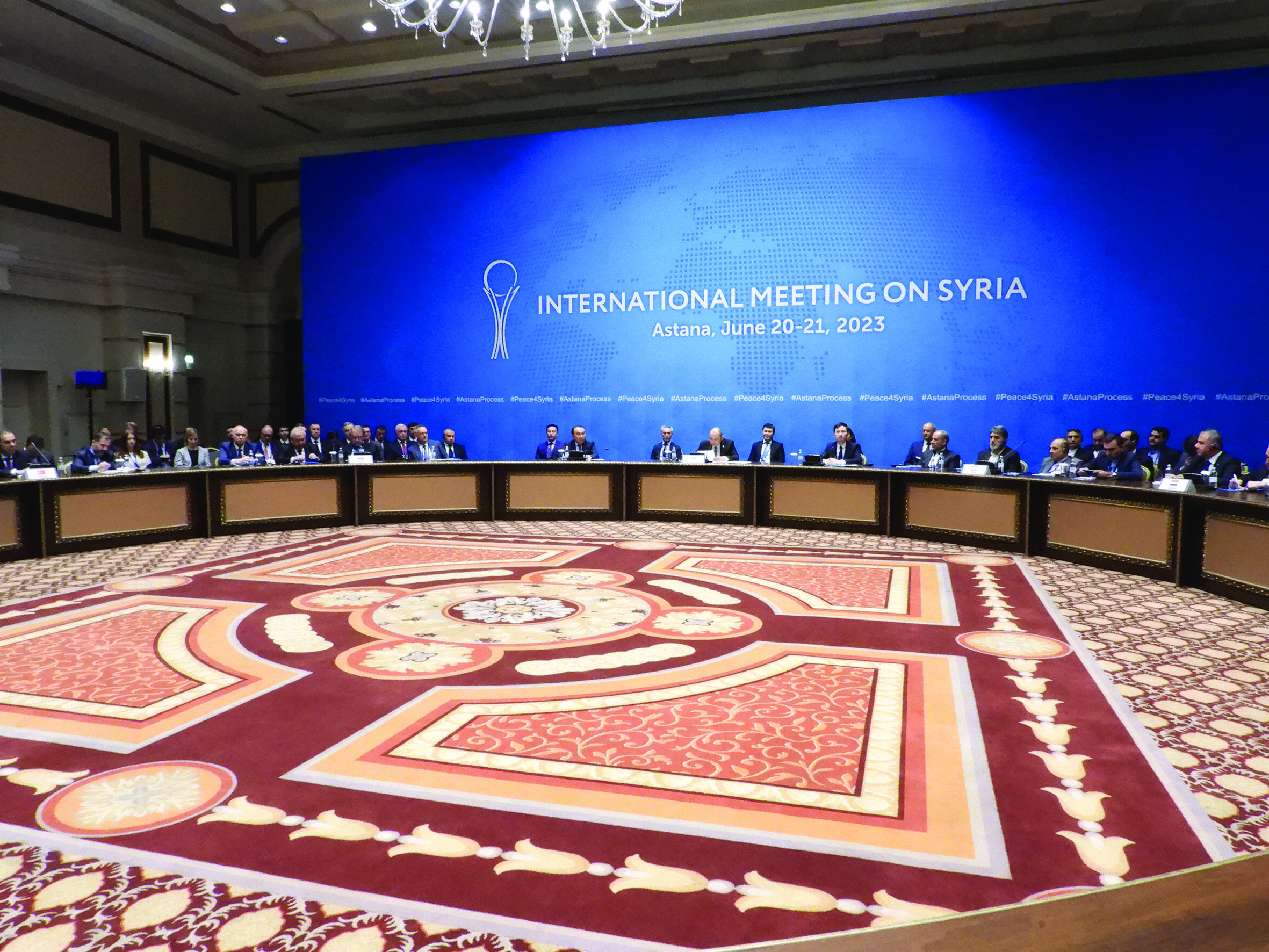
The role of the Astana track has declined since 2022, as evidenced by the faltering of the Constitutional Committee talks and renewed clashes in Northern Syria in 2023
European states quickly adopted the same position. In mid-March 2023, the United Kingdom, France, and Germany issued a joint statement along with the U.S., emphasizing the “Three No’s”: no normalization of relations with the regime, no financing for reconstruction of infrastructure damaged by the regime during the conflict, and no lifting of sanctions against it, pending genuine and durable progress towards a political solution, in accordance with Resolution 2254.
While Arab normalization with Damascus has made scant progress, Türkiye’s rapprochement with the regime has come to a complete standstill. It had started with a December 2022 tripartite meeting in Moscow between the defense ministers and intelligence chiefs of Türkiye, Russia, and the regime, whose foreign ministers −plus that of Iran− also met in Moscow in May 2023.
However, the process has not yielded any progress worth noting. Ankara and Damascus have not resumed full diplomatic relations, their presidents have not met, nor has a road map been drafted to address differences between the two sides. This is despite Russia tabling a draft road map in 2023 that focused on combating terrorism, bolstering border security between the two countries, condemning the deployment of foreign forces in Syria, facilitating the return of refugees and resuming bilateral trade and economic cooperation.
While the regime has been responsible for obstructing a solution since 2012, the presence of forces from its allies Russia and Iran on the ground makes finding a solution far more complex
By early 2024, Turkish officials were downbeat about the process. In January, Foreign Minister Hakan Fidan announced that communications with the regime had been suspended and that there were no meetings on the horizon, adding that Ankara’s priority was to fight the PKK and its branch in Syria the Syrian Democratic Forces (SDF).
Arab normalization and Ankara’s rapprochement with the regime have negatively affected UN-sponsored negotiations, deepening the regime’s unwillingness to return and engage in them with any seriousness. However, the Arab League’s May 2023 resolution called for “a comprehensive solution to the Syrian crisis that addresses all its consequences according to the step-for-step framework, and in a manner consistent with Security Council Resolution No. 2254.”3 Likewise, Turkish policy has continued to adhere to the Astana and Geneva tracks, while adhering to Resolution 2254 as the basic foundation for a political solution in Syria.
This was the result of the regime’s failure to address the security and humanitarian issues preoccupying Arab capitals and Ankara, moves that could create a safer and more stable environment to allow the voluntary and dignified return of refugees, mitigating the effects of the refugee crisis on neighboring countries.
The regime had been hoping that normalization would spark an influx of Arab funds to support its collapsed economy and allow it to begin the reconstruction process. However, in reality its lack of responsiveness on security and humanitarian issues, plus the threat of U.S. sanctions, prevented these Arab funds from materializing. This plunged the country into a deeper economic crisis, fueling protests in the Southern province of Suwayda in August 2023 and growing public discontent in the regime’s heartland on the Syrian coast.
Nor did normalization meet the regime’s hopes for an end to its international isolation. President Bashar al-Assad has had few chances to visit foreign capitals and meet world leaders, with the exceptions of the Arab Summit in Jeddah, the September 2023 opening ceremony of the Asian Games in China, and the Arab-Islamic Summit in Riyadh in November, where most leaders of Muslim countries avoided meeting him, treating him as an unwelcome guest or acting as if he did not exist.
This suggested that truly breaking the regime’s international isolation remains contingent on it seriously engaging in the Arab initiative, in line with the U.S. and Western demands for curbs on Iran’s influence, the withdrawal of foreign forces, efforts to combat drug manufacture and trafficking, moves to repatriate Syrian refugees, and serious engagement in the UN-sponsored political process under Resolution 2254 −most notably by resuming the work of the Constitutional Committee and the step-for-step approach championed by the world body’s Special Envoy, Geir Pedersen.
Meanwhile, the regime has pushed back against UN efforts to negotiate constitutional reforms in Syria, obstructing the holding of the ninth meeting of the Constitutional Committee since June 2022. It has leaned on Russia’s claim that Geneva is not a neutral venue, as well as on Russian conditions regarding sending diplomats to the Swiss city, in light of European sanctions related to Russia’s war on Ukraine.
Any effective solution in Syria must be supported by a single international framework, such as the one that Special Envoy Pedersen called for in 2019, and something resembling the International Support Group for Syria
In an attempt to break this stalemate, the Arab Ministerial Liaison Committee in mid-August 2023 suggested that the meeting be convened in the Omani capital, Muscat. However, all subsequent efforts to hold it there −or anywhere else− have so far failed. In his last briefing of 2023, the Special Envoy confirmed that there was no suitable venue in the region for the committee’s meetings. Accordingly, he proposed holding the talks in the Kenyan capital Nairobi, where the UN has another headquarters. However, the regime also rejected that and suggested Baghdad, which the opposition duly rejected. This prompted the envoy in late February 2024 to push once again for the meeting to be held in Geneva, which the regime again rejected.
As the Constitutional Committee discussions faltered, the Special Envoy resorted to formulating a proposal that he tabled at the Security Council in October 2023, regarding the step-for-step paradigm that he had announced at the beginning of his mission in 2019. He argued that his plan to implement Resolution 2254 required such an approach, alongside the creation of an international forum or framework that could facilitate understandings outside the scope of the Security Council, thus enabling an agreement on a formula for a political solution in Syria.
Pedersen said he had obtained European, American, and Arab backing for this approach, which he appeared to hope would help build confidence both between the parties to the conflict, and between the regime and the international community. International concerns would be addressed separately from domestic Syrian issues such as ceasefire, stabilization measures, the release of detainees, disclosure of the fate of the missing and the return of refugees and displaced persons, humanitarian aid deliveries, and Early Recovery (ER). In the meantime, the political process would continue, in accordance with Resolution 2254.
However, five years into his mission, Pedersen has not been able to build the unified international framework he has called for, something akin to the International Support Group for Syria that led to the Vienna II statement in 2015 and paved the way for the formation of the Syrian Negotiation Commission and the adoption of Resolution 2254. As things stand, diplomatic efforts on Syria are continuing to fragment. Current tracks include the Astana process, formed in late 2016 and led by Türkiye, Iran, and Russia, an Arab framework that has been crystallizing since the beginning of 2023 around countries that have normalized with the Assad regime, and a Western framework that includes the U.S., Britain, France, and Germany.
The Impact of Global Events on Syrian Peace Efforts
In addition to this fragmentation, these processes have had mixed results in terms of international engagement. Arab countries have been slow to find their role within UN efforts to resolve the conflict. Western countries’ interest in Syria has steadily declined, due to economic woes and the presence of conflicts with greater priority, particularly in Ukraine and Palestine. The guarantor countries of the Astana process only managed to freeze combat operations in the country and support the launch of the constitutional reform track, which had appeared moribund by the close of its 20th round but was jolted back into life for another round in late January 2024 given fears over the impact of the Gaza war on the situation in Syria. A joint statement after the meeting underlined the importance of preventing the conflict from spreading and dragging in other states in the region, as well as the need to preserve calm on the ground in the Idlib de-escalation zone and to move towards a more sustainable normalization of the situation in Northwestern Syria.
The role of the Astana track has declined since 2022, as evidenced by the faltering of the Constitutional Committee talks and renewed clashes in Northern Syria in 2023. That said, the guarantors of the process continue to play a pivotal role in preserving overall calm in the country, as well as helping to prevent the collapse of the political process and supporting UN efforts to keep it moving forward.
The U.S. also remains central to the trajectory of the ongoing conflict in Syria. Washington wants to keep alive the Geneva track for a political solution in accordance with Resolution 2254, support the resumption of the Constitutional Committee talks, and implement the step-for-step paradigm. However, escalating tensions between the West and Russia following Moscow’s invasion of Ukraine in 2022 have meant that any understanding that could lead to a political solution in Syria is effectively impossible until a final deal is reached over Ukraine. Russia has also continued to obstruct the implementation of Resolution 2254 and disrupt the meetings of the Constitutional Committee, refusing to work within the step-by-step approach and continuing to block any solution in Syria by re-imposing “reconciliation” and settlement deals between the regime and local actors, such as those in Daraa, rural Damascus and rural Homs.4
The failure of the U.S. and Türkiye to reach an agreement on outstanding disputes between them, including over Syria, has also impeded and delayed the process of reaching a political solution to the conflict. This is despite the fact that both parties want to see their relationship improve, even setting up a formal “Strategic Mechanism” in October 2021 to facilitate dialogue. Their ability to cooperate over a political solution will depend on the flexibility of each side, especially with regard to the political process, combating terrorism, and the fate of the PKK, along with its Syrian branch (the Democratic Union Party) and the bodies they control, notably the SDF and the Autonomous Administration in Eastern Syria.5
The U.S. may anyway be forced to reduce its cooperation with the SDF and the PKK, due to the latter’s cooperation with Iranian militias, especially in al-Hasaka province. Moreover, Iran has long wanted to remove American forces from there and from the whole of Syria, and a years-long campaign of attacks by Iranian-backed militias on international coalition bases and interests has increased in intensity since 2023.6
Stabilizing Northern and Eastern Syria would not only help Washington strengthen its cooperation with Ankara over Syria’s political future, but would also ensure the sustainability of any solution in which the two sides work with regional and local partners, especially Arab leaders and notables, in combating terrorism, so that individuals from those communities are not lured into helping Iran. It would also help ensure that oil revenues are used to develop basic services instead of allowing the PKK to control them.7
Syria’s political future is also closely linked to the fate of foreign forces present in the country. While the regime has been responsible for obstructing a solution since 2012, the presence of forces from its allies Russia and Iran on the ground makes finding a solution far more complex. It is no longer possible to formulate any solution without addressing the security concerns and various interests of foreign forces in Syria. Türkiye, for example, views the SDF and the PKK as a major terrorist threat it has no option but to neutralize, whether on its own or in partnership with the U.S. −or with Russia, Iran, and the regime. Also central to Türkiye’s Syria policy is the question of providing security and safe haven to enable the repatriation of Syrian refugees to their country, including more than three million living in Türkiye.8
Likewise, Iran will seek to preserve its assets in Syria in any future political solution, in order to maintain its influence there, as it has done in Iraq and Lebanon. Accordingly, it will work to disrupt any proposal that does not guarantee this, whether through its militias or its influence within the regime’s agencies and institutions. This could push Türkiye, the U.S., and Israel either to cooperate with Russia to reduce this influence, directly or through local actors, or to continue negotiating with Iran to reach a more durable formula.
Russia, in turn, has been seeking to shape Syria’s political future since intervening there militarily in 2015, based on a formula of restoring the regime’s full sovereignty and reforming its institutions, especially the military and security sector, and keeping Bashar al-Assad in power with a nominal role for the opposition. These questions have long been among the main points of disagreement between international actors. Moscow and Tehran largely agree on them, aside from differences over reforms and engaging the opposition.9
Both disagree with the vision of Ankara, which insists that the opposition must play an active role, with armed opposition factions integrated into the country’s military apparatus and the political opposition involved in governing the country, through elections.10 This vision is backed by the U.S., which nevertheless differs with Türkiye over the PKK and governance in Eastern Syria.
From the start of its intervention in Syria, Russia tried to reach an agreement with the U.S. that would help determine Syria’s political future, through the Vienna discussions that formed the basis of Resolution 2254, but as relations worsened between Washington and Moscow in late 2016, this soon affected their cooperation in Syria, which gradually deteriorated until late 2018. In the meantime, however, Russia moved to strengthen its cooperation with Türkiye and Iran, together designing the Astana formula. It has also strengthened its cooperation with Arab countries since the end of 2017, with the aim of breaking the regime’s regional isolation bringing the Arab League back into the process of finding a solution, a strategy that has borne some fruit since early 2023.
Cooperation with Washington remained a major goal for Moscow as it sought to find a final resolution to the conflict in Syria. It tried to resume cooperation with it at a 2019 summit in Jerusalem between the two countries’ national security advisors as well as that of Israel, but their differences persisted due to the absence of any guarantees for the withdrawal of Iranian forces, especially from the South of the country, as well as over the implementation of Resolution 2254 without delay or obstruction. Russia argued that it was unable to implement its pledges on its own regarding Iran, and does want to cooperate with Washington on the issue. This is because it does not want Iran to move towards the West at the expense of its own relationship with Tehran, especially in light of ongoing discussions on reviving the agreement over Iran’s nuclear program.11
Conclusion
All of the above means that local actors in Syria have, theoretically, declined in influence vis-à-vis international actors. In practice however, they are still an essential part of the solution, even if they lean on their international allies to strengthen their own positions and policies. That said, this dynamic means that the country’s future will ultimately depend on whether international powers can reach a consensus, fall into conflict or draw up new rules of engagement that lead to temporary or sustainable understandings.
Therefore, any effective solution in Syria must be supported by a single international framework, such as the one that Special Envoy Pedersen called for in 2019, and something resembling the International Support Group for Syria. In March 2024, Pedersen again laid out his vision of the formula needed for a solution in Syria, calling for preparatory talks until a point is reached when “all the main actors are ready to work together (for) a comprehensive settlement across a full set of interconnected tracks, with the contribution of the parties.”12 He continued that the formula “would need to fully engage all critical stakeholders including the Syrian parties and the international actors in the Astana format, the Arab Contact Group, the Western Quad, and (the Security) Council.” Recent years of diplomacy have made clear that “no party or group of actors alone can come close to resolving the Syrian crisis,” he said.
In the short and medium term, however, there seems to be little room for international and regional parties to work on one formula alone or through interconnected tracks. This means that the fragile stability on the ground in Syria since 2020 is likely to persist, as is uncertainty over any political solution and the progress of negotiations. Foreign powers will remain focused on achieving their own goals unilaterally, without necessarily considering the importance of seriously cooperating with others.
Reaching such a formula in Syria will remain contingent on a package of other regional and international settlements, and there is little immediate sign of that happening. In the absence of such a shift, the country is therefore set to remain divided among three local powers, and forces from four foreign powers will remain on the ground. Russia and Iran will continue to strengthen the regime’s domestic influence at the expense of the opposition, by pushing forward regional and international normalization with the regime, as well as coordinating to remove American forces from Eastern Syria. For its part, Türkiye will move forward with both unilateral and coordinated efforts with others to combat what it sees as terrorism and to prevent the establishment of a Kurdish canton on its Southern border, while making further efforts to establish a safe zone that can shelter more refugees. Israel, meanwhile, will continue to carry out strikes against Iranian militias and their interests in Syria, in coordination with the U.S.
Endnotes
1. Abdulwahhab Assi, “Arab Policies towards The Syrian Regime: Drivers and Outcomes,” Al Jazeera Centre for Studies, (June 9, 2023), retrieved from https://studies.aljazeera.net/ar/article/5664.
2. Ayman Abu Nuqta, “Jordan’s Role in Southern Syria, between Reality and the Future,” Jusoor for Studies, (February 13, 2024), retrieved from https://jusoor.co/ar/short-link/2406.
3. “Resolution No. 2254,” United Nation Security Council, (December 18, 2015).
4. Abdulwahhab Assi, “Reconciliation Deals and Mediators in Syria,” Jusoor for Studies, (October 28, 2021), retrieved from https://jusoor.co/ar/short-link/1564.
5. Ömer Önhon, “Warming US-Turkey Relations Bring New Hope to Syria,” Al Majalla, (March 6, 2024), retrieved from https://en.majalla.com/node/312251/politics/warming-us-turkey-relations-bring-new-hope-syria.
6. Anas Shawakh and Obada Alabdallah, “Iranian Militia Attacks on American Bases in Syria since the Gaza War,” Jusoor for Studies, (November 11, 2023), retrieved from https://jusoor.co/ar/short-link/2324.
7. Rena Netjes and Samer al-Ahmad, “Iran Is Attempting to Push the United States out of Syria via Hasaka Province,” The Washington Institute for Near East Policy, (March 8, 2024), retrieved from https://www.washingtoninstitute.org/policy-analysis/iran-attempting-push-united-states-out-syria-hasaka-province.
8. Murat Yeşiltaş and Ömer Özkızılcık, “Turkish Policies in Syria and their Prospects from a Turkish Perspective,” Al Jazeera Centre for Studies, (March 12, 2019), retrieved from https://studies.aljazeera.net/ar/reports/2019/03/190312095058935.html.
9. Abdulwahhab Assi, “The Vigilant Partnership between Russia and Iran in the Case of Syria,” Jusoor for Studies, (October 7, 2022), retrieved from https://jusoor.co/ar/short-link/e1803d8028b74b0eabc5f262a9ff51d0.
10. Kemal İnat, “Türkiye and Russia’s Perspectives on the Syrian File: Similarities and Differences,” Anadolu Agency, (November 11, 2019), retrieved from https://www.aa.com.tr/ar/1389042/.
11. Anna Borshchevskaya, “What to Expect from the U.S.-Russia Meeting in Jerusalem,” The Washington Institute for Near East Policy, (June 12, 2019), retrieved from https://www.washingtoninstitute.org/policy-analysis/what-expect-us-russia-meeting-jerusalem.
12. “Resolution No. 2254,” United Nation Security Council.