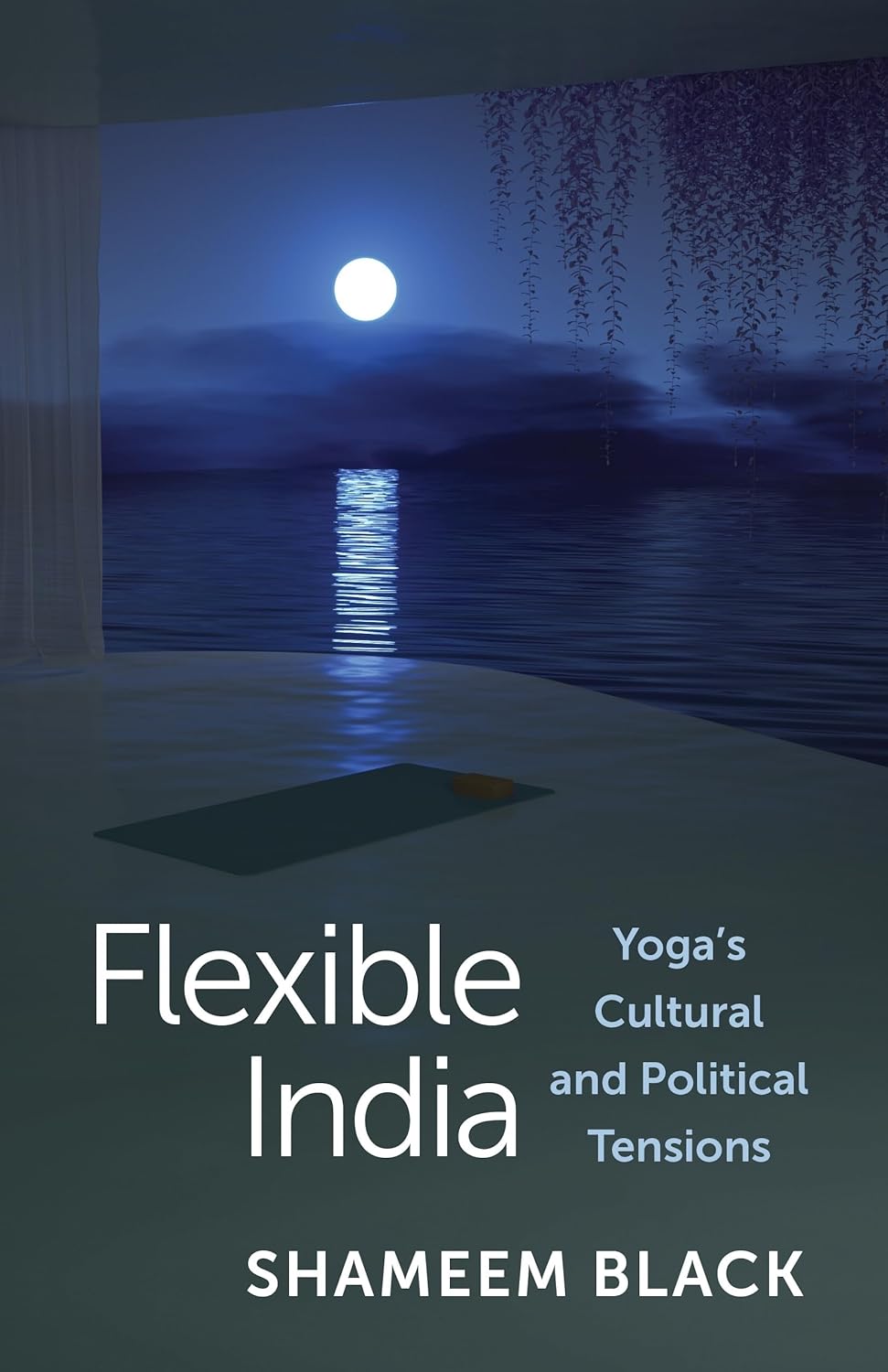
The Flexible India: Yoga’s Cultural and Political Tensions by Shameem Black takes its readers beyond popular explanations of yoga’s functions as a physical and spiritual improvement activity. Shameem Black is a Researcher at the Australian National University and works as the Head of Gender, Media and Cultural Studies Program in the School of Culture History and Language. Her research focuses on India and the Indian diaspora. The book prompts readers to consider yoga’s impact on the formation of identity and nationality, as well as its potential as a tool for soft power. The book attempts to blend media studies, political theories, and cultural analysis to give an insight into understanding the place of yoga in contemporary Indian life and the lives of those interested in it all over the world.
The chapter titles are based on yoga poses, reflecting different aspects of yoga’s role in society. It begins with a chapter titled “Setting Up: Yoga’s Flexible Forms”, where the author explores yoga’s deeper meanings through svādhyāya, originally meaning “studying texts in isolation” (p. 7). Over time, this evolved into self-study and critical evaluation, applicable to movies, books, and art. This broader interpretation helps reveal hidden societal injustices and examines yoga’s political and commercial uses, reshaping the Indian identity. The second chapter, “Conducting Mass Practice: India’s Vision for Yoga,” delves into India’s state involvement in yoga, particularly under Modi’s rule, where the first-ever yoga ministry promotes it as part of national identity aligned with Hindutva ideology, leading to cultural tensions and the exclusion of non-Hindu communities. The third chapter, “Aligning Both Hands: Yoga in Indian Fiction,” discusses two perspectives in Indian literature: one sees yoga as a national gift, while the other highlights its role in nationalism and ideological struggles. Fiction becomes a battleground where yoga is both a unifying symbol and a site of cultural contradictions.
The fourth chapter, “Assuming Corpse Pose: Yoga in U.S. Popular Culture,” explores yoga’s Americanization, commercialization, and its contradictions. While yoga is embraced as a healing force, South Asians, especially post-9/11, face discrimination and exclusion. The chapter also examines U.S. geopolitical interests and the soft power of Hindutva. The fifth chapter, “Bending over Backward: Yoga’s Precarious Work,” critiques the economic contradictions of yoga, exposing the exploitation of underpaid and feminized yoga instructors in a capitalist-driven industry. The sixth chapter, “Framing New Parts: Yoga Through Diasporic Critique,” focuses on shifts to Indian diaspora art and literature, showing how yoga is used as a form of resistance against racial and economic injustices. The final chapter, “Lying Out: Spectral Yoga,” critiques yoga’s transformation into a marketable spectacle. While traditionally offering control and spiritual growth, modern yoga is manipulated by wellness industries and governments for profit, disconnecting it from its cultural roots. Throughout the book, the author highlights yoga’s contradictions in the modern world, where economic and ideological interests overshadow its original teachings.
In its own way, the book explores how yoga is used to imagine India in times of cultural and political rise and questions the work under five major questions, the first being what constitutes India and Indianness in turning points in history. According to the author, India’s identity is complex and characterized by contradictions, and it is balanced by both exclusions and inclusions. The global practice of yoga contributes to the issue’s complexity, making defining its Indianness more challenging. While political and cultural narratives are very effective in shaping Indian identity, since yoga is accepted almost globally for health and wellness in many ways, it creates more questions about its cultural roots. Yoga has become more internationally known, especially in the 21st century, with it being the center of attention of corporations, health organizations, and officials, as well as governments, all looking for different levels of benefits from it.
The increasing popularity of yoga coincided with India’s efforts to enhance its global economic, political, and cultural recognition. In this way, India, especially under Bharatiya Janata Party (BJP) rule since 2014, took yoga as an important cultural and religious instrument to promote Hindu nationalist ideas, or Hindutva, which believes India is, in its essence, a Hindu nation, and tried to spread this by media and popular culture and link it to the world stage.
The second point pertains to the concept of Indianness within the broader context of racial and gendered politics that extend beyond India’s borders. The author chose the United States to discuss yoga’s Indian-ness, gender, and racial politics because the United States has a long history of Indian migration, a large industry runs on yoga, and there is a deep, complex racial inequality in its life and history. Despite yoga’s widespread popularity in the U.S., it is white women who frequently use it in their respective fields of interest within the industry. This causes questions about the cultural compatibility of the origins of yoga, where people’s practices erode cultural ties and meanings, and more economic benefit goes to non-Indians. The author explores the negotiation of yoga within racial issues in the U.S., where some Hindutva supporters campaign with some social justice movements while ironically promoting upper-caste ideals. At the same time, against that, some yoga advocates from the South Asian diaspora and India support equality and stand against hegemonies. The challenges against racial inequality and hegemonies, coupled with pressures from people of color and various groups, are compelling the yoga industry to reconsider its stance.
The third concern of Flexible Yoga is to investigate the place of yoga in global capitalism, transnational labor, and the cultural logics of neoliberal gender and racial issues. Yoga is generally represented as being outside of capitalism, however, while it may be affordable in India with the help of spiritual organizations, people still support the ideology of the group by paying some amount by being their wellness products consumer, so in reality it supports a capitalist approach. Using a variety of examples, the writer highlights how yoga both supports and challenges capitalism.
The fourth focus of the book is yoga’s representation across different cultures and the issues that come from misrepresenting it under more dominant cultural narratives. In this context, yoga stereotypically represents India as an ancient land full of mysticism; sometimes India is left out of the topic, and yoga is purely seen from the western lens. The author argues that we need to improve cross-cultural representation, combat injustice, hierarchy, and exploitation, and adopt a more thoughtful and self-reflective approach to yoga.
The author’s fifth and final concern is to incorporate multiple voices and perspectives into the analysis. The flexible Indian employs yoga as a metaphor in every section of the book, particularly for Indians residing in diverse cultures, to help them adapt to their new lifestyles. In this different culture, when borders silence, and divisions come to the scene, the English meaning of yoga as uniting or joining became more meaningful for the Indian diaspora as well as all those who have an interest in yoga. The author claims the best finding of the book is that yoga works best for democratic connection and creating social justice when it’s correctly understood in a self-reflective manner.
Drawing from a variety of disciplines, the book transcends conventional academic writing by including life writing and personal essays, creating an interesting and thought-provoking intellectual work. The approach uses introspection and svādhyāya (self-study) as a critical tool to analyze how yoga shapes identity, power, and cross-cultural interactions.
By presenting Indian intellectual traditions as sources of theoretical innovation, this self-study challenges Western epistemic dominance within the framework of decolonial knowledge creation. The approach uses introspection and svādhyāya as a critical tool to analyze how yoga shapes identity, power, and cross-cultural interactions. By presenting Indian intellectual traditions as sources of theoretical innovation, this self-study challenges Western epistemic dominance within the framework of decolonial knowledge creation. The author critiques the commercialization of yoga and its alignment with nationalist and neoliberal agendas by skillfully incorporating human narratives. Although the book’s interdisciplinary and self-reflective approach is a strength, it might not be as applicable to sociological or policy-oriented research. While personal anecdotes help illustrate key points, the book’s intricate language may be challenging for non-native English readers.