
Introduction
The period between the declaration of independence of Indonesia on August 17, 1945, and the transfer of sovereignty from the Netherlands on December 27, 1949, is considered to be one of the most significant turning points in Indonesian history. During this time, the country waged a revolutionary war against the returning Dutch forces determined to reclaim the former colony after Japan submitted to the Allied powers in August 1945.1
Indonesia declared its independence after being colonized by the Dutch for around 300 years. The historical struggle of Indonesia had a great effect on the formation of fundamental Indonesian policies, such as a free and active foreign policy and joining the non-alignment movement. Since the proclamation of Indonesian independence and its official recognition Indonesia has undergone various political phases, from the first president Sukarno to the last president Joko Widodo, commonly known as Jokowi. In this article, researchers strive to explain Joko Widodo’s appealing project, Global Maritime Fulcrum (GMF), and its repercussion on one of the key aspects of Indonesian foreign policy, namely remaining free and active in the context of Chinese Direct Investment (CDI) in Indonesia.
Indonesia’s GMF became one of Jokowi’s most essential programs during his first term to transform Indonesia into an independent maritime force
Although the purpose of GMF is to turn Indonesia into a global power in the maritime domain through its five pillars, there are funding obstacles for investment in the process of realization of this ambitious project. At this point, Jokowi has approved willingly to be a participant of the Belt and Road Initiative (BRI) with China’s direct investment and loans from the Asian Infrastructure Investment Bank (AIIB) as a member.2 The question in this case is whether or not China’s highly developed economic existence jeopardizes the application of the GMF and its repercussion on a free and active foreign policy. In addition, how Jokowi responded to these factors to deal with possible threats is analyzed through middle power theory, within models regarding strategic aspects of Indonesia. According to Jokowi, the fact that GMF is an extensive project, from infrastructure investments to improved connectivity, means that economic growth must be prioritized to fulfill the other pillars. Therefore, in this study, the commercial aspects of GMF are explained in terms of Chinese foreign investments and their impacts on free and active foreign policy. To comprehend GMF and free and active foreign policy with more clarity, these two concepts are discussed below separately.
The Emergence of the Global Maritime Fulcrum and Belt and Road Initiative
Indonesia is one of the world’s largest archipelagic countries, consisting of five big islands with thousands of small islands, strategically located between the Pacific Ocean in the North and the Indian Ocean in the South. Consequently, Indonesia’s extensive territorial waters cover sea lines that are crucial for world trade as well as national connectivity. Therefore, Joko Widodo desired to re-identify Indonesia as a maritime nation to reach its full potential. Meanwhile, the mega project that was announced by China in 2013, the BRI, shares a similar concept with GMF in terms of improving infrastructure and connectivity investment.
China’s economy is the fastest and most powerful among Asian countries with rapid economic progress. One of the most impressive projects in recent years has followed China’s strong economic growth, known initially as One Belt One Road (OBOR) which turned into BRI. China’s objective in this project is to attain the highest degree of investment and trade integration in Eurasia by strategically investing in infrastructure to connect South and Central Asia, the Middle East, Africa, and Central and Eastern Europe.3
The relationship between Indonesia and China continues to undergo changes and developments; the two countries are trying to benefit from the mutually beneficial economic relationship
Chinese President Xi Jinping first put forward an official statement, that China would be constructing a Silk Road Economic Belt, in Kazakhstan in September 2013. This policy connects the East Coast of China with Europe via high-speed rail, cargo terminals, pipelines, and airports. One month after that announcement, at the 2013 summit of the Association of Southeast Asian Nations (ASEAN) in Indonesia, President Xi Jinping again asserted that the People’s Republic of China (PRC) would build a 21st Century Maritime Silk Road (MSR) linking China’s Southern coastline to Southeast Asia, South Asia, and Africa. With its vision of a 21st Century Maritime Silk Road, China is committed to building maritime transportation infrastructure from China across Southeast Asia to South Asia, the Middle East, Europe, and Africa, sponsored by China via AIIB, concentrating on direct connectivity, as does GMF. With the announcement of BRI, Beijing also considered ongoing investments under the umbrella of BRI.4
A year later, on November 13, 2014, at the East Asia Summit (EAS) in Nay Pyi Taw, Myanmar, President Joko Widodo outlined Indonesia’s vision as the World Maritime Axis, or GMF, which is composed of five pillars in total:
i. Constructing a maritime culture
ii. Protecting and governance of marine resources
iii. Providing the necessary infrastructure and marine connectivity
iv. Maritime diplomacy
v. Improving maritime defense.5
Indonesia’s GMF became one of Jokowi’s most essential programs during his first term to transform Indonesia into an independent maritime force. Improving Indonesia as a maritime country through accelerating maritime connectivity, particularly via improving infrastructure investment is the critical point to activate other pillars of the Fulcrum. Additionally, GMF is purposed to rebuild the country’s maritime tradition and expand its capacity, providing a governmental strategy and improvement program.6
One of the first documents related to Widodo’s explanation was his Vision-Mission, prepared with his advisor Jusuf Kalla in 2014, which mainly underlined the need to increase the prosperity of Indonesia, demonstrating that in the early years, Joko Widodo’s policies were more into investments. The priority seemed to be economic problems within the country although the same document also mentioned the importance of growing involvement in the Indo-Pacific region through middle-power diplomacy in line with free and active policies and strengthening Indonesia’s identity as a maritime country.7
Joko Widodo already demonstrated that he is dedicated to making Indonesia achieve its full potential in the maritime domain. As a concept, GMF aligns with the foreign policy of being free and active if Indonesia is able to carry out this ambitious project solely. However, with plenty of opportunities in the area to realize the GMF, the main obstacle is a shortage of infrastructure investment. This raised the question of whether having a high amount of financial loans and investments from one country, China, can jeopardize the free and active policy with the danger of Indonesia being too dependent on China. It is important to note that in recent years, Indonesia has become China’s biggest economic partner among ASEAN countries, in terms of receiving CDI, after a long period of suspended relations during Suharto’s “New Order” regime.
Indonesia’s Free and Active Foreign Policy and a Brief Historical Background of Indonesia-China Relations
Indonesian foreign policy stresses independence and activity; rather than siding with one of the great powers, Indonesia prioritizes deciding its own destiny by achieving its own goals. However, this does not imply that Indonesia will be unconcerned about international affairs. On the contrary, Indonesia will always be alert to international politics to ensure peace and stability. Since the beginning of the independence era, the first Vice President of Indonesia, Mohammad Hatta introduced the “Mendayung Antara Dua Karang” policy, which means “Rowing between Two Reefs,” to avoid taking sides between the U.S. and the Soviet Union during the Cold War. Due to a long period of colonialism over Indonesia by the Dutch, anti-colonialism and free-active (bebas dan aktif) foreign policy are two fundamental ideas to which Indonesia has dedicated itself. Although there has been some political unrest since Indonesia’s independence, which has resulted in various changes, Indonesia has remained committed to these two principles.8
Indonesia’s extensive maritime territory provides plenty of quantifiable indicators, such as strategic geography, where sea lines pass through Indonesian territorial waters and cover most of the trade flow in that area
Mohammad Hatta first presented Indonesia’s foreign policy on September 2, 1948, in a meeting with the Working Group of the Central National Committee of Indonesia in Yogyakarta, Central Java (Komite Nasional Pemuda Indonesia, KNPI). Vice President Hatta stated at the time that the Indonesian government’s position on a variety of domestic and external issues was as follows:
Have the Indonesian people fighting for their freedom no other course of action open to them than to choose between being pro-Russian or pro-American? Is there no other position that can be taken to pursue our national ideals? The Indonesian government believes that the position to be taken is that Indonesia should not be a passive party in international politics. Still, it should be an active agent entitled to decide its standpoint with the right to fight for its own goal, the goal of a fully independent Indonesia.9
In the last decade, Indonesia has been facing similar problems in the Indo-Pacific, this time not pro-Russia but pro-China. The competition between the U.S. and China has been primarily affecting not only Indonesia but also all of the ASEAN countries in the region. Regional countries desire to take economic advantage of BRI while having bilateral cooperation agreements with the U.S. to balance the region.
As an example, Susilo Bambang Yudhoyono, the predecessor of Jokowi, considered the essential indications of middle power diplomacy, through his main policy, zero enemies thousand friends, in the implementation of a free and active policy.10 Furthermore, the response of the Yudhoyono Administration towards the South China Sea conflict between China, the U.S., and the claimant countries in the region, was more through centralizing the ASEAN turning it into a ground to pacify the restlessness. On the other hand, Joko Widodo’s first period has been considered to have had a more nationalist tendency and focus on Indonesia to be more assertive in the area.11 However, it does not indicate that Jokowi is far from the middle power policy. In fact, the policy of Jokowi is still that of a middle power, yet more confident and demanding with regard to its national interests.
The importance of Indonesia’s strategic location and potential also attracts the U.S. mainly in response to the rising competition between the U.S. and China in the Indo-Pacific
In terms of the relationship between the two countries, Indonesia and China started a new era of good relations in late 1999, after Suharto’s 30-year-long ‘New Order’ ended. Indonesia and China took the next big step in 2005 by signing a strategic partnership agreement launched during President Hu Jintao’s visit to Indonesia. This meeting then resulted in a partnership development action plan signed in 2010. In October 2013, the agreement was upgraded to a comprehensive strategic partnership committed to cooperating in various functional areas, from education to military activities. With this agreement, President Susilo Bambang Yudhoyono and President Xi Jinping simultaneously announced that bilateral relations were now at the level of a “comprehensive strategic partnership” and the signing of documents for cooperation in economic, trade, finance, fishery, and tourism would directly affect maritime collaboration between the two countries in terms of foreign policy steps. In addition, this strategic partnership included CDI and industrial parks, which turned out to be an essential component of the Belt and Road Initiative.12
Indonesia’s good regional citizenship has contributed to closing the gaps between regional players through mechanisms led by the ASEAN, especially in light of the competition between China and the U.S.
The relationship between Indonesia and China continues to undergo changes and developments; the two countries are trying to benefit from the mutually beneficial economic relationship. At the same time, they are mutually alert to the possibility of China controlling Indonesia’s resources through various dialogues and cooperation within the framework of bilateral relations. Ultimately, during Joko Widodo’s period, CDI has been boosted in Indonesia, and the country has participated in the BRI, consequently borrowing one of the highest amounts of loans among the participant countries. Given that Indonesia is geographically in a strategic and significant position as a route to world trade, Indonesia has sought ways to make CDI align with Indonesia’s national interests as much as possible, primarily to employ GMF.
The Implementation of Global Maritime Fulcrum through Middle Power Theory
Middle power diplomacy was articulated as one of the policies of Indonesia, by Jokowi in 2014, as a part of the presidential election campaign. In this presidential run, Jokowi emphasized that applying middle power is necessary to be a more effective part of the Indo-Pacific, particularly in special situations, aiming to increase regional power and involvement.13 In the same year, Jokowi also announced GMF. Although GMF is described as a grand strategy, it implies a middle power strategy because Indonesia is indeed a middle power yet seeks more power in the region by taking advantage of or avoiding conflicts as much as possible. Given current circumstances in the Indo-Pacific, namely the U.S.-China competition, BRI, and the direction of ASEAN countries, these factors were also determinative for the utilization of Indonesian foreign policies. Therefore, understanding how GMF realizes itself through middle power theory is crucial.
Historically, middle power theory can be traced back to the 16th century, to the Italian political philosopher Giovanni Botero who hypothesized about international order in 1589, just 50 years before the Westphalian state model was established and introduced the first “middle power” concept into the European state system. He portrayed the international order of the period as consisting of three categories of nations: grandissime (empires), mezano (middle powers), and piccioli (little states), highly influenced by his experiences in European diplomatic courts.14
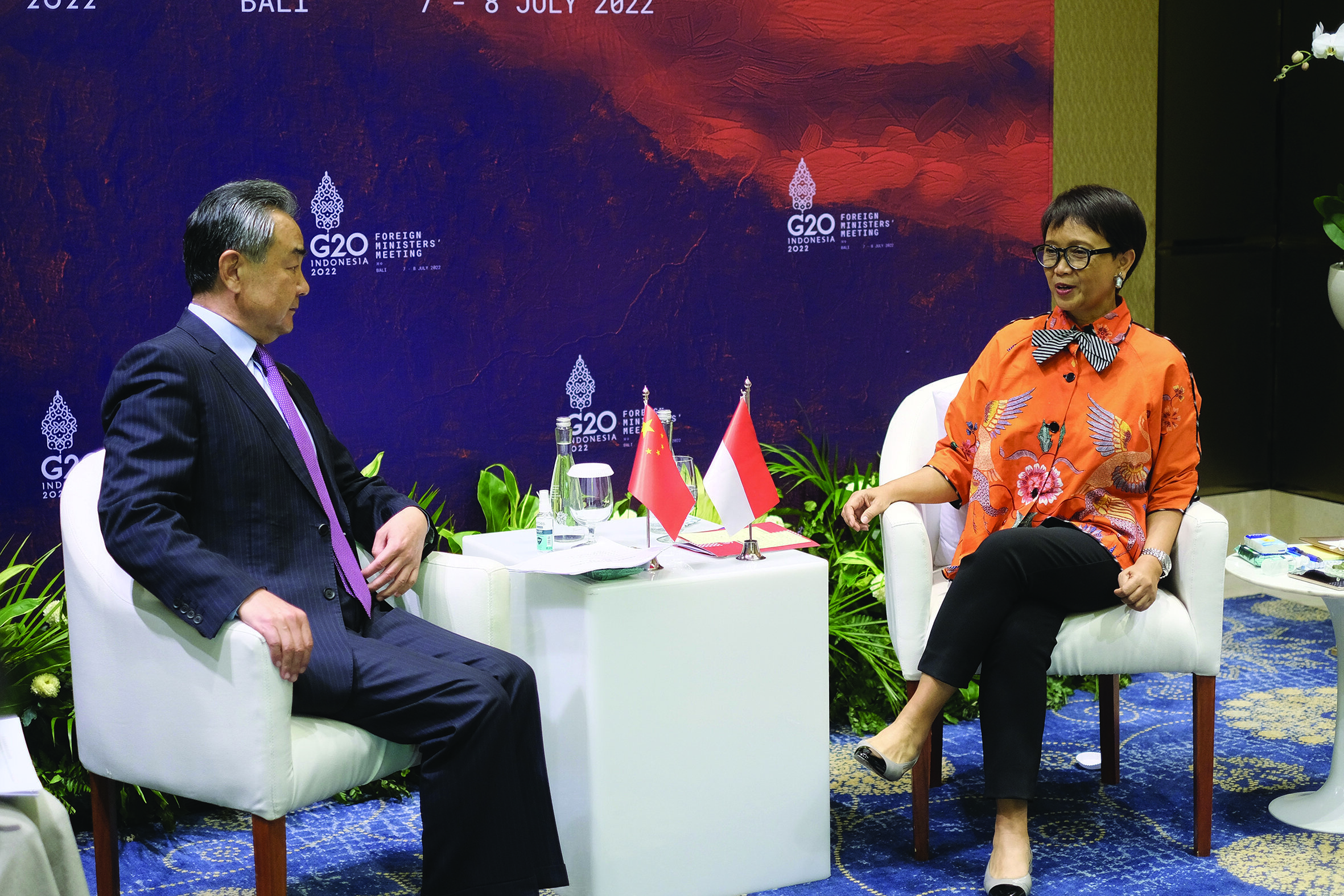
Indonesian Foreign Minister Marsudi (R) meets with Chinese Foreign Minister Wang (L) during a bilateral meeting on the sidelines of the G20 Foreign Ministers Meeting in Bali, Indonesia on July 7, 2022. MOFA INDONESIA / HANDOUT / AA
A country that maintains a status in the international power scale that is “middle,” that is still lower than that of the most powerful states but can utilize higher effects on other states, on the other hand, has strong sovereignty and sufficient potential to influence international cases, is referred to as a middle power in international relations. Rather than making decisions unilaterally in foreign policy, the middle power promotes multilateralism and the development of cooperation. Because middle powers’ partial pursuit of foreign policy goals is a result of their power potential being inferior to that of big powers or superpowers, their diplomatic approach has been labeled “niche diplomacy.”15 The fact that Indonesia has been supporting ASEAN centrality to lead multilateralism in the region to prevent the domination of one major power is a clear example of a middle power.
Despite the concept of middle power dating back to the late 16th century, it has recently resurfaced as a common way of referring to non-great powers. Because of the popularity of the term, it has been observed that the concept of “middle power” is having a resurgence. A number of significant emerging nations are now part of the medium-power group as a result of the development of the Global South in particular. For the past two decades, the concept has been firmly connected with the IBSA states (India, Brazil, and South Africa), while the MIKTA (Mexico, Indonesia, South Korea, Türkiye, and Australia) group has gained recognition for its capacity to adjust to the needs of existing and developing middle powers looking to extend their influence through creative coalition-building techniques.16
Obviously, one of the chances to increase activeness in the international area for middle powers is to be a negotiator and coalition builder, mainly to sustain peace. Since Indonesia has been one of the founders and highly effective leaders in ASEAN, it is a key point for Indonesia’s aims, especially for discussions in the process of resolution of multilateral problems such as the South China Sea problems.
Even though there is not one fully accepted definition regarding what exactly the measurement of middle power is, there are three widely acknowledged theoretical approaches to the subject: functional, behavioral, and hierarchical. Every approach has its own strengths and weaknesses in terms of situation and employment in designing foreign policy. It is beneficial to examine whether GMF fits just one or a combination of them.
The Global Maritime Fulcrum in the Functional Model
In a functional model, the middle-power country comes into prominence in an area that it has interests in and is also able to be more functional than other powers. At this point, while a great power has a chance to impact regardless of conditions, a middle power can only show their influence in a more defined area based on their interests. According to former Canadian Prime Minister Mackenzie King, middle-power countries distinguish themselves from small countries with their functional interests, which is important when compared to those who lack these. King asserted that the contributions of middle-power countries must be acknowledged and consequently they should be given more respect and recognition.17 In this regard, evidently, the Indonesian functional area is its maritime domain since it is located at the heart of the Indo-Pacific as the largest archipelagic country. Furthermore, GMF’s first aim is to improve Indonesian maritime strength in its environment, as explained above through the five main pillars. One of the other aspects of the functional model is niche diplomacy, which carries out middle power diplomacy in a specific area, a condition that Indonesia exactly underlines in the GMF’s maritime diplomacy. Therefore, the application of GMF through the middle power functional model is accurate. However, based on their connected political and economic potential, functional middle-power states’ dominance may be unstable. The state of their situations is at risk of becoming constrained due to time and circumstance, causing the functional model to fail.18 However, considering the realization of GMF in middle power theory with two other models is helpful to reach a more accurate and full assessment.
Global Maritime Fulcrum in the Hierarchical Model
The emphasis on quantitative measures of power across states, such as variations in gross domestic product (GDP), military spending, strategic location, and population size, is what distinguishes the hierarchical model. One advantage of using quantitative indicators is that they allow for easier comparisons between states and can be used to quantify a state’s power objectively. Put differently, middle power states have the ability to draw in other nations and establish mutually beneficial partnerships by use of their copious resources. As a result, we utilize the implementation of resources and powers from the hierarchy approach.19 As stated by Chapnick, the hierarchical model is linked with the state’s material capacity, whereas the behavioral model is related to the state’s desire for multilateralism, conflict resolution, and moral power.20
Indonesia’s extensive maritime territory provides plenty of quantifiable indicators, such as strategic geography, where sea lines pass through Indonesian territorial waters and cover most of the trade flow in that area. Furthermore, population growth and increased GDP, particularly in recent years with a high level of foreign investment, are undeniable. At this point, Indonesia is hierarchically above most regional countries. Consequently, in this model, due to the powerful aspects of Indonesia, the GMF is accountable in the context of turning the country into a maritime power. It implies that not only does Indonesia need CDI but China also needs Indonesia for the realization of its BRI project as Indonesia is at the center of the 21st Century Maritime Silk Road. Therefore, Indonesia’s willing approach to BRI investment is not fully profitable for one side only but is in fact mutually beneficial.
Finally, the importance of Indonesia’s strategic location and potential also attracts the U.S. mainly in response to the rising competition between the U.S. and China in the Indo-Pacific. Thus, as a middle-power country, Indonesia should reinforce its position by combining the power of tangible and intangible features such as conflict resolution and moral power aspects pointing toward a behavioral model.
Global Maritime Fulcrum in the Behavioral Model
The third and final approach is the behavioral model. As is implied in the name of the model, the attitudes and approaches of countries are determinative rather than material. Governments that support multilateralism, conflict resolution, and moral power are concerned with the behavioral model. In the functional model, the Indo-Pacific region is identified as a niche area of the GMF. However, to improve this region with measurable factors, Indonesia is hierarchically ahead of its neighbors, referring to the second model.
Additionally, good international citizenship is more widely recognized and is strongly linked to middle powers. To be more precise, good citizenship in the region entails actively bolstering inclusive multilateralism, improving the rules-based system, and supporting initiatives to build bridges. Indonesia’s good regional citizenship has contributed to closing the gaps between regional players through mechanisms led by the ASEAN, especially in light of the competition between China and the U.S.21 This model stresses the importance of maritime diplomacy in the GMF by highlighting multilateralism and good regional citizenship in the highly contested Indo-Pacific area.
Finally, it can be seen that Indonesia uses all three models to reach its full potential of GMF in international incidents. For example, niche diplomacy is one of the ways to be effective for middle-power countries such as Indonesia, especially if it is applied in combination with the behavioral model providing multidimensional advantages where there are insufficient bargaining capabilities.22 Although the employment of GMF can be described through the middle power theory, to fully analyze the state of affairs it is critical to analyze the CDI and its effects on Indonesia’s free and active policy.
Despite its strategic position, with substantial sea lines, and the scale of its economy, Indonesia is not fully connected with the global economy and is far from realizing its full potential due to factors such as low competitiveness, mostly due to a lack of infrastructure
The Effects of Chinese Direct Investments on Free and Active Policy
The quantity of CDI has significantly expanded as a result of Indonesia’s official involvement in the BRI and AIIB. The upward trend of China’s investment in Indonesia particularly after 2013-2014 can be seen in Graph 1; Indonesia’s share of China’s outward investment in Asia was calculated at $11,840 million in 2005 and increased to an all-time high of $4,550 billion by 2022.23
Graph 1: Chinese Investment in Indonesia ($ billions, 2004-2022)
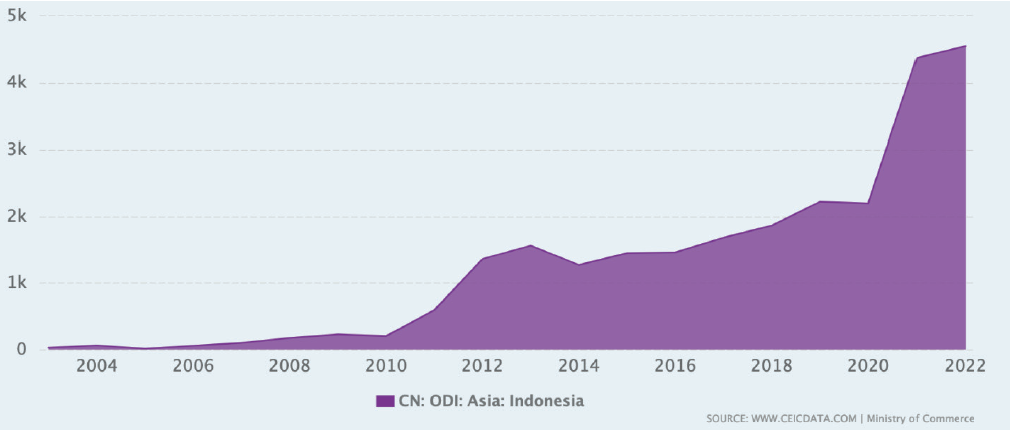
Source: CEICDATA24
China is now a significant player in Indonesia’s FDI as a result. China overtook Singapore to become the nation with the greatest foreign investment in Indonesia in the fourth quarter of 2019 ($1.4 billion). The most prominent of China’s investments in Indonesia are industry, transportation, and travel.25 Furthermore, China has invested more than $3.8 billion in Indonesia in the first half of 2023, stated Deputy Minister for Economic Affairs Airlangga Hartarto. With such an increase in investment, he envisioned that China’s Belt and Road Initiative would continue to support the growth of industry and special economic zones in North Sumatra, North Kalimantan, Sulawesi, and Bali. As a result, he considered that Indonesia’s economy might benefit highly from the BRI.26
Despite its strategic position, with substantial sea lines, and the scale of its economy, Indonesia is not fully connected with the global economy and is far from realizing its full potential due to factors such as low competitiveness, mostly due to a lack of infrastructure. When compared to some of its neighboring economies, including even smaller ones, Indonesia’s share of global commerce is relatively small. According to the World Trade Statistical Review 2019, published by the World Trade Organization (WTO), Indonesia shared only 0.9 percent of world total exports, ranking Indonesia in 30th place, followed by Malaysia and Thailand at 1.3 percent, India at 1.7 percent, and Japan at 3.8 percent in 2018.27 However, based on the WTO report in 2022, Indonesia increased its share to 1.7 percent, which revealed the positive results of investments.28
In the marine section, Rizal Sukma, Jokowi’s long-term foreign policy advisor, stressed the importance of maritime knowledge being backed up by a resolve to improve maritime infrastructure. In this respect, The Jokowi-Jusuf Kalla development agenda work plan states that infrastructure development is also a priority.29
The Sea Highway (Tol Laut) development plan, which aims to provide favorable marine transportation links from Western to Eastern Indonesia, includes 24 ports, five of which serve as hubs (collectors). These are the Ports of Belawan/Kuala Tanjung, Tanjung Priok/Kalibaru, Tanjung Perak, Makassar, and Bitung, with the remaining 19 ports acting as feeder ports.30 GMF’s efforts to boost workers’ production efficiency and competence in the global market, as well as the development of internal connectivity to ensure that development is dispersed fairly over rural areas, includes the Sea Highway policy.31
In addition, The Bitung Special Economic Zone is intended to serve as both an important hub port for Eastern Indonesia and the entry point to the Asia-Pacific region. Bitung Special Economic Zone, 45 km from Manado, was constructed from one of Indonesia’s largest fishing ports and would support other businesses involved in the production of coconut oil, vegetable and essential oils, and spices as well. The growth of other facilities, including Manado’s international airport and seaport, could potentially be greatly impacted by the Bitung Special Economic Zone.32
Graph 2: Indonesia’s GDP ($ trillions, 2015-2022)
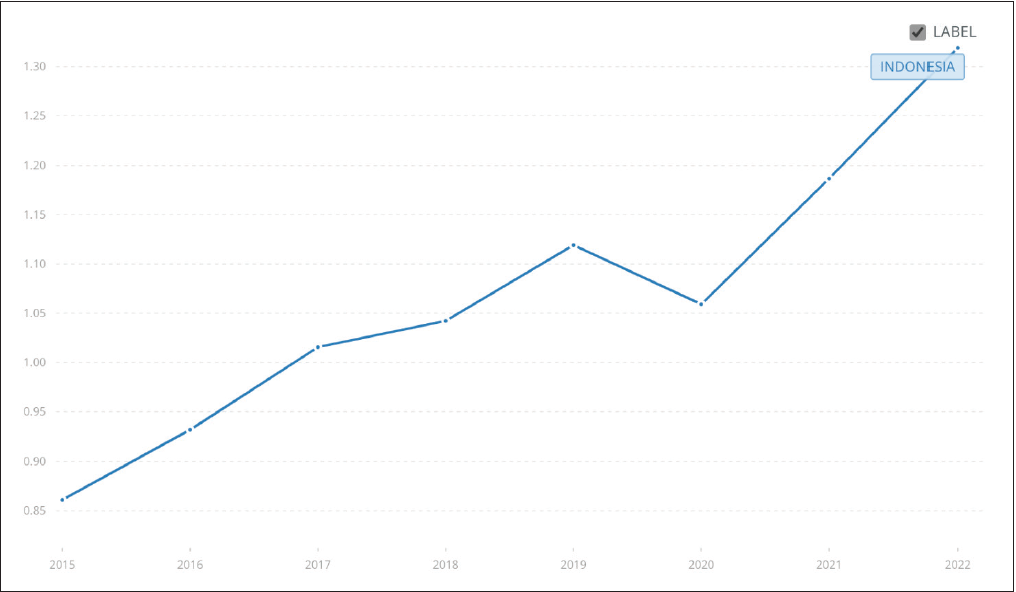
Source: The World Bank Data33
According to consultancy company Baker & McKenzie, Indonesia may benefit the most from the program in the region, drawing in infrastructure projects valued at over $87 billion.34 The involvement of Indonesia in FDI, particularly CDI, drastically increased between 2014 and 2019. One of the ways to track economic improvement is to observe GDP during that term. As can be seen from the graph, Indonesia’s GDP has been constantly increasing since 2015, the drop in 2020 was due to COVID-19 restrictions. Thus, economic development in Jokowi’s first term is undeniable.
In this research an explanatory qualitative research method is used since it can explain specific connections of causation and interactions between countries, allowing researchers to discuss social phenomena comprehensively.35
Another point of access for CDI within BRI is the multinational financial agency founded by China, the Asian Infrastructure Investment Bank, which plans to expand credit capabilities for BRI participant countries including project development in Indonesia. According to the Vice President and Chief Administrative Officer of the AIIB, Luky Eko Wuryanto, with a total borrowing of $2.89 billion, or around 41.3 trillion Indonesian Rupiah, Indonesia was the second-highest borrower.36 In this context, both the public and elites have questioned if one of Indonesia’s key principles of foreign policy, free and active, is in jeopardy due to the economic dependence and increased effect of China’s economic existence on the Indonesian economy.
In order to prevent Indonesia’s dependency on China, Jakarta had been cautious in the past. Concerns over China’s debt trap policy have grown among Indonesian elites and the general public as a result of current circumstances. To deal with this situation a policy of dividing the risk between various countries and bilateral business agreements with China have been implemented. Luhut Binsar Pandjaitan, the Minister of Maritime Affairs for Indonesia, agreed to sign 23 Memorandums of Understanding (MoUs) with the BRI Forum in Beijing on April 26, 2019. Project cooperation agreements were business-to-business (B2B), not government-to-government (G2G). Luhut underlined that 200 trillion Indonesian rupiah, which constitutes 14 of the 23 MoUs, is not a loan. Regarding licensing from China to Indonesia, the government acts as a facilitator.37
Therefore, in Jokowi’s first term, between 2014 and 2019, it can be said that CDI supports the pillars of GMF and due to improvements detailed above especially the development of the Bitung maritime economic zone, these policies hamper the possible violation of Indonesia’s free and active policy.
Joko Widodo’s Policy to Maintain GMF Compatibility with Free and Active Foreign Policy
In President Joko Widodo’s first term of office from 2014 to 2019, his favored policy was to turn Indonesia into a maritime power first regionally and then globally via increasing infrastructure investment development. GMF was launched in 2014 just one year after the BRI. Consequently, attracting foreign investment into Indonesia became critical in the short term.
Indonesia, on the other hand, has investors from a variety of nations, including the U.S., Singapore, and Japan. Furthermore, the “dynamic equilibrium” which Indonesia’s stance on the U.S.-China competition reflects a preference for not allowing one power to dominate in Southeast Asia. This strategy gives President Joko Widodo flexibility and opportunities between two powerful countries, the U.S. and China, limiting overdependence on one side. It aligns with the free and active foreign policy principle of Indonesia, stating that Indonesia cannot fully commit to alliances with major countries and must play a constructive and dynamic role in international affairs. This policy also reflects Indonesia’s character of being a middle power, demonstrating in particular the behavioral model.38
Regional nations do not want to allow the Asia-Pacific region to become a theatre for a great power clash between the U.S. and China. To create a more inclusive regional architecture and prevent “unchecked preponderance of a single state” or “disorder or uncertainty associated with a multipolar area,” they follow a strategy known as “the dynamic equilibrium.”39
It can be considered that with this policy, GMF is supported to not have a dominant partner and to ensure the independence of the Indo-Pacific. For instance, the U.S. government has lately stressed its commitment to assisting Indonesia in accelerating private sector investment for infrastructure development through the International Development Finance Corporation (DFC). This initiative builds on the Indonesian Ministry of Finance’s and the U.S. Treasury Department’s previous engagement in infrastructure finance and market development.40
Strengthening ASEAN centrality through bilateral, multilateral, and global cooperation will reflect upon the Indonesian ambitions to maintain its level of activity with diverse countries while preventing dependence on one country
A goal of Joko Widodo’s first period of office, as he emphasized in his election campaign, was to increase the level of Indonesian citizens’ wealth. One way to achieve this was by having loans and infrastructure investments. Given the long and unclear period of BRI, it is not precisely predictable how far its influence would be in the Sea Lines and maritime traffic. Besides, after providing loans for a particular port renovation or construction, in the eventuality of not having enough finances to pay back the loans, China takes possession of the port, as has happened in Sri Lanka where a port has already been leased to China for 99 years.41
In his foreign policy agenda, Joko Widodo has clearly defined that middle power will be a part of foreign policy in the region which means diversifying risk and mutual trust with middle power policy.42 Therefore, Joko Widodo has tried to minimize the negative effects of CDI through specific criteria in agreements, despite the fact that Indonesian foreign policy between 2014 and 2019 reflects a very supporting inclination towards CDI. Yet, middle power theory as a concept is not new to Indonesia as some of his predecessors used similar concepts, such as Yudhoyono’s “zero enemy thousand friend” policy, also is known “zero enemy millions friend.”43 One of the supporter foundations for Indonesia’s middle power policy is ASEAN. Indonesia is one of the primary founders of ASEAN and is the biggest Southeast Asian country consisting of an extremely extensive maritime domain including Sea Lines which are crucial for world trade as well as for participant countries.
To analyze middle power theory as mentioned above, there are three models which are functional, hierarchical, and behavioral. To be able to accomplish the GMF project while remaining in line with his free and active policy Joko Widodo’s middle power policy combines all three of the models in accordance with the circumstances and conditions.
In the hierarchical model, even though, Indonesia doesn’t have a highly developed military, its location in terms of both its size and strategic aspects, like having high reserves of natural resources in the maritime domain, allows Indonesia to support the GMF as a middle power. Moreover, in the functional model, Indonesia as a middle power is using “niche diplomacy” to focus on the GMF and so gain the best results in its interest area of the maritime zone, which needs to be protected with full authority from major powers and negligibly from small powers.44 Ultimately, Indonesia can attract other countries to align with its policies by having a broad maritime domain.
Finally, yet equally importantly, in the behavioral model, the intention is to be a good citizen in the international arena, such as being a peacemaker and bridge builder in a plural environment. For instance, solving the South China Sea dispute peacefully through dialog in multilateralism in ASEAN is one of the roles Indonesia has taken upon itself as a peacemaker.45
It seems likely that in a broader strategic analysis, with respect to current development in the Indo-Pacific region, the stance of Indonesia could affect the economic and strategic stability of the region. It is obvious that ASEAN countries need to work with both the U.S. and China to maintain the regional balance and stability and thus to reduce the possibility of U.S.-China confrontation.
Niche diplomacy and being a coalition builder in a multilateral environment helps to strengthen Indonesia’s position, given the rising competition between the U.S. and China
In practice, the Chinese market economic system has allowed the expansion of Chinese investment across borders that are relatively immune to political problems. China’s investment and trade activities are not affected by the country’s political agenda. This is evident in the high investment and trade of Taiwan, India, and Vietnam, all political rivals of the PRC. The character of economic cooperation from China provides a separate incentive for the lesser state to make China a partner in the economic cooperation group.
In economic cooperation with China, it is assumed that an agreement has occurred that China will invest in developing Batam Island as a global transhipment port as well as a special economic zone. But if in its implementation, China is not dedicated to carrying out its agreement with Indonesia, Indonesia can conduct a more comprehensive study of sensitive matters that can make China’s behavior more cooperative with Indonesia. For example, giving access to the U.S. to increase its investment in Natuna Island −which has a geographical position that is very strategic for China’s geopolitics− would give Indonesia more leverage over China making it conducive to working towards Indonesia’s aspirations.46
Conclusion
This study analyzed GMF and its repercussions on Indonesia’s free and active foreign policy, notably the effect of Chinese investments and AIIB loans made as a part of BRI between 2014 and 2019, on this policy. In the realization process of GMF, President Joko Widodo pursued a middle power policy combining all three models, given that Indonesia has powerful aspects such as natural resources in the maritime domain and a strategic position, within major international Sea Lines. To examine what type of impact BRI investment has had on Indonesia, data related to the economic growth of Indonesia after Chinese investment are demonstrated. According to Jokowi, maritime connectivity is vital to enhance the ability of mobility in the Indo-Pacific which contributes to Indonesia being more active in the maritime domain.
Consequently, CDI investments within the BRI are considered catalysts to accelerate the realization process of GMF and have resulted in positive repercussions on Indonesia’s free and active foreign policy between 2014 and 2019. On the other hand, the nature of BRI targets means that not only is Indonesia part of this mega project but also all ASEAN countries. Subsequently, strengthening ASEAN centrality through bilateral, multilateral, and global cooperation will reflect upon the Indonesian ambitions to maintain its level of activity with diverse countries while preventing dependence on one country. This demonstrates that the free and active principle is continuing in the same manner and complies with the middle power strategy that also aims to use the GMF for this purpose. In this respect, niche diplomacy and being a coalition builder in a multilateral environment helps to strengthen Indonesia’s position, given the rising competition between the U.S. and China. Moreover, Jokowi is well aware of the long-term dangers of over-dependency on one major power and thus has followed policies that balance the Indo-Pacific while strengthening the Indonesian position and maritime domain with GMF through a middle power strategy.
Endnotes
1. Krishnan Srinivasan, James Mayall, and Sanjay Pulipaka, Values in Foreign Policy: Investigating Ideals and Interests, (Maryland: Rowman & Littlefield, 2019).
2. Ardhitya E. Y. Lalisang and Darang S. Candra, “Indonesia’s Global Maritime Fulcrum & China’s Belt and Road Initiative,” Friedrich-Ebert-Stiftung, (April 2020), retrieved from https://library.fes.de/pdf-files/bueros/indonesien/16770.pdf.
3. Tom Hancock, “China Encircles the World with One Belt, One Road Strategy,” Financial Times, (May 3, 2017), retrieved from https://www.ft.com/content/0714074a-0334-11e7-aa5b-6bb07f5c8e12.
4. James McBride, Noah Berman, and Andrew Chatzky, “China’s Massive Belt and Road Initiative,” Council on Foreign Relations, (February 2, 2023), retrieved April 17, 2022, from https://www.cfr.org/backgrounder/chinas-massive-belt-and-road-initiative.
5. “Indonesia’s Foreign Policy Priorities in 5 Years Ahead,” Cabinet Secretariat of the Republic of Indonesia, (January 9, 2015), retrieved from https://setkab.go.id/en/indonesias-foreign-policy-priorities-in-5-years-ahead/.
6. Tiola, “Jokowi’s Global Maritime Fulcrum: 5 More Years?” The Diplomat, (June 11, 2019), retrieved April 17, 2022, from https://thediplomat.com/2019/06/jokowis-global-maritime-fulcrum-5-more-years/.
7. “Visi–Misi–Program Aksi,” The General Election Commission of the Republic of Indonesia, (2014), retrieved October 9, 2023, from https://www.kpu.go.id/koleksigambar/Visi_Misi_JOKOWI-JK.pdf.
8. Rizal Sukma, “The Evolution of Indonesia’s Foreign Policy: An Indonesian View,” Asian Survey, Vol. 35, No. 3 (March, 1995), pp. 304-315.
9. Mohammad Hatta, “Indonesia’s Foreign Policy,” Foreign Affairs, Vol. 31, No. 3 (April 1953), pp. 441-452.
10. Rizky Alif Alvian, Ganesh Cintika Putri, and Irfan Ardhani, “Haluan Baru Politik Luar Negeri Indonesia: Perbandingan Diplomasi ‘Middle Power’ Susilo Bambang Yudhoyono Dan Joko Widodo,” Jurnal Hubungan Internasional, Vol. 6, No. 2 (2018), pp. 148-163.
11. Evan Laksmana, “Indonesia as ‘Global Maritime Fulcrum’: A Post-Mortem Analysis,” Asia Maritime Transparency Initiative, (November 8, 2019), retrieved from https://amti.csis.org/indonesia-as-global-maritime-fulcrum-a-post-mortem-analysis/.
12. “President Xi Jinping and President Susilo Bambang Yudhoyono of Indonesia Attend the Indonesia-China Business Luncheon, Encourageing Entrepreneurs of the Two Countries to Join Hands Creating Better Future for China-Indonesia Economic and Trade Cooperation,” Ministry of Foreign Affairs of the People’s Republic of China, retrieved July 31, 2022, from https://www.fmprc.gov.cn/ce/ceindo/eng/xwdt/t1089956.htm.
13. Nanto Sriyanto, “Global Maritime Fulcrum, Indonesia-China Growing Relations, and Indonesia’s Middlepowermanship in the East Asia Region,” Jurnal Kajian Wilayah, Vol. 9, No. 1 (2018), pp. 1-19.
14. Costas M. Constantinou, Pauline Kerr, and Paul Sharp, The SAGE Handbook of Diplomacy, (California: SAGE Publications Ltd, 2016).
15. Meltem Müftüler Baç, “Middle Power,” Britannica, (March 19, 2024), retrieved October 28, 2021, from https://www.britannica.com/topic/middle-power.
16. Charalampos Efstathopoulos, “Middle Powers and the Behavioural Model,” Global Society, Vol. 32, No. 1 (January 2018), pp. 47-69.
17. Blair Fraser, “Canada: Mediator or Busybody?” in J. King Gordon (ed.), Canada’s Role as a Middle Power, (Toronto: Canadian Institute of International Affairs, 1966).
18. Adam Chapnick, “The Middle Power,” Canadian Foreign Policy Journal, Vol. 7, No. 2 (January 1999), pp. 73-82.
19. Fadhila Inas Pratiwi, Irfa Puspitasari, Indah Hikmawati, and Harvian Bagus, “Global Maritime Fulcrum: Indonesia’s Middle Power Strategy Between Belt and Road Initiatives (BRI) and Free-Open Indo Pacific (FOIP),” Central European Journal of International and Security Studies, Vol. 15, No. 3 (2021), p. 30.
20. Jeffrey Robertson, “Middle-Power Definitions: Confusion Reigns Supreme,” Australian Journal of International Affairs, Vol. 71, No. 4 (July 2017), pp. 355-370.
21. Sarah Teo, “Middle Powers amid Sino-U.S. Rivalry: Assessing the ‘Good Regional Citizenship’ of Australia and Indonesia,” The Pacific Review, Vol. 35, No. 6 (November 2022), pp. 1135-1161.
22. Cameron G. Thies and Angguntari C. Sari, “A Role Theory Approach to Middle Powers: Making Sense of Indonesia’s Place in the International System,” Contemporary Southeast Asia, Vol. 40, No. 3 (2018), pp. 397-421.
23. “China Outward Investment: Asia: Indonesia | Economic Indicators,” CEIC, retrieved June 12, 2024, https://www.ceicdata.com/en/china/outward-direct-investment-by-country/outward-investment-asia-indonesia.
24. “Maharashtra Emerges as Economic Activity Hub in India,” CEIC, (March 16, 2021), retrieved November 6, 2023, from Ceicdata.Com/Datapage/Charts/O_china_outward-Investment-Asia-Indonesia/?Type
=area&from=2011-12-01&to=2022-12-01&lang=en.
25. “Here Are 5 Countries with Biggest Foreign Direct Investment in Indonesia,” Ministry of Investment - Indonesia Investment Coordinating Board, retrieved November 7, 2023, from https://www.investindonesia.go.id/en/article-investment/detail/here-are-5-countries-with-biggest-foreign-direct-investment-in-indonesia.
26. “Belt and Road Initiative Contributory to Indonesia’s Economy: Minister,” Antara News, (October 19, 2023), retrieved November 7, 2023, from https://en.antaranews.com/news/296580/belt-and-road-initiative-contributory-to-indonesias-economy-minister.
27. “World Trade Statical Review 2019,” WTO, retrieved June 12, 2024, from https://www.wto.org/english/res_e/statis_e/wts2019_e/wts2019_e.pdf.
28. “Indonesia - Trade Profiles 2023,” WTO, retrieved June 11, 2024, from https://www.wto.org/english/res_e/statis_e/daily_update_e/trade_profiles/ID_e.pdf.
29. Rizal Sukma, “Gagasan Poros Maritim,” KOMPAS, (August 21, 2014), retrieved from https://bisniskeuangan.kompas.com/read/xml/2014/08/21/080000726/Gagasan.Poros.Maritim.
30. “Ministry of Transportation Strategic Plan 2015-2019,” Ministry of Transportation of Indonesia, (September 9, 2015), retrieved August 1, 2022, from http://dephub.go.id/post/read/rencana-strategis-kementerian-perhubungan-2015-2019.
31. Nanto Sriyanto, “Global Maritime Fulcrum, Indonesia-China Growing Relations, and Indonesia’s Middle Powermanship in the East Asia Region,” Jurnal Kajian Wilayah, Vol. 9, No. 1 (2018), pp. 1-19.
32. Chatzky and McBride, “China’s Massive Belt and Road Initiative.”
33. “World Bank Open Data,” World Bank, retrieved November 7, 2023, from https://data.worldbank.org.
34. Sarah Yuniarni, “Here’s How Indonesia Can Benefit From China’s Belt and Road Initiative,” Jakarta Globe, (July 5, 2018), retrieved November 7, 2023, from https://jakartaglobe.id/business/heres-how-indonesia-can-benefit-from-chinas-belt-and-road-initiative.
35. W. Creswell, Research Design: Qualitative, Quantitative, and Mixed Methods Approaches, (California: SAGE Publications, 2003).
36. Ardiansyah Fadli, “Indonesia, Pengutang Kedua Terbesar AIIB Setelah India,” KOMPAS, (September 10, 2021), retrieved from https://www.kompas.com/properti/read/2021/09/10/070000821/indonesia-pengutang-kedua-terbesar-aiib-setelah-india.
37. Dikanaya Tarahita and Muhammad Zulfikar Rakhmat, “How Can Indonesia Manage Its Concerns about BRI Investments?” The Diplomat, (March 9, 2019), retrieved July 22, 2021, from https://thediplomat.com/2019/05/how-can-indonesia-manage-its-concerns-about-bri-investments/.
38. Natasha Hamilton-Hart and Dave McRae, “Indonesia: Balancing the United States and China, Aiming for Independence,” United States Studies Centre at the University of Sydney, (November 2015), p. 14.
39. Hardi Alunaza Sd, Moh Sarifudin, and Dini Septyana Rahayu, “The Strategic Cooperation between Indonesia and Tiongkok under Jokowi’s Foreign Policy towards Global Maritime Diplomacy,” Political Science, (2017), p. 16.
40. Eko Saputro, “Rowing between Two Reefs: Indonesia’s Infrastructure Investment Strategy,” The Diplomat, (February 15, 2021), retrieved July 21, 2021, from https://thediplomat.com/2021/02/rowing-between-two-reefs-indonesias-infrastructure-investment-strategy/.
41. Michael J. Green, “China’s Maritime Silk Road: Strategic and Economic Implications for the Indo-Pacific Region,” Center for Strategic and International Studies, (April 2, 2018), retrieved November 3, 2020, from https://www.csis.org/analysis/chinas-maritime-silk-road.
42. Miss Febrianti Tentyana S. Tarno, “Global Maritime Fulcrum (GMF) Performances to Deal with Tensions in South China Sea Disputes: A Constructivist Analysis of Indonesia’s Strategic Culture,” PhD Thesis, Thammasat University, 2017.
43. Kompas Cyber Media, “SBY: Million Friends, Zero Enemy,” KOMPAS, (October 20, 2009), retrieved from https://nasional.kompas.com/read/2009/10/20/1308159/~Nasional.
44. Pratiwi, Puspitasari, Hikmawati, and Bagus, “Global Maritime Fulcrum.”
45. Premesha Saha, “Indonesia’s Potential as a Maritime Power,” Maritime Affairs: Journal of the National Maritime Foundation of India, Vol. 12, No. 2 (2016), pp. 28-41.
46. Yanyan Mochamad Yani, “Indonesia and Security Challenges in the Indo-Pacific Region,” in Asia and Europe in the 21st Century (Routledge, 2021), pp. 175-184.