
Introduction: Uniting for Freedom and Justice
The historic relationship between South Africa’s liberation movement and the Palestinian struggle is deeply rooted in shared experiences of oppression, resistance, and solidarity. From the days of apartheid to the contemporary challenges faced by Palestinians, the two movements have found common ground in their quests for freedom, justice, and equality. This article aims to explore the historical ties between these two movements, the motivations behind South Africa’s initiative to take Israel to the International Court of Justice (ICJ), strategies to support the Palestinian struggle, and a projection of the potential outcomes of the ICJ interim measures.
Historical Ties: Echoes of Apartheid and Occupation
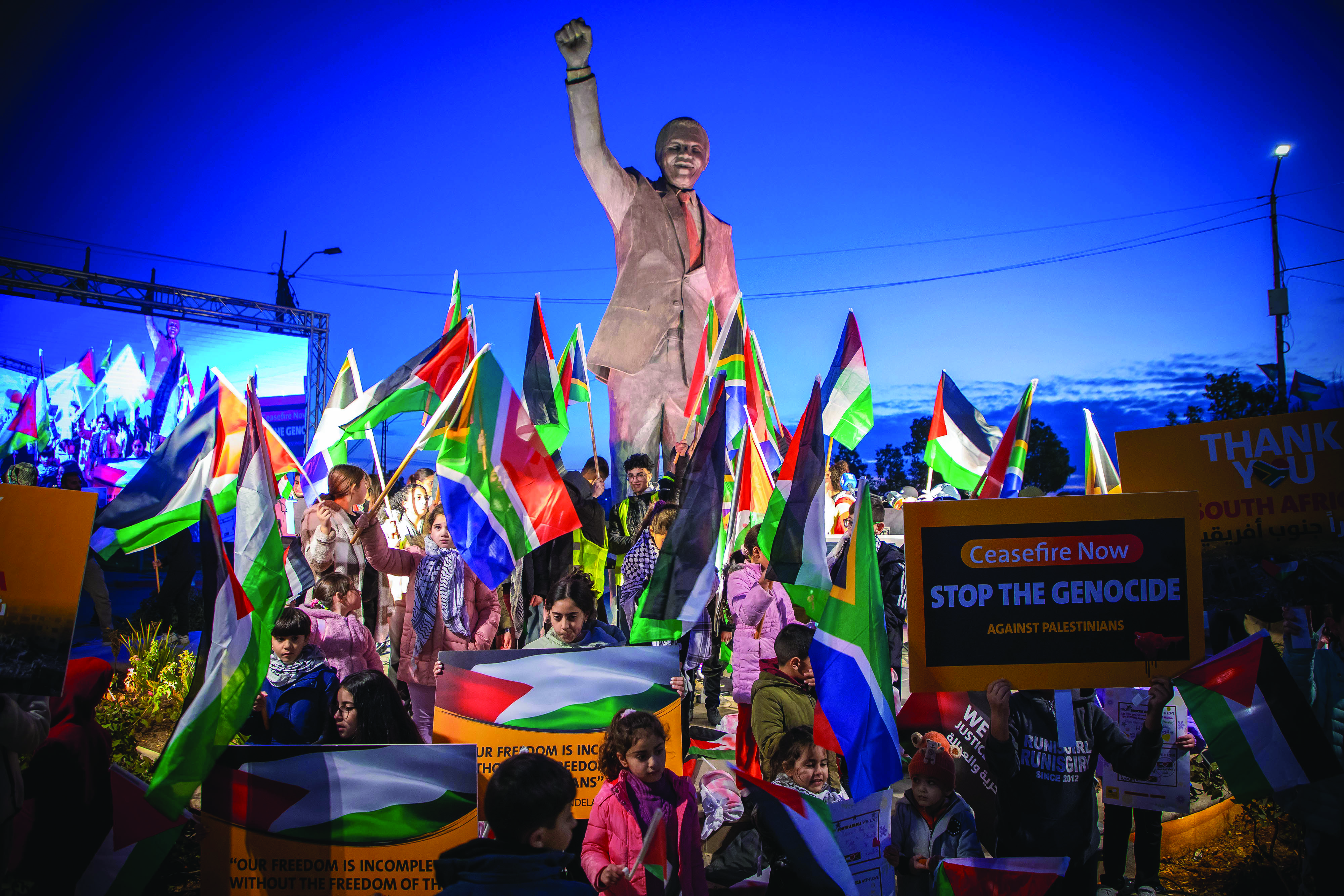
The parallels between apartheid South Africa and Israel’s treatment of Palestinians are striking. Both regimes implemented discriminatory policies, enforced segregation, and committed human rights abuses against the oppressed populations. South Africa’s liberation movement, led by iconic figures like Nelson Mandela, drew inspiration from global struggles against injustice, including the Palestinian struggle. Mandela’s unequivocal support for the Palestinian cause, encapsulated in his statement, “Our freedom is incomplete without the freedom of the Palestinians,” exemplifies the solidarity between the two movements.
Throughout the decades, South African activists, politicians, and civil society organizations have consistently expressed solidarity with Palestinians, condemning Israel’s occupation, colonization, and violence. The African National Congress (ANC), the ruling party of South Africa, has been at the forefront of advocating for Palestinian rights on the international stage. This solidarity is not merely symbolic but reflects a deep-seated commitment to justice and human rights forged through shared struggles against oppression.
South Africa’s Motivation for Legal Action
South Africa’s decision to pursue legal action against Israel at the ICJ stems from a commitment to uphold international law, justice, and accountability. The accusation of genocide against Israel is a serious charge necessitating legal recourse to address ongoing atrocities committed against Palestinians, particularly in Gaza. By invoking the ICJ, South Africa seeks to hold Israel accountable for its violations of international humanitarian law and to challenge the impunity with which it operates.
South African civil society organizations, trade unions, and student groups have been instrumental in organizing protests, boycotts, and divestment campaigns targeting companies complicit in Israel’s occupation and apartheid policies
Moreover, South Africa’s historical experience with the Truth and Reconciliation Commission (TRC) following the end of apartheid serves as a precedent for pursuing justice through legal mechanisms. The TRC demonstrated the power of truth-telling, accountability, and reconciliation in addressing past injustices and laying the foundation for a more just society. Similarly, by pursuing legal action against Israel, South Africa aims to contribute to the pursuit of justice and accountability in the Israeli-Palestinian context.
The Power of Solidarity
Solidarity between the South African liberation movement and the Palestinian struggle is not merely symbolic; it has tangible impacts on the ground. Over the years, South African activists, including veterans of the anti-apartheid movement, have traveled to Palestine to witness the situation firsthand, express solidarity with Palestinian communities, and share their experiences of resisting oppression. These exchanges of solidarity have strengthened the bonds between the two movements and inspired joint efforts to challenge injustice and build alliances across borders.
Moreover, the solidarity between South Africa and Palestine extends beyond political rhetoric to concrete actions aimed at supporting Palestinian rights and freedoms. South African civil society organizations, trade unions, and student groups have been instrumental in organizing protests, boycotts, and divestment campaigns targeting companies complicit in Israel’s occupation and apartheid policies. There has also been significant groundswell support for the Global Campaign to Return to Palestine. These grassroots initiatives reflect a groundswell of popular support for Palestinian rights within South Africa and globally, demonstrating the power of people-to-people solidarity in effecting change.
Challenges and Opportunities
Despite the progress made in building solidarity between South Africa and Palestine, both movements face formidable challenges in their respective struggles for justice and liberation. In South Africa, the legacy of apartheid continues to manifest in persistent socio-economic inequalities, endemic poverty, and rising unemployment. Likewise, in Palestine, the Israeli occupation, settler colonialism, and systemic discrimination remain entrenched, perpetuating violence, displacement, and dispossession.
However, amidst these challenges, there are also opportunities for solidarity and resistance. The global momentum in support of the Palestinian struggle and in opposition to the ongoing genocide in Gaza has gained significant traction, mobilizing support for Palestinian rights and challenging complicity with Israeli apartheid. It is of particular interest to observe the internal pressure exerted on the governments of the U.S. and the UK to change their stand on the genocide in Gaza. Whilst this may not lead to direct condemnation from Apartheid Israel’s traditional supporters, it does demonstrate the power of protest as well as the significance of the electronic intifada and social media in influencing perceptions.
In South Africa, the ruling ANC’s commitment to Palestinian solidarity remains strong, despite internal debates and external pressures. By harnessing the power of grassroots activism, international solidarity, and legal advocacy, both movements can advance their respective struggles for justice and liberation.
A Moral Victory: Implications of ICJ Interim Measures
While the outcome of South Africa’s case against Israel at the ICJ remains uncertain, the pursuit of justice through legal means sends a powerful message about the importance of accountability for human rights violations. The ICJ interim measures were a significant moral victory for South Africa and addressed urgent humanitarian concerns, such as the protection of civilian populations in Gaza, the cessation of violence against Palestinians, and the creation of a bridge to deliver urgent humanitarian aid.
These interim measures included directives for Israel to halt its military operations, although it stopped short of ordering an immediate ceasefire, effectively lifting the blockade on Gaza, and allowing for the delivery of humanitarian aid to alleviate the suffering of Palestinians. Additionally, the ICJ may call for the establishment of mechanisms to monitor and investigate human rights violations committed by all parties, ensuring accountability for perpetrators of violence and justice for victims.
The impunity with which Israel continues to ignore the ICJ ruling is indicative of its arrogance and the cover it receives from Western powers, especially the U.S. This reality underscores the need to create effective UN mechanisms to enforce rulings or face the risk of undermining the confidence and legitimacy of the UN body.
In the long term, the ICJ proceedings could contribute to shifting the international discourse on the Israeli-Palestinian war, highlighting the need for a just and sustainable resolution based on the principles of international law, human rights, and self-determination for the Palestinian people. While the legal process may be protracted and complex, South Africa’s initiative at the ICJ represents a significant step towards achieving accountability and justice for Palestinians.
The Role of International Law in Justice and Accountability
International law provides a framework for addressing human rights violations, holding perpetrators accountable, and promoting peace and justice. South Africa’s decision to take Israel to the ICJ reflects a belief in the power of international law to uphold justice and accountability in the face of impunity.
While the outcome of South Africa’s case against Israel at the ICJ remains uncertain, the pursuit of justice through legal means sends a powerful message about the importance of accountability for human rights violations
It is also significant that the South African government has called for a review of the veto powers to prevent a member state from acting in direct opposition to the founding principles of the UN while still being protected by the power of the U.S.’ veto in the UN Security Council.
By pursuing legal action against Israel, South Africa seeks to challenge the normalization of Israeli occupation and apartheid and to reaffirm the principles of international law, including the prohibition of genocide. It has also raised the level of awareness that the war did not start on October 7, 2023, but is now nearly eight decades old.
The historic relationship between the South African liberation movement and the Palestinian struggle exemplifies the power of solidarity, resilience, and collective action in the face of oppression and injustice
Moreover, the ICJ proceedings offer an opportunity to shed light on the reality of Israeli apartheid and colonialism, raising awareness and mobilizing international support for Palestinian rights. Regardless of the outcome of the ICJ case, the legal process itself serves as a platform for amplifying Palestinian voices, documenting human rights violations, and challenging the impunity enjoyed by Israel.
Voices of Resistance: Supporting the Palestinian Struggle
To support the Palestinian struggle, individuals, organizations, and governments can engage in various forms of activism, advocacy, and solidarity efforts. First and foremost, raising awareness about the plight of Palestinians and the root causes of the conflict is essential. This includes educating the public about the history of Israeli occupation, colonization, and apartheid policies, as well as the ongoing human rights abuses faced by Palestinians.
Additionally, advocating for political pressure on parliamentarians and governments to implement sanctions, divestments, and boycotts (BDS) against Israel can exert economic and diplomatic pressure to end its occupation and oppression of Palestinians. Civil society organizations, academic institutions, and grassroots movements play a crucial role in organizing BDS campaigns and mobilizing support for Palestinian rights.
Furthermore, supporting Palestinian-led initiatives for justice, such as the Palestinian call for boycott, BDS, and amplifying Palestinian voices and narratives in mainstream discourse are essential steps in standing in solidarity with the Palestinian struggle.
Conclusion: A Shared Path to Liberation
The historic relationship between the South African liberation movement and the Palestinian struggle exemplifies the power of solidarity, resilience, and collective action in the face of oppression and injustice. Significantly, it has awoken the sleeping giant of the global South. Specifically, it is also a significant indicator of a changing mood in the world that South Africa’s legal action against Apartheid Israel has effectively opened Pandora’s box with a number of countries in the global South either supporting South Africa’s case or pursuing additional legal challenges.
Furthermore, South Africa’s initiative in bringing a genocide case against Israel before the ICJ underscores a commitment to upholding international law and seeking accountability for human rights violations. By standing in solidarity with Palestine, South Africa reaffirms its commitment to the principles of justice, freedom, and equality that guided its own struggle against apartheid. It also underscores its principled commitment towards the transformation of the institutions of global governance.
As the global community continues to mobilize en masse in support of Palestinian rights, it is essential to recognize the interconnectedness of struggles for justice and liberation around the world. By amplifying Palestinian voices, challenging complicity with Israeli apartheid, and advocating for accountability through legal mechanisms such as the ICJ, we can contribute to building a more just and equitable world for all. In the words of Nelson Mandela, “Our freedom is incomplete without the freedom of the Palestinians,” reminding us of our shared humanity and our collective responsibility to stand in solidarity with those who continue to struggle for their rights and dignity.