
Introduction
In 2020, the 44-Day War profoundly redesigned the dynamics of a protracted conflict between Armenia and Azerbaijan over the Nagorno-Karabakh region. The final victory was made by Azerbaijan over the region in September 2023, and the ethnic Armenian population residing in the area finally set out for an exodus to Armenia. The fighting between Azerbaijan and Armenia not only impacted the two states, but ripple effects reached the neighboring states and affected the whole region. The fighting was linked to decades-old waves of anger over control of the Nagorno-Karabakh region, internationally acknowledged as an area of Azerbaijan.1 After a full-scale war in 2020, both Azerbaijan and Armenia alongside Russia, signed a tripartite declaration of the ceasefire, in which both also conceded to build a corridor to connect the territory of Azerbaijan to its exclave in Nakhchivan.2 However, Armenia has started to renege on the provisions of the agreement, generating new tension in the region.
The conflict resurfaced in 2023 when Azerbaijan launched a military offensive on Artsakh, citing the action as indispensable to stopping the terrorists’ activities. Azerbaijan demanded “the complete withdrawal of ethnic Armenian troops and the dissolution of the government in Stepanakert.”3 Baku proposes to “reintegrate” the region for economic development. Thereafter, the stakeholders’ attention has turned to the pros and cons of building the Zangezur Corridor, the Armenian territory that separates Azerbaijan from its exclave Nakhchivan.
In this situation, several actors showed their interest in offering their role as mediators for the settlement of the issue. However, Russia, the EU, and Türkiye have emerged as primary mediators, appearing to be the only hope for curbing violence, given their influence in Yerevan and Baku and the constant attention they are providing.4 The efforts of the EU, Russia, and Türkiye show the serious concerns of these states and also give hope that diplomacy may bring Azerbaijan and Armenia closer to peace, and an eventual settlement will ensue. In post-war mediators, Brussels appeared as an influential party along with Moscow, bringing Azerbaijan and Armenia’s leaders closer to talking terms. However, these efforts of mediators were somehow becoming suspicious too because they leaned towards warring parties. The mediators are at odds, the role of the EU as mediator annoys Russia; whereas the EU is critical of Russia’s efforts to resolve the conflict sincerely. Some scholars (Whatley, Mayer) believe the efforts of mediators for the peace talks between Azerbaijan and Armenia are due to the political interests of mediators,5 and this could cause regional instability. This paradox is compounded by the fact that Armenia prefers the EU to be a guarantor of peace and Azerbaijan seeks a regional solution. Given the puzzling situation, some experts say that despite the disagreements of mediators, peace talks are essential6 and post-war development construction projects are crucial as it would be a win-win situation for all. Even the working of the Minsk Group of the Organization for Security and Cooperation in Europe (OSCE), as the primary platform for negotiations over Nagorno-Karabakh, was noticeably declined due to the complexity of the matter.
The efforts of the EU, Russia, and Türkiye show the serious concerns of these states and also give hope that diplomacy may bring Azerbaijan and Armenia closer to peace, and an eventual settlement will ensue
During the negotiation efforts, it was emphasized to open transportation and demarcate the border between Armenia and Azerbaijan. However, both states were insisting on different strategies to end the conflict. The EU preferred soft power and financial incentives to the states to end their conflicts, whereas Russia appeared as a hard power, mainly due to the Ukraine war. At the same time, the divisions between Russia and the West have deepened, which has provided dual negotiating platforms for Azerbaijan and Armenia. Nevertheless, Azerbaijan wants a genuine and permanent solution to the conflict and relies on its neighboring states. To proceed with some peace assurances, in November 2020, Armenia and Azerbaijan decided to unblock regional connections, but very blurred details were given at this stage.
Earlier, the issue of the corridor construction was included in a proposal for the normalization of relations,7 but negotiations to implement it were not successful. Despite the ceasefire violations and bleak situation, the parties appeared closer than ever to inviting a mediator to resolve the issue. In this setting, some questions become pertinent, such as: what led to the end of the flare-up that happened in 2020 between Azerbaijan and Armenia? What are the anomalies attached to the mediators’ efforts to resolve the conflict between Azerbaijan and Armenia? How do the EU, Russia, and Türkiye ensure the stability and security of the South Caucasus region in the wake of the September 2023 situation?
This article is organized into four parts; the first section of this article provides a background on the conflict between Armenia and Azerbaijan to understand the deep-rooted causes of conflict and the reasons for its recurrence. The second section reviews the role of mediators in the Armenia-Azerbaijan conflict, and the third part examines the increasing complexities in resolving the conflict. The concluding section presents recommendations and findings.
Background
The hostility between Azerbaijan and Armenia is not new; a brief history of the issues between the two states will help in determining the underlying causes of conflict. The Soviet Union set up an autonomous oblast of Nagorno-Karabakh within the territory of the Azerbaijan Soviet Socialist Republic in 1923.8 The ethnic differences made this region controversial and caused tension many times. Nevertheless, the security situation was largely controlled during the Soviet period. The clashes first erupted in late 1980 over Nagorno-Karabakh.9
With the disintegration of the Soviet Union, Armenia and Azerbaijan gained independence. The controversy over Nagorno-Karabakh became so severe that it caused a war between Azerbaijan and Armenia over the region, resulting in nearly thirty thousand deaths and displacing as many as 600,000 Azerbaijanis.10 After almost two years, Armenia controlled the region of Nagorno-Karabakh and occupied 20 percent of Azerbaijan’s territory. Thereby, Russia mediated and brought the two states to an agreement, by signing the Bishkek Protocol in 1994.11 This truce was presented by the then President of Russia, Boris Yeltsin, who forced Azerbaijan to accept the result.12 Subsequently, the de facto autonomy of Nagorno-Karabakh, with a self-proclaimed government in Stepanakert, was reliant on Armenia economically, politically, and militarily. Thus, many ceasefire initiatives were taken after the Bishkek Protocol as the intermittent clashes continued to take place.
The strategic landscape changed in 2020 with the outbreak of war between Azerbaijan and Armenia, which steered Russia into the conflict and made it the central mediator between the two
Nagorno-Karabakh has been the subject of many UN Resolutions, UNSC 822 (1993), UNSC 853 (1993), UNSC 874 (1993), UNSC 884 (1993), UNGA 62/243, asking for an end to the occupation of Azerbaijan’s territory. During Armenia’s thirty-year occupation, this occupied territory suffered much damage. The leadership of Azerbaijan adopted strategic silence for many years. However, the intense fighting took place in April 2016, which resulted in a large number of casualties along the line of separation in just four days. During the period of strategic patience, Azerbaijan gained much strength and strategized to get its lost territory back. Both sides announced the end of the war, but tensions remained high.
On September 25, 2020, heavy fighting broke out between Armenia and Azerbaijan, in which thousands of people were killed and many were reported as wounded. Tensions continued to escalate, and even longer-range artillery and other heavy weaponry were used in the war. After some futile attempts for a ceasefire made by Russia, the U.S., and France, Russia successfully brokered an agreement on November 9, 2020, to end the Second Nagorno-Karabakh War. In this way, Azerbaijan regained its lost territory, which remained under Armenia’s control for thirty years.
Since the Nagorno-Karabakh region is accepted internationally as part of Azerbaijan,13 the latter has been spending a considerable amount on the reconstruction of this devastated region. Besides, Baku proclaims that it has presented many initiatives to restore relations with Armenia, including proposals for a peace agreement, but Armenia has hampered the process.14 Moreover, the position of Azerbaijan in negotiations with Armenia is strengthened due to its reliance on diplomatic engagements with Russia and Türkiye. Even Azerbaijan signed a strategic alliance agreement with Moscow in February 2022. Historically, Russia acted as the sole mediator and arbiter, and after the 44-Day War, it also deployed its peacekeeping forces in the Nagorno-Karabakh region. However, the end of the Second Nagorno Karabakh War drove progressive meditators to play their role in finding the solution to the perennial conflict between Armenia and Azerbaijan.
Mediation Initiatives
Usually, a mediator helps the warring parties to reckon and focus on the crucial issues required to resolve.15 Historically, Kazakhstan, Russia, Türkiye, Iran, and France tried to mediate the conflict of Nagorno-Karabakh between Azerbaijan and Armenia. Their efforts remained significant; however, ceasefire agreements had never been effective. The attempts for mediation started in the initial years of the independence of post-Soviet Republics, where Russia was a dominant third party in budding fracases. Azerbaijan and Armenia joined the then Conference on Security and Cooperation in Europe (CSCE, now OSCE), hoping to find a solution. However, like other observers, both parties also realized that CSCE was focusing more on setting up its status as a peacekeeping force in the region than presenting a solution to the conflict. Therefore, Azerbaijan and Armenia could not trust the ability of the CSCE to resolve the conflict.
Moscow continued to mediate a resolution between Armenia and Azerbaijan amid high tensions and successfully brought them to the negotiation table. However, Moscow could not make an effective effort to settle the issue of the status of the Nagorno-Karabakh
Besides, Russia and Kazakhstan had also been actively involved in the mediation efforts. They tried to convince Azerbaijan and Armenia to settle the conflict in their initial years of tension. Moreover, Nursultan Nazarbayev, then President of Kazakhstan, was able to assume the role of a neutral mediator because he had good relations with the leaders of both the warring parties, Armenia and Azerbaijan.16
These were the years when the Soviet Union was on the verge of disintegration. Political leaders of the Soviet Union and Kazakhstan, namely Gorbachev and Nursultan Nazarbayev, were worried about getting political support in their areas. Their concerns about the conflict were to show their political capabilities. Otherwise, their inability to deal with the conflict constructively was apparent. Nevertheless, these two mediators were more interested in projection than finding a solution to the conflict. Soon, with the realization that the Soviet Union was almost broken, both leaders retreated.17 At this point, Azerbaijan did not receive any support from other Central Asian republics. The leaders of the Central Asian states were careful about keeping their relations with Russia and risking anything to help Azerbaijan.18 The early years of conflict also show Russian involvement; for instance, in May 1993, the Russian-led Commonwealth of Independent States (CIS) arranged a meeting of the warring parties, which resulted in a ceasefire. The peace talks and fragile ceasefire, which were broken many times, became a permanent feature of this conflict.
While focusing particularly on Russia’s efforts for the settlement of the conflict, after the disintegration of the Soviet Union, all became suspicious and gradually tactless because it could not maintain neutrality and visibly took the side of Armenia. The reasons for the growing partnership between Armenia and Russia were many, including military and economic. For Armenia, military and political cooperation with Russia has been an essential element of its defense as well as its security policy.19 Hence, the problem of taking sides and biases of states due to political reasons continued to impede the sincere play of states’ role in conflict resolution.
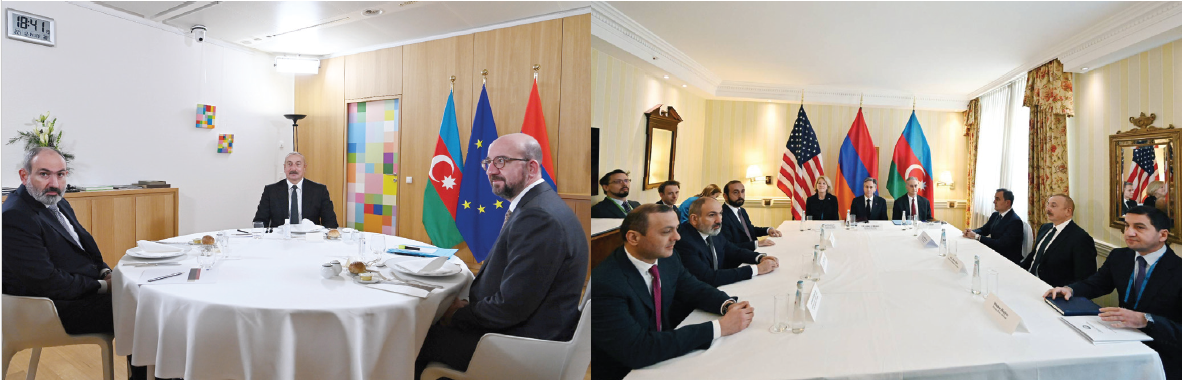
The trilateral meeting of Blinken, Aliyev, and Pashinyan in Germany, as well as the meeting of Aliyev, Pashinyan, and Michel in Brussels, serve as examples of unsuccessful mediation by the U.S. and Europe in the Armenia-Azerbaijan conflict. AZERBAIJANI PRESIDENCY / AA
Moreover, the warring parties were reluctant to rely on their neighboring states due to their leaning towards Armenia or Azerbaijan. Other neighbors also expressed their concerns due to their historical, cultural, and geographical connections. In this regard, Iran and Türkiye appeared as the most relevant actors. In early 1992, the then-Iranian Foreign Minister Vellyati went to Baku to start negotiations with the leaders of Armenia and Azerbaijan for preliminary mediation attempts, but a ceasefire was not possible.20 Besides, Türkiye tried to mediate many times, but Armenia was not ready to accept Türkiye’s involvement and rejected the offer by calling it a biased actor.21
Notwithstanding the efforts of third parties such as the U.S., France, and Russia as co-chairs of the Minsk Group, the mediation attempts have been hopeless. The strategic landscape changed in 2020 with the outbreak of war between Azerbaijan and Armenia, which steered Russia into the conflict and made it the central mediator between the two. Russia installed peacekeeping forces in the region to prevent further rage. The peace agreement emphasized the unblocking of communication channels, including transport corridors between the Western areas of Azerbaijan and Nakhichevan, to set up the unrestricted movement of people and goods in both directions.22
Later, when Russia entered into war, the regional trade routes were obstructed, causing delays in economic activities and impacting Russia’s stakes in other states. Furthermore, the Russia-Ukraine war has also squeezed energy and food markets.23 Since the trade transportation routes are under direct threat, the realization of the construction of new road links is also underway because the transport routes are to connect Asia with Europe. The stakeholders have been trying to find practical ways to transport goods from East to West, not only for economic advantages but also for the mitigation of interstate tensions. For that reason, the opening of roads and communications became the foremost interest of the states.
Since Russia considers the post-Soviet states its area of influence, it has become critical of any Western countries’ involvement in settlement of the conflict between Armenia and Azerbaijan
In this context, the Zangezur Corridor seems like the best option for perpetual harmony and economic prosperity, as it connects Azerbaijan to its exclave. The corridor is needed for regional connectivity and a trade boost, but Armenia’s indecisiveness after the agreement caused delays in its building. The proposed corridor would run through Nakhichevan, the exclave of Azerbaijan, and then to Türkiye and beyond.24 Notwithstanding Armenia’s objection to the route of the proposed corridor, neighboring Türkiye consented to its building because Türkiye has a border with Nakhichevan, and it would provide Türkiye with geographical access to mainland Azerbaijan and Central Asia, Turkic states. So, the only wait is for Armenia to return to the negotiating table and accept the mediation. Many efforts are being made to convince Armenia to accept economic partnership offers for establishing permanent peace.
Gradually, it became clear that the transportation corridor was crucial for enduring regional peace. This transportation corridor between Azerbaijan and Nakhichevan was one of the most crucial articles of the agreement.25 Furthermore, Baku presented a 5-point proposal for the sake of peace in March 2022. The points are the following:
1. Mutual recognition of sovereignty, territorial integrity, inviolability of borders, political independence from each other; 2. Mutual confirmation of renouncing territorial claims against each other; legal obligation and other encroachments in the future; 3. The Parties undertake to refrain from threatening each other’s security in interstate relations, from threatening political independence and territorial integrity, as well as from other circumstances which are contrary to the Charter of the United Nations; 4. Demarcation of the state border, the establishment of diplomatic relations; 5. Opening of roads and communications, the establishment of other relevant communications and cooperation in other areas of mutual interest.26
In response to this proposal, Yerevan stressed that the proposed settlement put aside the future status of Nagorno-Karabakh, which is the most contentious issue. Hence, the regional states have re-energized diplomacy designed to build peace in the South Caucasus.
Russia: An Old Referee
Russia is one of the critical stakeholders in the Caspian region. Moscow continued to mediate a resolution between Armenia and Azerbaijan amid high tensions and successfully brought them to the negotiation table. However, Moscow could not make an effective effort to settle the issue of the status of the Nagorno-Karabakh. Accordingly, it was foreseeable that the conflict would break out again.27 However, Armenia and Azerbaijan had shown their confidence in Russia’s mediation for the settlement of the conflict because, previously, the whole charge was on the Soviet Union. The interesting aspect about Russia is that it presented itself as a neutral power in the region; however, its political leaning continued to make its role doubtful. For example, Russia’s political leaning towards Armenia has been quite explicit, as it supplies arms to Armenia. Moreover, the Border Control Department of the Russian Federal Security Service defends the border of Armenia with Türkiye and Iran, together with the border guards of Armenia.28 Yet, the connections between Moscow and Yerevan could not separate Russia from Azerbaijan because of the changing geopolitical environment. Russia needs its neighbor to play an active role in regional politics. So, it is not surprising that both Azerbaijan and Armenia showed their confidence in Russia’s mediation, even knowing the restraint Russia showed.
For Armenia, the Russian presence is a guarantee to prevent further wars in the future and to safeguard the Armenian populace in Nagorno-Karabakh.29 Yerevan also calls Moscow its main ally to guarantee security through the Moscow-led Collective Security Treaty Organization (CSTO). As far as Baku is concerned, its relations with Russia have always been complex; however, Russia’s mediation role cannot be ignored as it is among the major stakeholders in the region. Moreover, the volume of trade between the two states is huge enough to connect them together.
Azerbaijan’s victory over Nagorno-Karabakh has highlighted the limits of Russia’s power in the region and made it more conscious of future dealings with Azerbaijan and its partners
Unlike Armenia, Azerbaijan has neither joined the CSTO, a leading Russian organization and major guarantor of security in the Caucasus and Central Asian region nor has it joined the Russian-led Eurasian Economic Union (EAEU).30 Yet, Azerbaijan is important for Russia because of its interests in the Middle East too.
Both countries have signed “allied cooperation,” an agreement where both parties are ready for the development of integration processes in the space of the CIS.31 Baku reckons that the situation in the South Caucasus after the decisive war has provided an opportunity to build sustainable regional peace. Although Russia facilitated the peace talks between Armenia and Azerbaijan and ended up in a ceasefire, the agreement has lost its beat. It appears fragile because of the inflexible attitude of Armenia over the opening of transportation channels.
Indeed, Moscow strives to continue to preserve its influence in Yerevan and Baku. At the same time, Azerbaijan and Armenia seek to increase their collaboration with the EU,32 which makes Russia more apprehensive. Since Russia considers the post-Soviet states its area of influence, it has become critical of any Western countries’ involvement in settlement of the conflict between Armenia and Azerbaijan.
Türkiye’s ties have been valuable for the EU and the U.S. in countering Russian power and checking Iran’s activities in the region
Russian relations with the West reached their lowest point in the wake of the attack on Ukraine. The border of Europe with Russia has been affected, and the route from the South Caucasus to Türkiye, Iran, and beyond has gained new significance.33 Further, the EU sided with the U.S. in supporting Ukraine militarily and imposing economic sanctions on Russia. The situation paved the way for Brussels to lead the negotiation process between Armenia and Azerbaijan. This Russian reaction is normal as it has been overtly criticizing the West-facilitated format of negotiations, arguing that their primary goal was to push Russia out of the region.34
Further, the evolving shreds of evidence of the increased role of the U.S. in the mediation efforts between Armenians and Azerbaijan have been causing fears for Russia since late 2022. Russia considers it the plot of the West to spread anti-Russian sentiments in Armenia. Nevertheless, Azerbaijan’s victory over Nagorno-Karabakh has highlighted the limits of Russia’s power in the region and made it more conscious of future dealings with Azerbaijan and its partners.
European Union: An Emerging Player
The EU has been entering into the Armenia-Azerbaijan reconciliation efforts and playing a mediatory role since 2021.35 It appeared to be the most considerable actor in the Armenia-Azerbaijan conflict because of the tepid reaction of the Russian-led CSTO. The EU attempted to mediate the dispute between the two Caucasus countries for almost 15 years but failed.36 It was largely due to Russia’s military engagement in Ukraine that the EU’s mediation efforts between Armenia and Azerbaijan gained momentum. In other words, Russia’s ongoing “special operation” in Ukraine left space for the EU to assume a new role as moderator in the conflict.37
The deployment of the EU’s mission is late, but it is still crucial from the perspective of having versatile information.38 Moreover, the EU appears to be a reliable partner for Azerbaijan and Armenia, as they have entered into important agreements. Azerbaijan has been trying to align itself more closely with the West; further, Europe also appears deeply interested in Azerbaijani energy, which signals a decoupling of Russia and Azerbaijan. Moreover, the rift between the EU and Russia has been widening, particularly since 2020. The EU has sought to restructure the dialogue and brushed off Moscow’s attempts to manipulate the situation. Indeed, Russia is unhappy over this new development, as Russia sees it through the lens of geopolitical rivalry in the region. The pertinent aspect of Azerbaijan and EU relations is that the EU supports closer economic integration with Azerbaijan through the European Neighborhood Policy (ENP) and the Eastern Partnership initiative.39
Similarly, the Comprehensive and Enhanced Partnership Agreement (CEPA) mirrors the close relations between the EU and Armenia; the agreement came into force on March 1, 2021.40 Further, the high-level meetings of the EU, Armenia, and Azerbaijan leaders show the increased partnership between them. The EU Chief Charles Michel organized a meeting in December 2021 between Azerbaijani President İlham Aliyev and Armenian Prime Minister Nikol Pashinyan at the fore of the Eastern Partnership Summit.41 Later, with French President Emmanuel Macron, another effort was made to coordinate talks between Pashinyan and Aliyev in February 2022 virtually. The EU also attempted a civilian mission in Armenia (EUMA Armenia) in February 2023. Despite these efforts, the biases of mediators were dissuading states not to accept specific provisions already signed in the tripartite declaration of the ceasefire.
After Azerbaijan took control of Nagorno-Karabakh, the EU is ready to exert diplomatic and economic influence to keep the situation from escalating. Despite all the show of displeasure, it is unlikely that the EU would extend sanctions on Baku because of its energy needs. The EU would continue its mediation efforts. However, Nagorno-Karabakh would no longer be part of the negotiations, and the discussion would revolve around the issue of borders and the opening of new corridors, including the Zangezur Corridor.
It appears that Azerbaijan also wants to get help from the EU for many reasons. First, the EU is seemingly the biggest customer of Azerbaijan’s oil industry. Second, Azerbaijan has a transit link between the EU and Central Asian states. Oil transits from Central Asia to Europe through Azerbaijan have strengthened its position for the European and Central Asian states. Thus, Azerbaijan and the EU understand that any disturbance in the region would disrupt oil and gas supplies. It also supports the plan of the construction of a road throughout this region, as it would break the obstructions of passageways.
In this regard, the construction of the Zangezur Corridor would remain crucial for regional stability and economic development. The realization of supplies through new routes has further increased as states are already taking advantage of the collaborative efforts of Azerbaijan, Türkiye, and Georgia for new networks such as the Baku-Tbilisi-Kars railway and the Southern Gas Corridor pipelines, supplying Caspian gas and other resources to Europe.
Türkiye: A Bold Conciliator
Türkiye and Azerbaijan’s relations have been growing fast since the early years of Azerbaijan’s independence. Türkiye began helping Azerbaijan in the defense sector soon after the disintegration of the Soviet Union; however, their military bonds have deepened significantly over the past decade.42 Besides, both states have cordial political, economic, and cultural relations. Türkiye, being an adjacent state to both Armenia and Azerbaijan and a common neighbor of the region, was largely affected by this conflict.
In the beginning, Türkiye adopted a policy of neutrality, but gradually it started to present itself as a mediator between the two. The Turkish effort for neutral mediation could not last long, and it started to speak for the rights of Azerbaijan at international fora. The change particularly took place after the holocaust of Azeri civilians in Khojaly (a town in Karabakh) in late February 1992. In reaction, a huge demonstration against Armenia was held in Türkiye.
Whereas, Armenia and Türkiye have problematic historical relations, as Armenia alleges that Türkiye is responsible for the (so-called) genocide of Armenians in 1915. These stances brought Azerbaijan and Türkiye closer.43 Therefore, with the leaning of Türkiye towards Azerbaijan, Yerevan could not immediately find fault with Ankara’s effort.44
Due to the strong partnership between Baku and Ankara, it is predominantly considered that Azerbaijan’s recent victory against Armenia is largely due to the explicit military support of Türkiye for Azerbaijan.45 Türkiye is becoming more relevant day by day after the signing of a ceasefire agreement between Azerbaijan and Armenia, as both states tend to initiate a connecting corridor. Moreover, the Zangezur Corridor augmented the importance of Türkiye because its route ranges from the Eastern province of Türkiye, namely Kars, to Baku Azerbaijan, and it passes through Armenian territory near its border with Iran.
Certainly, Türkiye, as an ally of Azerbaijan, wants Yerevan to ease its provocations against Baku.46 The official statements of Türkiye are also a manifestation of its political leaning towards Azerbaijan. Turkish President Tayyip Erdoğan has expressed many times that Türkiye supports Azerbaijan and that these two states have each other’s backs. He said, “Türkiye will continue to stand with Azerbaijan with all our means and all our hearts.”47
Moreover, Türkiye has been expressing its displeasure over the role of France, the U.S., and Russia as co-chairs of the OSCE Minsk Group, which mediated the conflict. Both Baku and Ankara deliberated that the format of OSCE Minsk Group is neither efficient nor neutral, as it could not present any solution in the past thirty years. Nevertheless, Türkiye has repeatedly emphasized its interest in resolving the conflict between Azerbaijan and Armenia with Russia. Türkiye’s ties have also been valuable for the EU and the U.S. in countering Russian power and checking Iran’s activities in the region.
Evolving Complexities
The Armenia-Azerbaijan conflict has destabilized the region, hampered regional economic initiatives, given birth to difficulties in transforming the South Caucasus region into a transportation hub, and also curbed the inflow of investments. Although the leaders of Armenia, Azerbaijan, and Russia signed a ceasefire deal on November 10, 2020, which outlined the features of the post-war development of the region later, this caused confusion among the signatories as Armenia started to refuse to implement it. Article 9 of the agreement stressed at the initiation of regional transportation connections that had been blocked in the early 1990s means a transportation channel shall be given to Azerbaijan through the Syunik region of Armenia to connect it to its exclave Nakhichevan.48 Baku took it as a road connecting Western Azerbaijan to Nakhichevan, running through the Southern Armenian region of Syunik but not controlled by the Armenian authorities. Russia also received it as an acceptable option because it would provide an alternative communication link, which would be direct to Türkiye. However, Armenia has started to call it a threat to its sovereignty because the corridor could hinder the transport link between Armenia and Iran, which also passes through Syunik. Adding fuel to the fire, Yerevan’s concerns are being supported by Tehran because Iran fears it would lose control over the transport links with Armenia. Thus, new tension is surfacing in the region and causing new confusion. Iran has started to signal its displeasure and also conducted a military exercise in October 2022 along the border with Azerbaijan, which was reciprocated by Azerbaijan by holding military drills at the border with Iran.49
It is pertinent for the conflicting parties and mediators to understand that the regional dynamics have changed, the state’s strengths have been improved, and their alliances are now more complex than ever before
Azerbaijan was worried about Armenia’s evasion of the tripartite declaration, which both parties signed in November 2020. It reiterated that Armenia would equally get benefit from this corridor as it would be an opening of a new link in the global supply chain and would add to regional integration. Further, Armenia, Iran, and Russia would also get access to new commercial routes. Türkiye will also benefit from establishing a geographical link between the Western districts of Azerbaijan.50 Both Türkiye and Russia agree on the positive effects the Zangezur Corridor can have in the region.51 However, complexities are blurring the chances of its construction. Further, the evolving complexities and renewed tensions can weaken the efforts of mediators to convince warring parties to evade future wars. Further, the oil and gas exports from Azerbaijan would likely be disrupted (to Europe and Central Asia if the conflict does not end).
Conclusion
With the decisive victory of Azerbaijan over Nagorno-Karabakh, the external actors now have more room for maneuvering in the region. The role of mediators has become more crucial as regional peace is deemed in danger due to the deep-rooted differences over the available solutions for regional stability.
The international mediation efforts, which were at their peak in 2020, set Moscow’s role as the key mediator in the conflict and gradually shifted to the EU to evade a security void in the region. Moscow openly disapproved of Washington’s involvement in the ongoing mediation process and ended its participation in the OSCE Minsk Group. Therefore, after the utter defeat in 2023, the people of Armenia seem to blame Russia more than their own government for the failure. However, Türkiye proved an undaunting mediator of the conflict and preferred to establish the Zangezur Corridor through peaceful means for regional stability.
The prolonged conflict over Nagorno-Karabakh proved that the superficial involvement of mediators was linked to their own interests. For instance, during the mediation efforts led by the Minsk Group of the OSCE over thirty years, no solution to the conflict could be found. Similarly, the mutual distrust of mediators and the fear of losing the popularity of leaders within respective states have given birth to artificial decisions affecting regional stability. Even though several meetings have been held under the auspices of the OSCE and the EU and ended up with no solution. The viable solution is being rejected by Armenia as it is considered a trap. Notwithstanding that the three signatories, Russia, Armenia, and Azerbaijan, accepted the opening of the transportation route, the internal pressure has made the Armenian leader frail, and now it is finding different excuses to accept the provision to construct the corridor. Certainly, the reluctance is making the issue more complicated and putting the peace process in limbo.
The paper found that the lack of unity among the mediators and their competing interests have hampered the peace process in the Azerbaijani-Armenian conflict. Azerbaijan’s decisive victory over Nagorno-Karabakh and the war in Ukraine have added new complications to the mediation process. The main mediators take sides with the conflicting parties, and the same goes for the mediators with the warring parties. Armenia seemed more dissatisfied with Russia after Azerbaijan’s takeover of Nagorno-Karabakh. Meanwhile, Azerbaijan calls for regional mediators, including Türkiye, Russia or Georgia, to resolve the conflict.
It is pertinent for the conflicting parties and mediators to understand that the regional dynamics have changed, the state’s strengths have been improved, and their alliances are now more complex than ever before. There are chances of new friction between stakeholders too, and it could slow down the peace process. For instance, there is the possibility that EU-Russia discord over the issue of Ukraine could affect the states’ angling either for Moscow or Brussels. Moreover, Türkiye could increase its standing in the region by increasing its mediation efforts, which would push Russia to redesign its policy.
Endnotes
1. Cory Welt and Andrew S. Bowen, “Azerbaijan and Armenia: The Nagorno Karabakh Conflict,” Congressional Research Service, (January 7, 2021), retrieved from https://crsreports.congress.gov/product/pdf/R/R46651.
2. Natalia Konarzewska, “Armenia and Azerbaijan at Odds over Planned Transport Link,” The CACI Analyst, (June 7, 2021), retrieved from https://www.cacianalyst.org/publications/analytical-articles/item/13674-armenia-and-azerbaijan-at-odds-over-planned-transport-link.html.
3. Anna Borshchevskaya, “Nagorno-Karabakh’s Perpetual Conflict Shows Soviet Union still Crumbling,” The Washington Institute for Near East Policy, (September 25, 2023), retrieved from https://www.washingtoninstitute.org/policy-analysis/nagorno-karabakhs-perpetual-conflict-shows-soviet-union-still-crumbling.
4. Luca Urciuolo, “Moscow’s Involvement in Ukraine Allows the EU to Accredit Itself as a Mediator between Armenia and Azerbaijan,” Geopolitical Report: Geopolitika Evrazija, Vol. 25, No. 3 (November 7, 2022), retrieved from https://www.specialeurasia.com/2022/11/07/european-union-caucasus/.
5. Mat Whatley, “Lasting Peace between Armenia and Azerbaijan Will Reduce Russia’s Influence,” Foreign Policy, (May 12, 2023), retrieved from https://foreignpolicy.com/2023/05/12/peace-armenia-azerbaijan-russia-nagorno-karabakh/; Timothy R. Mayer, “Intractability and Mediation of the Nagorno-Karabakh Conflict,” published Master thesis, Naval Postgraduate School, 2013.
6. Nino Samkharadze, “Georgia’s Mediation Efforts in the Peace Talks between Azerbaijan and Armenia and the Post-Conflict Regional Reality,” The Georgian Institute of Politics, (May 11, 2022), retrieved from https://gip.ge/georgias-mediation-efforts-in-the-peace-talks-between-azerbaijan-and-armenia-and-the-post-conflict-regional-reality/.
7. This connection is famous for the name “Zangezur Corridor.” The term Zangezur refers to a historical area that covers most of the southern province of Armenia, Syunik.
8. Hakan Yavuz and Michael M. Gunter, The Karabakh Conflict between Armenia and Azerbaijan: Causes and Consequences, (Palgrave Macmillan Cham, 2022), p. 22.
9. Thomas de Waal, Black Garden: Armenia and Azerbaijan through Peace and War, (New York: New York University Press, 2003), pp. 10-16.
10. Gabriel Gavin, “The EU Is Stepping into Russia’s Shoes in Nagorno-Karabakh,” EURACTIV, (June 13, 2022), retrieved from https://www.euractiv.com/section/europe-s-east/opinion/the-eu-is-stepping-into-russias-shoes-in-nagorno-karabakh/.
11. Nazim Jafarov and Araz Aslanlı, “Russia’s Policy During the 44-Day Karabakh War,” Insight Turkey, Vol. 23, No. 4 (December 2021), p. 218.
12. Gavin, “The EU Is Stepping into Russia’s Shoes in Nagorno-Karabakh.”
13. “Strasbourg Plenary Session: Continuous Deadly Clashes between Armenia and Azerbaijan,” European Parliament, (October 3-6, 2022), retrieved from https://www.europarl.europa.eu/news/en/agenda/briefing/2022-10-03/6/continuous-deadly-clashes-between-armenia-and-azerbaijan.
14. Elena Teslova, “Azerbaijan Says ‘No Obstacles’ to Traffic in Lachin Corridor,” Anadolu Agency, (December 30, 2022), retrieved from https://www.aa.com.tr/en/politics/azerbaijan-says-no-obstacles-to-traffic-in-lachin-corridor/2776520.
15. Sara Horowitz, “Mediation,” in Charles Webel and Johan Galtung (eds.), Handbook of Peace and Conflict Studies, (London: Routledge, 2007), p. 58.
16. Svante E. Cornell and S. Frederick Starr, Kazakhstan’s Role in International Mediation under First President Nursultan Nazarbayev, (Washington DC: Central Asia-Caucasus Institute & Silk Road Studies Program, 2020), p. 39.
17. “Azerbaijan: Artsakh,” Uppsala Conflict Data Program, retrieved from https://ucdp.uu.se/additionalinfo/388/1.
18. Svante E. Cornell, “Turkey and the Conflict in Nagorno Karabakh: A Delicate Balance,” Middle Eastern Studies, 34, No. 1 (1998), p. 59.
19. Sergey Minasyan, “Russian-Armenian Relations: Affection or Pragmatism?” Ponars Eurasia, (July 23, 2013), retrieved from https://www.ponarseurasia.org/russian-armenian-relations-affection-or-pragmatism/.
20. “Azerbaijan: Artsakh,” Uppsala Conflict Data Program.
21. “Armenia: Yerevan Rejects Turkish Mediation,” Radio Free Europe/Radio Liberty, (February 19, 2001), retrieved from https://www.rferl.org/a/1095778.html.
22. “Full Text of the Agreement between the Leaders of Russia, Armenia and Azerbaijan,” eu, (November 10, 2020), retrieved from https://www.commonspace.eu/news/document-full-text-agreement-between-leaders-russia-armenia-and-azerbaijan; “Statement by President of the Republic of Azerbaijan, Prime Minister of the Republic of Armenia and President of the Russian Federation,” Peace Agreements, (November 10, 2020), retrieved from https://www.peaceagreements.org/viewmasterdocument/2324.
23. “Impact of Russia’s Invasion of Ukraine on the Markets: EU Response,” European Council, retrieved from https://www.consilium.europa.eu/en/policies/eu-response-ukraine-invasion/impact-of-russia-s-invasion-of-ukraine-on-the-markets-eu-response/#energy.
24. Stephen Blank, “Armenia Must Build the Zangezur Corridor,” Turan, (September 21, 2022), retrieved from https://www.turan.az/ext/news/2022/9/free/Want_to_Say/en/9627.htm.
25. Ayşegül Ketenci, “Importance of Zangezur Corridor for the Region Explained,” Anadolu Agency, (December 21, 2022), retrieved from https://www.aa.com.tr/en/analysis/3-questions-importance-of-zangezur-corridor-for-the-region-explained/2769019.
26. “Baku Spar over Proposed ‘Peace Talks,’” Asbarez, (March 15, 2022), retrieved from https://asbarez.com/yerevan-baku-spar-over-proposed-peace-talks/.
27. Cornell, “Turkey and the Conflict in Nagorno Karabakh: A Delicate Balance,” p. 55.
28. “Bilateral Relations: Russia,” Ministry of Foreign Affairs of the Republic of Armenia, retrieved from https://www.mfa.am/en/bilateral-relations/ru.
29. Lusine Martirosyan, “Armenia and Azerbaijan Are Restarting Peace Negotiations,” Friedrich Naumann Foundation, (May 11, 2022), retrieved from https://www.freiheit.org/south-caucasus/armenia-and-azerbaijan-are-restarting-peace-negotiations.
30. Philip Remler, “Russia’s Stony Path in the South Caucasus,” Carnegie Endowment for International Peace, (October 20, 2020), retrieved from https://carnegieendowment.org/files/Remler_Caucasus_v2.pdf, p. 12.
31. “Azerbaijan Signs a Declaration on Allied Cooperation with Russia. What Does It Mean?” JAM News, (February 22, 2022), retrieved from https://jam-news.net/azerbaijan-signs-declaration-on-allied-cooperation-with-russia-what-does-it-mean/.
32. Urciuolo, “Moscow’s Involvement in Ukraine Allows the EU to Accredit Itself as a Mediator between Armenia and Azerbaijan.”
33. Mikael Zolyan, “How the West Managed to Sideline Russia in Mediating the Nagorno-Karabakh Conflict,” Carnegie Endowment for International Peace, (November 9, 2022) retrieved from https://carnegieendowment.org/politika/88347.
34. Benyamin Poghosyan, “Opinion: Balancing the Mediators - Armenia and Azerbaijan Should Avoid Offending Russia,” Common Space, (October 27, 2022), retrieved from https://www.commonspace.eu/opinion/opinion-balancing-mediators-armenia-and-azerbaijan-should-avoid-offending-russia.
35. Vasif Huseynov, “EU Mediation between Armenia and Azerbaijan Is Needed Now more than Ever,” Center of Analysis of International Relations, (January 6, 2023), retrieved from https://aircenter.az/en/single/opinion-eu-mediation-between-armenia-and-azerbaijan-is-needed-now-more-than-ever-1112.
36. Nicu Popescu, “How the EU Became Marginalised in Nagorno-Karabakh,” European Council on Foreign Relations, (October 13, 2020), retrieved from https://ecfr.eu/article/commentary_how_europe_became_marginalised_in_nagorno_karabakh/.
37. Urciuolo, “Moscow’s Involvement in Ukraine Allows the EU to Accredit Itself as a Mediator between Armenia and Azerbaijan.”
38. Urciuolo, “Moscow’s Involvement in Ukraine Allows the EU to Accredit Itself as a Mediator between Armenia and Azerbaijan.”
39. “The European Union and Azerbaijan,” Delegation of the European Union to the Republic of Azerbaijan, (July 22, 2021), retrieved from https://www.eeas.europa.eu/azerbaijan/european-union-and-azerbaijan_en?s=217.
40. “EU-Armenia Relations – Factsheet,” The Diplomatic Service of the European Union, (November 16, 2021), retrieved from https://www.eeas.europa.eu/eeas/eu-armenia-relations-factsheet_en.
41. Martirosyan, “Armenia and Azerbaijan Are Restarting Peace Negotiations.”
42. Patrick Keddie, “What’s Turkey’s Role in the Nagorno-Karabakh Conflict?” Al Jazeera, (October 30, 2020), retrieved from https://www.aljazeera.com/features/2020/10/30/whats-turkeys-role-in-the-nagorno-karabakh-conflict.
43. Gamze Helvacıköylü, “The Role of Türkiye and Russia on the Resolution of the Nagorno-Karabakh Conflict,” UPA Strategic Affairs, Vol. 2, No. 1 (March 2021), p. 160.
44. Cornell, “Turkey and the Conflict in Nagorno Karabakh: A Delicate Balance,” p. 60.
45. Hülya Kınık and Sinem Çelik, “Azerbaijan’s Increasing Military Effectiveness: An Assessment of the Second Nagorno-Karabakh War,” Insight Turkey, Vol. 23, No. 4 (2021), p. 176.
46. “What Is behind the Armenia-Azerbaijan Conflict Flare-up?” Al Jazeera, (September 13, 2022), retrieved from https://www.aljazeera.com/news/2022/9/13/what-is-behind-the-armenia-azerbaijan-conflict-flare-up.
47. Keddie, “What’s Türkiye’s Role in the Nagorno-Karabakh Conflict?”
48. Vasif Huseynov, “Zangazur Corridor Is the Cornerstone of the Post-War Regional Cooperation Projects in the South Caucasus,” Valdai Discussion Club, (March 22, 2022), retrieved from https://valdaiclub.com/a/highlights/zangazur-corridor-is-the-cornerstone-of-the-post/.
49. Sherif Haridy, “Examining the Iranian-Azeri Tensions over Zangezur Corridor,” FUTURE for Advanced Research and Studies, (November 29, 2022), retrieved from https://futureuae.com/en-US/Mainpage/Item/7826/vicious-cycle-examining-the-iranian-azeri-tensions-over-zangezur-corridor.
50. “What Is the Zangezur Corridor and Why Does It Matter to Eurasia?” TRT World, (June 29, 2022), retrieved from https://www.trtworld.com/magazine/what-is-the-zangezur-corridor-and-why-does-it-matter-to-eurasia-58405.
51. Umud Shokri, “Why Iran Opposes Azerbaijan’s Zangezur Corridor Project,” Gulf International Forum, (September 28, 2022), retrieved from https://gulfif.org/why-iran-opposes-azerbaijans-zangezur-corridor-project/.