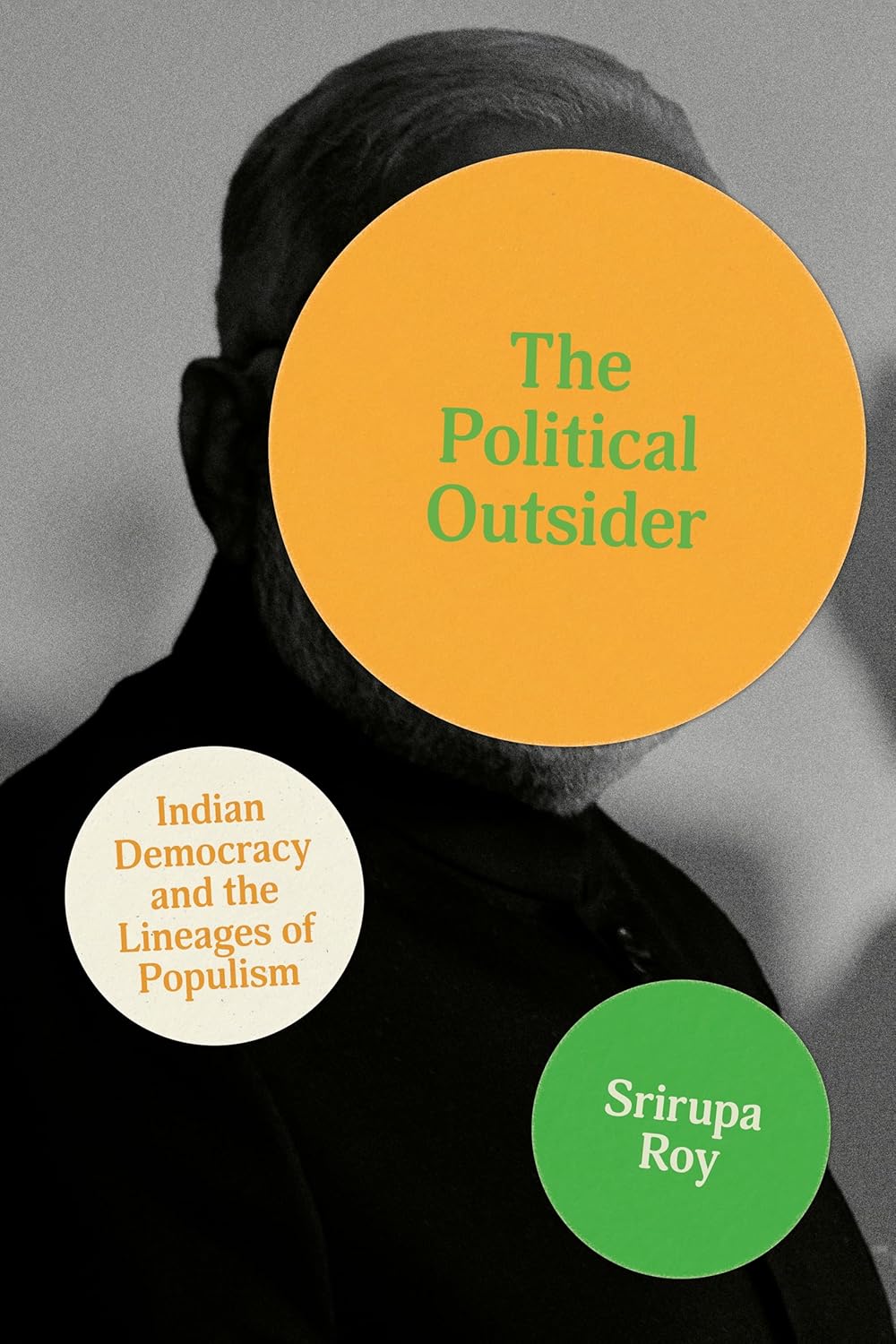
Populist movements in various countries, including India, the United States, Türkiye, Spain, and Brazil, mark a new direction in studying political science and democracy. One common characteristic of populism is the people’s opposition to the democratic system and practices, which tend to be established and benefit the political elite. An interesting question to discuss, in this context, is why populist movements are important for democracy. In the book entitled The Political Outsider: Indian Democracy and the Lineages of Populism, Srirupa Roy discusses and provides answers to this problem, especially regarding populism in India. Srirupa Roy is a professor of political science from India at the University of Göttingen. Roy argues that India is a country that is close to the practice of protest and opposition against the establishment of the political elite.
In this book, Roy not only reviews the classic issues about the populist movement but also makes an academic statement that was previously not explained in detail and completely. Roy argues that populism is also another form of electoral ideology or movement. How could it not be? Populism, supported by the power of the media, seems to have succeeded in creating hoaxes and false narratives to manipulate opinions, even the political choices of the people, from those who were initially against populism to those supporting populist parties. Roy begins his explanation of populism in India with the emergence of popular resistance against the state, which occurred en masse and on a large scale since the country gained independence from colonialism. At this point, Roy uses the terms reform and democratization to highlight the emergence of curative democracy to restore democracy after the colonial era. However, in several cases, Roy found the practice of intervention against curative institutions carried out systematically by political elites, complete with the support of several of their alliance groups. Thus, this book emphasizes the role of political outsiders, such as religious leaders, intellectuals, and community leaders, who are considered to have nothing to do with electoral political intrigue. Populism and its movements in India, explained by Srirupa Roy chronologically. In this book, Roy divides the topic into four key chapters. In the first chapter on new politics, Roy argues that the discourse of new politics, which focuses on anti-establishment, has become a political movement, which is typical in the dynamics of politics in India.
The second chapter of this book reviews transformational media. In this chapter, Roy explains how the media and its actors can worsen the quality of democracy in India. Now, Roy said, the news industry has changed its orientation to become like a traded good, like other commodities, which are sold and bought competitively. The impact is that the news media is no longer oriented towards objectivity and facts that occur in society. Far different from the liberalized media, Roy believes that the media has an important role in recording facts in a balanced, neutral, and objective manner, of course, by setting aside partisanship towards the interests of certain groups. According to Roy, this is so because the presence of the media is an alternative way to have an impact on social and political change.
In the third chapter, Roy describes the long emergency. In this section, Roy highlights the protests and criticisms of the Indian people towards the government about the problems and sufferings they have experienced for approximately 21 months, namely the state of emergency in India. This is related to the assumption that the state of emergency is also seen as a temporary state, even though it has deviated far from the orbit of politics and democracy in India. In this section, Roy admits that the state of emergency that occurred was not easy to prove because no key witnesses were found who could explain how the state of emergency was not followed by a sudden change of regime.
The fourth chapter describes outsider agency. In this book, Roy mentions that the discussion of outsider agency is the same as in the previous chapter because both produce deviant practices in the study of politics and democracy in India. Instead of restoring democracy, politicians in India tend to continue corrupt political practices, resulting in many bureaucrats who are not sincere in serving the community. Finally, this book contains a review of Crooked Line, which Roy also uses in providing a conclusion. As a replacement chapter for the conclusion, this section tries to reflect on why outsider agency and curative democracy should be discussed in as much detail as possible. Basically, the concept and practice of curative democracy explain two important things. First, this concept provides hope for a reformist political struggle and a special space for political improvement and change. Meanwhile, the next point illustrates that this concept provides legitimacy and political validity to outsider agencies as the main agents in the political democratization project.
One of the shortcomings of this book is that it tends to use academic manuscripts as the main source. The author seems to ignore sources such as interview documents, focus group discussions, and formal and non-formal letters, which often contain important information. This is because it takes more energy and effort to obtain important data about politics and democracy, which comes from correspondence that often occurs among political elites and may even occur in the concept of outsider agencies. As a result, several points are not explained in this book. Among them, what needs to be explained relates to integrating and aggregating all the people’s interests, which generally originate from problems of unrest felt by the community. This is why, what happens in political practice tends to say that political elites and outsider agencies seem to be fighting for improvements to the democratic and political system. This explanation is necessary and important to provide complete points related to democratization in India.
Nevertheless, this book has contributed to the process of political and democratic history, including studies on the concept of populism in India. The book’s strength lies in its systematic and in-depth explanations of each chapter, shaped by the author’s extensive experience in teaching and researching political science. Firstly, the book contains a variety of important terms and a collection of references from old to new. Secondly, each chapter contains key points and academic citations to attract the reader’s attention. Thirdly, the authors are meticulous in their presentation, demonstrating that the publication is wellpackaged to enhance the reader’s understanding. The book is well presented in the most appropriate language for the discipline of political science. Indian intellectuals should not miss the legacy of democratic thinking in resolving various social, political, legal, religious, customary, and historical problems. Srirupa Roy does so chronologically to highlight the populism that seems to be growing in the democratic system in India.