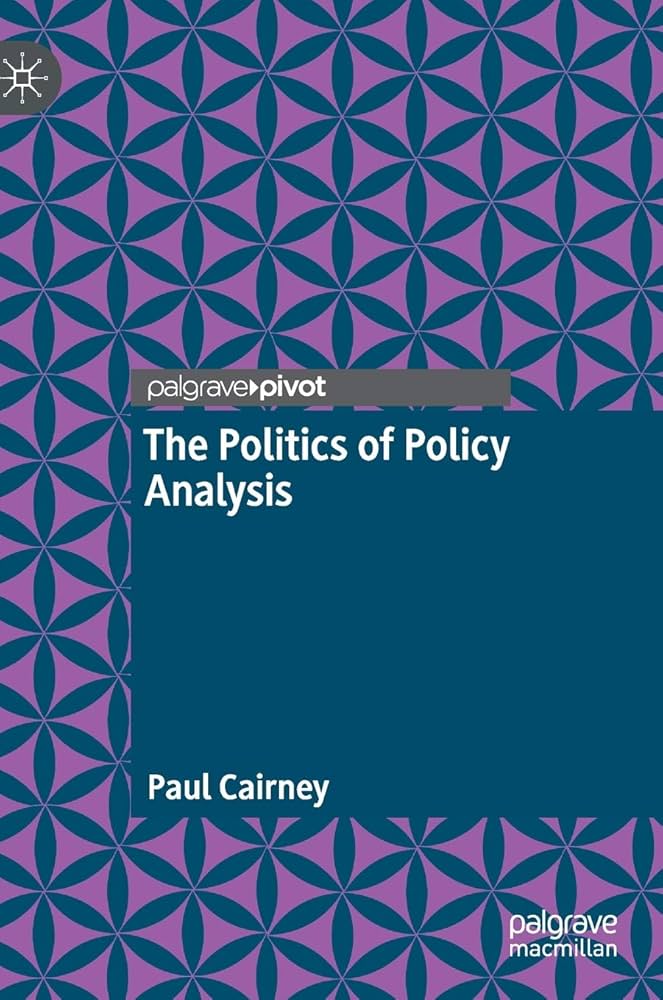
Paul Cairney’s The Politics of Policy Analysis discusses how policy analysis reflects the new political environment. As a professor of politics and public policy in the division of history, heritage, and politics at the University of Stirling, Cairney specializes in British politics and public policy. The book offers a broader perspective on the policy analysis process and critiques the classical five-step policy analysis method. According to the author, a five-step policy analysis represents pragmatic responses to solve political problems, but he points out that the approach remains far from providing a full understanding of the complexity of policy making. Also, classical five-step policy analysis methods are client-oriented, which limits your time, and freedom. Classic five-step policy analysis emphasizes technical and political feasibility, which means the perspective ignores the human aspect and misses the big picture.
The book consists of two main parts and 13 sub-chapters, with each sub-chapter written in an article format. It comprises of an abstract, keywords, introduction, discussion, and conclusion. Under part one, in the introduction, according to the book, policy analysis processes are divided into classical and new models. Classical policy analysis uses technical methods and political feasibility when forming a political solution. These tools are far from providing an understanding of the wider politics of policy analysis and the complexity of the policy process. Thus, the old ways of conducting policy analysis are gone, including analytical tools such as cost-benefit analysis methods. This book offers two ways to expand on policy analysis literature. The first new policy analysis process includes the role of psychology in communication, and the second combines power, co-production, feminism, racism, and decolonization.
The second chapter explains the classical five-step model for conducting policy analysis. The author uses Bardach and Patashnik as practical examples, as well as Dunn’s public policy, Meltzer and Schwartz’s problem-solving, Mintrom’s contemporary policy analysis models, and step-by-step, in detail, describes the methods of the policy-making process. Cairney also criticizes all classical policy analysis models. According to him, these five models are both client-oriented and include problem definition has a technical element but are limited to addressing power balances and politics. All classical policy analysis methods discuss a small number of policy solutions; the only difference is their perspective on cost and benefit analysis. Their main aim is to minimize cognitive load and make the problem seem soluble. The author gives guidance about an accurate and efficient policy analysis process and points out that policy analysts should watch out for such things as gathering evidence, communicating clearly and concisely, and ethics.
The third chapter explains the changing political environment and why policy analysts need new methods. Classic policy analysis texts highlight the client-oriented nature of policy analysis, but the new policy environment and changing policymaking processes require a new style, skills, and training. For the classic method, policymakers are generally inside the government, and they give only technical advice to solve policy problems; however, their recommendations are not suitable or feasible for real-world implementation. Modern policy analysis is more open to understanding the complexity of policymaking and political realities. According to the author, the new policy analysis process includes identifying the client, analyst, and required skills of policy analysts who can use economic and scientific techniques to analyze a problem and its solution. According to the author, there is no “best” way to conduct policy analysis because the process is chaotic and messy rather than neat and rational. Thus, policy analysts could focus on six activities for more effective results: research and analyze, design and recommend, clarify values and arguments, advise strategy, democratize, and mediate rather than follow the classical five-step methods.
The fourth chapter qualifies policy making psychology, policymaking environments, the new policy science, policy process theories, and how policy analysis might incorporate these components in policy analysis. The fifth chapter criticizes the five-step policy analysis perspectives, which are often rational and technical, to define problems and identify solutions. Five-step policy analyses help clarify political choices but ignore the human aspect and moral institutions. As a result, policy analysts could consider elements such as power, feminism, race, gender, and decolonization since beliefs, norms, and rules are significant factors as unspoken rules for the policy analysis process. Knowledge and how to use this knowledge is an important concept when creating a policy analysis strategy. Cairney also offers Bacchi’s six-step process to identify political problems.
The sixth chapter focuses on how policy analysis texts incorporate ethical and normative responses, such as being honest about the methods and calculations, presenting feasible solutions, engaging in problem definition, and clarifying the trade-offs between alternatives. New analytical strategies compromise the balance of responsibility to the client, answering client’s question with confidence and describing uncertainty. Flexible communication is also crucial when forming policies.
Part two, chapter seven, delves into what policymakers and analysts need to do their job effectively and what their expectations are. They generally use a stage-based model like the policy cycle, which includes agenda setting, formulation, legitimation, implementation, evaluation and maintenance, succession, or termination. Functional requirements of policy analyses use the five-step policy process and engage in the process. Policymakers use regulations, taxes, and sharing information as types of policy tools.
Chapter eight describes who should be involved in the process of policy analysis. The author answers this question by citing two approaches. First, according to evidence-based policymaking, only a small group of experts produces policy; second, according to co-produced policymaking, a large group of people is involved.
Chapter nine questions the role of the policy analyst during the policy process. Cairney asks two questions: What can you do, and what should you do? Answering these two questions frames the role of a policy analyst. Cairney believes that a policy actor needs to gather information, define the problem, select one way to interpret the problem, and use tools to solve the problem, such as political and technical feasibility.
Chapter ten analyzes the requirements needed to be a policy entrepreneur. According to the author, their basic attributes include ambition, social acuity, credibility, sociability, and tenacity. Besides, the policy environment has an important impact on the policy’s success. Chapter eleven identified the importance of systems thinking for policy analyses and gave examples such as complex systems, complex policy problems, complex policy mixes, socio-technical systems, and socio-ecological systems. The idea of systems thinking is a helpful tool to determine limits and borders, and also provides wider views and possible consequences in order to solve the problem.
Chapter twelve explains the impacts of policy analysis on analyst expectations. According to the book, analysts who are inside the government hope to give technical advice about policy formulation and solve problems via analysis and action. They aim for high direct impact and explain a lot of pragmatic forms of policy analyses and politically feasible solutions through their analyses.
The end of the book comprises of a conclusion and an annex section. Cairney emphasizes two important lessons. The first lesson is that the five-step policy analysis is pervasive, but it ignores emotions and moral institutions. Second, policymaking should adapt to the process’s complexity. The annex sums up all important information and the author’s criticism about the policy analysis process. The author directs the student to make efficient policy analyses.
The book analyses the politics of the policy process and guides the readers on how conduct efficient policy analyses. It comprises articles, all of which are concise and technical. Students at all levels can use the book to follow policy making processes step by step and conduct policy analyses. The message of this book is that the policy analysis process is a complex system that determines the impact of the solution. Before reading the book, readers should have knowledge about the classical five-step policy analysis methods so they can easily understand the provided articles. The author explains the process, actors, and impact of policy analyses in detail, and this book provides training on the politics of policy analyses for all relevant actors.