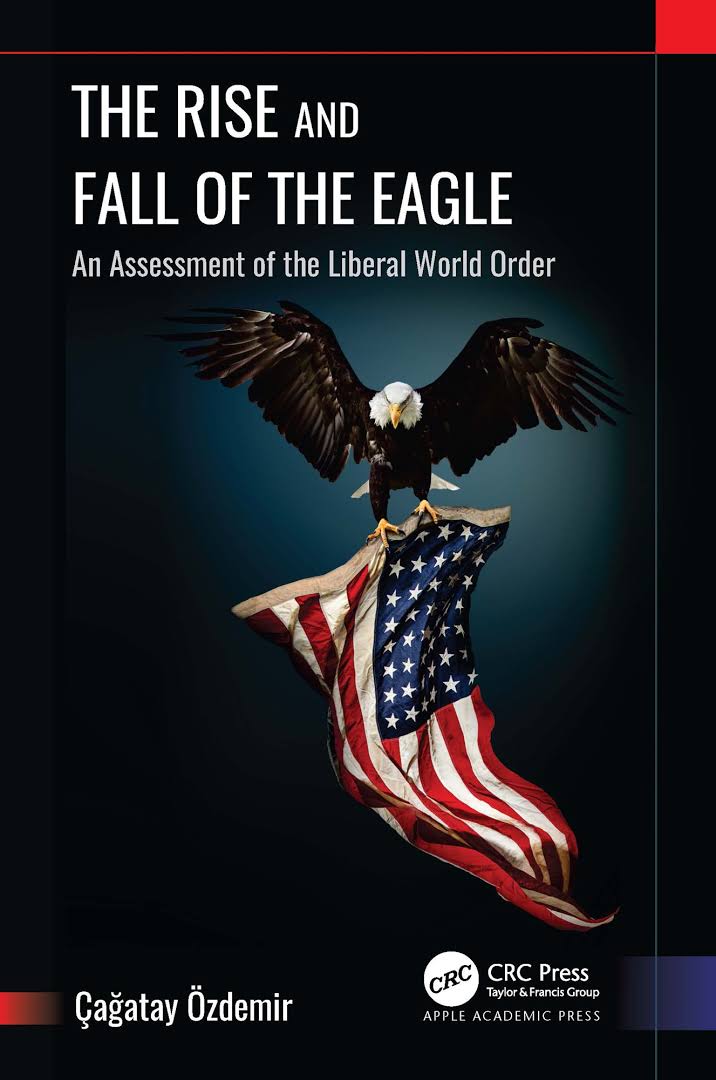
Çağatay Özdemir’s The Rise and Fall of the Eagle analyzes the liberal world order shaped by U.S. hegemony. The title itself is symbolic, invoking the bald eagle –America’s national emblem and a representation of power– to illustrate the trajectory of U.S. dominance in global politics. The author has a Ph.D. in International Relations from Marmara University and he is an expert on academic on America, the Middle East, and trans-Atlantic studies. The book contains a total of six chapters with an elaborate introduction and an articulate conclusion. It intricately explores the establishment of the liberal world order initiated and secured by the U.S. after World War II.
The author illustrates the structural factors that contributed to the formation of this liberal order. Özdemir starts by discussing the rise of U.S. hegemony during the Cold War, when two superpowers, the USSR and the United States, competed for global hegemony. This ideological and geopolitical struggle between the U.S. and the USSR, embodied by the economic systems of capitalism versus communism, defined much of the latter half of the 20th century. Additionally, the author reflects on the emerging potential of multipolarity, emphasizing global inclusivity, where rising powers also bear responsibilities.
Özdemir has woven the grid of events that took place during the Cold War, including the division of Germany, the Korean War, and the Vietnam War, as well as the arms race and various proxy conflicts in regions such as the Middle East and Eastern Europe (like Yugoslavia). The foundation of “Pax Americana” (p. 66) was built on the premise that communist authoritarian regimes were a threat to international peace. Hence, they needed to be contained and thwarted from entering the Western Hemisphere and other newly independent states. Throughout the Cold War, both the U.S. and the USSR continued their ideological warfare, constantly attracting states with enmities that could ensure the survival and security of weak states.
Accordingly, U.S. hegemony was steadily established over the years through security alliances, international financial institutions, and democratic rhetoric, all favoring the liberal paradigm. The U.S. unipolar moment following the fall of the USSR in 1991 was a boastful period, but the 1990s were a crucial decade. The U.S. faced criticism for not responding in a timely manner to conflicts in Yugoslavia and Rwanda. Later on, the “War on Terror” was another game-changing event in 2001 (p. 78). Associated with the Bush Doctrine, it defined the course of the next two decades of U.S. foreign policy. The real challenge began for U.S. hegemony after the 2003 Iraq invasion, which sparked significant criticism of the war and led to rising anti-American sentiment in the Middle East. Additionally, the roles of China and Russia are analyzed as key challenges to U.S. hegemony.
The author further scrutinizes that America’s emphasis on individualism and consumerism has led to the erosion of its collective sense of purpose and commitment to the common good. Özdemir also elaborates on the work of scholars who argue that the U.S. is experiencing a growing sense of seclusion and self-absorption, making the future of democratic liberalism increasingly uncertain. The author then traces the rise of the liberal order before discussing its dismantling, emphasizing various contributing factors such as the rise of populism, the role of political leaders, and anti-globalization forces.
The effects of COVID-19 are also discussed in the book, as the pandemic exposed the vulnerabilities and fault lines within the liberal international order. The pandemic not only impacted global institutions but also affected state politics, economics, and society as a whole. The pandemic became a catalyst against the liberal institutional regime, accelerating the rise of nationalist regimes and populist movements. The relationship between international events and domestic politics is also explored, and the author suggests that this dynamic has contributed to the decline of the liberal order, as populism and right-wing nationalism gained momentum in domestic politics.
This book offers an intricate analysis of successive U.S. presidents’ foreign and domestic policies, including George Bush, Barack Obama, Donald Trump, and Joe Biden. It examines the role of their policies in weakening, rather than strengthening, the U.S. position within the global system. The author highlights how events such as the outbreak of COVID-19 and the Russia-Ukraine war in 2021 have weakened liberal institutions. Additionally, the rise of cyber warfare has blurred the boundaries among states, opening up new domains of warfare and competition. Unilateral foreign policies and regional agendas have increasingly challenged traditional international cooperation and global governance norms. The rise of China has further challenged U.S. economic hegemony, as China now presents an alternative economic system to other states, effectively establishing a parallel global governance model. The author labels this approach as a “heterodox” brand of capitalism, presenting an alternative path to the Western model of capitalism and governance. The author argues, “A more inclusive order would need to be founded on a broader set of values that consider the diversity of cultures and political structures around the globe” (p. 227).
The book is an excellent resource for readers and scholars of international relations, political science and global politics as it offers details and analysis which allow the reader to attain a clear understanding of international politics. Özdemir, explores the various challenges faced by this order, which have gradually eroded its foundations, leading to its current decline. What sets this book apart is its approach to integrating historical events with theoretical perspectives, providing a deeper understanding of international politics. This approach allows the reader of international politics a clear edge in understanding the arguments through a theoretical lens.
Moreover, the author demonstrates expertise by drawing on the work of prominent international relations theorists, using their works as a foundation for analyzing the functioning, evolution, flaws, and challenges to the international order. The book offers valuable insights to understand the impact of global politics on the international system. It offers a thorough analysis of political events that have shaped contemporary international relations, with a particular focus on the rise of U.S. hegemony and the establishment of the liberal order through a theoretical and empirical evidence.