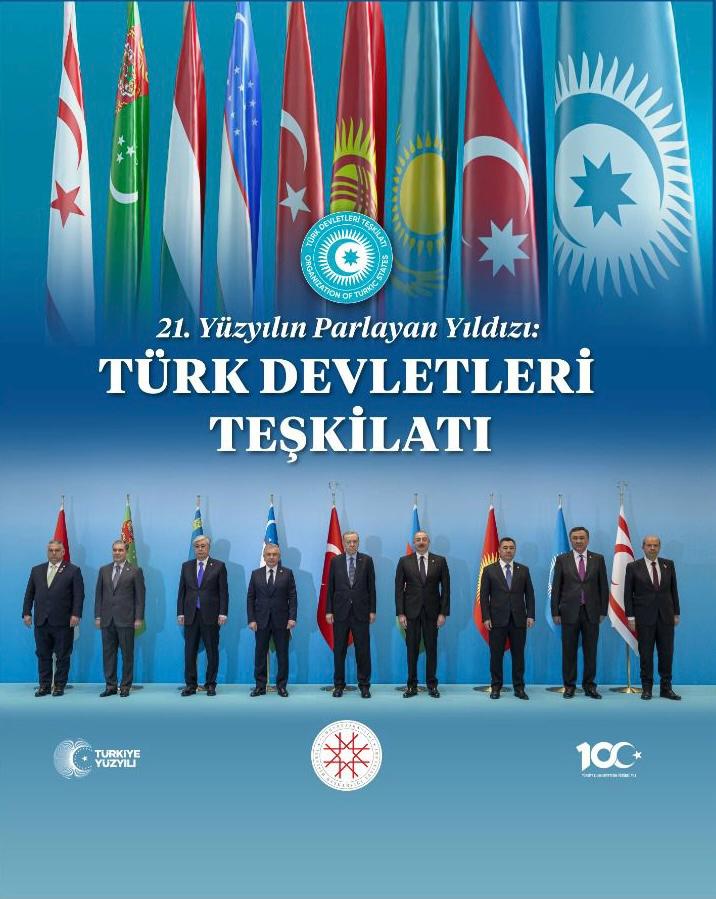
Globalization, multipolar international system and new economic initiatives in Eurasia, such as the Belt and Road Project, alongside the energy crisis between Europe and Russia and the emergence of new energy routes, have presented significant opportunities for the rise of the Turkic world. Initially, the Organization of Turkic States (OTS) focused on cooperation in the fields of culture and economy, known as low politics. Since 2010, however, it has expanded to include security and military cooperation, referred to as high politics. The integration process of OTS is progressing rapidly, and significant decisions are made annually. The introduction of OTS is crucial for Eurasia’s prosperity, security, and stability. Therefore, the book The Shining Star of the 21st Century: Organization of Turkic States, published by the Directorate of Communications of the Republic of Türkiye, aims to provide an essential introduction to OTS and its vital role in shaping the region’s future.
The book introduces the OTS, which plays a significant role in Türkiye’s foreign policy. The President of the Republic of Türkiye, Recep Tayyip Erdoğan, provides introductory remarks, discussing the construction of a common identity, shared interests, and mutual threats. Following the introduction, the book is divided into three main chapters. The first chapter explores the history and institutional framework of the OTS, detailing its summits and organizational bodies. Each summit is introduced individually, with a detailed explanation of the decisions made at these gatherings. Through these summits, the step-by-step institutionalization of relations between Türkiye and the Turkic Republics is clearly visible, illustrating the path leading to the establishment of the OTS. These summits established wide-ranging cooperation and partnerships, including economy, agriculture, industry, trade, politics, education, culture, sports, art, tourism, media, religion, foreign policy, infrastructure, mining, transportation, and communication. The most important breakthroughs that created integration among the Turkic states were decided at these summits. After the summits, the book introduces the organizational chart and the functioning of OTS. The duties and powers of the organs and sub-organizations of the OTS are explained in detail at the end of the first chapter.
The book’s second chapter, “Common Past and Strong Future,” summarizes the cooperation among Turkic states across 14 sectors. The first part of this chapter focuses on political and economic cooperation, highlighting the expansion of these relations into security and military areas starting in 2010. Türkiye provides military training and exports defense industry products to the Turkic Republics. Through this expansion, the Turkic Republics are not only enhancing their national military capacities but also strengthening their relations with their natural ally, Türkiye. This alliance is rooted in a shared identity, making Türkiye a closer partner than major powers like Russia and the United States. Furthermore, the book highlights the significant benefits that the Turkic Republics gained by strengthening their relations with Türkiye and OTS’s ability to take a common stance on regional and international problems. For example, in response to the reactions of the international public opinion during the Peace Spring Operation carried out by the Turkish Armed Forces in 2019, Turkic states stated that they were with Türkiye in its fight against terror and proved that Türkiye is not alone in the international arena.
In the third chapter, cooperation in the field of customs and transportation is analyzed. Developments such as the facilitation of transportation and shipping between Turkic states, the construction of the Digital Silk Road-Trans Caspian Fiber Optic internet line, the implementation of projects such as the Central Corridor passing through the Caspian Sea and the Zangezur Corridor that will connect Türkiye and Central Asia are explained. Furthermore, the book tackles cooperation in the field of energy. The construction of safe energy corridors transit through Türkiye that will enable the Turkic Republics, which are rich in underground resources, to export their energy to Europe is explained. In addition to these sectors, the book emphasizes cooperation in the fields of tourism, agriculture, education, space, media, culture, youth, and sports. In other words, it explains that Türkiye and the Turkic Republics have established and developed multidimensional relations.
The book’s final chapter, “All Together in Difficult Times,” emphasizes the unity demonstrated during crises. It highlights how Türkiye and the Turkic republics stand together, support one another, and overcome challenges during difficult periods. One of these crises was COVID-19. During this pandemic, Türkiye provided humanitarian aid such as money, medical supplies, and educated personnel in the Turkic Republics. Another significant crisis covered is the Second Karabakh War. The book emphasizes that Türkiye’s political, economic, and military support greatly aided Azerbaijan’s victory in this war. It underscores the importance of Türkiye’s advancements and exports in the defense industry and highlights Türkiye’s crucial role in the national security of the Turkic republics. The final section of this chapter discusses the February 6 earthquake, often referred to as the “disaster of the century,” and details the humanitarian aid provided by the Turkic republics during Türkiye’s time of need.
The book adequately summarizes essential information about all OTS member and observer countries, providing core knowledge for students interested in the Turkic World. It explains the OTS’ history, structure, and suborganizations effectively, making it a comprehensive resource. In my view, it serves as a very successful encyclopedia. The construction of Turkic identity is strongly emphasized throughout the book, both in President Recep Tayyip Erdoğan’s introduction and in the subsequent chapters. The book conveys the importance of Turkic identity and how this unity will provide strength. After reading this book, every young Turkish student will feel excited about the future of the Turkic World. Additionally, the book is enjoyable to read. It avoids boring the reader with long texts, including visuals from all summits since 1991, images of significant moments from the World Nomad Olympics, and historical photos. These visuals make the reading experience much more engaging.
In summary, this book is like an encyclopedia that you should always have on hand. I highly recommend it, especially to students and academics working on the Turkic World and Eurasia. A rising Turkic World in Eurasia will have a profound impact on the political and economic landscape of the Asian, European, and African continents. Therefore, preparing such a valuable book is immensely useful and timely.
In the other hand, when we look at the book critically, it is possible to see that an important issue can be included in the book. It is a section on the future of the OTS. Considering the Turkic World Vision 2040, the importance of the organization for Turkish history could be explained. It could be emphasized that for the first time in Turkic history, Turkic states are establishing such frequent and strong ties. Furthermore, it could be mentioned that the organization could be an important turning point not only for Turkic history but also for human history. A supranational organization that the Turkic states would establish by taking their relations to a higher level can be an example for many nations that have been fragmented and colonized, such as African nations. Additionally, the benefits OTS will provide regionally and globally in the future should have been mentioned. With the realization of the 2040 vision, the OTS is expected to have a key role in the energy corridors and trade routes of Eurasia in terms of its geopolitics. Explaining how important the OTS is for the stability, prosperity and security of Eurasia would be beneficial in understanding the future potential of the organization. Especially with the rise of Asia in the 21st century, OTS will play a much more important role in world politics. It is also important to note that such an organization would strengthen the hand of the revisionist group of states, including Türkiye and many other states, for the reform of the United Nations Security Council, which is monopolized by 5 permanent member states and is ineffective in ensuring world peace. Therefore, if a chapter discussing the positive effects of OTS on regional and global politics in the future had been added to the book, a much more useful work for international relations studies could have been produced.