
Introduction
During the Cold War era, global powers engaged in multifaceted confrontations in various locations, spanning from Korea and Vietnam to Cuba and Afghanistan. In the Afghan conflict, the U.S. and its allies backed insurgents against the Soviet intervention, while in Vietnam and Cuba, the Soviet Union supported forces resisting the American involvement. In Korea, the Soviet Union extended its support to North Korea and China, countering the efforts of the U.S. and its allies, who sent troops to the South against the Chinese intervention. Since the Cold War ended with the West’s supremacy and the emergence of the U.S. as the sole superpower, no such confrontations occurred in the 1990s and 2000s. The U.S.-led military intervention in Serbia in 1995 and 1999, or against Iraq in 1991 and 2003, unfolded without the involvement of any major power to challenge it. On the other hand, the U.S. and its allies did not take any steps to stop Russia’s military intervention in Georgia in 2008, as Russia had been gaining power since the mid-2000s, following Vladimir Putin’s assumption of the presidency.
This situation began to evolve in the 2010s when power struggles among global powers on the ground resurged. The U.S. intervened militarily in Syria’s civil war, which was triggered by the Arab Uprising, challenging Russia in its traditional sphere of influence. Yet the power struggle between these global players unfolded more notably in Ukraine. Aiming to forestall Western influence in Ukraine, Russia initially annexed Crimea in 2014 which in turn prompted European and U.S. sanctions against them. Subsequently, Russia’s broader aggression against Ukraine in 2022 escalated Western sanctions and elicited military support for Ukraine. With the intensification of the conflict, the Ukrainian front started to look increasingly like the Soviet invasion of Afghanistan. Confronted with conventional military challenges and financial constraints amid substantial U.S. and EU backing for Ukraine, Moscow began to hint at leveraging its nuclear arsenal to maintain the balance.
The escalation of tensions with Russia raises debatable implications for the U.S., which perceives China as its primary rival in the global power struggle and seeks to rally its European allies behind itself in countering Beijing. There existed a strong anticipation that Moscow’s aggressive policies of influence, spanning from its military interventions in Georgia in 2008 to its engagements in Syria, Ukraine, Libya, and other regions in North Africa and Eastern Europe, would be met with resistance. However, at this juncture, the U.S. and its allies were cautious about exerting excessive pressure on Russia, fearing it could potentially drive it closer to China in the overarching power struggle against Beijing, or worse, could result in an improbable risk of a nuclear confrontation. Despite these risks, the West stands to benefit from a policy of firmness in its stance against Moscow, aiming to contain Russia and prevent actions that could undermine the interests of the U.S. and the EU in Europe, the Middle East, and Africa. The course of the conflict in Ukraine will ultimately determine which of these outcomes materializes.
The Ukraine War is the first major conflict since the end of the Cold War that has directly pitted the two major nuclear powers, namely the U.S. and the Russian Federation, against each other
The main argument of this article is that the Ukraine War is the first major conflict since the end of the Cold War that has directly pitted the two major nuclear powers, namely the U.S. and the Russian Federation, against each other. In the struggle for influence in Ukraine, which Russia sees as a country of vital importance for its national security, the U.S.’ intensive support for the Zelensky Administration and its heavy sanctions against Russia have brought Washington and Moscow into conflict at a level never seen since the end of the Cold War. Therefore, this article argues that the impact of the Ukraine war on the international system has been enormous. As a close neighbor of Russia and an ally of the U.S., Türkiye is also affected by this war and the changes it has caused in the international system.
The International System and Russia’s Dilemma before the Ukrainian War
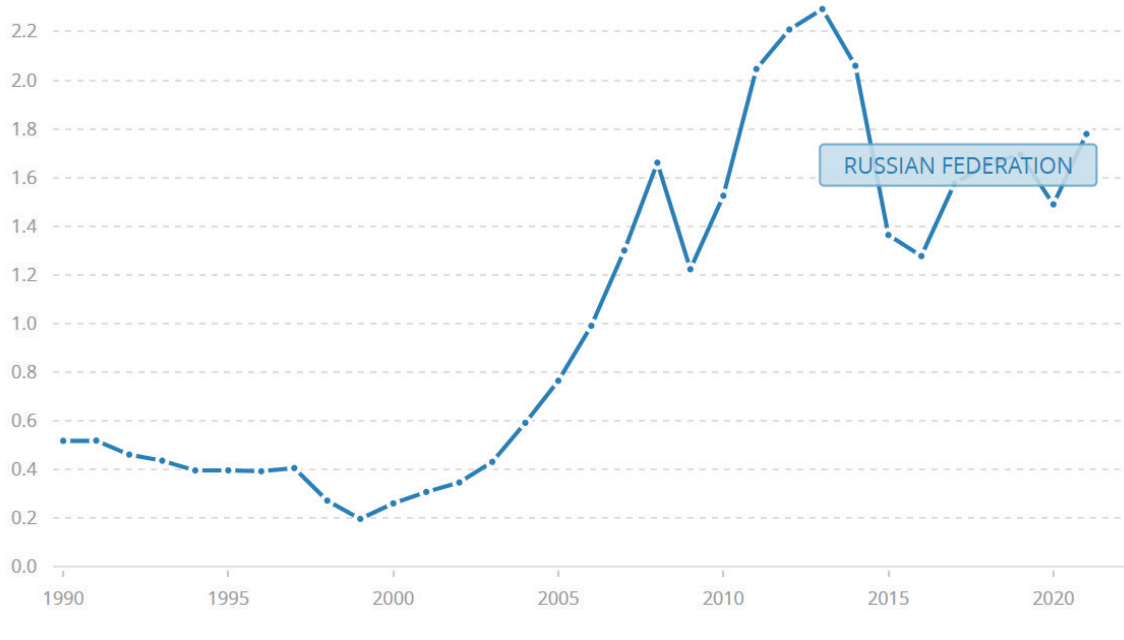
To comprehend Russia’s motivations in its Ukraine policy, it’s necessary to trace the evolution of the post-Cold War international political system. After losing ground in the geopolitical struggle of the 1990s, Russia, once one of the two superpowers during the Cold War, found itself in a drastically altered position. Despite possessing the largest nuclear arsenal globally, it also faced significant economic challenges and was in need of international economic assistance. By the year 1999, Russia had plummeted to the 22nd-largest economy globally, with a GDP of $195.9 billion, and in the same period, it lost to the West most Eastern European countries that were formerly within its sphere of influence. By 2004, nearly all of these nations had joined NATO and the EU. Moscow, uneasy with Western institutions encroaching upon its borders, initially lacked the capacity to impede these developments. However, Russia experienced substantial economic growth throughout the 2000s, elevating its GDP from $259.7 billion in 2000 to $1.6 trillion in 2008 (Graph 1). Consequently, Russia began to more vehemently oppose the eastward expansion of the U.S. and the EU.
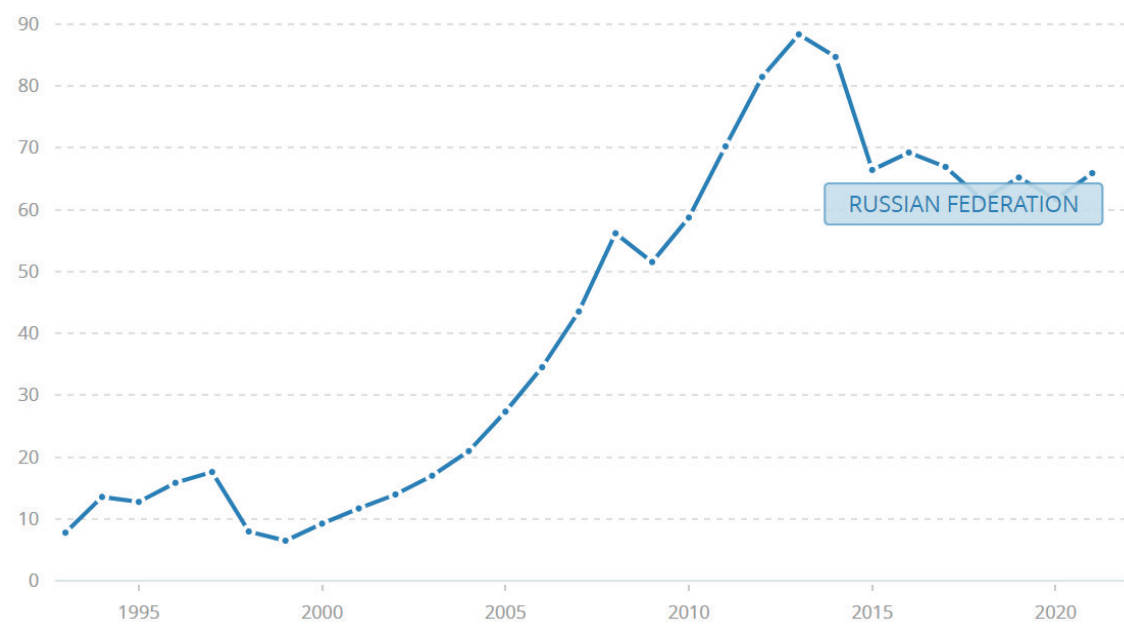
During the same period, Russia significantly ramped up its military expenditures, nearly sextupling its spending from $9.2 billion to $56.2 billion (Graph 2) and started to assert its military power and influence over Eastern European countries that had not yet become members of NATO and the EU to keep them within its sphere of influence. As a result, countries such as Georgia, Armenia, Azerbaijan, Ukraine, Belarus, and Moldova have been subjected to Russia’s economic, political, or military interventions.
Graph 1: Development of Russia’s GDP after the Cold War (Trillion Dollars)
Source: World Bank1
Graph 2: Russia’s Military Expenditures after the Cold War (Billion Dollars)
Source: World Bank2
The rapid expansion of Russia’s economy, mirrored by a parallel increase in its military expenditures, persisted throughout the 2010s. By 2013, Russia’s GDP had surged to $2.3 trillion, while its military spending reached as much as $88.3 billion. This robust economic growth, coupled with ongoing economic challenges facing EU countries stemming from the 2008/2009 global economic crisis, prompted the Putin Administration to adopt a more assertive foreign policy stance. This tougher approach manifested notably when Russia annexed Crimea in 2014 amid escalating tensions over influence in Ukraine vis-à-vis the EU. At this juncture, Russia supported separatist movements in the Donbas region with the objective of achieving its separation from Ukraine. In response to these aggressive actions, EU countries and the U.S. levied sanctions against Russia. The imposition of sanctions, coupled with the economic burdens of direct involvement in conflicts such as Syria and Libya alongside Ukraine, culminated in the cessation of Russia’s rapid economic growth in 2013, and its GDP contracted to $1.3 trillion in 2016.
During the global economic crisis, the refugee crisis, and the COVID-19 crisis, the EU’s behavior showed that it was unable to manage these crises effectively
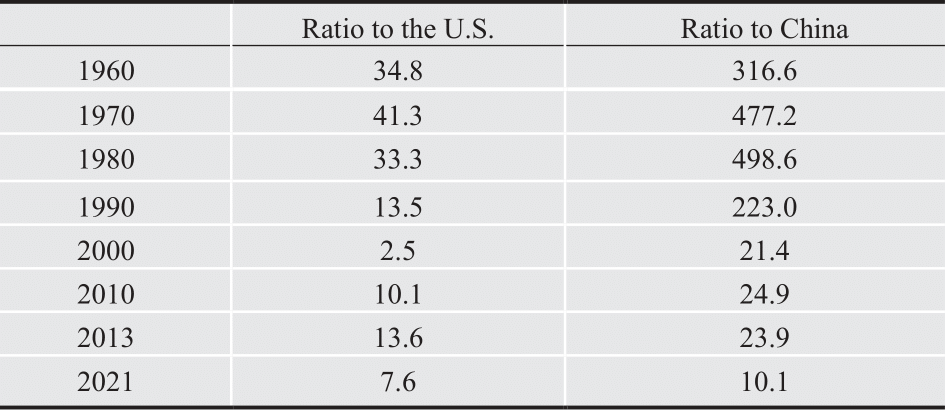
The core challenge for Russia lies in its significant lag behind the U.S. and China, the primary players in the global power struggle of the post-Cold War era. During the Cold War, the Soviet Union maintained an average output of approximately one-third that of the U.S. economy. However, Russia’s GDP dwindled to a mere 2.5 percent of the U.S.’ GDP by 2000 and experienced a rise to 13.6 percent in 2013, only to regress to 7.6 percent by 2021. Russia’s comparative decline in relation to China has been even more pronounced. While the GDP of the Soviet Union far surpassed that of China during the Cold War, the situation inverted from the 1990s onward. By 2000, Russia’s GDP had shrunk to a mere 21.4 percent of China’s, with Russia producing only one-tenth of China’s output by 2021 (Table 1).
Table 1: Ratio of Russia’s (Pre-1991 USSR) GDP to the U.S. and China (percent)
 Source: World Bank3
The reason for Putin’s aggression against Ukraine should be sought primarily in these figures. As Russia steadily lost ground in the global power struggle, Putin was particularly unsettled by former U.S. President Obama’s characterization of Russia as a “regional power” in a 2014 speech.4 Eager to demonstrate Russia’s prowess as a formidable global actor capable of resisting Western expansionism, Putin increasingly turned to a foreign policy that relied heavily on military means.
The decision-makers in Moscow likely thought that the fact that their country is one of the two largest nuclear powers in the world would act as a deterrent for countries that would want to help Ukraine
Several factors bolstered Putin’s resolve, ultimately culminating in the attempted invasion of Ukraine on February 24, 2022. Firstly, serious discord within NATO and the EU led the Russian leader to believe that the West would be unable to mount a unified, decisive, and effective response to Russia’s military intervention in Ukraine. Statements like French President Emmanuel Macron’s assertion that NATO was “brain dead”5 and former U.S. President Donald Trump’s characterization of NATO as an “obsolete” organization6 underscored the challenges within the West’s most critical military alliance.
Furthermore, tensions between the U.S., the leader of the alliance, during the Trump Administration and Germany, along with some other European members, over the latter’s low defense spending and its energy relations with Russia strained NATO’s cohesion. Additionally, frictions between the U.S. and Türkiye concerning support for the YPG/PKK terrorist organization, Eastern Mediterranean issues, and military and energy cooperation with Russia exacerbated rifts within NATO. Moreover, conflicts between Türkiye and Greece, as well as France, over Eastern Mediterranean affairs, were perceived by Moscow as indicators of NATO’s vulnerabilities. Similarly, discord between countries like Hungary and Poland, as well as Brussels, Berlin, and Paris, on various issues led Russia to consider the EU as an organization that lacked the capacity for concerted action on critical matters.
The failure of the EU and the U.S. to manage recent crises may have also encouraged Moscow to take action in Ukraine. During the global economic crisis, the refugee crisis, and the COVID-19 crisis, the EU’s behavior showed that it was unable to manage these crises effectively. In 2008, the global economic crisis, which started in the U.S., brought many countries in Europe, especially Greece, Italy, and Spain, to the brink of bankruptcy, and the economic contraction in some EU countries lasted until 2014, resulting in dramatic increases in unemployment rates. The failure to manage the economic crisis successfully, coupled with the massive influx of Syrian refugees in 2015, led to an extreme increase in xenophobia and refugee hostility in many European countries, and the rise of far-right parties that took advantage of this situation threatened the future of the EU. During this period, allegations that Russia was supporting these far-right parties both to increase instability within the EU and to use them as a useful tool to intervene in European politics became widespread.7
During the COVID-19 crisis, the EU also came to the fore with very poor crisis management.8 Problems with access to simple products such as masks, gloves, and respirators, EU countries confiscating each other’s masks, and similar sharing problems with vaccines pointed to a serious lack of coordination. Russia has also used the EU’s failure as an opportunity for a show of strength during this crisis, with Russian military vehicles appearing on the streets of Northern Italy to help Italy, which had a very difficult time in the first phase of the pandemic.10
One of the factors Putin took into account when he ordered the attack on Ukraine was undoubtedly the rupture in the international political system caused by the rise of Asia. There was an expectation in Moscow that the U.S. and the EU, which had to focus on the challenge from China, would refrain from escalating tensions with Russia too much over the Ukraine issue.11 Indeed, with its rapid growth, especially in the last 30 years, China was now the world’s largest power in terms of purchasing power parity GDP (PPP-GDP) and Asia had surpassed the West in the same measure. The “supremacy of the West,” which had been in place for nearly 250 years, had become more questionable than ever. The U.S. and the EU needed to focus on China and Asia, where the real challenge was coming from. But the West’s response to the Ukraine war was not at all what Moscow had expected.
Furthermore, another reason that pushed Russia to attack Ukraine, especially in the belief that the European reaction would not be so harsh, was the dependence of many European countries on natural gas from Russia. Some European countries were up to 100 percent dependent on Russian gas, even a country like Germany, which is very influential in shaping the EU, was seriously dependent on Russia for energy. In 2021, Germany imported “55 percent of its natural gas, 34 percent of its oil and 26 percent of its coal” from Russia.12 Putin believed that Central and Eastern European countries with this level of energy dependence on Russia would not dare to confront Moscow directly over the Ukraine aggression. However, it should be emphasized that the Russian leader was largely mistaken in this regard as well. While imposing heavy sanctions against Russia and providing military aid to Ukraine, the European countries in question quickly began to look for alternative energy suppliers despite their high costs.13 In this framework, they gradually banned imports from Russia in oil and coal,14 where it is relatively easier to find alternative suppliers, while buying large quantities from Russia to fill their natural gas reserves before Moscow shut off the natural gas valves.
Finally, another factor that needs to be taken into account when explaining Russia’s aggression against Ukraine is the former’s nuclear arsenal. The decision-makers in Moscow likely thought that the fact that their country is one of the two largest nuclear powers in the world would act as a deterrent for countries that would want to help Ukraine. It seems that they assumed that their conventional military power would be sufficient to defeat Ukraine and that the countries that would support Ukraine would be afraid of Russia’s nuclear power and would not cross a certain line. Although the talk of nuclear weapons by Russian leaders at different stages of war15 reflects these calculations, so far it seems that the threat of Russia’s nuclear weapons has not prevented Western countries from taking many steps to help Ukraine and sanction Russia.
The Effects of the Ukrainian War on the International System
The development of the war so far indicates that Russia has failed to achieve the results it had planned and has miscalculated in many respects. Ukraine has received support from Western countries beyond Moscow’s anticipation and is resisting more effectively than Moscow expected. The West’s military aid to Ukraine and strong sanctions against Russia have bolstered Ukraine’s military resistance, prolonging the war. As a result, there is increasing discussion about the possibility of Russia losing the war. With this possibility looming, various scenarios, including the use of nuclear weapons, are being considered.
At this juncture, the refusal of both Russia and Ukraine to relinquish control of Crimea and the Donbas region diminishes the prospects of a peaceful resolution to the conflict. Russia’s loss of control over these regions due to increased support from Western countries would undermine Putin’s authority. It remains unclear to what extent the Russian leader is willing to use nuclear weapons to prevent such a development. Consequently, the Ukrainian crisis poses a grave danger to the U.S., the EU, and Ukraine, which is supported by both the U.S. and the EU, as well as to Russia.16
Talk of the use of nuclear weapons in a war in which the U.S. is heavily supporting a European country fighting against the Russian occupation is the most important consequence of the Ukraine war for the international political system. Considering that the West’s military support for Ukraine is being upgraded every day, the risk of direct confrontation between the two major nuclear powers in this war is increasing every day. If Russia, whose conventional superiority is balanced by the arms aid to Ukraine, were to use nuclear weapons on Ukrainian soil to achieve its goal, Washington, which has been encouraging the Kyiv regime to resist, would be under great pressure.17 Nuclear-armed states have confronted each other before in wars similar to Ukraine’s in Korea, Vietnam, and Afghanistan. But neither Korea nor Vietnam was as important for the U.S. nor Afghanistan for the Soviet Union as Ukraine is for Russia today. The importance of Ukraine for Russia can be likened to the importance of Cuba for the U.S., where the Soviet Union tried to deploy nuclear-tipped missiles in 1962. Just as there was a risk of nuclear war in Cuba, there is potentially a similar risk in Ukraine. Therefore, a peaceful resolution of the Ukrainian crisis before it escalates further is crucial for the stability of the international system.
The alignment of European countries behind the U.S. during the Ukraine crisis has also served as a rehearsal for the global power struggle against China, which is expected to be more fierce
Another consequence of the war on the international political system is the deterioration of the relationship between the West and Russia to a level that is very difficult to repair. Since Putin’s ascent to power, Russia’s use of military force in Georgia, Crimea, and Syria has caused discomfort in Western countries. However, many EU countries, especially Germany and France, attempted to maintain relations with Moscow at a certain level. Those countries which were particularly dependent on Russia for energy were not taking steps to reduce their dependence. Despite criticism from Washington, Germany persisted in constructing the Nord Stream 2 pipeline, which would increase its reliance on Russian natural gas.18
However, Russia’s aggression against Ukraine in February 2022 profoundly shocked European countries and heightened serious security concerns, particularly in Eastern Europe. Putin’s aggression prompted even those European countries that had previously maintained the idea of cooperation with Russia to distance themselves from Moscow and work together with Washington. Almost all EU countries now view Russia not as a potential partner but as an aggressor threatening Europe’s security. It is important to emphasize that even if the Ukraine war reaches a peaceful resolution, the negative perception towards Russia is likely to persist for a long time.
It should be noted that the deepening of the threat perception of Russia in Europe directly impacts the NATO alliance and, consequently, the dynamics of the power struggle between the West and China, which is expected to intensify. The U.S., assuming a leadership role in response to Russian aggression, has also bolstered the Atlanticist wing within the EU. While the Atlanticists, who argue that Europe needs the U.S. for its defense and that NATO should remain the main actor in the European security architecture, have gained strength, the Europeanists, who argue that Europe should have its own security structure independent of the U.S., have remained in the background.
While the sanctions decided by the EU tried to make Russia back down in Ukraine by damaging its economy, the sanctions started to hit European countries with Russia’s countermeasures
The alignment of European countries behind the U.S. during the Ukraine crisis has also served as a rehearsal for the global power struggle against China, which is expected to be more fierce. Realizing once again their need for U.S. support against Russia, EU countries were compelled to align behind Washington in the competition against China. Germany, which has shown the most resistance in this regard, is expected to follow a similar path to China, just as it has backtracked on its Russia policy under pressure from Washington and the Atlanticists within the EU, as well as from the Greens and the FDP, the junior partners in its coalition government.19
From a short-term perspective, Germany’s decision to abandon its policy of balance and follow the U.S. in the aftermath of Russia’s aggression against Ukraine and to intensively increase its military expenditures may have important consequences for the global political system in the medium and long term. Berlin’s decision to increase its annual military expenditures above 2 percent of its GDP and its announcement that it plans to spend an additional €100 billion20 will make Germany, which is the world’s fourth-largest economy, the third largest military spender. This means that Germany’s political and military influence in the international system will increase in the medium and long term. The importance of Germany’s decision to arm itself is better understood when one remembers Berlin’s role in world politics in the 20th century, especially in the two world wars. There is a vast literature on Germany’s historical and economic capacity to influence the international system.21
The issue of energy supply and market security has also come to the fore in the context of Russia’s aggression against Ukraine. Following the harsh sanctions imposed by EU countries against Russia, Moscow cut off gas supplies to Europe in September, with some exceptions, the EU bans on coal and oil imports from Russia, and the attack on the Nord Stream gas pipelines in late September 2022 brought new debates on energy security. Given the importance of oil, natural gas, and coal export revenues for Russia and the fact that for many EU countries, Russian natural gas imports are a difficult energy source to replace, the disruption in the flow of these resources to Europe due to the war is significant. While the sanctions decided by the EU tried to make Russia back down in Ukraine by damaging its economy, the sanctions started to hit European countries with Russia’s countermeasures. The excessive increase in energy prices led to serious cost inflation, and austerity measures were put into effect due to concerns that there would not be enough energy to heat up in winter. Europe perceived that Russia was not a reliable supplier, and Russia perceived that Europe was not a reliable market.22
On September 26, 2022, explosions on the Nord Stream 1 and 2 gas pipelines in a large area bordering the Danish and Swedish Exclusive Economic Zone brought a different dimension of energy security to the agenda. The explosions, which caused serious damage to three of the four pipelines, resulted in both sides blaming each other after it was realized that the explosions were the result of a sabotage or attack. While there were numerous reports in the Western media blaming Russia for the sabotage23 and countries such as Poland and Ukraine accused Russia,24 Moscow claimed that Britain was behind the attack.25
Over time, the possibility that Russia could have carried out such a self-destructive attack weakened, while the Western media focused on the question of who was the real perpetrator of the attack.26 On February 8, Pulitzer Prize-winning American journalist Seymour Hersh’s claim that the U.S. was behind the attack caused a great resonance.27 Hersch’s claim that the bombs planted by American divers in the Nord Stream pipelines in cooperation with Norway were detonated on the orders of President Biden was denied by Washington and led to harsh accusations against the U.S. from Moscow. While Russian Parliament Speaker Wjatscheslaw Wolodin accused the American president and demanded reparations, saying that “Biden has written his name in history as a terrorist,”28 Foreign Minister Sergey Lavrov claimed that the U.S. had carried out this sabotage to spoil good relations between Russia and Germany and that American officials had confessed that they had carried out the attack.29 By this, Lavrov was referring to statements made by some American officials against the Nord Stream pipeline. At a Senate hearing on January 27, the American Under Secretary of State for Political Affairs, Victoria Nuland, said she was “very happy that Nord Stream 2 is now a piece of metal at the bottom of the sea.”30 U.S. President Biden had also stated that the Nord Stream 2 pipeline would be blocked if Russia attacked Ukraine.31 This confrontation of two nuclear powers over an attack on a natural gas pipeline from Russia to Germany means that a new door of conflict that will affect the future of the international system has been opened.
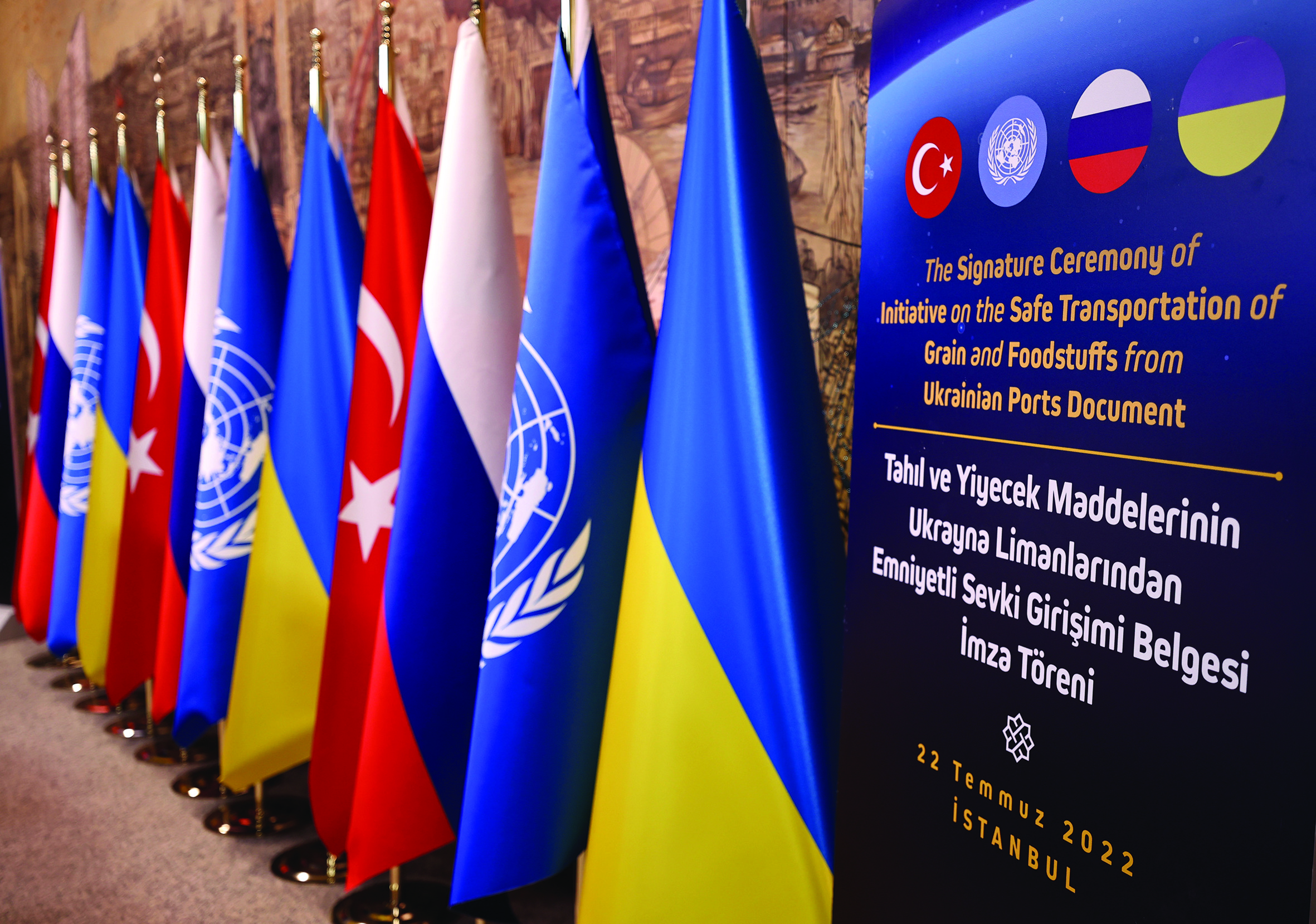
In addition to energy security, food security and the security of international trade routes have also come to the fore in the context of the Ukraine War. The war created obstacles for Russia and Ukraine, two of the world’s most important grain producers, to transport these products to international markets, which led to excessive increases in food prices on the one hand and the growing danger of hunger in many dependent countries on the other. Although this problem was largely eliminated with the Black Sea Grain Corridor Agreement32 signed on July 22, 2022 with Türkiye’s mediation and extended for 120 days on November 17, this crisis has once again demonstrated the catastrophic consequences of problems in which the suppliers of critical products are directly involved.33
Another important issue that the Ukraine war has raised for the international system is the reliability of the SWIFT system for international payments. The use of SWIFT sanctions as a weapon by the U.S. and EU countries34 has been seen before, but the fact that this weapon has targeted a major state like Russia has increased the desire in the non-Western world to develop an international payment system independent of the U.S. and European countries. Moscow and Beijing are increasingly looking for alternatives,35 and there have been reports that sanctions against Russia are an advantage for China.36 Russia and China were joined in their search for alternatives to SWIFT by other countries concerned about the West’s increasing use of this weapon.37 Taken together with the rise of Asia, these developments could undermine the West’s dominance in the international payments system in the near or the medium term.
Effects of the War on Türkiye
Türkiye has maintained its policy of balance, a stance it has pursued since AK Party came to power, during the Ukraine war. There are three significant reasons why Ankara chose this policy, despite the clear position taken by most NATO members in support of Ukraine against Russia. Firstly, recent heavy-handed interventionist and repressive policies by the U.S. and certain EU countries against Türkiye have hindered Ankara from aligning behind the U.S. in this conflict. Secondly, in its efforts to uphold an independent foreign policy amidst substantial pressure and sanctions from the West, Türkiye’s relationship with Russia -which it regards as an important balancing actor- has deterred it from openly opposing Russia in the conflict. Thirdly, as Mevlüt Çavuşoğlu, the Foreign Minister at the time, articulated during the initial phase of the war, Türkiye preferred a neutral stance and sought to play a facilitating role in achieving a peaceful resolution to the conflict between Russia and Ukraine.38 The fact that the foreign ministers of both countries met for the first time in Antalya in March 2022 under Türkiye’s mediation, and the Black Sea Grain Corridor Agreement was signed in İstanbul in July 2022, which had global significance, once again underscored the validity of Ankara’s policy choice.39
Despite Ankara’s neutral position since the beginning of the war, the Ukraine-Russia conflict has had significant effects on Türkiye
Despite Ankara’s neutral position since the beginning of the war, the Ukraine-Russia conflict has had significant effects on Türkiye. Primarily, the rise in energy and food prices resulting from the war has imposed a new burden on the Turkish economy, which has already been grappling with challenges stemming from its strained relations with Western countries and the adverse impacts of the COVID-19 pandemic. The price of a barrel of Brent oil, standing at $94 on February 24, 2022, when Russia attacked Ukraine, rapidly rose due to the war-related risks, reaching $128 by March 8, has shaken the budget balances of countries like Türkiye, which heavily rely on foreign oil and natural gas.
Although oil prices, which remained above $100 per barrel until the end of July, declined towards the end of the year, Türkiye’s expenditure on energy imports rose by 91 percent year-on-year to reach $96.5 billion in 2022.40 This steep rise in energy prices precipitated a rapid increase in inflation in Türkiye. The inflation rate surged from 54.4 percent in February, at the outset of the war, to 85.5 percent in October, causing considerable discomfort, particularly among those with fixed incomes. Moreover, the disruption in the flow of grains and oils from Russia and Ukraine to Turkish and global markets until Türkiye brokered the Black Sea Grain Corridor Agreement significantly contributed to the substantial inflation hike due to the exorbitant increase in the prices of these commodities.
Aside from triggering the highest inflation rates witnessed during the AK Party era in Türkiye through rises in energy and food prices, the war also had a significant impact on the volume of foreign trade between Türkiye and Russia. In 2022, Türkiye’s share in Russia’s foreign trade surged notably due to restrictions imposed on Russia’s trade with other countries by Western sanctions. Between 2021 and 2022, Türkiye’s share in Russia’s total imports rose from 2.26 percent to 4.68 percent, while its share in Russia’s exports climbed from 5.37 percent to 9.89 percent during the same period. As a result, Türkiye’s became Russia’s top export destination after China. A similar trend was observed in Russia’s share in Türkiye’s foreign trade. While Russia’s share in Türkiye’s total imports was 10.67 percent in 2021, it rose to 16.18 percent in 2022. Additionally, Russia’s share in Türkiye’s exports increased from 2.56 percent to 3.67 percent within the same timeframe.41 Consequently, Russia emerged as Türkiye’s largest trade partner in 2022.
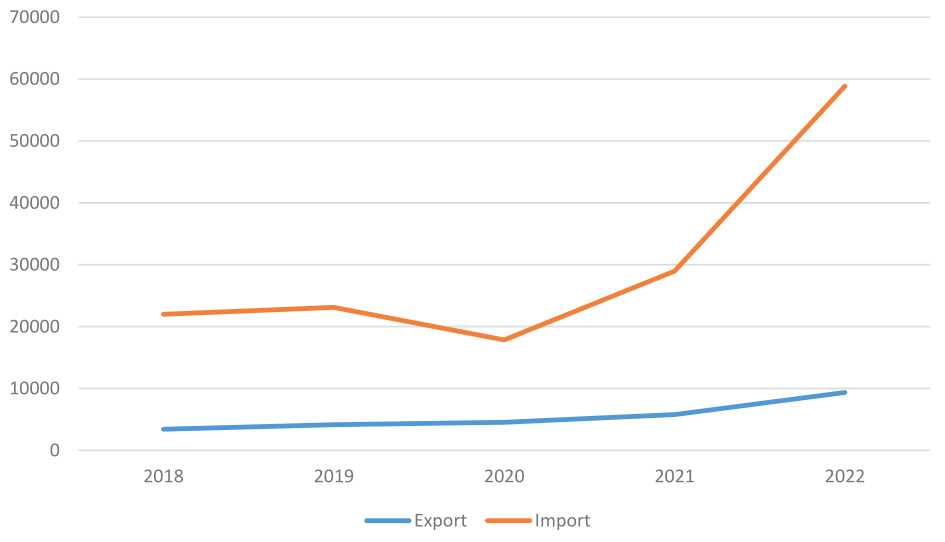
The rise in Türkiye’s imports from Russia by 103 percent in 2022, compared to 2021, to reach $58.8 billion (Graph 3), was directly linked to the effects of the Ukraine-Russia war. Türkiye notably increased its oil imports from Russia during a period when Russia encountered challenges in selling its energy due to the imposed sanctions, and many nations struggled to access energy resources. In 2021, Russia’s share in Türkiye’s total oil imports stood at 29.9 percent (13.3 million tons), which rose to 40.7 percent (19.3 million tons) in 2022. Concurrently, Russia’s share in Türkiye’s natural gas imports dipped from 44.8 percent (26.3 million Sm3) to 39.5 percent (21.6 million Sm3) during the same period.42 Türkiye’s energy import payments to Russia also rose by 203 percent in 2022, to rise from $13.7 billion to $41.6 billion.43 Also, the 62 percent rise in Türkiye’s exports to Russia in 2022 indicates that Russia has turned to Türkiye for certain products that it experienced difficulties in obtaining from other countries due to the war and the accompanying sanctions.
Graph 3: Development of Türkiye-Russia Trade (2018-2022, Million Dollars)
Source: Trade Map44
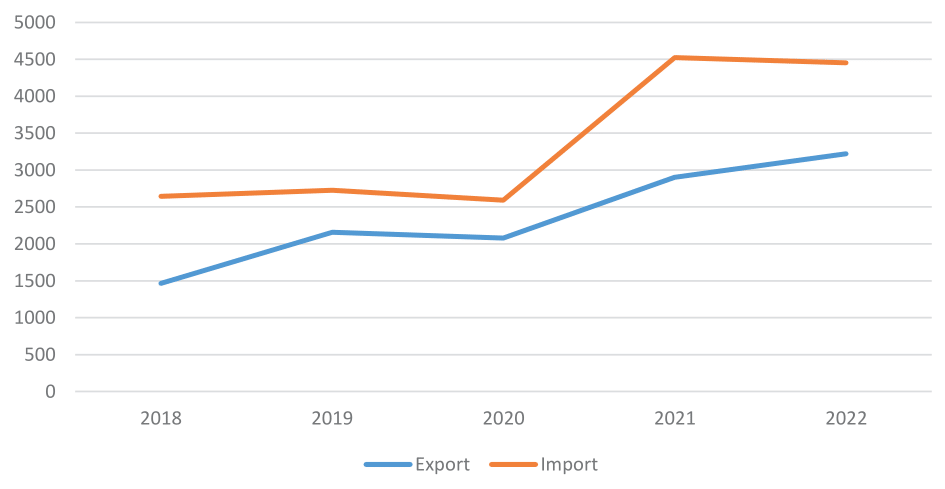
As for the impact of the war on Türkiye’s economic ties with Ukraine, there hasn’t been a comparable shift in relations as observed with Russia. In 2022, Türkiye’s imports from Ukraine experienced a slight decline of 1.6 percent compared to 2021, whereas Türkiye’s exports to Ukraine saw an 11 percent increase during the same period (Graph 4).
Graph 4: Development of Türkiye-Ukraine Trade, (2018-2022, Million Dollars)
Source: Trade Map45
Although there has not been a significant war-linked change in Türkiye’s trade with Ukraine, the sale of Unmanned Combat Aerial Vehicles (UCAVs) to Ukraine46 holds great importance in showing the progress of Türkiye’s defense industry and its approach to regional issues. Since 2019, Türkiye has supplied a considerable number of Bayraktar TB2 UCAVs to Ukraine. Ukraine’s effective utilization of these weapons against Russia during the conflict underscores Türkiye’s pivotal role in the arms trade within its vicinity.47 Following the use of Türkiye’s UCAVs in Syria, Libya, and Karabakh, influencing the course of conflicts, their deployment against Russia on the Ukrainian front has unsettled Moscow.48 However, as previously noted, the fact that although Türkiye sold these weapons to Ukraine, it significantly increased its trade relations with Russia, which motivated Moscow to maintain favorable relations with Ankara despite the sale of UCAVs.
The future development and conclusion of the war will be pivotal for both the international system and Türkiye’s policy of balance. From this perspective, three scenarios can be envisioned. Firstly, Russia might come to accept that it cannot secure a conclusive victory in its conventional war due to the robust Western support for Ukraine and that it is too risky to resort to nuclear weapons. As a result, Russia might opt to withdraw from some or all of the Ukrainian territories it occupied in exchange for assurances of significant autonomy. In this scenario Putin is doomed to failure. His failure to achieve his objectives in Ukraine, coupled with economic repercussions, could diminish Putin’s popularity at home and weaken Russia’s global stature. The weakened position of Russia would carry both positive and negative implications for Türkiye. As Russia is Türkiye’s regional rival in the Middle East and the Caucasus, a decline in Russia’s power would likely reduce its influence in these regions, potentially granting Ankara a strategic advantage. However, given Russia’s significance as a counterbalance to Western pressures in Türkiye’s foreign policy, its weakened position could complicate Türkiye’s balancing strategy.
Türkiye’s policy of neutrality has shielded its balance of power strategy from significant damage and has helped mitigate potential energy supply disruptions experienced by some European nations
In the second possible scenario, if Russia achieves most of its objectives in the Ukraine offensive, the international system could witness a shift characterized by relatively weaker Western countries and a stronger Russia and China. In such a scenario, the U.S. and Europe will be further discredited, after their failure in Afghanistan, for being incapable of providing the pro-Western government in Ukraine with the necessary support it needs. Consequently, the West might retreat its defense line against Russia from Ukraine to a line stretching from Romania to Poland and the Baltic states, amplifying security concerns in these countries and deeply eroding confidence in NATO and the EU. Should this scenario unfold, it would likely weaken the interventionist policies of the U.S. and European countries against Türkiye. Furthermore, in this case Moscow’s increased influence in the power struggle in the Middle East and the Caucasus could compel Ankara to emphasize its cooperation with Western countries in its balancing policy. The extent to which Russia and Western countries respect Türkiye’s sovereignty in their relations with Ankara will be another crucial determining factor in this regard.
In the less likely third scenario, if Russia suffers a clear defeat in the war, significant consequences would likely unfold for both the country and the international system. Putin’s loss of power could plunge Russia into profound instability, or in an effort to avoid such a scenario, Putin might resort to the limited use of nuclear weapons. In either case, the response of the West would be pivotal for the future trajectory of the international system. If Putin were to lose power, Western nations that adeptly manage this transition could potentially foster closer relations with Russia, akin to the era under Yeltsin. If the process following Putin’s potential loss of power is not managed effectively by the West, Russia could descend into chaos or fall under the influence of China, both scenarios posing significant risks for the U.S. and European countries. Moreover, the prospect of this process escalating to involve the use of nuclear weapons, as mentioned earlier, presents even greater dangers for Western nations and the international system at large.
From Türkiye’s perspective, the destabilization of a major neighboring country like Russia would inflict serious harm on Türkiye. Türkiye has firsthand experience with the repercussions of neighboring countries like Iraq and Syria descending into chaos. While Russia’s destabilization might afford Türkiye a relative advantage in regions competing with Russia for influence, the economic and security losses stemming from such instability would far outweigh any gains. Furthermore, the prospect of Russia weakening and falling under the sphere of influence of the West or China would complicate Türkiye’s policy of balance.
Conclusion
Russia’s aggression in Ukraine has already left a significant imprint on the international system by precipitating a confrontation between two major nuclear powers, sparking energy and grain crises leading to hyperinflation, and fostering solidarity within the Western alliance by prompting European nations such as Germany to forsake their policy of balance and align themselves more closely with the U.S.49 Depending on the evolving dynamics of the war, these effects are likely to intensify. Growing apprehensions regarding the occupation of Eastern European countries by Russia, energy and food security concerns, and the potential use of nuclear weapons have been frequent topics of discussion in the international media since the war’s onset. The fact that the U.S. finds itself indirectly engaged in a conflict with Russia while prioritizing the broader global struggle against China represents a pivotal development for the future of the international system, especially in light of Asia’s ascent. How Washington navigates this conflict with Russia in the future and whether it will emerge stronger or weaker from this struggle will be pivotal for the trajectory of the broader confrontation with China, which poses the real challenge to the existing global order.
Türkiye has opted to maintain a neutral stance in the ongoing struggle between the U.S. and Russia as the major power in its longstanding policy of balance practiced for over a decade. The problems and collaborations it experienced in recent years with both the U.S., European countries, and Russia have been instrumental in shaping Ankara’s policy choice. Türkiye’s stance also aimed to position itself as a mediator in peace efforts between Russia and Ukraine while averting potential counter-sanctions from Russia. Despite declaring neutrality and abstaining from joining Western sanctions against Russia, Türkiye has unequivocally expressed support for Ukraine’s territorial integrity and has even supplied combat-effective UCAVs to this country. Thus far, Türkiye’s policy of neutrality has shielded its balance of power strategy from significant damage and has helped mitigate potential energy supply disruptions experienced by some European nations. The extent of the war’s impact on Türkiye in the forthcoming period will largely hinge on the trajectory of the conflict itself.
Endnotes
1. “GDP (Current US$) - Russian Federation,” World Bank, retrieved December 29, 2023, from data.worldbank.org/indicator/NY.GDP.MKTP.CD?end=2021&locations=RU&start=1990.
2. “Military Expenditure (Current USD),” World Bank, retrieved December 29, 2023, from https://data.worldbank.org/indicator/MS.MIL.XPND.CD?end=2021&locations=RU&start=1993.
3. “GDP (Current US$)-Russian Federation, United States, China,” World Bank, retrieved December 29,
2023, from data.worldbank.org/indicator/NY.GDP.MKTP.CD?end=2021&locations=RU-US-CN&start=
1960; Kemal İnat and Melih Yıldız, “Will the Rise of China Transform the International System?,” Insight Turkey, Vol. 23, No. 4 (2021), p. 242.
4. “Obama Calling Russia a Regional Power Is ‘Disrespectful’–Putin,” The Moscow Times, (January 12, 2016), retrieved from https://www.themoscowtimes.com/2016/01/12/obama-calling-russia-a-regional-power-is-disrespectful-putin-a51414; Scott Wilson, “Obama Dismisses Russia as ‘Regional Power’ Acting out of Weakness,” The Washington Post, (March 25, 2014), retrieved from https://www.washingtonpost.com/world/national-security/obama-dismisses-russia-as-regional-power-acting-out-of-weakness/2014/03/25/1e5a678e-b439-11e3-b899-20667de76985_story.html.
5. “NATO Alliance Experiencing Brain Death, Says Macron,” BBC, (November 7, 2019), retrieved from https://www.bbc.com/news/world-europe-50335257.
6. “Trump: NATO ‘Obsolete,’ Brexit a ‘Great Thing,” France 24, (January 16, 2017).
7. Benjamin Bidder, “Russlands Rechte Freunde,” Der Spiegel, (February 4, 2016), retrieved from https://www.spiegel.de/politik/ausland/russland-wladimir-putins-rechtsextreme-freunde-in-europa-a-1075461.html; Andrew S. Weiss, “With Friends Like These: The Kremlin’s Far-Right and Populist Connections in Italy and Austria,” Carnegie Endowment, (February 27, 2020), retrieved December 29, 2023, from https://carnegieendowment.org/2020/02/27/with-friends-like-these-kremlin-s-far-right-and-populist-connections-in-italy-and-austria-pub-81100.
8. Tobias Käufer, “Europa – Das Wahre Corona-Desaster,” Die Welt, (October 15, 2020), retrieved from https://www.welt.de/politik/ausland/plus217924076/Globaler-Vergleich-Europa-das-wahre-Corona-Desaster.html.
9. “Lieferung Für Italien: Tschechien und Polen Kassierten Angeblich Masken und Beatmungsgeräte Ein,” Kurier, (March 22, 2020), retrieved from https://kurier.at/politik/ausland/corona-lieferung-fuer-italien-polen-und-tschechien-kassieren-masken-und-beatmungsgeraete-ein/400789163; “Der Impfstoff-Streit Verschärft Sich,” FAZ, (March 22, 2021), retrieved from https://www.faz.net/aktuell/wirtschaft/eu-und-grossbritannien-streit-um-corona-impfstoff-verschaerft-sich-17257415/boris-johnson-hebt-die-daumen-17257426.html; “Impfstoff Ungerecht Verteilt? EU Droht Neuer Streit,” T-Online, (March 13, 2021), retrieved from https://www.t-online.de/nachrichten/ausland/id_89647124/corona-impfstoff-ungerecht-verteilt-eu-droht-neuer-streit.html. For the acceleration of great power competition after COVID-19 and its effects on the EU, see: Burhanettin Duran, “The Future of Global Great Power Competition after the Coronavirus,” Insight Turkey, Vol. 22, No. 2 (Spring 2020), pp. 79-92.
10. Yaroslav Trofimov, “Viruspolitik at Play as Moscow Sends Soldiers to Help Italy,” The Wall Street Journal, (March 31, 2020), retrieved from https://www.wsj.com/articles/russian-soldiers-in-italy-contain-the-coronavirus-and-mark-a-political-shift-11585647002; Andres Wysling and Markus Ackeret, “From Russia with Love: Putin Bohrt Seinen Propaganda-Spiess in Die Weiche Nato-Flanke,” Neue Zürcher Zeitung, (April 15, 2020), retrieved from https://www.nzz.ch/international/coronavirus-italien-putins-propaganda-mit-hilfsaktion-in-bergamo-ld.1551922; Ellen Ivits, “Russland Schickt Corona-Hilfe nach Italien – Was Sich Putin Davon Verspricht,” Stern, (March 27, 2020), retrieved from https://www.stern.de/politik/ausland/coronavirus--was-sich-russland-von-der-hilfe-an-italien-verspricht--9198832.html.
11. Marwan Bishara, “Putin’s Five Fatal Mistakes in Ukraine,” Al Jazeera, (October 6, 2022), retrieved from https://www.aljazeera.com/opinions/2022/10/6/putins-five-arrogant-mistakes.
12. Kemal İnat, “Savaşın Yıldönümünde Almanya’nın Ukrayna Politikası,” Kriter, Vol. 7, No. 76 (February 2023), retrieved from https://kriterdergi.com/dosya-ukrayna/savasin-yil-donumunde-almanyanin-ukrayna-politikasi.
13. Kemal İnat, “Almanya ‘Kışı Atlatmak’ için Körfez’in Kapısında,” Anadolu Ajansı, (September 26, 2022), retrieved from https://www.aa.com.tr/tr/analiz/almanya-kisi-atlatmak-icin-korfez-in-kapisinda/2694763.
14. “EU-Embargo Für Russisches Öl Tritt in Kraft,” FAZ, (December 5, 2022), retrieved from https://www.faz.net/aktuell/politik/eu-embargo-fuer-oel-aus-russland-tritt-in-kraft-18511279.html; “EU-Embargo Auf Russische Kohle Ist in Kraft Getreten,” Der Spiegel, (August 11, 2022), retieved from https://www.spiegel.de/wirtschaft/unternehmen/importverbot-eu-embargo-auf-russische-kohle-ist-in-kraft-a-d0d7c6dd-0c92-47d3-9c0d-1ad068834444.
15. Carlo Martuscelli, “Top Russia Official Threatens West with ‘Global Catastrophe’ over Weapons to Ukraine,” Politico, (January 22, 2023), retrieved from https://www.politico.eu/article/top-russia-official-vyacheslav-volodin-threatens-west-with-global-catastrophe-over-weapons-to-ukraine-war/; Jessie Yeung and Katharina Krebs, “Ukraine War Is Going to ‘Take a While,’ Putin Says as He Warns Nuclear Risk Is Increasing,” CNN, (December 8, 2022), retrieved from https://edition.cnn.com/2022/12/07/europe/putin-ukraine-russia-nuclear-intl-hnk/index.html; Kristin Ven Bruusgard, “How Russia Decides to Go Nuclear,” Foreign Affairs, (February 6, 2023), retrieved from https://www.foreignaffairs.com/ukraine/how-russia-decides-go-nuclear.
16. Andres Gannon, “If Russia Goes Nuclear: Three Scenarios for the Ukraine War,” CFR, (November 9, 2022), retrieved from https://www.cfr.org/article/if-russia-goes-nuclear-three-scenarios-ukraine-war; Masha Gessen, “Why Vladimir Putin Would Use Nuclear Weapons in Ukraine,” The New Yorker, (November 1, 2022), retrieved from https://www.newyorker.com/news/our-columnists/why-vladimir-putin-would-use-nuclear-weapons-in-ukraine.
17. Gannon, “If Russia Goes Nuclear: Three Scenarios for the Ukraine War.”
18. Daniel Brössler, “Merkel Verteidigt Einigung im Streit um Nord Stream 2,” Süddeutsche Zeitung, (July 22, 2021), retrieved from https://www.sueddeutsche.de/politik/gaspipeline-einigung-kritik-ukraine-1.5360519; Matthew Karnitschnig, “Why Merkel Chose Russia over US on Nord Stream 2,” Politico, (July 26, 2021), retrieved from https://www.politico.eu/article/vladimir-putin-german-chancellors-nord-stream-russia-energy-angela-merkel/.
19. İnat, “Savaşın Yıldönümünde Almanya’nın Ukrayna Politikası”; Nikolas Busse, “Scholz in China – Nicht den Russland-Fehler Wiederholen,” FAZ, (November 4, 2022), retrieved from https://www.faz.net/aktuell/politik/ausland/scholz-reise-nach-china-den-russland-fehler-nicht-wiederholen-18437131.html; Wilfried Jilge, “Deutsche Russlandpolitik: Die Lehren aus dem Scheitern,” FAZ, (December 11, 2022), retrieved from https://www.faz.net/aktuell/politik/die-gegenwart/deutsche-russlandpolitik-die-lehren-aus-dem-scheitern-18526904.html.
20. “Olaf Scholz Kündigt 100 Milliarden Euro Zusätzlich für Bundeswehr an,” Die Zeit, (February 27, 2022), retrieved from https://www.zeit.de/politik/deutschland/2022-02/olaf-scholz-ukraine-luftraum-bundeswehr; Maria Sheahan and Sarah Marsh, “Germany to Increase Defence Spending in Response to ‘Putin’s War’ – Scholz,” Reuters, (February 27, 2022), retrieved from https://www.reuters.com/business/aerospace-defense/germany-hike-defense-spending-scholz-says-further-policy-shift-2022-02-27/; Guy Chazan, “How War in Ukraine Convinced Germany to Rebuild Its Army,” Financial Times, (May 23, 2022), retrieved from https://www.ft.com/content/a9045654-f378-4f42-a012-e35f9e43b135.
21. Kemal İnat, “Birleşme Sonrasında Almanya’nın Dış Politikası: ‘Normalleşme’nin Son Adımları,” Bilgi, No. 1 (June 2009), pp. 1-38.
22. “German Chancellor Scholz publicly Brands Russia an Unreliable Gas Supplier,” Yahoo News, (July 24, 2022), retrieved from https://news.yahoo.com/german-chancellor-scholz-publicly-brands-070200923.html?; Kate Connolly, “German Chancellor Says He Is Working Fast to Find Alternatives to Russian Gas,” The Guardian, (August 22, 2022), retrieved from https://www.theguardian.com/world/2022/aug/22/germany-chancellor-visits-canada-russian-gas-energy-olaf-scholz; “Kreml: ‘Russland Bleibt Maximal Zuverlässiger Lieferant,’” Süddeutsche Zeitung, (June 20, 2022), retrieved from https://www.sueddeutsche.de/wirtschaft/gas-kreml-russland-bleibt-maximal-zuverlaessiger-lieferant-dpa.urn-newsml-dpa-com-20090101-220620-99-730281.
23. Florian Niederndorfer and Alicia Prager, “Deutscher Experte Sieht Russland Hinter Anschlag auf Nord-Stream-Pipelines,” Der Standard, (September 28, 2022), retrieved from https://www.derstandard.at/story/2000139497876/deutscher-experte-sieht-russland-hinter-anschlag-auf-nord-stream-pipelines?limit=all; “Was Für Russland als Täter Spricht – Und Was Dagegen,” Der Spiegel, (September 30, 2022), retrieved from https://www.spiegel.de/politik/deutschland/nord-stream-anschlag-operation-seebeben-a-2525d727-a892-4781-89b7-34cd5d1ecae3?sara_ref=re-xx-cp-sh.
24. “Neue Spekulationen Uber Anschlag auf Nord Stream,” Exxpress, (December 27, 2022), retrieved from https://exxpress.at/neue-spekulationen-ueber-anschlag-auf-nord-stream-russland-beginnt-mit-reparatur/.
25. “Kreml Wirft Briten Pipeline-Anschläge Vor,” Tagesschau, (October 29, 2022), retrieved from https://www.tagesschau.de/ausland/europa/russland-vorwurf-nord-stream-explosion-101.html; “Großbritannien Wirft Russland ‘Glatte Lüge’ Bei Vorwürfen zu Nord Stream-Explosionen Vor,” Der Spiegel, (October 29, 2022), retrieved from https://www.spiegel.de/ausland/ukraine-news-iran-will-mit-kiew-ueber-drohnen-vorwuerfe-sprechen-a-fa1d7e33-3d06-453a-abc0-ee7786907dc7.
26. “Keine Belege Für Russische Sabotage an Pipelines,” Stern, (February 4, 2023); Sergey Vakulenko, “Shock and Awe: Who Attacked the Nord Stream Pipelines?” Carnegie Endowment, (September 30, 2022), retrieved December 29, 2023, from https://carnegieendowment.org/politika/88062.
27. “US-Journalist Sieht USA Hinter Nord-Stream-Sabotage,” Der Spiegel, (February 9, 2023), retrieved from https://www.spiegel.de/ausland/russland-duma-sprecher-wjatscheslaw-wolodin-bezeichnet-joe-biden-als-terroristen-a-b5b14034-ec08-47ce-90b1-6810be9c6828.
28. “Moskau Bezeichnet Biden als ‘Terroristen’,” NTV, (February 9, 2023), retrieved from https://www.n-tv.de/politik/Moskau-bezeichnet-Biden-als-Terroristen-article23904811.html.
29. “Lawrow: USA Geben Beteiligung an Nord-Stream-Explosionen zu,” RT Deutsch, (February 12, 2023), retrieved from https://de.rt.com/international/162720-lawrow-usa-geben-beteiligung-an/.
30. “Top US Official Hails Nord Stream 2 Blast,” RT, (January 27, 2023), retrieved from https://www.rt.com/news/570572-nuland-celebrates-nord-stream-blast/.
31. “Biden Droht Mit Aus Für Nord Stream 2, Falls Russland Ukraine Angreift,” Die Zeit, (February 7, 2022), retrieved from https://www.zeit.de/politik/ausland/2022-02/usa-olaf-scholz-joe-biden-pk-ukraine-krise.
32. Kaan Bozdoğan, “Tahıl Koridoru için İmzalar Atıldı,” Anadolu Ajansı, (July 22, 2022), retrieved from https://www.aa.com.tr/tr/gundem/tahil-koridoru-icin-imzalar-atildi/2643424; “Tahıl Anlaşması Uzatıldı, Türkiye’ye Övgü Yağdı,” TRT Haber, (November 18, 2022), retrieved from https://www.trthaber.com/haber/gundem/tahil-anlasmasi-uzatildi-turkiyeye-ovgu-yagdi-724382.html.
33. İlkay Dellal, “Tahıl Koridoru Anlaşması’nın 3 Önemli Etkisi,” Anadolu Ajansı, (December 2, 2022), retrieved from https://www.aa.com.tr/tr/analiz/tahil-koridoru-anlasmasinin-3-onemli-etkisi/2753756.
34. Markus Frühauf, “SWIFT als Waffe,” FAZ, (May 4, 2022), retrieved from https://www.faz.net/aktuell/finanzen/sanktionen-gegen-russland-swift-als-waffe-18005641.html.
35. Sven Hilgers, “China und Russland: Kommt Jetzt Die Anti-Dollar-Koalition?” Friedrich Naumann Stiftung, (April 22, 2022), retrieved December 29, 2023, from https://www.freiheit.org/de/suedost-und-ostasien/china-und-russland-kommt-jetzt-die-anti-dollar-koalition; Huileng Tan, “China and Russia Are Working on Homegrown Alternatives to the SWIFT Payment System,” Business Insider, (April 29, 2022), retrieved from https://www.businessinsider.in/politics/world/news/china-and-russia-are-working-on-homegrown-alternatives-to-the-swift-payment-system-heres-what-they-would-mean-for-the-us-dollar-/articleshow/91168432.cms; Bernhard Seyringer, “Digital Yuan Setzt Auf Russland,” Wiener Zeitung, (January 19, 2023), retrieved from https://www.wienerzeitung.at/h/digital-yuan-setzt-auf-russland#:~:text=Ein%20Jahr%2C%20nachdem%20China%20den,von%20Chinas%20digitaler%20W%C3%A4hrung%20gerichtet.
36. Andreas Nölke, “Abkopplung Russlands Von Swift: Vorteil China,” Börsen Zeitung, (February 25, 2022), retrieved from https://www.boersen-zeitung.de/banken-finanzen/abkopplung-russlands-von-swift-vorteil-china-6891e294-9614-11ec-bc8c-14469fb372ce.
37. Günter Mainhold, “Von BRICS zu BRICS+: Suche Nach Allianzen und Neuer Identität,” Stiftung Wissenschaft und Politik, (July 27, 2022), retrieved December 29, 2023, from https://www.swp-berlin.org/publikation/von-brics-zu-brics-suche-nach-allianzen-und-neuer-identitaet.
38. “Dışişleri Bakanı Mevlüt Çavuşoğlu’ndan Rusya Ukrayna Savaşı Açıklaması: Türkiye Taraf Tutmak Zorunda Değil,” Sabah, (March 1, 2022), retrieved from https://www.sabah.com.tr/dunya/disisleri-bakani-mevlut-cavusoglundan-rusya-ukrayna-savasi-aciklamasi-turkiye-taraf-tutmak-zorunda-degil-5890947.
39. Burhanettin Duran, “Ukrayna Krizinde Türk Diplomasisi,” Kriter, Vol. 6, No. 67 (April 2022), pp. 6-8.
40. “Türkiye’nin Enerji Faturası 2022’de Yüzde 91 Arttı,” Enerji Günlüğü, (January 31, 2023), retrieved December 29, 2023, from https://www.enerjigunlugu.net/turkiyenin-enerji-faturasi-2022de-yuzde-91-artti-52683h.htm.
41. “Trade Map,” International Trade Centre, retrieved December 29, 2023, from https://www.trademap.org/Index.aspx.
42. EPDK, retrieved December 29, 2023, from https://www.epdk.gov.tr/.
43. “Dış Tıcaret İstatistikleri,” TUİK, retrieved December 29, 2023, from https://biruni.tuik.gov.tr/disticaretapp/menu.zul.
44. “Trade Map,” International Trade Centre, retrieved December 29, 2023, from https://www.trademap.org/Index.aspx.
45. “Trade Map,” International Trade Centre, retrieved December 29, 2023, from https://www.trademap.org/Index.aspx.
46. Muhammed Ayyıldız, “Ukrayna’ya 50 Adet Bayraktar TB2 Teslimatı,” SavunmaSanayİST, (June 30, 2022), retrieved December 29, 2023, from https://www.savunmasanayist.com/ukraynaya-50-adet-bayraktar-tb-2-teslimati/.
47. “Ukrayna’da Bayraktar SİHA’larının Başarı Sırrı Ne?” DW Türkçe, (March 17, 2022), retrieved from https://p.dw.com/p/48eYW.
48. “Rusya: Ukrayna’nın Türk SİHA’larını Kullanması Ülkenin Doğusunda İstikrarsızlığa Yol Açabilir,” BBC Türkçe, (October 27, 2021), retrieved from https://www.bbc.com/turkce/haberler-dunya-59067531.
49. Burhanettin Duran, “Ukrayna’da Savaşın İkinci Evresi,” Kriter, Vol. 7, No. 68 (May 2022), pp. 6-8.