
Introduction
The Alliance of Sahel States (AES), comprising Mali, Burkina Faso, and Niger, is a coalition of neighboring Sahelian nations that have recently experienced coup d’états and have decided to establish a confederation among themselves. The military takeovers in these countries were accompanied by notable events. For instance, the military juntas’ seizures of powers were met with massive and forceful anti-France protests compelling France to withdraw from these territories. Subsequently, the three nations defected from the Economic Community of West African States (ECOWAS). In addition, the hoisting of Russian flags signaling dissatisfaction with the presence of Western countries like France and the United States (U.S.) and a search for alternatives was another significant event that occurred, precisely in Niger.
It is within the context of exploring other alternatives outside the West that Türkiye’s strengthening of relations with these countries is simultaneously strategic and challenging. Strategic in the sense that both the Alliance and Türkiye hold promise for mutual benefit in diverse ways. It is, however, challenging given the heightened expectation from Türkiye compared to these countries’ earlier engagement with external actors like France and the U.S. Besides, these Sahelian countries maintain strong relations with China and Russia, both also having vested interest in the region. However, Türkiye, as a prominent NATO member, is considered a more favorable candidate compared to China or Russia, which typically operates in the Sahel via its private mercenaries like the Wagner Group.
In his geopolitical Heartland Theory, Halford Mackinder (1904) argues and explains how controlling some parts of the world, specifically Eurasia, could lead to wielding power over the entire globe.1 The theory originally framed Eurasia as the geographical pivot of history and the heartland due to its location and abundance of natural resources. He, therefore, theorized that whoever controls the heartland rules the world.2 Despite the contentious nature of the theory, it gained prominence during the ‘great power politics’ and continued to shape the geopolitical engagements of various nations worldwide in diverse ways.3 As a result, countries like China, Russia, and the U.S. have deepened their ties with different regions, particularly Africa. Türkiye, as a key player in global affairs, is no exception when it comes to engagement with different geographies for strategic reasons.
Türkiye has effectively combined both hard power instruments and soft power elements in appropriate measures towards achieving desired outcomes in diverse contexts in Africa
The concept of the “Century of Türkiye” frequently cited in recent political discussions within Türkiye, among other connotations, serves to signify the nation’s celebration of its 100th year since the proclaiming of the Republic in 1923 and the need for it to project itself and its shrewdness as an experienced centenarian in current global affairs, in terms of its foreign policy and diplomacy.4 As a result, taking inspiration from the Heartland Theory (and simultaneously challenging it) rather than attempting to control the entire world by controlling a particular region, as the original theory posits, Türkiye is positioned to assume larger roles in both its regional and global relations. While the original idea behind the theory remains relevant in understanding geopolitics, there is a growing challenge to the notion of dominating specific geography as a means of gaining global dominance.5
As such, countries can now leverage the theory to selectively engage in influential roles in certain geographies for strategic reasons it envisages beyond mere global dominance. In this regard, one of Türkiye’s global ambitions is to engage the African region in a strategically multifaceted way. Türkiye’s engagement with the African continent, like many other countries’ engagements with the continent, could be explored via the Heartland Theory. The involvement of Türkiye in the Sahel region of Africa forms part of a broader strategic engagement with Africa. This engagement reflects regional dynamics marked by security cooperation, economic initiatives, and diplomatic influence, as Türkiye seeks to solidify its presence in response to recent developments, especially the formation of the Alliance.
While the Heartland Theory could be utilized in exploring Türkiye’s strategic interest in the Sahel region geopolitically, Türkiye’s approach and the content of its engagements in the region, particularly the membership of the Alliance, could be explored within the smart power paradigm. Smart power refers to an appropriate combination of hard power instruments and soft power elements at the right moment or context toward achieving a desirable foreign policy outcome.6 As sophisticated as the concepts may appear, Türkiye has effectively combined both hard power instruments and soft power elements in appropriate measures towards achieving desired outcomes in diverse contexts in Africa. The efficacy of smart power lies in recognizing that neither hard nor soft power alone is sufficient in the complex global geopolitical environment. Instead, a blend of both −tailored to the specific context and objectives− can be more effective.
The concept emphasizes the need for a balanced approach that utilizes the strengths of both strategies to achieve sustainable and favorable outcomes in global affairs. In this regard, manifestations of Türkiye’s hard power instruments in dealing with these three Sahelian states are already noticeable in terms of its military operations, supplies, and security cooperations, together with active economic engagements. This is well augmented with diplomacy, cultural exchanges, and humanitarian assistance, among other projects that fall outside the categorization of hard power but could be well placed within the soft power domain. Inasmuch as the smart power paradigm illustrates well Türkiye’s foreign policy tools, it must be emphasized that engaging the Sahel trio as a unit accentuates defense and security matters, thereby overshadowing other spheres of engagement, regardless of their relevance.
The paper critically evaluates Türkiye’s burgeoning relations with the three countries at the forefront of the Alliance, aiming to provide a preliminary comprehensive insight into Türkiye’s overall engagement with them as a collective entity and the implications for Türkiye, particularly its engagement with the West African region in relation to other external actors interested in that geographical area. This will be done through analyses of various official documents such as agreements, memoranda, and cooperation documents between the Alliance states and Türkiye particularly those focusing on security issues, economic engagements, and cultural/humanitarian endeavors. This would be augmented with secondary data on these three segments of the engagement.
The paper takes the view that while Türkiye’s relations with these countries have been burgeoning in the last decade in various spheres, the new approach of engaging with the trio under the auspices of the Alliance presents a strategic opportunity that could situate Türkiye as one of the prominent actors, if not the prominent actor, in the Sahelian region. Yet because these countries are ruled by military juntas and the alliance comes as a direct defiance of ECOWAS, engaging the alliance presents Türkiye with a weighty obligation that when not shouldered tactically, could become an insurmountable challenge. This challenge may not only be experienced by Türkiye’s engagement with the Sahel region but also in its engagements in the wider continent. The subsequent sections of the article will first discuss a generic overview of the relations with the African continent and the Sahel region especially the three countries in focus. The nuances of the relations in terms of security and defense issues, economic engagements, and humanitarian/cultural exchanges between these countries and Türkiye are also discussed.
Contemporary Engagements with the Alliance of Sahel States
Türkiye’s engagement with Africa dates back to the Ottoman era, particularly through its relations with the Northern parts of the African continent.7 A few decades after declaring itself a republic, it expanded its relations within the continent to include other African regions. Although Türkiye has experienced numerous ebb and flow in its relationship with post-independent African states since the 1960s, it has been steadily growing and strengthening its relations with the continent since 2005, as marked by increased diplomatic, economic, and humanitarian efforts.8 Embassies have been established across the continent by Türkiye, including in the Sahelian countries, and have been involved in various development and humanitarian projects.9 However, it should be noted that Türkiye’s relations with other African regions like North Africa and East Africa are significantly larger than its interaction with the Sahel. Particularly, its successes in Libya and Somalia have served as a model for other African countries building trust and having confidence in Türkiye.10
Within the context of Türkiye’s relations with the Sahel States Confederation, the countries’ connections date back to their independence, but the engagements have intensified recently through the establishment of diplomatic missions, economic relationships, security, and military cooperation. Türkiye and Niger established formal diplomatic relations shortly after Niger gained independence from France in 1960. However, the relationship has significantly deepened in the past decade. Türkiye opened its embassy in Niamey, Niger’s capital, in early 2012, while Niger opened its embassy in Ankara later that same year.11 Likewise, Türkiye and Burkina Faso established formal diplomatic relations in the early post-independence period of the West African country. However, recent engagements by both nations have been remarkable. In 2012, Türkiye established its embassy in Ouagadougou, the capital of Burkina Faso. In reciprocity, Burkina Faso inaugurated its embassy in Ankara in 2014.12 This diplomatic presence has strengthened bilateral relations and facilitated regular diplomatic dialogues. Similarly, Türkiye and Mali established formal diplomatic relations after Mali gained independence in 1960. However, the relationship began to intensify significantly in recent years, particularly under the leadership of President Recep Tayyip Erdoğan. Similarly, the establishment of Türkiye’s embassy in Bamako, the capital of Mali, in 2010 was reciprocated by Mali with the opening of its embassy in Ankara in 2014.13 These embassies have played a crucial role in facilitating diplomatic, economic, and cultural exchanges between the two countries. Prior to the establishment of the recent alliance, there was a noticeable development in the relationship between Türkiye and the confederation membership.
Within the context of Türkiye’s relations with the Sahel States Confederation, the countries’ connections date back to their independence, but the engagements have intensified recently through the establishment of diplomatic missions, economic relationships, security, and military cooperation
However, the Confederation, comprising Niger, Burkina Faso, and Mali, represents a new geopolitical development in the Sahel as well as the wider Africa region. This alliance aims to strengthen security cooperation economic integration and foster political solidarity among its member states. It emerged in the context of openly expressed discontentment with France as well as the U.S., which led to their withdrawal from these countries and contributed to the rise of military rule in these three nations. It also represents a form of contestation against the existing regional bodies. Despite this, Türkiye has maintained a strong relationship with both ECOWAS and AU and has held observer status in the AU since 2005.14 This offers Türkiye both an opportunity as well as added responsibility in enhancing relations with other African nations whilst dealing with the Alliance. Although Türkiye has shown keen interest in the security dynamics of the Sahelian region for an extended period, these security concerns have never taken precedence over other dimensions of the interaction, such as economic, humanitarian, or cultural exchanges.
Türkiye has imparted military training and supplied military equipment to these nations in their combat against terrorism and insurgency, particularly in the context of the ongoing conflicts in the Sahel. The establishment of a federation comprising these Sahelian countries would afford Türkiye the opportunity to engage these countries in a single forum and as a unified entity. However, this entails the responsibility of ensuring that Ankara does not only extend maximum support towards achieving the motives behind which the federation was formed but also ensures that such objectives are achieved within reasonable boundaries of the regional dynamics, especially with respect to the federation’s relations with regional blocs like AU and ECOWAS. Furthermore, considering Türkiye’s broader interests in the region, it would be advantageous to advocate for the enhancement of good governance and sustainable development. Türkiye might need to deliberate on endorsing and advocating for the upholding of human rights along with a broader democratic dispensation and accountability, bearing in mind that the response from the Alliance members may not be entirely predictable. All these take place in the presence of other influential actors like China and Russia, who are also keen to strengthen and push their strategic interests in the region as well, particularly in defense and security. The subsequent passages would explore Türkiye’s relations with the Alliance countries within the confines of security, economy, and cultural and/or humanitarian activities.
Defense and Security Engagements
The Alliance countries are seeking to collectively address security-related challenges afflicting the region, including those posed by extremist groups and transnational criminal networks operating within the Sahel and its ungoverned spaces.15 These could be addressed comprehensively when tackled collectively as a region. Dealing with extremist groups and some of the ongoing conflicts in the region may require a confederation that might focus on joint military efforts, intelligence sharing, and coordinated responses to mitigate some of these security threats. Türkiye’s existing military cooperation with these countries could be leveraged to support this new regional security framework. In its engagement with Mali, considering its security challenges, particularly in the context of the ongoing conflict in the Sahel, Türkiye has provided military training and assistance to Malian forces. This cooperation aims to enhance Mali’s ability to combat terrorism and maintain internal security. Both have signed agreements on defense and security cooperation, which include training programs, logistical support, and the provision of military equipment and intelligence sharing.16 This is part of Türkiye’s broader engagement in supporting security in the Sahel region. In January 2024, Mali purchased six Bayraktar TB2 drones in addition to its purchase in March of the previous year.17 This additional purchase was not surprising, as the Malians have indicated satisfaction with the drones’ performance. As a result of the satisfaction with the performance of the drones, the Malian leader towards the end of 2023 awarded the leaders of the Bayraktar company with Malian national order in recognition of their contribution to Mali’s security.18 Besides, on August 6, 2024, a high-level military assembly took place in Bamako, attended by senior military officials from both nations. During this gathering, Türkiye restated its unwavering dedication to collaborating with Mali in matters concerning defense and security.19
Similarly, Türkiye has offered military training and assistance to Burkina Faso’s armed forces. This collaboration is intended to enhance Burkina Faso’s capabilities to combat terrorism and stabilize the region.20 In April and May 2022, Burkina Faso took delivery of the five drones, consisting of Bayraktar’s TB2 and Akıncı drones it had purchased from Türkiye. These drones were reportedly used to neutralize a number of Ansaru Dine and Jama’at Nusrat al-Islam wal Muslimeen (JNIM) members during the Djibo military installation attack in 2023.21 As if by a domino effect, the Chief Executive Officer (CEO) of the Baykar company was again awarded a state medal in Burkina Faso by President Ibrahim Traore for his outstanding and exceptional contribution to the country’s peace, security, and counter-terrorism efforts.22
Despite Niger’s strategic location in the Sahel region, it has been plagued by terrorist activities. Türkiye, in its engagements with Niger, has offered military training and assistance to Nigerien forces to help bolster their capacity to combat terrorism and maintain regional stability. The two countries have signed military cooperation agreements that include training programs, logistical support, and the provision of military equipment.23 In the summer of 2022, Niger also took delivery of six Turkish Bayraktar TB2 it purchased from Türkiye.24 These drones were used to improve Niger’s surveillance and precision strike capacity to enable it to fight diverse threats bedeviling the country. Clearly, there is ongoing cooperation between the alliance membership and Türkiye, which both parties could easily build on in terms of defense and security.
Although Türkiye has shown keen interest in the security dynamics of the Sahelian region for an extended period, these security concerns have never taken precedence over other dimensions of the interaction, such as economic, humanitarian, or cultural exchanges
However, the Confederation represents an interesting juncture in the respective members’ relations with Türkiye. Türkiye relations with various countries in the continent have been viewed to mainly focus on diplomacy, trade, humanitarian, and cultural activities, with inevitably, security on the fringes as the preceding activities could only succeed in a safe and secure environment. Indeed, it’s been argued that even Türkiye’s engagement in the security sphere is to help secure its economic interests with the economic engagement being the main target and not merely a security provider or guarantor.25 This assertion is strongly challenged by the Alliance formation and its expectation of Türkiye to assume a pivotal role in the area of defense and security as indicated by respective defense and security agreements signed with Türkiye. By engaging these countries as a group, military and security engagement have been automatically projected to be at the center stage of the relationship, relegating trade and humanitarian issues to the fringes.
Türkiye has, in the post-Arab Spring or the past decade, attempted to explore and extend into other geographies for a number of reasons. This is due to the fluctuating nature of its relationship with some of its strategic partners in other regions. Türkiye’s relations with the West, especially the U.S., in the past decade especially during the Presidency of Donald Trump, have not been smooth sailing. It further worsened under the current Biden Administration due to its double standards and unwavering support of Israel in the Gaza onslaught.26 Besides its ambition to join the European Union, it continuously hit stumbling blocks.27 As a result, it started to establish and strengthen relations with other regions that were not particularly in the Western camp. With France and the U.S. being forced out of the region, Türkiye’s growing role is likely to face pushback, especially from France. This could further strain relations between Türkiye and these countries, which might try to reestablish their influence. France has for some time prior to its departure regarded Türkiye as a rival in the Sahel.28 Such tensions could have a negative impact on Türkiye’s already struggling economy, which has been dealing with a weak currency, high inflation, and other financial difficulties over the past decade. If diplomatic ties worsen, it could hurt economic cooperation with the West, making recovery even more challenging for Türkiye.
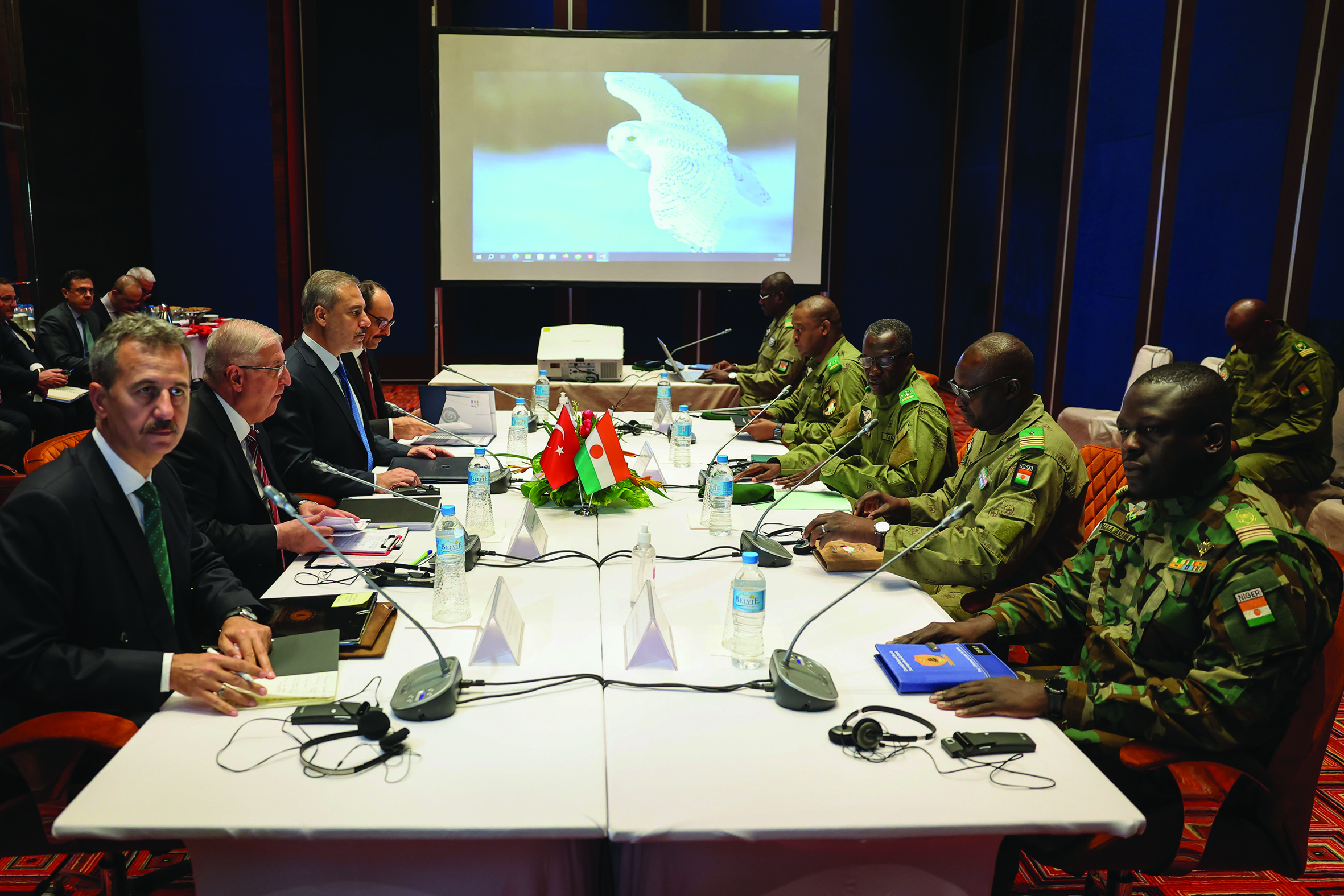
Turkish Foreign Minister Fidan (3rd L)and Defense Minister Güler (2nd L), hold a meeting with Nigerian Minister of State for National Defense Mody and Foreign Minister Sangare in Niamey, Niger on July 17, 2024. ARDA KÜÇÜKKAYA / AA
However, engaging with the Confederation on the military and security fronts provides some opportunities that could boost Türkiye’s image and fetch it some foreign exchange that could help boost its economy. These opportunities come with some challenges Türkiye would have to grapple with. A significant opportunity Türkiye is presented with is the necessity for a reliable actor to step in as France withdraws from these countries in the Sahel region. This void must be filled by a dependable entity that the Sahelian nations can rely on, like Türkiye. While filling the gap presents an opportunity to play a bigger role in the Sahel and the wider African continent, a challenge would be for Türkiye to introspect itself if it is indeed ready to shoulder such a responsibility considering how precarious the Sahel region is. According to a 2024 mid-year report by ACLED, the global conflict index of Burkina Faso and Mali is both categorized as high, while that of Niger is classified as turbulent.29 In 2017, there was an instance where a Turkish restaurant in Ouagadougou was targeted with multiple casualties.30 While one could argue that the focal point may not solely be the restaurant itself, but rather foreigners (particularly the French nationals) who frequent the establishment for dining purposes, one could also interrogate the root cause of the anger, which stems from years of interactions with France and the populace’s disenchantment with such relationships. Should Türkiye succeed in serving as a better replacement, this would surely boost its image and could earn it extensive partners in the continent and beyond.
Another opportunity that also comes with embedded challenges is in regard to weapons supply. It is widely known that the Turkish defense industry is growing, and there is so much interest in its output, especially its drones, the Bayraktar TB2.31 As indicated above, the members of the alliance have already purchased some of the Bayraktar UAVs (Unmanned Aerial Vehicles) individually, and they have testified to their efficacy. Supplying these drones and other military equipment to the Alliance as a unit could further boost Türkiye’s export earnings to fill some of the gaps of a much-needed foreign exchange. A challenge, however, would be if Ankara will be willing to do that ‘with no strings attached’ like other actors are doing and/or if it would act differently in that regard. Besides, Türkiye may have to assess how such intensified military and security engagement with this trio impacts Türkiye’s relations with other mainstream regional blocks like the AU and ECOWAS and other actors like China and Russia, especially in the area of similar engagements in terms of defense and security.
While filling the gap presents an opportunity to play a bigger role in the Sahel and the wider African continent, a challenge would be for Türkiye to introspect itself if it is indeed ready to shoulder such a responsibility considering how precarious the Sahel region is
Türkiye has been a committed supporter of some earlier security arrangements like the Sahel 5 and the United Nations Multidimensional Integrated Stabilization Mission in Mali (MUNISMA).32 The Sahel 5 consisted of the Alliance membership alongside Chad and Mauritania. Regarding the erstwhile MUNISMA, both Burkina Faso and Niger actively participated in it. In addition, Türkiye provided financial and logistical support for these agreements. Türkiye allocated five million dollars towards the Sahel 5 and deployed police personnel to support the MUNISMA mission.33 With this renewed engagement of the Alliance membership as a unit, Türkiye would be presented with the challenge of avoiding duplication of efforts or could be overly stretched if it intends to actively participate in existing arrangements simultaneously. For some of the arrangements, prominent architects such as the U.S. and France have departed, leaving Türkiye with a formidable challenge in assuming leadership and establishing alternative frameworks that can secure the support of not only the Alliance members but also external entities concerned with the welfare of the regions. Türkiye’s ability to pull that off would be a skillful delight to observe in this unfolding regional theater.
Regionally, with the spillover effect of violent extremism from the Sahel region to coastal West Africa, regional countries may be willing to offer support to Türkiye in whatever security arrangement that Türkiye could engineer if they deem it worthy of support. In this regard, Türkiye’s success in leading or partnering with the confederation in fighting and stemming terrorism in the Sahel would automatically lead to stanching of the spillover. This would earn commendations from the littoral nations of West Africa who may not be part of this confederation but would be compelled to recognize Türkiye’s efforts. What this implies, however, is that in the event such an arrangement encounters a setback, it would have a detrimental impact on other nations, thus blemishing Türkiye’s reputation in the region.
Globally, however, deepening relations with the Sahelian countries has the implication of deepening the Türkiye-France rivalry, as the latter have long regarded Türkiye as a staunch rival in the region.34 Türkiye’s involvement in advocating for France’s expulsion implies a significant stance in diplomatic circles.35 Ironically, this rift, though potentially damaging to Türkiye’s relations with the EU, could fortify its relations with member states like Spain and Italy. Türkiye’s strategic position as a pivotal ally in combating illegal migration both from the Sahel region and within its borders may establish it as a partner in fighting illegal migration, addressing the issue on both a local and international scale.
Economic Engagements
The membership of the confederation recognizes that they could benefit from greater regional integration, including creating a unified front to tackle security issues, creating a common market, sharing infrastructure projects, and harmonizing trade policies. However, they have chosen to disengage from ECOWAS, a significantly larger initiative that surpasses their current level of integration. Indeed, integration could help boost economic growth, reduce poverty, increase security, and create jobs in the Sahel region, where development is a critical need. In the first decade of Türkiye’s engagement with the African continent, including the Alliance membership, the main focus has been on trade and investment.36 The focus has been on how to secure business and investment opportunities for businesspeople. A very common practice during that time was for the Turkish president to travel with a number of entrepreneurs and businessmen who would participate in a business forum in the host country as part of the visiting itinerary.
Regionally, with the spillover effect of violent extremism from the Sahel region to coastal West Africa, regional countries may be willing to offer support to Türkiye in whatever security arrangement that Türkiye could engineer if they deem it worthy of support
The coalition nations, prior to this very confederation, embraced Türkiye as the ideal partner they were seeking, given its aspirations to broaden its trade and investments in the region. Trade between Türkiye and these Sahel countries has seen significant growth, with Turkish exports to the region including textiles, machinery, construction materials, and consumer goods. Conversely, Türkiye imports agricultural products, raw materials, and minerals from Mali, Niger, and Burkina Faso. Besides, Turkish companies and individual investors have increased their investments in infrastructure projects in the region, including construction, energy provision, transportation, and logistics. Turkish construction firms, in particular, have been involved in building roads, airports, and housing projects across the region as well.37
Table 1: Türkiye’s Export to AES ($, 2013-2024)
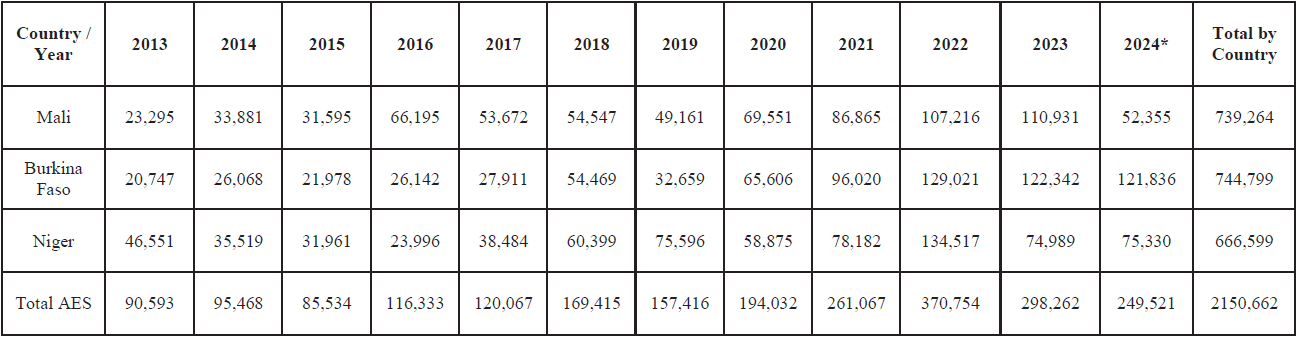
* As of August 2024
Source: Prepared by the Author from the Raw Data of the Turkish Statistical Directorate38
Bilateral trade between Türkiye and Burkina Faso, for instance, has been growing, although the overall volume remains modest. Turkish exports to Burkina Faso include textiles, machinery, food products, and construction materials, while Burkina Faso primarily exports raw materials and agricultural products to Türkiye. Turkish companies are involved in infrastructure projects, such as building roads, hospitals, and schools. Combined bilateral trade totaled $52 million as of 2019 according to the data from the Turkish Foreign Ministry.39 This data is confirmed by those from the Turkish Statistical Directorate (see Table 1 and 2, Burkina 2019 for both import and export). Besides, despite the fluctuating nature of the figures, as shown in both Table 1 and Table 2, from 2020 to 2024, what is evident is that combined trade volumes have seen significant increase in this period compared to 2013 to 2019, from slightly over $20 million in 2013 to over $120 million in 2024.
Similarly, bilateral trade between Türkiye and Mali has been steadily growing, although it remains modest compared to Türkiye’s trade with other African nations. Türkiye exports a range of goods to Mali, including machinery, textiles, food products, and construction materials. Similar to Burkina Faso, Mali also exports agricultural products and raw materials to Türkiye. As such, Turkish companies have shown increasing interest in investing in Mali, just like in Burkina Faso. Firms from Türkiye have been involved in major construction projects, including building roads, hospitals, and schools, which are critical for Mali’s development. Trade volumes between the two countries rose from a modest $5 million in 2003 to $57 million as of 2019, as indicated by the data from the Ministry of Foreign Affairs.40 This figure is consistent with those of the Statistical Services Directorate as shown in both Table 1 and Table 2. The figures of the last five years 2019-2024, in both Table 1 and Table 2, show significant increase in combined trade between both countries, despite the fluctuating nature of figures. Interestingly, a data shared by the Industry and technology ministry indicated that trade with Mali has reached historical record high of $ 255 million as at 2023.41 All these figures point to the increasing nature of the bilateral trade between the two countries.
Even though the share of the Sahelian Alliance may seem modest, the aggregate figure provides a compelling reason for their involvement with Türkiye on the continent, as it has established a stronger trade and investment network across the region
Trade between Türkiye and Niger has been growing, though it also remains modest in volume. Türkiye exports a range of goods to Niger, including machinery, textiles, and food products, while importing primarily raw materials and agricultural products from Niger. Turkish companies have shown increasing interest in investing in Niger, particularly in the construction, energy, and infrastructure sectors. Projects funded or built by Turkish companies have included hospitals, roads, and other infrastructure critical to Niger’s development. Niger’s trade volume with Türkiye appears to be the highest, totaling $67 million as of 2019 as shown by the data from the foreign ministry.42 However, the data from the statistical directorate over $70 million as can be observed from Tables 1 and 2. Within the past five years this figure has risen exponentially. According to a data from the Turkish statistical services, trade figures with Niger has seen significant increase yet falls behind Burkina Faso and Mali as captured by the data in Tables 1 and 2. From 2020 to 2023, Niger appears to fall behind in terms of aggregate trade figures.
Table 2: Türkiye’s Import from AES ($, 2013-2024)
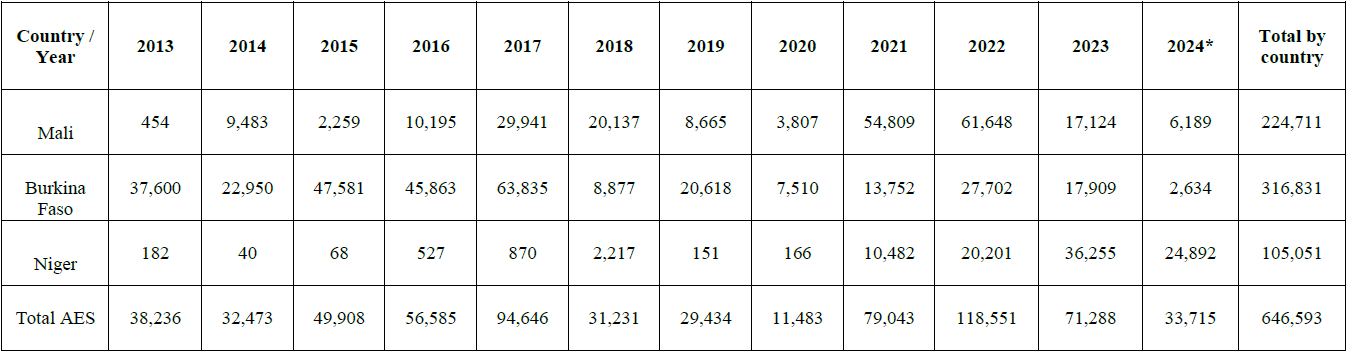
* As of August 2024
Source: Prepared by the Author from the Raw data of the Turkish Statistical Directorate43
Türkiye’s engagement with the African continent has for a very long time revolved around trade and investment. From a modest beginning, trade and investment between Africa and Türkiye have seen a significant leap. Even though the share of the Sahelian Alliance may seem modest, the aggregate figure provides a compelling reason for their involvement with Türkiye on the continent, as it has established a stronger trade and investment network across the region. While the individual trade appears relatively small, when lumped together based on the totals for 2019, Türkiye’s total trade volume with the Alliance combined reaches almost $200 million. This figure has sharply increased in just the last four (2020-2024) years to over $1 billion as can be synthesized from the data in Table 1 and Table 2. Besides, an interesting aspect of trade and investment between these countries and Türkiye is that it extends far beyond state-to-state huge sums of trade and investments to ordinary businessmen conducting business in the Sahel or in Türkiye. That is, the volume of trade and investments among ordinary businessmen is also growing exponentially. In particular, apart from government-to-government contracts within the domain of business and investments, Turkish entrepreneurs privately engage in significant business activities. Turkish private construction firms are engaged in diverse significant construction and investment activities as well.
Cultural, Humanitarian, and Developmental Engagements
Challenges in the Sahel region, including poverty, insecurity, and environmental degradation, have attracted the attention of several actors for diverse reasons for support. Türkiye has positioned itself as a key player in the region, especially in the member states of the confederation, through cultural, humanitarian, and development engagements. Cultural diplomacy has been the cornerstone of these relationships, with the Turkish government promoting Turkish culture, language, and education through diverse avenues, including annual cultural performances in Türkiye, where a number of countries are invited to participate and demonstrate their culture while learning Turkish culture as well.44
Türkiye, through its Türkiye Scholarships (Türkiye Bursları) offers scholarships to students from Sahelian countries to study in Turkish universities.45 These educational exchanges are designed to foster long-term relationships and create a network of alumni who understand and appreciate Turkish culture and values. Indeed, there are already many such alumni playing prominent roles in their home countries. There are a few Turkish schools also operating in these countries. A prominent player in this regard is the Turkish Maarif Foundation schools.46 There are Turkish Maarif schools in all three countries and many other countries on the continent. Türkiye also engages in social and religious programs in these countries. It has also implemented social programs aimed at improving the livelihoods of vulnerable populations in the Sahel, including women and children. Türkiye supports religious institutions in terms of the construction and renovation of mosques and Islamic schools in the Sahel as part of its broader outreach to Muslim communities in the region.47
On the humanitarian front, Türkiye has a very good record in that regard. It has been active in providing humanitarian aid in response to crises in the Sahel, including food, medical supplies, and shelter to communities affected by conflicts, droughts, and other emergencies. Türkiye has launched several healthcare projects in the region, including the construction of hospitals, mobile clinics, and vaccination campaigns. These initiatives aim to address the critical health challenges faced by populations in the Sahel, particularly in remote and underserved areas. It has been involved in various infrastructure projects in the Sahel, including the construction of roads, schools, and water systems. These projects are often implemented in partnership with local governments and are aimed at improving access to essential services. Spearheading most of these humanitarian and developmental initiatives are two key institutions, the Turkish Cooperation and Coordination Agency (TİKA)48 and the Turkish Red Crescent.49 It is worth noting that certain non-governmental organizations also contribute to this effort. Some of these entities organize medical screening and minor surgical procedures, among other services. The writer played a significant role in a charitable event that provided complimentary cataract surgeries, organized by a Turkish non-governmental organization.
Conclusion
What is evident in the aforementioned passages is a vital utilization of smart power mechanisms within a particular geography of strategic interest, highlighting the utility of the Heartland Theory in understanding why an actor would be interested in a particular region and how securing any strategic interest, whether soft or hard power-related, in the region potentially elevates the actor’s influence within that geography and beyond. The visible hard power instruments point us to the component of smart power that recognizes the utility of hard power instruments as an essential piece of the smart power paradigm. Economic engagements and humanitarian or cultural exchanges fill the other piece of the whole in terms of soft power elements of the smart power paradigm. It would be erroneous, especially within the context of Türkiye’s relations with the Alliance, to classify its approach as solely utilizing soft power or solely hard power. A nuanced view would be to regard its approach within the smart power paradigm, as it utilizes both hard power instruments and soft power elements in an appropriate measure for a desired foreign policy goal, especially in the Sahel.
Türkiye’s engagement with the membership of the Alliance reflects a multifaceted approach that utilizes smart power that combines security cooperation, and economic engagements together with cultural diplomacy, and humanitarian assistance
Türkiye’s engagement with the membership of the Alliance reflects a multifaceted approach that utilizes smart power that combines security cooperation, and economic engagements together with cultural diplomacy, and humanitarian assistance. The formation of the Sahel States Alliance could create a more stable and cooperative regional environment, which might enhance the effectiveness of Türkiye’s initiatives and strategic engagements. Such an enabling environment could afford Türkiye the opportunity to play diverse prominent roles in the region, particularly matters revolving around security, defense, and conflict resolution. Inasmuch as the engagement comes with some opportunities, there are also some challenges that come with it. The volatile security situation in the Sahel poses risks to Türkiye’s investments and citizens operating in these countries.
Additionally, political instability and economic difficulties in these countries could impact the sustainability of bilateral projects with the Alliance. More importantly, should the alliance grow stronger, Türkiye’s engagement in the Sahel region and the wider West Africa could potentially expand, posing an additional challenge in mitigating its concurrent relations with the Alliance whilst maintaining cordial relations with other regional bodies like the ECOWAS, with whom the Alliance holds divergent perspectives. Moreover, Türkiye would have to ground itself to deal with stiff competition coming from other countries with vested interests in the Sahel, like China and Russia. It would be interesting to examine, in future studies, the depth of the relations between the Alliance and China and Russia vis-à-vis their engagement with Türkiye. On the whole, Türkiye’s relations with the Sahel, particularly in the context of the Alliance, are marked by a blend of humanitarian engagement and economic cooperation, but more importantly, collaboration on security and defense appears to have overshadowed the other facets of the engagement. Türkiye-AES relations need to be strategically handled with caution as we hope for a stable Sahel region.
The formation of the Sahel States Alliance could create a more stable and cooperative regional environment, which might enhance the effectiveness of Türkiye’s initiatives and strategic engagements
Endnotes
1. Halford John Mackinder, The Geographical Pivot of History, (Cosimo Classics, 2020).
2. Mackinder, The Geographical Pivot of History.
3. Oliver Krause, “Mackinder’s ‘Heartland’ – Legitimation of US Foreign Policy in World War II and the Cold War of the 1950s,” Geographica Helvetica, Vol. 78, No. 1 (2023).
4. Muhittin Ataman, “The Century of Türkiye: A New Foreign Policy Vision for Building the Türkiye Axis,” Insight Turkey, Vol. 25, No. 3 (September 30, 2023), pp. 73-96.
5. Najimdeen Bakare and R. Minahil Toor, “Revisiting Mackinder’s Heartland Theory: Identifying the Emergence of a Complex Power Competition in the Indian Ocean Region,” Przegląd Strategiczny, Vol. 9, No. 12 (2019), pp. 43-58.
6. Joseph S. Nye, The Future of Power, (New York: Public Affairs, 2011).
7. Dolapo Fakuade, “Türkiye-Africa Relations: A Case Study of Somalia, Nigeria, and Libya from Humanitarian and Security Perspectives,” Insight Turkey, Vol. 25, No. 3 (2023), pp. 51-62.
8. Tom Wheeler, “Ankara to Africa: Turkey’s Outreach since 2005,” South African Journal of International Affairs, 18, No. 1 (April 1, 2011), pp. 43-62.
9. Ali Onur Tepeciklioğlu, Elem Eyrice Tepeciklioğlu, and Can Karabıyık, “(Exploring) the Impact of Turkey’s Embassies on Trade with Sub-Saharan Africa,” Journal of Balkan and Near Eastern Studies, 26, No. 3 (2024), pp. 360-377.
10. Mehmet Özkan, “Turkey’s Involvement in Somalia,” SETA, (2014); Fakuade, “Türkiye-Africa Relations.”
11. “Relations between Türkiye and Niger,” Republic of Türkiye Ministry of Foreign Affairs, retrieved August 21, 2024, from https://www.mfa.gov.tr/relations-between-turkiye-and-niger.en.mfa#:~:text=T%C3%BCrkiye%20established%20diplomatic%20relations%20with,in%20Istanbul%2C%20Bursa%20and%20Antalya.
12. Tepeciklioglu, Tepeciklioğlu, and Karabıyık, “(Exploring) the Impact of Turkey’s Embassies on Trade with sub-Saharan Africa”; “Relations between Türkiye and Burkina Faso,” Republic of Türkiye Ministry of Foreign Affairs, retrieved from https://www.mfa.gov.tr/relations-between-turkiye-and-burkina-faso.en.mfa.
13. “Relations between Türkiye and Mali,” Republic of Türkiye Ministry of Foreign Affairs, retrieved, August 22, 2024, from https://www.mfa.gov.tr/relations-between-turkiye-and-burkina-faso.en.mfa.
14. Ali Bilgic, “Becoming a Humanitarian State: A Performative Analysis of ‘Status-Seeking’ as Statecraft in World Politics,” Review of International Studies, Vol. 50, No. 4 (2023), pp. 700-719.
15. Muhammad Dan Suleiman, Hakeem Onapajo, and Ahmed Badawi Mustapha, “External Influence, Failed States, Ungoverned Spaces and Small Arms Proliferation in Africa,” in Usman A. Tar and Charles P. Onwurah (eds.), The Palgrave Handbook of Small Arms and Conflicts in Africa, (Cham: Springer International Publishing, 2021), pp. 161-185.
16. Elem Eyrice Tepeciklioğlu, Francois Vreÿ, and Bahar Baser, Turkey’s Pivot to the African Continent: Strategic Crossroads, 1st, (Taylor & Francis, 2024), p. 72.
17. “Mali Receives New Batch of Turkish Bayraktar TB2 Drones,” Daily Sabah, (January 4, 2024), retrieved September 21, 2024, from https://www.dailysabah.com/business/defense/mali-receives-new-batch-of-turkish-bayraktar-tb2-drones.
18. “Malian President Awards Turkish Drone Innovators with ‘National Order’,” Daily Sabah, (October 19, 2023) retrieved September 22, 2024, from https://www.dailysabah.com/business/defense/malian-president-awards-turkish-drone-innovators-with-national-order.
19. “Cooperation: Turkey Reaffirms Its Support for Mali in the Fight against Terrorism,” FAMa, (August 8, 2024), retrieved August 21, 2024, from https://www.fama.ml/en/cooperation-turkey-reaffirms-its-support-for-mali-in-the-fight-against-terrorism.
20. “Relations between Türkiye and Burkina Faso,” Republic of Türkiye Ministry of Foreign Affairs.
21. Sakshi Tiwari, “Akinci UCAVs Begin Combat Duty; Burkina Faso Uses Turkish-Supplied Drones to Hit Militants – Reports,” The EuroAsian Times, (April 30, 2024) retrieved September 23, 2024, from https://www.eurasiantimes.com/akinci-ucavs-begin-combat-duty-burkina/#:~:text=Burkina%20Faso%20received%20five%20Bayraktar,Islam%20wal%20Muslimeen%20(JNI).
22. Göksel Yıldırım, “Turkish Drone Manufacturer’s CEO Awarded State Medal in Burkina Faso,” Anadolu Agency, (April 26, 2023), retrieved September 22, 2024, from https://www.aa.com.tr/en/africa/turkish-drone-manufacturer-s-ceo-awarded-state-medal-in-burkina-faso/2881534.
23. Tepeciklioğlu, Vreÿ, and Baser, Turkey’s Pivot to the African Continent, p. 72.
24. Inder Singh Bisht, “Turkey Delivers Six Bayraktar Drones to Niger” The Defense Post, (June 1, 2022), retrieved September 23, 2024, from https://thedefensepost.com/2022/06/01/turkey-bayraktar-drones-niger/.
25. Michaël Tanchum, “The Niger Coup and Turkey’s Military Industrial Complex in Africa,” The Turkey Analyst, (August 23, 2023), retrieved from https://www.turkeyanalyst.org/publications/turkey-analyst-articles/item/712-the-niger-coup-and-turkey%E2%80%99s-military-industrial-complex-in-africa.html.
26. “Strains in US-Türkiye Relations,” International Institute for Strategic Studies, 30, No. 3 (March 15, 2024), pp. 13-16.
27. Seda Gürkan, “EU-Turkey Relations in a ‘Dangerous World’: Prospects and Challenges after the 2023 Elections in Turkey,” in Nikos Christofis (ed.), Elections and Earthquakes: Quo Vadis Turkey, (London: Transnational Press London, 2024), pp.197-207.
28. Jana J. Jabbour, “Turkey-France Political and Diplomatic Relations: Contemporary Issues and Future Perspectives,” in Aurélien Denizeau and Ozan Örmeci (eds.), Turkish-French Relations: History, Present, and the Future, (Cham: Springer International Publishing, 2022), pp. 117-150.
29. Christina De Paris and Ciro Murillo, “The Sahel: Mid-year Metrics 2024,” ACLED, (August 14, 2024), retrieved September 23, 2024, from https://acleddata.com/2024/08/14/the-sahel-mid-year-metrics-
2024/.
30. Jason Burke, “Burkina Faso: At Least 18 Dead in Restaurant Attack,” The Guardian, (August 14, 2017), retrieved from https://www.theguardian.com/world/2017/aug/14/terror-attack-restaurant-burkina-faso-many-dead.
31. Jens Bastian, “Turkey: An Emerging Global Arms Exporter: Growing Competitiveness and Strategic Recalibration of the Turkish Defence Industry,” Stiftung Wissenschaft und Politik (SWP), (February 2024), retrieved from https://www.swp-berlin.org/publikation/turkey-an-emerging-global-arms-exporter.
32. Jordán Olivér Petrőcz, “Turkish Army and Military Industry Presence in Africa,” Journal of Central and Eastern European African Studies, 3, No. 1 (2024), pp. 76-100.
33. Serhat Orakçı, “The Rise of Turkey in Africa,” Al Jazeera, (January 9, 2022), retrieved from https://studies.aljazeera.net/en/analyses/rise-turkey-africa.
34. Jabbour, “Turkey-France Political and Diplomatic Relations: Contemporary Issues and Future Perspectives.”
35. Abdennour Toumi, “How Algeria-Turkey Ambitious Strategic Rapprochement Will Affect France’s Sahel Policy?” Insight Turkey, 23, No. 4 (2021), pp. 39-50.
36. Tepeciklioğlu, Tepeciklioğlu, and Karabıyık, “(Exploring) the Impact of Turkey’s Embassies on Trade with Sub-Saharan Africa.”
37. Andrew Lebovich and Nienke van Heukelingen, “Unravelling Turkish Involvement in the Sahel: Geopolitics and Local Impact,” Clingendael Institute, (July 2023), retrieved from https://www.jstor.org/stable/resrep52624.
38. “Dış Ticaret İstatistikleri,” Türkiye İstatistik Kurumu, retrieved October 3, 2024, from https://data.tuik.gov.tr/Bulten/Index?p=Dis-Ticaret-Istatistikleri-Mart-2024-53535
39. “Relations between Türkiye and Burkina Faso,” Republic of Türkiye Ministry of Foreign Affairs.
40. “Relations between Türkiye and Mali,” Republic of Türkiye Ministry of Foreign Affairs.
41. “Türkiye-Mali 4. Dönem Kek Toplantısı,” Sanayi ve Teknoloji Bakanlığı, retrieved October 3, 2024, from https://www.sanayi.gov.tr/medya/haber/turkiyemali-4-donem-kek-toplantisi.
42. “Relations between Türkiye and Niger,” Republic of Türkiye Ministry of Foreign Affairs.
43. “Dış Ticaret İstatistikleri,” Türkiye İstatistik Kurumu, retrieved October 3, 2024, from https://data.tuik.gov.tr/Bulten/Index?p=Dis-Ticaret-Istatistikleri-Mart-2024-53535.
44. Muhammet Tarhan, “Attended by 55 Embassies, World Cultures Festival 2023 Kicks off in Ankara,” Anadolu Agency, (September 23, 2023), retrieved from https://www.aa.com.tr/en/culture/attended-by-55-embassies-world-cultures-festival-2023-kicks-off-in-ankara/2999119.
45. “Relations between Türkiye and Mali,” Republic of Türkiye Ministry of Foreign Affairs; “Relations between Türkiye and Burkina Faso,” Republic of Türkiye Ministry of Foreign Affairs; “Relations between Türkiye and Niger,” Republic of Türkiye Ministry of Foreign Affairs.
46. Yunus Turhan, “Turkish Humanitarian Assistance during the COVID-19 Pandemic: Focus on Africa,” Journal of Balkan and Near Eastern Studies, 26, No. 3 (2024), pp. 327-345 ; “Relations between Türkiye and Mali,” Republic of Türkiye Ministry of Foreign Affairs; “Relations between Türkiye and Burkina Faso,” Republic of Türkiye Ministry of Foreign Affairs”; “Relations between Türkiye and Niger,” Republic of Türkiye Ministry of Foreign Affairs.
47. Lebovich and van Heukelingen, “Unravelling Turkish Involvement in the Sahel.”
48. “Our Activities,” TİKA, retrieved September 23, 2024, from https://tika.gov.tr/en/our-activities/.
49. “What We Do,” TİKA, retrieved September 23, 2024, from https://www.kizilay.org.tr/what-we-do.