
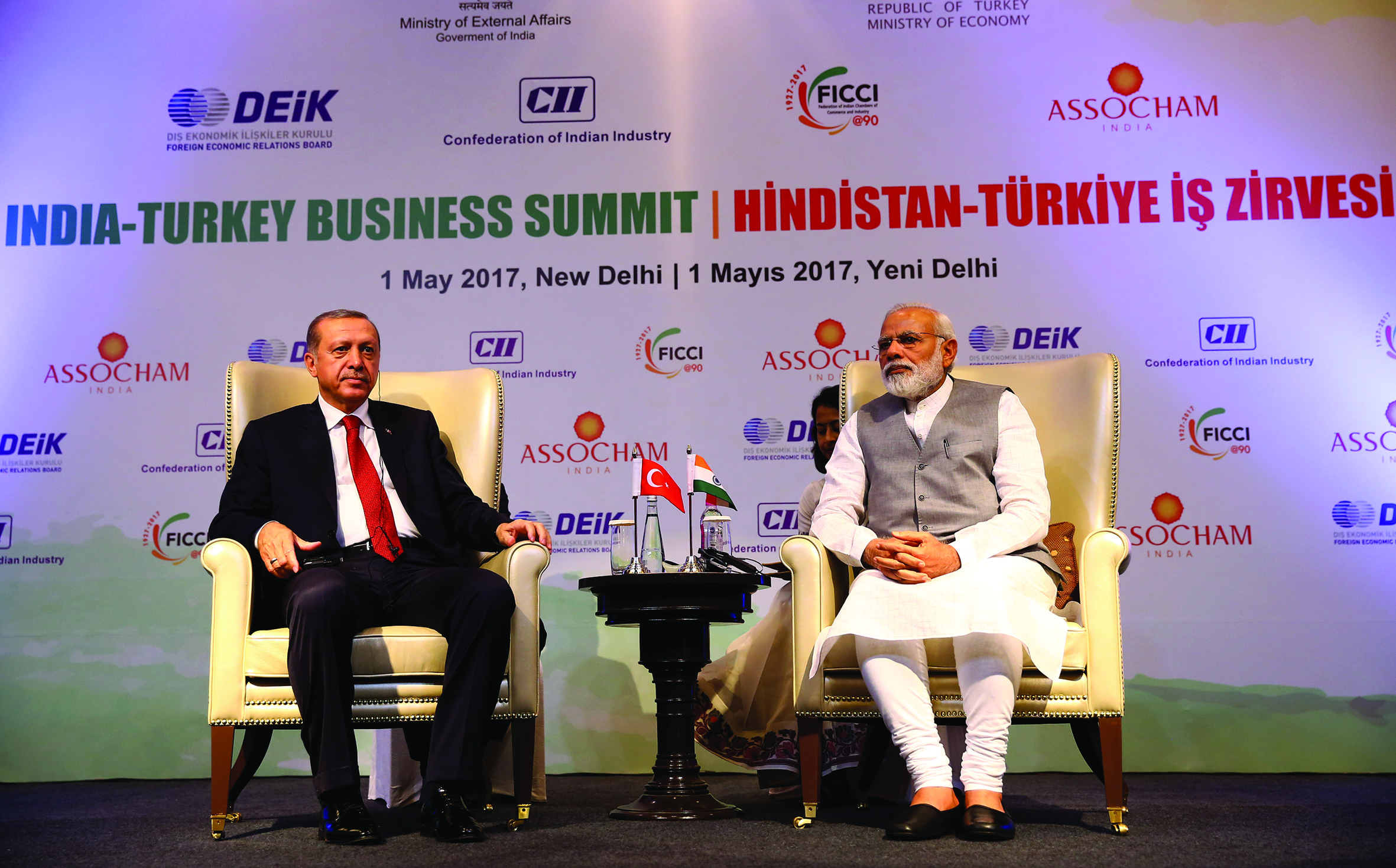
Introduction
When characterizing Türkiye-India relations, or any other bilateral ties for that matter, we usually limit our analysis to government-to-government interactions, mainly in diplomatic, economic, scientific, or cultural spheres within a specific period. In this analysis, we will examine Türkiye-India relations from a broader perspective, analyzing both countries’ overall foreign policy orientations as well as their specific foreign policy behavior toward one another at both the bilateral and multilateral levels between 2000 and 2023. It should be emphasized that the usage of beginning and ending years is intended to make the article’s presentation more analytical rather than to highlight any significant event in Turkish-Indian relations. In addition to assessing government-level engagements between Türkiye and India, we will assess interactions between private actors in the economic and socio-cultural spheres, provide examples of actual people-to-people contact, and provide a subjective view of the two countries’ current relations.
The history of relations between Türkiye and India as modern nation-states traces back to the late 1940s, coinciding with India’s independence from British colonial rule. Throughout much of the Cold War era, bilateral ties between the two nations were either negligible or strained due to significant disparities in their foreign policy orientations.1 Key points of contention included the Kashmir and Cyprus issues, which led to diplomatic discord and hindered the development of robust bilateral relations. Türkiye underwent a foreign policy reorientation under Prime Minister Turgut Özal, marked by economic liberalization initiatives since the early 1980s and efforts to diversify international partnerships. This shift contributed to an improvement in Türkiye-India relations, particularly in the economic realm, following Özal’s visit to India in 1986.2 Despite India’s reciprocation of efforts to enhance relations, led by Prime Minister Rajiv Gandhi during his tenure from 1984 to 1989, and later bolstered by India’s adoption of economic liberalization policies in 1991, unresolved political issues continued to overshadow bilateral ties throughout the 1990s. Türkiye’s domestic economic challenges and its strategic focus on neighboring regions such as Central Asia, the Balkans, and West Asia marginalized the economic dimension of its relations with India. However, in 2000, Turkish Prime Minister Bülent Ecevit revised Türkiye’s longstanding pro-Pakistan stance on the Kashmir issue.3 This shift not only alleviated primary sources of tension between the two countries but also paved the way for improved relations across various domains during much of the subsequent period under review.
The dominance of AK Party in Türkiye and the BJP leadership in India have significantly influenced their foreign policy trajectories during the assessed period
From the perspective of rising economies and emerging powers, the momentum of Türkiye and India’s ascent has notably accelerated since the early years of the 21st century. Both countries have sought to assert their political and economic influence on the global stage, prompting an examination of the dynamics of Türkiye-India relations in this context. Understanding their foreign policy priorities is crucial for this analysis. Analyzing Türkiye-India relations requires considering changes in foreign policy priorities under different governments. While rational choice perspectives may overlook shifts in foreign policy due to changes in government and domestic political dynamics, it is essential to examine the foreign policy orientations of Türkiye and India under various administrations.4 The dominance of the Justice and Development Party (AK Party) in Türkiye and the Bharatiya Janata Party’s (BJP) leadership in India have significantly influenced their foreign policy trajectories during the assessed period.
Türkiye and India have distinct foreign policy agendas that shape their interactions. Türkiye, under the dominant leadership of Recep Tayyip Erdoğan’s AK Party since late 2002, has consistently pursued assertive policies to enhance its regional and global standing. India, on the other hand, experienced a series of coalition governments, initially led by the rightist-nationalist BJP until mid-2004, followed by a centrist and left-of-center coalition known as the United Progressive Alliance (UPA) from 2004 to 2014. Since mid-2014, a single-party dominant government led by the BJP’s Narendra Modi has been in power, continuing beyond the period under review.
In the subsequent sections, we will explore the broad foreign policy priorities of Türkiye and India, examining their implications for bilateral relations. Additionally, we will delve into the political, economic, and other aspects of Türkiye-India relations, considering the nuanced interactions observed during the period under review.
Broad Parameters and Priorities of Turkish Foreign Policy (2000-2023)
Türkiye’s foreign policy orientation and conduct in the 21st century underwent significant transformations, particularly after 2002, as it navigated a complex interplay of domestic, regional, and global factors. In the period spanning from 2000 to 2002, Türkiye faced a myriad of challenges on the domestic front, including political instability stemming from a series of coalition governments, economic turmoil, and regional instabilities such as those in neighboring Iraq and tensions with Greece over territorial disputes.5
Against this backdrop, Türkiye’s external priorities were shaped by its pursuit of European Union (EU) membership and the aftermath of the 1999 earthquake, which underscored the country’s reliance on international assistance and collaboration. Türkiye intensified its efforts toward EU accession during this period, implementing political and economic reforms to align with the EU’s membership criteria. Concurrently, Türkiye placed significant emphasis on strengthening relations with Western allies, particularly the U.S., driven by shared security concerns and collaboration in counterterrorism and regional stability endeavors. These efforts underscored Türkiye’s strategic imperative to foster closer ties with Western partners while simultaneously addressing domestic and regional challenges.
India’s external affairs priorities during the 21st century have evolved from a focus on normalization and engagement in the early 2000s to a more assertive and proactive approach toward achieving strategic autonomy and promoting regional stability in later years
Following the ascendancy of the AK Party to a single-party majority government in late 2002, Türkiye experienced substantial transformations both domestically and internationally. From 2003 to 2023, Türkiye’s external affairs priorities underwent significant changes, reflective of evolving regional dynamics and the country’s shifting geopolitical orientation under the leadership of the AK Party, led by Erdoğan (as Prime Minister from 2003 to 2014 and President 2014-present).6
A central objective during this period was the pursuit of a more assertive and independent foreign policy stance, aimed at augmenting Türkiye’s regional influence and global standing. This entailed diversifying Türkiye’s diplomatic partnerships beyond traditional Western allies, fostering closer relations with nations across the Middle East, Africa, and Asia. In the 2000s, Türkiye placed particular emphasis on projecting soft power especially in its interactions with neighboring regions. However, in recent years, the nation has increasingly leveraged its hard power capabilities as well, signaling a shift in its foreign policy approach.7
The AK Party government’s foreign policy agenda also prioritized economic diplomacy as a means to expand Türkiye’s trade and investment opportunities on a global scale. Initiatives such as the “Economic Diplomacy” strategy, launched in 2014, sought to capitalize on Türkiye’s growing economic prowess and strategic geographic position as a bridge between Europe, Asia, and Africa, positioning the country as a significant player in the global economy. Furthermore, Türkiye’s external affairs strategy from 2003 to 2023 placed a heightened focus on addressing security challenges, particularly those posed by terrorist organizations such as the PKK and ISIS. Türkiye’s military interventions in regions such as Syria and Libya were driven by imperatives to counter-terrorist threats and safeguard national security interests, underscoring Türkiye’s commitment to regional stability and security cooperation.
Overall, Türkiye’s foreign policy priorities in the 21st century have evolved dynamically, transitioning from a focus on EU accession and Western alliances in the early 2000s to a more proactive and diversified approach aimed at enhancing regional influence, economic diplomacy, and addressing security challenges in subsequent years. Türkiye’s strategic shifts reflect its adaptation to global dynamics and efforts to assert its interests on the world stage, as articulated by the AK Party government, partly on the framework of its moral responsibility as the world’s conscience (dünyanın vicdanı).8
Broad Parameters and Priorities of Indian Foreign Policy (2000-2023)
India’s external affairs priorities during the 21st century can be analyzed across three distinct periods: 2000-2004, 2004-2014, and 2014-2023, each marked by its unique challenges and opportunities. During the period 2000-2004, India’s foreign policy priorities were shaped by economic liberalization, nuclear diplomacy, and regional engagement.9 In the aftermath of the Pokhran-II nuclear tests in 1998, India faced international isolation and sanctions, prompting a concerted effort to rebuild diplomatic ties. The primary focus during this period was on normalizing relations with key global players, particularly the U.S., which culminated in the landmark India-U.S. Civil Nuclear Agreement. Additionally, India sought to strengthen ties with neighboring countries through initiatives like the “Look East” policy aimed at enhancing economic cooperation with Southeast Asian nations.
The period from 2004 to 2014 saw a continuation of India’s pursuit of strategic autonomy and economic growth, with an added emphasis on multilateralism and regional stability. Under the leadership of Prime Minister Manmohan Singh, India sought to elevate its global profile through active participation in international forums like the G20 and BRICS. Efforts were made to deepen ties with major powers like the U.S., Russia, and the EU while simultaneously addressing longstanding regional conflicts, such as the Kashmir issue and tensions with Pakistan. Economic diplomacy remained a key priority, with initiatives like the India-Africa Forum Summit aimed at expanding trade and investment opportunities.
The period from 2014 to 2023 witnessed a significant recalibration of India’s foreign policy under Prime Minister Narendra Modi, characterized by a more proactive and assertive approach on the global stage.10 This period saw a renewed emphasis on India’s cultural and civilizational ties, as evidenced by the “Neighborhood First” and “Act East” policies, which aimed to strengthen relations with India’s immediate and extended neighborhood while also projecting India as a Vishwaguru (the world’s leader)11 on the global stage. Economic diplomacy continued to be a priority, with initiatives like “Make in India” and “Digital India” aimed at attracting foreign investment and promoting innovation-led growth. Additionally, there was a notable focus on security concerns, particularly in response to terrorism and border disputes, leading to a more robust defense and security cooperation framework with key partners. In a nutshell, India’s external affairs priorities during the 21st century have evolved from a focus on normalization and engagement in the early 2000s to a more assertive and proactive approach toward achieving strategic autonomy and promoting regional stability in later years. Economic growth, diplomatic engagement, and security cooperation have remained consistent themes, albeit with varying degrees of emphasis across different periods.
Türkiye-India Relations at Bilateral Level
From the perspectives of either Turkish or Indian foreign policy we find that throughout the assessment period, Türkiye and India have experienced both points of convergence and divergence, with varying dynamics shaping their bilateral relations.
Political Relations
The bilateral relations between Türkiye and India have been notably influenced by the interplay of the former’s shifting stance on the Kashmir issue, which has been intertwined with the evolving dynamics of the Kashmir conflict itself, and Türkiye’s increasing alignment with Pakistan. These factors have contributed to the intricate nature of the diplomatic relationship between the two nations. As previously stated, due to a significant shift in Türkiye’s traditional foreign policy approach to the Kashmir issue following Ecevit’s (the Turkish Prime Minister during the 1999-2002 period) pronouncement that it is an integral matter of India, the issue became less dominant in the two countries’ bilateral relations. The bilateral talks between India and Pakistan, which began in 1997 and were accelerated by the National Democratic Alliance (NDA) government (1998-2004), such as the Lahore process (1999), the Agra Summit (2001), and the signing of various Confidence Building Measures (CBMs) during that time, were viewed positively in Ankara.12 During the UPA government rule (2004-2014) also, India, because of its growing self-confidence and a variety of other factors, paid less attention to the Pakistani factor in bilateral relations with third countries. Hence the issue of Kashmir remained less consequential than other pragmatic aspects in bilateral ties between Türkiye and India during the early 2000s, as their relations were characterized by a shared interest in strengthening economic ties although with cautious engagement.
Both Türkiye and India, influenced by their status as emerging economies and the absence of significant conflicts, are inclined to give primacy to economic ties in strengthening their bilateral relations
From a Turkish foreign policy perspective, it was observed that while initially adopting a relatively neutral position, Türkiye’s growing alignment with Pakistan’s stance on Kashmir beginning in the second term of the AK Party government (2007 onward) began to strain relations with India. This shift was influenced by geopolitical considerations and Türkiye’s desire to bolster its ties with Pakistan, a fellow Muslim-majority country.13 It was observed that the period post-2008 witnessed a significant deterioration in India-Türkiye relations, largely due to Türkiye’s increasing closeness with Pakistan on several regional issues including the former’s support to the latter on the Kashmir issue.14 Following the 2008 Mumbai attacks, which India considered an act of cross-border terrorism, and with the aggravation of insurgency in Kashmir in subsequent years, the conflict evolved into a complex web of political, social, and regional intricacies, which in turn became the subject of incongruity in Türkiye-India bilateral relations.
During the AK Party’s leadership, Türkiye’s deepening solidarity with Pakistan, based on Muslim identity on one hand and its urge for conflict resolution of the Kashmir issue on the other, led to heightened tensions with India in the 2010s. Türkiye’s alignment with Pakistan’s stance on Kashmir in various international forums further strained bilateral relations, with India viewing Türkiye’s approach as detrimental to India’s interest and regional stability. The issue played out more sensitively during the BJP-led government in power in India from 2014 onwards. Although the Organization of Islamic Cooperation (OIC) had previously adopted resolutions on Kashmir multiple times, New Delhi was critical of Türkiye’s current assertiveness and leadership on the topic. At the OIC’s 2016 special meeting in New York, Türkiye along with Azerbaijan urged for the “cessation of violence” in Jammu and Kashmir.15 In a similar vein, Türkiye maintained its distance from the “OIC Contact Group” on Kashmir during most of the 2000s and 2010s, even though it has been a member since 1994. However, when Turkish Foreign Minister Mevlüt Çavuşoğlu reiterated in September 2018 during his visit to Pakistan that Türkiye would collaborate with Pakistan in the OIC contact group, India’s diplomatic community viewed the stance negatively.
The issue of Kashmir further became a point of vexation and strain in Türkiye-India bilateral relations post-2019 after some constitutional rearrangement between the Indian Union government and the province of Jammu and Kashmir. The move of the Indian government to abrogate Article 370 in August 2019, which reshaped the constitutional status of the region, while garnering domestic support, heightened tensions with Pakistan and drew international attention.16 In this context, President Erdoğan raised the issue of Kashmir in the UN General Assembly annual meeting in September of that year as well as in subsequent years between 2020 and 2023. From the perspective of the existing Turkish leadership, the developments in Kashmir after the abrogation of Article 370 were considered to have adversely impacted the “Muslim population of Kashmir,” human rights, and regional stability.17
It is useful to note that fostering cultural linkages at the government level was a top priority for both Türkiye and India, though they did so for different aspects and at different times
From an Indian perspective, the mentioning of the issue of Kashmir by Türkiye at an international forum was seen as antagonistic and negatively impacted the Türkiye-India relations. However, analysis of Erdoğan’s remarks at the UNGA on Kashmir between 2019 and 2023 reveals a clear shift in emphasis that takes India’s interest in this matter into consideration. From sharply criticizing India in 2019 and even bringing up the 1948 UN Security Council resolution, in 2022 he essentially endorsed Kashmir remaining a bilateral issue between India and Pakistan in the hopes of achieving peace. Speaking at the 78th UNGA meeting, Erdoğan said, “Another development that will pave the way for regional peace, stability, and prosperity in South Asia will be the establishment of a just and lasting peace in Kashmir through dialogue and cooperation between India and Pakistan.”18
Economic Relations
Both Türkiye and India, influenced by their status as emerging economies and the absence of significant conflicts, are inclined to give primacy to economic ties in strengthening their bilateral relations. From 2000 to 2023, both countries consistently pursued measures to enhance economic cooperation, acknowledging the mutual benefits and opportunities presented by such collaboration. In terms of Türkiye-India bilateral trade, there was a consistent increase in the trade volume during the evaluation period, with the exception of a few years that were mostly caused by global events such as the 2008 global economic crisis or the post-2019 pandemic. As shown in Graph 1, the volume of total trade increased from $500 million in 2000 to $1.5 billion in 2005, $4 billion in 2010, $6.3 billion in 2015, $5.7 billion in 2020, and $9.6 billion in 2023. Although the balance of trade throughout the period remained in favor of India, the pattern of its exports to Türkiye fluctuated more, unlike Türkiye’s exports to India.
Moreover, in terms of share, the total export or total import of either country is very marginal. While India’s share in Türkiye’s total imports increased from below 1 percent in 2000 to 2.7 percent by 2023, Türkiye’s share in India’s overall imports remained less than 1 percent over the period. From India’s perspective, Türkiye’s share in India’s total exports as well as total imports hovered around 1 percent throughout the period, which suggests that India has lent less primacy to Türkiye as a trading partner. Examining the bilateral trade pattern of merchandise goods between Türkiye and India from 2000 to 2023, it becomes evident that Türkiye’s significant imports from India include organic chemicals, primary plastics, and petroleum products. Conversely, Türkiye’s exports to India primarily comprise minerals (including ferrous and non-ferrous minerals), chemicals, and jewelry. This reciprocal exchange highlights the divergent yet complementary nature of their trade relations over the specified period.
Graph 1: Türkiye-India Bilateral Trade, 2000-2023 (Million $)
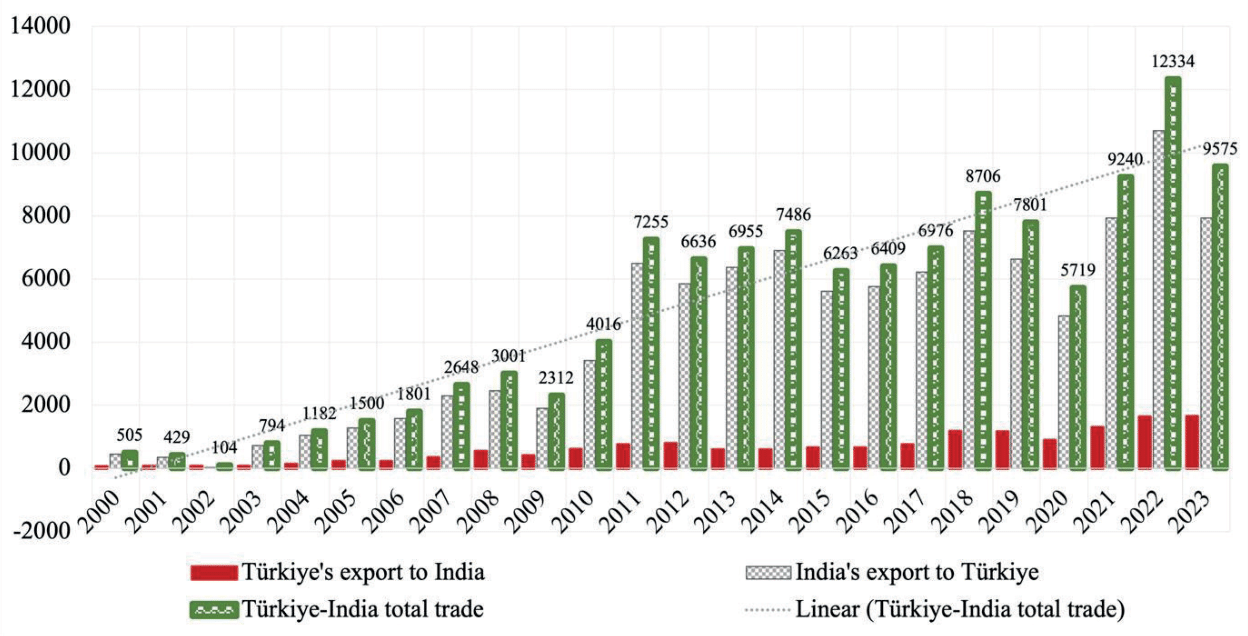
Source: TÜİK19
The economic ties between Türkiye and India benefited from a multitude of institutional mechanisms spanning governmental and corporate domains. These mechanisms, including bilateral agreements and business-to-business ties, provided a robust framework for enhancing relations across diverse sectors. The India-Türkiye Joint Commission on Economic and Technical Cooperation (JCETC), founded in 1983 through a bilateral agreement and revitalized in the early 21st century, operated as a forum to promote economic cooperation between the two countries.20 JCETC meetings, scheduled to take place alternately in India and Türkiye, convened in 2000, 2005, 2009, 2014, and 2019 during the assessment period. Since the meetings were held three times during the earlier period instead of just once during the BJP government (post-2014), it suggests that the drive was stronger during the UPA government in India (2004–2014), which coincided with the early years of the AK Party in Türkiye, than it was over the subsequent decade.
A Joint Business Council (JBC), established in 1996 by the Foreign Economic Relations Board of Türkiye (DEİK) and the Federation of Indian Chambers of Commerce and Industry (FICCI), the two major platforms representing their respective countries’ business interests in foreign countries, continued to strengthen business-to-business cooperation between Türkiye and India during the period. Other organizations have occasionally created institutional frameworks for cooperation, depending on the degree of support from their governments. For instance, Türkiye’s Union of Chambers and Commodity Exchange (TOBB) signed a Memorandum of Understanding (MoU) with FICCI in 2008 as well as signed an agreement to establish India-Türkiye Working Committee and Investment Forums and the Confederation of Indian Industry (CII). TOBB also signed an MoU in 2015, the Turkish-Indian Chambers of Commerce and Industry (TICCI)21 signed an MoU with ASSOCHAM (the Associated Chambers of Commerce and Industry of India) in 2015, and CII signed an MoU with DEİK in March 2018.
Notable in the context of Türkiye and India’s bilateral economic cooperation is the signing of multiple MoUs in various other industries, such as banking and finance. While an MoU (signed in 2015) between the National Small Industries Corporation (NSIC), a Government of India Enterprise, and Türkiye’s Small and Medium Industry Development Organization (KOSGEB) intended to facilitate cooperation in the sector of small and medium enterprises, the MoU in the banking and financial sector included (i) one signed between the State Bank of India (SBI) and Türkiye’s Akbank in 2015, and (ii) in 2016 between the Reserve Bank of India (RBI), the central bank of India, and the Banking Regulation and Supervision Agency (BRSA), the Turkish banking regulator.22
Aligned with Türkiye’s efforts to bolster its soft power since the early AK Party period, organizations like the Turkish Cooperation and Coordination Agency, and later the Yunus Emre Institute, engaged in initiatives to promote Turkish language education in India
At the ground level, it is notable that between 2000 and 2023, and particularly following Türkiye’s increased economic influence post-2002, numerous significant companies from both India and Türkiye exhibited substantial engagement in each other’s nations across a diverse array of sectors, reflecting the deepening economic ties between the two countries. While there was virtually no Indian corporate presence in Türkiye at the end of the 20th century, by the early 2020s, over 150 Indian commercial entities were operating in the country, many of which were significant enterprises like Tata Motors, Mahindra & Mahindra, Punj Lloyd, Wipro, Dabur, Reliance Industries, GMR Infrastructure, Jindal, Birla Cellulose, Polyplex, Tractors and Farm Equipment Limited (TAFE), etc. Many of these companies work in agriculture, services, and manufacturing. Similarly, the presence and operations of Turkish enterprises in India have grown significantly since the early 2000s. Turkish firms operating in India include Koç Holding, Arçelik A.Ş., Doğuş Holding, Doğuş Construction, Limak Holding, Çelebi Holding, Orhan Holding, Fernas, Sarar, and others in various industries such as construction, aviation services, consumer durables, home appliances, and automobiles.23
Throughout the assessment period, both countries witnessed steady growth in their business engagements within the trade and economic domain. However, despite the significant potential for strengthening economic ties between the two nations, certain non-economic factors have persisted as barriers. In terms of investment in each other’s countries, the situation also remained far below potential. Türkiye ranks 44th in FDI equity inflows into India, with a cumulative FDI of $220.07 million from April 2000 to March 2023,24 while total cumulative investment by Indian companies in Türkiye by 2023 was approximately $126 million, according to data from the Central Bank of the Republic of Türkiye quoted by the Embassy of India in Türkiye.25
Since the mid-2000s, the Turkish government has prioritized developing economic connections, including advocating for a free trade agreement (FTA) with India. This view was expressed as early as 2008, when then-Turkish Foreign Minister Ali Babacan disclosed during a visit to India that talks for an FTA between the two countries were in the advanced stages. Subsequently, during then-Prime Minister Erdoğan’s visit later that year to India, the proposal for an FTA was reiterated. Türkiye believed that India stood to benefit from such an agreement, as it could access discounted tariffs on certain products for export to Türkiye through the Generalized System of Preferences (GSP), owing to Türkiye’s customs union with the EU. However, despite multiple rounds of negotiations between the two countries, an India-Türkiye FTA remained unrealized by 2023.26
Enhanced connectivity, particularly through frequent flights from various Indian cities to Türkiye, played a pivotal role in facilitating these interactions, a stark contrast from the limited connectivity observed in the early years of the century
The overall relationship between Türkiye and India in trade and economic fields remained subdued due to political and ideological differences between their governments, despite Türkiye’s persistent efforts to strengthen economic ties, as demonstrated by President Erdoğan’s most recent bilateral state visit to India in 2017, during which the economy was the main focus. Despite shared interests in enhancing bilateral trade and investment, these differences have limited the potential for deeper collaboration across various domains beyond the economic sphere.
Cultural Relations
Cultural relations between Türkiye and India have their roots in a cultural agreement signed in the early 1950s, shortly after the establishment of diplomatic relations in 1948. This landmark agreement, inked in 1951 by Maulana Abul Kalam Azad, India’s Education Minister, and Fuat Koprülü, Türkiye’s Foreign Minister, marked India’s first such agreement with any country after its independence in 1947.27 Initially set for 10 years, with provisions for continuation unless either party withdraws, the agreement maintains its legitimacy in both countries.28 It consequently gave them an institutional foundation to maintain their relationships in this area from 2000 to 2023. It is useful to note that fostering cultural linkages at the government level was a top priority for both Türkiye and India, though they did so for different aspects and at different times.
Aligned with Türkiye’s efforts to bolster its soft power since the early AK Party period, organizations like the Turkish Cooperation and Coordination Agency (TİKA), and later the Yunus Emre Institute, engaged in initiatives to promote Turkish language education in India. MoUs were signed with prominent Indian universities such as Jamia Millia Islamia and Jawaharlal Nehru University in 2005-2006. These agreements facilitated the deployment of Turkish language teachers from Türkiye, organized student and academic exchange programs, and offered scholarships for Indian students to pursue higher education in Türkiye, beginning in the early 2010s.
In the past decade, the Indian government intensified its Indian Technical and Economic Cooperation (ITEC) program to promote Hindi language education among foreign students.29 As part of this initiative, scholarships were regularly awarded to Turkish students to study Hindi at the Central Institute of Hindi in Agra. From India’s standpoint, it continued to emphasize cultural relations by sending academics to promote Indology and Hindi at Ankara University. The Indian Council for Cultural Relations (ICCR) deputed an Indian professor proficient in Hindi to Ankara University’s Indology Department on a three-year deputation basis during the 2000s and 2010s. However, such exchanges have become less frequent in recent years, partly attributed to the prevailing political differences between Türkiye and India since the mid-2010s.
During the assessment period, societal-level relations between Türkiye and India experienced significant growth, marked by increased people-to-people contact in various domains such as business, tourism, academic, and cultural exchanges. This expansion was facilitated by greater exposure to each other’s entertainment sectors and heightened general awareness. Enhanced connectivity, particularly through frequent flights from various Indian cities to Türkiye, played a pivotal role in facilitating these interactions, a stark contrast from the limited connectivity observed in the early years of the century. Direct flights from Delhi and Mumbai to İstanbul further facilitated this connectivity.30 The expansion of societal-level interactions not only contributed to the economic and tourism sectors but also fostered a deeper understanding between the two countries through increased mutual visits of tourists, business communities, scholars, and students. This, in turn, led to a greater understanding of each other’s perceptions and perspectives.
The number of Indian visitors to Türkiye increased from a few thousand in the early years of this century to 270,000 in 2023.31 In recent years, Türkiye emerged as one of the favorite destinations for Indian tourists, as well as a location for wedding ceremonies and film and television series productions. Similarly, the influx of Turkish tourists to India witnessed a notable increase, rising from 3,300 in 2002 to approximately 35,000 prior to the onset of the COVID-19.32 The tourism sector holds significant importance in the Turkish economy and is a key consideration in Turkish foreign policy. Since 1995, a bilateral “Tourism Cooperation Agreement” has been in place between India and Türkiye, aimed at facilitating mutual prospects in this sector. Over the past two decades, the India-Türkiye Joint Committee on Tourism, though meeting infrequently, has provided an institutional framework for cooperation in this domain.
Türkiye-India Relations: Regional and Global Dimensions
Since both India and Türkiye are among the emerging economies and are regional powers in their own right, both countries are bound to seek a greater role in one or more regions in which they have common interests. As far as Türkiye is concerned, it is an important player in many of its bordering regions, such as West Asia, Central Asia, the Caucasus, the Balkans, the Southern Mediterranean, the Black Sea region, and Africa. It has a varied degree of interest in all these regions. On the other hand, India is undoubtedly a major power in South Asia and has considerable geostrategic and geo-economic interests in regions like West Asia, Central Asia, Africa, Southeast Asia, and the Indian Ocean region.
Regional Geopolitical Issues
The strain in bilateral political relations between Türkiye and India, particularly concerning Türkiye’s evolving stance on the Kashmir issue, has also been exacerbated by Türkiye’s growing closeness with Pakistan in defense and economic cooperation.33 This development has hindered progress in bilateral relations between Türkiye and India. It is important to note that Türkiye’s consistent support for Pakistan’s position on Kashmir has been reciprocated by Pakistan’s backing of Türkiye’s stance on issues such as Cyprus and Kurdish separatism. Türkiye’s provision of military aid and equipment to Pakistan, aimed at bolstering its defense capabilities, has been viewed unfavorably by India. For instance, the recent deal between Türkiye and Pakistan for the sale of Turkish-made attack helicopters to Pakistan has raised concerns in India regarding the implications for regional stability. These developments underscored the diverging geopolitical interests of Türkiye and India and hindered efforts to improve bilateral relations between the two countries.
Another geopolitical issue that had implications on Türkiye-India relations concerned the developments in post-2001 Afghanistan at least until the Taliban takeover in August 2021. Post-9/11, Afghanistan’s reconstruction and regional stability were key concerns and both countries held interests in these aspects. Although there was no direct conflict of interest, Türkiye’s initial exclusion of India from the Heart of Asia or İstanbul process –a forum for Afghanistan’s resolution with regional players– raised concerns for India. India’s exclusion from initial meetings led to tensions, which were resolved during then-Turkish President Abdullah Gül’s visit to India, where India’s concerns were acknowledged by Türkiye, and its future participation in this process was ensured by Türkiye. In November 2011, India was invited to the second leg of the conference that was held in İstanbul in which 27 countries took part to discuss the nation-building and future situations in Afghanistan. India’s subsequent participation in the İstanbul process signaled improving relations between Türkiye and India on geopolitical concerns in the region.34
Since both India and Türkiye are among the emerging economies and are regional powers in their own right, both countries are bound to seek a greater role in one or more regions in which they have common interests
Ever since the emergence of post-Soviet Central Asian republics, the region has attracted many external players, including Türkiye and India. Both countries have respective geopolitical and geo-economic interests as well as strategic priorities. Drawing on its geographical proximity, historical connections, and strategic positioning, Türkiye has prioritized trade and investment opportunities in the Central Asian region. It also aimed to establish itself as a key transit hub for energy pipelines and foster security cooperation among regional stakeholders. Similarly, India’s interests have centered on expanding economic engagement through energy cooperation, infrastructure development, and trade agreements. India has sought to secure its energy needs by collaborating with Central Asian nations and bolstering strategic partnerships to address regional security challenges and foster stability. India and Türkiye engaged in a complex mix of competition and cooperation in various areas within the Central Asian region during the 2000-2023 period. While they competed for economic opportunities, energy resources, geopolitical influence, and cultural ties, they also pursued collaborative efforts to address common challenges and promote regional stability and development. So far as security matters in Central Asia are concerned there is a general convergence of interests of both Türkiye and India and both the countries exhibited their cooperation in various regional forums. The Shanghai Cooperation Council (SCO) is one of them.
India, holding observer status from 2015 to 2017 before becoming a full member of the SCO, and Türkiye, a dialogue partner since 2012 with aspirations for full membership, expressed interest in collaborating on security-related issues within the SCO framework. Both countries sought to engage with other SCO members, including Russia and China, to address regional security concerns during the past decade.35 During the 2022 SCO Summit, President Erdoğan and Indian Prime Minister Narendra Modi held useful discussions not only on regional and global trends but also about bilateral relations, which were strained at the time due to Erdoğan’s statements in the UNGA regarding Kashmir.36
The West Asian and North African region also remained a vital geopolitical landscape both for Türkiye and India throughout this quarter century. Türkiye has been one of the major regional powers in this region, particularly since the early AK Party period, and India’s close linkage with the region with a wide variety of geopolitical and geo-economic interests has had implications on their bilateral relations from time to time. There were several points of convergence and divergence in the approaches of the two countries concerning various regional issues. On the issues of tackling several regional conflicts, differences in approaches between Türkiye and India’s foreign policy that emerged in the post-Arab Spring period can be noted. For instance, there were clear differences of opinion between the two countries regarding ISIS, the issue of Syrian Kurdish, the Syrian civil war, the 2013 Egyptian military coup, the Iranian nuclear issue, the intra-GCC crisis, and India’s growing relations with Israel to name a few. Türkiye had been critical of India with regard to the latter’s involvement in I2U2, a formation of strategic partnership between India, Israel, the UAE, and the U.S., or the recently proposed India-Middle East-Europe Economic Corridor (IMEC), which could bypass Türkiye in India’s trade with Europe via Israel.37 It proposed an alternate transport route.38
Since both Türkiye and India have confronted significant terrorism challenges, there has been a general convergence of understanding between the two countries to counter this threat
Another region where differences in foreign policy approaches of Türkiye and India remained stark is the wider Eastern Mediterranean region, including notably the longstanding Cyprus issue that continued to shape Türkiye’s policies in the region during the period between 2000 and 2023.
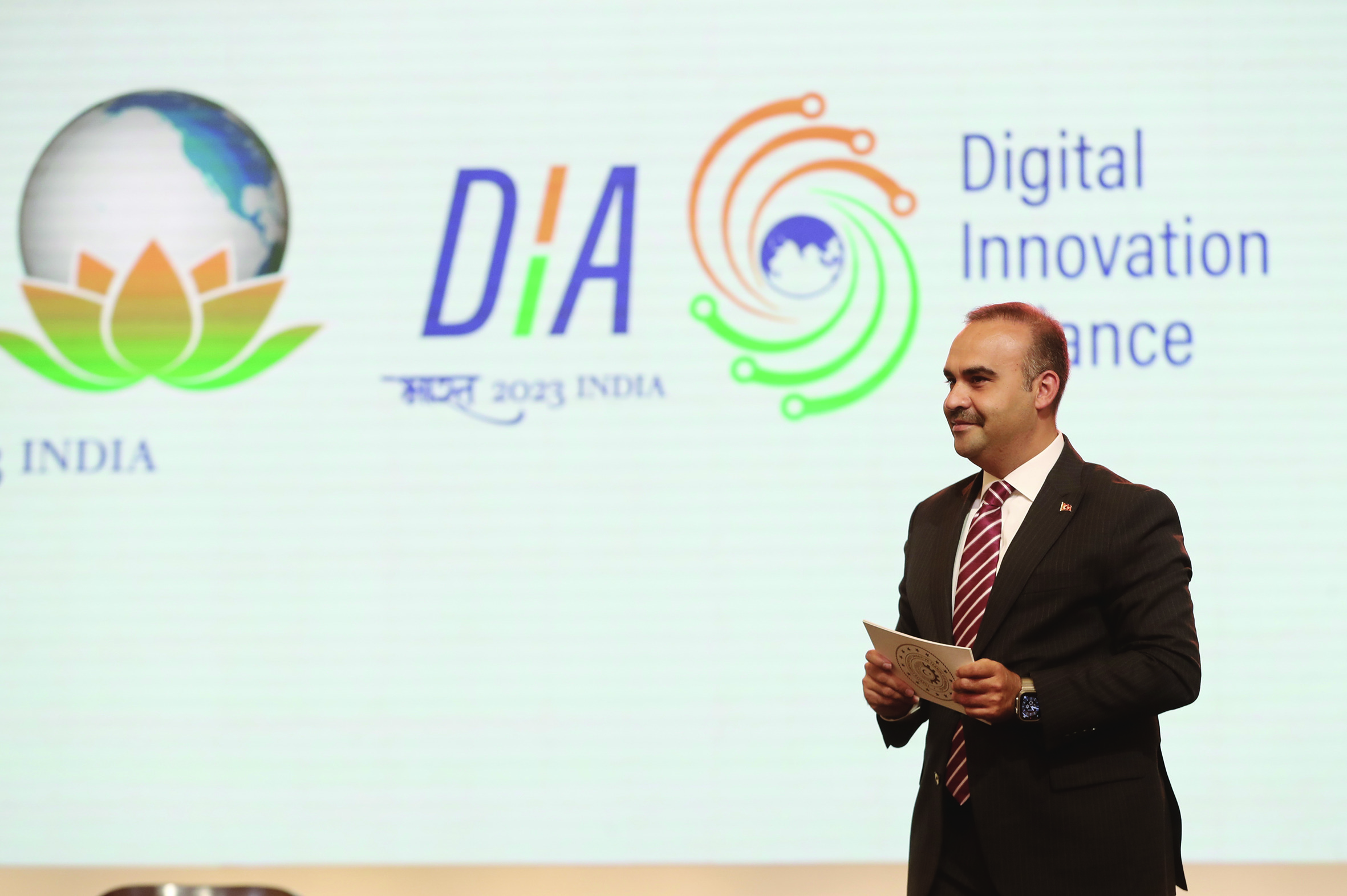 Turkish Minister of Industry and Technology, Mehmet Fatih Kacır, talking about the progress made by Türkiye’s entrepreneurship ecosystem in recent years, at the G20 Digital Economy Ministerial Meeting held in Bangalore, India, in August, 2023. MINISTRY OF INDUSTRY AND TECHNOLOGY / AA
From Türkiye’s perspective, its core interests in the Eastern Mediterranean revolve around safeguarding its territorial integrity, protecting the rights of the Turkish Republic of Northern Cyprus (TRNC), and ensuring energy security. Thus, the above period has been marked by a number of developments that have both challenged and shaped Türkiye’s security and economic interests in the region. Türkiye has maintained its stance of support for the TRNC and has advocated a solution to the Cyprus issue based on equitable terms for both the Turkish and Greek Cypriot communities especially since the Southern part became a member of the European Union in 2004. The unresolved status of Cyprus continued to be a major point of contention in Türkiye’s relations with the EU, affecting not only regional dynamics but also Türkiye’s relations with countries outside the region, including India. India has always supported the Greek Cyprus and Greece, which in turn shaped Türkiye-India bilateral relations. India’s approach to the Cyprus issue remained diagonally opposed to the one held by Türkiye.
The discovery of significant gas reserves in the Eastern Mediterranean around the 2010s escalated tensions, with Türkiye conducting its own exploratory missions and asserting its claims over the maritime area based on the Blue Homeland (Mavi Vatan) doctrine.39 This doctrine emphasized Türkiye’s jurisdiction over its continental shelf and the protection of its maritime borders, which Ankara sees as critical to its energy independence and economic prosperity. During the past couple of years, Türkiye contested the unilateral actions by Greece and the Greek Cypriot administration in exploring and exploiting hydrocarbon resources in contested areas, arguing that such moves disregard the rights of Türkiye and the TRNC. In this context, Türkiye’s involvement in the Eastern Mediterranean, albeit indirectly, also intersects with its relationship with India. India, with its growing energy needs and strategic interests in the wider Asian and West Asian region, saw the Mediterranean as an essential link in its Suez Canal-Red Sea maritime route, or its recent intention which was expressed through IMEC proposal, which could adversely impact Türkiye’s interests in the region.
Counter-terrorism
Since both Türkiye and India have confronted significant terrorism challenges, there has been a general convergence of understanding between the two countries to counter this threat. Since the onset of the 21st century, especially after the 9/11 terrorist attacks, both countries have taken initiatives to cooperate in the field of counter-terrorism, at least at the global-multilateral level. While Türkiye has long struggled with domestic terrorism, particularly from terrorist groups such as the PKK and its affiliates, and more recently, ISIS, terrorism in India has been a persistent concern due to separatist movements and the threat of cross-border terrorism from Pakistan. Recent terrorist incidents such as the 2015 Ankara bombings and the 2016 İstanbul airport attack in Türkiye as well as the 2008 Mumbai attacks and the 2019 Pulwama attack in India, serve as manifestations of both countries’ concerns about terrorism.
In the backdrop of the global “War on Terrorism,” during the visit of Indian Prime Minister A.V. Vajpayee to Türkiye in 2003, the subject of terrorism was one of the main agenda items for mutual collaboration and improving relations between Türkiye and India. In the aftermath of 9/11, Türkiye, under the rule of the AK Party, adopted a cautious stance by refraining from associating terrorism with Islam, in contrast to many Western nations, avoiding terms such as “Islamic” or “Islamist” terrorism. This approach fostered a greater consensus between Türkiye and India on the issue of terrorism, which was reflected in the “Joint Declaration on Terrorism” issued during the February 2010 visit of then-Turkish President Abdullah Gül to India. Both countries agreed to work together to finalize the Comprehensive Convention on International Terrorism (CCIT), which has been under negotiation within the United Nations framework.40 In addition to the aforementioned, the joint declaration reflected a consensus on “affirming their common commitment to fight terrorism,” “stressing that terrorism should not be associated with any religion, nationality, civilization or ethnic group” and “denouncing those who sponsor, abet and instigate terrorism and provide them safe havens.”41 From India’s standpoint, it was Pakistan’s overt or covert backing of terrorism and insurgency in Jammu and Kashmir; from Türkiye’s perspective, it was the outside help that the PKK received from different external actors.
In April 2017, President Erdoğan and Prime Minister Modi released a joint declaration on terrorism during the former’s state visit to India. Both leaders reaffirmed their countries’ commitment to combating terrorism and urged all governments and institutions to cooperate diligently to dismantle terrorist networks and their financing, as well as to halt cross-border terrorist movements. In recent years, discernible differences have emerged between Türkiye and India, particularly concerning allegations of each country facilitating terrorist activities within the other’s borders and supporting or abetting terrorist organizations operating within their respective territories. The Turkish government has expressed apprehensions regarding the activities of the Fetullah Terror Group (FETÖ) within India.42
By endorsing India’s membership bids, Türkiye demonstrates a willingness to collaborate with India within the framework of multilateral institutions to address common challenges and promote global security and stability
Multilateral Forums, International Regimes, and Global Governance Issues
The reform of the United Nations (UN), particularly the expansion of the UN Security Council (UNSC), serves as a significant benchmark for assessing the approaches of India and Türkiye toward global governance. This issue highlights a notable divergence of interests between India and Türkiye within the UN framework. Both countries have advocated for reforms in the UNSC to reflect contemporary geopolitical realities. Erdoğan’s recurrent proclamation, “The World Is Bigger than Five,” highlights Türkiye’s advocacy for expanding the Security Council beyond its current composition of five permanent members.43 This assertion reflects Türkiye’s aspiration for broader representation in global governance institutions, aligning with its expanding influence within the Muslim world. By emphasizing the inadequacy of the current UNSC structure, Erdoğan underscores Türkiye’s ambition to secure a more prominent role in shaping international affairs, particularly in addressing issues relevant to the Muslim community.
Similarly, India, being the most populous country with growing economic and political clout seeks permanent UNSC membership to bolster its global influence. India, along with Japan, Germany, and Brazil, collectively known as the G-4, advocates for permanent seats on the UNSC to enhance their global influence and representation. In contrast, Türkiye aligns itself with the “United for Consensus” group, or the “Coffee Club,” opposing the G-4’s bid for permanent UNSC seats. This opposition from Türkiye could potentially undermine India’s interests within the UN system. China, as a permanent member of the UNSC and a significant player in reform discussions, maintains close ties with Pakistan and Türkiye, with strained relations with India. China opposes immediate reform efforts and advocates for a “broader consensus,” delaying structural changes to the UNSC. Türkiye’s alignment with the “United for Consensus” group reflects its opposition to the G-4’s claim, potentially hindering India’s aspirations within the global governance structure, especially within the UN.
An important dimension for assessing the convergence or divergence of Türkiye and India’s approaches is their engagement with various multilateral export control regimes. Türkiye, a member of the Missile Technology Control Regime (MTCR) since 1997, has actively supported India’s accession to this 35-member multilateral nuclear export control arrangement. India submitted its membership application in mid-2015 and formally joined the MTCR in June 2016.44 Regarding India’s bid for membership in the Nuclear Suppliers Group (NSG), Türkiye, under the AK Party government, initially expressed conditional support. However, in August 2016, Türkiye unequivocally affirmed its full and unconditional backing for India’s NSG membership aspirations.45 This shift in Türkiye’s stance underscores its evolving approach toward international non-proliferation efforts and its recognition of India’s growing role in global nuclear governance. Türkiye’s support for India’s accession to these export control regimes reflects a convergence of interests between the two countries on issues related to nuclear proliferation and non-proliferation. By endorsing India’s membership bids, Türkiye demonstrates a willingness to collaborate with India within the framework of multilateral institutions to address common challenges and promote global security and stability.
Türkiye also lends its support to India’s bid for membership in the Wassenaar Arrangement, another significant multilateral export control regime established in 1996, comprising 41 participating countries, including Türkiye. During Erdoğan’s visit to India in April 2017, a joint statement issued by Erdoğan and Modi reiterated Türkiye’s backing for India’s membership in the Missile Technology Control Regime (MTCR), the Nuclear Suppliers Group (NSG), and the Wassenaar Arrangement.
The statement highlighted the common interests shared by India and Türkiye in preventing the proliferation of weapons of mass destruction (WMD) and their delivery systems through participation in multilateral export control regimes.46 This reaffirmation of support underscores the alignment of India and Türkiye’s objectives in promoting global non-proliferation efforts and strengthening international security architecture. Additionally, it reflects the recognition of India’s responsible conduct and commitment to upholding non-proliferation norms, further fostering cooperation between the two countries in addressing shared challenges related to arms control and disarmament on the international stage.
As middle powers in the international arena, both India and Türkiye are actively striving for greater recognition and influence on the global stage. Their shared membership in the G20, a forum primarily focused on economic development, underscores the importance of cooperation in the economic domain. However, Türkiye, along with select nations, is spearheading the formation of an informal grouping known as MIKTA, comprising Mexico, Indonesia, South Korea, Türkiye, and Australia, aimed at fostering dialogue and collaboration on global issues.47 Notably, India is not included in this grouping. Furthermore, both Türkiye and India are among the more developed economies within the N-11 group of nations, which are identified as emerging economies with the potential for significant growth. Türkiye, in particular, has been considered a prominent contender for inclusion in the BRICS grouping, which consists of Brazil, Russia, India, China, and South Africa. This positioning reflects Türkiye’s aspirations for greater influence and recognition within the global community.
While India and Türkiye may converge on certain issues, such as their joint opposition to the inclusion of trade and investment facilitation, they also encounter disparities, as exemplified by conflicting stances on specific proposals like trade facilitation in services
The dynamic interplay between India and Türkiye within these multilateral frameworks underscores their strategic maneuvering and pursuit of shared objectives while also highlighting areas of divergence in their respective diplomatic agendas. As they navigate the complexities of international relations, both countries seek to leverage their economic and geopolitical strengths to advance their interests and aspirations for greater prominence on the world stage.
In the World Trade Organization (WTO), India and Türkiye have encountered both areas of concurrence and discordance on various matters, illustrating the nuanced landscape of international trade governance. Periodically, instances arise where Türkiye and India express reservations within the WTO framework, exemplifying the complexities inherent in global trade dynamics. One such instance occurred on February 13, 2012, when India raised concerns to Türkiye within the context of the WTO’s dispute resolution system.48 India sought consultations regarding Türkiye’s imposition of safeguards on the import of cotton yarn, distinct from sewing thread. This disagreement underscored differing interpretations of trade regulations and their implications for bilateral trade dynamics.
Similarly, in May 2017, another instance of dissent emerged between the two nations within the WTO domain. India, in conjunction with South Africa and several other developing countries, voiced opposition to the integration of “trade and investment facilitation” into WTO discussions. Conversely, a coalition comprising China, Russia, Brazil, Türkiye, and other members of the MIKTA alliance, supported by several developed countries, advocated for its inclusion. This discrepancy highlights contrasting viewpoints regarding the role of trade and investment facilitation within the broader WTO framework, reflecting varying national priorities and economic strategies. Moreover, within the G20, a trade and investment working group (TIWG) actively pursued the integration of items pertaining to trade and investment facilitation into WTO deliberations. However, India’s proposition for “trade facilitation in services” (TFS) in May 2017 encountered opposition from numerous least-developed countries (LDCs) in Africa, underscoring divergent interests within the WTO membership.
These instances epitomize the intricate dynamics within the WTO, where member states navigate diverging priorities and interests. While India and Türkiye may converge on certain issues, such as their joint opposition to the inclusion of trade and investment facilitation, they also encounter disparities, as exemplified by conflicting stances on specific proposals like trade facilitation in services. Such divergences underscore the formidable task of consensus-building within the WTO and the diverse array of perspectives among its member states.49
Their engagement in multilateral forums, from the United Nations to the G20 and beyond, highlights a shared commitment to contribute constructively to global governance, notwithstanding occasional differences in specific forums
Conclusion
In the comprehensive study of Türkiye-India relations spanning from 2000 to 2023, the research delves into the multifaceted dimensions of their bilateral engagement, encompassing political, economic, cultural, and multilateral interactions. This research has illuminated the complex interplay of historical legacies, geopolitical shifts, and economic imperatives that have shaped the trajectory of relations between these two significant emerging powers. Despite periods of divergence, particularly on sensitive issues like Kashmir and alignments with regional powers, the relationship between Türkiye and India demonstrates a resilient framework of cooperation, underscored by mutual interests in regional stability, economic development, and global governance reform.
The evolution of Türkiye-India relations within this period underscores the significance of economic diplomacy as a cornerstone of bilateral engagement. The growth in trade volumes, despite global economic fluctuations, reflects the potential for deepening economic ties. Institutional mechanisms such as the Joint Economic and Technical Cooperation Committee and business-to-business platforms have laid the groundwork for expanded cooperation in sectors ranging from trade to technology and investment. However, the realization of a comprehensive free trade agreement remains an untapped opportunity that could significantly bolster economic exchanges between the two nations. Culturally, the relationship has benefited from historical connections and contemporary initiatives that foster people-to-people ties, educational exchanges, and cultural diplomacy. The increasing mutual interest in each other’s cultural heritage and contemporary society has contributed to a broader understanding and appreciation, facilitating a conducive environment for deepening bilateral relations.
On the geopolitical front, both Türkiye and India have navigated the challenges and opportunities presented by regional and global dynamics with a pragmatic approach. While differences have occasionally surfaced, notably in their stances on the Kashmir issue and alignments with regional allies, there have been concerted efforts to manage these divergences through dialogue and mutual respect. Their engagement in multilateral forums, from the United Nations to the G20 and beyond, highlights a shared commitment to contribute constructively to global governance, notwithstanding occasional differences in specific forums.
The trajectory of Türkiye-India relations reflects the complexities inherent in the international relations of the 21st century, where bilateral ties are influenced by a confluence of domestic priorities, regional dynamics, and global imperatives. Looking forward, the prospects for Türkiye-India relations hinge on the ability of both nations to leverage their growing economic and geopolitical influence to foster a partnership that not only advances their bilateral interests but also contributes to regional stability and global prosperity. As they navigate the challenges and opportunities ahead, the foundation laid in the past two decades offers a blueprint for a strategic partnership characterized by mutual respect, economic collaboration, and constructive engagement on global issues.
Endnotes
1. Michael B. Bishku, “Turkey and India: From Distant Acquaintances to Partners in World Politics and Trade,” Journal of South Asian and Middle Eastern Studies, Vol. 40, No. 1 (2016), p. 80.
2. Mujib Alam, “Evolving Pragmatism in Indo-Turkish Relations: From Cold War to Post-Cold War Period,” Turkish Yearbook of International Relations, No. 38 (2007), pp. 138-139.
3. Aswini K. Mohapatra, “Bridge to Anatolia: An Overview of Indo-Turkish Relations,” Turkish Yearbook of International Relations, No. 39 (May 2008), p. 167.
4. Alice Pannier, “Bilateral Relations,” in Thierry Balzacq, Frédéric Charillon, and Frédéric Ramel (eds.), Global Diplomacy, (London: Palgrave Macmillan, 2020), pp. 19-33.
5. Nasuh Uslu, Turkish Foreign Policy in the Post-Cold War Period, (New York: Nova Science Publishers, 2004), pp. 3-20.
6. Mesut Hakkı Caşın and Tayyar Arı, Turkish Foreign Policy during JDP Era: Regional Coexistence and Global Cooperation, (Berlin: Peter Lang, 2021), pp. 1-6.
7. Karabekir Akkoyunlu, “The Five Phases of Türkiye’s Foreign Policy under the AKP,” The Social Research, Vol. 88, No. 2 (2021), p. 259.
8. Sebastian Haug and Supriya Roychoudhury, “Civilizational Exceptionalism in International Affairs: Making Sense of Indian and Turkish Claims,” International Affairs, Vol. 99, No. 2 (March 2023), pp. 540-541.
9. Rajindar Sachar, “India’s Foreign Policy,” in V. D. Chopra (ed.), India’s Foreign Policy in the 21st Century, (Delhi: Kalpaz Publications, 2006), pp. 13-18.
10. Jo Inge Bekkevold and S. Kalyanaraman, “India’s Great Power Politics: A Framework for Analysis,” in Jo Inge Bekkevold and S. Kalyanaraman (eds.), India’s Great Power Politics: Managing China’s Rise, (London: Routledge, 2021), pp. 1-8.
11. Kate Sullivan de Estrada, “What Is a Vishwaguru? Indian Civilizational Pedagogy as a Transformative Global Imperative,” International Affairs, Vol. 99, No. 2 (March 2023), pp. 433-455.
12. Ishtiaq Ahmad, “Turkey and Pakistan: Bridging the Growing Divergence,” Perceptions, 5, No. 3 (September 2000).
13. Ömer Aslan, “The Evolution of Türkiye’s ‘South Asia Policy’: Continuities and Ruptures in Outlook, Roles, Actors and Constraints,” Journal of Asian Security and International Affairs, Vol. 9, No. 1 (2022), p. 124.
14. “Turkish PM Pledges Unwavering Support against Terrorism,” Dawn (Pakistan), (October 27, 2009), retrieved March 27, 2024, from https://www.dawn.com/news/amp/847741.
15. “OIC Meet on Kashmir Finds Support from Turkey, Azerbaijan,” The Hindu, (September 21, 2016), retrieved February 23, 2024, from https://www.thehindu.com/news/national/Jammu-and-Kashmir-crisis-OIC-meet-on-Kashmir-finds-support-from-Türkiye-Azerbaijan/article55913194.ece.
16. Khalid Shah and Kriti M. Shah, “Kashmir after Article 370: India’s Diplomatic Challenge,” ORF Occasional Paper, 259 (July 2020), retrieved March 7, 2024, from https://www.orfonline.org/wp-content/uploads/2020/07/ORF-OccasionalPaper-259-Kashmir-Diplomatic.pdf.
17. “India Revokes Kashmir’s Special Status,” Al Jazeera, (September 4, 2019), retrieved March 27, 2024, from https://www.aljazeera.com/news/2019/9/4/india-revokes-kashmirs-special-status.
18. “Turkey Calls for Pakistan-India Dialogue to Resolve Kashmir Dispute,” TRT World, (October 2023), retrieved March 5, 2024, from https://www.trtworld.com/turkiye/turkiye-calls-for-pakistan-india-dialogue-to-resolve-kashmir-dispute-15062735.
19. “Foreign Trade Indicens,” TUİK, retrieved from https://data.tuik.gov.tr/Kategori/GetKategori?p=dis-ticaret-104&dil=2.
20. “India-Türkiye Relations,” Ministry of External Affairs Government of India, retrieved March 1, 2024, from https://www.mea.gov.in/Portal/ForeignRelation/19_-08-_2023_Websits_India_-_Turkiye_Relations__1_.pdf.
21. TICCI, the reincarnation of the Indo-Turkish Business Association (ITBA), was founded in 2013 as a business chamber under the auspices of TUSKON (Confederation of Businessmen and Industrialists of Türkiye). TUSKON was regarded as one of the active conglomerations of the Turkish business community until the Turkish government outlawed it following a failed military coup. TICCI claims to have branches in at least six cities in India.
22. “RBI Signs Memorandum of Understanding (MoU) on “Supervisory Cooperation and Exchange of Supervisory Information” with the Banking Regulation and Supervision Agency, Turkey,” Reserve Bank of India, (December 21, 2016), retrieved January 31, 2024, from https://www.rbi.org.in/commonperson/english/scripts/PressReleases.aspx?Id=2033.
23. “India-Türkiye Bilateral Trade and Investment Profile,” India Briefing, retrieved March 8, 2024, from https://www.india-briefing.com/doing-business-guide/india/trade-relationships/india-turkiye-bilateral-trade-and-investment-profile.
24. Data available on the website of Department for Promotion of Industry and Internal Trade, see: “FDI Statistics,” Ministry of Commerce and Industry Government of India, retrieved from https://dpiit.gov.in/publications/fdi-statistics.
25. “India-Türkiye Relations,” Embassy of India in Ankara, (October 2023), retrieved March 1, 2024, from https://www.indembassyankara.gov.in/eoiank_pages/ODg.
26. “Türkiye-India Economic and Trade Relations,” Republic of Türkiye Ministry of Foreign Affairs, retrieved March 3, 2024, from https://www.mfa.gov.tr/turkiye_s-commercial-and-economic-relations-with-india.en.mfa#.
27. “Cultural Agreement,” Ministry of Culture, Government of India, retrieved March 27, 2024, from https://indiaculture.gov.in/cultural-agreement.
28. “Agreement: Concerning Cultural Relations between the Republic of India and Republic of Turkey,” Ministry of Culture, Government of India, retrieved March 27, 2024, from https://indiaculture.gov.in/sites/default/files/Cultural%20Agreement/231.pdf.
29. “India Celebrates 55 Years of Scholarship Program,” Embassy of India in Ankara, (October 31, 2019), retrieved March 5, 2024, from https://www.indembassyankara.gov.in/eventlistview/MjYx.
30. Shakir Husain, “Indian Visitors to Türkiye Grow 10 Per Cent in 2015,” Business World, (February 8, 2016), retrieved January 31, 2024, from http://businessworld.in/article/Indian-Visitors-To-Türkiye-Grow-10-Per-Cent-In-2015/08-02-2016-90949/.
31. “India Will Be among the Top 10 Tourism Markets for Turkey in Three Years,” Businessline, (January 30, 2024), retrieved January 31, 2024, from https://www.thehindubusinessline.com/news/india-will-be-among-the-top-10-markets-in-three-years-for-Türkiye/article67793177.ece.
32. Data accessed from Ministry of Tourism, see: “India Tourism Statistics 2003-2023,” Government of India Ministry of Tourism, retrieved from https://tourism.gov.in/market-research-and-statistics.
33. Vinay Kaura, “The Erdogan Effect: Turkey’s Relations with Pakistan and India,” ISAS Working Paper, 336 (October 16, 2020), retrieved March 1, 2024, from https://www.isas.nus.edu.sg/wp-content/uploads/2020/10/336.pdf.
34. Nihar Ranjan Das, Athar Zafar, and Smita Tiwary, “Assessing Istanbul Process as Regional Initiative on Afghanistan and Way Forward,” Indian Council of World Affairs, (March 24, 2017), retrieved March 6, 2024, from https://www.icwa.in/show_content.php?lang=1&level=3&ls_id=1749&lid=762.
35. “Flexibility by Design: The Shanghai Cooperation Organisation and the Future of Eurasian Cooperation,” Center for Security Studies ETH Zurich, (May 2018), retrieved February 14, 2024, from https://css.ethz.ch/content/dam/ethz/special-interest/gess/cis/center-for-securities-studies/pdfs/Maduz-080618-ShanghaiCooperation.pdf.
36. Manjiri Chitre, “PM Modi Meets Turkey’s Erdogan at SCO Summit, Discusses Bilateral Cooperation,” The Hindustan Times, (September 16, 2022), retrieved from https://www.hindustantimes.com/india-news/pm-modi-meets-Türkiye-s-Erdoğan-at-sco-summit-discusses-bilateral-cooperation-101663330649276.html.
37. “Erdogan Says India-Gulf Transport Corridor Won’t Work with Türkiye Exclusion,” The New Arab, (September 12, 2023), retrieved March 6, 2024, from https://www.newarab.com/news/Türkiyes-erdogan-slams-india-gulf-israel-transport-corridor.
38. “Türkiye Floats Alternative to G20’s India-Middle East Trade Corridor Plan,” Financial Times, (September 17, 2023), retrieved March 6, 2024, from https://www.ft.com/content/0673f928-dec9-48fb-83b3-8b868a9dcbbe.
39. Aviad Rubin and Ehud Eiran, “Regional Maritime Security in the Eastern Mediterranean: Expectations and Reality,” International Affairs, Vol. 95, No. 5 (2019), p. 990.
40. The Comprehensive Convention on International Terrorism (CCIT) was proposed by India in 1996. The ratification of the CCIT is in limbo due to opposition from the U.S. and several other countries. For details on India’s perspective, see: Vikash Chandra, “India’s Counter-Terrorism Diplomacy at the United Nations: Progress and Problems,” India Quarterly, Vol. 76, No. 1, (March 2020), pp. 40-57.
41. “Joint Declaration on Terrorism between the Republic of Turkey and the Republic of India,” Government of India Ministry of External Affairs, (February 9, 2010), retrieved February 23, 2024, from https://www.mea.gov.in/bilateral-documents.htm?dtl/3666/Joint_Declaration_on_Terrorism_between_the_Republic_of_Türkiye_and_the_Republic_.
42. “India Condemns Terrorism in all Forms, Birla Tells Turkish Speaker,” The Statesman, (October 15, 2023), retrieved February 23, 2024, from https://www.thestatesman.com/india/india-condemns-terrorism-in-all-forms-birla-tells-turkish-speaker-1503231644.html.
43. Berdal Aral, ““The World Is Bigger than Five”: A Salutary Manifesto of Turkey’s New International Outlook,” Insight Turkey, Vol. 21, No. 4 (Fall 2019), p. 71.
44. “Turkey Confirms Its Support to India’s Bid for NSG, MTCR,” ANI, (August 20, 2016), retrieved February 23, 2024, from https://aninews.in/news/national/politics/Türkiye-confirms-its-support-to-india039s-bid-for-nsg-mtcr/.
45. Dipanjan Roy Chaudhury, “Turkey Confirms Support for India’s Membership in NSG,” The Economic Times, (August 19, 2016), retrieved February 20, 2024, from http://economictimes.indiatimes.com/news/politics-and-nation/Türkiye-confirms-support-for-indias-membership-in-nsg/articleshow/53776270.cms.
46. “India, Turkey Condemn ‘Double-Standards’ in Combating Terrorism, to Boost Cooperation,” Hindustan Times, (May 2, 2017), retrieved March 2, 2024, from http://www.hindustantimes.com/india-news/india-Türkiye-condemn-double-standards-in-combating-terrorism-to-boost-cooperation/story-AUAyF4SinUm923e6amSNDO.html.
47. Emel Parlar Dal and Ali Murat Kurşun, “Assessing Turkey’s Middle Power Foreign Policy in MIKTA: Goals, Means, and Impact,” International Journal, Vol 7, No. 4 (2016), pp. 608-629.
48. “India Files Dispute against Turkey,” World Trade Organisation, (February 13, 2012), retrieved March 10, 2024, from https://www.wto.org/english/news_e/news12_e/dsrfc_13feb12_e.htm.
49. “India’s TFS Proposal Gets Little Support,” Third World Network, (May 8, 2017), retrieved February 23, 2024, from http://www.twn.my/title2/wto.info/2017/ti170508.htm.