
Introduction
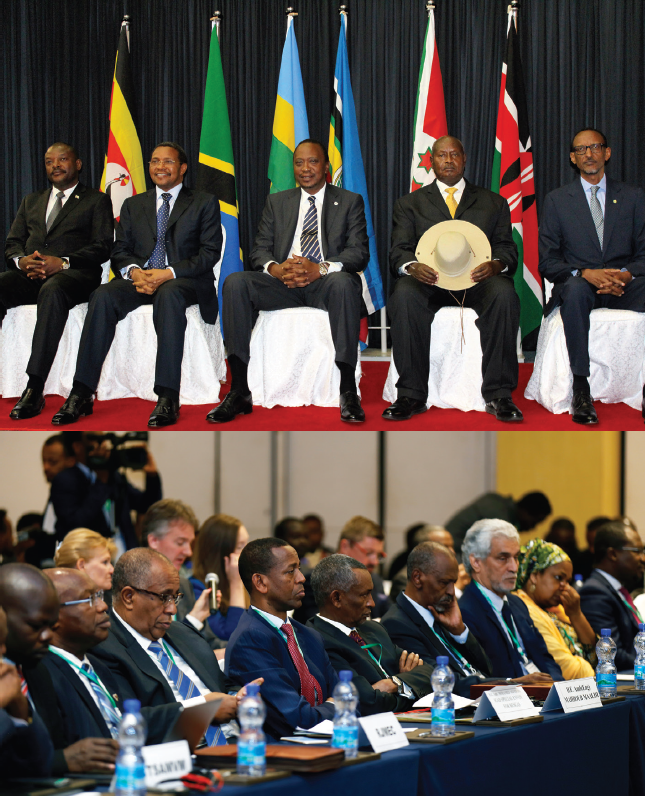
The Intergovernmental Authority on Development (IGAD) and the East African Community (EAC) are two regional organizations in East Africa, with each comprising different member countries. The IGAD countries have a combined population of 300 million, while the EAC has a population of 162 million. In 1986, IGAD was established, and on November 30, 1999, the Treaty for Establishment of the EAC was signed, coming into effect on July 7, 2000.
IGAD and EAC are both serving different purposes and have distinct goals. They also have similarities, including both bodies working towards regional integration and addressing issues like forced displacement and economic challenges within their respective areas. Additionally, they overlap in membership, which can facilitate collaboration. These countries collaborate on various issues, including peace and security, economic development, and humanitarian assistance within the region. IGAD is composed of 8 member states, namely, Djibouti, Eritrea, Ethiopia, Kenya, Somalia, South Sudan, Sudan, and Uganda. On the other hand, EAC currently has 8 member states. These are Burundi, Kenya, Rwanda, South Sudan, Tanzania, Uganda, and the Democratic Republic of Congo (DRC). The most recent development is Somalia’s admission to EAC. Somalia was officially admitted into EAC on November 24, 2023, and became a full member on March 4, 2024.
Differences between IGAD and EAC lie in their priorities. IGAD focuses more on political stability and security issues, particularly in relation to conflicts and humanitarian challenges, while EAC emphasizes economic integration, trade, and development initiatives. Their operational frameworks and member states’ interests also differ, as evidenced by their inconsistent priorities regarding political and economic needs.
Türkiye has engaged with IGAD primarily through its efforts to contribute to peace and stability in the region. Given Türkiye’s increasing involvement in Somalia, it has coordinated with IGAD on security issues, including anti-terrorism efforts and supporting the African Union Mission in Somalia (AMISOM). Türkiye has also provided capacity-building support to IGAD member states, particularly in conflict resolution and mediation processes.
Türkiye has been a significant provider of humanitarian aid in East Africa, especially during times of crisis, such as droughts and conflicts in Somalia and South Sudan. This aid is often channeled through both bilateral relations with IGAD member states and multilateral mechanisms involving IGAD. Furthermore, Türkiye’s diplomatic efforts include active participation in regional forums organized by IGAD. Within this perspective, Ankara has positioned itself as a key partner in IGAD’s initiatives aimed at fostering regional integration and development.
In terms of EAC, it can be stated that Türkiye’s economic relations with EAC countries have been robust, with trade and investment at the forefront. Turkish businesses are increasingly active in the EAC region, particularly in infrastructure projects, manufacturing, and the energy sector. Türkiye has signed trade and investment agreements with several EAC member states to facilitate smoother business operations and enhance bilateral trade. The EAC sees Türkiye as a valuable partner in achieving its goal of economic integration within the region. Specifically, Turkish companies have been involved in various infrastructure projects across the EAC region, including the construction of roads, airports, and other critical infrastructure. These projects align with the EAC’s priority to improve regional connectivity and infrastructure. Moreover, Türkiye has invested in cultural diplomacy and educational exchanges with EAC countries. The Turkish government offers scholarships to students from EAC member states, aiming to strengthen people-to-people ties and build long-term partnerships. Türkiye also promotes cultural exchanges through its embassies in the region, fostering a deeper understanding and cooperation between Turkish and East African societies.
Türkiye views its relationship with both IGAD and the EAC as strategically important. The region’s location, economic potential, and the need for security and stability align with Türkiye’s broader foreign policy objectives in Africa
Türkiye views its relationship with both IGAD and the EAC as strategically important. The region’s location, economic potential, and the need for security and stability align with Türkiye’s broader foreign policy objectives in Africa. By engaging with these East African regional blocs, Türkiye not only strengthens its bilateral relations with East African countries but also enhances its influence in the continent’s political and economic affairs.
This multifaceted engagement reflects Türkiye’s broader ambition to be a key partner in Africa’s development, leveraging its economic, diplomatic, and cultural resources to foster closer ties with the region. It is noteworthy, meanwhile, that Turkish ties to the East African region, today encompassed by the IGAD and EAC blocks, date back centuries before these blocks came into being. It should be mentioned that the context of Turkish African policy and its engagement on the continent must be considered while interpreting its connection with the IGAD and EAC blocks or the region they represent. Thus the next few paragraphs are devoted to looking into the Turkish policy of Africa and Turkish historical and contemporary ties with the continent.
The Historical Relationship between Türkiye and the IGAD-EAC Regions
A varied historical relationship spanning several centuries, trade, military exchanges, and diplomatic contacts have always existed between Türkiye, which is the heir apparent to the Ottoman past, and the Eastern half of Africa, represented by the two East African blocks of IGAD and EAC.
The Ottomans began extending their influence to the Red Sea and the Horn of Africa in the early 16th century. This was partly in response to the growing Portuguese presence in the Indian Ocean, which threatened Muslim trade routes and territories. The Ottomans established a presence in cities like Suakin (in modern-day Sudan) and Massawa (in present-day Eritrea), as well as in parts of modern-day Somalia. The Ottomans were deeply involved in the trade routes of the Red Sea, which connected the Middle East with the African interior. They traded in goods such as gold, and ivory −which were highly valued in the Empire. Ottoman influence helped facilitate trade between the Eastern African coast and the broader Muslim world, including the Arabian Peninsula, Persia, and India.
East Africa’s relations with the Ottomans are also manifested in the military and naval influence. The Ottomans used their naval power to exert influence over the Red Sea and protect their trading interests against European powers like Portugal. They supported local Muslim rulers in the region, helping them resist Portuguese incursions, particularly in areas like the Somali Coast and Ethiopia. The Portuguese and Ottoman rivalry in East Africa was a significant aspect of the broader geopolitical struggles during the ‘Age of Exploration’ and the early modern period. The rivalry emerged in the late 15th century as both empires sought to expand their influence in the Indian Ocean region. The Portuguese aimed to control trade routes and establish a monopoly over the spice trade, while the Ottomans sought to expand their territory and influence in Africa and the Arabian Peninsula.
Cultural diplomacy is also integral to Türkiye’s approach, with the historical connections between Türkiye and Eastern African nations enhancing cultural exchange
The Ottomans were interested in East Africa primarily for its strategic location and resources. They sought to control trade routes that connected the Red Sea to the Indian Ocean and to counter Portuguese influence. The rivalry led to several military confrontations. The Portuguese engaged in naval battles and land assaults against Ottoman-supported forces in East Africa. The Ottomans, leveraging local alliances, sought to undermine Portuguese control. By the late 17th century, the Portuguese began to lose their grip on East Africa due to internal strife, competition from other European powers, and the rising strength of local kingdoms and the Ottomans.
The Ottomans, as a major Muslim power, fostered Islamic ties with the predominantly Muslim populations of the Eastern African coast. This relationship was not just political but also religious, as the Ottoman sultans were seen as protectors of the Islamic faith, a role that resonated with Muslim communities in Eastern Africa. By the 19th century, Ottoman influence in Eastern Africa had waned due to internal decline and the increasing dominance of European colonial powers, particularly the British and the French. However, remnants of Ottoman influence remained in the region’s culture, architecture, and the spread of Islam. In the 20th and 21st centuries, modern Türkiye has sought to re-establish and strengthen its ties with African countries, including those in the Eastern part of the continent. Türkiye has opened numerous embassies in Africa and has engaged in significant diplomatic outreach, focusing on economic, cultural, and educational exchanges.
Challenges in Türkiye’s Multilateral Relationship within the IGAD and EAC Regions
Türkiye’s foreign policy aims to balance its national interests with its global responsibilities. Central to this policy is the principle of national independence and sovereignty, not only for Türkiye but also for the nations with which it maintains ties. Another key principle is the peaceful resolution of conflicts, with a strong emphasis on diplomacy and dialogue in international disputes. Multilateralism is also at the core of Türkiye’s approach, demonstrated by its active participation in international and regional organizations, including NATO, the UN, the African Union (AU), IGAD, and the EAC. Furthermore, a commitment to regional stability remains a fundamental pillar of Türkiye’s foreign policy.
Türkiye’s foreign policy seeks to support the IGAD and EAC regions by promoting stability in the Middle East and neighboring areas. A key pillar of this policy is fostering economic cooperation, strengthening ties with nations and regional blocs such as IGAD and EAC. Cultural diplomacy is also integral to Türkiye’s approach, with the historical connections between Türkiye and Eastern African nations enhancing cultural exchange. Leveraging its strategic geographic position, Türkiye has the depth and capacity to apply these principles in its relations with the IGAD, EAC, and the wider region, thereby boosting both its influence and security.
However, IGAD and EAC have encountered many obstacles in bringing their member nations together, which makes it harder for Türkiye to approach the region using the multilateralism paradigm. Political divisions among the member states are an issue that threatens their unity, resulting in tensions and a lack of agreement on regional problems. The region’s diversity in terms of ethnicity and culture is another issue. There are many different ethnic groups in the area, each with their own unique cultural identity, which can lead to conflict and impede cooperation. Significant economic gaps across member states are one way that the region’s economic disparities are expressed. These discrepancies can result in unequal advantages from regional initiatives, which can lead to friction and reluctance to participate. The main problem in the IGAD-EAC region is therefore security concerns. The persistence of hostilities and instability in some of the member states, such as South Sudan and Somalia, impedes attempts at unification and collaborative efforts.
Furthermore, there are not enough natural resources in this area to support the regional blocks, notwithstanding their abandonment. IGAD frequently has resource constraints, both financial and logistical, which might make it more difficult for it to carry out initiatives and programs successfully. Another issue that makes it difficult to bring the region together under the regional blocks of IGAD and EAC is external influences. Geopolitical interests from external powers frequently affect the dynamics within IGAD and EAC, sometimes exacerbating divisions among member states. Members of IGAD and EAC frequently show a lack of commitment to putting their policies into practice. It is possible for certain member nations to put their own interests ahead of regional collaboration, which could result in uneven involvement in blocks’ programs. To tackle these obstacles, member states must maintain consistent diplomatic efforts, be dedicated to regional integration, and concentrate on common objectives.
Türkiye has played a significant role in helping Somalia rebuild its security forces and combat terrorism, particularly against al-Shabaab
Despite its good bilateral relationship with almost all IGAD-EAC member states, Türkiye faces several challenges in balancing its relations with countries engaged in hostility in the region. A typical example of this is the recent conflict between Ethiopia and Somalia. While Türkiye has strong ties with both countries, its engagement with each nation poses unique difficulties that require careful diplomatic maneuvering.
Ethiopia and Somalia are regional power contenders. The two Horn of Africa states have historically had a complex relationship, partly due to border disputes, Somalia’s claim of the Ogaden region in Ethiopia, and differing interests in regional politics. Somali nationalism and Ethiopia’s concerns should be understood properly. Somalia’s long-standing desire to reunite the Somali-inhabited regions of Ethiopia (and Kenya) with Somalia remains a sensitive issue. Türkiye, while supporting Somalia, must ensure that it does not get involved in or appear to endorse Somali nationalism in a way that could inflame tensions with Ethiopia, a critical regional power.
The situation is not different in the EAC region. Disputes among EAC member states have arisen due to various factors. Territorial disputes are one of the issues. Conflicts over borders and territorial claims, such as the long-standing dispute between Uganda and Tanzania over the Kagera River region, have created tensions between the two states. Tensions between Rwanda and Uganda over allegations of espionage and support for rebel groups are the other challenges. Türkiye’s growing involvement in all these countries can be seen as positioning itself in the broader geopolitical rivalry in the IGAD-EAC states. Balancing its support for all nations without exacerbating regional tensions is a significant challenge.
As mentioned above other foreign influences are also an issue. The IGAD-EAC region is a strategic region, attracting interest from major powers such as the U.S., China, the Gulf States (UAE and Saudi Arabia), and others. Ethiopia and Somalia have their own foreign alliances and interests in the Horn, and Türkiye must navigate these external influences carefully. For example, Türkiye’s growing presence in Somalia may cause concern in Ethiopia due to competition with other external actors like the UAE. Some external actors may provide support to rebel groups or opposition movements within EAC countries like the DRC, undermining stability and unity. This can lead to conflicts spilling over borders and complicating regional cooperation. Türkiye’s growing presence should take into account this factor too.
Somalia is a member of IGAD and recently joined the EAC regional club. Somalia’s security is therefore highly linked to the security of both IGAD and EAC countries. Türkiye has played a significant role in helping Somalia rebuild its security forces and combat terrorism, particularly against al-Shabaab. It has established a military training base in Mogadishu and provided substantial security assistance. While this strengthens Türkiye’s relations with Somalia, it has the potential to complicate its relationship with Ethiopia and Kenya, which have a security stake in Somalia. Both Ethiopia and Kenya have their own concerns about regional security and the threat posed by al-Shabaab.
Kenya’s problems with Somalia are primarily rooted in security concerns and territorial disputes. The relationship has been strained due to a series of factors, including a “wave of attacks” from the al-Qaeda-linked al-Shabaab group, which Kenya blames for violence within its borders. Additionally, there is a long-standing maritime boundary dispute between the two countries. Ethiopia’s internal conflicts are also difficult for Türkiye to navigate. Ethiopia has been grappling with internal conflicts, such as the Tigray War and other ethnic tensions. Türkiye has maintained relations with the Ethiopian government, even providing drones and military support during the Tigray conflict. However, Türkiye’s involvement in Ethiopia’s internal security dynamics could strain its relations with regional forces in Ethiopia and Somalia, especially if Somalia perceives Ethiopia’s actions as destabilizing the region.
Balancing humanitarian and development aid among different countries, especially when resources are limited, can be a challenge for Türkiye
Competing economic interests is also a challenge for Türkiye in dealing with IGAD-EAC ties. Türkiye has invested in infrastructure, trade, and development projects in both Ethiopia and Somalia. It is one of the largest foreign investors in Somalia, particularly in areas like port development, healthcare, and education. At the same time, Ethiopia is a major economic partner for Türkiye due to its larger economy and market potential. Türkiye must ensure that its economic focus on Somalia, which relies heavily on Turkish aid and investment, does not alienate Ethiopia. It should not be seen as favoring Somalia at the expense of Ethiopia.
There is a potential for a conflict of interests in trade routes and strategic access in Turkish relations with IGAD-EAC ties. Somalia’s coastal access to the Indian Ocean is of strategic importance to Türkiye, particularly for trade routes and maritime security. Ethiopia, being landlocked, also relies on neighboring countries like Somalia for port access. Türkiye must balance its maritime and trade interests in Somalia with Ethiopia’s strategic needs, especially given Ethiopia’s reliance on Djibouti and potential access to Somali ports. Here the Turkish stance in Ethiopia’s attempts to secure access to the sea manifested in the MoU it signed with Somaliland is the case.
Balancing humanitarian aid is another challenge for Türkiye. Türkiye has increasingly positioned itself as a significant player in providing humanitarian aid in Africa over the past two decades. It should be noted, however, that balancing humanitarian and development aid among different countries, especially when resources are limited, can be a challenge for Türkiye. Somalia’s dependence on aid can be seen favoring it disproportionally by other countries in the region. Somalia is highly dependent on foreign aid, and Türkiye has been one of the largest donors in terms of humanitarian assistance, particularly during times of drought, famine, and conflict. However, Ethiopia, with its larger population and significant development needs, also requires substantial support. This is also very connected to public perception and influence. Türkiye’s large-scale aid efforts have helped it gain influence in Somalia, where it is seen as a key partner in rebuilding the country. However, Türkiye’s involvement in Ethiopia’s conflicts and its political alliances within the country could lead to negative perceptions in Somalia, especially if Türkiye is viewed as prioritizing Ethiopia’s interests over Somali stability.
Türkiye faces additional challenges from the business competition in the EAC region. While the EAC aims to promote economic integration, cooperation, and development among its member states, there are several underlying rivalries and tensions that can affect its functioning. Economically, there is significant competition for market share and investment among EAC member states. For instance, Kenya is often seen as the economic powerhouse of the region, leading to competition with Tanzania and Uganda for dominance in trade, tourism, and agricultural exports. Türkiye must navigate this rivalry carefully, ensuring its support for one’s sovereignty without alienating others, which view their own development as tied to the rest of the region.
Maintaining a neutral, cooperative approach while addressing the distinct needs and concerns of all countries in the region is critical to sustaining Türkiye’s influence and positive relations in the Eastern part of Africa
Turkish mediation role may also be hampered by regional rivalry. Türkiye often plays the role of mediator in regional conflicts, including in the IGAD-EAC regions. Balancing its diplomatic role in both Ethiopia and Somalia, particularly as tensions rise in the region, requires delicate handling. For instance, Türkiye’s desire to mediate or engage in peace-building initiatives in Ethiopia, especially concerning the Tigray conflict, could be viewed differently by Somalia, which might want Türkiye to focus more on its internal security and state-building efforts. Or the Türkiye peace initiative in Somalia may receive the same response in Ethiopia.
Türkiye’s challenge to IGAD-EAC ties may stem from multilateral relations. Türkiye’s balancing act in the region is complicated by its membership in international organizations like the UN, the AU, and the Organization of Islamic Cooperation (OIC). These organizations may have differing stances on the Ethiopia and Somalia conflict or the Uganda-Kenya rivalry, which Türkiye must navigate without damaging its broader international relations.
In summary, Türkiye’s challenge in balancing its relations with IGAD-EAC regions revolves around navigating regional rivalries, managing security dynamics, and ensuring its economic and diplomatic efforts do not favor one nation over the other. Maintaining a neutral, cooperative approach while addressing the distinct needs and concerns of all countries in the region is critical to sustaining Türkiye’s influence and positive relations in the Eastern part of Africa.
Conclusion and Recommendation
The dilemma of being a friendly country with multiple rival states involves navigating complex geopolitical relationships, balancing diplomatic ties, and managing national interests. Türkiye should take into account some key considerations in its relationship with the IGAD-EAC regions. Türkiye may strive to maintain neutral diplomatic relations with competing nations in the region, which can be challenging. It requires careful communication and diplomacy to avoid escalating tensions. Economic ties with one or both rival states may be beneficial, but engaging too closely with one can provoke the other. This economic balancing act can impact trade, investments, and sanctions. Türkiye should address this challenge through careful planning and implementation of bilateral and multilateral economic strategies.
For every state, national security is a significant concern. Türkiye must tread carefully to prevent the impression that it is favoring one nation at the expense of others. Through alliances, Türkiye hopes to enhance its geopolitical power, but it must first navigate a variety of political environments and governance styles throughout the region. Through cultural exchanges and educational initiatives, Türkiye demonstrates its soft power. Overall, Türkiye’s strategy requires careful consideration of local dynamics and global competition while aiming for mutually beneficial relationships.