

Introduction
Following the end of the Cold War, a new concept emerged to deal with international and foreign affairs. This concept was dubbed the “New World Order.”1 However, the concept was not truly a novel one. Earlier, throughout the 1970s, a different designation was used in the international and United Nations (UN) fora: the “New International Economic Order.”2 These concepts could not have meant the same thing. Whatever the interpretation, one thing is certain: a new system is being adopted, within which only the greatest, most productive, and most competitive will survive. In other words, the ability of nations or states to compete in this new global economic order will determine whether they survive, how they survive, and with whom they survive. To put it succinctly, their level of collaboration and solidarity with the outside world will determine how successful they will be. The idea of comparative advantage is driving this effort to establish regional economic and commercial blocs. Many countries are particularly drawn to regional blocs by their economic scale and the desire for increased productivity and competitiveness. Asia, Europe, and the Americas all witness the expansion and strengthening of new commercial and economic ties.
Concomitantly, the complex web of relationships between states and regional blocs is progressively influencing the dynamics of international relations in the modern global environment. On the one hand, good relations among these global actors are pivotal in fostering prosperity, stability, and cooperation on both regional and international scales.3 On the other hand, strong diplomatic ties and cooperative frameworks are crucial considering the world’s multifaceted challenges, such as transnational crime, economic volatility, security risks, and climate change. Therefore, enhancing global capacity to address shared challenges effectively requires positive relations between state and non-state actors to combine resources, harmonize policies, and amplify collective influence; all of which improve the ability to deal with shared problems efficiently.4 In addition to fostering economic development and progress, this synergy also improves cultural exchanges, fortifies political unity, and supports the preservation of peace and security. Essentially, fostering positive links between nations and regional alliances is essential to building a stronger, more cohesive global community that can successfully negotiate the challenges of the contemporary world.
Türkiye has greatly broadened its horizons in terms of foreign policy in recent years, forging and strengthening ties with many Sub-Saharan African regional blocs. This tactical change is a component of Türkiye’s larger goal to broaden its international alliances, increase its clout, and promote world peace and development. Particularly in its dealings with important regional institutions like the African Union (AU), the East African Community (EAC), the Economic Community of West African States (ECOWAS), and the Southern African Development Community (SADC), among others, Türkiye’s engagement with Sub-Saharan Africa is dynamic and multifaceted. Türkiye’s foreign policy towards these regional blocs is characterized by a blend of political dialogue, symbiotic economic cooperation, and cultural exchange.5 Economically, Türkiye has participated in significant infrastructure projects, increased investment flows, and pursued robust trade agreements across the continent. Politically, Türkiye has sought to align itself with regional efforts to promote security, peace, and stability, often supporting conflict resolution initiatives and participating in peacekeeping missions.6 Culturally, Türkiye’s soft power has been projected through health diplomacy, cultural exchange initiatives, and educational scholarships aimed at fostering goodwill and mutual understanding.
As the principal continental organization, the AU embodies a unified vision for the integration and development of Africa. Türkiye’s engagement with the AU encompasses funding peacekeeping and development projects as well as supporting AU-led initiatives.7 Relationships between Türkiye and the ECOWAS in West Africa have been characterized by a common interest in political stability and economic growth, as well as cooperative efforts in counter-terrorism and regional security.
The goal of this paper is to present a comprehensive analysis of Türkiye’s foreign policy dealings with the AU and ECOWAS, examining the objectives, tactics, and results of its involvement. The paper looks at political alliances, cultural linkages, and economic relationships to shed light on the subtleties and complexity of Türkiye’s place in the region. Gaining an appreciation of these processes is essential to comprehending the larger geopolitical and economic changes that are influencing contemporary Sub-Saharan African international engagements. The discussions provide a comprehensive understanding of the multifaceted relationships between Türkiye and Sub-Saharan Africa, highlighting both opportunities and challenges in their engagements.
Relationships between Türkiye and the ECOWAS in West Africa have been characterized by a common interest in political stability and economic growth, as well as cooperative efforts in counter-terrorism and regional security
At this point, it would be intellectually appropriate to situate the analysis within specific dominant international relations theoretical and conceptual frameworks. These frameworks aid in explaining states’ diplomatic dealings with others in this anarchic international system. Together, these theoretical and conceptual frameworks provide a comprehensive understanding of the complex and multi-dimensional nature of Türkiye’s foreign policy in Sub-Saharan Africa. They reveal how Türkiye navigates the challenges and opportunities of engaging with a dynamic and diverse region, seeking to position itself as a key player in the evolving landscape of African international relations.
Theoretical and Conceptual Frameworks Underpinning Türkiye’s Foreign Policy Engagements in Sub-Saharan Africa
Foreign policy, the strategies and decisions a state employs in its interactions with other states and international entities, is shaped by various theoretical and conceptual frameworks in international relations. These frameworks provide lenses through which scholars and policymakers understand, analyze, and predict state behavior in the international arena. Türkiye’s expanding foreign policy engagements in Sub-Saharan Africa represent a significant and strategic shift in its international relations, reflecting a blend of theoretical and conceptual frameworks that inform its actions on the continent. As Türkiye deepens its diplomatic, economic, and security ties with African nations, particularly through regional organizations like the AU and ECOWAS, understanding the underlying motivations and strategies requires a multifaceted theoretical and conceptual approach. The following are some of the key theoretical and conceptual frameworks used in analyzing Türkiye foreign policy engagements with regional blocs in Sub-Saharan Africa.
Realism
Realism posits that international relations are governed by an anarchic structure, where no central authority exists above the state.8 States, driven by the imperative of survival, prioritize national interest and security. Realist frameworks emphasize power, national interest, and the balance of power in foreign policy decisions.9 States engage in diplomacy, military alliances, and strategic partnerships to enhance their security and maintain their sovereignty. Realist foreign policy is often characterized by pragmatism, with decisions made based on strategic calculations rather than ideological commitments. For instance, the Cold War era, where the U.S. and the Soviet Union engaged in power politics, exemplifies realist principles in foreign policy, with both superpowers seeking to balance each other’s influence globally.10
Türkiye’s engagement with the AU and ECOWAS can be understood through the lens of realism, a dominant theory in international relations that emphasizes the pursuit of national interest, power, and security within an anarchic international system. From a realist perspective, Türkiye’s growing involvement in Sub-Saharan Africa, particularly with key regional blocs, is driven by strategic considerations aimed at enhancing its geopolitical influence, securing economic opportunities, and counterbalancing the influence of other global powers in the region. In recent years, Türkiye has intensified its diplomatic, economic, and security engagements across Africa, recognizing the continent’s rising importance in global affairs. This engagement serves as a counterbalance to the influence of traditional foreign powers on the African continent, such as France and the U.S., and emerging actors like China, who are also vying for influence in Africa. Through strategic partnerships with the AU and ECOWAS, Türkiye seeks to position itself as a key player in African regional affairs, using diplomacy, trade agreements, and military cooperation to advance its national interests. This realist interpretation underscores the pragmatic and interest-driven nature of Türkiye’s foreign policy, which prioritizes tangible gains in power and security over ideological or altruistic considerations.
Liberalism
Liberalism, in contrast to realism, views international relations as a system where cooperation is possible and beneficial. It emphasizes the role of international institutions, democracy, and economic interdependence in promoting peace and stability. Liberal frameworks advocate for multilateralism, international cooperation, and the promotion of democracy and human rights. States engage in foreign policy through international organizations (e.g., the United Nations, WTO), fostering alliances that support economic and political stability. Liberal foreign policy emphasizes diplomatic engagement, conflict resolution, and global governance.11 The establishment of the European Union (EU) as a supranational body to promote economic integration and prevent conflict among European states reflects liberal principles in foreign policy.12
Türkiye’s engagement with the AU and ECOWAS can also be analyzed through the lens of liberalism, a theory in international relations that emphasizes cooperation, mutual benefits, and the role of international institutions in promoting peace and prosperity. From a liberalist perspective, Türkiye’s increasing involvement with these African regional organizations reflects its commitment to fostering multilateral cooperation, economic interdependence, and the promotion of shared values such as development, stability, and good governance. Türkiye’s outreach to Africa, particularly through the AU and ECOWAS, aligns with the liberalist emphasis on building strong international partnerships to address global challenges. By engaging with these regional bodies, Türkiye is not only seeking to enhance bilateral relations with individual African states but also contributing to the strengthening of regional governance structures that support peace, security, and sustainable development across the continent. This approach reflects Türkiye’s broader foreign policy goals of contributing to global stability through diplomacy, trade, and development cooperation. Furthermore, Türkiye’s involvement in Africa is characterized by its emphasis on win-win partnerships, where economic ties, cultural exchanges, and developmental aid are seen as mutually beneficial for both Türkiye and African nations. This liberalist perspective highlights Türkiye’s efforts to create a network of cooperative relationships that transcend mere power politics, instead focusing on shared interests and collective progress. Through its engagements with the AU and ECOWAS, Türkiye seeks to contribute to a more interconnected and prosperous world where collaboration and dialogue take precedence over unilateralism and conflict.
Through strategic partnerships with the AU and ECOWAS, Türkiye seeks to position itself as a key player in African regional affairs, using diplomacy, trade agreements, and military cooperation to advance its national interests
Constructivism
Constructivism argues that international relations are socially constructed through interactions, ideas, and identities.13 State behavior is shaped by ideational factors rather than just material capabilities.14 Constructivist frameworks focus on the role of norms, values, and identities in shaping state interests and foreign policy. States engage in foreign policy by promoting norms that align with their identity, such as human rights, environmental sustainability, or regional integration. The foreign policy process involves the construction and reconstruction of state identities and interests in response to global and domestic social dynamics. The foreign policy of Türkiye,15 which prioritizes humanitarian aid and peacekeeping based on its national identity as promoter of global welfare, demonstrate constructivist principles.
Türkiye’s engagement with African regional blocs can, as well, be fruitfully examined through the constructivist lens, which emphasizes the role of ideas, identities, and norms in shaping international relations. From a constructivist perspective, Türkiye’s growing involvement in Africa is not merely a strategic or economic pursuit but is also deeply influenced by the construction of a shared identity and the desire to promote certain norms and values in its interactions with African states and regional organizations. Türkiye’s foreign policy in Africa is shaped by its evolving national identity and the projection of itself as a bridge between different cultures and regions. This identity construction is evident in Türkiye’s emphasis on shared historical ties, cultural connections, and a common destiny with African nations. Through the engagement with the AU and ECOWAS, Türkiye is not only seeking to build strategic alliances but also to cultivate a narrative of solidarity and partnership with Africa, which aligns with its broader foreign policy goal of being a global actor that transcends traditional East-West divides. Moreover, Türkiye’s relations with African regional blocs or organizations reflect its commitment to promoting norms such as regional cooperation, development, and conflict resolution. Through its active participation in AU and ECOWAS initiatives, Türkiye is contributing to the diffusion of these norms across Africa, while simultaneously reinforcing its identity as a responsible and cooperative international actor. This constructivist approach highlights how Türkiye’s interactions with Africa are informed by the mutual shaping of identities and the continuous redefinition of interests based on evolving normative frameworks.
In sum, from a constructivist perspective, Türkiye’s diplomatic ties with the AU and ECOWAS are not just about securing material gains but also about constructing and reinforcing a shared sense of purpose and common values that guide its foreign policy in Africa. This approach underscores the importance of ideational factors in understanding Türkiye’s role in the region, as well as the broader implications of its engagement for the future of Africa-Türkiye relations. Theoretical and conceptual frameworks for foreign policy engagements provide diverse perspectives on how states interact with the international system. When these frameworks are intellectually applied, scholars and policymakers can better understand the motivations behind state behavior, the potential for cooperation or conflict, and the broader implications of foreign policy decisions. Whether through the power-centric lens of realism, the cooperative ideals of liberalism, or the identity-focused approach of constructivism, these frameworks offer valuable tools for analyzing and shaping foreign policy in an increasingly complex and interconnected world.
Türkiye’s Foreign Relations with the African Union: A Strategic Partnership
The AU, which was established in July 2002 by the Durban Summit, is a continent-wide intergovernmental organization, succeeding the Organization of African Unity (OAU), founded in May 1963 by 32 member states. Currently, the AU has 55 member states, all committed to its vision of “an integrated, prosperous, and peaceful Africa, driven by its own citizens and representing a dynamic force in the global arena.”16 The AU’s total GDP is $5.4 trillion, with a per capita GDP of $4,602. To foster trade among its member states, the AU coordinates and harmonizes the policies and programs of existing and future regional economic communities (RECs), aiming to integrate all African nations gradually. The AU’s institutions and organs overseeing this integration process include the African Investment Bank, the African Monetary Fund, the Committee on Monetary and Financial Affairs, the Committee on Trade, Customs, and Immigration Matters, and the Economic, Social, and Cultural Council (ECOSOCC).
Türkiye’s increasing involvement with these African regional organizations reflects its commitment to fostering multilateral cooperation, economic interdependence, and the promotion of shared values such as development, stability, and good governance
The AU has recently published a comprehensive table of its treaties, including their synopses, signatories, ratification status, and a list of non-ratifying African countries. In 2018, the AU members adopted the African Continental Free Trade Area (AfCFTA) to boost trade and economic growth across the continent.17 Along with the Intra-African Trade Fair, the AU has also planned events, summits, and prioritized trade integration to promote Africa’s global competitiveness.18 Over the past three decades, Türkiye has undergone a significant transformation in its foreign policy, notably expanding its diplomatic and economic engagement with Sub-Saharan Africa.19 A central component of this endeavor is Türkiye’s relationship with the AU, a continental organization that plays a pivotal role in Africa’s political and economic integration. This section examines the various aspects of Türkiye’s partnership with the AU, concentrating on diplomatic alignment, economic cooperation, and cultural diplomacy, and evaluates the impact and future potential of these collaborative efforts.
Türkiye Diplomatic Ties with the African Union
Diplomatically, between 1963 and 2002, Türkiye’s formal ties with the AU remained quite restricted.20 However, following the 1998 Action Plan for the Opening Policy towards Africa, Türkiye was granted “observer status” in the African Union in 2005 and began attending summits as a guest nation.21 The African Union-accredited Turkish Embassy in Addis Ababa has been closely monitoring the organization’s activities. The Chairperson of the African Union Commission then, Professor Oumar Alpha Konare, visited Türkiye on November 21-25, 2005, at the behest of Mr. Abdullah Gül, the Minister of Foreign Affairs and Deputy Prime Minister of the Republic of Türkiye at the time. This was the first time that the AU paid a high-level official visit to Türkiye. Conversely, the then Prime Minister Erdoğan also made the first high-level visit from Türkiye to the AU on January 29-30, 2007, to take part in an AU summit in Addis Ababa, at the request of the Chairperson of the African Union Commission.22
In 2008, the AU designated Türkiye as a strategic partner of Africa, indicating the continental organization’s diplomatic will to deepen ties with Türkiye. The First Türkiye-Africa Cooperation Summit took place in İstanbul between August 18 and 21, 2008. The summit resulted in the adoption of the “İstanbul Declaration on Türkiye-Africa Partnership: Solidarity and Partnership for a Common Future” as well as its appendix, the “Framework of Cooperation for Türkiye-Africa Partnership.”23 The priority cooperation fields identified in this context were trade and investment, intergovernmental cooperation, small and medium-sized enterprises, health, agribusiness, education, agriculture, and rural development, water resources management, peace and security, information and communication technology, energy, infrastructure, tourism, transport, culture, environment, and the media. The Foreign Economic Relations Board (DEİK) organized the “Türkiye-Africa Business Forum” in conjunction with the summit. The forum enhanced Türkiye’s diplomatic capacity to promote economic potential to the African business community.
The Turkish Prime Ministry announced on March 26, 2010, an “African Strategy” to undertake a comprehensive plan based on the cooperation of the sectors stated above as part of the efforts to further enhance the Turkish-African relationship. By taking into consideration their unique characteristics, the Africa strategy seeks to enhance Türkiye’s relationship with the AU and the member states of the continent. On December 15, 2010, İstanbul hosted the High-Level Officials Meeting of the Türkiye-Africa Partnership under the scope of the follow-up mechanism that was approved during the summit. During the meeting, the “2010-2014 Türkiye-Africa Partnership Joint Implementation Plan” was approved and a joint press release was issued.24
The First Ministerial Review Conference of the Türkiye-Africa Partnership took place in İstanbul on December 16, 2011, in accordance with diplomatic procedures. The meeting was a great chance to assess the progress made since 2008 and talk about the next actions that needed to be taken to further the collaboration between Türkiye and Africa. The conference resulted in a communiqué that was adopted with the unanimous consent of the ministers. The Conference reaffirmed that thanks to the parties’ shared desire, the Türkiye-Africa Partnership was progressing well. Several high-level discussions between Türkiye and the AU were conducted in Ankara and Addis Ababa as part of the arrangements for the second summit of the Türkiye-Africa Partnership. “A New Model of Partnership to Enhance Sustainable Development and Integration” was the subject of the second Türkiye-Africa Partnership Summit, which took place in Malabo from November 19-21, 2014. At the summit, a Joint Implementation Plan for 2015-2019 and a workable Declaration were unanimously adopted. The meeting decided that the Third Türkiye-Africa Partnership Summit would take place in Türkiye in 2019. At the Senior Officials’ Meeting in Ankara on March 19, 2015, a matrix to be used in the upcoming years was agreed upon, and the 2015-2019 Implementation Plan was examined.
The AU and Türkiye have a partnership marked by a shared commitment to peace, security, and development activities. Türkiye has taken an active role in AU-led peacekeeping operations, contributing personnel and resources to help in crisis areas like Somalia and Mali. This engagement demonstrates Türkiye’s larger strategic goal of advancing security and stability throughout the continent. As part of its political involvement with the AU, Türkiye supports the development of institutional capacity and good governance.25 African diplomats and officials have access to training programs offered by Ankara with the goal of improving their administrative and governance capacities. By taking such steps, Türkiye hopes to further its own diplomatic goals on the continent and harmonize with the AU’s vision of a peaceful and prosperous Africa.
The AU and Türkiye have a partnership marked by a shared commitment to peace, security, and development activities
Türkiye Economic Ties with the African Union
A key component of Türkiye’s relationship with the AU is economic cooperation. Türkiye has made a concerted effort to improve investment and commerce with all of Africa. A major turning point was reached in 2008 when the Türkiye-Africa Partnership Summit was established, offering a forum for discussion and collaboration on economic matters. Subsequent summits have seen Türkiye pledge significant commitments to invest in energy, infrastructure, and agriculture. The Turkish Cooperation and Coordination Agency (TİKA), which has initiated many projects aimed at enhancing infrastructure and stimulating local economies, facilitates Türkiye’s economic activities in Africa.26 Additionally, due to prospects in consumer products, textiles, and construction, Turkish enterprises have been expanding into African markets.27 By improving connectivity and commerce, Turkish Airlines’ launching of services to several African cities has strengthened economic connections even further.
Available statistics indicate that, between 2015 and 2021, Türkiye’s trade volume with North Africa (NA) was much larger than its trade volume with Sub-Saharan Africa (SSA). For example, in 2020, NA accounted for $15 billion of the $25 billion in trade volume with the African continent.28 The circumstance may be explained by the fact that North African exports are more diverse than those of Sub-Saharan African nations, and Türkiye has considerably longer-standing contacts with NA than with SSA. Generally, Türkiye’s trade with Africa began to rise in 2016. For example, although Africa had a negative trade balance with Türkiye in both years, Türkiye’s commerce with Africa climbed from $25 billion in 2020 to $34 billion in 2021, indicating Türkiye’s growing commercial activities on the continent.
Africa is not considered to be one of Türkiye’s primary commercial partners, and although commerce between the two parties has increased significantly over the last decade, Africa still accounts for a modest portion of Türkiye’s overall international trade. North America, the EU, and nations in the Near and Middle East are Türkiye’s main commercial partners. For instance, in 2020, the EU’s and the Near and Middle Eastern nations’ portions of Türkiye’s total commerce were 41.2 percent and 18.47 percent, respectively, while Africa’s contribution was only 6.14 percent.29 Furthermore, compared to the other areas, Türkiye’s trade asymmetry with both SSA and NA is significantly more apparent because the African regions account for three times as much of Türkiye’s total global exports as Türkiye receives from them.
The low number of Free Trade Agreements (FTAs) signed with African nations (four FTAs have been concluded thus far, with Morocco in 2004, Tunisia in 2004, Egypt in 2005, and Mauritius in 2011), as well as the double taxation that businesspeople on both sides must deal with, contribute to Africa’s low ranking among Türkiye’s trading partners.30 Although Türkiye is not one of the top trading partners in SSA, it is noteworthy that despite its recent participation, it has managed to establish a non-negligible place in the region’s commercial landscape. For example, Türkiye achieved the rank of 19th largest exporter in Africa in 2018 and 2019, with a share of 1.33 percent and 1.47 percent, respectively. When compared to the major importers in SSA, however, this position drops significantly, despite an improvement from 38th rank (0.49 percent) in 2018 to 30th place (0.74 percent) in 2019.31
Table 1 lists Türkiye’s top ten trading partners in Africa from 2015 to 2021. Of them, five are from NA, and the other five are from SSA. These trading partners are mostly found in the West, East, and South of the continent. In 2020 and 2021, the five North African nations accounted for almost 60.98 percent and 71.96 percent, respectively, of Türkiye’s overall trade volume with Africa. The top position of North African nations may be readily explained by the countries’ proximity to Türkiye, their long-standing relationship dating back to the Ottoman Empire, and their higher levels of industrialization and infrastructural development. A further noteworthy point is displayed in Table 2. Only Algeria, Nigeria, and South Africa, three of Türkiye’s top 10 trading partners in Africa, were able to sustain a positive trade difference with Türkiye in 2020 and 2021. The overall imbalance in Türkiye’s trade with African nations is skewed by the higher balance with these nations.
Table 1: Top Ten Trading Partners of Türkiye in Africa (%, 2015-2021)
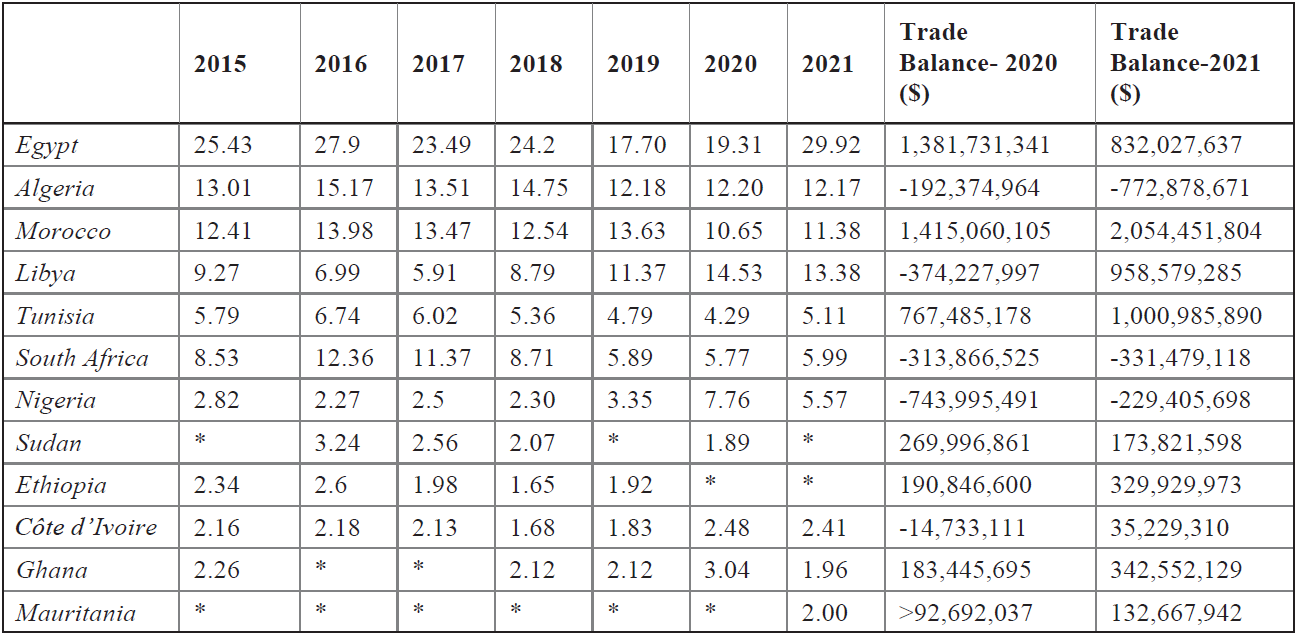
Note: * Country not ranked among Türkiye’s top ten trading partners for that year
Source: Constructed by Author Based on Turkish Statistical Institute-TÜİK- TÜRKSTAT Data Portal, 2022
Türkiye Cultural Diplomacy with the African Union
Turkish cultural diplomacy is a key component of the country’s attempt to improve ties with the AU. To promote goodwill and understanding between nations, Türkiye has used soft power strategies, including humanitarian aid, cultural exchanges, and educational programs. Important elements of this strategy include the creation of Turkish cultural institutions and the offering of scholarships to African students to study in Türkiye. The Yunus Emre Institute and the Turkish Maarif Foundation play a significant role in advancing the Turkish language and culture throughout Africa.32 By arranging educational programs, language classes, and cultural events, these organizations support the development of cultural ties between Türkiye and African countries. Additionally, Türkiye’s reaction to humanitarian disasters in Africa –such as aiding during famines and droughts– has improved its standing and influence throughout the continent.
To promote goodwill and understanding between nations, Türkiye has used soft power strategies, including humanitarian aid, cultural exchanges, and educational programs
As an alternative model of development cooperation to the Washington consensus of the U.S. and the Beijing consensus of China, Türkiye has positioned its assistance policy as the “Turkish way” of development cooperation, based on what is known as “the Ankara consensus.” Table 2 shows that, relative to NA, SSA received a much larger portion of Türkiye’s ODA distribution between 2015 and 2020. Nonetheless, overall, less Turkish aid is being sent toward Africa. The sharp decline in SSA’s ODA share from Türkiye is a result of a consistent decline from 9.66 percent in 2015 to 0.71 percent in 2020. The percentage has varied for NA, whose assistance flow was significantly smaller. After a sharp decline between 2016 and 2019, it recovered to be somewhat higher in 2020 than it was in 2015. The overall downward trend can be attributed to local problems like the inflation and currency crises, as well as the Syrian crisis’ knock-on effects on Türkiye’s border security, which increased defense spending and may have decreased assistance disbursements.
Table 2: SSA and North Africa’s Share of Türkiye’s Total Gross ODA Disbursement (%, 2015-2020)

Source: Constructed by the Author Based on OECD Credit Reporting System Statistics, 2022
Impact and Future Prospects of Türkiye Relations with the African Union
Growing cultural exchanges, improved political collaboration, and stronger economic ties are some of the impacts of Türkiye’s diplomatic relations with the AU. Türkiye’s aggressive engagement in the continent’s development is consistent with its overarching foreign policy goals of increasing its sway and cultivating long-term alliances. With much promise, Türkiye’s relationship with the AU appears to have a bright future. With Africa’s economy expanding at a rapid pace and its geopolitical relevance growing, Türkiye is ideally positioned to assume a central role in the continent’s development trajectory. For this collaboration to continue, funding for infrastructure, technology, and human resources will be essential. Furthermore, Türkiye’s dedication to bolstering peace and security endeavors will bolster its position as an essential AU partner. The strategic and multidimensional connection between Türkiye and the AU has changed dramatically during the last ten years. By means of strong economic collaboration, political alignment, and cultural diplomacy, Türkiye has emerged as a significant participant in the development of Africa. The continued strengthening of this relationship promises mutual benefits and contributes to the broader goals of stability, prosperity, and integration on the African continent.
Türkiye’s Foreign Relations with ECOWAS: A Growing Partnership
As indicated above, strengthening ties with African regional blocs, particularly those in Sub-Saharan Africa, has been a major emphasis of Türkiye’s burgeoning foreign policy. ECOWAS has become one of these key partners. In recent years, Türkiye’s diplomatic ties with ECOWAS have grown significantly, characterized by a growing relationship across political, cultural, and economic spheres. Motivated by common goals and interests, Türkiye’s expanding ambition to increase its influence and presence in Africa includes developing partnerships with regional blocs. The 15 West African nations that make up ECOWAS, a regional bloc, are essential to the advancement of economic integration, stability, and development in the area. A strong foundation of economic agreements, development cooperation projects, and diplomatic connections supports Türkiye’s participation in ECOWAS. High-level diplomatic contacts, investments in vital infrastructure, and cooperative initiatives in fields like security, healthcare, and education are further attributes of this alliance. Türkiye and ECOWAS are becoming more involved, which is indicative of strategic alignment and a shared commitment to promoting peace in the area and sustainable development.33 This section examines the dimensions of Türkiye’s relations with ECOWAS, emphasizing political or diplomatic cooperation, economic ties, peacekeeping, and cultural exchanges. Through an examination of these facets, the discussion underscores the tactical significance and possibilities of Türkiye’s involvement in ECOWAS. The analysis will also delve into the key aspects of Türkiye’s foreign relations with ECOWAS, exploring the drivers behind this growing partnership and its implications for both parties.
By means of strong economic collaboration, political alignment, and cultural diplomacy, Türkiye has emerged as a significant participant in the development of Africa
Türkiye Diplomatic, Economic and Cultural ties with ECOWAS
In addition to fortifying its strategic ties with the AU, Türkiye has revitalized its relations with other African regional organizations. In this context, ECOWAS accredited the Turkish Embassy in Abuja, Nigeria, in 2005. The First Türkiye-ECOWAS Economic and Business Forum was held in February 2018 by DEİK (Foreign Economic Relations Board) under the direction of the Ministry of Economy.34 In the forum, a contract for trade and investment cooperation was inked by both parties. The ECOWAS-Türkiye Joint Commission was also formed by Türkiye and ECOWAS, and it is a major factor in the expansion of their mutual economic ties. Since 2010, Türkiye has also attempted to formally enter into a free trade agreement with ECOWAS.
Turkish Economy Minister Nihat Zeybekçi made a forceful statement during the 2018 Business and Economic Forum between Türkiye and the Economic Community of West African States in İstanbul, emphasizing that a free trade deal would be a crucial step in enhancing business connections between Ankara and ECOWAS.35 Over the past ten years, trade volume with the bloc has grown from $200 million to over $2 billion, a tenfold rise. With a win-win strategy, Türkiye hoped to raise it to $5 billion in the near future and $10 billion in the long run. Türkiye and ECOWAS can only accomplish this through a free trade deal. Kalilou Traore, ECOWAS commissioner for business and industry, stated that collaboration with Türkiye was crucial to the growth of the sub-region. According to Traore, there is abundant commercial potential in ECOWAS countries for infrastructure projects in a variety of industries, including railroads, roads, hospitals, energy, maritime, and agriculture. “We are aware of Turkey’s potential,” he asserted. “We are aware that Turkish businesses carry out projects in our area, and the caliber of the work they produce demonstrates their most notable achievements.”36
Through several Foreign Direct Investment (FDI) initiatives, Türkiye has increasingly focused on strengthening its economic diplomacy within the ECOWAS. These investments are a component of Türkiye’s broader foreign policy strategy to strengthen and broaden its economic relationships with Africa. Türkiye has adopted a multipronged approach to its investment in the ECOWAS countries, focusing on important industries like manufacturing, services, energy, and construction. Turkish companies have contributed significantly to the development of infrastructure, which reflects the country’s excellent engineering expertise and robust construction industry.37 For instance, Turkish construction firms like Summa and TAV Airports have been active in the development and renovation of road networks and airports across the region. Renovating Ghana’s Kotoka International Airport and building Nigeria’s main roadways are two noteworthy projects. To promote urban growth, Turkish companies have also been hired to build public structures, including commercial complexes and government offices. To alleviate the lack of electricity in many ECOWAS nations, Turkish energy corporations have made investments in power-production projects. As an illustration, Aksa Energy operates power plants in Mali and Ghana, supplying vital electricity to sustain industrial activity. 50 Turkish companies were active in Nigeria as of 2016, mostly in the manufacturing, energy, and construction industries. They invested a total of $419.5 million. The overall amount of Turkish investment in Nigeria was even $620 million, including the shares of the local partners. Additionally, the two governments desired to work together to combat arms trafficking, drugs, and terrorists.38
The signing of a trade agreement in Lagos, the former capital of Nigeria, in 1982 marked a significant improvement in the commercial ties between Türkiye and Nigeria. Nigeria was able to buy building supplies, electronics, and farm equipment from Türkiye, while Türkiye was able to import cola nuts, rubber, zinc, crude oil, coal, palm nuts, and tinstone.39 Except for oil and gas, bilateral commerce in 2018 was close to $500 million in value. Nigerian product sales to Türkiye were $340 million; however, Türkiye only imported $160 million worth of commodities from Nigeria. When Nigeria started selling LNG (liquefied natural gas) to Türkiye in 1999, international trade relations took off. Nigeria also began exporting crude oil to Türkiye in 2019. According to statistics, the value of bilateral commerce between Nigeria and Türkiye in 2019 was $2.3 billion. 90 percent of Türkiye’s imports from Nigeria include oil and liquefied natural gas; other products Türkiye bought included seeds, fruits, sesame, charcoal, and cocoa.40
Ghana and Türkiye have maintained diplomatic and commercial ties for a long time. Accra formed diplomatic ties with Ankara in 1958, shortly after gaining independence from Britain in 1957, and the Turkish government constructed an embassy in Accra in 1964. The embassy was closed due to economic austerity measures from 1981 until 2010. Early in the 1980s, tensions between the two countries deteriorated because of Jerry Rawlings, the president of Ghana at the time, supported Libya’s stance and quickly reestablished diplomatic ties with Gaddafi’s Libya.41 Ghana established an embassy in Ankara in 2012. Ghana was considered a strategically significant African nation by the Turkish government due to its status as one of the few operational democracies in the region and its impressive economic growth. The building of the large, ultra-modern Ghana national mosque in Accra, which can accommodate up to 15,000 people with the assistance of Ankara and the Aziz Mahmud Hüdayi Foundation, at an estimated cost of $10 million, is a symbol of the friendly development partnership. A library complex, the Chief Imam of Ghana’s office and house, research and senior high school complexes, a clinic, an administration block, an auditorium, and a conference center were among the facilities when it was opened in July 2021. In addition to seeking to strengthen the position of Sunni Muslims in Ghana and expand Muslim educational prospects in a predominantly Christian nation, President Erdoğan also sought to benefit from increased bilateral trade.42
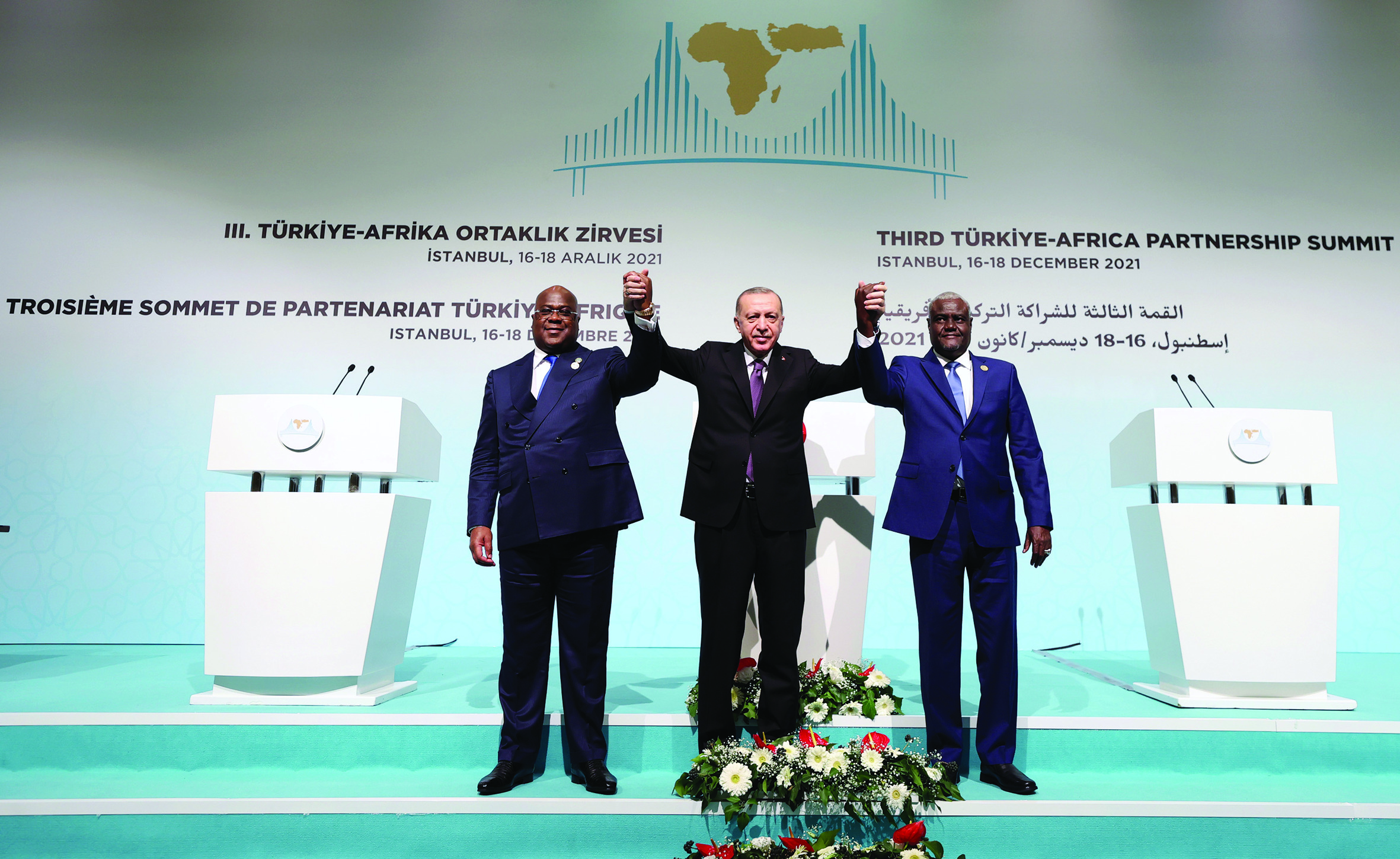
Turkish President Recep Tayyip Erdoğan (C), Democratic Republic of the Congo President Felix Tshisekedi (L) and African Union Commission President Moussa Faki Mahamat (R) met within the scope of the 3rd Türkiye-Africa Partnership Summit held in İstanbul on December 18, 2021. MURAT KULA / AA
In 2011, during the official state visit of Turkish President Abdullah Gül, bilateral trade negotiations between Ghana and Türkiye encompassed a range of topics, particularly defense. On March 24, 2011, the two states discussed and signed an agreement on military cooperation in the fields of research, technology, and training.43 In 2020, Türkiye and Ghana’s bilateral trade volume was estimated to be $560 million. When President Erdoğan visited Ghana in 2016, he demanded a $1 billion target in bilateral trade volume between the two countries.44 In 2021, Ghana’s imports from Türkiye totaled $461 million, while its total exports to Türkiye were $119 million.45 There is also growing interest in projects related to renewable energy, with Turkish energy companies exploring opportunities in wind and solar energy across the West African sub-region.46 Turkish businesses have set up textile production facilities in Senegal and Nigeria, leveraging the favorable trade agreements and the low cost of labor within the region. Turkish companies have established cement plants across several ECOWAS nations to meet the regional need for building supplies. Notable investments have been made in food processing and agriculture. In Ghana and Côte d’Ivoire, for instance, Turkish businesses have set up processing facilities for goods like cashew nuts and cocoa. Technology transfer is a common component of Turkish agricultural investments, which aids in the modernization of farming methods in the area.
Türkiye and ECOWAS are becoming more involved, which is indicative of strategic alignment and a shared commitment to promoting peace in the area and sustainable development
Four years after Côte d’Ivoire gained its independence from France in August 1960, Türkiye and the Côte d’Ivoire established their first official diplomatic ties in 1964. The Turkish embassy in Dakar, Senegal, was given accreditation to represent Turkish interests in the Côte d’Ivoire until 2009. Only in November 2009 did Türkiye open its own embassy in Abidjan. In February 2013, an Ivorian embassy was established in Ankara.47 The foundation of bilateral economic and trade relations was established in 2005 with the signing of agreements on trade and economic and technological cooperation. A few Turkish businesses have established branch offices in Côte d’Ivoire since 2012, including BEKO, DEKOSET, INCI, FERGEN, and KAYDAN.48 The first official visit between the two nations was in 2014, when Guillaume Soro, the Côte d’Ivoire president of the National Assembly, attended President Erdoğan’s inauguration as head of state. On March 25, 2015, Ivorian President Alassane Ouattara made an official visit to Ankara.49 Along with a sizable Turkish team, President Erdoğan made an official reciprocal visit to Abidjan in February 2016, and several more agreements of cooperation in a variety of areas, such as the economy, education, security, and technological development, were endorsed. Türkiye’s main trading partner in Francophone Sub-Saharan Africa is the Côte d’Ivoire. Türkiye’s strategy toward the largest economy in francophone West Africa, Côte d’Ivoire, is like its strategy for Senegal, albeit on a smaller scale. The main attraction for Türkiye in Côte d’Ivoire is a cement factory built by Limak Cement Group in 2018 with a 1 million ton and 1 million cubic meter yearly production capacity for ready-mixed concrete. It is intended to support the expanding building industry throughout the whole of West Africa.50
The Agreement on Economic and Trade Cooperation of 2005 created bilateral economic and commercial connections between the two countries. As I have already indicated above, Côte d’Ivoire is the biggest trading partner in French-speaking Sub-Saharan Africa and is ranked among Ankara’s top six commercial partners in Sub-Saharan Africa. Although it was signed in February 2016, the Agreement on Avoidance of Double Taxation on Income Taxes and Prevention of Tax Evasion is still pending. Furthermore, national parliaments have not yet approved the Agreement on Mutual Encouragement of Investments.51 Like other West African states such as Nigeria and Ghana, Türkiye became a new player in the international arena of educational exchanges as hundreds of young people travel from Côte d’Ivoire annually for further studies in Türkiye as a result of the Turkish government’s internationalization policy.52 Africans discovered Turkish student mobility programs to be a viable option to more conventional travel destinations such as Britain, France, Germany, and the U.S. Despite the purges that followed the military-political events between the Ankara government and the Gülen movement in July 2016, West African students, including Ivoirians, were able to mostly integrate into Turkish society. This student movement, which was once written off as an unwarranted “brain drain,” eventually turned into a mutually beneficial economic and social scenario.53
In this sense, these educational programs –which include scholarships for African students to attend Turkish universities– are quite important. Prominent actors or players in the advancement of Turkish education and culture in West Africa are the Yunus Emre Institute and the Turkish Maarif Foundation. These organizations plan educational programs, language classes, and cultural events that promote understanding among people. Cultural diplomacy is a vital component of Türkiye’s strategy to build strong relations with ECOWAS. Türkiye has increased its influence and presence in West Africa by utilizing soft power instruments like cultural programs, educational exchanges, and humanitarian aid. Another crucial component of Türkiye’s cultural diplomacy is humanitarian aid. Türkiye has contributed significantly to the recovery of ECOWAS countries hit by natural disasters and health epidemics. In addition to meeting immediate needs, this aid promotes stability and long-term growth.
To foster an environment that is favorable to Turkish investors, Türkiye has negotiated several bilateral trade and investment agreements with ECOWAS member countries
To foster an environment that is favorable to Turkish investors, Türkiye has negotiated several bilateral trade and investment agreements with ECOWAS member countries. Such agreements mostly include provisions for enhanced trade cooperation, investment protection, and avoidance of double taxation. Turkish investments have improved infrastructure, supported industrial development, and created jobs, all of which have contributed considerably to the economic expansion of the ECOWAS member states. These investments boost regional economies, lower poverty rates, and promote economic diversification. The growing volume of Turkish investments in ECOWAS nations is indicative of the improvement in bilateral ties between Türkiye and the West African continent. It is anticipated that this economic cooperation will keep expanding due to shared interests and strategic alliances. With digital technology, renewable energy, and healthcare as potential growth areas, Turkish investments in ECOWAS member states appear to have a bright future. Türkiye’s proactive investment approach in ECOWAS countries is expected to bring significant benefits for both parties as they both aim to broaden their economic horizons.
Türkiye’s Peacekeeping Roles in West Africa
Peacekeeping has emerged as a critical component of global security architecture, particularly in regions where conflict threatens stability and development.54 West Africa, a region fraught with political instability, civil wars, and violent extremism, has been a focal point for peacekeeping missions led by both regional and international actors.55 While West African states and regional organizations like the ECOWAS) have traditionally played the primary role in addressing conflict in the region, non-African countries, including Türkiye, have increasingly become involved in supporting peace and stability efforts.56 Türkiye’s engagement in West Africa reflects its broader foreign policy goals of fostering peace, enhancing diplomatic ties, and contributing to international stability. This subsection explores Türkiye’s peacekeeping roles in West Africa, focusing on its diplomatic, military, and humanitarian contributions. It also highlights Türkiye’s evolving relationship with the region and its role as a bridge between West Africa and international peacekeeping frameworks, such as those led by the UN and the AU.
Türkiye demonstrates its commitment to a peaceful and wealthy African continent by supporting the AU’s development objectives, peacekeeping operations, and capacity-building initiatives
Diplomatic Contributions to Peacekeeping in West Africa
Türkiye’s diplomatic efforts in West Africa have been significant in supporting peacekeeping missions through multilateral platforms like the UN and the AU. As a UN member state, Türkiye has consistently supported resolutions aimed at enhancing peace and security in West Africa. Its diplomatic efforts are often focused on advocating for peaceful negotiations, conflict resolution, and the protection of civilians in conflict zones.57 One of Türkiye’s notable contributions has been its active role in promoting dialogue between conflicting parties in West Africa. Türkiye has often acted as a mediator in various peace talks, leveraging its diplomatic channels to promote peaceful settlements. For instance, Türkiye has worked closely with the UN and ECOWAS in supporting efforts to mediate conflicts in countries like Mali and Côte d’Ivoire, where political instability and insurgencies have threatened regional security. Through its diplomatic missions in the region, Türkiye provides technical support for peace processes, including the organization of negotiations and providing platforms for dialogue. These efforts placed Türkiye as one of the most committed contributors to UN peacekeeping missions, earning the country global recognition in 2022.58
In addition to its multilateral engagements, Türkiye’s bilateral relations with West African states have also contributed to peacekeeping efforts. Türkiye has been able to offer support in areas such as security sector reform, disarmament, and post-conflict reconstruction by strengthening its ties with individual countries. These initiatives are essential for maintaining peace in fragile states where the risk of renewed conflict remains high.
Military and Security Cooperation in Peacekeeping
Although Türkiye’s direct military involvement in peacekeeping operations in West Africa has been limited compared to its engagements in other regions, such as the Balkans and the Middle East, it has played an important role in providing military training and capacity building for West African security forces. This support has been crucial in enhancing the effectiveness of peacekeeping missions led by regional organizations and the UN. One key aspect of Türkiye’s military contribution to peacekeeping in West Africa has been through its participation in UN peacekeeping missions. Turkish military personnel have been deployed as part of UN missions, such as the United Nations Multidimensional Integrated Stabilization Mission in Mali (MINUSMA).59 In these missions, Türkiye’s troops have contributed to securing conflict zones, protecting civilians, and supporting local governance structures. The presence of Turkish forces in these peacekeeping missions demonstrates Türkiye’s commitment to supporting international peace and stability in West Africa.
Türkiye has also contributed to regional security by providing training and logistical support to the armed forces of West African states. For example, Türkiye has been involved in training West African peacekeepers through its military cooperation agreements with countries like Ghana, Nigeria, and Senegal.60 This training focuses on enhancing the capabilities of local forces to participate in peacekeeping missions, improving their skills in areas such as counter-insurgency operations, intelligence gathering, and civilian protection. Through its military training programs, Türkiye has also helped to strengthen regional peacekeeping initiatives led by ECOWAS. ECOWAS has been at the forefront of addressing conflicts in West Africa, deploying peacekeeping forces in countries like Liberia, Sierra Leone, and Guinea-Bissau.61 Türkiye’s support for ECOWAS peacekeeping efforts has included the provision of equipment, logistical assistance, and technical expertise, further enhancing the capacity of the region’s peacekeepers.
Türkiye has worked closely with the UN and ECOWAS in supporting efforts to mediate conflicts in countries like Mali and Côte d’Ivoire, where political instability and insurgencies have threatened regional security
Humanitarian Assistance and Peacebuilding
Besides its diplomatic and military contributions, Türkiye’s humanitarian assistance has played a significant role in peacebuilding efforts in West Africa. Humanitarian crises often accompany conflicts in the region, exacerbating the challenges faced by peacekeeping missions. Türkiye, through organizations such as the TİKA and the Turkish Red Crescent, has provided critical humanitarian aid to conflict-affected populations in West Africa.62 Türkiye’s humanitarian interventions have focused on delivering food aid, medical supplies, and infrastructure development in post-conflict zones. In countries like Mali, where insurgency and political instability have displaced millions of people, Türkiye’s humanitarian efforts have helped to alleviate suffering and promote stability.63 Türkiye’s contributions to education, healthcare, and water supply projects have also supported long-term peacebuilding by addressing the root causes of conflict, such as poverty and lack of access to basic services.
Moreover, Türkiye’s engagement in peacebuilding extends to supporting local governance and development initiatives that promote social cohesion and reconciliation. In many West African countries, post-conflict reconstruction is critical for ensuring that peace is sustainable. Türkiye has supported these efforts by investing in infrastructure projects, vocational training, and initiatives aimed at empowering women and youth, who are often disproportionately affected by conflict.
Challenges and Opportunities
While Türkiye’s peacekeeping role in West Africa has had a positive impact, there are challenges that could hinder its long-term effectiveness. One major challenge is the complex political and security environment in West Africa, where fragile states, extremist groups, and cross-border conflicts present significant obstacles to peace. Türkiye’s ability to navigate these complexities and maintain a consistent presence in the region will require careful diplomacy and sustained engagement. Again, Türkiye’s peacekeeping efforts may face competition from other external actors such as China, France, and the U.S., who have vested interests in West Africa. Balancing these relationships while contributing to peace and security in the region will require Türkiye to adopt a collaborative approach that aligns with both regional and international peacekeeping frameworks. However, Türkiye’s growing influence in West Africa also presents opportunities. Türkiye can play a more active role in shaping the region’s security architecture by deepening its engagement with regional organizations like ECOWAS and the AU. Furthermore, Türkiye’s expertise in post-conflict reconstruction and development can be leveraged to support long-term peacebuilding efforts, addressing the socio-economic factors that often fuel conflicts.
Türkiye’s peacekeeping role in West Africa, though still evolving, reflects its commitment to promoting peace, stability, and development in the region. Through its diplomatic engagement, military support, and humanitarian efforts, Türkiye has contributed to addressing the challenges of conflict and insecurity in West Africa. As Türkiye continues to strengthen its ties with the region, it has the potential to play an even more significant role in peacekeeping and peacebuilding, helping to create a more secure and prosperous West Africa.
Türkiye’s engagement in West Africa reflects its broader foreign policy goals of fostering peace, enhancing diplomatic ties, and contributing to international stability
Conclusion
This article explored Türkiye’s engagement with the Sub-Saharan African regional blocs, such as the AU and ECOWAS. The engagement has developed into a complex alliance characterized by shared political interests, economic cooperation, and strategic collaboration. This partnership underscores Türkiye’s diplomatic will to use bilateral and multilateral frameworks to increase its influence and presence on the African continent. The primary platform for Türkiye’s diplomatic outreach is the AU, which facilitates projects throughout the continent and promotes solidarity on international issues. Türkiye demonstrates its commitment to a peaceful and wealthy African continent by supporting the AU’s development objectives, peacekeeping operations, and capacity-building initiatives. The collaboration aims to address some of the most important issues facing the continent and covers health, education, and infrastructure development. Türkiye’s participation in ECOWAS highlights the importance of security cooperation and economic diplomacy. With a number of investment initiatives and trade agreements, Türkiye has emerged as a significant player in the economic landscape of West Africa. Furthermore, Türkiye’s support of ECOWAS’ peace and security initiatives demonstrates its dedication to counter-terrorism efforts and regional stability, both of which are essential for the socioeconomic development of ECOWAS member states.
Generally, Türkiye’s assertive foreign policy towards Sub-Saharan African regional blocs shows a thorough and calculated approach meant to forge enduring alliances. These connections are predicated on the principles of mutual respect, common interests, and shared objectives. Through the utilization of its diplomatic, economic, and cultural resources, Türkiye has established itself as a pivotal player in the regional dynamics of Africa. It is anticipated that Türkiye’s continued engagement with the AU, ECOWAS, and other regional organizations will consolidate its position and further the development trajectory of the continent, paving the way for a more cooperative and interconnected global landscape.
Endnotes
1. Bart Raymond Kessler, “Bush’s New World Order: The Meaning Behind the Words,” Air Command and Staff College, (2012), p. 1.
2. Wellenstein Edmund, “The New International Economic Order: The “New International Economic Order,”” Netherlands International Law Review, Vol. 25, (1978), pp. 222-224.
3. Philip Nel and Detlef Nolte, “Introduction: Special Section on Regional Powers in a Changing Global Order,” Review of International Studies, Vol. 36, No. 4 (2010), pp. 877-879.
4. Chester Crocker, Fen Osler Hampson, and Pamela Aall, “Collective Conflict Management: A New Formula for Global Peace and Security Cooperation?” International Affairs, Vol. 87, No. 1 (January 2011), pp. 39-58.
5. Dolapo Fakuade, “Türkiye-Africa Relations: A Case Study of Somalia, Nigeria, and Libya from Humanitarian and Security Perspectives,” Insight Turkey, Vol. 25, No. 3 (2023), pp. 51-62.
6. Haruna Abdallah Imam, “The African Factor in Türkiye’s Foreign Policy: Turkish Policy Options Versus African Perceptions,” in Ermağan İsmal, Boztaş Asena, and Turhan Yunus (eds.), Dünya Siyasetinde Afrika-9, Vol. 9 (Nobel Akademik Yayıncılık, 2023), pp. 1-34.
7. Samiratou Dipama and Emel Parlar Dal, “Assessing Turkey-Africa Engagements,” APRI Policy Brief, No. 2 (2023), pp. 1-44.
8. Thomas Juneau, Squandered Opportunity: Neoclassical Realism and Iran’s Foreign Policy, 1st ed., (Stanford University Press, 2015), pp. 17-34.
9. Samuel Barkin, “Realism, Prediction, and Foreign Policy,” Foreign Policy Analysis, Vol. 5, No. 3 (2009), pp. 233-246.
10. Sebastian Rosato and John Schuessler, “A Realist Foreign Policy for the United States,” Perspectives on Politics, Vol. 9, No. 4 (2011), pp. 803-819.
11. Katerina Dalacoura, “Defining a Liberal Foreign Policy,” International Studies Notes, Vol. 24, No. 3 (1999), pp. 53-59.
12. Devin Caughey and Christopher Warshaw, “The Dynamics of State Policy Liberalism, 1936-2014,” American Journal of Political Science, Vol. 60, No. 4 (2016), pp. 899-913.
13. Hannes Peltonen, “Constructivism, Cognition, and Duality,” European Review of International Studies, Vol. 3, No. 3, (2016) pp. 76-86.
14. Ted Hopf, “Common-Sense Constructivism and Hegemony in World Politics,” International Organization, Vol. 67, No. 2 (2013), pp. 317-354.
15. Pınar İpek, “Ideas and Change in Foreign Policy Instruments: Soft Power and the Case of the Turkish International Cooperation and Development Agency,” Foreign Policy Analysis, Vol. 11, No. 2 (2015), pp. 173-193.
16. Chitja Twala, “The 50 Years Struggle of the Organization of African Unity (OAU): A Search for a Developmental Paradigm in Africa?” Journal of Social Sciences, Vol. 39, No. 1 (2014), pp. 103-109.
17. Scott Timcke, “WhatsApp in African Trade Networks: Professional Practice and Obtaining Attention in AfCFTA Policy Formation,” First Monday, Vol. 27, (2022), pp. 1-17.
18. “Africa’s Regional and Sub-Regional Economic Cooperation Frameworks: A Summary,” Afronomicslaw, retrieved from https://www.afronomicslaw.org/category/repository/africas-regional-and-sub-
regional-economic-cooperation-frameworks-summary.
19. Volkan İpek and Gonca Biltekin, “Turkey’s Foreign Policy Implementation in Sub-Saharan Africa: A Post-International Approach,” New Perspectives on Turkey, Vol. 49, No. 1 (March 5, 2013), p. 126.
20. Dipama and Dal, “Assessing Turkey-Africa Engagements,” pp. 1-44.
21. Mehmet Özkan and Birol Akgün, “Turkey’s Opening to Africa,” The Journal of Modern African Studies, Vol, 48, No. 4 (2010), pp. 525-546.
22. “Türkiye and the African Union,” Republic of Türkiye Ministry of Foreign Affairs, retrieved from https://www.mfa.gov.tr/turkiye-and-the-african-union.en.mfa.
23. Abdurrahim Sıradağ, “Turkey-Africa Alliance: Evolving Patterns in Security Relations,” African Security Review, Vol. 27, No. 3-4 (2018), pp. 308-325.
24. Sıradağ, “Turkey-Africa Alliance: Evolving Patterns in Security Relations,” pp. 308-325.
25. Mehmet Özkan, “A Post-2014 Vision for Turkey-Africa Relations,” Insight Turkey, Vol. 16. No. 4 (2014), pp. 23-31.
26. Özkan and Akgün, “Turkey’s Opening to Africa,” pp. 525-546.
27. Turan Cavlan, “Turkey in Africa: Turkey’s Strategic Involvement in Sub-Saharan Africa,” International Affairs, Vol. 98, No. 4 (July 2022), pp. 1481-1482.
28. Kahraman Arslan, “The Place and Importance of African Countries in Turkey’s Seeking New Markets,” Journal of International Business and Economics, Vol. 7, No. 2 (2019), pp. 31-46.
29. “EU-Türkiye Trade Relations,” The European Council, retrieved July 16, 2024, from https://www.consilium.europa.eu/en/infographics/eu-turkiye-trade-relations/.
30. Mehmet Özkan and Serhat Orakçı, “Viewpoint: Turkey as a “Political” Actor in Africa: An Assessment of Turkish Involvement in Somalia,” Journal of Eastern African Studies, Vol. 9, No. 2 (2015), pp. 343-352.
31. “TURKSTAT Data Portal,” Turkish Statistical Institute-TUIK, (2023), retrieved July 20, 2024, from https://www.tuik.gov.tr/Home/Index.
32. Dipama and Dal, “Assessing Turkey-Africa Engagements,” pp. 1-44.
33. Abdurrahim Sıradağ, “Turkey’s Engagement with the African Organisations: Partner or Competitor?” India Quarterly, Vol. 76, No. 4 (2020), pp. 519-534.
34. “Turkey-ECOWAS Economic and Business Forum,” DEİK, (2018), retrieved from http://www.tebforum.org/.
35. “Economic Community of West African States (ECOWAS),” Republic of Türkiye Ministry of Foreign Affairs, retrieved from http://www.mfa.gov.tr/ecowas.tr.mfa.
36. “Turkey Seeks Free Trade Agreement with ECOWAS,” org, (March 6, 2018), retrieved July 25, 2024, from https://www.bilaterals.org/?turkey-seeks-free-trade-agreement.
37. “ECOWAS Signs Trade and Investment Agreement with Turkey,” B&FTOnline, (February 26, 2018), retrieved July 16, 2024, from https://thebftonline.com/2018/02/26/ecowas-signs-trade-and-
investment-agreement-with-turkey/.
38. Muhammad Abdulqadir, “Understanding Nigeria-Turkish Relations,” Punch, (October 19, 2021), retrieved July 20, 2024, from https://punchng.com/understanding-nigeria-turkish-relations/.
39. “Turkey to Invigorate Commercial Ties with Nigeria,” Further-Africa, (January 17, 2020), retrieved July
27, 2024, from https://furtherafrica.com/2020/01/17/turkey-to-invigorate-commercial-ties-with-nigeria/.
40. “Turkey to Invigorate Commercial Ties with Nigeria,” Further-Africa.
41. Chazan Naomi, “The Republic of Ghana,” in George E. Delury (ed.), World Encyclopaedia of Political Systems and Parties, Vol. 1, (New York: Facts on File, 1999), pp. 408-412.
42. Haynes Jeffrey, “Religious and Economic Soft Power in Ghana-Turkey Relations,” Religions, Vol. 13, No. 11 (2022), pp. 1-12.
43. Kunbuor Benjamin, “The Ratification of the Defence Industry Co-operation Agreement between the Republic of Turkey and the Republic of Ghana,” Parliament of Ghana, (2015), retrieved July 20, 2024, from https://parliament.gh/bitstream/handle/123456789/457/doc04349120160509125103.pdf?sequence=1&isAllowed=y.
44. “Türkiye, Ghana Agree to Nurture Ties, Continue Consultations,” Daily Sabah, (October 27, 2022), retrieved July 20, 2024, from https://www.dailysabah.com/politics/diplomacy/turkiye-ghana-agree-to-
nurture-ties-continue-consultations.
45. “Turkish Government to Support Ghana’s Trade,” Ghana National Chamber of Commerce, (November 29, 2022), retrieved July 21, 2024, from https://ghanachamber.org/turkish-government-to-support-ghana-s-international-trade-with-1-billiondollars/#:~:text=The%20event%20was%20aimed%20at,Relations%20Board%20of%20Turkey%2C%20Mr.
46. Dolapo, “Türkiye-Africa Relations,” pp. 51-62.
47. “Turkey-Africa Relations,” Republic of Türkiye Ministry of Foreign Affairs, (2023), retrieved July 5, 2024, from http://www.mfa.gov.tr/turkey-africa-relations.en.mfa.
48. Binaté Issouf, “La Présence Turque en Côte d’Ivoire Contemporaine: Entreprise Transnationale au Service de l’éducation, l’humanitaire et l’islam en Afrique de l’ouest,” Canadian Journal of African Studies, Vol. 53, No. 2 (2019), pp. 215-233.
49. Djamanca Abdu, “Türkiye and West Africa in the Perspective of Public Diplomacy: The Cases of Senegal, Ivory Coast, Niger and Guinea-Bissau,” Unpublished D. Thesis, Hacettepe University, (2023), p. 301.
50. Michaël Tanchum, “Turkey’s Maghreb-West Africa Economic Architecture: Challenges and Opportunities for the European Union,” Stiftung Wissenschaft und Politik, No. 3 (June 2021), pp. 1-32.
51. Tanchum, “Turkey’’s Maghreb-West Africa Economic Architecture,” pp. 1-32.
52. Issouf, “La Présence Turque en Côte d’Ivoire Contemporaine.”
53. Issouf, “La Présence Turque en Côte d’Ivoire Contemporaine.”
54. Franz Kernic, “Peace Keeping,” in James D. Wright (ed.), International Encyclopedia of the Social & Behavioral Sciences, 2nd ed., (Elsevier, 2015), pp. 631-636.
55. Francis David, “Peacekeeping in a Bad Neighbourhood: The Economic Community of West African States (ECOWAS) in Peace and Security in West Africa,” African Journal on Conflict Resolution, Vol. 9, No. 3 (2009).
56. Victor Adetula, Redie Bereketeab, and Cyril Obi, Regional Economic Communities and Peacebuilding in Africa: Lessons from ECOWAS and IGAD, (New York: Routledge, 2021).
57. “Peaceful Resolution of Conflicts and Mediation,” Republic of Türkiye Ministry of Foreign Affairs, (2003), retrieved from https://www.mfa.gov.tr/resolution-of-conflicts-and-mediation.en.mfa.
58. “United Nations Thanks Türkiye for Its Contribution to Peacekeeping,” United Nations, (November 9, 2022), retrieved from https://turkiye.un.org/tr/node/206475.
59. Ayfer Genç Yılmaz and Billy Agwanda, “Turkey’s Contribution to International Policing,” Global Change, Peace & Security, Vol. 33, No. 2 (2021), pp. 143-161.
60. Shinn David, “Turkey’s Engagement in Sub-Saharan Africa Shifting Alliances and Strategic Diversification,” Africa Programme, (September 2015); Abdurrahim Sıradağ, “Turkey-Africa Alliance: Evolving Patterns in Security Relations,” African Security Review, Vol. 27, No. 3-4 (2018), pp. 308-325.
61. Karen Kaya and Jason Warner, “Turkey and Africa: A Rising Military Partnership?” Fort Leavenworth, (2013).
62. Emel Parlar Dal and Samiratou Dipama, “Assessing Turkey-Africa Engagements,” APRI, (April 27, 2023).
63. Yunus Turhan, “Turkey’s Foreign Aid to Africa: An Analysis of the Post-July 15 Era,” Journal of Balkan and Near Eastern Studies, Vol. 23, No. 5 (2021), pp. 795-812.