
Introduction
International organizations (IOs) are entities formed by sovereign states or non-state actors with the purpose of achieving general or specific objectives on a global or regional scale.1 They go beyond cooperation on security, economic, and societal issues, establishing structural mechanisms that allow for formal or informal collaboration among their members. In this sense, they can be defined as the art of creating and managing universal and regional institutions composed of sovereign states or non-state units to facilitate cooperation in order to achieve or maintain common goals and objectives.2
The underlying rationales for the establishment of international organizations vary. One primary reason for the formation of international organizations is the security needs of states, particularly of weaker and smaller nations that seek to counter external threats by uniting under a common security umbrella. For example, after World War II, the threats posed by the Soviet Union to Türkiye’s territorial integrity led the country to align more closely with the Western Bloc, joining the North Atlantic Treaty Organization (NATO) and other Western institutions. Another reason for the establishment of international organizations is the pursuit of economic development and prosperity. States aim to improve the living standards of their citizens and enhance their security by utilizing economic tools, often requiring cooperation with other countries. States also turn to international organizations to address problems that they cannot solve unilaterally or when the cost of the solution outweighs the unilateral capabilities in certain issues3 such as migration, environmental problems, drugs, and human trafficking, where regional or global cooperation is essential.
In addition, international competition and cooperation in certain sectors drive countries to form international organizations. For instance, NATO and the Warsaw Pact were formed during the Cold War as responses to military competition and political tension between two global blocs. When the competition dissipated, as in the case of the Warsaw Pact, the organization ceased to exist. Similarly, the European Union was established to eliminate economic competition and increase economic efficiency on the European continent. States may also create international organizations based on shared values, such as cultural, linguistic, ethnic, or religious similarities. The Council of Europe, for example, was founded to preserve and promote the political and cultural values of Europe. Likewise, the Organization of Islamic Cooperation (OIC) was created to coordinate political actions on issues affecting Muslim countries.
States also turn to international organizations to address problems that they cannot solve unilaterally or when the cost of the solution outweighs the unilateral capabilities in certain issues such as migration, environmental problems, drugs, and human trafficking, where regional or global cooperation is essential
Lastly, some international organizations are created to establish international regimes or standards in specific areas. For example, the General Agreement on Tariffs and Trade (GATT) and later the World Trade Organization (WTO) were established to regulate international trade.4 Similarly, the International Maritime Organization (IMO) and the International Civil Aviation Organization (ICAO) were created to regulate maritime and civil aviation activities, respectively.5
International organizations have a significant impact on international politics in various ways. One of their primary effects is the development of cooperation habits among states. Through regular interactions and exchanges, states engage in socialization processes and implement confidence-building measures.6 They also play a key role in agenda-setting by bringing specific issues to the attention of the international community,7 helping to shape the global discourse. Another critical function is surveillance and information gathering.8 International organizations monitor activities and collect data, enabling states to avoid recurring costs for similar activities.9 For instance, the International Atomic Energy Agency (IAEA) monitors whether states are involved in nuclear weapons production and shares relevant information with them. Furthermore, international organizations engage in operational activities aimed at resolving international issues. They play essential roles in addressing public health crises,10 assisting in decolonization,11 ensuring democratic elections,12 and addressing economic disparities.13 They also contribute to diplomatic processes by facilitating negotiations, building coalitions, and creating conducive environments for cooperation.14 Through their support, states can collaborate more effectively, both through intergovernmental and transnational networks. In this sense, international organizations can be conducive to establishing, maintaining, and developing international regimes.15
Notwithstanding these supra-state functions of the international organizations, those entities occupy an inexorable role in states’ foreign policy formations. Indeed, an intricate relationship exists between the foreign policymaking of the states and the international organizations. On the one hand, it is not uncommon to observe that states often use international organizations as foreign policy tools to further their interests. Powerful states, in particular, seek to influence or direct the activities of these organizations to align with their agendas, as seen with the United States’ use of the UN to advance its foreign policy.16 On the other hand, international organizations can also limit the scope of actions of nation-states by imposing constraints on certain behaviors, thereby influencing state priorities and actions.17 This explicit interaction between states and international organizations provides opportunities to understand one nation’s foreign policy objectives by examining its adopted roles, undertaken actions, and exerted influence within the realm of international organizations. Nonetheless, this relationship was overlooked in the research agenda focusing on the foreign policy analyses of the states.
For many states, motivations such as aligning with the organization’s founders, enhancing international prestige, or securing material benefits, if available, may outweigh considerations related to the agenda-setting
The proliferation of international organizations from the 20th century to the present, coupled with their increasing role as both tools and platforms for states, who remain the principal actors in international politics, within foreign policy processes, as well as their growing influence as independent actors shaping global affairs, represents an undeniable shift in the landscape of international relations. Initially limited in number and scope, the expansion and impact of these organizations surged in the aftermath of the two devastating world wars of the first half of the 20th century, as the necessity for enhanced international cooperation and coordination became increasingly evident.18 Today, these organizations are indispensable actors in the formulation and evaluation of foreign policy for nations across the globe. Over time, the specialization, composition, and geographical distribution of these organizations have evolved significantly. Particularly since 1945, there has been a rapid increase in European and Western-centric organizations, and other countries, eager to gain access to these centers, have actively sought to secure positions within them. However, it appears that the influence and popularity of such Western-centric organizations have diminished to some extent.19 In contrast, we are now witnessing the emergence of highly influential international organizations composed of diverse actors from various global regions, including those outside the Western sphere.20
This study contends that analyzing Türkiye’s increasing engagement with international organizations may be conducive for enhancing prevailing conceptual tools to understand states’ foreign policy activism through their relations with the international organizations. In the following sections, the article first discusses the conceptual usefulness of employing the concept of “initiator state” to make a better sense of states’ foreign policy activism observed in international organizations. Then, the study maps Türkiye’s engagements with international organizations by underpinning the significant historical turning points and the Turkish foreign policy orientation. Finally, the research showcases the utility of harnessing this conceptual framework to examine Türkiye’s relationship with international organizations in order to conceive Türkiye’s foreign policy activism under the leadership of three political leaders, which are Atatürk, Özal, and Erdoğan respectively.
The Concept of Initiator States and Foreign Policy Activism in IOs
Joining international organizations has long been a significant means for states to enhance their status in international politics.21 One of the most crucial aspects of the recognition process, an essential factor in the formation of a political entity as a state, is its acceptance as a member of international organizations. Membership in international organizations, as well as playing a pioneering role in their establishment and hosting their headquarters, are important criteria for understanding a state’s foreign policy orientation, activism, and its position within the international system. Additionally, factors such as the sectoral and geographical focus of the organizations to which a state belongs, along with the composition of their member states, offer valuable insights into the state’s foreign policy direction.
In this article, the concept of “initiator state” is introduced as a more effective tool for understanding the foreign policy activism of international organizations, as opposed to the terms “founder state” or “member state.” By “initiator state,” we refer to the state that proposes the initial idea of establishing a certain international organization, leads the formation processes, outlines the broad objectives and scope of the organization, and lastly fosters the cooperation of members within this organization around pre-specified agendas. An initiator state differs from a member state or founder state in several respects handled in this chapter.
Levels of State Activism in International Organizations
The link between international organizations and foreign policy activism is largely based on the number of international organizations of which a state is a member.22 A state’s participation on international platforms indicates both its acceptance by other countries on these platforms and its interest in various international issues. However, we contend that the mere count of memberships in organizations is an insufficient and oversimplified measure of states’ foreign policy activism. This is because international organizations often reflect the agendas and preferences of the states that played the central role in the creation of the organization. These organizations serve as mechanisms through which states share, publicize, and legitimize these agendas with other countries.23 Therefore, not all members of these organizations have the opportunity and capability to reflect all their policy preferences. Moreover, although the founding objectives of the organizations are to pursue an agenda, not all members of these organizations have the same agenda. For many states, motivations such as aligning with the organization’s founders, enhancing international prestige, or securing material benefits, if available, may outweigh considerations related to the agenda-setting.
Our primary presumption in this study is that any engagement with an international organization indicates the states’ foreign policy activism. However, not all engagements reveal the same level of engagement, and a state’s activism varies according to the type of engagement it has with the IO. Therefore, as illustrated in Figure 1, we classify the level of state activism through IOs into four different clusters: official affiliation, full membership, founding membership, and the initiator state. What differentiates the activism in each cluster is the role that a state plays in the designation and transformation (if any) processes of the international organization.
Figure 1: Levels of State Activism in International Organizations

Official affiliation encompasses all different kinds of affiliations with an international organization without full membership. States, intergovernmental organizations (IGOs), and non-governmental organizations (NGOs) can be affiliates with an IO. These non-full member associates cannot participate in the decision-making process and mostly have no voting rights. The statute or labelling of such associations varies according to the IO’s organizational and legal structure, including observer, dialog partner, sectoral dialog partner, etc. An international organization can also have more than one category and status for affiliates, indicating the level of partnership. The UN system provides a clear example of such differentiation between the members and non-members and also among the non-members. The UN has several observer statuses. Non-state observers are named as the non-member observer entities, while the non-member states are “non-member observer states.” Switzerland had been an observer state at the UN since 1946 until its full membership in 2002. The status of Palestine, on the other hand, altered to observer state from the non-member observer entity in 2012. Furthermore, Türkiye is an observer state while it is one of the dialogue partners in the Shanghai Cooperation Organization and a “sectoral dialog partner” in ASEAN. There is also the possibility of partial membership below the full membership that can be counted under this category. Türkiye, for example, is a member of the customs union in the EU, while it is not a full member of it. Whatever the status states have under this category of engagement, affiliations without the full memberships imply the limited foreign policy activism since they have limited or no authority over policies and the actions of IOs.
The second type of participation in international organizations is full membership, which can be attained both in the formative period of the organization or after the formation through admission processes.24 Full members are the members who “have the full rights in the activities of the organizations.”25 There may also be different hierarchies between the full members. Some members have various privileges over other members. A dictionary example of such a privilege is the veto power of the permanent members of the UN Security Council. Only the five permanent members of the UNSC have the veto power. Participating in the activities, especially in decision-making processes and policy implementation, signifies a higher level of activism and authoritative power than the affiliates.
An important category of participation which indicates the highest level of activism, we argue, is still absent. Among all the equal full-member states and even the founder states, some are distinguished from others in several respects. Those “more equal” states are usually the ones who initially enable and lead the formation or transformation of the organization
Even though, with rare exception, of course, status of the full members within an international organization in terms of the responsibilities and entitlements has no disparities from the legal perspective,26 founding membership also matters in different cases. The Organization of Petroleum Exporting Countries (OPEC), for instance, obligates the “concurrent votes of all founding members”27 for the admission of new members to the organization. Above-mentioned permanent members of the UN Security Council are all founding members of the UN and such a privilege has not been given to any other late-admitted states. As illustrated, the founding membership provides an upper hand to states in the functioning processes of international organization and denotes a higher level of foreign policy activism through IOs. However, it should be acknowledged that not all founding members hold identical advantages. Some founding memberships may merely exist on paper in some cases. For instance, although the Republic of Türkiye is a founding member of international organizations such as the United Nations and the Council of Europe, it does not emerge as a major actor in directing these organizations or setting their agendas.
These three levels of participation encompass a large portion of the degree of activism in international organizations. However, they are still far from being fully exhaustive. An important category of participation which indicates the highest level of activism, we argue, is still absent. Among all the equal full-member states and even the founder states, some are distinguished from others in several respects. Those “more equal” states are usually the ones who initially enable and lead the formation or transformation of the organization. These “initiator states” convey several indicators to differentiate their power and authority and level of activism from others. Following Koromenos, Lipson, and Snidal,28 we infer these indicators from the roles that states play in designing and modifying international organizations.
Indicators of Being an Initiator State
Since international organizations are the instruments for the states to handle issues, they are either unable to do it individually or platforms to provide the opportunity to decrease the cost of solutions. they are mostly state creations and byproducts of formal or informal bargaining and negotiations. Their design and modifications, therefore, reflect the interests and priorities of initiator states. In the design of international organizations, four significant aspects indicate the weight of members and distinguish the initiator states from the founder states or the admitted members.
Koromenos et al. propose five dimensions of the design of international organizations: membership, scope, control, centralization, and flexibility.29 We argue that the initiator states have a substantial sway in two of these eminent dimensions of international organizations by instituting constraints on the rules and regulations on the memberships and delimiting the scope of the international organizations. Additionally, this study proposes a third and fourth one, which are the decision-making structure and central locations (or headquarters) as indicators of the initiator states.
The first characteristic of the initiator state is the capacity of these states to impose constraints on the procedures stipulating on accepting new members to the organization
The first characteristic of the initiator state is the capacity of these states to impose constraints on the procedures stipulating on accepting new members to the organization.30 In other words, the initiator states may allow, restrict, or deny the new memberships, membership categories, and the rights and responsibilities of the prospective members. The background negotiations for the entrance of Türkiye into the NATO alliance as a full member illustrate this point. When Türkiye applied to NATO in 1950, most of the Western European countries, especially the Scandinavians and the British, opposed the enlargement of the NATO area to the Mediterranean and the Middle East.31 The British even proposed the formation of a separate security structure to provide security guarantees to Greece and Türkiye rather than accepting those states into the NATO framework. Türkiye preferred to resume its negotiations regarding the membership with the Americans, since the U.S. was the state that initiated and dominated the alliance. Only after the Americans were convinced that Türkiye could play a significant role in the security of the Mediterranean did they break the British opposition and accept Türkiye’s bid for full membership in NATO.32
The second attribute of the initiator state is the ability to influence the scope of international organizations. The initiator states’ effect on the scope of IOs can be comprehended by two means. Firstly, the scope implies the range of issues the organization deals with.33 The institutions and the foundational norms of the Bretton-Woods system, for example, reflect the initiator states’ and American interests, and their visions in terms of their issue-related scope, despite the existence of the British reluctance to accept them during the negotiations.34 Similarly, Türkiye-initiated organizations during the 1930s were mostly restricted to defensive security concerns and the existence of extra-regional threats. The second is to designate the geographical scope of the organization regarding the membership and also its operational reach. In instances where the initiator state is a major power or superpower, the organization’s scope is often global, thereby encompassing the entire international community. For example, the U.S. initiated the processes for the establishment of both the League of Nations and the United Nations, two universal general-purpose IOs. However, these organizations, although they are global, represent the global policy perspective of the U.S. and its allies.
Conversely, in smaller countries, the geographical focus of the organization is typically more limited, often restricted to specific regions. Initiator states have a significant influence on geographical boundaries and interests that determine the establishment of international organizations and consequently have an indirect influence on the members’ composition and membership profiles of these organizations. When an organization is established to address a common identity (e.g., the European Union, D-8, and OTS), a specific geographical region, or a specific issue, membership is naturally shaped by these constraints.
Thirdly, the decision-making framework plays a pivotal role in determining the influence of participants within international organizations. It varies based on the organization in question or the nature of the decisions being made. Some organizations, such as NATO, require unanimity, while some others, such as the Council of Europe, seek majority, sometimes qualified majority, voting systems. The reason for this variation is the tendency of the states to hold their sovereignty over the critical decisions in different international settings. Hence, we contend that another characteristic of the initiator states is their influence in stipulating decision-making procedures within the IOs that align with its foreign policy preferences. One primary example of this is that the French role, as the initiator of the European integration, is decreasing the role of the power of the Commission, the supranational leg of the European Economic Community, compared to the High Authority of the European Coal and Steel Community.35 Another example is the decision-making process of the UN Security Council and veto power of the five permanent members. The initiator states of the UN –namely, the U.S., USSR, Britain, and China– granted themselves veto power in the formation of the UN Security Council in order to preserve the privilege of making the final decision and to ensure that decisions they opposed would not be adopted.
Türkiye’s relationship with international organizations was inevitably affected by the nature of the Cold War. The process that began with the Soviet Union’s territorial claims against Türkiye in 1945 resulted in Türkiye’s full integration with the Western bloc
Finally, hosting the headquarters or the important branches of the international organizations can be another attribute of the initiator states. Those states often choose one of their own cities to host these headquarters or branches. The headquarters of the United Nations, for example, is in the United States because the U.S. first and foremost initiated and enabled the creation of the organization. Similarly, Türkiye hosts the headquarters of the organizations it played the initiator role in their formation, such as the Black Sea Economic Cooperation Organization and the D-8.
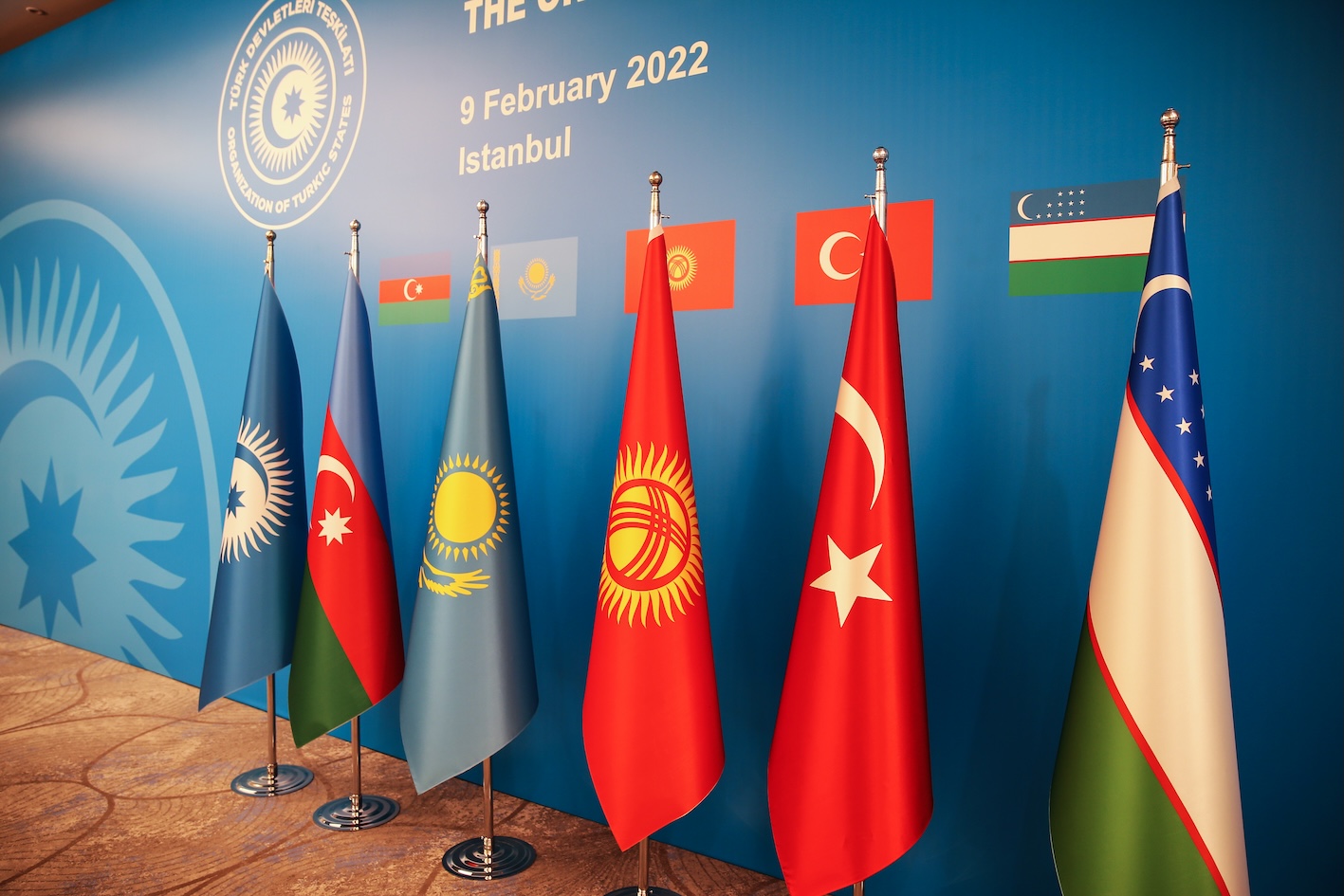
12th Organization of Turkic States “Aksakallar” Council meeting in İstanbul, Turkiye on February 9, 2022. YASİN ARAS / AA
Mapping Türkiye’s Engagements in International Organizations
Türkiye’s relationship with international organizations has gained importance since the last decades of the Ottoman Empire, the predecessor of the Republic of Türkiye. The normative and legalist concepts of international law and international regimes, which have emerged especially since the late 19th century, were regarded as mechanisms to counter the relative decline of the Ottoman Empire and to provide a legitimate basis for defending its position against the European imperial powers.36
The Republic of Türkiye has continued the legacy of the Ottoman Empire’s commitment to international organizations, a commitment that has been a fundamental aspect of its foreign policy since the early years of the Republic. At that time, two basic principles guided Türkiye’s participation in international organizations. The first principle was Türkiye’s involvement in technical and cultural organizations, particularly those that promoted development and Westernization.37 These organizations facilitated Türkiye’s adaptation to global standardization efforts, which were integrated into its restructuring processes.38 The second factor influencing the early membership of international organizations was the desire to enhance Türkiye’s international recognition as a non-revisionist power and consolidate its position, particularly within the Western-centric structures. Türkiye’s involvement in these organizations, particularly those dedicated to maintaining the status quo, was driven by several factors. Chief among them was to demonstrate that its emergence as a nation was not driven by a revisionist agenda, despite its formation following a struggle against Western powers. Türkiye sought to demonstrate its openness to cooperative relationships with European states, emphasizing the preservation of the status quo.39 Additionally, it aspired to establish a shared identity with European states, fostering a sense of solidarity and shared values.40
Despite the significant importance attributed to international organizations during the initial period, Türkiye’s cautious approach during this time should not be disregarded. In this period, consistent with its general foreign policy preferences, Türkiye endeavored to maintain a distance from any formations that might result in its involvement in the competitive dynamics among the major powers. The fundamental tenet of this prudence entailed the pursuit of a balanced policy between the Soviet Union and Great Britain while maintaining a distance from the polarizing ideological divide between liberal democracies and authoritarian regimes in Europe. This strategic caution in the early years of the Republic played a pivotal role in safeguarding the autonomy of Turkish foreign policy.41
Türkiye’s relationship with international organizations was inevitably affected by the nature of the Cold War. The process that began with the Soviet Union’s territorial claims against Türkiye in 1945 resulted in Türkiye’s full integration with the Western bloc.42 During this period, Türkiye became a founding member of the Council of Europe, joined NATO, and applied to join the European Economic Community. The security concerns that dominated Türkiye’s foreign policy during this period significantly influenced its perspective on international organizations. Notably, Türkiye’s relationship with the Eastern bloc was limited during this time, and it refrained from joining the non-aligned movement, led by countries such as Egypt and India, which sought to maintain an impartial stance between the two blocs.43
During the Cold War era, regional organizations were regarded by Türkiye as a means to perpetuate NATO’s foreign policy agenda. A notable illustration of this phenomenon is the Baghdad Pact, which would later evolve into the Central Treaty Organization (CENTO). This pact, pioneered by Türkiye in conjunction with several countries in the region, including Iraq, Iran, and Pakistan, was a pivotal instrument in the broader geopolitical strategy of the United States and NATO. Its primary objective was to counter the growing influence of the Soviet Union in the region.44
The application to the European Economic Community, the precursor to the European Union, for association was also an effort to integrate the Turkish economy with the Western economies. In addition to economic motivations, this application was conceived as a declaration that Türkiye was a Western country in terms of values.45 Therefore, it was also important to apply to this organization in order to demonstrate that the rules and norms of the European Community were adopted by the Republic of Türkiye.
Türkiye’s growing involvement in regional organizations such as the Economic Cooperation Organization (ECO), the Organization of the Black Sea Economic Cooperation (BSEC), the Community of Turkish-Speaking Countries, and the D-8, underscores its role as a catalyst for regional integration
Since the late 1980s, as the impact of the Cold War waned and ultimately ended, there has been an observable increase in the prominence of regionalization in Turkish foreign policy and in the broader international context. This trend is characterized by an increase in regionalization initiatives, not only in the context of bilateral relations but also in the establishment of regional international organizations.46 For countries of Türkiye’s size, the significance of relations with their immediate regional environment has increased. The establishment of regional organizations has been instrumental in fostering improved relations among member countries, thereby enabling them to collectively articulate and advocate for shared agendas within larger international institutions.47 The increasing number of states in regions such as the Middle East, the Balkans, the Caucasus, and Central Asia, and especially the increasing opportunities for Türkiye to forge identity-based partnerships, have paved the way for Turkish foreign policy to pursue a proactive policy in regional politics.48
Türkiye’s growing involvement in regional organizations such as the Economic Cooperation Organization (ECO), the Organization of the Black Sea Economic Cooperation (BSEC), the Community of Turkish-Speaking Countries, and the D-8, underscores its role as a catalyst for regional integration. D-8 deserves special attention at that point since its exceptional place in terms of Türkiye’s rare initiator role in the 1990s. The D-8 organization was proposed by then Prime Minister of Türkiye, Necmettin Erbakan. The organization is critical of the inequalities created by the current international economic order. These developments cumulatively reflect a shift in Turkish foreign policy, where it is increasingly willing to join and contribute to organizations established by other countries.
During the 2000s, Türkiye experienced a significant resurgence in its foreign policy within the context of international organizations. While this period marked a continuation of the regional activism that had grown stronger in the 1980s and 1990s, Türkiye began to assume a more prominent role in various organizations, including the Organization for Security and Cooperation in Europe (OSCE), the UN, and the Organization of Turkic States. Additionally, it initiated efforts to diversify its foreign relations and to promote pluralism in regional and global governance through organizations like MIKTA (Mexico, Indonesia, Korea, Türkiye, and Australia).49 Notably, the first decade of the 2000s marked the commencement of Türkiye’s full membership negotiations with the European Union, and in the 2009-2010 period Türkiye secured a non-permanent seat on the UN Security Council, garnering an unprecedented number of votes. This era, coinciding with the first term of the ruling Justice and Development Party (AK Party), proved instrumental in Türkiye’s emergence as a pivotal mediator, peacemaker, and diplomatic actor on the global stage.50
In addition to its activism in global organizations, Türkiye has maintained a consistent presence in regional organizations, playing a leadership role in their establishment. Türkiye’s expanding interest in organizations operating in new areas for Turkish foreign policy, such as Africa and Asia, has also grown. In this context, Türkiye joined the African Union as an observer member in 2005, and in 2008, relations were elevated to the level of a strategic partnership. A similar pattern emerged with its involvement in the Economic Community of West African States (ECOWAS), where Türkiye assumed the role of an observer member in 2005. Notably, Türkiye’s engagement with the Shanghai Cooperation Organization (SCO) was elevated to the level of a dialogue partner in 2017. MIKTA, established in 2013 as an informal consultation mechanism, is also important in demonstrating Türkiye’s motivation to collaborate with like-minded countries from different regions on global issues.51
During this period, Türkiye maintained an active role in the organizations to which it belongs, with Turkish individuals assuming prominent executive positions within these entities. For instance, Ekmeleddin İhsanoğlu served as the Secretary General of the Organization of Islamic Cooperation from 2005 to 2013. Similarly, former Foreign Minister Mevlüt Çavuşoğlu was President of the Parliamentary Assembly of the Council of Europe from 2010 to 2012, and Tacan İldem served as NATO Deputy Secretary General from 2016 to 2020. Presently, the Organization for Security and Cooperation in Europe (OSCE) Secretary-General is Turkish Ambassador Feridun Sinirlioğlu.52
As demonstrated in this section, Türkiye’s relationship with international organizations is deeply entrenched in a prolonged historical context. Türkiye’s involvement and active participation in these organizations have been increasing over time. Based on this framework, the subsequent section will address three key periods in Türkiye’s activity and contrast them with other significant historical periods in order to qualitatively assess Türkiye’s heightened level of engagement and activism in international organizations.
Türkiye’s Foreign Policy Activism in IOs: Three Leadership Periods
Foreign policy orientations and levels of activism throughout the history of the Republic of Türkiye can be analyzed through its membership in and involvement with international organizations. This degree of activism, however, did not follow a consistent or linear trajectory over the past century. During certain periods, developments in both the international system and Türkiye’s domestic politics influenced the nation’s foreign policy activism and, consequently, its engagement with international organizations. Periodizing this process will aid in a more thorough analytical approach. The recognition that both systemic transformations and the actions of decision-makers have shaped Türkiye’s foreign policy activism through international organizations at different points in history will provide a clearer and more explanatory framework for understanding this non-linear progression.
In this context, three distinct periods in Turkish foreign policy leadership stand out in terms of pioneering the establishment of international organizations, taking initiative, and diversifying Türkiye’s foreign policy framework through international organizations. The first of these periods was the era of Mustafa Kemal Atatürk, the founding leader of the early Republic. Following this, especially with the waning influence of the Cold War and Türkiye’s steadfast alignment with the Western bloc, Türkiye, for many years, adopted a more passive role as a follower rather than an initiator. However, with Turgut Özal’s leadership, particularly from the late 1980s as the Cold War ended, Türkiye’s foreign policy activism reemerged, and international partnerships and organizations became crucial tools in this new approach. Finally, in the period starting after 2008, Türkiye sought to diversify its traditional foreign policy, shifting its focus beyond Europe to foster broader international cooperation and organizations.53 This shift marked a resurgence of activism akin to the earlier periods. Although each of these phases is driven by distinct motivations and systemic factors that differentiate them, they collectively demonstrate a pattern in which Turkish foreign policy has increasingly embraced activism, especially through the initiatives of its decision-makers.
Formation of Security-Oriented International Organizations under Atatürk
Although the motivation, frequency, and capacity of the Republic of Türkiye to establish relations with international organizations have changed over the past hundred years, it has attached special importance to these structures, which are the most important tools and platforms of international cooperation today, in almost every period starting from the founding of the Republic.
With Turgut Özal’s leadership, particularly from the late 1980s as the Cold War ended, Türkiye’s foreign policy activism reemerged, and international partnerships and organizations became crucial tools in this new approach
When examining Turkish foreign policy from the founding of the Republic to the end of the Second World War, several key principles emerge. These include the preservation of national independence, the adoption of a peaceful foreign policy, the avoidance of bloc politics, the maintenance of autonomy in foreign policy decision-making, and a rejection of interference in internal affairs.54 These principles largely shaped Türkiye’s approach to international organizations during this period. Accordingly, Türkiye’s foremost priority was to steer clear of foreign policy actions that could jeopardize its national independence, adhering to the status quo established by the Treaty of Lausanne.55 In this context, Türkiye emphasized maintaining constructive communication with neighboring countries’ political authorities and sought to resolve disputes primarily through international law and diplomacy. A notable example of this policy is the Mosul Question, which remained unresolved during the Lausanne negotiations and was designated to be addressed by international organizations even before the Republic was formally established. Realizing that it could not settle the issue with Britain, one of the imperial powers of the time, within the Lausanne framework, Türkiye agreed to Britain’s suggestion of referring the matter to the League of Nations. Türkiye was fully aware that this organization, of which it was not yet a member, was heavily influenced by the United Kingdom and that it was highly unlikely that a decision favorable to Türkiye would be reached. However, even before the Republic was formally established, Türkiye accepted this course of action to demonstrate its commitment to and engagement with the mechanisms of international law and diplomacy.56
Aware of the fact that membership in the League of Nations was a major anti-Soviet policy at that time, Türkiye specifically asked to be invited to the League, and in this context, it showed that it did not want to be caught between the Soviets and especially Britain and that it did not accept this preference to be imposed on it. Membership upon invitation also revealed Türkiye’s expectations that it would be treated as a valued country in the international community.
The Atatürk period is notable for its initiator role in establishing numerous international cooperation platforms, with its foreign policy activism being grounded in the preservation of the regional status quo
However, it is crucial to note that the examination of this period reveals not only the influx of membership applications and endeavors to join pre-existing organizations, but also the activism exhibited by Türkiye itself during the Atatürk period. This era is notable for its initiator role in establishing numerous international cooperation platforms, with its foreign policy activism being grounded in the preservation of the regional status quo. It was particularly important to prevent the growing international polarization of the 1930s from reaching Türkiye’s doorstep, as the escalation of great power struggles in Türkiye’s immediate neighborhood would make it difficult for Türkiye to maintain a policy of neutrality that is particularly aimed at.57 The second pillar of preserving the regional status quo was the policy of suppressing separatist movements, which Türkiye shared with the states to its east and south.
The success of an ethnic-based separatist rebellion in one country could trigger similar movements in other countries, and thus local crises could become regional in nature.58 The most significant illustrations of the proactive character of Atatürk’s foreign policy can be observed in the establishment of international cooperation mechanisms to address these two threats. Türkiye endeavored to minimize both of the aforementioned problems through the international organizations it initiated. The Balkan Treaty was devised as a solution to the first problem, while the Sadabad Pact emerged as a response to the second. Türkiye’s leadership in the establishment of these two organizations was instrumental in shaping their respective agendas.
The Balkan Treaty/Pact of 1934 was a pivotal moment in the geopolitical landscape of the Balkans and the Eastern Mediterranean. The advent of Italy’s expansionist policy in the region, coupled with the escalating armament of European states, culminated in the ascent of the Nazi Party to power in Germany in 1933 and its revisionist foreign policy approach. These developments precipitated an urgent need for a rapprochement among the pro-status quo Balkan states.59 Consequently, Türkiye and Greece initiated a process of diplomatic engagement by signing a Pact of Cordial Friendship in Ankara on September 14, 1933. This was followed by the signing of a Treaty of Friendship, Non-Aggression, Arbitration, and Conciliation between Türkiye and Romania on October 17, also in Ankara. Subsequently, the Türkiye-Yugoslavia Treaty of Friendship, Non-Aggression, Judicial Settlement, Arbitration, and Conciliation was signed in Belgrade on November 27, 1933. Finally, the Balkan Treaty Act was signed in Athens on February 9, 1934, by Türkiye, Greece, Romania, Yugoslavia, and Greece. The treaty stipulated that the Balkan states would respect each other’s existence and that the signatory states would mutually secure their borders.
The non-aggression pact was established by Türkiye, Iran, Iraq, and Afghanistan with a treaty signed in Tehran (Sadabad Palace) on July 8, 1937, under the leadership of Türkiye. One of the primary objectives of the pact was to resolve border issues. The pact called for consultation between the parties when their common interests required it. They were also obliged to refrain from launching attacks against each other. The pact officially existed until 1979, at which point Islamic Iran announced its dissolution.
Emergence of Economy-Oriented International Organizations during the Özal Era
Throughout the Cold War, Türkiye’s foreign policy was chiefly characterized by its harmonious collaboration with the Western institutions and governing principles. Despite the crises within the alliance in 1964 and 1974, Türkiye’s ties with the West remained strong. During the Özal era, the country’s foreign policy incorporated the concepts of regionalization and cooperation, while maintaining its Western-centric orientation. In the transition from import substitution industrialization to an export-oriented and open market economy based on full competition, Türkiye’s need for regional countries increased in terms of energy, raw materials, and market necessities. Furthermore, the collapse of the Soviet Union had created power vacuums in and around Türkiye. These vacuums could only be addressed through regional cooperation mechanisms. These factors were the main motivations for Türkiye to lead the establishment of international organizations in this period.
During this period, Türkiye pursued a policy of regionalization, establishing partnerships with regional countries as it did during the Özal era, and taking initiatives and playing an initiator role in this regard
Özal’s personal leadership in this regard was prominent, and he was a strong proponent of liberal institutionalism and the interdependence of economic interests to foster cooperation and stability.60 Furthermore, Özal believed that Türkiye would play a central role in any strong cooperation mechanisms that emerged in the region because Türkiye’s economy, in relative terms, was the strongest in the region, and its population was the third largest in the Balkans, the Middle East, and Central Asia, along with those of Iran and Russia. It was a member of NATO with a robust military, and it felt that its ties with the West would give it an advantage in its non-Western relations. These advantages provided the conditions for Türkiye to promote, initiate, and lead regional organizations. The prevailing sentiment was that the success of these organizations would further enhance Türkiye’s regional prominence, establishing it as a pivotal center of attraction.
During the Özal era, two regional organizations were established under Türkiye’s leadership and have persisted to the present day. One of these organizations is the ECO, and the other is the BSEC. The primary objectives of both of these organizations were to stimulate economic development in Türkiye’s immediate neighborhood, to enhance regional cooperation and inter-sectoral coordination, and to address the security concerns of the countries in the region.61
Türkiye, under the leadership of Özel, proposed Iran and Pakistan establish the ECO in 1985, replacing the Regional Cooperation for Development (RCD) established in 1964. Following the dissolution of the Soviet Union in 1992, the organization’s membership expanded to include ten states, including the former Soviet Turkic republics and Afghanistan. The primary objectives of this organization included the promotion of trade between member states, the assurance of economic growth, and the promotion of cultural and spiritual common values among its member states and their local partners. This initiative emerged as the strategic importance of the founding members waned, leading them to adopt an export-oriented economic development policy.
Another significant organization established during the Özal period by Türkiye’s initiative is the Black Sea Economic Cooperation (BSEC), a regional cooperation organization initiated and led by Türkiye, which brings together the states in the Black Sea basin. The organization was established in 1992 following an invitation by Türkiye to regional states to meet for a regional initiative. The summit meeting in İstanbul on 22 June 1992 led to the establishment of the BSEC. The primary objective of the BSEC is to ensure regional peace, stability, and prosperity; to develop mutual respect, trust, and cooperation among members in the spirit of friendship and good neighborliness; to diversify bilateral and multilateral cooperation; to develop business life; to encourage private sector investments; and to enhance economic cooperation. The BSEC is both an IGO and an NGO, engaging in intergovernmental, inter-parliamentary, and inter-business activities. The international permanent secretariat of the organization, that is to say, its headquarters, was designated as İstanbul. The position of the First Deputy Secretary General of the BSEC is assigned to Türkiye on a permanent basis in the Secretariat.
Leading the Transformation of International Organizations during the Erdoğan Era
The advent of a single-party government in Türkiye in the 2000s, which persisted for an extended period, signified a pivotal shift in the nation’s foreign policy landscape. A notable consequence of this transition was the ability to sustain long-term initiatives with uninterrupted continuity, a development that fostered a conducive environment for initiating and leading international organizations. While the relations with the international organizations in this period followed the regionalization trend of the Özal era, Türkiye’s participation in the formation of organizations where like-minded countries came together to address global issues increased.
The motivations that marked this period included Türkiye’s rapidly growing economy, growing private sector needs, and the changing balances of the international system. During the initial decade of the Erdoğan era, a foreign policy approach consistent with Türkiye’s broader economic development strategy, centered on trade, was adopted. In this context, a foreign policy framework was implemented to facilitate the activities of the Turkish business community, aligning with the approach that was in place during the Özal era.62
The relationship between Türkiye and the UN during the Erdoğan era merits particular attention. President Recep Tayyip Erdoğan has been attaching great importance to the UN platforms and accordingly delivering agenda-setting speeches at the UN General Assembly for years. Türkiye has recently become the 20th largest contributor to the UN budget, and İstanbul, the cosmopolitan Turkish city, has emerged as a regional hub for different UN institutions.63
Furthermore, Erdoğan has repeatedly raised the issue of UN reform at various international forums, particularly at the UN General Assembly.64 He contends that the UN’s portrayal of the post-1945 world does not align with the transformations the world has experienced in the 2000s. President Erdoğan especially has been calling for the transformation of the UN Security Council. His globally celebrated motto, “The World Is Bigger than Five,” has evolved into a global call for a more inclusive and just organization. The UN’s ineffectiveness in addressing numerous challenges, including genocides in Bosnia and Herzegovina, the Cyprus issue, the Karabakh issue, and the protracted Israeli occupation in Palestine, further substantiates these critiques. Additionally, the policy preferences of dominant nations within the global system, such as the U.S., which frequently disregard UN resolutions and institutions, further underscore the validity of these criticisms.
During this period, Türkiye pursued a policy of regionalization, establishing partnerships with regional countries as it did during the Özal era, and taking initiatives and playing an initiator role in this regard. In this context, the most prominent international organization of the Erdoğan era was the Organization of Turkic States (OTS). The OTS is a prominent international platform that aims to strengthen cooperation and solidarity among the Turkic countries. The foundational principles of this organization were established during the inaugural Turkic Speaking Countries Summit, which took place in Ankara in 1992. This summit is widely regarded as a pivotal moment in the consolidation of cultural, linguistic, and historical bonds within the Turkic world. The summit resulted in the formation of a unified front among Turkic-speaking nations, guided by a shared understanding and a unified objective, thereby establishing the foundations for regional collaboration.
The Cooperation Council of Turkic-Speaking Countries (The Turkic Council) was formally established with the signing of the Nakhichevan Agreement on October 3, 2009, in Nakhichevan. Following the establishment of the Turkic Council as an international organization, the 8th Turkic States Organization Summit held in İstanbul on November 12, 2021, officially renamed the organization as the Organization of Turkic States. Türkiye provided the main motivation for the transformation of the organization into a full-scale international institution with its headquarters based in İstanbul, a city with profound cultural and historical significance within the Turkish world. This new appellation symbolizes the unified might of the Turkic world and aims to reflect the organization’s expanding scope and influence in the global arena. This modification is also indicative of an initiative to augment the Turkic Council’s vision and efficacy on a global scale.
The organization’s origins can be traced to the early 1990s; however, due to the evolving geopolitical landscape of the era, with the increasing disagreements among the members and Türkiye’s waning interest in the organization during the post-Özal period, its influence remained confined to cultural collaboration and the exchange of goodwill statements until the mid-2000s.65 After this period, the close bilateral relations established by the then-Prime Minister Erdoğan with Kazakh President Nazarbayev and Azerbaijani President İlham Aliyev paved the way for the establishment of the Turkish state organization as a truly international organization. Türkiye, as the initiator country of the organization in this process, aims to achieve the full membership of Uzbekistan in the organization and to ensure the increasing engagement of Turkmenistan, which had stayed away from becoming a part of international organizations, through observer status. Furthermore, Hungary, under the leadership of Prime Minister Victor Orban, who has close personal relations with President Erdoğan, became an observer member of the organization, thereby beginning to closely monitor the organization’s activities.
The initiator state role of Türkiye in this era is not limited to the OTS. Türkiye currently leads different initiatives within different international organizations. The Alliance of Civilizations Initiative (AoC) is one of them
The OTS has been instrumental in fostering cooperation among Turkic countries in various domains, including economics, culture, and, subsequently, security and politics. This collaborative endeavor is poised to enhance the interconnectedness among the diverse geographical regions where Türkiye is situated. The significant role that Türkiye’s defense industry played in Azerbaijan’s liberation of Karabakh from occupation has garnered the attention of other Turkic states, particularly with regard to defense vehicles that Türkiye is capable of exporting, including unmanned aerial vehicles.66 The OTS is evolving as a significant actor that will influence the political future of the Turkic peoples in a geopolitically pivotal region, sitting at the intersection of great global powers, including China, Russia, and the U.S., and is rich in both mineral resources and major trade routes.
The initiator state role of Türkiye in this era is not limited to the OTS. Türkiye currently leads different initiatives within different international organizations. The Alliance of Civilizations Initiative (AoC) is one of them. Introduced by President (then Prime Minister) Recep Tayyip Erdoğan and the former Prime Minister of Spain Jose Zapatero in 2005, AoC aims to foster mutual understanding, tolerance and cooperation between Muslim and Western societies in order to eliminate extremism, prejudices and conflicts that threaten international stability.67 The AoC then became a UN initiative. Another example is the zero-waste project which was initiated by the Turkish First Lady Emine Erdoğan. The project is also adopted by the UN General Secretary Antonio Guterres.68
Conclusion
The relationship between membership in international organizations and foreign policy activism has received little attention in the extant literature. Although a country’s membership in international organizations and the scope and focus of these organizations that define them can offer insight into their foreign policy activism, this article proposes a novel approach in order to grasp the foreign policy activism and international organization relations. It suggests that being a member of international organizations is not sufficient; rather, it is essential to be an initiator state in the formation of organizations as a measure of activism. The term “initiator state,” denoting active involvement from the ideation stage of international organizations to their establishment processes and subsequent policy determinations, signifies a qualitatively superior level of activism compared to mere late-joiner member and founder roles.
Türkiye has also prioritized accession to international organizations since its establishment, engaging with these platforms to foster international cooperation from the early years of the republic. In its engagement with international organizations, Türkiye has intermittently adopted a follower role by joining established entities, and at other times, it has taken the lead in establishing these organizations, thereby creating opportunities for pursuing a more active foreign policy. Until the late 1980s, Türkiye placed a high priority on its membership in Western-centered organizations while deliberately avoiding involvement with non-Western ones.
Mustafa Kemal Atatürk, Turgut Özal, and Recep Tayyip Erdoğan perceiving these organizations as instruments to pursue a more autonomous foreign policy and safeguard Türkiye’s interests, played a pivotal and initiatory role in facilitating the establishment of these entities
However, certain periods in Turkish foreign policy, characterized by specific leadership profiles, deviated from this prevailing approach during the Cold War. In this context, Turkish foreign policy has exhibited greater dynamism by assuming the role of initiator in the establishment of international organizations under certain leaders. Prominent figures such as Mustafa Kemal Atatürk, Turgut Özal, and Recep Tayyip Erdoğan, who significantly influenced Turkish foreign policy, spearheaded the establishment of several effective regional international organizations. These leaders, perceiving these organizations as instruments to pursue a more autonomous foreign policy and safeguard Türkiye’s interests, played a pivotal and initiatory role in facilitating the establishment of these entities.
Endnotes
1. Tamar Gutner, International Organizations in World Politics, (London: Sage, 2017), p. 19.
2. Gutner, International Organizations in World Politics, p. 25.
3. Kenneth W. Abbott and Duncan Snidal, “Why States Act through Formal International Organizations,” The Journal of Conflict Resolution, Vol. 42, No. 1 (February 1998).
4. Thomas Oatley, International Political Economy, (London: London, 2022), pp. 26-27.
5. David Mackenzie, ICAO: A History of the International Civic Aviation Organization, (Toronto: Toronto University Press, 2010).
6. Alan M. Saks and Blake E. Ashforth, “Organizational Socialization: Making Sense of the Past and Present as a Prologue for the Future,” Journal of Vocational Behavior, Vol. 51, No. 2 (1997), pp. 234-279.
7. Niina Meriläinen and Marita Vos, “Human Rights Organizations and Online Agenda Setting,” Corporate Communications: An International Journal, Vol. 16, No. 4 (2011), pp. 293-310.
8. David Le Blanc and Jean-Marc Coicaud, “Information Gathering, Analysis and Dissemination,” in Jacob Catz Cogan, Ian Hurd, and Ian Johnstone (eds.), Oxford Handbook of International Organization, (Oxford: Oxford University Press, 2016).
9. Barbara Koremenos, Charles Lipson, and Duncan Snidal, “The Rational Design of International Institutions,” International Organization, Vol. 55, No. 4 (2001), pp. 761-799.
10. Maria Josepha Debre and Hylke Dijkstra, “Covid‐19 and Policy Responses by International Organizations: Crisis of Liberal International Order or Window of Opportunity?” Global Policy, Vol. 12, No. 4 (2021), pp. 443-454.
11. Eva-Maria Muschik, “Special Issue Introduction: Towards a Global History of International Organizations and Decolonization,” Journal of Global History, Vol. 17, No. 2 (2022), pp. 173-190.
12. Judith Kelley, “Assessing the Complex Evolution of Norms: The Rise of International Election Monitoring,” International Organization, Vol. 62, No. 2 (2008), pp. 221-255.
13. Andrew Hurrell, “Global Inequality and International Institutions,” Metaphilosophy, Vol. 32, No. 1‐2 (2001), pp. 34-57.
14. Kenneth W. Abbott, International Organizations as Orchestrators, (Cambridge: Cambridge University Press, 2015).
15. Keohane, After Hegemony.
16. Michael N. Barnett and Martha Finnemore, “The Politics, Power, and Pathologies of International Organizations,” International Organization, Vol. 53, No. 4 (1999), pp. 699-732, p. 715.
17. Giulio M. Gallarotti, “The Limits of International Organization: Systematic Failure in the Management of International Relations,” International Organization, Vol. 45, No. 2 (1991), pp. 183-220; Ian Hurd, International Organizations: Politics, Law, Practice, (Cambridge: Cambridge University Press, 2024).
18. Jon Pevehouse, Timothy Nordstrom, and Kevin Warnke, “The Correlates of War 2 International Governmental Organizations Data Version 2.0,” Conflict Management and Peace Science, Vol. 21, No. 2 (2004), pp. 101-119, p. 112.
19. Bob Reinalda, “Regional International Organizations from the 1980s Onwards,” in Bob Reinalda (ed.), Routledge History of International Organizations: From 1815 to the Present Day, (London: Routledge, 2009), pp. 697-720.
20. Reinalda, “Regional International Organizations from the 1980s Onwards,” pp. 697-720.
21. Ann Kent, “China’s International Socialization: The Role of International Organizations,” Global Governance, Vol. 8, No. 3 (2002), pp. 343-364, p. 346.
22. Zehra Aksu, “Türk Dış Politikası ve Uluslararası Örgütler,” Uluslararası Stratejik Boyut Dergisi, Vol. 2, No. 2 (2022), pp. 79-91.
23. Randall W. Stone, Controlling Institutions, (Cambridge: Cambridge University Press, 2011), p. 1.
24. Henry G. Schermers and Niels M. Blokker, International Institutional Law, 4th, (Leiden: Martinus Nijhoff Publishers, 2003), p. 53-54.
25. Schermers and Blokker, International Institutional Law, p. 53.
26. Schermers and Blokker, International Institutional Law, p. 67.
27. Gerd Droesse, Membership in International Organizations: Paradigms of Membership Structures, Legal Implications of Membership and the Concept of International Organization, (Hague: Asser Press, 2020), pp.146-147.
28. Koremenos, Lipson, and Snidal, “The Rational Design of International Institutions.”
29. Koremenos, Lipson, and Snidal, “The Rational Design of International Institutions,” p. 769.
30. Koremenos, Lipson, and Snidal, “The Rational Design of International Institutions,” p. 770.
31. George McGhee, “Turkish Entry into NATO: The United States’ Role, 1950-51,” in George McGhee (ed.), The US-Turkish-NATO Middle East Connection: How the Truman Doctrine Contained the Soviets in the Middle East, (London: Palgrave Macmillan UK, 1990), p. 78.
32. Şuhnaz Yılmaz, “Turkey’s Quest for NATO Membership: The Institutionalization of the Turkish-American Alliance,” Southeast European and Black Sea Studies, Vol. 12, No. 4 (2012), pp. 481-495
33. Koremenos, Lipson, and Snidal, “The Rational Design of International Institutions,” pp. 770-771.
34. John Ikenberry, “The Political Origins of Bretton Woods,” in Michael D. Bordo and Barry Eichengreen (eds.), A Retrospective on Bretton Woods System: Lessons for International Monetary Reform, (Chicago: Chicago University Press, 1993), pp. 156-157.
35. Neill Nugent, The Government and Politics of the European Union, 8th, (London: Palgrave, 2017), pp. 46-47.
36. Mustafa Serdar Palabıyık, “International Law for Survival: Teaching International Law in the Late Ottoman Empire (1859-1922),” Bulletin of the School of Oriental and African Studies, Vol. 78, No. 2 (2015), pp. 271-292.
37. Özgehan Senyuva and Sevecen Tunç, “Turkey and the Europe of Football,” in Paul Dietschy (ed.), Origins and Birth of the Europe of Football, (London: Routledge, 2018).
38. Akansel Yalçınkaya, “Adapting Western Management Practices: The Rationalization and Taylorization of Turkish State Monopolies in Early Republican Türkiye (1933-1950),” Journal of Management History, Vol. 30, No. 4 (2024), pp. 513-526.
39. Baskın Oran, Türk Dış Politikası Cilt 1, 13th, (İstanbul: İletişim, 2008), p.46.
40. Oran, Türk Dış Politikası Cilt 1.
41. Oran, Türk Dış Politikası Cilt 1, pp. 107-109.
42. Birol Akgün, Türk Dış Politikası ve Uluslararası Örgütler, Akademik Ortadoğu, Vol. 3, No. 2 (2009), pp. 1-40.
43. Oran, Türk Dış Politikası Cilt 1.
44. Çağrı Erhan, “ABD ve NATO’yla İlişkiler,” in Baskın Oran (ed.), Türk Dış Politikası Cilt 1, (İstanbul: İletişim, 2008), pp. 561-570.
45. Çağrı Erhan and Tuğrul Arat, “AET’yle İlişkiler,” in Oran (ed.), Türk Dış Politikası Cilt 1, p. 813.
46. Richard Rosecrance, “Regionalism and the Post-Cold War Era,” International Journal, Vol. 46, No. 3 (1991), pp. 373-393; Richard Falk, “Regionalism and World Order after the Cold War,” Australian Journal of International Affairs, Vol. 49, No. 1 (1995), pp. 1-15.
47. Raimo Väyrynen, “Regionalism: Old and New,” International Studies Review, Vol. 5, No. 1 (2003), pp. 25-51.
48. Sabri Sayari, “Turkish Foreign Policy in the Post-Cold War Era: The Challenges of Multi-Regionalism,” Journal of International Affairs, (2000).
49. Ziya Öniş and Şuhnaz Yilmaz, “Between Europeanization and Euro‐Asianism: Foreign Policy Activism in Turkey during the AKP Era,” Turkish Studies, Vol. 10, No. 1 (2009), pp. 7-24.
50. Meliha Altunışık and Esra Çuhadar, “Turkey’s Search for a Third Party Role in Arab-Israeli Conflicts: A Neutral Facilitator or a Principal Power Mediator?” Mediterranean Politics, Vol. 15, No. 3 (2010), pp. 371-392.
51. Emel Parlar Dal and Ali Murat Kurşun, “Assessing Turkey’s Middle Power Foreign Policy in MIKTA: Goals, Means, and Impact,” International Journal, Vol. 71, No. 4 (2016), pp. 608-629; Jorge A. Schiavon and Diego Domínguez, “Mexico, Indonesia, South Korea, Turkey, and Australia (MIKTA): Middle, Regional, and Constructive Powers Providing Global Governance,” Asia & the Pacific Policy Studies, Vol. 3, No. 3 (2016), pp. 495-504.
52. “AGİT’in Yeni Genel Sekreteri Emekli Büyükelçi Feridun Sinirlioğlu Oldu,” Anadolu Agency, (December 4, 2024), retrieved from https://www.aa.com.tr/tr/gundem/agitin-yeni-genel-sekreteri-emekli-buyukelci-feridun-sinirlioglu-oldu/341625.
53. Muhittin Ataman, “The ‘Century of Türkiye’: A New Foreign Policy Vision for Building the Türkiye Axis,” Insight Turkey, Vol. 25, No. 3 (2023), pp. 73-96.
54. Mustafa Aydın, “Determinants of Turkish Foreign Policy: Historical Framework and Traditional Inputs,” in Sylvia Kedourie (ed.), Seventy-Five Years of the Turkish Republic, (London: Frank Cass, 2000), pp. 152-186.
55. Oran, Türk Dış Politikası Cilt 1.
56. İlhan Uzgel, “Batı Avrupa’yla İlişkiler,” in Oran (ed.), Türk Dış Politikası Cilt 1, p. 267.
57. William Hale, Turkish Foreign Policy since 1774, (London: Routledge, 2012).
58. Mustafa Serdar Palabıyık, “Sadabad Paktı (8 Temmuz 1937): İttifak Kuramları Açısından Bir İnceleme,” Ortadoğu Etütleri, 2, No. 1 (2010), pp. 147-179.
59. Ziya Öniş, “Turgut Özal and His Economic Legacy: Turkish Neo-Liberalism in Critical Perspective,” Middle Eastern Studies, Vol. 40, No. 4 (2004), pp. 113-134.
60. Öniş, “Turgut Özal and His Economic Legacy: Turkish Neo-Liberalism in Critical Perspective,” p. 121.
61. Muhittin Ataman, An Integrated Approach to Foreign Policy Change: Explaining Changes in Turkish Foreign Policy in the 1980s, Ph.D. thesis, University of Kentucky, 1999, p. 174.
62. Kemal Kirişçi, “The Transformation of Turkish Foreign Policy: The Rise of the Trading State,” New Perspectives on Turkey, No. 40, pp. 29-56.
63. Ataman, “The ‘Century of Türkiye’: A New Foreign Policy Vision for Building the Türkiye Axis,” p. 89.
64. “President Erdogan Calls for Urgent UN Security Council Reform, Echoing Global Concerns,”
Anadolu Agency, (August 14, 2024), retrieved from https://www.aa.com.tr/en/world/president-erdogan-calls-for-urgent-un-security-council-reform-echoing-global-concerns/3303974.
65. Muhammet Koçak, “Potential of Organization of Turkic States in the International System,” Insight Turkey, Vol. 25, No. 4 (Fall 2023), pp. 115-138.
66. Koçak, “Potential of Organization of Turkic States in the International System,” p. 120.
67. “The Alliance of Civilizations Initiative,” The Ministry of Foreign Affairs, retrieved March 8, 2025 from https://www.mfa.gov.tr/the-alliance-of-civilizations-initiative.en.mfa.
68. “Sıfır Atık Projesi,” The Ministry of Foreign Affairs, retrieved March 8, 2025 from https://www.mfa.gov.tr/sifir-atik-projesi.tr.mfa.