
Introduction
Türkiye has pursued an increasingly vibrant partnership policy with the African countries. Türkiye successfully adopts a conceptual framework of cooperation with African countries that includes all actors and makes use of multiple strategies. This approach that Türkiye adopts towards Africa does not constrain its footprint to that of security defense cooperation; it is anchored through aid and projects of development that target the people directly, expanding the scope further. Türkiye cooperates in humanitarian diplomacy, economy, finance, defense, education, health, and security in addressing its relations with Africa. At present, Türkiye has diplomatic missions in 44 out of the 54 countries located on the African continent.
Increasing its security relations with Sub-Saharan Africa, Türkiye does not escape the initiatives aimed at the betterment and welfare of people. In this context, peace, security, and stability in Africa are among Türkiye’s top priorities. In East Africa, Türkiye’s security policies and cooperation are shaped by terrorism and security issues originating from al-Shabaab, security problems stemming from historical disputes between states, security concerns arising from geopolitical power struggles, and risks of instability. In West Africa, challenges include terrorism from al-Qaeda and ISIS factions, organized crime, piracy, internal conflicts, and weak state structures. Meanwhile, in the Sahel region, terrorism and related instability are significant factors influencing Türkiye’s security strategies.
Counter-terrorism is one of the key areas in which Türkiye places significant emphasis. As a country that has suffered from terrorism for many years, Türkiye seeks to share its capabilities and experiences in this field with friendly nations. Radicalism and counter-terrorism are seen as primary issues across many sub-regions of Africa. In East Africa, exemplified by Somalia, as well as in West Africa and the Sahel Belt, Türkiye is taking steps to advance its defense industry and intelligence capabilities in cooperation with various countries in counter-terrorism efforts. However, while Türkiye maintains its security policies, it simultaneously pursues a balanced approach in Sub-Saharan Africa by aligning its policies with identities, norms, and discourses.
In East Africa, Türkiye’s security policies and cooperation are shaped by terrorism and security issues originating from al-Shabaab, security problems stemming from historical disputes between states, security concerns arising from geopolitical power struggles, and risks of instability
This study aims to analyze Türkiye’s security relations in Sub-Saharan Africa from a constructivist perspective, focusing on the sub-regions of East Africa, West Africa, and the Sahel Belt. The study seeks to answer questions regarding the primary motivations behind Türkiye’s relations with Sub-Saharan African countries, how and according to what these relations are shaped, the main factors influencing these relations, and how the philosophical foundations of the unique Turkish model supporting these relations are established.
A qualitative approach will be employed in this study, examining Türkiye’s security policies in Sub-Saharan Africa through official documents, academic literature, international organization reports, and discourse analysis. Furthermore, data from reliable sources such as SIPRI (Stockholm International Peace Research Institute) and ACLED (Armed Conflict Location and Event Data) will be used to provide concrete examples of Türkiye’s defense industry exports and military cooperation.
Constructivism and Security Relations
Constructivism uses discourses, identities, norms, and cultural elements to explain state action in the international system. According to constructivism, ideational components play a significant role in international politics alongside material ones.1 Constructivism is a theoretical perspective that contends that identities, norms, and social structures influence states’ foreign policy. It was established in the 1980s and 1990s by scholars including Nicholas Onuf and Alexander Wendt.2
It asserts that the essential elements are identities, norms, social constructions, and change through talking. Constructivism identifies that states’ identities and attitudes towards international norms and policies influence their behavior and policy decisions, respectively. Within the theory of constructivism, states can more than utilize physical power within international relations but act on their ideals and values. Under its principles, constructivism states that international relations is not a state of nature but a process based on identity and norms and involves the states in question. These processes affect the way states act in the international system.3 It has been stated earlier in the theory that threats to social stability and conflict resolution by cooperation are also regarded as the stages of the social construction process.
On the contrary, this exposure is fundamental in the constructivist perspective of world politics. It has been argued that in the international realm, states’ policy decisions are framed within the discourse as a means of political justification. Discourse is a fundamental factor that informs how states are understood or how they behave in the global arena. In addition, the soft power theory holds that international relations can be reversed. The relations of the actors tend to change in creating new normative systems depending on the change in self-perceptions.4 However, this means that the world order is not stationary but fluid and is constantly changing.
As a country that has suffered from terrorism for many years, Türkiye seeks to share its capabilities and experiences in this field with friendly nations
According to constructivists, security threats are not natural but socially constructed threats. In this framework, the image of a foreign state as a threat is not determined solely by its military potential but also by historical memory and cultural differences. Security threats are often constructed based on the relationship of states and how these relationships are interpreted.5 For instance, rather than being driven solely by military necessity, Türkiye’s emphasis on counter-terrorism in Sub-Saharan Africa represents a security philosophy built around shared identities, regional norms, and common interests. States base their security strategies on their identities.6 Historical characteristics of Turkish Identities, such as its Ottoman heritage and Muslim Identity, impact the country’s military cooperation in Sub-Saharan Africa.7 These components of Turkish identity enhance the country’s social acceptability of its security cooperation by positioning it as a trustworthy ally and partner in the region.8 According to constructivism, states aim to fulfill a normative role in addition to pursuing their interests and power.9 Through peace missions, development cooperation, and humanitarian aid, Türkiye plays a normative role in Sub-Saharan Africa. Indeed, this situation contributes to regional security cooperation and enhances the social acceptability of Türkiye’s security cooperation.
In this context, it can be said that constructivism approaches Türkiye’s security strategy in Sub-Saharan Africa through identity, norms, and discourse. Türkiye establishes and legitimizes its military cooperation and regional presence with the countries in the region based on shared identities and historical ties. Türkiye frequently uses discourses that emphasize common security interests, peacebuilding, and stability, all of which are well-regarded by the states in the region.
Türkiye acts as a normative power in Sub-Saharan Africa.10 It does not operate solely through traditional methods. Instead of relying only on military and economic power elements, it adopts approaches emphasizing shared interests, peace-oriented solutions, and humanitarian values. This approach makes Türkiye’s relations with regional countries more sustainable. Türkiye’s approaches and strategies can be applied across the continent despite the diversity of regional dynamics and differences. The most concrete example of this is Somalia, where normative elements such as security support and humanitarian aid are provided together.11
Türkiye implements a security policy by participating in peacekeeping missions in a normative sense. In this context, Türkiye has taken part in peacekeeping missions in sub-regional systems in Sub-Saharan Africa, such as Sudan, Mali, the Democratic Republic of the Congo, and other countries.12 Through these missions, Türkiye has actively contributed to peace within the framework of international cooperation. These active contributions have further enhanced Türkiye’s normative power.13 In Eastern Africa, Somalia, and recently Niger in the Sahel region stand out as examples of normative influence. In the Sahel countries, which struggle with poverty, famine, health issues, and other challenges, Türkiye’s humanitarian aid facilitates the acceptance of collaborations with regional countries.
The principles of equality and partnership in Türkiye’s Sub-Saharan Africa policy are fundamental approaches that set Türkiye apart from other global and regional powers in the region
Regarding the element of discourse, it is observed that Türkiye’s security discourse in Sub-Saharan Africa generally revolves around cooperation, mutual benefit, and shared security interests.14 Türkiye employs peace and stability narratives to articulate its security policies, which are positively perceived by the states in the region.15 These narratives enhance the social acceptance of Türkiye’s security cooperation and contribute to strengthening relationships.
Indeed, Türkiye’s constructivist approaches in Sub-Saharan Africa do not advance uniformly across all elements. The elements utilized are known to vary according to sub-regional systems. In East Africa, Türkiye highlights its Muslim identity and role in supporting peace, especially with Somalia’s TURKSOM military academy and peace endeavors. This identity formation makes the acceptance and legitimacy of Türkiye’s security cooperation in the area possible. On the other hand, exports from the weapons sector and regional counter-terrorism initiatives are the main drivers of Türkiye’s security cooperation in West Africa. Nevertheless, Türkiye serves as a normative power, guaranteeing the longevity of its security cooperation by highlighting humanitarian ideals and common objectives.
The Turkish Model in Sub-Saharan Africa
Türkiye’s security policies in Sub-Saharan Africa offer an alternative to conventional security strategies, as they prioritize mutual respect, a human-centered approach, and an emphasis on common interests. This model is a distinct approach incorporating ideals from Turkish culture, historical legacy, and contemporary foreign policy perspectives. Türkiye’s security strategies in Sub-Saharan Africa are human security oriented. The most fundamental principle and key concept of Turkish foreign policy, particularly in its Africa policy, is “People First.”16 Within the context of Türkiye’s Africa policy, key principles include human-to-human engagement, equality, partnership, win-win, collective growth, non-interference in internal affairs, siding with the people rather than political elites, the absence of a colonial legacy, mutual respect, sincerity, transparency, the language of the heart, and prosperity. These principles distinguish Türkiye from other actors on the continent and position it as a reliable partner for African countries.17
At the core of Türkiye’s security policy in Sub-Saharan Africa lies a human-centered and people-first approach. The “People First” principle is applied across various domains, from security cooperation to development aid. Through this approach, Türkiye clearly differentiates itself from other actors on the continent, positioning itself in a unique place among African nations. In its security cooperation, Türkiye aims not only to strengthen inter-state relations but also to enhance cooperation among peoples. Furthermore, within the “People First” framework, Türkiye actively engages in humanitarian aid, education programs, and healthcare services.18 In addition to strengthening military ties with Sub-Saharan Africa, Türkiye hopes to create ties at the local level and promote trust in these relationships. This allows Türkiye to be perceived not only as a state actor but also as a partner developing relationships at the individual level in the region.
Türkiye’s military presence in Somalia extends beyond security cooperation to include humanitarian aid, healthcare, and education, reinforcing Türkiye’s role not only as a security provider but also as a development partner in the region
In order to convey Türkiye’s positive image to the region and to create the “Türkiye” brand in East Africa, the “people-to-people contact” approach is also maintained. In essence, this understanding represents the fact that people who come to Türkiye for educational, commercial, touristic, or health purposes are more likely to convey a positive image of Türkiye to their own circles when they return home. For example, when a student who comes to Türkiye for education tells his/her family, relatives, or friends about his/her impressions of Türkiye, Türkiye’s approach towards Africa, Türkiye’s humanitarian approach, commercial experiences, and the opportunities he/she has identified, this will have a much greater impact than the promotions that Türkiye will make with material and financial means. This is because “people-to-people” promotion/advertising has the potential to add value to the “Türkiye” brand compared to the advertisements of international brands due to the strong family ties in African culture in general and the trust that the local community has in each other.19
The principles of equality and partnership in Türkiye’s Sub-Saharan Africa policy are fundamental approaches that set Türkiye apart from other global and regional powers in the region. Türkiye bases its relations with Sub-Saharan countries on equality and sees itself as an equal partner in cooperation with these nations.20 This positioning makes Türkiye’s security cooperation with Sub-Saharan Africa more sustainable and acceptable, enhancing Türkiye’s credibility among regional states.
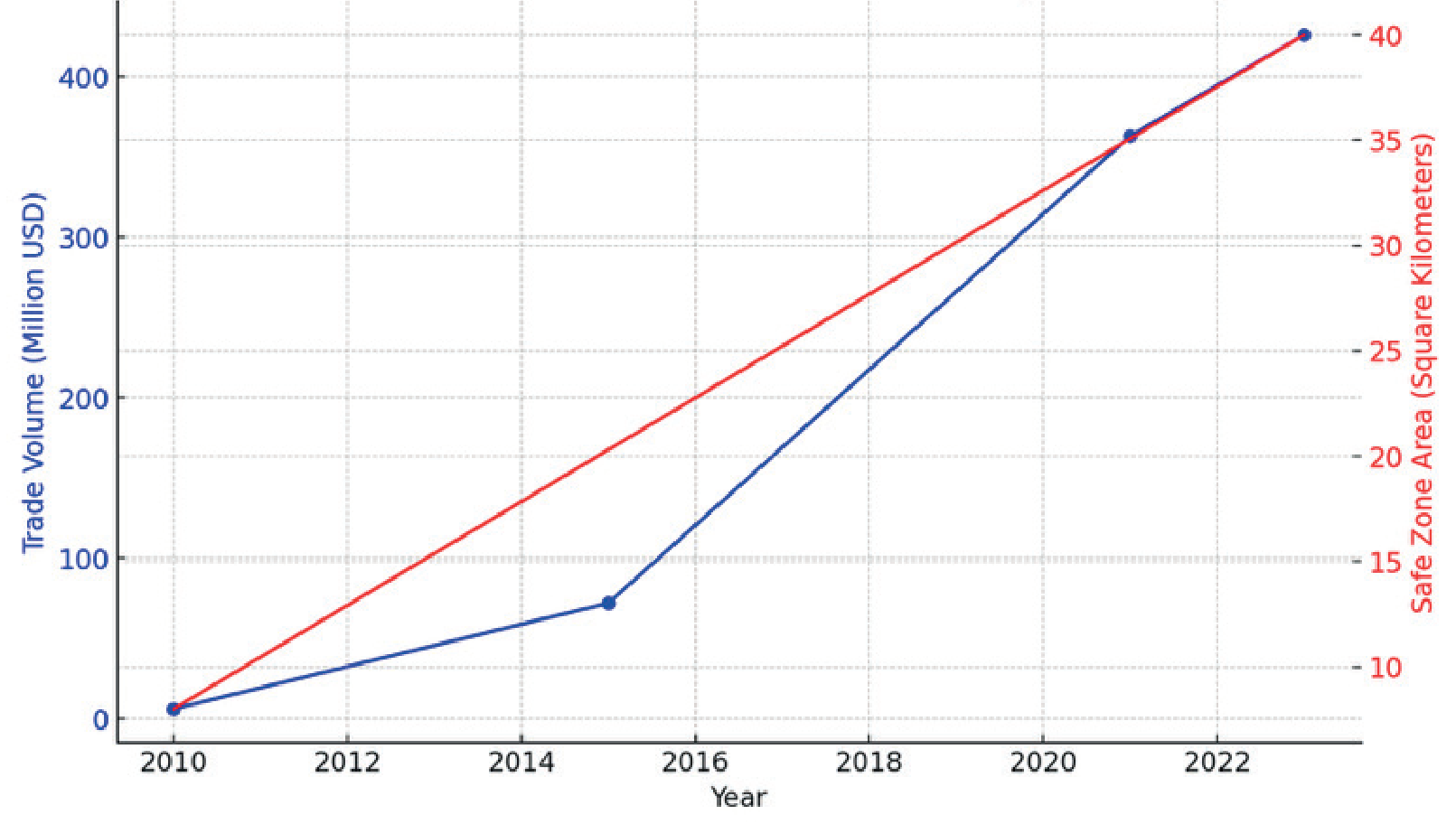
Moreover, the principles of win-win and partnership are also significant approaches for Türkiye in Sub-Saharan Africa.21 Indeed, Türkiye structures its security cooperation in a way that ensures mutual benefits. In this context, the TURKSOM military academy, established in Somalia in 2017, contributes to Somalia’s security while also enabling stability and, consequently, economic opportunities in secure areas of Somalia. This approach allows for the possibility of achieving mutual economic gains following the establishment of security. For instance, in 2010, when security in Somalia was relatively weaker and the state-controlled area in Mogadishu was approximately a 1-2 kilometer radius, the trade volume between Türkiye and Somalia was recorded at $6 million. However, following the establishment of the TURKSOM military academy in 2017 and subsequent developments, the controlled area expanded to approximately 4 square kilometers, and the trade volume reached $426 million by 2023 (Graph 1).22 This strategy helps strengthen Türkiye’s security cooperation in Sub-Saharan Africa and positions Türkiye as a “reliable partner.”
Graph 1: Somalia Safe Zone Area and Trade Volume Relations (2010-2023)
Source: Prepared by the Authors23
The principle of non-interference in internal affairs is embedded in Türkiye’s security policies towards Sub-Saharan Africa. Türkiye supports development and security initiatives in Sub-Saharan African countries without intervening in their internal and political affairs.24 In this context, while strengthening security cooperation, Türkiye respects the sovereignty of its partner countries and avoids meddling in their internal matters. This approach provides Türkiye with significant advantages in these countries.
Another critical approach Türkiye adopts in Sub-Saharan Africa is siding with the people rather than the political elites. Therefore, Türkiye’s influence in Sub-Saharan Africa stems from the grassroots level. Through this approach, Türkiye can win the hearts and minds of local people, thereby increasing the social acceptance of its military cooperation. This approach is rooted in the win-win principle, ensuring no harm to the respective country. Consequently, Türkiye enhances support for security cooperation by expanding its bureaucratic and societal influence in Sub-Saharan Africa.
Türkiye stands out in Sub-Saharan Africa as a country without a colonial past and thus free from the colonial baggage that other nations might carry. The positive reflection of Türkiye’s historical background and the absence of a colonial legacy allow it to differentiate itself from other actors in the region distinctly.25 This gives Türkiye significant advantages in security cooperation with Sub-Saharan countries. Not having a colonial history enables Türkiye to establish security partnerships with regional countries on an equal and respectful basis. One of the main factors for Türkiye’s acceptance among regional countries is that, unlike other powers with colonial histories, it builds its relationships on mutual respect, a non-condescending approach, and shared interests.
Mutual respect thus emerges as a guiding principle in all of Türkiye’s initiatives in Sub-Saharan Africa. Türkiye respects Sub-Saharan African countries’ political, social, and cultural dynamics, taking these dynamics into account when forming partnerships. By establishing relationships on equal footing, free from condescension and arrogance, Türkiye facilitates the development of long-term, and sustainable security partnerships. Sincerity and transparency are among the fundamental principles of Türkiye’s engagement in Sub-Saharan Africa. Türkiye adheres to the principle of transparency at all stages of cooperation, building security partnerships with regional countries on a foundation of sincerity.26 Consequently, many regional states view Türkiye as a trustworthy partner, leading to broader acceptance of security cooperation with Türkiye.
Türkiye employs a unique communication strategy in Sub-Saharan Africa called the “language of the heart.”27 The language of the heart allows Türkiye to strengthen its security cooperation by emphasizing sincerity, respect, and understanding in its interactions with the people and states of the region. This communication strategy shapes Türkiye’s military and security cooperation and its development support through humanitarian values. Thus, this approach strengthens Türkiye’s security policies in Sub-Saharan Africa.
Türkiye supports counter-terrorism efforts in West Africa through military training, defense industry exports, and security consultancy services
Another fundamental principle of Türkiye’s security cooperation in Sub-Saharan Africa is “growing together.” Türkiye structures its partnerships to ensure sustainability so that all parties progress together. Türkiye prioritizes the principle of mutual growth in all aspects of its military training and defense industry partnerships, thereby strengthening its position in the region. Lastly, a prominent principle highlighted in Türkiye’s approach is “abundance/prosperity” (bereket). Abundance reflects an approach that includes both material and spiritual elements, encompassing not only material wealth and prosperity but also social cohesion, spiritual well-being, peaceful coexistence, and increased positive developments. Understanding the whole meaning of the term requires knowing its etymology. The concept of abundance, which combines material and spiritual elements, is significant in Türkiye’s foreign policy, particularly in its Africa policy.28 Türkiye strives to structure its security cooperation with Sub-Saharan Africa around this concept. Indeed, Türkiye adopts a comprehensive approach that not only addresses its interests but also encompasses the security interests of the partner country’s population and state, including military assistance, contributions to regional peace, and the promotion of stability and development.
Therefore, Türkiye’s unique approach in Sub-Saharan Africa, which includes philosophical dimensions and incorporates the concept of abundance, plays a vital role in its security policies. This approach, referred to as the Turkish model, has a broad scope and encompasses humanitarian, economic, social, and military-security cooperation, thereby enhancing mutual trust. Through this model, Türkiye’s influence in Sub-Saharan Africa is further consolidated. Thanks to this unique model, Türkiye aims to enhance regional security, peace, and stability significantly. It continues its role as an influential actor that encompasses indispensable components for the security of Sub-Saharan Africa.
Türkiye’s Expanding Security and Defense Cooperation in Sub-Saharan Africa
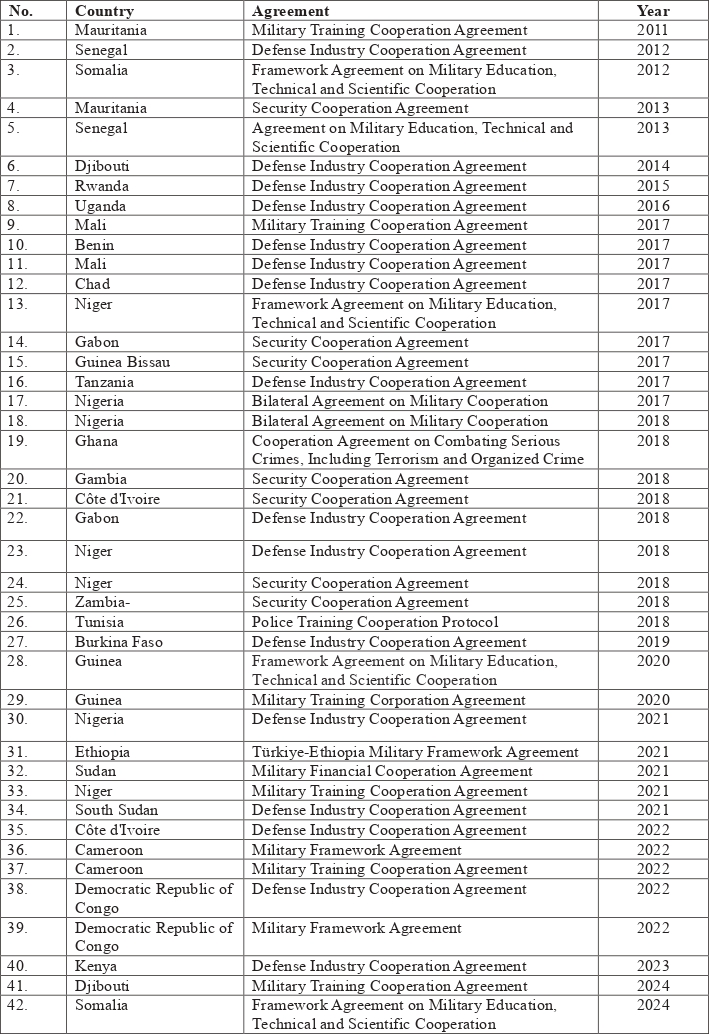
Since the 2010s, Türkiye has sought to expand and diversify its security policies in Sub-Saharan Africa. This article examines three sub-regional systems: East Africa, West Africa, and the Sahel Belt. Although these three regions cover a vast area within the continent, they are crucial for understanding Türkiye’s security approach. Each sub-regional system has unique dynamics, structures, security threats, and strategic significance. Acknowledging these regional dynamics, Türkiye has increased its security cooperation by signing defense and security agreements with various countries, launching military training programs, and supplying strategic military equipment. These policies also demonstrate Türkiye’s aim to contribute to regional stability in Sub-Saharan Africa. As shown in Table 1, dozens of security and defense agreements have been signed between Türkiye and Sub-Saharan African countries since 2011. Notably, the number of these agreements increased sharply after 2017.
Table 1: Selected Security and Defense Cooperation Agreements Signed between Türkiye and Sub-Saharan African Countries (2011-2024)
Source: Prepared by the Authors
The large number of agreements indicates that a larger number of countries in Sub-Saharan Africa have sought security and defense cooperation with Türkiye since 2017. Key factors contributing to this trend include Türkiye’s advancements in the defense industry and the success of its defense industry products.29 Through these agreements, aimed at contributing to regional security, Türkiye pursues an effective, multi-dimensional, and multi-stakeholder security policy in Sub-Saharan Africa. Türkiye’s strategy not only provides military support but also represents a comprehensive cooperation model that promotes regional stability and development.
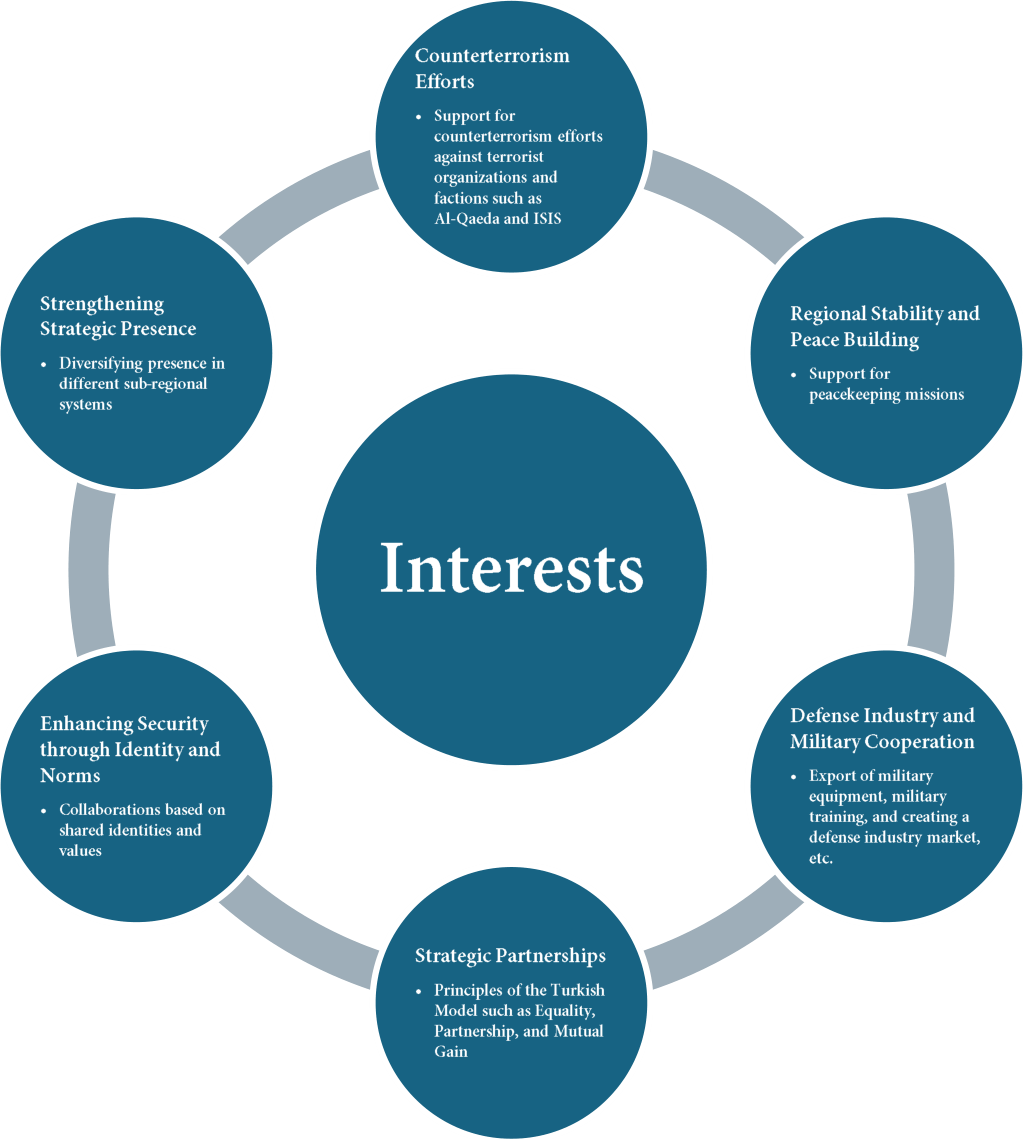
Figure 1: Türkiye’s Strategic Security Interests in Sub-Saharan Africa
Source: Prepared by the Authors
In this context, Türkiye’s strategic security interests in Sub-Saharan Africa as a security provider include counter-terrorism, regional stability and peace, defense industry and military cooperation, strategic partnerships based on mutual interests, strengthening its strategic presence in sub-regional systems, and enhancing security through identity and norms.
Security Relations with East Africa
East Africa holds a significant place in Türkiye’s Sub-Saharan Africa policies due to its strategic location, historical ties, and existing security threats. The region faces security challenges such as strategic transit points to the Red Sea, the threat of terrorism, internal conflicts, and weak state structures. Türkiye aims to enhance regional stability by developing security cooperation in this region.30 Establishing regional stability would allow the implementation of various principles such as “People First,” “Growing Together,” and partnership, enabling the fruitful operation of a win-win model.
Geographically, East Africa serves as a gateway to the Red Sea, the Indian Ocean, and the interior regions of Africa. This strategic importance places the region at the center of international trade routes, making it attractive to regional and international actors. However, this strategic significance also brings various security challenges. Terrorism, ethnic conflicts, weak state structures, civil wars, protests, the reflections of global and regional power struggles, and historical disputes between regional countries are among the key factors shaping the region’s security dynamics. In particular, internal conflicts and terrorist activities in countries like Somalia and Ethiopia are major factors threatening regional stability.
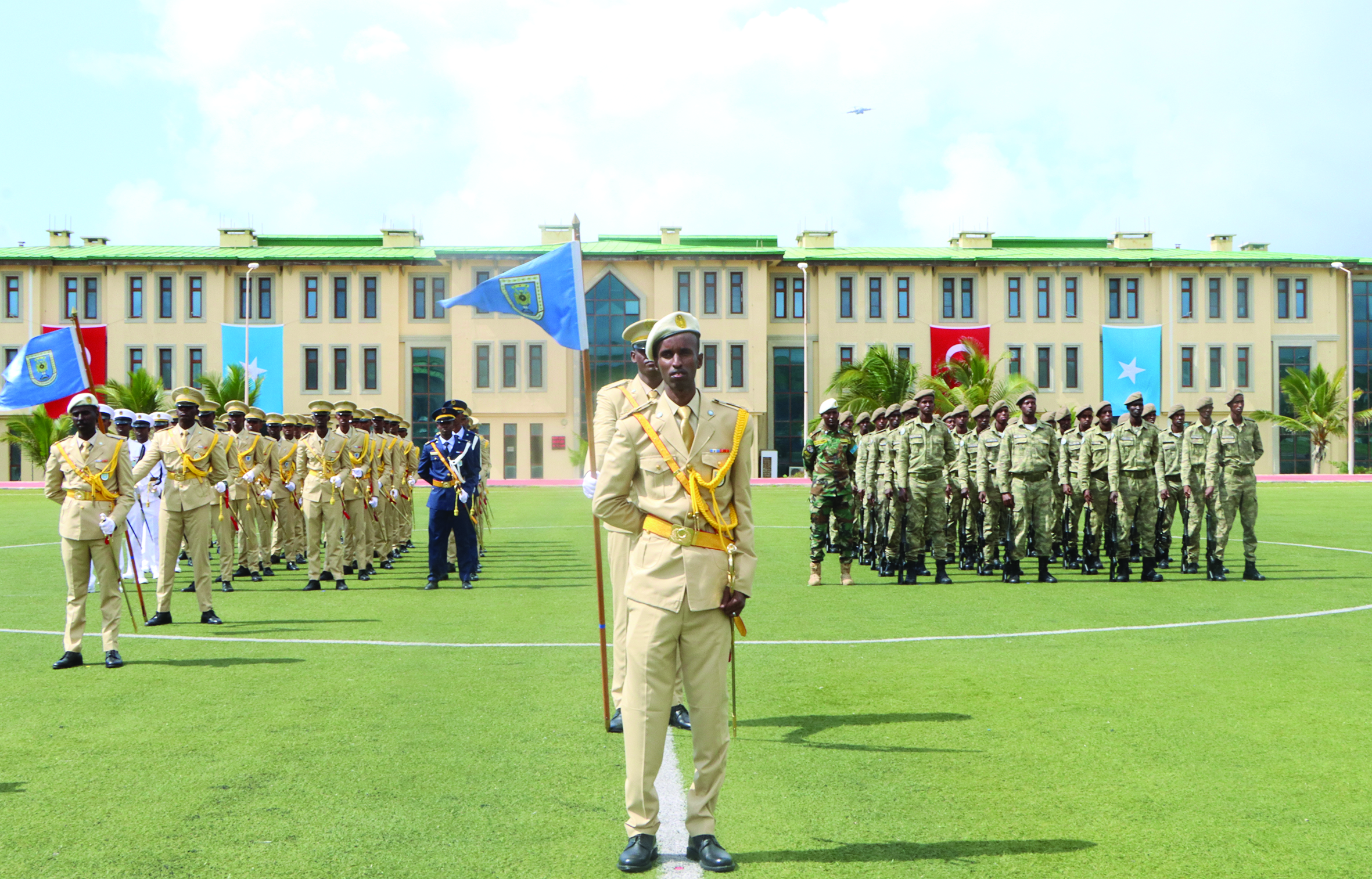
By increasing its presence in East Africa, Türkiye acts alongside the local population and legitimate governments, without interfering in their internal affairs, in response to the region’s security challenges. Notably, Somalia stands out as the focal point of Türkiye’s security strategies in East Africa. In September 2017, Türkiye opened its second and largest overseas military academy in Mogadishu, Somalia, with a construction cost of $50 million. This active Turkish military academy hosts 400 Turkish personnel, with plans to train one-quarter of the Somali National Army. In this context, TURKSOM assists Somalia in achieving a self-sufficient security capacity.31 This military academy significantly contributes to the training of the Somali National Army and is part of Türkiye’s broader efforts to enhance security capacities in Somalia. Consequently, this training base has positioned Türkiye as one of the key security providers in the region. Türkiye’s military presence in Somalia extends beyond security cooperation to include humanitarian aid, healthcare, and education, reinforcing Türkiye’s role not only as a security provider but also as a development partner in the region. Therefore, when evaluated from a constructivist perspective, Türkiye’s security relations in East Africa reflect a strategy shaped by identity and norms.
Türkiye’s contributions to counter-terrorism efforts in West Africa are not limited to military cooperation. They are also complemented by humanitarian aid and development assistance aimed at enhancing regional stability and development
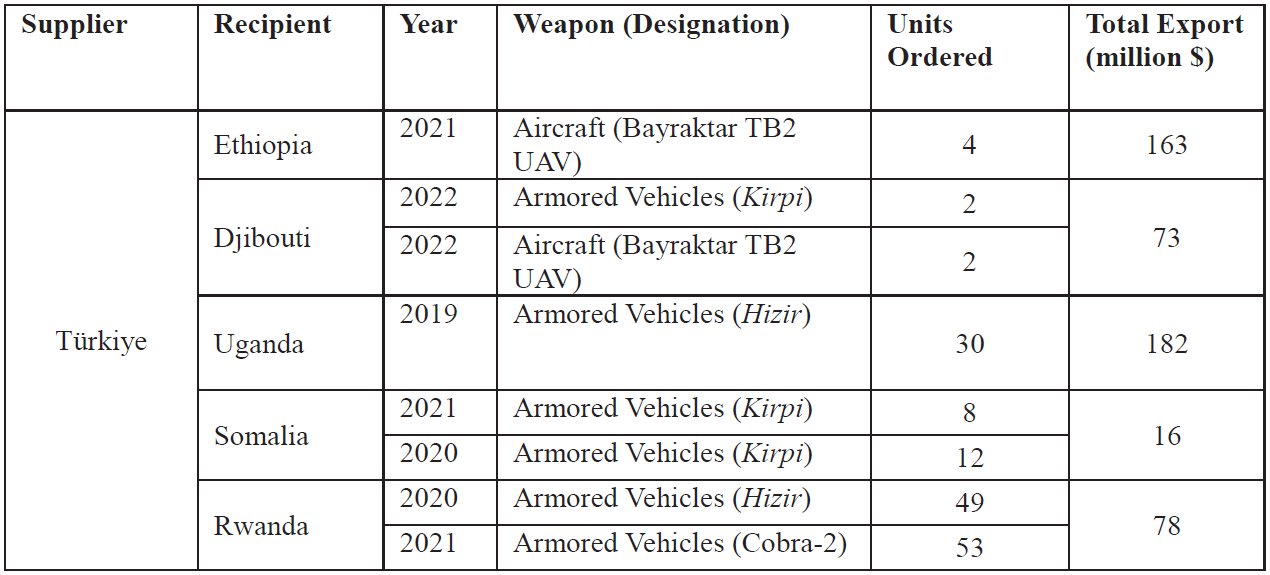
In East Africa, particularly in Somalia, many countries have become key partners in Türkiye’s security policies. Ethiopia, for instance, receives support from Türkiye in strengthening its internal security and defense capacities. Türkiye contributes to regional security by supplying defense industry products to Ethiopia. Notably, during the Tigray War,32 Ethiopia’s acquisition of Bayraktar TB2 drones from Türkiye played a crucial role in maintaining Ethiopia’s stability against Tigray forces. In the context of that period, this move, which helped end the civil war in Ethiopia, also contributed to regional security.
Table 2: Selected Weapons Exports from Türkiye to East African Countries (2018-2024)
Source: SIPRI33
Military training and capacity-building programs are among the most critical elements of Türkiye’s security cooperation in the East African sub-regional system. Türkiye’s military training programs contribute to the consolidation of strategic partnerships established with regional countries, subsequently enhancing regional security and stability.
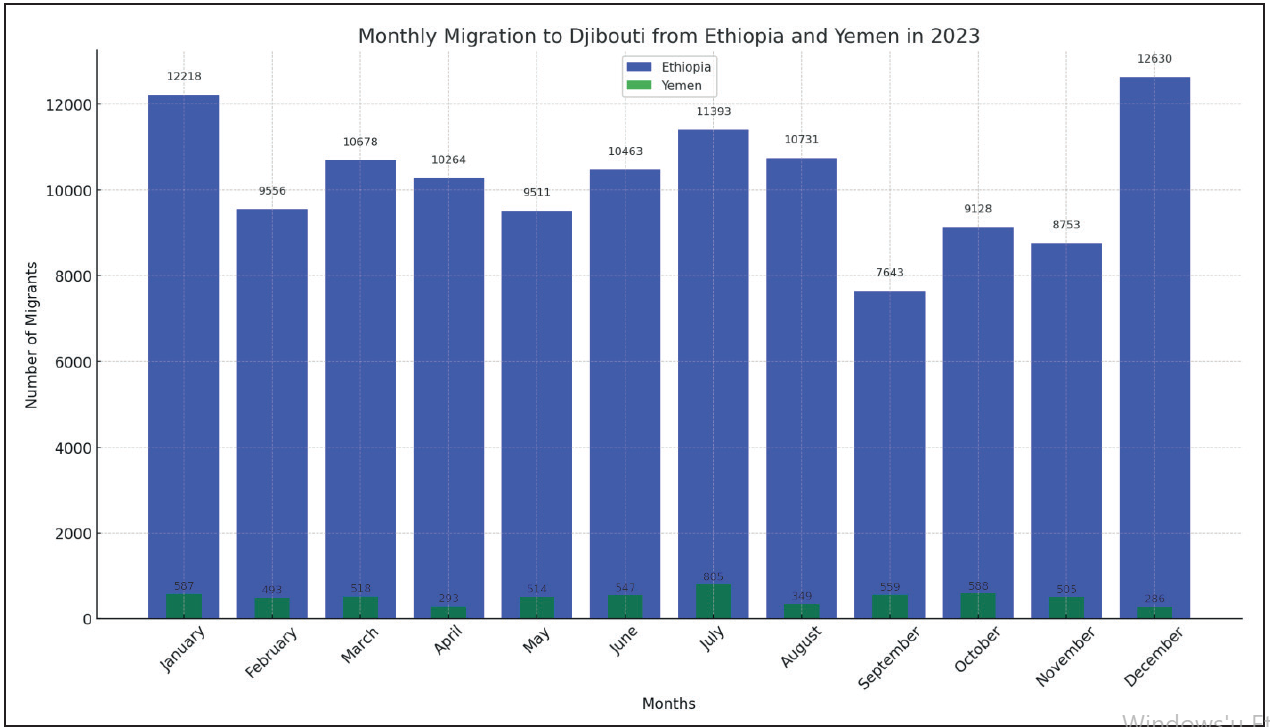
Graph 2: Migratory Flows Arriving from Ethiopia and Yemen in 2023
Source: IOM34
On the other hand, military and security cooperation with Djibouti, Rwanda, and Uganda represents other facets of Türkiye’s security engagements in East Africa. Türkiye supplies these countries with various defense industry products, primarily armored vehicles and unmanned aerial vehicles. These provisions enhance the countries’ capacities for counter-terrorism and strengthen their defense capabilities against migration and internal threats.
In this context, as seen in Graph 2, data pertaining to migrants received by Djibouti from Ethiopia and Yemen as of 2023 is presented. In 2023, Djibouti witnessed an influx of 122,968 migrants from Ethiopia and 6,044 from Yemen. Therefore, migration and the associated security challenges are among Djibouti’s primary security concerns. Türkiye collaborates with Djibouti in various fields to address these issues. In this regard, Türkiye supports Djibouti’s police force, providing assistance in capacity-building for public order and security.
Through these partnerships, Türkiye is developing a strategic partnership with East Africa and positioning itself as a key actor in regional security. However, there remain opportunities for further cooperation, particularly on migration, which is one of Africa’s significant security challenges. In this context, increased cooperation with Djibouti on migration is feasible. The continuity of cooperation can be ensured by providing sub-cloud drone systems, census support, and technical equipment assistance, which Türkiye possesses.
Security Relations with West Africa
Within the framework of Türkiye’s Africa policy, West Africa holds great significance due to its potential, geopolitical importance, rich natural resources, and security challenges. The region faces numerous security threats, including terrorism, organized crime, piracy, internal conflicts, and weak state structures.35 These security threats jeopardize regional and global stability, necessitating the strengthening of the military capacities of regional states and the enhancement of international cooperation. In this context, Türkiye contributes to the security landscape of West Africa through increased security cooperation, defense industry exports, and military training programs.
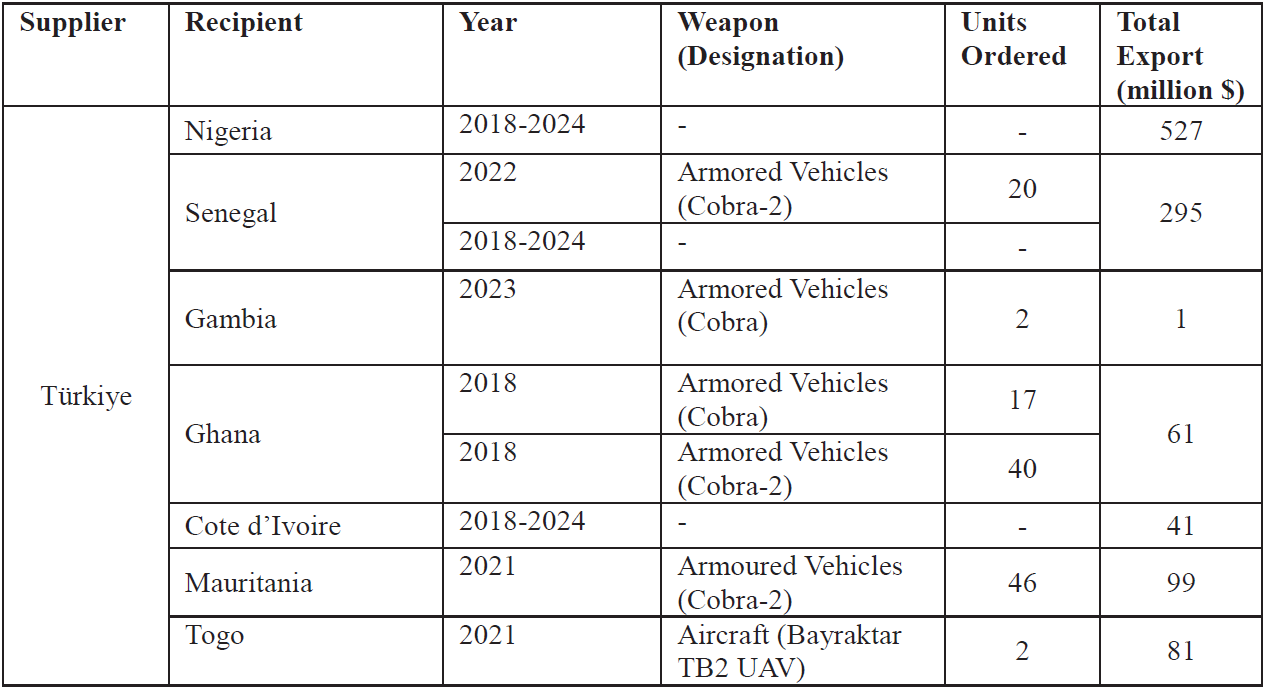
Table 3: Selected Weapons Exports from Türkiye to West African Countries (2018-2024)
Source: SIPRI36
West Africa stands out as a region marked by instability and faces various security challenges. Terrorist organizations such as Boko Haram, the Islamic State’s West Africa Province (ISWAP), al-Qaeda in the Islamic Maghreb (AQIM), and ISIS affiliates cause significant security issues, particularly in countries like Nigeria, Niger, Chad, and Mali. These groups conduct attacks on civilian targets, threaten regional security, and undermine the authority of governments.37 In addition to terrorism, West African states also contend with organized crimes such as border security issues, human trafficking, and drug trafficking. According to UNODC’s 2020 data, a total of 187,915 victims of human trafficking were identified globally between 2017 and 2020. In 2020, the number of identified human trafficking victims worldwide decreased by 11 percent compared to 2019. However, this decline is linked to the COVID-19 pandemic.38 In Sub-Saharan Africa, the number of identified victims decreased by 12 percent in 2020. Additionally, trafficking for sexual exploitation saw a 24 percent decrease compared to 2019.39 This reduction can also be associated with the closure of public spaces during the COVID-19 pandemic.
Just as Türkiye has become a pivotal actor in Eastern Africa, particularly in Somalia, Niger has similarly emerged as a critical player in the Sahel
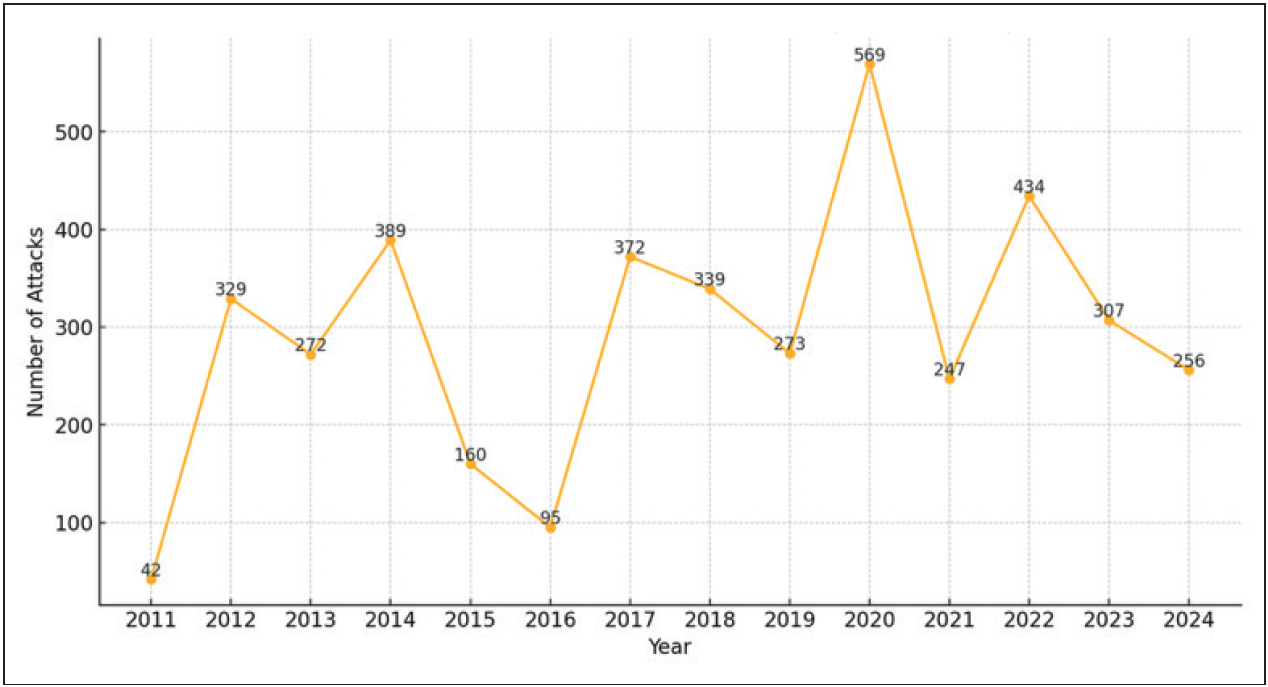
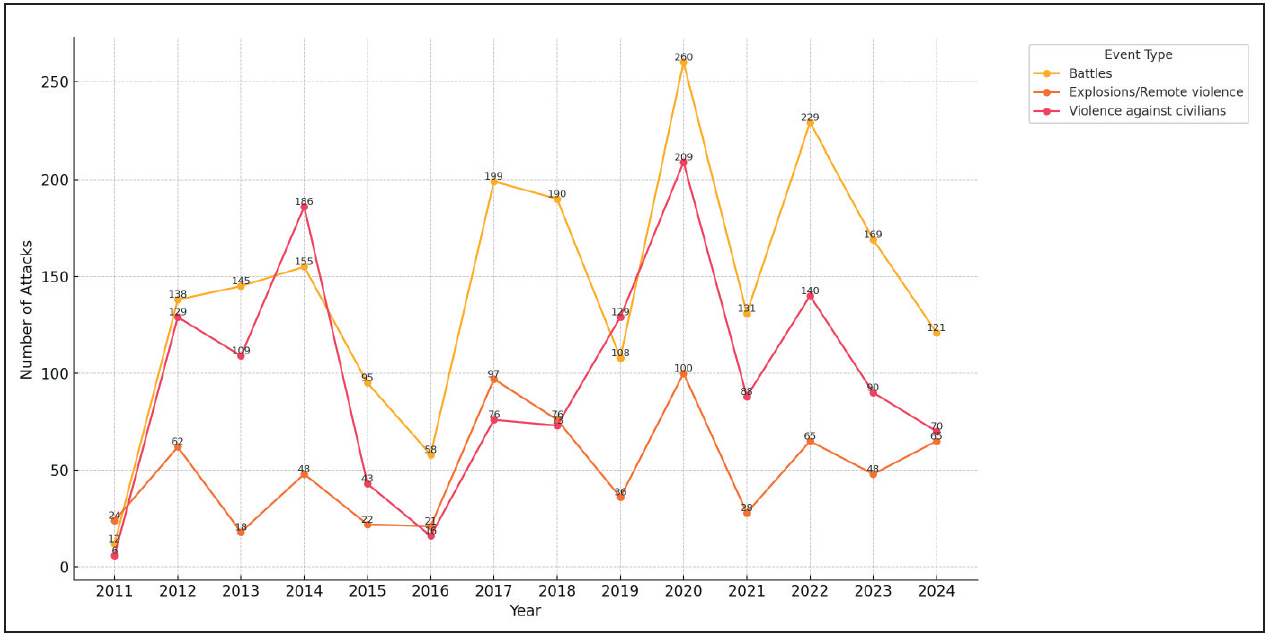
Türkiye supports counter-terrorism efforts in West Africa through military training, defense industry exports, and security consultancy services. By providing strategic support to regional countries in counter-terrorism, Türkiye participates in international efforts to enhance regional security. Consequently, following Türkiye’s involvement in security support efforts, there has been a relative decrease in attacks in the region, particularly from 2017 onward. Notably, when examining Graph 4 and Graph 5 by attack types, while the total number of attacks increased from 372 in 2017 to 569 in 2020, it decreased to 256 in 2023.
Graph 4: Number of Attacks in Western Africa (2011-2024)
Source: ACLED Data40
On the other hand, when examining the fluctuations in Graph 5, a downward trend in data related to the types of incidents is observed, when comparing figures between 2017 and 2023. However, it is important to note that this trend has been volatile, with increases in attacks in some years followed by temporary decreases, only to rise again in subsequent years. Despite the observed decline compared to the past, there remains a risk that conflict and violent incidents could increase again in the near term if the root causes, such as security vulnerabilities and socio-economic issues, are not fully addressed. Therefore, developing comprehensive and sustainable strategies to minimize security risks, dependent on the effectiveness of security policies, international support, and local governance, is critically important. These strategies should not be confined solely to military measures. They should also encompass a holistic approach that supports social and economic development, strengthens social cohesion, and empowers local governance. Such a comprehensive strategy would ensure long-term regional stability and prevent the resurgence of conflict and violence. In this context, Türkiye’s capacity-building support, provided through various institutions in line with the needs of regional countries, stands out prominently.
Türkiye’s contributions to counter-terrorism efforts in West Africa are not limited to military cooperation. They are also complemented by humanitarian aid and development assistance aimed at enhancing regional stability and development. In counter-terrorism operations in West Africa, Türkiye supports local populations through humanitarian aid activities and development projects, in addition to enhancing military capacities.41 This approach demonstrates Türkiye’s role as a normative power, integrating humanitarian values into regional security cooperation.
Graph 5: Number of Attacks in Western Africa by Event Type (2011-2024)
Source: ACLED Data42
Türkiye responds to the complex security environment in West Africa through defense partnerships and military training programs developed with regional countries. Türkiye’s strategic approach in West Africa encompasses defense industry exports and military advisory services aimed at enhancing regional security capacity.43 Through the provision of military training and defense industry products to West African countries, Türkiye contributes to the modernization of regional security forces. While advancing not only institutionally but also through diplomacy at the leadership level, Türkiye utilizes this approach to its advantage. In this context, President Recep Tayyip Erdoğan’s bilateral relations with leaders of states in Sub-Saharan Africa play a significant role as a key (f)actor in Türkiye’s regional security policies, as seen in West Africa. For example, as shown in Table 3, the purchase of Bayraktar TB2 drones by Togo occurred after Erdoğan’s visit to the country.44
Meanwhile, today, 13.5 million people are forcibly displaced in West Africa.45 In this context, Nigeria stands out more prominently than other countries. Nigeria, with the largest economy and population in West Africa, is not only a regional power but also a country grappling with severe security challenges. Terrorist groups such as Boko Haram and the ISWAP, operating in the country’s North, have caused thousands of deaths and displaced over 3 million people.46 Nigeria seeks international support in its fight against terrorism, and its security cooperation with Türkiye in this context holds strategic importance. Although not reflected in SIPRI data, it is known that Nigeria has procured systems from Türkiye, including Bayraktar TB2 UAVs, T129 ATAK helicopters, TOGAN Autonomous Rotary Wing Surveillance UAV System, and systems like SONGAR and BAHA.47
On the other hand, Ghana and Senegal, despite being relatively stable and democratically governed countries in West Africa, are also affected by regional security threats and the risk of terrorism. Türkiye is taking steps to enhance the security capacities of these countries by strengthening its military cooperation with Ghana and Senegal. Türkiye provides military training programs, defense industry products, and security consultancy services to both countries.
Türkiye adapts to local dynamics and security requirements in East Africa, West Africa, and the Sahel Belt by adhering to a foreign policy approach that caters to specific needs
Ghana is an important partner for Türkiye in the context of increasing security cooperation in West Africa. As seen in Table 3, Türkiye exports defense industry products to Ghana and conducts military training programs for the Ghanaian military.48 These partnerships enhance Ghana’s resilience against regional security threats and reinforce Türkiye’s strategic partnership with Ghana. Meanwhile, Senegal is another key cooperation partner for Türkiye in West Africa. Türkiye is expanding its defense industry cooperation with Senegal, supplying products such as military vehicles, unmanned aerial vehicles, and defense systems. Additionally, Türkiye’s security cooperation with Senegal contributes to the modernization of Senegal’s defense capacity.
Security Relations with Sahel Belt
The Sahel Belt emerges as a region struggling with multifaceted threats such as terrorism, internal conflicts, climate change, migration, and weak state structures.49 These challenges initially pose security threats to the local populations, but they also become significant regional and global security concerns over time. In response to these issues, countries in the Sahel have recently strengthened their relations with Türkiye, expanded security cooperation, enhanced defense industry collaborations, and received critical support for counter-terrorism efforts.
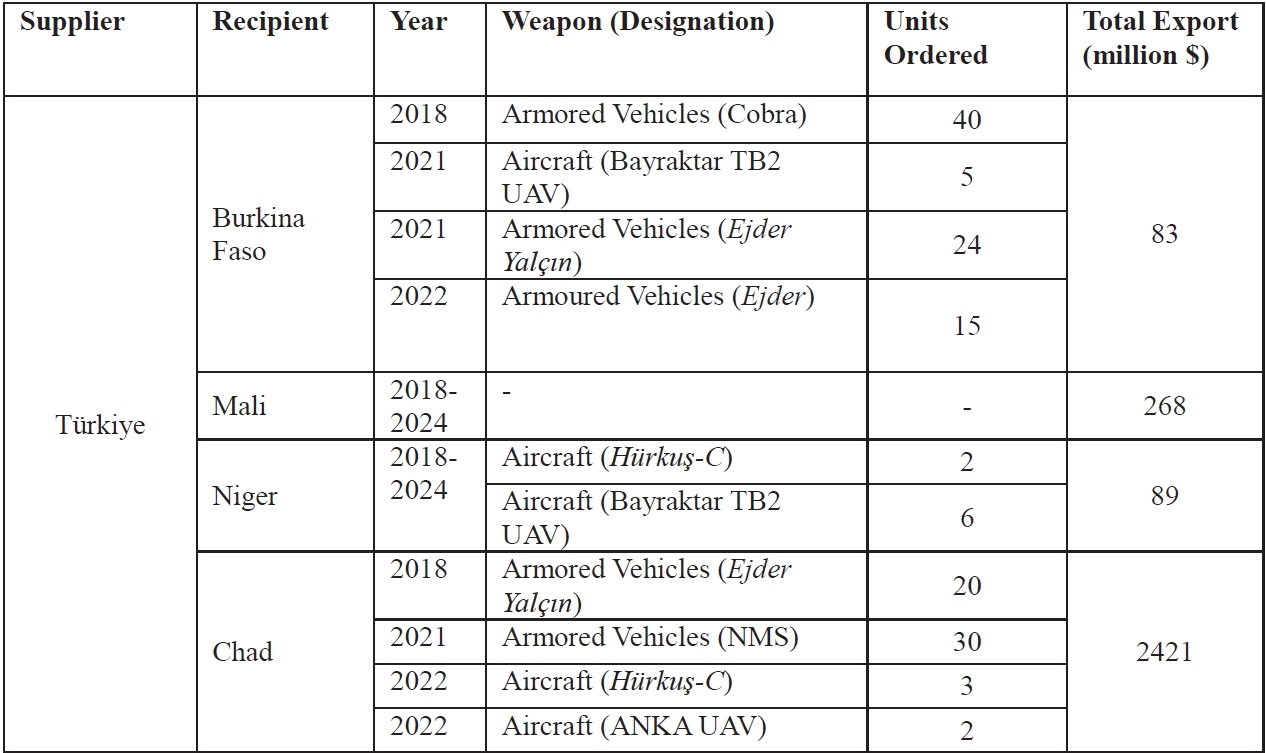
Table 4: Selected Weapons Exports from Türkiye to Sahel Belt Countries (2018-2024)
Source: SIPRI50
The primary security challenge in the Sahel region is terrorism. However, secondary security issues such as climate change, food insecurity, and scarcity persist. These challenges contribute to instability in the region, adversely affecting security. In the context of climate change, issues like desertification and drought negatively impact people’s lives and their livelihood activities. These problems, in turn, affect agriculture and livestock, further weakening and rendering the already fragile economy more vulnerable. This situation triggers migration and displacement.
Moreover, the increase in migration and displacement caused by terrorism and conflict further exacerbates existing security issues. On the other hand, the resources of the regional states are quite limited, and their governance systems have not yet been fully strengthened to develop solutions to these problems. Corruption, the legacy of colonial mismanagement, neo-colonial activities, and inadequate military capacity in the regional states are factors that hinder the resolution of security issues.51 Therefore, these challenges pose risks to regional security and raise concerns for international security, peace, and stability.
The Confederation of Sahel States established by Niger, Mali, and Burkina Faso, represents a clear manifestation of the strategic transformation occurring in the Sahel region.52 This shift has significantly impacted the security dynamics of the area. The Confederation seeks to enhance cooperation among its member states and jointly tackle regional security challenges. Just as Türkiye has become a pivotal actor in Eastern Africa, particularly in Somalia, Niger has similarly emerged as a critical player in the Sahel. Recent military interventions in the Sahel have gradually withdrawn Western powers such as France and the United States from the region. Following the cessation of cooperation between Western countries and Sahel states, there has been a noticeable increase in collaboration between Türkiye and the countries of the region. Türkiye has addressed the Sahel’s security challenges by aligning its efforts with the specific needs of Sahel countries. In this regard, Türkiye has not only strengthened its ties with Niger but has also expanded its cooperation with other members of the Confederation, thereby continuing to contribute to regional security.53
Reflecting Türkiye’s broader security policy in Sub-Saharan Africa, its strategy in the Sahel Belt emphasizes counter-terrorism, military capacity-building, and the promotion of regional peace and stability. The new framework for security cooperation with Niger stands out as particularly noteworthy in this context. The strategic shift in the Sahel, marked by the establishment of the Confederation of Sahel States, has led to significant changes in the security landscape. In this evolving sub-regional system, new security partnerships and collaborations with alternative actors have the potential to provide a more comprehensive and effective response to security challenges.54
The Confederation of Sahel States provides a robust security cooperation framework that includes coordinated military operations against terrorism, border security partnerships, and intelligence-sharing mechanisms. The establishment of this structure is viewed as a step that could mitigate security threats and reshape regional dynamics. It also enables a more holistic and practical approach to the security issues faced by Sahel countries. In this framework, Türkiye is actively working to deepen its security cooperation with member states of the Confederation, aiming to contribute to regional peace and stability. To enhance security cooperation in the Sahel Belt, Türkiye meticulously applies the principles of the Turkish model in its engagements with regional states.55
Relations are built on mutual respect, equality, partnership, and shared interests. Türkiye’s “People First” approach is supported by humanitarian aid, education, and development projects, which increase the social acceptance of its military cooperation. Türkiye’s relations with Niger are not limited to defense industry exports and military training; they are also supported by health services, agricultural projects, and other development assistance.56 This comprehensive approach allows Türkiye to contribute to the security goals of the Confederation of Sahel States.
Türkiye strengthens Niger’s counter-terrorism capacity by exporting armored vehicles, unmanned aerial vehicles (UAVs), and various military equipment. In this regard, Table 4 shows that Türkiye plans to include armored vehicles that have not yet been reflected in SIPRI data in Niger’s inventory.57 Additionally, the training programs provided by Turkish military experts will significantly contribute to the modernization and enhancement of the operational capacity of the Nigerian army. This situation also provides an opportunity to implement the model used by Türkiye in Somalia as a template in Niger within the Sahel Belt. The success story resulting from the contributions of the successful model in Somalia to the country’s institutional and societal security serves as an example that could be extended to other regions of Sub-Saharan Africa.
Building partnerships that enhance regional strategic integration will inevitably strengthen Türkiye’s ties with Sub-Saharan African states
Türkiye’s defense cooperation with Niger, Mali, and Chad aims to contribute to regional security and advance Türkiye’s strategic interests in the region. Agreements with regional countries are intended to enhance their counter-terrorism capacities and support regional stability. In this context, Türkiye’s exports of armored vehicles, UAVs, and various defense equipment to Niger, Mali, Burkina Faso, and Chad, as well as its military training collaborations, contribute to the modernization of these countries’ armed forces.58
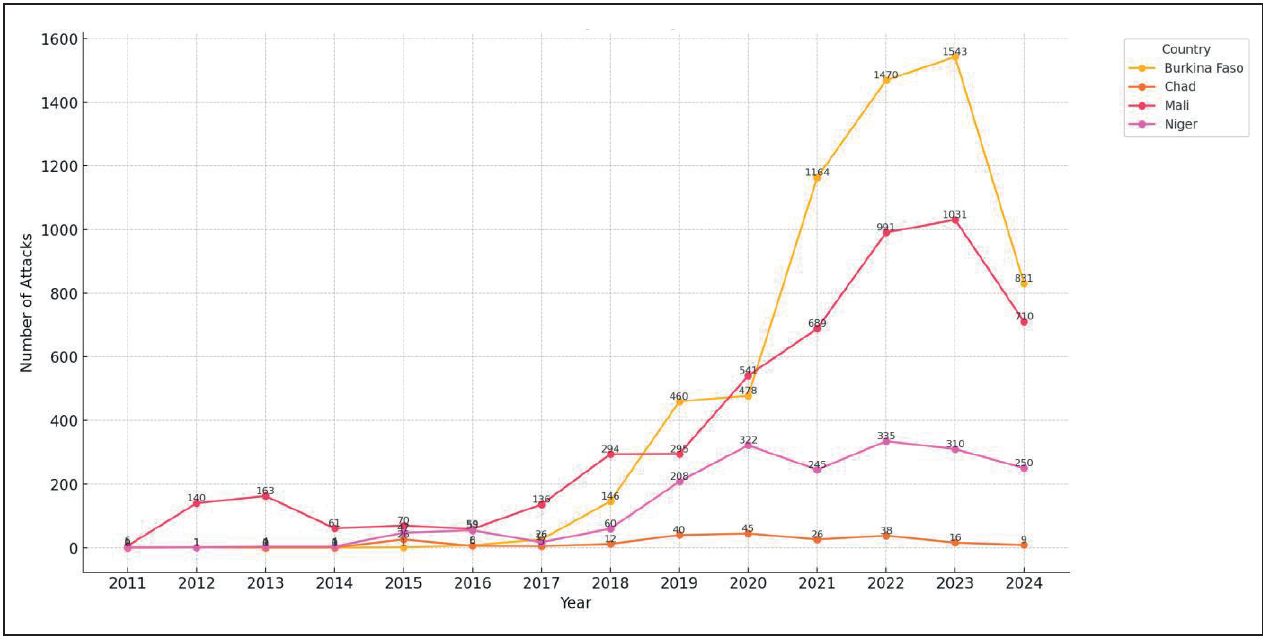
However, as seen in Graph 6, Burkina Faso stands out as the most notable country in the Sahel Belt. Burkina Faso is one of the countries in the Sahel region where terrorist groups are most active. Attacks in Burkina Faso have sharply increased since 2017. This increase indicates that the country’s security forces are insufficient against terrorist groups and that regional instability significantly affects Burkina Faso. While this situation is also noteworthy for Mali since 2016, though not as severely as in Burkina Faso, Niger shows relatively fewer fluctuations with a lower incidence of attacks compared to other countries. However, even with a relatively low number of attacks, the persistence of attacks indicates that terrorist groups continue to pose a threat. On the other hand, Chad is observed to have a relatively more stable security environment compared to other countries. The trends seen in Graph 6 reveal that the security situation in the Sahel region is highly complex and fragile. Türkiye’s support of defense industry products plays an important role in enhancing military capacity in the region. However, this support should be bolstered by security reforms, political stability, and socio-economic development in regional countries to achieve more tangible successes.
Graph 6: Number of Attacks in Sahel Belt by Country (2011-2024)
Source: ACLED Data59
Furthermore, Türkiye has partnerships in the Sahel Belt to support counter-terrorism efforts. Türkiye’s UAV technology provides a significant advantage in counter-terrorism operations in the Sahel Belt. Indeed, the defense industry plays a crucial role in Türkiye’s security policy in the Sahel Belt. UAVs, equipped with both reconnaissance and surveillance capabilities as well as direct attack capacities, play an effective role in detecting and neutralizing terrorist elements. Türkiye organizes training on the use of UAVs in countries like Niger and Mali, and these trainings enable regional militaries to effectively utilize UAV technology.60 These partnerships strengthen Türkiye’s strategic presence in the region while directly contributing to the counter-terrorism capacities of Sahel countries. Military training programs are a crucial component of Türkiye’s approach to the Sahel Belt. Türkiye conducts various training programs for military personnel in Niger, Mali, and Chad, focusing on enhancing the operational capacities of regional military forces. These programs allow the region’s forces to operate more effectively in counter-terrorism efforts. In summary, Türkiye’s military training in the Sahel Belt contributes to the modernization and professionalization of security forces in the region.61
Conclusion
Türkiye’s security engagement in Sub-Saharan Africa transcends regional dynamics and strategic interests, embracing a strategy grounded in identity, normative values, and discourse. Türkiye’s security policy in Sub-Saharan Africa focuses on counter-terrorism, regional stability, and advancing mutual interests based on a win-win principle. The sustainability and legitimacy of this approach are reinforced through identity construction and the integration of normative frameworks.
Although African countries may have similar characteristics, it is not a homogeneous continent. Africa has hundreds of different cultures, languages, and ethnicities. In addition to similarities, the continent comprises distinct regions, sub-regions, and 54 different countries, each with unique experiences and histories, making it essential to evaluate Africa separately by region or country. Türkiye adapts to local dynamics and security requirements in East Africa, West Africa, and the Sahel Belt by adhering to a foreign policy approach that caters to specific needs. Across these regions, Türkiye’s approach to security cooperation generally emphasizes counter-terrorism, defense industry collaborations, institutional capacity building, contributions to peacekeeping and peacebuilding efforts, and military training initiatives, which enhance Türkiye’s strategic presence in different regions. Moreover, Türkiye’s identity as a Muslim country and its historical and cultural ties that trace back to the Ottoman Empire help bolster the legitimacy and acceptance of its security collaborations in various parts of Africa.
Türkiye’s approaches to security cooperation in different regions, including military assistance, training, and defense industry partnerships, combine these efforts with normative strategies to ensure the long-term sustainability of these partnerships. Furthermore, Türkiye also supports efforts to address complex security challenges in various regions, focusing on counter-terrorism. In this context, Türkiye has recently strengthened its security policies in the Sahel Belt through a strategic transformation. Consequently, it has been observed that Türkiye prioritizes counter-terrorism and defense industry collaborations in its security policies across East Africa, West Africa, and the Sahel Belt, thereby increasing its strategic influence. Additionally, Türkiye incorporates normative elements in its security partnerships to garner societal support for its security agenda.
Nevertheless, to further consolidate Türkiye’s security policies in Sub-Saharan Africa, strategic advancements are necessary. Building partnerships that enhance regional strategic integration will inevitably strengthen Türkiye’s ties with Sub-Saharan African states. Enhancing intra-regional cooperation and establishing joint security mechanisms will increase the effectiveness of Türkiye’s security partnerships. In this context, Türkiye should strengthen its cooperation with regional organizations such as the Confederation of Sahel States. Secondly, it is important for Türkiye to continue its soft power strategies to support its security policies. The soft power element, which holds a significant place in Türkiye’s Africa policy, is effectively utilized today within the scope of smart power. Support in areas such as humanitarian aid, education, and health services will enhance Türkiye’s image in the region and increase the social acceptance of its security cooperation.
Türkiye’s security policy in Sub-Saharan Africa extends beyond addressing regional security threats; it encompasses a strategy shaped by shared identities, norms, and values
While Africa is often perceived as a monolithic entity, each regional and sub-regional system, and indeed each country, possesses unique values, cultures, and structures. Therefore, Türkiye’s approach to Sub-Saharan Africa is not uniform; it adapts to the distinct dynamics and security challenges of East Africa, West Africa, and the Sahel Belt. Establishing a new military academy within the borders of the Confederation of Sahel States, as in Somalia, in line with needs and strategic partnerships, could further consolidate Türkiye’s relations with this newly formed structure. Such an initiative would significantly enhance regional states’ military capacities and modernize their armed forces in response to regional security threats. However, the management of this proposal and a comprehensive cost-benefit analysis warrant a separate investigation. By taking these steps, Türkiye’s security relations with Sub-Saharan Africa could evolve into a more integrated, comprehensive, and sustainable framework.
In conclusion, Türkiye’s security policy in Sub-Saharan Africa extends beyond addressing regional security threats; it encompasses a strategy shaped by shared identities, norms, and values. This comprehensive approach bolsters regional peace, stability, and security. As these strategies are further developed and deepened, it is evident that Türkiye is positioning itself as a more significant actor in Sub-Saharan Africa’s security landscape, contributing substantially to the regional security architecture and, by extension, to global security.
Endnotes
1. Stephano Guzzini, “A Reconstruction of Constructivism in International Relations,” European Journal of International Relations, Vol. 6, No. 2 (2000), pp. 147-182.
2. Alexander Wendt, “Anarchy Is What States Make of It: The Social Construction of Power Politics,” International Organization, Vol. 46, No. 2 (1992), pp. 391-425.
3. Ronald L. Jepperson, Alexander Wendt, and Peter J. Katzenstein, “Norms, Identity, and Culture in National Security,” in Peter J. Katzenstein (ed.), The Culture of National Security: Norms and Identity in World Politics, (New York: Columbia University Press, 1996), p. 15.
4. Jesus A. Soto. “The Constructivism of Social Discourse: Toward a Contemporaneous Understanding of Knowledge,” Open Journal of Philosophy, Vol. 12, (2022), pp. 376-396.
5. Ted Hopf, “The Promise of Constructivism in International Relations Theory,” International Security, Vol. 23, No. 1 (1998), pp.174-175.
6. Wendt, “Anarchy Is What States Make of It.”
7. Nicola Melis, “The Ottoman Africa and the Ottomans in Africa,” EURASIAN Studies 21, (2023), pp. 143-150.
8. Andrew Lebovich and Nienke van Heukelingen, “Unravelling Turkish Involvement in the Sahel: Geopolitics and Local Impact,” Clingendael, Netherlands Institute of International Relations, (July 2023), p. 12.
9. Jeffrey T. Checkel, “International Norms and Domestic Politics: Bridging the Rationalist Constructivist Divide,” European Journal of International Relations, Vol. 3, No. 4 (1997), pp. 473-495.
10. Ferhat Pirinççi and Tunç Demirtaş, Türkiye’nin Afrika Politikasında Yumuşak Güç, (Bursa: Dora Yayınevi, 2018).
11. Pirinççi and Demirtaş, Türkiye’nin Afrika Politikasında Yumuşak Güç.
12. “United Nations Thanks Türkiye for Its Contribution to Peacekeeping,” United Nations Türkiye, (November 9, 2022).
13. Samuel Ramani, “Türkiye’s Sahel Strategy,” The Middle East Institute, (September 23, 2020).
14. Zeliha Eliaçık and Metin Erol, “Dışişleri Bakanlığı Batı ve Orta Afrika Genel Müdürü Sağman: Türkiye-Afrika İlişkileri 2002 Sonrası İvme Kazandı,” Anadolu Ajansı, (May 24, 2022).
15. Inrahim Traore, X, (May 29, 2023), retrieved from https://twitter.com/CapitaineIb226/status/1662969935503540224.
16. “Cumhurbaşkanı Erdoğan: “21. Yüzyılın Afrika Yüzyılı Olacağı İnancıyla İş Birliğimizi Artırarak Sürdüreceğiz,” C. Cumhurbaşkanlığı İletişim Başkanlığı, (January 28, 2020).
17. Tunç Demirtaş, “Türkiye’nin Doğu Afrika Ortaklığı: Öngörüler, Fırsatlar ve Riskler,” SETA, (2023), p. 36.
18. “Sayın Emine Erdoğan’ın Himaye Ettiği Projeler,” C. Cumhurbaşkanlığı.
19. Demirtaş, “Türkiye’nin Doğu Afrika Ortaklığı.”
20. “Türkiye-Africa Relations,” Republic of Türkiye Ministry of Foreign Affairs.
21. “Türkiye-Africa Relations,” Republic of Türkiye Ministry of Foreign Affairs.
22. “Somali Ülke Profili,” Ticaret Bakanlığı Uluslararası Anlaşmalar ve Avrupa Birliği Genel Müdürlüğü, (2024), retrieved from https://ticaret.gov.tr/data/5b885d7baf23be7c5c10c692/Somali%20%c3%9clke%20Profili%202024.pdf, p. 7.
23. “Somali Ülke Profili,” Republic of Türkiye Ministary of Trade, retrieved from https://ticaret.gov.tr/data/5b885d7baf23be7c5c10c692/Somali%20%c3%9clke%20Profili%202024.pdf; “Conference: Somalia-Türkiye Relations | Achievements and Challenges on Security and Stabilisation,” SETA, retrieved from https://www.youtube.com/watch?v=-XQFuFNdIFY&t=5167s.
24. Burhanettin Duran, “Türkiye’nin Afrika Vizyonu,” Kriter, Vol. 6, No. 63 (2021), p. 8.
25. Duran, “Türkiye’nin Afrika Vizyonu.”
26. Eliaçık and Erol, “Dışişleri Bakanlığı Batı ve Orta Afrika Genel Müdürü Sağman.”
27. Abdullah Eren, “Cumhuriyetin 100. Yılında Türkiye-Afrika İlişkileri,” YTB, (May 16, 2023).
28. “Bereket,” Türk Dil Kurumu Sözlükleri, retrieved from https://sozluk.gov.tr/?ara=bereket.
29. Ferhat Pirinççi and Murat Yeşiltaş, Savunma Politikaları, (İstanbul: SETA Yayınları, 2022).
30. Demirtaş, “Türkiye’nin Doğu Afrika Ortaklığı,” pp. 35-40.
31. Paul Antonopoulos, Oliver Villar, Drew Cottle, and Aweis Ahmed Mohamed, “Somalia: Turkey’s Pivot to Africa in the Context of Growing Inter-Imperialist Rivalries,” Journal of Comparative Politics, Vol. 10, No. 2 (2017), p. 8.
32. Tunç Demirtaş, “Etiyopya-Tigray Krizi: Yeni Bir Balkanlaşma mı?” SETA, (2021).
33. “Arms Transfers Database,” SIPRI, retrieved from https://armstransfers.sipri.org/ArmsTransfer/TransferData.
34. “Djibouti, Displacing Tracking Matrix,” DTM IOM, (December 2023), retrieved from https://iom.int/sites/g/files/tmzbdl1461/files/reports/11.%20DJI_FM_DEC2023_Dashboard_EN_PDF.pdf.
35. Alexandre Marc, Neelam Verjee, and Stephen Mogaka, “The Challenge of Stability and Security in West Africa,” World Bank Group, Africa Development Forum, (2015).
36. “Arms Transfers Database,”
37. “Violent Extremism in the Sahel,” Center for Preventive Action, Council on Foreign Relations, (February 14, 2024).
38. “Global Report on Trafficking in Persons 2022,” United Nations Office on Drugs and Crime, (2022), p. 10.
39. “Global Report on Trafficking in Persons 2022,” United Nations Office on Drugs and Crime, p. iv.
40. “Number of Attacks in Western Africa (2011-2024),” ACLED Data, retrieved from https://developer.acleddata.com/dashboard/main/.
41. “Our Activities, Emergency Humanitarian Aid,” TİKA, retrieved from https://tika.gov.tr/en/activity/emergency-humanitarian-aid/.
42. “Number of Attacks in Western Africa by Event Type (2011-2024),” ACLED Data, retrieved from https://developer.acleddata.com/dashboard/main/.
43. Joséphine Dedet, “Turkey’s Arms Industry Takes off in Africa,” The Africa Report, (October 17, 2023), retrieved from https://www.theafricareport.com/325048/turkeys-arms-industry-takes-off-in-africa/.
44. “Togo,” C. Cumhurbaşkanlığı, (October 19, 2021); Ekenem Lionel, “Togo Acquires Bayraktar TB2 Drone,” Military Africa, (August 31, 2022).
45. “Total Forcibly Displaced Population,” UNHCR, retrieved from https://data.unhcr.org/en/situations/rbwca.
46. “Nigeria Situation,” UNHCR, retrieved from https://data.unhcr.org/en/situations/nigeriasituation.
47. Eren Yiğitoğlu, “Nijerya, Türkiye’den Ek S/İHA Tedarik Edecek,” Defence Turk, (December 9, 2023), retrieved from https://www.defenceturk.net/nijerya-turkiyeden-ek-s-iha-tedarik-edecek.
48. Ghana Army, “Turkish Defence Attaché Assures Ghana Army of Training Support,” Instagram, retrieved from https://www.instagram.com/gharmyofficial/p/C6Gn6AOsNfl/?img_index=1.
49. “Violent Extremism in the Sahel,” Center for Preventive Action, Council on Foreign Relations, (February 14, 2024).
50. “Arms Transfers Database,”
51. Jennifer G. Cooke, Thomas M. Sanderson, J. Caleb Johnson, and Benjamin Hubner, “Militancy and the Arc of Instability: Violent Extremism in the Sahel, Corruption, Fragility, and Hardship in the Sahel and Lake Chad Basin,” Center for Strategic and International Studies (CSIS), (2016), p. 4.
52. Hassan Isilow, “Niger, Burkina Faso, Mali Military Leaders Sign Treaty to Become Confederation,” Anadolu Agency, (July 7, 2024).
53. Tunç Demirtaş, “Türkiye’den Kritik Zamanda Nijer Çıkarması,” Anadolu Ajansı, (July 17, 2024).
54. “Mali, Niger and Burkina Faso Establish Sahel Security Alliance,” Al Jazeera, (September 16, 2023).
55. “Sayın Bakanımızın Nijer’i Ziyareti, Niamey,” Türkiye Cumhuriyeti Dışişleri Bakanlığı, (July 17, 2024).
56. Hayati Akçay, “Nijer Halkı Yardım Organizasyonları Dolayısıyla Türkiye’ye Minnettar,” Anadolu Ajansı, (June 17, 2024),
57. “Niger Announces Nurol Armoured Vehicle Order,” JANES, (March 15, 2022), retrieved from https://www.janes.com/osint-insights/defence-news/land/niger-announces-nurol-armoured-vehicle-order.
58. “Cooperation: Turkey Reaffirms Its Support for Mali in the Fight against Terrorism,” Forces Armées Maliennes, (August 8, 2024), retrieved August 21, 2024, from https://www.fama.ml/index.php/en/cooperation-turkey-reaffirms-its-support-for-mali-in-the-fight-against-terrorism.
59. “Number of Attacks in Sahel Belt by Country (2011-2024),” ACLED Data, retrieved from https://developer.acleddata.com/dashboard/main/.
60. “Türkiye’s Growing Drone Exports,” International Crisis Group, (December 20, 2023).
61. “Dışişleri Bakanı Hakan Fidan’dan Nijer Ziyareti Sonrası Basın Toplantısı,” Olcay Kabaktepe, retrieved from https://www.youtube.com/watch?v=_KkiQAvzMNM.