
Introduction
Gulf Cooperation Council (GCC) countries, comprising Bahrain, Kuwait, Oman, Qatar, Saudi Arabia, and the United Arab Emirates (UAE), have become critical players in the global financial markets thanks to large natural resources revenues. Among these nations, Saudi Arabia and the UAE stand out as the most influential in terms of economic and financial factors. However, Qatar and Kuwait have also become notable players, particularly through their investments abroad. Moreover, Qatar holds a unique position thanks to its abundant gas reserves and its role as a major exporter of liquefied natural gas (LNG). This has not only bolstered Qatar’s economy but also enhanced its standing in the global energy market. Kuwait, on the other hand, has strategically invested its considerable wealth in various sectors internationally, further solidifying its economic influence. Bahrain and Oman have a more moderate economy compared to other GCC countries. However, they have recently been developing economic policies as part of their national vision, including economic diversification. In Oman, the agriculture and halal tourism sectors are the most important in this regard, while in Bahrain, the financial sector plays a dominant role.
The economic and financial prowess of these GCC countries has not only transformed their economies but has also contributed significantly to the global financial landscape. Their investments and financial activities have had far-reaching impacts, shaping markets and industries beyond the Gulf region. As such, the GCC countries continue to play a crucial role in the global economy, with their economic policies and investments influencing global financial trends. The partnership between Türkiye and the Gulf states is mutually beneficial, with Türkiye seeking to diversify its investments to overcome economic challenges. Recent agreements show increased economic cooperation, which could affect their long-term strategic alignment. Continued collaboration is expected to strengthen their relationship, benefiting their economies and strategic positions in the region.1
Historically, improving economic relations with the GCC countries has been a consistent goal of the Turkish government since the Justice and Development Party (AK Party) came to power in 2002.2 Under the AK Party’s leadership, Türkiye has increased its efforts to strengthen economic relations with the Middle East,3 especially the Gulf countries. Afterward, Turkish businesses began to capitalize more on economic opportunities in the Gulf countries. Particularly, companies in sectors like construction, food, energy, and finance have embarked on major projects in the Gulf. These projects have not only had significant economic impacts but have also bolstered Türkiye’s regional influence and power. To enhance economic ties with the Gulf countries, the Turkish government has implemented various policies and strategies. These include efforts to facilitate more business for the Turkish companies in the Gulf, such as through potential free trade agreements (FTAs)4 and investment incentives. These initiatives have led to an increase in Türkiye’s trade volume with the Gulf countries, fostering regional economic integration.5
As businesses deepen their involvement in the Gulf, there is a growing realization among the Turkish populace of the strategic importance of these partnerships for the country’s economic well-being and regional influence
The strengthening economic connections between Türkiye and the GCC countries mark a significant advancement benefiting both sides. The Turkish business community’s enthusiastic embrace of this trend underscores its acknowledgment of the mutual benefits and opportunities that come with increased economic collaboration. This mounting interest in the Gulf has driven many Turkish companies to actively seek opportunities in the region, demonstrating a firm commitment to expanding their footprint and activities to broaden their business portfolios and leverage the region’s economic growth potential.6 Moreover, this trend has not only bolstered economic ties but also fostered a broader social consensus within Türkiye regarding the importance of its relations with the Gulf nations. As businesses deepen their involvement in the Gulf, there is a growing realization among the Turkish populace of the strategic importance of these partnerships for the country’s economic well-being and regional influence.7 Ultimately, the deepening economic bonds between Türkiye and the GCC countries signify a mutually advantageous development. Through the active pursuit of opportunities in the Gulf, Turkish businesses contribute to the region’s economic expansion while also enhancing Türkiye’s economic variety and competitiveness, nurturing closer relations between the two regions and bolstering regional stability.8
Over the last 20 years, Türkiye’s trade with the GCC countries has grown significantly, from $2.1 billion in 2002 to $22.7 billion in 2022, representing an approximately 11-fold increase.9 While this figure is still relatively low compared to the full trade potential of both sides, it marks a notable success story in terms of historical development. Recently, Türkiye and the GCC have announced plans to negotiate an FTA to create one of the world’s largest free trade areas, valued at $2.4 trillion.10 This agreement aims to liberalize trade in goods and services, streamline investment processes, and significantly boost Türkiye’s trade volume and investments with the GCC countries. This growing economic relationship between Türkiye and the GCC countries has become increasingly significant for regional economic development, particularly since the early 2000s.
To reduce their dependency on oil, the GCC states have implemented strategies to diversify their economies, such as attracting financial investments to spur economic growth and fostering trade partnerships with other countries.
This paper argues that the relationship between Türkiye and the GCC countries is characterized by interdependence rather than being one-sided. To support this argument, the paper provides a descriptive discussion based on secondary data and conducts an Autoregressive Distributed Lag (ARDL) cointegration analysis to determine the long-run economic relationship between Türkiye and the GCC countries, focusing on the period from 1994 to 2020. The main question of this study is to determine the nature of the long-term economic relationship between Türkiye and the GCC, specifically whether this relationship is characterized by interdependence or is unilateral.
This paper aims to fill the gap in the literature by exclusively focusing on the economic relations between Türkiye and the GCC, an area that has been largely underexplored in existing studies. Additionally, the assertion for the advancement of economic relations is supported by empirical analysis using the cointegration technique, adding a significant contribution to the existing literature.
There has been a steady presence of diplomatic and cultural interactions between Türkiye and Gulf countries throughout history. There has, however, been a noticeable strengthening of economic and political ties since the early 2000s, due to mutual interests in trade, investment, and regional stability
Literature Review
The discovery of oil in the early 20th century transformed the economic and social structures of the GCC countries, leading to significant changes. This period marked a shift toward rentierism in the region’s political economy, where the newfound oil wealth was used to distribute benefits to the population, ensuring the traditional monarchies’ legitimacy.11 The oil boom also led to the expansion of wealth into the financial and investment sectors, propelling the GCC region to a prominent global position, particularly noticeable since the 1990s.12 To reduce their dependency on oil, the GCC states have implemented strategies to diversify their economies, such as attracting financial investments to spur economic growth and fostering trade partnerships with other countries.
The GCC countries’ reliance on imports beyond natural resources has driven them to seek new trade partners and enhance economic relations with existing ones, drawing the attention of global economies, especially regional countries.13 Türkiye has been one of these countries, particularly during the AK Party period. This unique aspect of the GCC countries has enriched the literature on the Gulf’s political economy. Despite the expanding literature on the growing trade between the GCC countries and Asian countries in recent years, there has been limited research directly related to Türkiye’s economy, with most studies conducted in the 2010s. Another period of focus on Türkiye-GCC relations emerged during the 2017 Gulf crisis, highlighting Türkiye’s swift response to Qatar’s urgent needs.14
In terms of the limited studies conducted, the literature can be divided into two categories for this study. The first category consists of studies focused on Türkiye,15 while the second category comprises empirical studies16 that support the analysis of this study. Among these studies, Rutledge and Polyzos17 analyzed the economic relations of GCC countries with East Asian countries using cointegration techniques. Their study suggests that the GCC countries’ longstanding relations with the EU and the U.S. are now shifting toward Asian countries. Supported by long-term econometric analysis, they argue that the GCC countries have altered their economic and political dependencies from the U.S. to Asian countries to establish new strategic partnerships. In another empirical study with similar findings, İnsel and Tekçe18 examined both intra-Gulf region trade of GCC countries and the trade of this region with other economies between 1997-2002 and 2003-2007 using panel data analysis. Their study revealed that the top five trade partners shifted from the EU and the U.S. to Asian countries after 2003. Akkaş and Altıparmak19 put forward similar arguments theoretically, claiming that the historical interdependence between GCC countries and the U.S. has recently turned into unilateral dependence and that GCC countries are directing their natural resources to Asian countries.
Saddam and Kari20 studied the trade patterns of GCC countries, focusing on the notable trade intensity of Saudi Arabia and the UAE within the region. Using a basic gravity model analysis that included Türkiye among other countries, they found that increasing transportation costs did not significantly impact Saudi Arabia’s foreign trade. This finding suggests that Saudi Arabia, functioning as a hub economy, prioritizes trade with countries like Türkiye, the UK, and Brazil over its closer neighbors Oman and Qatar. Additionally, the study highlighted the GCC countries’ unified economic policy’s failure to stimulate non-oil industries. Furthermore, transportation costs were found to have an insignificant role in the trade dynamics of these countries. In another empirical study, Alam and Ahmed21 examined the trade relations between India and the GCC countries from 2001 to 2014. Their analysis revealed that India’s trade with the GCC countries was notably more intense than its trade with the rest of the world during the same period. They also suggested that fostering bilateral trade relations could lead to a mutually beneficial outcome for both India and the GCC countries.
In reviewing the literature on Türkiye’s relations with the Gulf region, it becomes apparent that most studies focus primarily on the political and security aspects.22 In the early 2000s, Aras23 conducted a study on the historical political and economic relations between Türkiye and the GCC countries. Despite existing foreign policy differences at the time, Aras emphasized the importance of developing economic relations. He stated that there would be a gradual increase in both political and economic ties between Türkiye and the GCC countries.
In another study examining the relations between Türkiye and GCC countries, Foley24 claimed that Türkiye developed their relations as regional strategic partnerships to create an alternative for the EU and the GCC for the U.S., but these bilateral relations are limited compared to the EU influence in Türkiye and the U.S. influence in the GCC. In another study examining relations with Türkiye and GCC countries in the early 2010s, Hürsoy25 states that although political and security relations are at the forefront, the economy is among the main targets of these developing relations. The study claims that bilateral relations need to go beyond trade partnerships and address a number of fundamental political challenges. In another study, Çetinoğlu26 examined the relationship between Türkiye and GCC countries and claimed that Türkiye’s dialogue with the region has evolved into a relationship in the direction of Qatar.
Overview of the Contemporary Economic Relationship between the GCC and Türkiye
There has been a steady presence of diplomatic and cultural interactions between Türkiye and Gulf countries throughout history. There has, however, been a noticeable strengthening of economic and political ties since the early 2000s, due to mutual interests in trade, investment, and regional stability. Deepening relationships reflect a strategic shift toward greater collaboration and partnership. While these relations remained at high levels in Saudi Arabia, the UAE, and Qatar, they remained at low levels in Kuwait, Oman, and Bahrain. With the embargo imposed on Qatar by its neighboring countries and some other countries on June 5, 2017,27 Türkiye maintained a Gulf relationship centered on Qatar for a while and developed a policy that supported Qatar militarily, politically, and economically in this process.28 However, as a result of Qatar reaching an agreement with other neighboring countries on January 5, 2021,29 Türkiye preferred a balanced relationship with the Gulf countries, especially Saudi Arabia and the UAE. This fluctuating and fractured relationship also manifested itself directly in commercial relations.
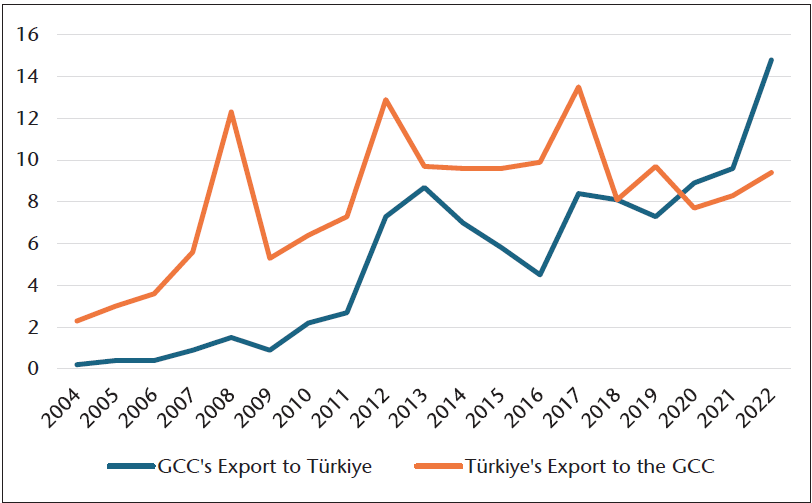
Figure 1: Total Exports among Türkiye and the GCC (2004-2022, $ billion)30
Source: International Trade Center31
As shown in Figure 1, the total exports from GCC countries to Türkiye in 2004 amounted to $0.2 billion. While it reached $8.7 billion in 2013, the real leap forward occurred in 2021 with the end of the Gulf crisis, and the exports to Türkiye in 2022 reached approximately $15 billion. Considering Türkiye’s exports to the region, while it was approximately $2.3 billion in 2004, it reached its first peak in 2008, reaching approximately $12.3 billion. It experienced a sudden decline with the 2008 global financial crisis and started to rise again in 2009. It reached its historical peak of approximately $13.5 billion in 2017. At this peak in 2017, the impact of urgent exports to Qatar can be seen. As of 2020, GCC countries’ exports exceeded Türkiye’s exports to the region, and as of 2022, GCC countries’ exports to Türkiye reached approximately $15 billion, while Türkiye’s exports to GCC reached approximately $9.4 billion.
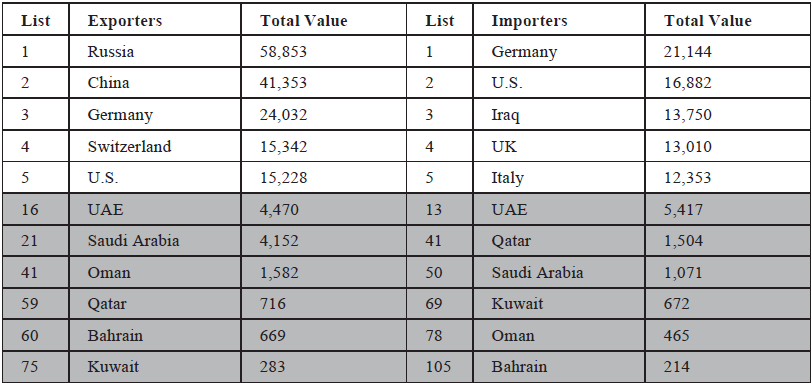
Table 1: The List of Top Trade Countries of Türkiye in 2022 (Million $)
Source: International Trade Center32
Table 1 shows the top five countries with which Türkiye trades the most, in the context of bilateral economic relations. The countries from which Türkiye imports the most are Russia, China, and Germany, while the countries to which it exports are Germany, the U.S., and Iraq. As of 2022, the UAE ranks 16th among Türkiye’s import partners with $4.5 billion, and 13th among export partners with approximately $5.4 billion. Table 1 shows the ranking of Türkiye’s top five trading partners as well as other GCC countries. According to this ranking, Saudi Arabia ranks 21st in the list of import partners, while the last GCC country is Kuwait, which ranks 75th. Among the export partners, Qatar ranked 41st, while the last GCC country was Bahrain, ranked 105th. Based on Türkiye’s trade partners’ rankings, the UAE stands out as a GCC country among both import and export partners. Here, the fact that the UAE has been the country that has diversified its non-oil economy the most in recent times and has important port trade has an impact. When Türkiye’s trade partners are examined, the UAE is prominent among the GCC countries in both imports and exports. This is largely because the UAE has recently diversified its non-oil economy significantly and has become a key player in port trade.
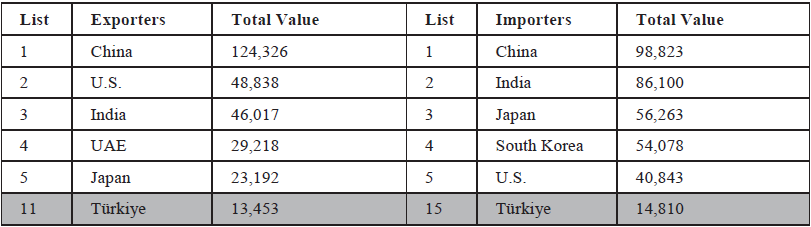
Table 2: The List of Top Trade Countries of the GCC in 2022 (Million $)
Source: International Trade Center33
Table 2 shows the top five countries with which the Gulf region trades the most. As a region, GCC countries import the most from China, the U.S., and India, while the countries from which they export are China, India, and Japan. In this ranking, Türkiye ranks 11th in terms of import partners with $13.5 billion, while it ranks 15th among export partners with approximately $15 billion. Looking at this table, it can be seen that Türkiye’s exports to GCC countries can be increased further.
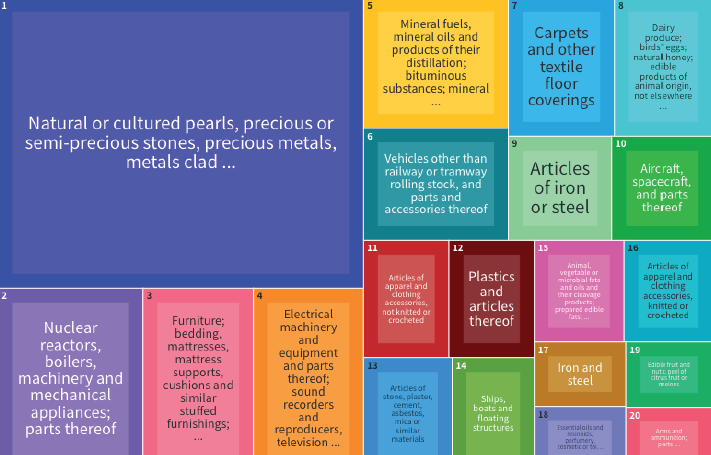
Figure 2: Türkiye’s Exports to the GCC in 2022
Source: International Trade Center34
Figure 2 shows the product categories that Türkiye exports to GCC countries. In the first place, with approximately $2.4 billion, are precious metals and gemstones such as natural pearls, diamonds, rubies, emeralds, gold, silver, and platinum, and products such as jewelry, coins, and ornaments made or plated from them. In the second place are products such as nuclear reactors, steam boilers, industrial machinery, engines, pumps, fans, and lifting and transport equipment, worth approximately $588 million. In the third place are products such as furniture, bedding mattresses, mattress supports, cushions, and similar stuffed furnishings, with approximately $448 million. Based on other export products, it is seen that Türkiye’s export products to the GCC are in a very wide range and diverse showing that Türkiye has a diversified economy.
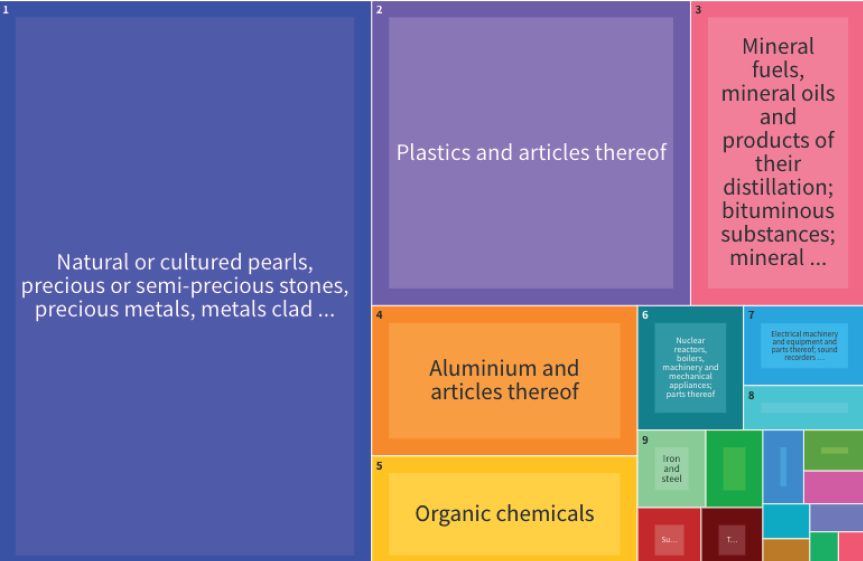
Figure 3: GCC Export to Türkiye in 2022
Source: International Trade Center35
Figure 3 shows the export products of GCC countries to Türkiye. In the first place, with approximately $6.2 billion, are precious metals and gemstones such as natural pearls, diamonds, rubies, emeralds, gold, silver, and platinum, and products such as jewelry, coins, and ornaments made or plated from them. In the second place are products such as plastic sheets, rods, tubes, films, and adhesives, with approximately $2.8 billion. In the third place, with approximately $1.6 billion, are products containing mineral fuels such as petroleum, natural gas, coal, mineral oils, and their distillation products. Following these products are products containing aluminum and organic chemicals. Taking a look at the export products of GCC countries, it shows that most of them are products related to natural resources. Despite the UAE’s success in diversifying its economy in recent years, Figure 3 shows that the economies of these countries are still dependent on natural resources.
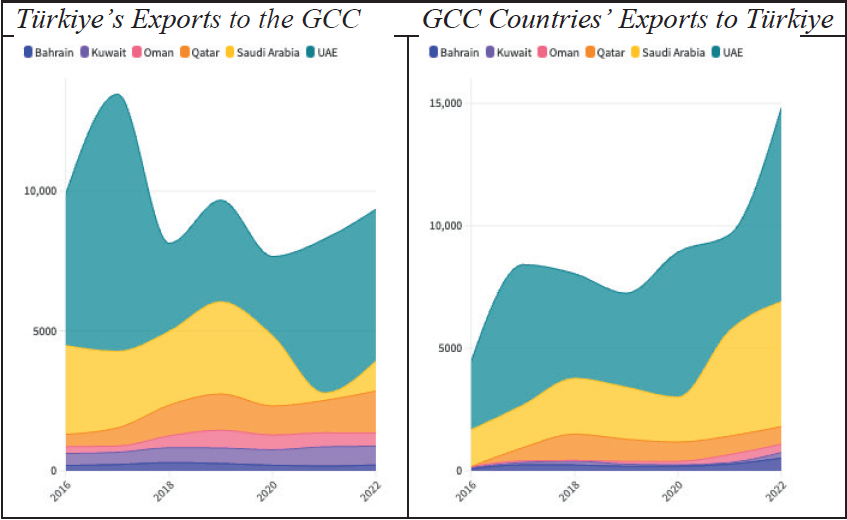
Figure 4 presents the trade between Türkiye and GCC countries between 2016 and 2022 utilizing a stacked band plot graph for each GCC country. The period 2016-2022 was selected to show how bilateral trade relations were affected before and after the Gulf crisis, supporting the argument that political uncertainties affect economic relations. Türkiye’s exports to the UAE and the UAE’s exports to Türkiye decreased in 2017 and subsequently entered a fluctuating period. However, with the end of the Gulf crisis, there has been an increase in mutual trade. Similar fluctuations in bilateral trade are also seen in Saudi Arabia. Türkiye’s trade with both countries started to decline with the Gulf crisis that started in 2017 and then fluctuated and started to rise again in 2021 when the crisis ended. Türkiye’s exports to Qatar increased suddenly in 2017, from $438 million in 2016 to over $1 billion in 2018. With the end of the Gulf crisis, this increase accelerated and reached $1.5 billion in 2022. Trade with Oman, Kuwait, and Bahrain remained at lower levels compared to other GCC countries. There was a trade contraction in Bahrain, one of the blockading countries, with the Gulf crisis, but a steady increase, although at low levels, has been observed in Kuwait and Oman.
Figure 4: Türkiye and GCC Countries Trade in 2016-2022
Source: International Trade Center36
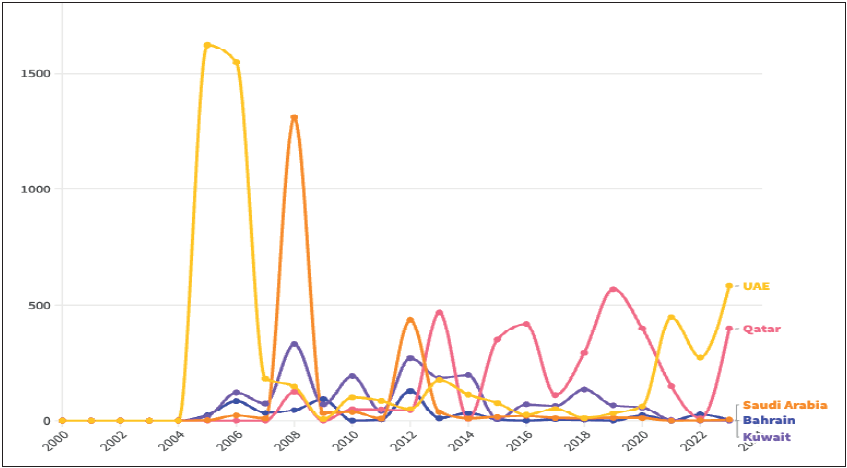
Figure 5: Total Value of FDI Stock of the GCC in Türkiye (2000-2023, Million $)
Source: TCMB37
Figure 5 shows the FDI investments of GCC countries in Türkiye. In 2005, the UAE’s FDI in Türkiye peaked at $1.6 billion. This high investment continued in 2006 but experienced a serious decline in 2007. The FDI increased again in 2021 and in 2023, it was expected to be around $584 million. Saudi Arabia reached its peak in 2008, reaching $1.3 billion, but there was a serious decline after this peak. Qatar, on the other hand, has had a fluctuating FDI graph since 2013. It made the highest FDI investment in 2019 with $570 million and then decreased and hit the bottom in 2022, but with $400 million in 2023, it ranked second after the UAE in the ranking of GCC countries’ FDI in Türkiye. Kuwait’s FDI investments have also followed a fluctuating trend in every period, but there is a higher level of investment relations compared to the trade relations with Türkiye. Kuwait’s highest FDI investment was in 2008 with $330 million. FDI investments of other Gulf countries in Türkiye are at very low levels. From this perspective, the amount of these investments will likely increase with the development of bilateral commercial relations.
Supporting this increasing trade relationship, the “Gulf Cooperation Council Free Trade Agreement Joint Declaration” signed between Türkiye and GCC countries on March 21, 2024, is expected to further boost bilateral trade, which has been increasing since 2021 as presented in the previous figures in this paper. Türkiye’s Minister of Trade, Ömer Bolat, announced the resumption of Türkiye-GCC Free Trade Agreement (FTA) negotiations, which started in 2005 but halted in 2010. He highlighted that completing these negotiations would improve commercial and economic ties between the countries, offering a more defined framework for diversification.38 Jasem Mohamed Albudaiwi, Secretary General of the GCC, also highlighted the GCC countries’ active participation in free trade with other nations to expand trade opportunities, enhance regional and global economic cooperation, and establish robust markets for goods and services from GCC countries. He stressed the significance of this cooperation with Türkiye, emphasizing ongoing negotiations between the two parties.39 Both comments indicate a positive outlook for mutual commercial relations, benefiting both Türkiye and the Gulf countries. This reciprocal relationship is evident in historical data and the recent joint declaration, reflecting a mutually beneficial framework.
Empirical Analysis
In this study, the ARDL cointegration was used to determine the short- and long-term relationship between variables such as those devised by Engle and Granger40 and Johansen,41 requiring that each variable have a distinct order of integration. The ARDL model can also produce consistent results even when working with a small dataset.42 From this point of view, in this paper, the analysis included examining the interactions of trade between the sample countries over time and analyzing the short- and long-term effects of these interactions. The aim is to understand the long-term effects of trade policies and economic variables of Türkiye and GCC countries.
Research Methodology and Data
The econometric analysis investigates whether Türkiye’s exports to the GCC and the GCC’s exports to Türkiye signal a long-run relationship that supports historical trade trends. Therefore, an equation using the following parameters has been developed and employed for testing the validity of the hypothesis of growing bilateral economic relations between Türkiye and the GCC countries, as follows:

In Equation 1, EX is the exports of the GCC countries to Türkiye between 1994 and 2020. IMP displays the imports of GCC countries from Türkiye. The data was collected from the Direction of Trade Statistics (DOTS) database of the International Monetary Fund.43 Based on the hypothesis, coefficients for each model are expected to be positive, which means GCC exports to Türkiye affect Türkiye’s exports to the GCC positively. It is also suggested by this hypothesis that the bilateral economic relationship between Türkiye and the GCC is growing. GCC countries’ exports to Türkiye are represented by EX in these models, and GCC countries’ imports from Türkiye are represented by IMP, which also refers to Türkiye’s exports to the GCC.
ARDL Cointegration Method
The long-run relationships between the time series can be investigated using cointegration techniques.44 Therefore, initially, Augmented Dickey-Fuller (ADF) and Phillips-Perron (PP) unit root tests were used to assess the stationarity of the variables.45 Accordingly, all variables had unit roots in their constant, and constant and trend forms but became stationary at their first difference. In the following step, ARDL bounds tests were used to investigate possible long-run relationships among the variables. The F-test was conducted prior to running the ARDL bounds since there was only one variable in the model, and it showed that there was cointegration between them.
The equation for an ARDL model can be expressed as follows:

Where:

The short- and long-run coefficients were estimated after determining cointegration between the variables. It was found that there were short-run positive and significant relationships. In the long-run, positive and statistically significant relationships were also found between the variables.
Empirical Results
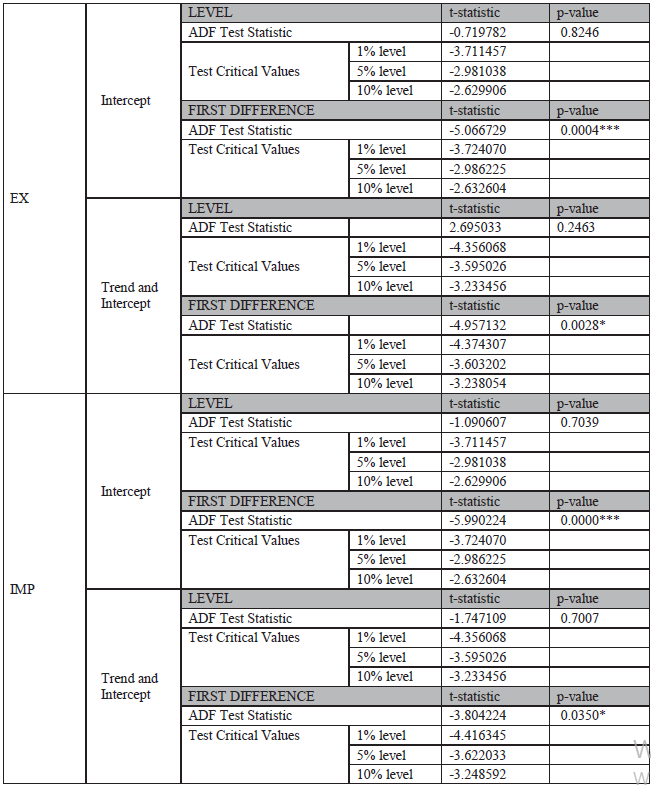
To maintain the validity of the analysis, it is necessary to perform a unit root test and some diagnostic tests before conducting the cointegration test. This was accomplished by performing ADF and PP tests.46 The unit root test for the data can be found in Table 3.
Table 3: Unit Root Test - Augmented Dickey-Fuller
Note 1: *** significant at 1% level, ** significant at 5% level, * significant at 10% level.
Note 2: Phillips-Perron test results for all the models can be made available upon request, as only results of the ADF are presented in Table X due to the length.
For the model with the dependent variable exchange rate (EX), the initial analysis indicates non-stationarity in the series at the level test due to the test statistic exceeding critical values, suggesting the presence of a unit root. However, the first difference is deemed stationary as the test statistic is greater than the critical values. Similarly, in the ADF test for trend and intercept, the series is considered stationary because the test statistic for the level is less than the critical values, indicating no unit root. This result is consistent with the first difference, confirming its stationarity.
Economic ties between Türkiye and the GCC countries have been steadily deepening, particularly marked by increasing trade and investments in recent years
In contrast, for the model with the dependent variable IMP, the initial ADF test for the level suggests non-stationarity as the test statistic exceeds the critical values, implying the presence of a unit root. Consequently, the series is considered non-stationary. However, for the first difference, the test statistic is greater than the critical values, indicating stationarity. In the ADF test for trend and intercept, the series is stationary since the test statistic is greater than the critical values for the level, with the same result for the first difference, confirming its stationarity.
Following identifying the non-stationary component of the data, relationships between variables are examined in both the short- and long-run.
Table 4: F-Bound Test for Cointegration Result (Dependent Variable: EX)
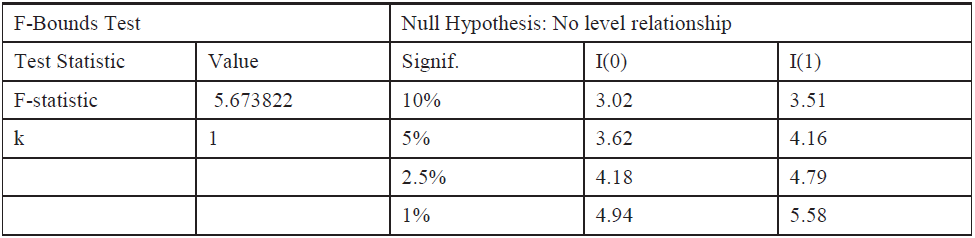
Table 4 presents the results of the F-Bound Test for Cointegration, which is used to determine if a variable is stationary. The test statistic (F-statistic) is 5.673822, indicating a high probability of stationarity. At the 10 percent significance level, the critical values range from 3.02 to 3.51, suggesting significance relative to these values. For a lag length of 1, the critical values at the 5 percent significance level range from 3.62 to 4.16. Thus, the F-statistic rejects the null hypothesis, indicating that there is a cointegration relationship. These results support the existence of cointegration for the EX variable, suggesting long-term trade relations between Türkiye and GCC countries.
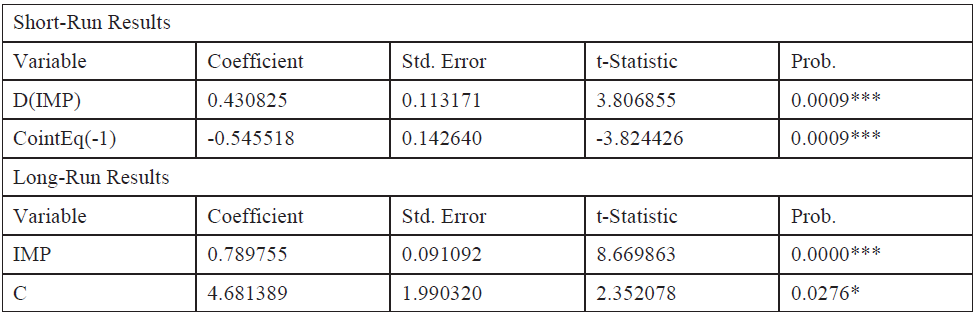
Table 5: ARDL Estimation Results (Dependent Variable: EX)
Note 1: *** significant at 1% level, ** significant at 5% level, * significant at 10% level.
Note 2: In the Jarque–Bera test, the heteroskedasticity test, the Ramsey Regression Equation Specification Error Test (Ramsey RESET), the Cumulative Sum (CUSUM) and CUSUM of squares tests have been conducted for this model. The diagnostic test results support the validity of the analysis. Due to their length, they are not included in the text. These results can be made available upon request.
The CointEq(-1) coefficient in Table 5 represents the cointegration balance in the model. This coefficient signifies the long-term equilibrium and indicates a connection based on past values of stationary variables in the model. A CointEq(-1) coefficient of -0.545518 means that deviations from the long-term balance in the previous period are negatively related to deviations from the current balance. This suggests that short-term shocks will diminish over time, leading to a return to the long-term equilibrium in the model. Table 5 also shows there is a positive relationship between IMP and EXP in both the short- and long-run. In the short-run, a 1 percent increase in IMP is associated with approximately a 0.43 percent increase in EXP. The negative and statistically significant error correction term indicates a long-run relationship between the variables. In the long-run, a 1 percent rise in IMP leads to a 0.79 percent increase in EXP. According to Model 1, in the short-run trade relationship, a 1 percent increase in GCC countries’ imports from Türkiye corresponds to a 0.43 percent increase in GCC countries’ exports to Türkiye. This suggests that Türkiye has an export advantage over GCC countries in the short-run. In the long-run, a 1 percent increase in GCC countries’ imports from Türkiye leads to a 0.79 percent increase in GCC countries’ exports to Türkiye. Türkiye maintains its trade superiority in the long-run, but the growth in GCC countries’ trade surpasses that of the short-run. These results highlight the impact of the rapid increase in Türkiye’s exports to Qatar following the blockade imposed by Qatar’s neighboring countries in 2017. Overall, both groups benefit positively from the short- and long-run trade relationship, with GCC countries gaining a relative advantage as the duration extends.
Table 6 presents the results of the F-Bound Test for Cointegration with the dependent variable being imports (IMP). This test is used to assess whether a variable is stationary. The test statistic (F-statistic) is 3.805041, indicating significance at the 10 percent level, with critical values between 3.02 and 3.51. This suggests a high probability of stationarity. For a lag length of 1, critical values range from 3.62 to 4.16 at the 5 percent significance level, indicating cointegration with a lag length of one. The results support the existence of cointegration for the import variable, implying long-term trade relations between Türkiye and GCC countries.
Table 6: F-Bound Test for Cointegration Result (Dependent Variable: IMP)
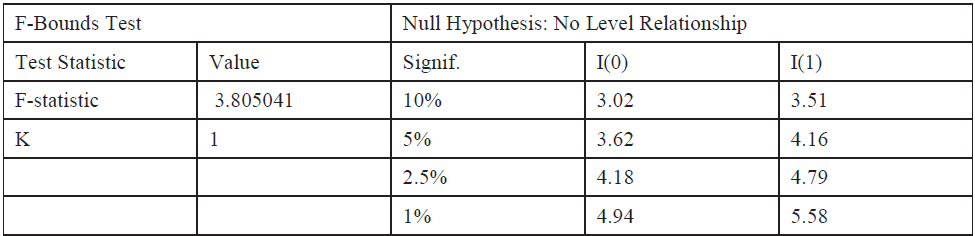
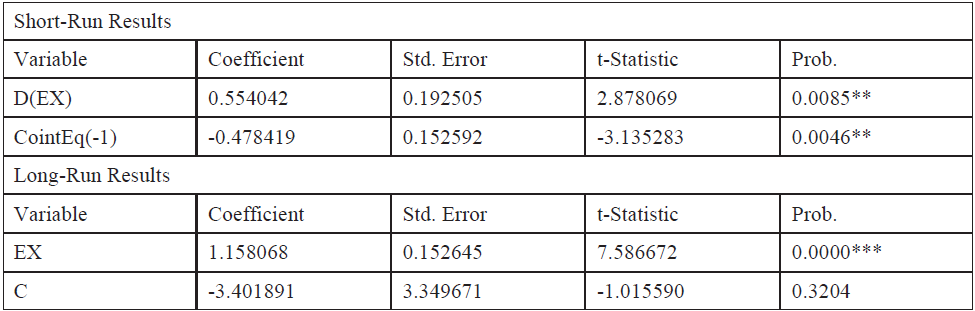
Table 7: ARDL Estimation Results (Dependent Variable: IMP)
Note 1: *** significant at 1% level, ** significant at 5% level, * significant at 10% level.
Note 2: Jarque–Bera test, heteroskedasticity test, Ramsey Regression Equation Specification Error Test (Ramsey RESET), and Cumulative Sum (CUSUM) and CUSUM of squares tests have been conducted for this model. The diagnostic tests results support the validity of the analysis. Due to their length, they are not included in the text. These results can be made available upon request.
In Table 7, the CointEq coefficient represents the long-term equilibrium and shows a connection based on past values of stationary variables in the model. The coefficient of -0.47 indicates that deviations from the long-term balance in the previous period are negatively related to deviations from the current balance. This suggests that deviations resulting from short-term shocks will diminish over time, indicating a tendency for a return to the long-term equilibrium in the model. Table 7 also shows that there is a positive and significant relationship between EX and IMP in the short-run. Specifically, a 1 percent increase in EX is associated with approximately a 0.55 percent increase in IMP. The negative and statistically significant error correction term indicates a long-run relationship between the variables. In the long-run, there is a positive connection between EX and IMP, with a 1 percent rise in IMP leading to a 1.15 percent increase in EX. According to Model 2, in the short-run trade relationship, a 1 percent increase in GCC countries’ exports to Türkiye results in a 0.55 percent increase in imports from Türkiye to GCC countries. This indicates that in the short-run, the exports of GCC countries tend to increase more. However, compared to the previous model, Türkiye’s exports increased by 0.12 percent more than those of GCC countries. In the long-run effect, a 1 percent increase in GCC countries’ exports to Türkiye leads to a 1.15 percent increase in imports from Türkiye to GCC countries. Türkiye’s trade superiority is evident in the long-run, as GCC countries’ exports to Türkiye increase, and their imports from Türkiye increase even more. This difference arises from the fact that GCC countries export final goods from Türkiye. Overall, both groups benefit positively from the short- and long-run commercial relationship. In the long-run, Türkiye’s exports to GCC countries increase more than GCC countries’ exports to Türkiye.
For the GCC countries, developing relations with Türkiye align with their economic diversification goals post-oil, as it can increase their market shares and diversify their economies by leveraging Türkiye’s demographic size and diversified economy
Discussion and Conclusion
Economic ties between Türkiye and the GCC countries have been steadily deepening, particularly marked by increasing trade and investments in recent years. The period of AK Party rule has seen a significant expansion in trade, reflecting the maturation of these relations. However, these ties have not been immune to regional political uncertainties, leading to fluctuations over time. Differences in foreign policy can directly affect economic relations and may even lead to unofficial boycotts. For instance, during the Gulf crisis, Saudi citizens boycotted Turkish products. However, after a similar shift in foreign relations post-crisis, this unofficial boycott was lifted.47 Such disputes can significantly impact trade between countries, leading to negative consequences for both parties. Therefore, it can be concluded that the 2017 Gulf crisis had a direct impact on Türkiye-GCC economic relations, resulting in sudden declines in trade volume. Yet, the resolution of the Gulf crisis has ushered in a period of rapid growth in trade volume. The initiation of FTA negotiations following this upsurge in relations indicates a commitment to further strengthening these ties. Empirical analyses demonstrate a long-term cointegration in Türkiye-GCC economic relations, with bilateral trade positively affected in the long-term. Therefore, to sustain a mutually beneficial economic relationship for both parties, economic relations should not be affected by political turmoil. The analyses also indicate that as GCC countries’ exports to Türkiye increase, Türkiye’s exports to the GCC increase even more over the long-term. This dynamic suggests that Türkiye’s trade is significantly influenced by GCC countries’ trade, highlighting the interdependence of these economies. Türkiye exports end-use products and has a wider product range. The main reason for this is that Türkiye can process the products it imports from GCC countries and turn them into end-use products to be exported back to GCC countries. In contrast, the products imported from Türkiye by GCC countries are largely end-use consumption products.
The descriptive data and empirical results suggest a mutual dependence between the economies of both sides for regional development. The theory of complex interdependence emphasizes the importance of economic relations in fostering positive outcomes and cooperation.48 Empirical results in this paper confirm a mutual economic relationship between Türkiye and the GCC countries, illustrating this concept. As these countries deepen their economic ties through trade and investment, they create interdependencies that enhance political cooperation.49 This relationship reduces the likelihood of conflict and encourages stability. The mutual benefit of economic complementarities such as Türkiye’s industrial capabilities and the GCC’s financial resources and energy supplies drives their commitment to stronger ties. This dynamic shows how complex interdependence can promote regional peace, stability, and prosperity.50 The results in this study are supported by interdependence theory, and vice versa.
From Türkiye’s perspective, its recent economic challenges and the desire to close the budget deficit can positively impact the country’s economy by increasing exports to the Gulf countries and attracting FDI investments from them. For the GCC countries, developing relations with Türkiye align with their economic diversification goals post-oil, as it can increase their market shares and diversify their economies by leveraging Türkiye’s demographic size and diversified economy. Considering that these bilateral economic relations can also positively affect political relations, it is likely that they will have positive effects on regional stability. As a result of the mutual benefits derived from long-term economic relations, both parties must prioritize the development of strong diplomatic ties. This will ensure that their economic cooperation remains largely unaffected by regional political uncertainties and the divergent foreign policies pursued by each party.
Endnotes
1. Serhat S. Çubukçuoğlu and Mouza Hasan Almarzooqi, “What’s Behind Growing Ties between Turkey and the Gulf States,” Atlantic Council, (July 21, 2023), retrieved April 10, 2024, from https://www.atlanticcouncil.org/blogs/turkeysource/whats-behind-growing-ties-between-turkey-and-the-gulf-states/#:~:text=Turkey%20and%20the%20GCC%20countries,beneficial%2C%20in%20a%20volatile%20world.
2. Dorothée Schmid and Jules Subervie, “Turkey/GCC Economic Relations,” IFRI, (September 2014), retrieved April 15, 2024, from https://www.ifri.org/sites/default/files/atoms/files/article-subervie-final.pdf.
3. Erdal Tanas Karagöl, “The Turkish Economy during the Justice and Development Party Decade,” Insight Turkey, Vol. 15, No. 4 (October 5, 2013), pp. 115-129.
4. For further information about the effects of FTAs on the economy, see: Shujiro Urata, “Globalization and the Growth in Free Trade Agreements,” Asia Pacific Review, Vol. 9, No. 1 (2002), pp. 20-32.
5. Nader Habibi, “Turkey-GCC Trade Talks Mark another Step toward Rapprochement with Arab World,” Stimson, (April 11, 2024), retrieved June 10, 2024, from https://www.stimson.org/2024/turkey-gcc-trade-talks-mark-another-step-toward-rapprochement-with-arab-world/.
6. Meliha Benli Altunışık, “The End of the Gulf Rift May not Signal the End of Turkey-Qatar Relations,” Atlantic Council, (April 5, 2021), retrieved June 10, 2024, from https://www.atlanticcouncil.org/blogs/turkeysource/the-end-of-the-gulf-rift-may-not-signal-the-end-of-turkey-qatar-relations/.
7. Andrew Jay Rosenbaum, “Turkey and the GCC: ‘A Win-Win Dynamic,’ Economists Say,” Anadolu Agency, (August 13, 2015), retrieved June 10, 2024, from https://www.aa.com.tr/en/economy/turkey-and-the-gcc-a-win-win-dynamic-economists-say/16766.
8. Siret Hürsoy, “Turkey’s Foreign Policy and Economic Interests in the Gulf,” Turkish Studies, Vol. 14, No. 3 (September 2013), pp. 503-519.
9. Pramod Kumar, “Turkey’s Trade with GCC Soars 11-fold in Two Decades,” Arabian Gulf Business Inside, (November 13, 2023), retrieved April 5, 2024, from https://www.agbi.com/finance/2023/11/turkeys-trade-with-gcc-soars-11-fold-in-2-decades/.
10. Pramod Kumar, “Turkey and GCC to Create $2.4trn Free Trade Area,” Arabian Gulf Business Inside, (March 22, 2024), retrieved April 5, 2024, from https://www.agbi.com/trade/2024/03/turkey-and-gcc-set-to-create-2-4trn-free-trade-area/.
11. Hazem Beblawi and Giacomo Luciani (eds.), The Rentier State, (London: Routledge, 2016).
12. Martin Hvidt, “The State and the Knowledge Economy in the Gulf: Structural and Motivational Challenges,” The Muslim World, Vol. 105, No. 1 (December 19, 2014), pp. 24-45.
13. Martin Hvidt, “Economic Diversification in GCC Countries: Past Record and Future Trends,” LSE, Kuwait Programme on Development, Governance and Globalisation in the Gulf States, (2013), retrieved June 25, 2024, from https://eprints.lse.ac.uk/55252/.
14. Necibe Hicret Battaloğlu, “Ideational Factors in Turkey’s Alignment with Qatar and Their Impact on Regional Security,” The International Spectator, Vol. 56, No. 4 (December 8, 2021), pp. 101-118.
15. Karagöl, “The Turkish Economy During the Justice and Development Party Decade”; Hürsoy, “Turkey’s Foreign Policy and Economic Interests in the Gulf”; Bülent Aras, “Turkey and the GCC: An Emerging Relationship,” Middle East Policy, Vol. 12, No. 4 (December 2005), pp. 89-97; Sean Foley, “Turkey and the Gulf States in the Twenty-first Century,” Middle East Review of International Affairs (MERIA), Vol. 14, No. 3 (September 2010), pp. 29-37; Nur Çetinoğlu Harunoğlu, “Turkey’s Intensifying Partnership with Qatar and Its Implications for Turkish-American Relations,” Middle East Review of International Affairs (MERIA), Vol. 20, No. 3 (2016), pp. 1-11.
16. Emilie Rutledge and Efstathios Polyzos, “The Rise of GCC‐East Asian Trade: A Cointegration Approach to Analysing Trade Relationships,” The World Economy, Vol. 46, No. 7 (November 27, 2023), pp. 2231-2246; Aysu İnsel and Mahmut Tekçe, “Econometric Analysis of the Bilateral Trade Flows in the Gulf Cooperation Council Countries,” MPRA, No. 22130 (April 15, 2010); Ahmed Saddam and Fatimah Kari, “Size of Economy, Cost of Transport and Their Impact on Trade in GCC Countries: Evidence from Qualitative and Quantitative Approaches,” Journal of Finance and Investment Analysis, Vol. 1, No. 3 (2012), pp. 137-169; Imran Alam and Shahid Ahmed, “Prospects of India-GCC Trade Relations: An Empirical Investigation,” Foreign Trade Review, Vol. 52, No. 2 (March 30, 207), pp. 118-129.
17. Rutledge and Polyzos, “The Rise of GCC‐East Asian Trade.”
18. İnsel and Tekçe, “Econometric Analysis of the Bilateral Trade Flows in the Gulf Cooperation Council Countries.”
19. Erhan Akkaş and Süleyman Orhun Altıparmak, “The Reshaping Oil and Arms Trade between the United States and GCC: Is the Theory of Complex Interdependence Still Prevailing?” Journal of Asian and African Studies, Vol. 57, No. 7 (202), pp. 1430-1445.
20. Saddam and Kari, “Size of Economy, Cost of Transport and Their Impact on Trade in GCC Countries.”
21. Alam and Ahmed, “Prospects of India–GCC Trade Relations.”
22. Emad Y. Kaddorah, The Rise of the GCC States and Turkey: Convergent and Divergent Regional Agendas, (Newcastle upon Tyne: Cambridge Scholars Publishing, 2021); Özden Zeynep Oktav, “Arap Bahari ve Türkiye-KİK Ülkeleri Arasindaki İlişkilere Etkisi,” Siyasal Bilgiler Fakültesi Dergisi, Vol. 1, No. 1 (June 16, 2016), pp. 43-69; Aras, “Turkey and the GCC: An Emerging Relationship”; Birol Baskan, “Turkey-GCC Relations: Is There a Future?” Insight Turkey, Vol. 13, No. 1 (January 1, 2011), pp. 159-173; Ali Bakır, “Post-Ottoman Legacy in the Middle East,” Insight Turkey, Vol. 25, No. 3 (October 2, 2023), pp. 37-50.
23. Aras, “Turkey and the GCC: An Emerging Relationship.”
24. Sean Foley, “Turkey and the Gulf States in the Twenty-first Century,” Middle East Review of International Affairs (MERIA), Vol. 14, No. 3 (September 2010), pp. 29-37.
25. Hürsoy, “Turkey’s Foreign Policy and Economic Interests in the Gulf.”
26. Harunoğlu, “Turkey’s Intensifying Partnership with Qatar and Its Implications for Turkish-American Relations.”
27. “Qatar-Gulf Crisis: How It All Got Started on June 5,” Al Jazeera, (November 26, 2017), retrieved April 20, 2024, from https://www.aljazeera.com/news/2017/11/26/qatar-gulf-crisis-how-it-all-got-started-on-june-5.
28. “Turkey and Qatar: Behind the Strategic Alliance,” Al Jazeera, (August 16, 2018) retrieved April 20, 2024, from https://www.aljazeera.com/economy/2018/8/16/turkey-and-qatar-behind-the-strategic-alliance.
29. “Gulf States Sign ‘Solidarity and Stability’ Deal at GCC Summit,” Al Jazeera (January 5, 2021), retrieved April 20, 2024, from https://www.aljazeera.com/news/2021/1/5/gulf-states-sign-solidarity-and-stability-deal-at-gcc-summit.
30. When collecting secondary data, it is expected that in bilateral trade, Türkiye’s exports to GCC countries will be numerically equal to GCC countries’ imports from Türkiye, or vice versa. However, depending on the base country’s data, the figures announced by the countries may differ. Therefore, there may be discrepancies between Türkiye’s export to the GCC countries and the GCC countries’ import from Türkiye, depending on the countries used as the basis for analysis. This numerical difference arises from this reason in the following tables and figures.
31. “Trade Map,” International Trade Center, retrieved April 5, 2024, from https://www.trademap.org/Index.aspx.
32. “Trade Map,” International Trade Center.
33. “Trade Map,” International Trade Center.
34. “Trade Map,” International Trade Center.
35. “Trade Map,” International Trade Center.
36. “Trade Map,” International Trade Center.
37. “Foreign Direct Investments,” Türkiye Cumhuriyet Merkez Bankası, retrieved April 1, 2024 from https://evds2.tcmb.gov.tr/index.php?/evds/dashboard/4944.
38. “Bakan Bolat, Körfez İşbirliği Konseyi Serbest Ticaret Anlaşması Ortak Bildiri İmza Töreni’nde Konuştu,” Türkiye Cumhuriyeti Ticaret Bakanlığı, (March 21, 2024), retrieved April 5, 2024 from https://ticaret.gov.tr/haberler/bakan-bolat-korfez-isbirligi-konseyi-serbest-ticaret-anlasmasi-ortak-bildiri-imza-toreninde-konustu.
39. “HE GCCSG: The Signing of a Joint Statement to Initiate Free Trade Negotiations between the GCC and the Republic of Turkey Is a Demonstration of the Robust and Strategic Partnership between Both Sides,” Cooperation Council for the Arab States of the Gulf, Secretariat General, (March 21, 2024), retrieved April 5, 2024, from https://www.gcc-sg.org/en-us/MediaCenter/NewsCooperation/News/Pages/news2024-3-21-1.aspx.
40. Robert F. Engle and C. W. J. Granger, “Co-integration and Error Correction: Representation, Estimation, and Testing,” Econometrica, Vol. 55, No. 2 (March 1987), pp. 251-276.
41. Søren Johansen, “Statistical Analysis of Cointegration Vectors,” Journal of Economic Dynamics and Control, Vol. 12, No. 2-3 (June-September 1988), pp. 231-254.
42. Muhammet Daştan and Hakan Eygü, “An Empirical Investigation of the Link between Economic Growth, Unemployment, and Ecological Footprint in Turkey: Bridging the EKC and EPC Hypotheses,” Environment, Development and Sustainability, (November 2023), pp. 1-32.
43. “IMF Direction of Trade Statistics,” International Monetary Fund, (2024), retrieved April 1, 2024 from https://data.imf.org/?sk=9d6028d4f14a464ca2f259b2cd424b85.
44. Engle and Granger, “Co-integration and Error Correction: Representation”; Johansen, “Statistical Analysis of Cointegration Vectors,” 231-254.
45. Daştan and Eygü, “An Empirical Investigation of the Link between Economic Growth, Unemployment, and Ecological Footprint in Turkey.”
46. Daştan and Eygü, “An Empirical Investigation of the Link between Economic Growth, Unemployment, and Ecological Footprint in Turkey.”
47. “Saudi Lifts Unofficial Ban on Turkish Goods,” Middle East Monitor, (January 26, 2022), retrieved April 5, 2024, from https://www.middleeastmonitor.com/20220126-saudi-lifts-unofficial-ban-on-turkish-goods/.
48. Thomas C. Walker, “A Circumspect Revival of Liberalism: Robert O. Keohane and Joseph S. Nye’s Power and Interdependence,” in Henrik Bliddal, Casper Sylvest, and Peter Wilson (eds.), Classics of International Relations: Essays in Criticism and Appreciation, (London: Routledge, 2013), pp.148-156.
49. Albert O. Hirschman, The Passions and the Interests: Political Arrangements for Capitalism before Its Triumph, (Princeton: Princeton University Press, 1977).
50. Akkaş and Altıparmak, “The Reshaping Oil and Arms Trade between the United States and GCC.”