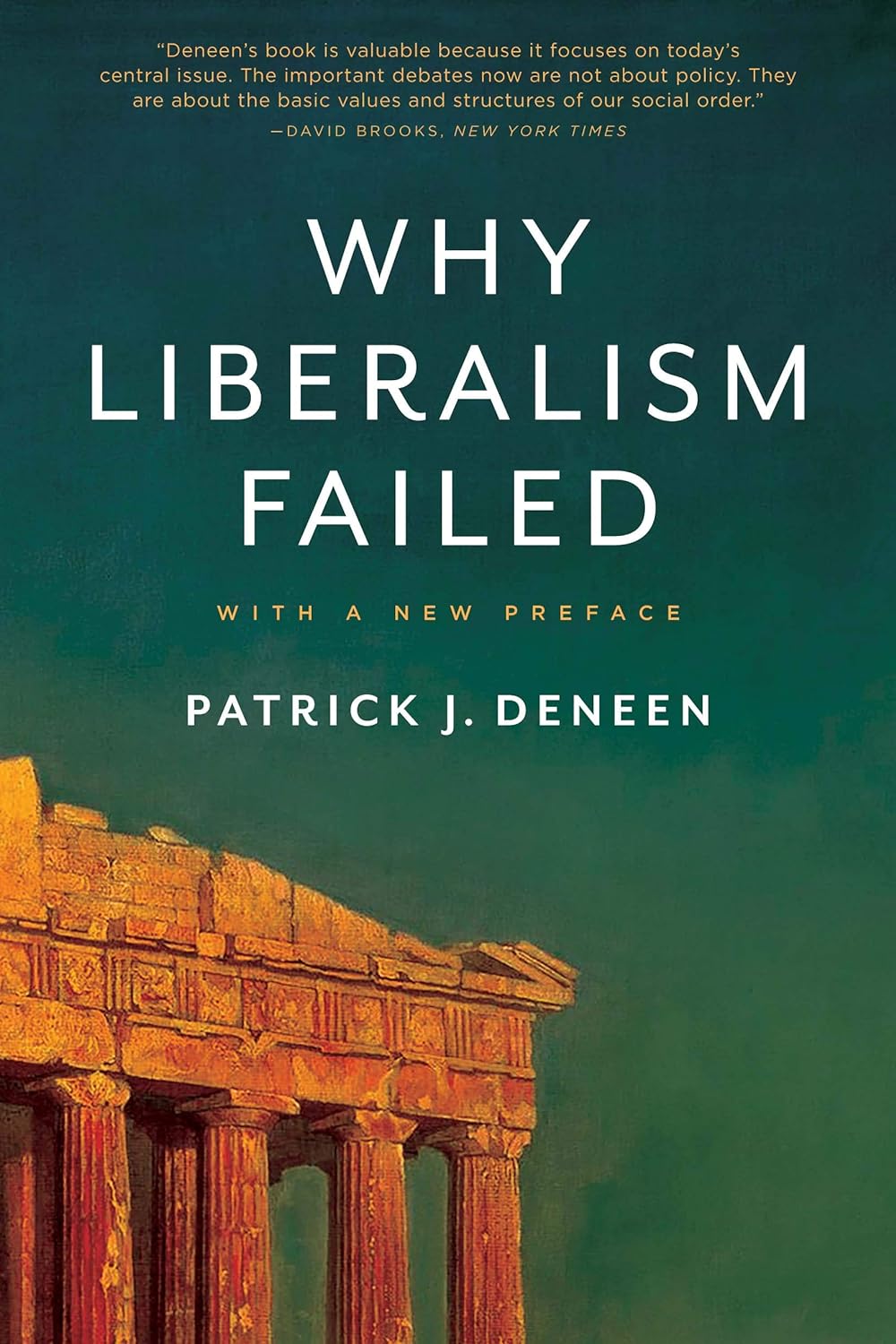
Patrick J. Deneen’s Why Liberalism Failed critically analyzes liberal political philosophy and its impact on contemporary society. Patrick J. Deneen is a political theorist and author known for his critical perspectiveson modern liberalism. He served as an associate professor of political science at the University of Notre Dame and has written extensively on topics related to political theory, democratic culture, and the history of political thought. His book explores the shortcomings of modern liberalism, focusing on how its pursuit of individual freedom has led to systemic failures, including increasing inequality, declining trust in government, and growing disillusionment among citizens. Deneen argues that liberalism’s promises of securing rights and limiting government have faltered, resulting in expanded state control and a widespread sense of powerlessness. The book contends that the failures of liberalism are not due to deviations from its principles but are instead the result of its adherence to its own ideals. By fostering economic and social inequalities, liberalism has contradicted its original intentions, leading to widespread discontent and a loss of legitimacy. The book consists of 7 chapters, beginning with an introduction that addresses the decline of liberalism. The first chapter highlights the concept of unsustainable liberalism. It discusses the historical rise and global appeal of liberalism, which is rooted in the commitment to liberty and the longing for human freedom. The introduction sets the stage by discussing liberalism’s rise and global appeal. Rooted in a commitment to liberty and individual freedom, liberalism has historically been attractive to those suffering under arbitrary rule. The chapter traces the origins of the desire for liberty back to ancient Greece and Rome, where virtue and self-rule were essential in countering tyranny. However, modern liberalism departs from these traditions, challenging established norms and seeking to dismantle traditional social and religious structures in favor of civil peace and individual freedom. Deneen identifies three key factors in liberalism’s development: the rejection of virtuebased politics, a critique of social structures, and a belief in human control through scientific and economic progress. Chapter 2 elaborates on uniting individualism and statism. It explores the seemingly contradictory nature of modern politics, particularly the division between the left and right. Despite their differences, both ideologies advance the liberal project by promoting individualism and statism. The chapter argues that both left- and right-leaning ideologies expand state power and individualistic tendencies, undermining vital relationships and mediating institutions. It discusses classical and progressive liberalism’s emphasis on individual liberation and the state’s expanding role in promoting this freedom. The focus point of chapter 3 is evaluating how liberalism interacts with and erodes traditional cultural norms. Deneen argues that liberalism creates isolated individuals by severing ties with historical cultural frameworks. This leads to a reliance on the state for governance and diminishes the intergenerational transmission of cultural norms. The chapter critiques liberal freedoms, such as market capitalism and sexual liberation, for dismantling longstanding cultural structures and contributing to social dysfunction. It contrasts this with authentic cultures promoting self-restraint, nature harmony, and a sense of belonging to multigenerational communities. Chapter 4 presents different aspects of technology and the loss of liberty. It discusses the dual themes of optimism and fear surrounding technological advancements. Deneen references popular culture and academic studies to illustrate how technology can erode real world communities and long-standing cultural practices. Critics such as Lewis Mumford and Jacques Ellul are cited to highlight concerns about technology’s impact on human life and culture. With a robust exploration, chapter 5 examines the impact of liberalism on liberal arts education. Historically, education was deeply intertwined with cultural values, but liberalism has introduced “anticulture” that erodes the traditional connection between education and culture (p. 64). The chapter argues that liberalism’s emphasis on autonomy and practicality has marginalized the study of classical texts and virtue. Deneen advocates for a return to premodern educational values that focus on cultivating responsible citizens through selfcommand and virtue.
Through in-depth examination, chapter 6 critically examines the relationship between liberalism and democracy (as a new aristocracy), arguing that liberalism has transformed democracy into a system focused on material benefits and individualism. It contends that liberal democracy undermines active citizen participation and fosters a degraded form of citizenship. The author highlights how liberalism prioritizes private interests over public goods, individual selfinterest over civic spirit, and the accumulation of individual opinions over the common good. The emergence of illiberal democracy is discussed as a threat to liberal democracy, particularly through nationalist popülist movements rejecting liberal principles. The author also acknowledges contemporary liberals questioning the competence of the electorate and proposing rule by an elite with specialized knowledge. By broadening the scope, chapter 7 elaborates on the degradation of Citizenship. In this part, the book delves into the concept of liberal democracy and its implications for citizenship. It argues that liberal democracy has fundamentally altered the traditional understanding of democracy, prioritizing individual self-interest and private concerns over civic engagement and collective welfare. This shift has resulted in a degraded form of citizenship, emphasizing personal gain rather than active participation in public affairs. The chapter explores how liberalism has played a crucial role in shaping the perception of democracy, equating it with expressive individualism. Simultaneously, it highlights the existence of a powerful government that provides material benefits, thereby maintaining legitimacy despite the absence of genuine popular control. Furthermore, the chapter addresses the rise of illiberal democracy as a significant threat to liberal democratic principles, exemplified by the rejection of liberal policies by democratic majorities. It discusses the arguments put forth by contemporary liberals who advocate for constraining democracy in favor of expert rule or an “epistocracy,”based on the belief that the general public is ill-informed and incapable of making sound political decisions (p. 157). Drawing on historical perspectives, the author reflects on early social sciences findings that questioned the electorate’s intellectual capacity, leading to calls for professionalizing government and limiting democratic decision-making.
The book offers a comprehensive critique of liberalism, examining its impact on politics, culture, and the environment. Deneen argues that liberalism’s pursuit of conquering nature and perpetual economic growth has led to ecological limits and brought humanity to the brink of environmental catastrophe. Deneen’s idealistic suggestions for local self-governance and self-limitation may not account for the complexities of political pragmatism, which could make their implementation difficult within contemporary governance frameworks. Additionally, critics point out that Deneen’s critique lacks a global perspective, as it does not address how liberalism has impacted and interacted with societies outside the Western world, potentially narrowing the scope of his analysis. The book overlooks the positive contributions of liberalism to social progress, including advancements in gender equality, civil rights, and social justice. By concentrating mainly on liberalism’s shortcomings, the book may neglect the substantial achievements that liberalism has facilitated in these areas. Furthermore, there are concerns about the book’s limited exploration of intersectionality and the experiences of marginalized communities within liberal societies. This omission could result in an incomplete understanding of how liberalism interacts with issues of race, gender, and social oppression. need for a more thorough examination of liberalism’s economic aspects, particularly its impact on wealth distribution and economic development. Also, whether the critique of individualism in liberalism sufficiently acknowledges the role of individual autonomy in driving innovation and personal growth. Additionally, the book’s neglect of the role that institutions play in shaping liberal democracies is noted. A deeper consideration of how institutions operate within liberal frameworks is necessary to offer a more nuanced view of both the successes and shortcomings of liberalism.